

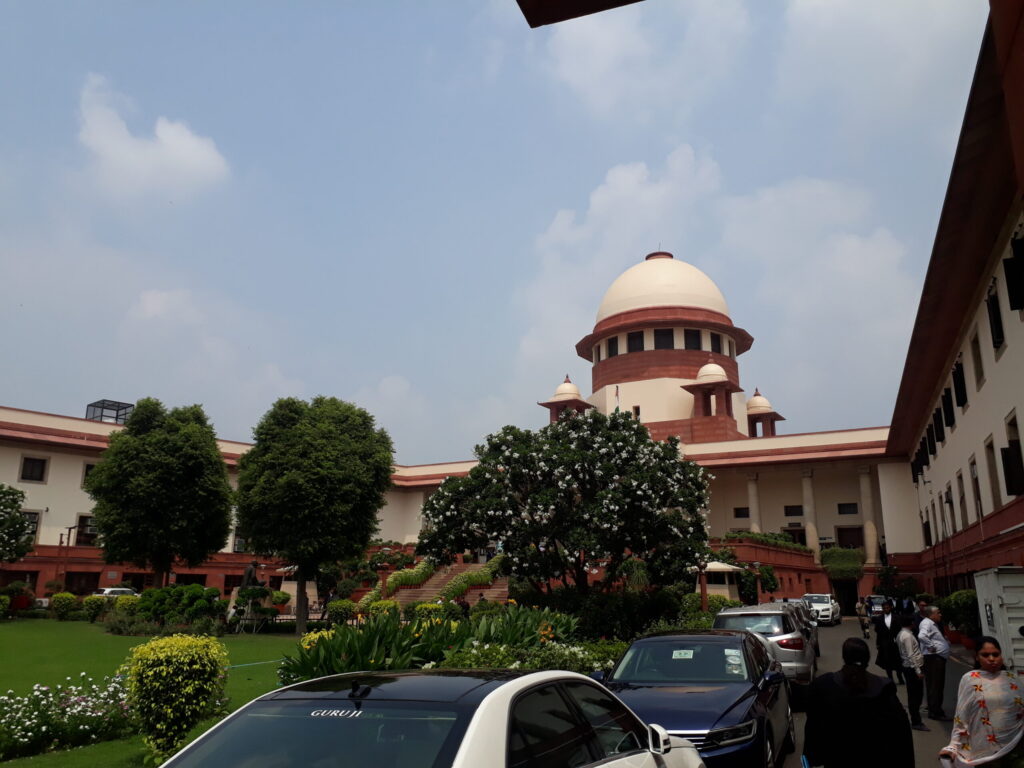
The Shah Bano case is the most influential personal law judgment in independent India. Decided on 23 April 1985 by a five-judge Constitution Bench led by Chief Justice Y.V. Chandrachud, the Shah Bano case held that a divorced Muslim woman is entitled to maintenance from her former husband under Section 125 of the Code of Criminal Procedure, 1973, a secular provision that applies to all citizens regardless of religion. The decision in Mohd. Ahmed Khan v. Shah Bano Begum (1985) became a constitutional flashpoint, triggered a parliamentary law that appeared to dilute it, and turned the Uniform Civil Code in India from an academic question into a national political debate.
The Shah Bano case matters today not just as a case in family law but as a constitutional study of how the Supreme Court reads secular statutes alongside religious personal law, how Parliament can respond to a judgment, and how the courts in turn respond to that response. The arc from 1985 to the Daniel Latifi judgment of 2001 to the Shayara Bano triple talaq verdict of 2017 begins with one woman in Indore who simply asked for maintenance under a criminal procedure section.
This explainer walks through the facts, the bench, the legal reasoning, the political reaction, the Muslim Women (Protection of Rights on Divorce) Act, 1986, the Daniel Latifi affirmation of 2001, the modern relevance, and the UPSC angles.
Quick Facts on the Shah Bano Case
- Case name. Mohd. Ahmed Khan v. Shah Bano Begum (1985) 2 SCC 556.
- Date of judgment. 23 April 1985.
- Bench. Five judges — Chief Justice Y.V. Chandrachud, Justices D.A. Desai, O. Chinnappa Reddy, E.S. Venkataramiah, and Rangnath Misra.
- Provision. Section 125 of the Code of Criminal Procedure, 1973 (maintenance for wives, children, and parents).
- Verdict. Unanimous in favour of Shah Bano; husband ordered to pay maintenance.
- Parliamentary response. Muslim Women (Protection of Rights on Divorce) Act, 1986.
- Reaffirmation. Danial Latifi v. Union of India (2001).
- Wider impact. Triggered renewed national debate on UCC under Article 44.
The Facts of the Shah Bano Case
Shah Bano Begum was a 62-year-old Muslim woman from Indore, Madhya Pradesh, married to advocate Mohammad Ahmed Khan since 1932. They had five children. In 1975, after 43 years of marriage, the husband threw her out of the matrimonial home. In 1978, Shah Bano filed an application before a Judicial Magistrate, First Class, Indore, under Section 125 CrPC seeking maintenance of ₹500 per month from her husband.
In November 1978, the husband pronounced divorce by triple talaq. He then contended in court that he had paid the prescribed dower (mahar) of ₹3,000 during the marriage and returned ₹5,400 as maintenance for the iddat period (approximately three months after divorce as prescribed in Muslim personal law). He argued that his obligations under Muslim personal law were now over and that Section 125 CrPC did not apply to him.
The Magistrate directed payment of ₹25 per month. The Madhya Pradesh High Court enhanced it to ₹179.20 per month. Mohammad Ahmed Khan appealed to the Supreme Court, which led to the famous Shah Bano case.
The Supreme Court Bench
The five-judge Constitution Bench was led by Chief Justice Y.V. Chandrachud. Joining him were Justices D.A. Desai, O. Chinnappa Reddy, E.S. Venkataramiah, and Rangnath Misra. The bench framed a single core question: whether Section 125 CrPC applies to Muslims and, if so, whether a divorced Muslim woman is a “wife” entitled to maintenance until she remarries.
The Legal Reasoning in the Shah Bano Case
The reasoning of Chief Justice Y.V. Chandrachud rested on three pillars.
Section 125 CrPC is a secular provision
Section 125 of the Code of Criminal Procedure, 1973 obliges any person with sufficient means to maintain his wife, children, and parents if they are unable to maintain themselves. The provision is part of the criminal procedure code and applies to citizens of any religion. The court held that personal law cannot displace this secular obligation because Section 125 is concerned with destitution and the prevention of vagrancy, not with the religious doctrines of any community.
A divorced wife is still a “wife” under Section 125
Explanation (b) to Section 125 defines wife to include a woman who has been divorced and has not remarried. The Shah Bano case interpreted this to mean a Muslim divorcee whose iddat period had ended still qualified as a “wife” if she was unable to maintain herself.
No conflict with Muslim personal law
Chief Justice Chandrachud held that Muslim personal law itself, properly interpreted, does not exempt a husband from maintaining a divorced wife if she is unable to maintain herself. The court quoted verses of the Quran and the views of jurists like Mulla and Tahir Mahmood to support its reading. Where personal law and secular law are consistent, no conflict arises; where they appear inconsistent, Section 125 prevails because it is a general criminal procedure provision.
The court held that Mohammad Ahmed Khan was liable to pay maintenance to Shah Bano even after the iddat period and even though the mahar had been returned.
The dictum on Article 44
The Shah Bano case is most famous for its dictum on Article 44. Chief Justice Chandrachud observed:
“It is also a matter of regret that Article 44 of our Constitution has remained a dead letter.”
The court urged the government to enact a uniform civil code. This single line transformed the political afterlife of the judgment. The Shah Bano case became the canonical citation for every subsequent court urging UCC, including Sarla Mudgal (1995) and John Vallamattom (2003).
Political Reaction and the 1986 Act

The Shah Bano case generated intense political reaction. Muslim clerical bodies and the All India Muslim Personal Law Board argued that the Supreme Court had reinterpreted the Quran without authority and that the decision interfered with Muslim personal law protected under Article 25.
Mass demonstrations were held in major cities. The Rajiv Gandhi government, which had returned with a landslide mandate in December 1984, came under intense pressure. Initially the government supported the judgment. Then it shifted course.
Parliament enacted the Muslim Women (Protection of Rights on Divorce) Act, 1986. The Act, despite its protective-sounding name, was widely read as overruling the Shah Bano case. Its key features:
- Section 3. A divorced Muslim woman is entitled to “reasonable and fair provision and maintenance” within the iddat period from her former husband.
- Section 4. If she is unable to maintain herself after the iddat period, the Magistrate may order her relatives or the State Wakf Board to provide maintenance.
- Section 5. Section 125 CrPC will apply only if both parties agree in writing.
The 1986 Act was passed within months of the Shah Bano case. Arif Mohammad Khan, then a minister in the Rajiv Gandhi cabinet, resigned in protest. Critics across the political spectrum accused the government of appeasing conservative Muslim opinion at the cost of gender justice.
Daniel Latifi 2001: The Reaffirmation
The Muslim Women (Protection of Rights on Divorce) Act, 1986 was challenged on constitutional grounds. The challenge came before a five-judge Constitution Bench in Danial Latifi v. Union of India (2001).
Senior Advocate Danial Latifi, who had originally appeared for Shah Bano in the 1985 case, now defended the constitutional validity of the 1986 Act while seeking a reading that preserved women’s rights. The Supreme Court upheld the constitutional validity of the Act but adopted a reading that substantively restored the Shah Bano position.
The court held in Daniel Latifi that the phrase “reasonable and fair provision and maintenance” in Section 3 of the 1986 Act required the husband to make provision for the divorced wife’s future, not merely for the iddat period. The provision had to be made within the iddat period but its duration could extend to the rest of her life or until she remarried.
The Daniel Latifi judgment thus achieved what the 1986 Act had appeared to prevent. Subsequent decisions, including Iqbal Bano v. State of Uttar Pradesh (2007) and Shabana Bano v. Imran Khan (2010), confirmed that a divorced Muslim woman can claim maintenance under Section 125 CrPC even after the 1986 Act, especially if she has not remarried and is unable to maintain herself.
The Larger Legacy
The Shah Bano case shaped Indian constitutional law in five lasting ways.
Personal law and constitutional review
The judgment established that personal laws are not immune from constitutional scrutiny when they conflict with fundamental rights or general statutes designed to prevent destitution.
Uniform Civil Code revived
The dictum on Article 44 made UCC a continuous political issue. From the 1996 Women’s Reservation Bill debate to the 2024 Uttarakhand UCC Act, every conversation traces back to the Shah Bano case.
Path to Shayara Bano 2017
The reasoning in Shah Bano on the limits of personal law set the doctrinal ground for the Shayara Bano triple talaq judgment in 2017 and the subsequent Muslim Women (Protection of Rights on Marriage) Act, 2019.
Constitutional morality
The willingness of the Shah Bano bench to subordinate customary religious interpretation to the secular maintenance obligation anticipated the constitutional morality framework that emerged later in the Sabarimala Judgment (2018).
Gender justice and the equality clauses
The Shah Bano case is now cited as foundational for the gender-equality reading of Article 14 and Article 15. It also informs the affirmative-action logic that culminated in the Women’s Reservation Bill of 2023.
Section 125 CrPC and the New Sanhita
The Code of Criminal Procedure, 1973 has been replaced by the Bharatiya Nagarik Suraksha Sanhita, 2023 (BNSS), which came into force on 1 July 2024. Section 144 of the BNSS is the successor to Section 125 CrPC and retains identical language on maintenance. The Shah Bano reasoning therefore carries forward without any change of substance into the new procedural code.
The criminal-procedure protections of Article 20 interact with this maintenance regime because Section 125 / Section 144 is in the criminal procedure code and uses criminal court machinery to enforce a civil maintenance obligation.
UPSC Angle on the Shah Bano Case
For prelims, candidates should remember the bench led by CJI Y.V. Chandrachud, the 1985 date, the Section 125 CrPC basis, the 1986 Act response, and the Daniel Latifi 2001 reaffirmation. For mains GS-II, the Shah Bano case is a high-yield topic on the relationship between personal law and the Constitution, the executive-judicial dynamic when Parliament legislates to override a judgment, and the gender-justice angle.
In ethics, the Shah Bano case is studied as a case where the highest court ruled against politically powerful conservative opinion to protect an individual woman, and where the political branch responded to that ruling in ways that raised questions of democratic accountability and minority appeasement.
Frequently Asked Questions
What is the Shah Bano case?
The Shah Bano case is the 1985 Supreme Court judgment in Mohd. Ahmed Khan v. Shah Bano Begum holding that a divorced Muslim woman is entitled to maintenance under Section 125 of the Code of Criminal Procedure, a secular provision applying to citizens of all religions.
Who delivered the Shah Bano verdict?
The five-judge Constitution Bench was led by Chief Justice Y.V. Chandrachud, with Justices D.A. Desai, O. Chinnappa Reddy, E.S. Venkataramiah, and Rangnath Misra. The decision was unanimous.
What did the Shah Bano case say about the Uniform Civil Code?
The court observed that u0022Article 44 of our Constitution has remained a dead letteru0022 and urged the government to enact a Uniform Civil Code. This dictum revived the national UCC debate.
What was the Muslim Women Act 1986?
The Muslim Women (Protection of Rights on Divorce) Act, 1986 was passed by the Rajiv Gandhi government after the Shah Bano verdict. It limited a husband’s direct maintenance obligation to the iddat period and was widely seen as diluting Shah Bano.
What is Section 125 CrPC?
Section 125 of the Code of Criminal Procedure, 1973 obliges a person with sufficient means to maintain his wife, children, and parents if they cannot maintain themselves. It is a secular criminal procedure provision applying to all citizens. Its successor under the new code is Section 144 BNSS.
What did Daniel Latifi 2001 decide?
In Danial Latifi v. Union of India (2001), the Supreme Court upheld the 1986 Act but read it to require the husband to provide reasonable and fair provision for the divorced wife’s future, restoring the substance of the Shah Bano case.
How does Shah Bano connect to triple talaq?
The reasoning in the Shah Bano case on constitutional limits of personal law laid the doctrinal foundation for the Shayara Bano (2017) judgment that struck down instant triple talaq and the Muslim Women (Protection of Rights on Marriage) Act, 2019.
Who was Shah Bano Begum?
Shah Bano Begum was a 62-year-old Muslim woman from Indore who in 1978 sought maintenance from her husband Mohammad Ahmed Khan under Section 125 CrPC. Her case reached the Supreme Court and became one of the most influential personal law judgments in Indian constitutional history.
Tell Google you want more of this.
Add Anantam IAS as a preferred sourceOne tap, and this site shows up more often in your own Top Stories, AI Overviews and AI Mode. Remove it any time.






