Aviation Turbine Fuel (ATF) in India: Pricing, Taxation and the Price Stabilisation Fund (UPSC Economy)
Aviation Turbine Fuel is roughly 40% of an Indian airline's running cost — the single line that decides whether carriers survive. This explainer breaks down how ATF is priced and taxed, why it stays out of GST, and what the new ₹10,000-crore Price Stabilisation Fund changes.
Every airline ticket you have ever bought carries a hidden passenger: a few litres of a clear, kerosene-like liquid called Aviation Turbine Fuel. It is the single largest cost an Indian carrier pays to fly you anywhere — by most industry estimates close to 40% of total operating expenses, against roughly a quarter to a third for airlines elsewhere in the world. So when the price of ATF moves, it doesn’t just nudge fares. It decides whether an airline makes money at all, and over the years it has decided which airlines survive and which ones don’t.
That is why a recent intervention by the Union government matters more than it first appears. With international jet fuel prices spiking on the back of the West Asia crisis, the Centre has stepped in with an ATF “Price Stabilisation Fund” to shield Indian airlines — and through them, passengers — from the worst of the shock. But the fund is only the latest chapter in a much older story about how India prices and taxes jet fuel, why that fuel is among the most expensive in the world, and why a sensible long-term fix keeps getting stuck in the politics of who collects the tax. For UPSC, this is a clean GS3 cluster — infrastructure, energy, public finance and fiscal federalism — wrapped around one product.
What ATF Is and Why It Runs the Airline Business
Start with the substance itself. Aviation Turbine Fuel, graded as Jet A-1, is a refined petroleum product distilled from crude oil — chemically a close cousin of kerosene, but held to far tighter standards because it has to ignite reliably and stay fluid at the cruelly low temperatures and high altitudes a jet engine works in. It freezes only well below minus forty, resists the kind of contamination that would choke an engine mid-air, and burns clean enough to keep turbine blades intact for thousands of hours. It is, in short, a fuel engineered for an environment where a stall is fatal.
Because aircraft drink so much of it, ATF dominates airline economics in a way no other input does. A wide-body on a long-haul rotation burns fuel by the tonne, and that fuel bill is the biggest single line in the airline’s accounts. In India the share is structurally higher than the global norm — analysts routinely put it at 35-40% of operating cost, and during the current price spike some carriers have seen it balloon past half their costs. Compare that with the global average of roughly 25-30%, and you see why Indian aviation runs on margins thin enough to read a newspaper through.
This is not abstract. The aviation business is famously unforgiving — high fixed costs, fierce price competition, and customers who will switch carriers to save a few hundred rupees. Layer a volatile, heavily taxed fuel bill on top and you get a sector where even strong airlines stay one bad quarter from trouble. India has watched this play out before: Kingfisher Airlines and Jet Airways, both once formidable, were ground down in part by fuel costs they could neither absorb nor pass on. When fuel is 40% of your cost and you can’t control its price, you are not really running an airline; you are running a bet on crude oil and the rupee. That structural fragility — touched on in our explainer on civil aviation — is the backdrop against which every ATF policy debate happens.
How India Prices and Taxes ATF
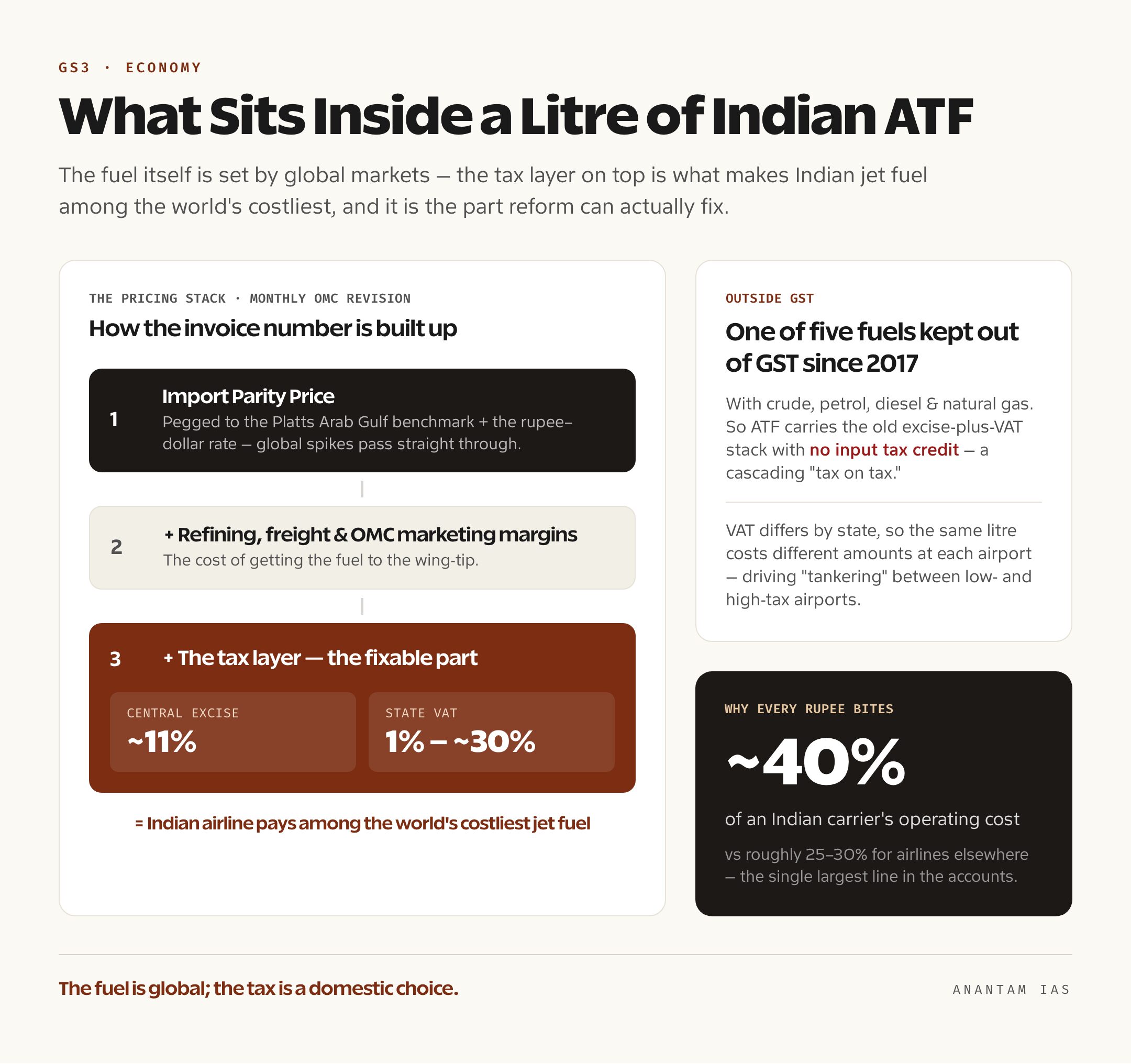
So how is the number on the OMC invoice actually arrived at? ATF in India is not under daily dynamic pricing like petrol and diesel at the pump. The three state oil marketing companies — Indian Oil, Bharat Petroleum and Hindustan Petroleum — revise ATF rates on a monthly cycle, typically at the start of each month, and the revision tracks two moving parts: the international jet-fuel benchmark (the Platts assessments for the Arab Gulf region that India buys against) and the rupee-dollar exchange rate. India imports a large share of its crude, so its product prices are pegged to an Import Parity Price, the notional cost of importing the fuel rather than the actual cost of producing it domestically.
The pricing formula, in plain terms, stacks up like this: Import Parity Price + refining margin + freight + the OMCs’ marketing margin + taxes. Two features of that stack matter for the exam. First, because it is import-parity-linked, the Indian airline pays roughly what the fuel would cost if shipped in from abroad, even when refined in India — which means any rise in global benchmarks or any weakening of the rupee flows straight through to the airline. Second, the taxes sitting at the top of that stack are unusually heavy and unusually uneven, and that is where the real story is.
Here is the core evergreen issue. ATF is one of five petroleum products — along with crude oil, petrol, diesel and natural gas — deliberately kept outside the Goods and Services Tax when GST was rolled out in 2017. So ATF still carries the old two-layer indirect tax structure: a central excise duty levied by the Centre (around 11%), and a State VAT levied on top by each state. And state VAT on jet fuel varies wildly — from as low as 1% in states that want to attract flights to as high as the high-twenties (Tamil Nadu has been near 29%), with several big states historically in the 20-30% band. The result is two distortions at once. Because excise and VAT sit outside GST, airlines cannot claim input tax credit on the tax they pay on fuel — a “tax on tax” cascade that simply piles onto the fare. And because VAT differs by state, the same litre of ATF costs sharply different amounts at different airports, so airlines play games like tankering — carrying extra fuel from a low-tax airport to avoid buying at a high-tax one. Add the heavy import-parity base, and you get the recurring headline: Indian ATF is among the most expensive jet fuel in the world.
This is exactly why airlines and the Civil Aviation Ministry have, for years, pushed to bring ATF under GST — a single national rate, with input tax credit, would cut both the cascade and the airport-to-airport disparity at a stroke. But the demand keeps dying in the GST Council, where states hold the votes. At the 55th GST Council meeting in December 2024, the proposal was tabled and the states rejected it once again. The reason is pure fiscal federalism: VAT on ATF is a fat, reliable revenue stream that states collect directly, and folding it into GST means surrendering that control to a shared, formula-driven pool. The one place states have voluntarily cut is regional connectivity — under the UDAN regional connectivity scheme, states agreed to hold VAT at 1% or less on flights to small towns for years, and during the current crisis even big jurisdictions like Delhi and Maharashtra slashed VAT to around 7% to give airlines temporary relief. The pattern is telling: states will trim VAT tactically to win flights or ease a crisis, but they won’t give up the lever permanently.
The ATF Price Stabilisation Fund: What the Cabinet Approved
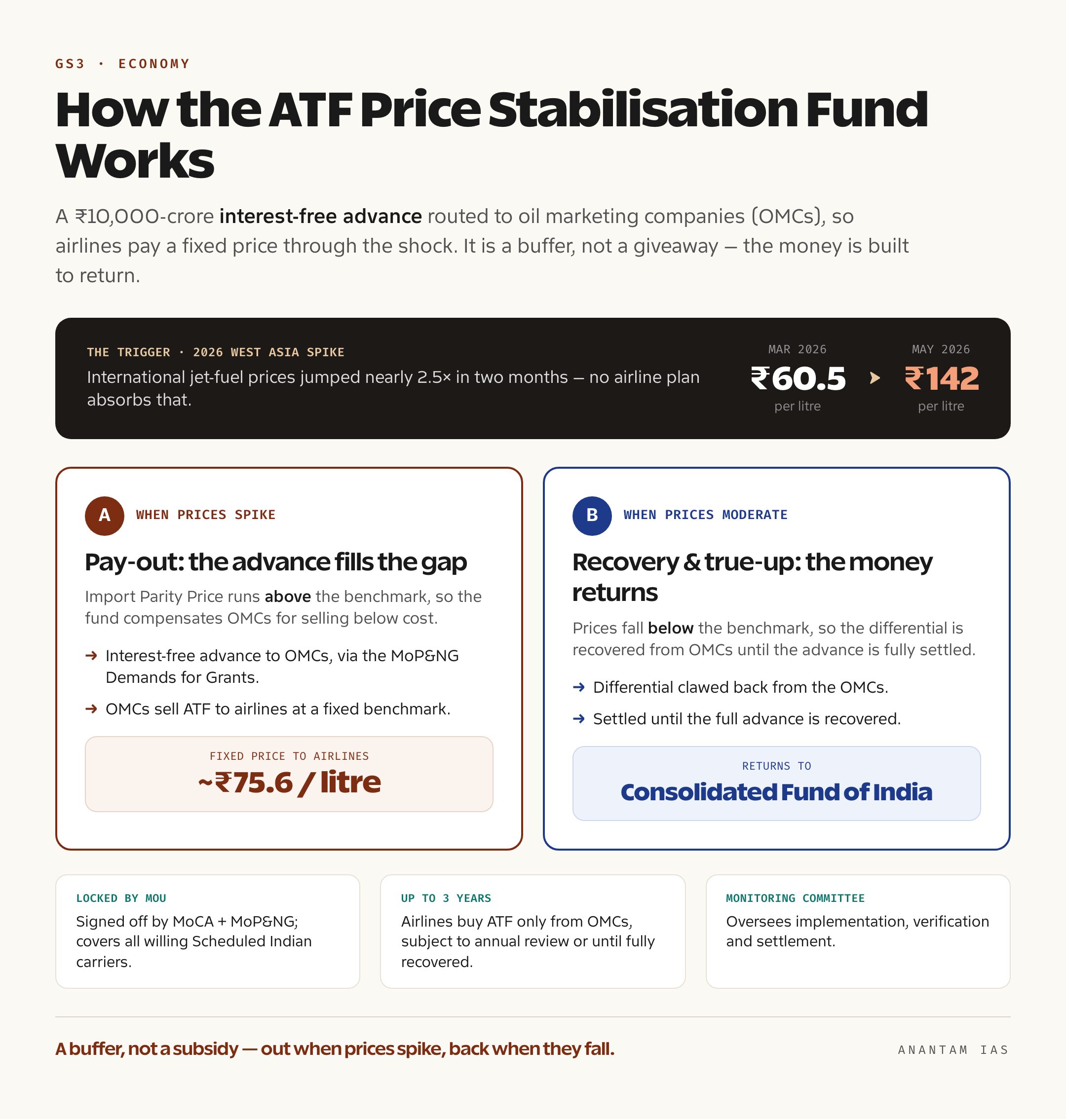
Against that backdrop, the latest move. On 3 June 2026 the Union Cabinet approved a one-time budgetary support of up to ₹10,000 crore to create an ATF “Price Stabilisation Fund” support for Scheduled Indian Airlines — both domestic and international carriers. The trigger was the exceptional volatility in international jet-fuel prices set off by the West Asia crisis: as the government’s own figures show, ATF that cost around ₹60.5 per litre in March 2026 had jumped to roughly ₹142 per litre by May, a near-2.5-times spike in two months that no airline business plan can absorb.
The architecture is worth getting exactly right, because the elegance of the scheme is that it is a buffer, not a giveaway. The money does not go to airlines as a grant. It flows as interest-free advances to the oil marketing companies, routed through the Demands for Grants of the Ministry of Petroleum and Natural Gas. The OMCs then sell ATF to participating airlines at a fixed, predictable benchmark price — reported at around ₹75.6 per litre — well below the spiking market rate. Five moving parts hold it together. One, when the prevailing Import Parity Price runs above that benchmark, the interest-free advance compensates the OMCs for the loss they take by selling below cost. Two — and this is the clever bit — when international prices moderate and fall back below the benchmark, a Recovery and True-Up kicks in: the differential is recovered from the OMCs and returned to the Consolidated Fund of India, until the entire advance is fully settled. So the taxpayer’s exposure is a loan, not a permanent cost. Three, it covers all willing Scheduled Indian carriers, so it is broad-based rather than picking winners. Four, the whole thing rests on a fixed-price arrangement that gives airlines a predictable fuel cost to plan and price tickets against. Five, it is locked in by an MoU between the airlines and the OMCs — signed off by the Ministry of Civil Aviation and the Ministry of Petroleum and Natural Gas — under which participating airlines agree to buy ATF only from OMCs for up to three years, subject to annual review or until the advance is fully recovered, whichever comes first. A Monitoring Committee oversees the implementation, verification and settlement.
Read it together and the logic is a classic price-stabilisation buffer: absorb the shock now with money that is meant to come back later, and give airlines a fixed price so the geopolitical spike doesn’t pass straight through to passengers. It is conceptually close to the Price Stabilisation Fund the government runs for onions, potatoes and pulses — buy into a buffer when prices are extreme, release or recover as the market normalises — except here the “buffer” is a fixed fuel price underwritten by a recoverable advance rather than a physical stockpile. The aim, in the government’s framing, is to insulate a strategically important sector and its flyers from a fuel shock they did not cause and cannot control.
Why It Matters, and the Hard Questions
For all its neat design, the fund invites genuine debate, and a good answer has to hold both sides. On the case for it: aviation is critical infrastructure for a country the size of India, the fuel shock is external and temporary, and letting it crater the carriers or spike fares during peak season would hurt the wider economy. The recoverable-advance structure means the headline ₹10,000 crore is a contingent liability rather than a straight subsidy — if prices fall, the money comes home. A fixed price gives airlines the planning certainty that is otherwise impossible when 40% of your cost swings with crude and the rupee. And by routing the support through OMCs rather than handing cash to airlines, the design avoids the optics and the moral hazard of bailing out private companies directly.
But the criticisms are real. Any large public commitment carries fiscal-cost and contingent-liability risk: if international prices stay elevated for longer than expected, the advance may not be fully recovered, and the gap lands on the Consolidated Fund. A fixed-price arrangement, however well-meant, interferes with the price signal and risks distorting the market — it dulls the incentive for airlines to hedge fuel themselves or improve efficiency, the classic moral-hazard problem, which is precisely why the government has stressed that this is a one-time, time-bound measure rather than a standing scheme. And critics make the sharpest point of all: this treats the symptom, not the disease. The structural reason Indian ATF is so painful is not the West Asia crisis; it is the tax architecture — ATF outside GST, no input tax credit, and punishing state VAT that varies airport to airport. The durable fix is to bring ATF under GST and rationalise state VAT, which would cut the cascade permanently and cost the exchequer nothing in the way a stabilisation fund can. A buffer buys time; only reform changes the structure.
That tension — emergency relief versus structural reform — is the line to carry into the exam. The Price Stabilisation Fund is a defensible short-term response to a genuine shock, but it works best if it is the bridge to GST inclusion and VAT rationalisation, not a substitute for them. The deeper question it raises is the federal one: a national problem (expensive fuel crippling a national network) is held hostage to state-level revenue interests, and until the Centre and states settle the bargain on ATF and GST, India will keep reaching for buffers every time crude and geopolitics move against it.
For Your Mains Answer
This topic sits squarely in GS Paper 3 — infrastructure (civil aviation), energy and the pricing of petroleum products, and most usefully, public finance and fiscal federalism (the GST-Council tussle over ATF). It also feeds the economy/government-intervention debate: when should the state cushion a sector from a price shock, and at what cost? The smartest answers will treat ATF as a single concrete case that lets you discuss taxation design, federal bargaining and market-versus-state intervention all at once.
How to Build the Answer
Open with the structural fact, not the news — ATF is roughly 40% of an Indian carrier’s cost, far above the global norm, so its price decides the sector’s survival. Then explain the two structural causes (import-parity pricing and the GST exclusion that leaves heavy, uneven excise-plus-VAT on top). Use the Price Stabilisation Fund as your current example of state intervention, explaining the buffer logic — interest-free advance out, recovery and true-up back. Close with the reform-versus-relief judgement: the fund is a sensible bridge, but the lasting fix is GST inclusion and VAT rationalisation, blocked by fiscal federalism. That arc — structure, causes, intervention, reform — works for almost any “aviation costs” or “petroleum taxation” question.
Common Mistakes to Avoid
Don’t write it as a news report on a Cabinet approval; the examiner wants the structural economics, with the fund as one data point. Don’t confuse the fund with a subsidy — its defining feature is that it is a recoverable interest-free advance, not a grant. Don’t forget the federal angle: saying “bring ATF under GST” without explaining why states resist (VAT revenue) misses half the answer. And don’t claim ATF is under GST — it is one of the five petroleum products explicitly kept out.
A Compact Answer Spine
ATF ≈ 40% of Indian airline cost (vs ~25-30% global) → priced on Import Parity + margins + taxes, revised monthly by OMCs → outside GST, so central excise + state VAT (1% to ~30%), cascading with no input tax credit → world’s costliest jet fuel, airport-to-airport disparity → 2026 West Asia spike (₹60.5 → ₹142/litre) → ₹10,000-cr Price Stabilisation Fund: interest-free advance to OMCs, fixed price to airlines, recovery-and-true-up to Consolidated Fund → significance (shields sector + flyers) vs criticism (distorts market, moral hazard, treats symptom) → durable fix = GST inclusion + VAT rationalisation, stuck on fiscal federalism.
Diagram or Flowchart Idea
Draw a simple loop. International ATF price spikes → OMCs sell to airlines at a fixed benchmark price → government’s interest-free advance fills the gap (price above benchmark) → prices moderate → differential recovered from OMCs → returns to the Consolidated Fund of India. Label the loop “buffer, not subsidy.” A second small panel breaking a litre of ATF into base price + excise + VAT makes the tax point instantly.
A Balanced-Conclusion Line
“The ATF Price Stabilisation Fund is a defensible buffer against an external shock, but a buffer is borrowed time — India’s lasting answer lies in bringing jet fuel under GST and rationalising state VAT, which is finally a test of cooperative fiscal federalism.”
How to Use Data Without Cramming
Two or three anchors are enough: ATF ≈ 40% of operating cost; the ₹60.5-to-₹142-per-litre spike between March and May 2026; the ₹10,000-crore size of the fund. Name the institutions in prose — the GST Council’s December 2024 rejection, the OMCs, the Ministries of Civil Aviation and of Petroleum — to show you know the machinery, not just the headline.
FAQ
Why is ATF such a big deal for airlines in India? Because it is the largest single cost they carry — roughly 35-40% of an Indian carrier’s operating expenses, against about 25-30% globally. With margins in aviation already razor-thin, a sharp rise in ATF can wipe out profits, and historically it has contributed to airline collapses like Kingfisher and Jet Airways. When fuel is 40% of your cost and you can’t control its price, the airline is effectively a bet on crude oil and the rupee.
Why is ATF not under GST, and why do states resist? ATF is one of five petroleum products (with crude, petrol, diesel and natural gas) deliberately kept out of GST in 2017. So it still attracts central excise duty plus state VAT, with no input tax credit — a cascading “tax on tax.” Airlines want it under GST to cut costs and end airport-to-airport price disparity, but the GST Council, where states have the votes, has repeatedly refused — most recently in December 2024 — because VAT on jet fuel is a large, directly collected state revenue that states don’t want to surrender.
What exactly did the Cabinet approve in June 2026? A one-time budgetary support of up to ₹10,000 crore to create an ATF Price Stabilisation Fund for Scheduled Indian Airlines, domestic and international. The money goes as interest-free advances to the oil marketing companies, which then sell ATF to participating airlines at a fixed benchmark price. When the import parity price is above that benchmark, the advance covers the OMCs’ loss; when prices fall, the differential is recovered and returned to the Consolidated Fund of India. It runs through an MoU for up to three years, subject to annual review or until the advance is recovered, and a Monitoring Committee oversees it.
Is the fund a subsidy or a loan, and is it the real solution? It is closer to a recoverable interest-free loan than a subsidy — the defining feature is the recovery-and-true-up mechanism that returns the money to the exchequer once prices normalise, which limits the taxpayer’s exposure to a contingent liability. It is a useful short-term buffer against the West Asia price shock, but it treats the symptom. The durable fix for India’s expensive jet fuel is structural — bringing ATF under GST and rationalising state VAT — which the fund is meant to bridge, not replace.
Practice Questions
Prelims MCQs
- With reference to Aviation Turbine Fuel (ATF) in India, consider the following statements. Which is/are correct?
(a) ATF is taxed under GST at a single national rate.
(b) ATF attracts central excise duty and state VAT, and is outside GST.
(c) ATF prices are revised daily under dynamic pricing like petrol and diesel.
(d) ATF is fully exempt from all indirect taxes.
Answer: (b) ATF is one of five petroleum products kept out of GST; it carries central excise plus state VAT and is revised by OMCs on a monthly cycle. - The Import Parity Price (IPP) used in Indian ATF pricing primarily reflects:
(a) the average cost of domestic refining only
(b) the notional cost of importing the fuel, linked to international benchmarks and the exchange rate
(c) a price fixed annually by the GST Council
(d) the lowest state VAT rate in the country.
Answer: (b) IPP pegs the price to what importing the fuel would cost, tracking international (Platts) benchmarks and the rupee-dollar rate, which is why global spikes pass straight through. - Under the ATF Price Stabilisation Fund approved in 2026, the budgetary support is provided as:
(a) a direct cash grant to airlines
(b) a tax rebate to passengers
(c) interest-free advances to Oil Marketing Companies, recoverable via a true-up mechanism
(d) equity investment in airlines.
Answer: (c) The support flows as interest-free advances to OMCs through the Demands for Grants of the Ministry of Petroleum and Natural Gas, with a recovery-and-true-up that returns money to the Consolidated Fund of India. - Consider the following with respect to the 2026 ATF Price Stabilisation Fund:
1. It covers only domestic scheduled airlines.
2. Participating airlines must procure ATF only from OMCs for up to three years.
3. A Monitoring Committee oversees implementation. Which are correct?
(a) 1 and 2
(b) 2 and 3
(c) 1 and 3
(d) 1, 2 and 3.
Answer: (b) The fund covers all willing Scheduled Indian carriers — both domestic and international — so statement 1 is wrong; statements 2 and 3 are correct. - Which of the following is the most commonly cited structural reason that ATF is among the world’s most expensive jet fuels in India?
(a) India produces no crude oil at all
(b) high and uneven taxation (central excise plus state VAT outside GST) combined with import-parity pricing
(c) airlines refuse to buy from OMCs
(d) ATF is banned for export.
Answer: (b) The exclusion from GST leaves a cascading excise-plus-VAT load that varies sharply by state, and import-parity pricing keeps the base high.
Mains Practice Questions
- “Aviation Turbine Fuel is the single line item that decides the survival of Indian airlines.” Examine how ATF is priced and taxed in India, and why this makes it among the world’s most expensive jet fuel. (15 marks, 250 words)
- The exclusion of ATF from GST is as much a question of fiscal federalism as of taxation policy. Discuss, with reference to the demand to bring ATF under GST and the resistance of states. (15 marks, 250 words)
- Critically evaluate the ATF Price Stabilisation Fund as a model of government intervention in a strategically important sector. Is it a buffer or a bailout? (15 marks, 250 words)
- Compare the design and rationale of the ATF Price Stabilisation Fund with buffer-stock-based price stabilisation in agriculture. What does the comparison reveal about the limits of price-stabilisation tools? (10 marks, 150 words)
- “Emergency relief buys time; only structural reform changes the structure.” In light of this statement, suggest a durable policy framework to insulate Indian aviation from fuel-price shocks. (15 marks, 250 words)