BBNJ Negotiations: High Seas Treaty, UNCLOS and India’s Position (UPSC)
UPSC guide to BBNJ Treaty (High Seas Treaty) — UNCLOS framework, marine genetic resources, ABMTs, EIAs, capacity building and 2024–26 ratification status.
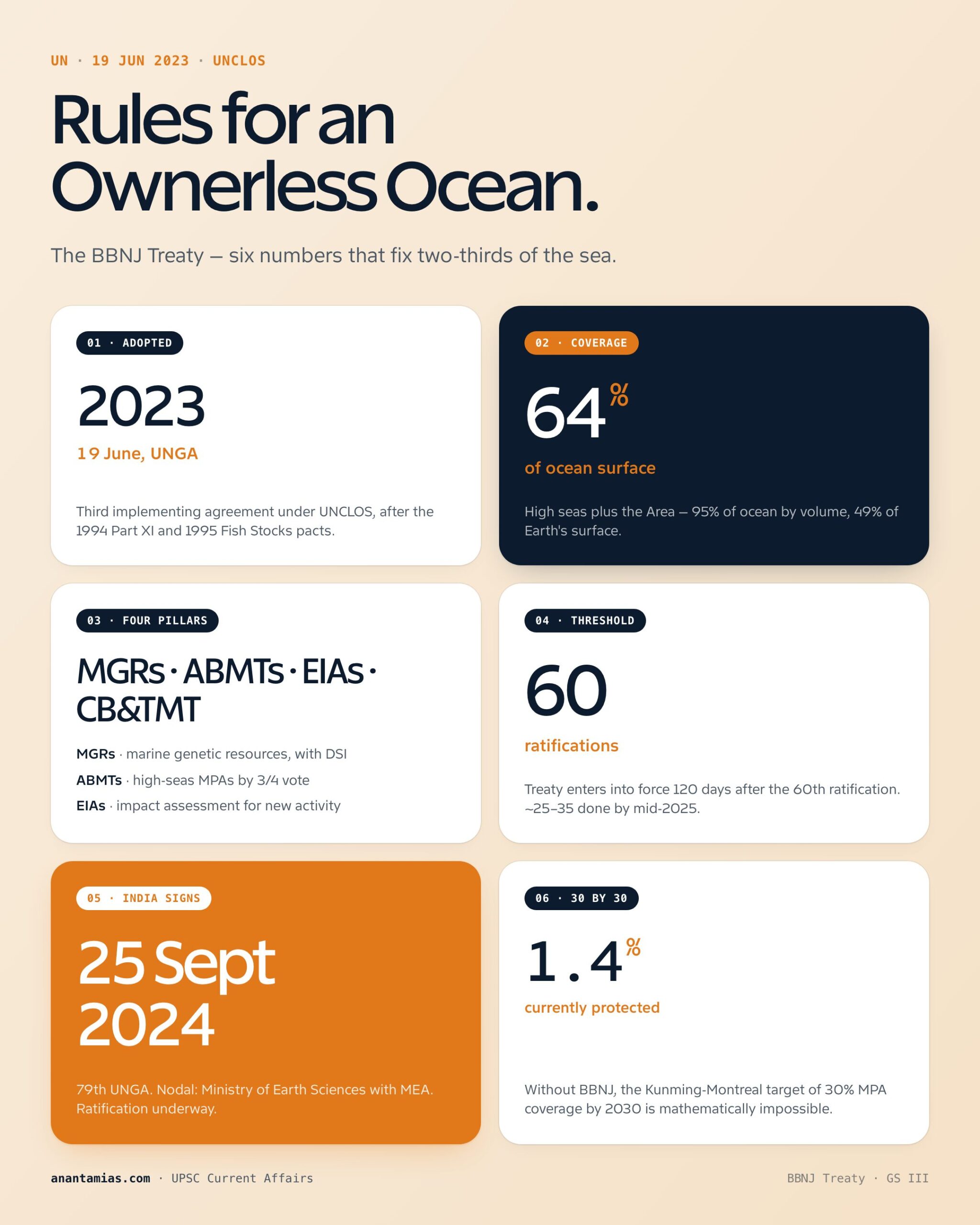
For the first time in history, the world has agreed on rules for the two-thirds of the ocean that belong to no one. On 19 June 2023, after nearly two decades of negotiation, UN member states adopted the Agreement on Marine Biological Diversity in Areas Beyond National Jurisdiction, popularly known as the BBNJ Treaty or the High Seas Treaty. India signed it on 25 September 2024 during the 79th UNGA session.
The high seas — every patch of ocean beyond 200 nautical miles from any coast — cover 64% of the ocean surface and 95% of its volume. They host the planet's largest carbon sink, half its photosynthesis, and species we have barely begun to discover. Until BBNJ, they were a legal black hole — a tragedy of the global commons. The treaty changes that.
This guide explains what the BBNJ Treaty is, how it relates to UNCLOS, what its four pillars cover, where ratification stands in 2024–26, and why it matters for India's blue economy and UPSC preparation.
What is BBNJ?
BBNJ stands for "Biodiversity Beyond National Jurisdiction". The full name is the Agreement under the United Nations Convention on the Law of the Sea (UNCLOS) on the Conservation and Sustainable Use of Marine Biological Diversity of Areas Beyond National Jurisdiction.
It is the third implementing agreement under UNCLOS, after:
- the 1994 Part XI Agreement on deep-sea mining,
- the 1995 UN Fish Stocks Agreement on straddling fish stocks.
Areas Beyond National Jurisdiction (ABNJ)
ABNJ refers to two zones of the ocean:
- The High Seas — water column beyond the 200 nautical mile Exclusive Economic Zone (EEZ) of any state. Governed historically by the principle of freedom of the high seas under UNCLOS Part VII.
- The Area — the seabed and ocean floor beyond the limits of national continental shelves. Declared the "common heritage of mankind" under UNCLOS Part XI; managed by the International Seabed Authority (ISA).
Together, ABNJ covers about 64% of the ocean surface and 49% of the Earth's surface.
Why a New Treaty Was Needed
UNCLOS, signed in 1982 and in force since 1994, is the constitution of the oceans. But it was drafted before the world understood:
- the role of deep-sea biodiversity,
- the commercial value of marine genetic resources (MGRs),
- the cumulative impact of climate change, plastic, noise and seabed mining on the open ocean.
A 2017 UN study showed that fewer than 1.4% of high seas were under any form of protection. Without a treaty, the 30% by 2030 ocean protection target adopted at CBD COP15 (Kunming-Montreal GBF, 2022) was mathematically impossible.
The result: a new instrument that fills four gaps in UNCLOS.
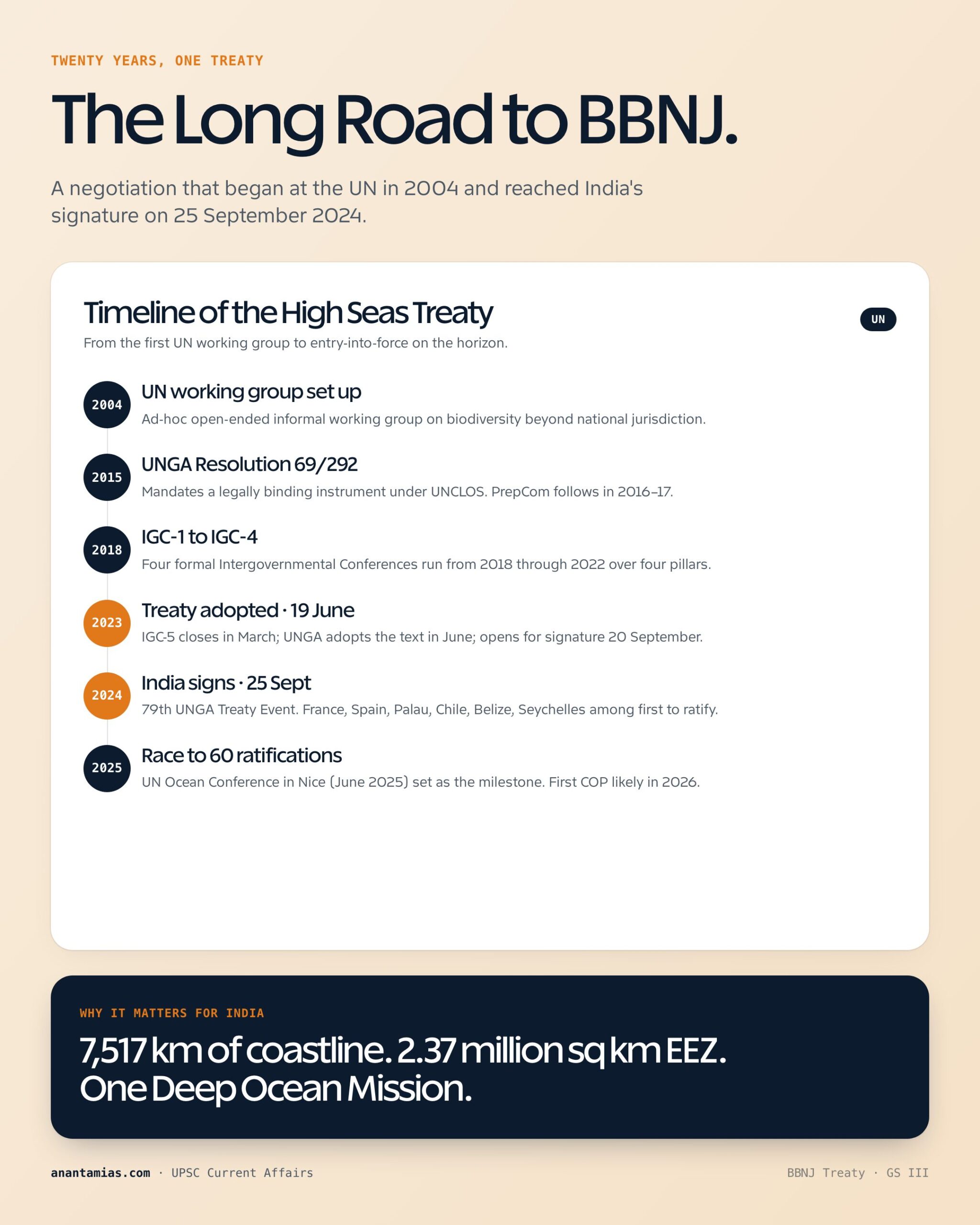
Timeline of Negotiations
| Year | Milestone |
|---|---|
| 2004 | UN Ad Hoc Open-ended Informal Working Group set up |
| 2015 | UNGA Resolution 69/292 launched negotiations |
| 2017 | Preparatory Committee report submitted |
| 2018–2022 | Four formal Intergovernmental Conference (IGC) sessions |
| March 2023 | IGC-5 final session — text agreed |
| 19 June 2023 | Treaty adopted at UN General Assembly |
| 20 Sept 2023 | Treaty opened for signature |
| 2024 | India signs (25 September 2024) |
| 2025 | Treaty enters into force after 60 ratifications (target) |
The Four Pillars of BBNJ
The treaty rests on four substantive pillars, each addressing a gap in existing ocean law.
1. Marine Genetic Resources (MGRs) and Benefit Sharing
The dispute: developed countries with the technology to bioprospect MGRs (drugs, enzymes, cosmetics) wanted free access; developing countries argued MGRs are part of the "common heritage of mankind" and benefits must be shared.
The compromise:
- A multilateral mechanism for fair and equitable sharing of monetary and non-monetary benefits from MGRs in ABNJ.
- A clearing-house mechanism to track samples from collection to commercialisation.
- Notification requirements before, during and after collection.
- Capacity-building and technology transfer for developing states.
- Digital sequence information (DSI) is included — a major win for developing nations.
2. Area-Based Management Tools (ABMTs), including Marine Protected Areas
The need: to protect ecologically and biologically significant areas in ABNJ.
Provisions:
- A formal procedure to establish High-Seas MPAs.
- A Conference of the Parties (CoP) can adopt MPAs by 3/4 majority if consensus fails.
- States can opt out, but must notify and justify.
- Existing regional bodies like CCAMLR, NEAFC, OSPAR continue to operate.
This unlocks the path to the 30 by 30 target.
3. Environmental Impact Assessments (EIAs)
The need: to vet new activities — deep-sea mining, geoengineering, fishing in new areas — before damage is done.
Provisions:
- States must conduct EIAs for activities in ABNJ that may have more than minor or transitory effect.
- Strategic Environmental Assessments (SEAs) for plans and programmes.
- Public participation and transparency required.
- Decision-making remains with the proposing state, but the CoP can comment.
4. Capacity Building and Transfer of Marine Technology (CB&TMT)
The need: to bridge the gap between developed and developing states in marine science.
Provisions:
- Mandatory technology transfer "on fair and most favourable terms".
- Training, scholarships, joint research, equipment access.
- A Capacity Building and Transfer of Marine Technology Committee.
- Funding through a Special Fund.
Institutional Architecture
The treaty creates a robust institutional framework:
- Conference of the Parties (COP) — the supreme decision-making body.
- Scientific and Technical Body — provides scientific advice, reviews EIAs, recommends MPAs.
- Clearing-House Mechanism — open-access database on MGRs, EIAs, ABMTs.
- Secretariat — administrative body (location to be decided).
- Implementation and Compliance Committee — facilitative, non-adversarial.
- Special Fund — for capacity building, especially for SIDS, LDCs, LLDCs.
- Access and Benefit Sharing Committee — oversees MGR provisions.
Ratification Status (2024–26)
The treaty enters into force 120 days after the 60th ratification. As of mid-2025:
| Status | Count (approx.) |
|---|---|
| Signatures | 100+ |
| Ratifications | 25–35 (rising) |
| Required for entry into force | 60 |
| India | Signed 25 Sept 2024; ratification in progress |
Major signatories include the EU, US, UK, China, Japan, Australia, India, and most African and Latin American states. The race is on to reach 60 ratifications before the UN Ocean Conference (Nice, June 2025).
India's Position
Why BBNJ Matters for India
- India has a 7,517 km coastline and a 2.37 million sq km EEZ — but its strategic interests extend far into the high seas of the Indian Ocean.
- India's bioprospecting capacity is growing — NIO, NCPOR and CMLRE are active in deep-sea research.
- India's Deep Ocean Mission (2021) depends on equitable access to seabed and high-seas resources.
- India is a leading voice for the Common Heritage of Mankind principle and benefit sharing — aligning with the G77 stance.
India's Engagement
- Active participant in all five IGC rounds (2018–2023).
- Supported MGR benefit-sharing and capacity building for developing nations.
- Signed on 25 September 2024 — Cabinet approval was given in late 2024.
- Ratification process underway via the Ministry of External Affairs and the Ministry of Earth Sciences (nodal).
India's Concerns
- Balancing freedom of high-seas navigation (vital for India's energy imports) with new MPA restrictions.
- Ensuring MGR benefit-sharing actually reaches developing states.
- Capacity to participate effectively in Scientific and Technical Body deliberations.
BBNJ vs UNCLOS — Key Distinctions
| Feature | UNCLOS (1982) | BBNJ (2023) |
|---|---|---|
| Scope | All ocean zones | Only ABNJ |
| Focus | Sovereignty, navigation, EEZ, ISA | Conservation and sustainable use of biodiversity |
| MPAs | No formal mechanism for high seas | Formal procedure with COP voting |
| MGRs | Silent | Detailed regime with DSI included |
| EIAs | Article 206 (vague) | Detailed procedural rules |
| Enforcement | Limited | Implementation Committee, COP review |
Recent Developments (2024–26)
- India signed BBNJ on 25 September 2024 at the 79th UNGA Treaty Event.
- France, Spain, Palau, Chile, Belize, Seychelles were among the first to ratify (2024).
- EU member states committed to collective ratification by end-2025.
- UN Ocean Conference 2025 (Nice, France) set as a milestone for reaching the 60-ratification threshold.
- First COP likely in 2026 once treaty enters into force.
- Deep-sea mining moratorium debate at ISA in 2024–25 has highlighted BBNJ's importance.
- India's Deep Ocean Mission is now actively cross-referencing BBNJ obligations in its mission planning.
- High-Seas Alliance — a coalition of 50+ NGOs — is tracking ratifications and pushing the "Race for Ratification".
- Pacific SIDS including Palau, Fiji and the Solomon Islands have ratified, citing existential climate threats.
- Antarctic linkage — BBNJ MPAs may complement CCAMLR designations for the Southern Ocean if the consensus rule continues to block CCAMLR action.
Way Forward
- Accelerate India's ratification — complete parliamentary and Cabinet approvals before mid-2026.
- Build institutional capacity at MoES, MEA, NIO, NCPOR for COP participation.
- Coordinate with the G77 on MGR benefit-sharing and CB&TMT.
- Develop a national MGR access regime to align Indian researchers with treaty obligations.
- Integrate BBNJ into the Deep Ocean Mission with biodiversity safeguards.
- Strengthen scientific data systems so India can meaningfully contribute to the Clearing-House Mechanism.
- Diplomatic leadership — host an early Indian Ocean BBNJ workshop, building on India's 2024 ATCM hosting.
- Civil society engagement through environmental groups and academic institutions.
Mains Hook
"The BBNJ Treaty fills a critical lacuna in UNCLOS. Discuss its four pillars and analyse its implications for India's blue economy and Deep Ocean Mission." — GS III
"Marine Genetic Resources are now recognised as part of the common heritage of mankind. Examine the BBNJ benefit-sharing regime and the position of developing countries." — GS III
"Without the BBNJ Treaty, the 30 by 30 ocean target is mathematically impossible. Comment." — GS III
Prelims Pointers
- BBNJ = Biodiversity Beyond National Jurisdiction; also called High Seas Treaty.
- Negotiated under UNCLOS (1982); third implementing agreement.
- Adopted: 19 June 2023; opened for signature 20 September 2023.
- India signed: 25 September 2024.
- Enters into force 120 days after 60th ratification.
- Four pillars: MGRs, ABMTs/MPAs, EIAs, CB&TMT.
- High Seas = beyond 200 nm EEZ; The Area = seabed beyond continental shelf.
- The Area is the "common heritage of mankind" under UNCLOS; managed by International Seabed Authority (ISA).
- MPAs under BBNJ can be adopted by 3/4 majority at COP if consensus fails.
- Digital Sequence Information (DSI) is covered.
- Kunming-Montreal GBF (2022) mandates 30% MPA coverage by 2030.
- BBNJ is one of three UNCLOS implementing agreements (1994 Part XI; 1995 Fish Stocks; 2023 BBNJ).
- India's nodal ministry for BBNJ: Ministry of Earth Sciences with MEA.
Conclusion
The BBNJ Treaty is the most important ocean agreement since UNCLOS itself. It transforms the high seas from a free-for-all into a managed global commons with rules for protected areas, equitable benefit-sharing, environmental safeguards and capacity building. For India — a country with a long coastline, growing blue economy ambitions and leadership pretensions in the Global South — ratification is not optional. It is the diplomatic and ecological investment of a generation.