The Biological Diversity Act 2002 is the principal Indian law for the conservation of biological diversity, the sustainable use of its components, and the fair and equitable sharing of benefits arising out of the use of genetic resources. It was enacted to give domestic effect to the Convention on Biological Diversity, 1992 and the Nagoya Protocol on access and benefit sharing. The Act sets up a three-tier institutional architecture spanning the central, state, and local levels and creates obligations on foreign entities, Indian commercial users, and researchers who tap into India’s biological wealth.
For UPSC the Biological Diversity Act sits at the intersection of GS Paper III environment and Paper II governance. Prelims questions ask about the National Biodiversity Authority, the State Biodiversity Boards, the Biodiversity Management Committees, People’s Biodiversity Registers, and Biodiversity Heritage Sites. Mains questions test the access and benefit sharing regime, biopiracy, the role of traditional knowledge, and the impact of the 2023 amendment that decriminalised offences and exempted users of codified traditional knowledge such as registered Ayurveda practitioners.
This guide reads the 2002 Act and its 2023 amendment together with the international framework, walks through every tier of authority, and maps the law to the prelims and mains material that aspirants are expected to write under exam pressure.
Quick Facts at a Glance
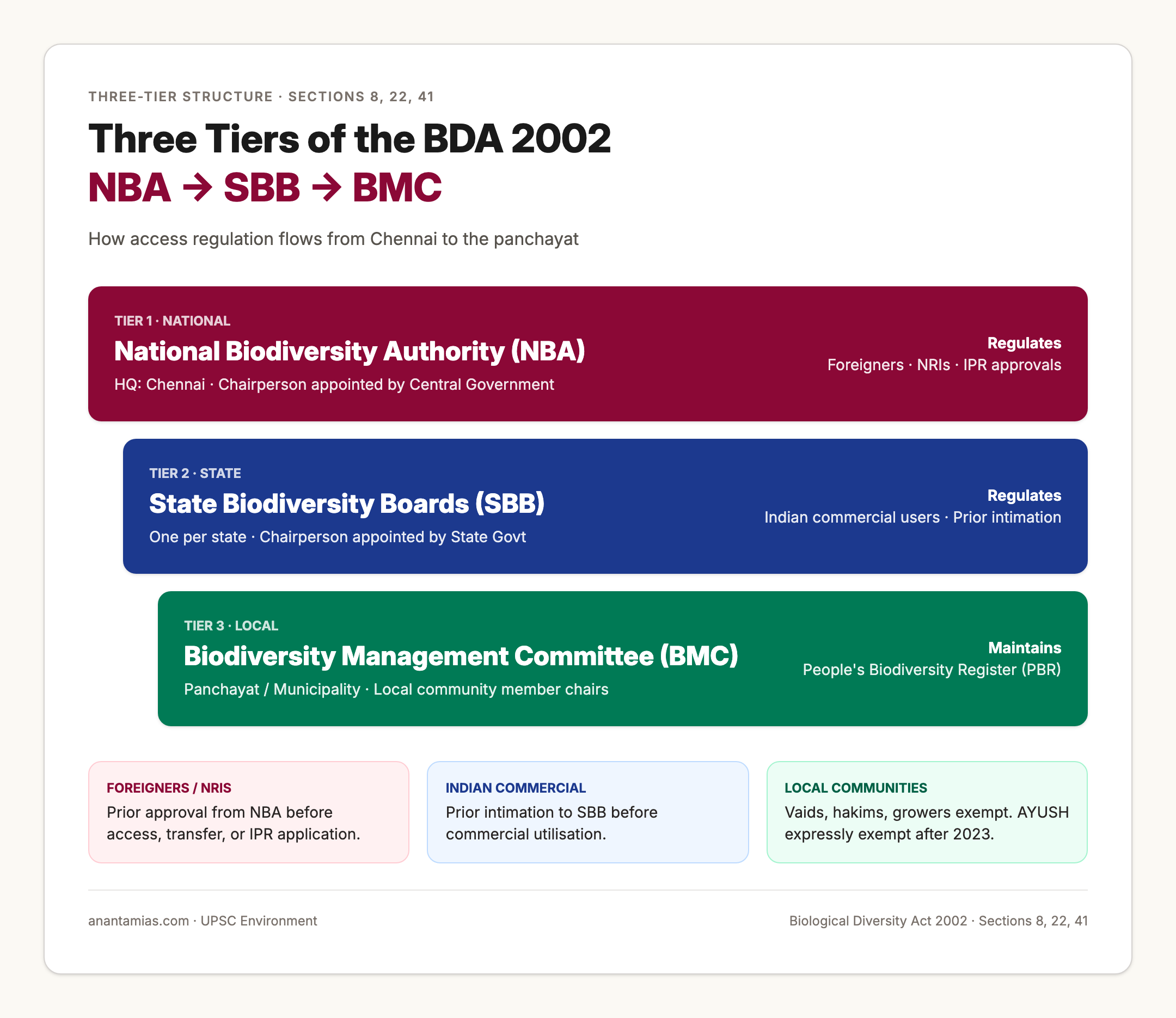
The Biological Diversity Act 2002 was passed by Parliament to discharge India’s obligations under the Convention on Biological Diversity signed at the Earth Summit in Rio in 1992. The Act has three stated objectives: conservation, sustainable use, and fair and equitable sharing of benefits. It applies to the whole of India. The administrative ministry is the Ministry of Environment, Forest and Climate Change. The Act sets up a three-tier system: the National Biodiversity Authority headquartered in Chennai, State Biodiversity Boards in each state, and Biodiversity Management Committees at the panchayat or municipality level. Foreign individuals, foreign companies, and non-resident Indians need prior approval from the NBA before they can access biological resources. Indian citizens and companies need to give prior intimation to the SBB. The Biodiversity Management Committee is required to maintain a People’s Biodiversity Register that documents local flora, fauna, and traditional knowledge. The Act allows state governments to notify Biodiversity Heritage Sites under Section 37; well-known examples include Ameenpur Lake in Telangana and Majuli river island in Assam. The Biological Diversity (Amendment) Act 2023 decriminalised offences, exempted users of codified traditional knowledge, fast-tracked intellectual property approvals, and excluded domesticated species from the definition of biological resources.
What the Biological Diversity Act Is
The Act is a framework law that converts an international treaty into a domestic regulatory regime. Three ideas anchor it. The first is that biological resources have measurable economic value and that this value must be shared with the communities that have conserved and used those resources for generations. The second is that bioprospecting cannot be left to private negotiation alone because the resources in question are public goods governed by sovereign rights. The third is that conservation works best when it is decentralised and participatory, which is why the Act pushes the bulk of recordkeeping work down to the panchayat level. India’s existing biodiversity policy is anchored by the biodiversity and conservation NCERT material and complemented by sector laws like the Wildlife Protection Amendment Act 2022.
The Act covers all biological resources occurring in India, plus knowledge associated with those resources. It does not cover cultivated agricultural plants and domesticated animals after the 2023 amendment, nor does it cover human genetic material. The geographical scope is broad: marine resources within Indian waters and microbial resources are included alongside terrestrial flora and fauna.
Background and Historical Context
The roots of the Biological Diversity Act lie in three streams. The first is the Convention on Biological Diversity itself, opened for signature at the Rio Earth Summit in June 1992 and ratified by India in 1994. The CBD recognised national sovereignty over genetic resources and made fair and equitable benefit sharing one of its three pillars. The second stream is the long-running Indian concern with biopiracy, sharpened by the turmeric and neem patent disputes of the 1990s, in which foreign patent offices granted exclusive rights over uses that had been part of Indian traditional medicine for centuries. India spent significant diplomatic and legal effort getting these patents revoked, and that experience fed directly into the design of the 2002 Act. The third stream is the realisation, anchored in the Convention on Biological Diversity itself, that conservation and sustainable use cannot be separated from livelihoods and that local communities are the real custodians of biodiversity.
Parliament passed the Act in December 2002. The Biological Diversity Rules followed in 2004. The National Biodiversity Authority was established with its headquarters at Chennai. The Nagoya Protocol on Access and Benefit Sharing was adopted in 2010 and entered into force in 2014; India ratified it in 2012. The Nagoya Protocol gave more legal teeth to the access and benefit sharing concept, set timelines for permits, and required user countries to support compliance with provider country laws.
The 2023 amendment was the most significant overhaul. The amendment had two main drivers. First, the AYUSH industry argued that the original Act treated registered traditional medicine practitioners and codified knowledge users in the same way as commercial bioprospectors, creating an unworkable compliance burden. Second, decriminalisation of regulatory offences became a broader policy goal in the same period, leading to a consistent shift from criminal jail terms to civil monetary penalties.
The Three-Tier Institutional Structure
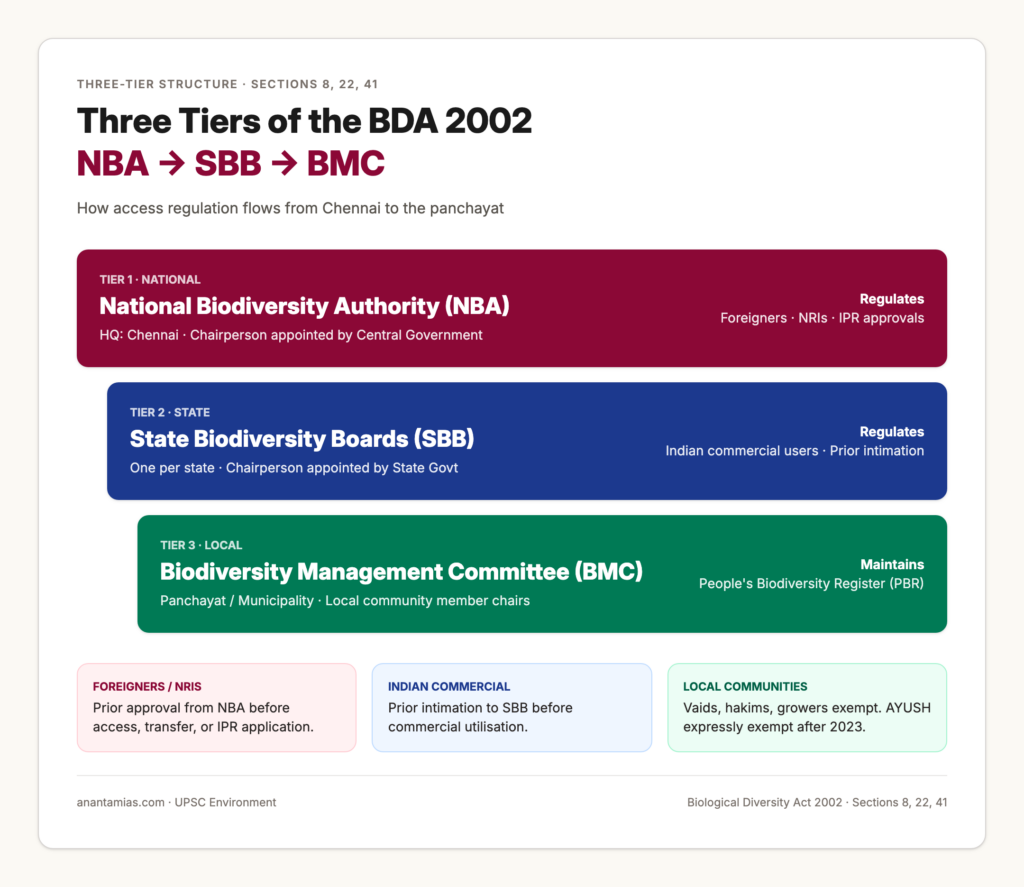
The Act creates a three-tier institutional structure that mirrors the three-tier governance system of the Indian polity. The structure is decentralised by design.
The National Biodiversity Authority sits at the apex. It is a statutory body headquartered in Chennai. Its chairperson is appointed by the Central Government. The NBA regulates access to biological resources by foreign individuals, non-resident Indians, foreign companies, and any person seeking to apply for intellectual property rights based on Indian biological resources. It also advises the Centre on conservation policy and on the selection of biodiversity heritage sites.
The State Biodiversity Boards operate at the next tier. They regulate access to biological resources by Indian individuals and companies for commercial use and by anyone for research in the public interest. The chairperson is appointed by the state government. Many states have set up active SBBs while a few have functioned mostly on paper, which is one of the recurring critiques of the Act’s implementation.
The Biodiversity Management Committee operates at the panchayat or municipal level. The BMC is the most important grassroots layer. Its core duty is to prepare and maintain a People’s Biodiversity Register that documents the local flora, fauna, agricultural varieties, microbial diversity, and the traditional knowledge associated with these resources. The BMC also has consultation rights when access decisions affect the area under its jurisdiction. As of the latest available data the number of BMCs across the country has crossed 2.7 lakh, although coverage and quality of the registers vary widely.
Access and Benefit Sharing under BDA 2002
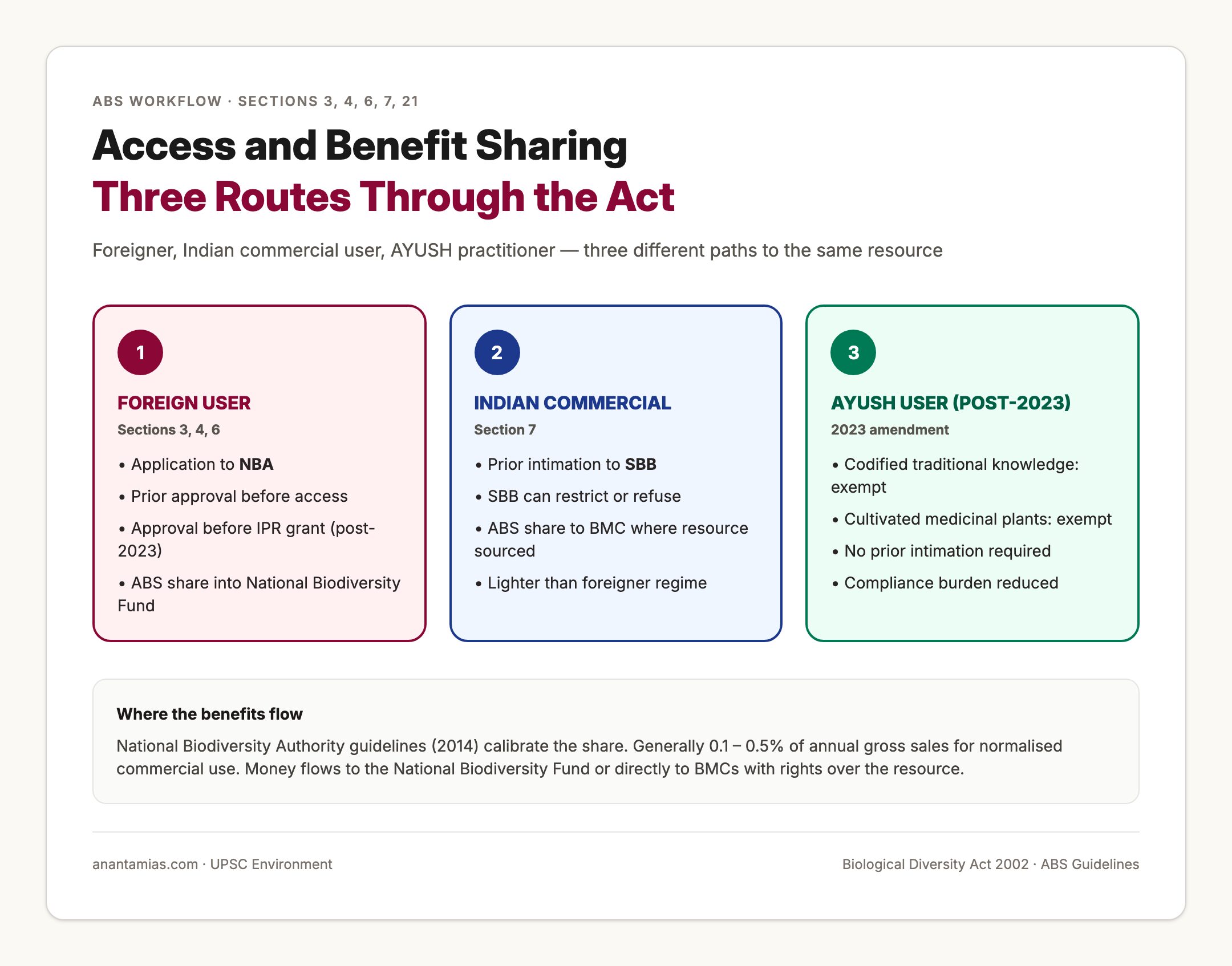
Access and Benefit Sharing, abbreviated as ABS, is the operational core of the Act. The principle is that any person or company that uses Indian biological resources or traditional knowledge to generate commercial value must share a fair portion of that value with the country and with the communities that conserved the resource.
Three categories of users face three different procedures. Foreigners, foreign companies, and non-resident Indians must seek prior approval from the National Biodiversity Authority before they can access biological resources, before they can transfer the results of any research conducted on those resources, and before they can apply for any intellectual property right based on those resources. Indian citizens and Indian companies must give prior intimation to the State Biodiversity Board before they obtain biological resources for commercial utilisation. Local people, including vaids and hakims, are exempt from these procedures, as are growers and cultivators of biodiversity. The 2023 amendment further widened this exemption to cover registered AYUSH practitioners and users of codified traditional knowledge such as the texts of Ayurveda, Siddha, and Unani.
Benefit sharing can take several forms. The NBA may direct that monetary benefits be paid into the National Biodiversity Fund or directly to the BMCs that hold the relevant resources. Non-monetary benefits include joint ventures, technology transfer, research collaboration, and capacity building. Section 21 of the Act lays out the broad parameters of benefit sharing while leaving the calibration to NBA guidelines. The 2014 ABS Guidelines published by the NBA quantify the share, generally between 0.1 and 0.5 percent of annual gross sales for normalised commercial use, scaled by the type of activity.
Why the Act Matters for India
The Biological Diversity Act matters because India is one of seventeen megadiverse countries that together hold roughly 70 percent of the planet’s biodiversity. India has four global biodiversity hotspots inside or partially inside its borders: the Western Ghats and Sri Lanka hotspot, the Eastern Himalaya, the Indo-Burma region, and the Sundaland through the Nicobar Islands. The country’s traditional knowledge systems are arguably even larger in monetary terms than its raw biological diversity, particularly when counted alongside Ayurveda, Siddha, Unani, Sowa-Rigpa, and the regional folk medicine traditions.
The Act gives India a legal handle on three fronts. It allows the country to regulate access by foreign actors and prevent another turmeric or neem situation. It gives local communities a tool to assert prior rights through the People’s Biodiversity Register and to negotiate benefit sharing. It creates the infrastructure for India to participate in international treaty regimes on equal terms with countries that have more developed environmental administrations.
The Act also matters for industry. The AYUSH sector, the agricultural seed sector, the pharmaceutical sector, and the cosmetics sector all operate under its shadow. The 2023 amendment was specifically designed to reduce friction for AYUSH and to make patenting smoother for Indian innovators while preserving the core ABS principle for foreign users.
Detailed Analysis: Provisions That Matter Most
Section 3 prohibits any person who is not an Indian citizen, any non-resident Indian, and any company that is not registered in India from obtaining biological resources without prior approval from the NBA. Section 4 prohibits the transfer of any results of research using Indian biological resources to foreign nationals without NBA approval. Section 6 requires NBA approval before any application for intellectual property rights based on Indian biological resources is made. After the 2023 amendment, this approval is now needed only before the grant of the patent rather than at the application stage, which is a significant procedural relaxation. Section 7 requires Indian citizens and companies to give prior intimation to the SBB before commercial utilisation of biological resources.
Section 18 lists the functions of the National Biodiversity Authority, including regulating access, advising the Centre, and taking steps to oppose grants of intellectual property rights outside India that are based on Indian biological resources. Section 21 governs benefit sharing. Section 22 provides for the constitution of State Biodiversity Boards. Section 36 mandates the Centre to develop national strategies, plans, and programmes for conservation, including the selection of areas of biodiversity importance. Section 37 empowers state governments to notify Biodiversity Heritage Sites; about 47 such sites had been notified across the country as of the latest available data. Section 38 allows the Centre to declare any species threatened.
Section 41 requires every local body to constitute a Biodiversity Management Committee for the purpose of promoting conservation, sustainable use, and documentation through the People’s Biodiversity Register. Section 55, before the 2023 amendment, made offences punishable with imprisonment up to five years and fines up to ten lakh rupees. After the amendment, offences are punishable only with civil monetary penalties ranging up to one crore rupees, with no imprisonment for the listed contraventions.
Comparative: Original Act 2002 vs Amendment Act 2023
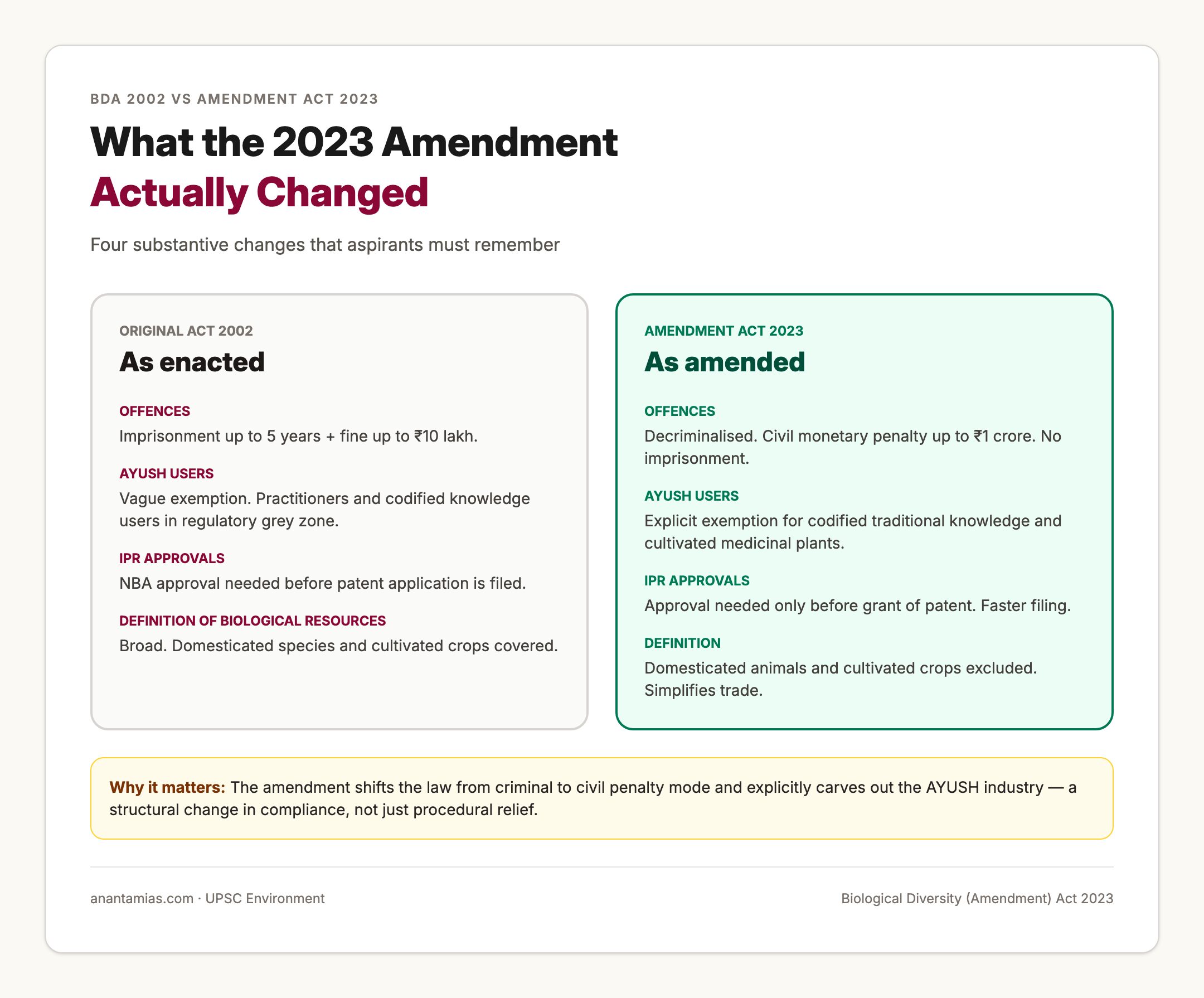
The 2023 amendment changed four things that aspirants must remember.
Offences shifted from criminal to civil. Under the original Act, contravention of access provisions could attract imprisonment up to five years, and the maximum fine was capped at ten lakh rupees. The amendment removed imprisonment entirely for these offences and replaced the criminal regime with monetary penalties imposed by an adjudicating officer, with the maximum penalty raised to one crore rupees.
The treatment of AYUSH users shifted from vague to explicit. The original Act exempted local people, vaids, and hakims practising indigenous medicine but left the position of registered AYUSH practitioners and the broader codified traditional knowledge industry uncertain. The amendment carved out an explicit exemption for users of codified traditional knowledge and for cultivated medicinal plants from access and benefit sharing requirements.
Intellectual property approvals shifted from upfront to back-loaded. Under the original Act the NBA approval had to be obtained before any patent application based on Indian biological resources was filed. The amendment moves this checkpoint to just before the grant of the patent, which lets innovators file applications and pursue prior art searches without procedural delay.
The definition of biological resources narrowed. The amendment expressly excludes value-added products and excludes domesticated animals, agricultural seeds, and cultivated plants from the definition of biological resources for the purposes of access regulation. This simplifies trade and brings the Indian regime closer to mainstream international practice.
Challenges and Critiques
The Act has been criticised on several fronts. Implementation has been uneven across states. The quality of People’s Biodiversity Registers ranges from rich, illustrated, community-led documents to bare-bones lists. Benefit sharing has flowed in only a fraction of cases that should have triggered it; one well-reported example is the Kani tribal community of Kerala, which received a share of royalties from the Jeevani drug developed using their traditional knowledge.
Critics of the 2023 amendment argued that the explicit AYUSH exemption could become a backdoor for the appropriation of community-held traditional knowledge by registered practitioners and corporates and that the move from criminal to civil penalties weakens deterrence. Critics from industry argued the opposite: that the original Act imposed unworkable compliance costs on small users and that amendment relief was overdue. The institutional capacity of the NBA, the staffing of SBBs, and the technical training of BMCs remain the binding constraint on outcomes regardless of which substantive position one takes.
Prelims Pointers
The Convention on Biological Diversity has three pillars: conservation, sustainable use, and fair and equitable benefit sharing. The Nagoya Protocol of 2010 operationalises the third pillar.
The National Biodiversity Authority is headquartered in Chennai. The chairperson is appointed by the Central Government.
State Biodiversity Boards regulate access by Indians for commercial use. Foreigners and NRIs must approach the NBA.
Biodiversity Management Committees are constituted at the panchayat or urban local body level under Section 41. They prepare People’s Biodiversity Registers.
Section 37 allows state governments to notify Biodiversity Heritage Sites. Examples: Ameenpur Lake in Telangana, Majuli in Assam, Glory of Allabad in Maharashtra, Tonglu and Dhotrey in West Bengal.
The 2023 amendment decriminalised offences, exempted codified traditional knowledge users, and excluded domesticated and cultivated species from the definition of biological resources.
Mains Questions
The Biological Diversity Act 2002 has been amended in 2023 to ease compliance for AYUSH users and to decriminalise offences. Examine the trade-off between compliance relief and the integrity of the access and benefit sharing regime. (GS III, 250 words)
Discuss the role of Biodiversity Management Committees and People’s Biodiversity Registers in the implementation of the Biological Diversity Act 2002. What are the main institutional and capacity challenges they face? (GS II and GS III, 250 words)
Evaluate the effectiveness of India’s domestic legal architecture in giving effect to the Convention on Biological Diversity and the Nagoya Protocol. (GS III, 150 words)
India is one of seventeen megadiverse countries. Examine how the Biological Diversity Act 2002 protects the country’s biological wealth from biopiracy in the context of the turmeric and neem patent disputes. (GS III, 250 words)
Way Forward
The road ahead has three priorities. The first is institutional capacity at the BMC level. People’s Biodiversity Registers cannot do the work the law assigns them if they remain underfunded and under-supported. State governments need to set aside dedicated budgets for digitisation and for ground truthing of the registers, and need to integrate the registers with land records and forest department databases. The second is monitoring of benefit sharing flows. NBA approvals run into thousands per year, but the share of those approvals that translate into actual benefit-sharing transactions, audited and disclosed, is much smaller. A public database of NBA approvals and benefit-sharing transactions would let researchers and civil society track outcomes. The third is alignment with related laws. The Forest Rights Act 2006 and the Forest Conservation Amendment Act 2023 interact directly with the BDA, and the rules framed under each must be read together so that community forest rights, conservation reserves, and biodiversity heritage sites form a single coherent layer rather than three competing ones.
Frequently Asked Questions
What is the Biological Diversity Act 2002?
The Biological Diversity Act 2002 is the principal Indian law for the conservation of biological diversity, the sustainable use of its components, and the fair and equitable sharing of benefits arising out of the use of genetic resources. It was enacted to give effect to the Convention on Biological Diversity, 1992 and the Nagoya Protocol on access and benefit sharing.
Who constitutes the three-tier structure under the Biological Diversity Act?
The three-tier structure consists of the National Biodiversity Authority at the apex, State Biodiversity Boards at the state level, and Biodiversity Management Committees at the panchayat or municipality level. The NBA regulates access by foreigners, the SBBs regulate access by Indians for commercial use, and the BMCs maintain People’s Biodiversity Registers and engage in local conservation.
What is the People’s Biodiversity Register?
The People’s Biodiversity Register, abbreviated PBR, is a legal document maintained by every Biodiversity Management Committee. It documents the local biological resources, agricultural varieties, microbial diversity, and traditional knowledge associated with those resources. It functions as a defensive tool against biopiracy and as the primary evidentiary base for benefit-sharing claims.
What are Biodiversity Heritage Sites?
Biodiversity Heritage Sites are well-defined areas notified by state governments under Section 37 of the Biological Diversity Act for being unique, ecologically fragile ecosystems with rich biodiversity or traditional knowledge. Examples include Ameenpur Lake in Telangana and Majuli in Assam.
What did the Biological Diversity Amendment Act 2023 change?
The 2023 amendment decriminalised offences by replacing imprisonment with civil monetary penalties, exempted users of codified traditional knowledge such as registered AYUSH practitioners from access and benefit sharing requirements, moved the NBA approval for intellectual property rights from the application stage to just before grant, and excluded domesticated animals and cultivated plants from the definition of biological resources.
Who needs prior approval from the National Biodiversity Authority?
Foreign individuals, non-resident Indians, and companies that are not registered in India need prior approval from the NBA before they can obtain biological resources, transfer research results, or apply for intellectual property rights based on Indian biological resources. Indian citizens and Indian companies need to give prior intimation to the SBB rather than seek NBA approval.
What is access and benefit sharing under the Act?
Access and benefit sharing is the operational core of the Act. Any user that obtains commercial value from Indian biological resources or associated traditional knowledge must share a fair portion of that value either as monetary payments into the National Biodiversity Fund or directly to the BMCs concerned, or as non-monetary benefits such as joint ventures and technology transfer.
How does the Biological Diversity Act help in protecting Indian agriculture?
The NBA checks biopiracy and protects indigenous and traditional genetic resources, including landraces and farmers’ varieties. After the 2023 amendment, agricultural cultivars and domesticated species are excluded from the access regime, which simplifies seed trade. Applications for intellectual property rights based on Indian biological resources still require NBA approval before the grant of the patent.
Is India a party to the Nagoya Protocol?
Yes. India ratified the Nagoya Protocol in 2012, and the Protocol entered into force globally in 2014. The Biological Diversity Act 2002 and the access and benefit sharing guidelines published by the National Biodiversity Authority give domestic effect to the Protocol’s obligations.
Where is the National Biodiversity Authority headquartered?
The National Biodiversity Authority is headquartered in Chennai, Tamil Nadu. It is a statutory body under the Ministry of Environment, Forest and Climate Change.
Tell Google you want more of this.
Add Anantam IAS as a preferred sourceOne tap, and this site shows up more often in your own Top Stories, AI Overviews and AI Mode. Remove it any time.