Best Book for Indian Economy for UPSC 2026: Ramesh Singh vs Sanjiv Verma
Ramesh Singh is the deeper UPSC reference; Sanjiv Verma is the easier first read. Compare the current editions and choose one book for your stage.
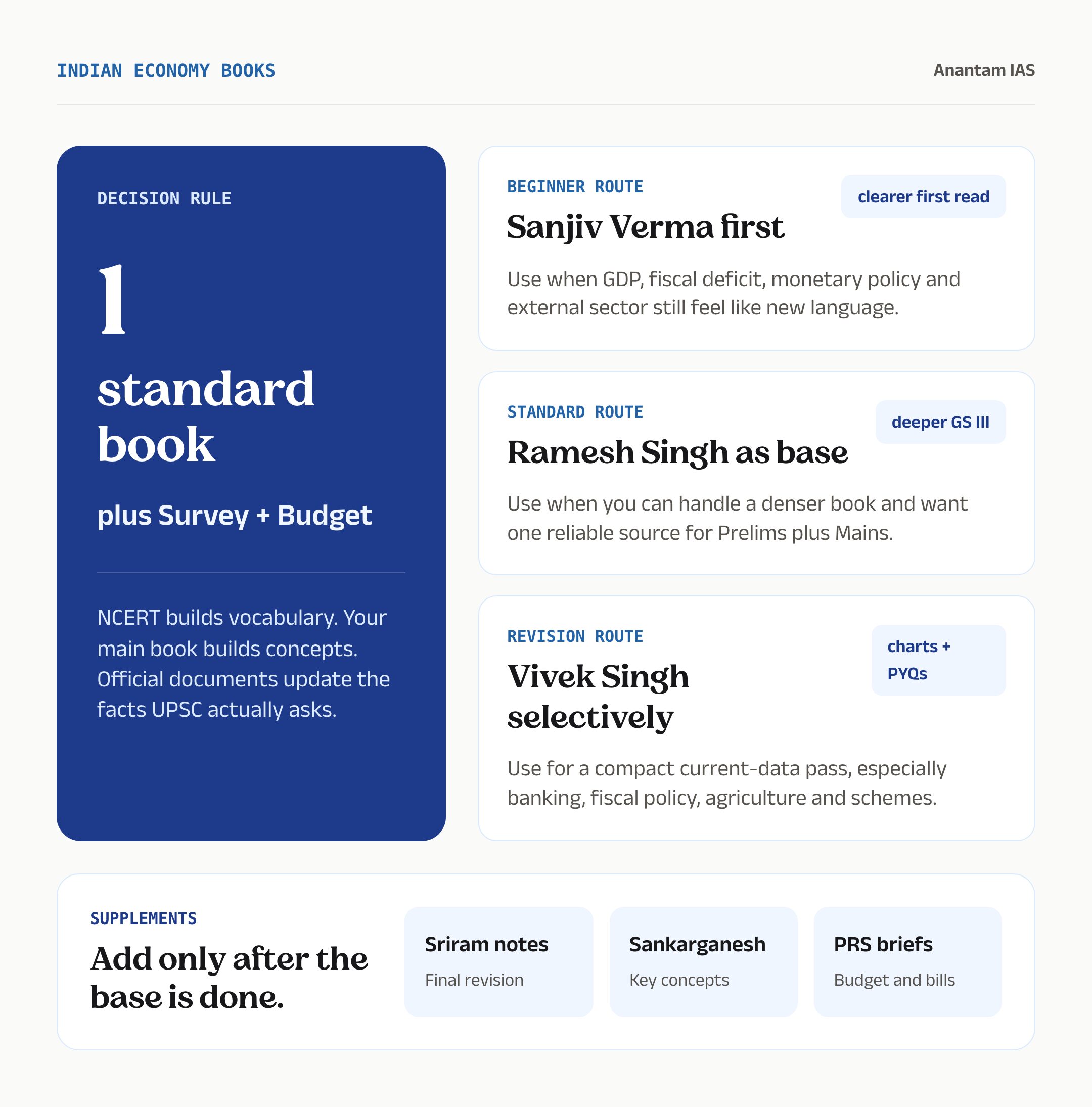
The best book for Indian Economy for UPSC depends on your starting point. Choose Sanjiv Verma if you need a clear first pass, Ramesh Singh if you want one deeper reference for Prelims and Mains, or Vivek Singh if you already have a foundation and need compact revision.
The practical rule is simple: finish one standard book, then update it with the latest Economic Survey, Union Budget, and PYQs. Buying two overlapping textbooks usually creates more unfinished reading, not better marks.
Best Book for Indian Economy for UPSC: The Short Answer
Ramesh Singh’s Indian Economy, 18th edition for 2026-27, is the best single standard book if you want depth for Prelims and Mains GS III. Sanjiv Verma’s The Indian Economy, 15th edition (2027), is the easier first read for beginners. Vivek Singh’s Indian Economy, 10th edition for 2026-27, is the tighter revision choice and includes Budget 2026-27 and Economic Survey 2025-26 coverage.

Indian Economy — Ramesh Singh (18th Edition)
- McGraw Hill courseware edition, 624 pages
- Concept-first treatment of growth, banking, fiscal policy and external sector
- Includes Economic Survey and Union Budget coverage
| Need | Best Pick | Why |
|---|---|---|
| First-time economy learner | Sanjiv Verma + NCERT | Clearer language and less intimidating first pass |
| One main UPSC book | Ramesh Singh | Broader GS III depth and better answer-building material |
| Current-data revision | Vivek Singh + Survey + Budget | Useful charts, PYQs and recent policy updates |
| Final month revision | Sriram notes, PRS briefs, Sankarganesh | Use selectively after the standard book is done |
Why most aspirants pick the wrong economy book
Most coaching shortlists stop at “buy Ramesh Singh and finish it.” That advice ignores the reader’s starting point and the need for current official data.
If you are starting without economics vocabulary, Ramesh Singh can be too dense for a first pass. Read the two relevant NCERTs or Sanjiv Verma first, then return to the chapters you need for Prelims and GS III.
A textbook can explain stable concepts, but it cannot replace the current data and policy direction in the Economic Survey, Union Budget, RBI material, and recent PYQs. Treat the book as the conceptual layer, not the complete economy syllabus.
So the right question isn’t “which is the best book on indian economy?” It’s “which book, in which order, paired with what?”
The Indian Economy book stack that actually matters
Do not buy every book in the market. Use each source for a separate job.
| Source | Role | Use It For | Skip If |
|---|---|---|---|
| NCERT Class 11: Indian Economic Development | Foundation | Planning, poverty, employment, human capital, rural development | You already have strong basics, but most aspirants should still skim it |
| NCERT Class 12: Introductory Macroeconomics | Vocabulary | GDP, money, banking, government budget, balance of payments | You can explain macro terms without notes |
| Ramesh Singh: Indian Economy | Standard book | Prelims facts, Mains frameworks, public finance, banking, external sector | You are a complete beginner and need a gentler first pass |
| Sanjiv Verma: The Indian Economy | Beginner alternative | Conceptual clarity before moving to a denser standard book | You already read Ramesh Singh comfortably |
| Vivek Singh: Indian Economy | Compact supplement | Charts, PYQs, Budget and Economic Survey integration, RBI/NABARD-style clarity | You have not finished NCERTs or one standard source |
| Economic Survey + Union Budget | Official current layer | Latest data, policy direction, schemes, fiscal indicators, employment and external sector | Never skip; even the best textbook becomes stale without this layer |
That is the core stack. Sriram IAS notes, Sankarganesh Karuppiah’s Indian Economy Key Concepts, PRS Budget briefs and good newspaper explainers are revision tools. They should not replace NCERTs, one standard book and official documents.
Ramesh Singh vs Sanjiv Verma vs Vivek Singh
This is the comparison that matters in practice. Treat them as different routes, not equal substitutes.

The Indian Economy — Sanjiv Verma (15th Edition)
- 512 pages — still a good deal shorter than Ramesh Singh
- Written for candidates with no economics background
- Tighter on concepts, lighter on data tables
| Parameter | Ramesh Singh | Sanjiv Verma | Vivek Singh |
|---|---|---|---|
| Best role | Main standard source | Beginner-friendly first read | Revision and current-data supplement |
| Depth | High | Moderate | Moderate and exam-focused |
| Language | Dense, textbook-like | Simpler and more direct | Compact, chart-heavy and data-oriented |
| Best for Prelims | High, but needs revision discipline | Good for conceptual questions | Good for quick factual and PYQ revision |
| Best for Mains | Strongest of the three | Needs Survey/Budget support | Useful for data points and policy examples |
| Who should pick it? | Second-attempt aspirants or confident readers | Beginners and non-economics backgrounds | Aspirants who already have a base and need consolidation |
When to pick Ramesh Singh
Pick Ramesh Singh if you want one book that can support both Prelims and Mains. The tradeoff is density. It rewards slow reading, margin notes and repeated revision. If you are new to fiscal deficit, current account, inflation targeting or external sector, read NCERT first.
When to pick Sanjiv Verma
Pick Sanjiv Verma if you are starting from zero and need a book you can finish. It is less intimidating than Ramesh Singh. The tradeoff is depth, so Mains candidates should add Economic Survey conclusions, Budget themes and selective Ramesh Singh chapters later.
When to pick Vivek Singh
Pick Vivek Singh as a supplement when you want a tighter revision source with updated data, diagrams, PYQs and exam-oriented framing. It is especially useful for banking, public finance, agriculture, external sector and schemes, but it should not become the third half-read textbook on your desk.
My honest call
If you can read only one main book, choose Ramesh Singh. If you are a beginner, read Sanjiv Verma first and then use Ramesh Singh selectively. If you already have notes and need a compact current-data pass, add Vivek Singh or Sriram notes for revision.
The reading order that actually moves Prelims marks
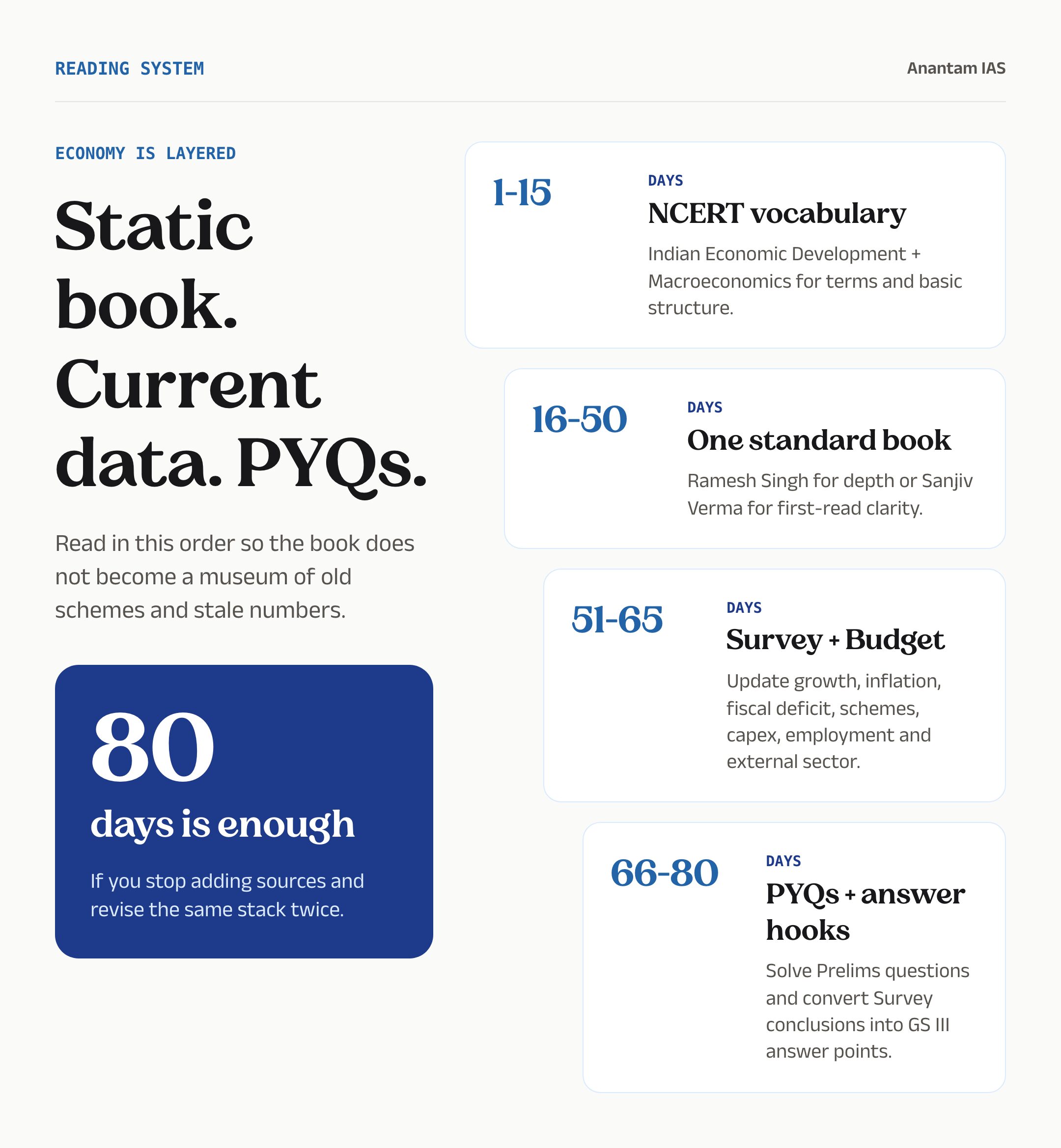
Most Indian Economy book lists fail because they do not give an order. Use this sequence.
| Phase | Days | Source | Output |
|---|---|---|---|
| Foundation | 1-15 | NCERT Class 11 Indian Economic Development + Class 12 Macroeconomics | Short concept notes and glossary |
| Standard book | 16-50 | Ramesh Singh or Sanjiv Verma | Chapter notes, diagrams, key schemes and PYQ markings |
| Current layer | 51-65 | Economic Survey and Union Budget | Updated data points for growth, inflation, fiscal deficit, employment, capex and external sector |
| Exam conversion | 66-80 | Prelims PYQs + GS III Mains questions | Question patterns, answer hooks and 10-12 reusable examples |
Do not open Sriram, Sankarganesh, PRS briefs, coaching handouts and newspaper explainers during Phase 1. They are helpful only after the core concepts have somewhere to attach.
Books to avoid (or use cautiously)
OK, time for the part nobody writes.
- Pratiyogita Darpan economy compilations — outdated, error-prone, and often summarised from Ramesh Singh anyway. Skip.
- Random YouTube channel “notes” PDFs — most are unedited transcriptions. They miss the second-order points examiners test.
- Class 12 Indian Economic Development by other publishers (non-NCERT) — stick to NCERT. The CBSE board edition is what UPSC questions reference.
- Mrunal Patel’s economy lectures: useful when a difficult topic needs explanation, but a long video queue can displace revision and PYQ practice. Use them selectively.
- Telegram-circulated “Ramesh Singh PDFs”: these are often unauthorized or outdated. The verified current McGraw Hill courseware is the 18th edition for 2026-27.
I’m not anti-shortcut. I’m anti-bad-shortcut. There’s a difference.
How to use Sriram, Sankarganesh, PRS and Mrunal
These resources are useful, but only if you know their job.
| Resource | Best Use | Warning |
|---|---|---|
| Sriram IAS Indian Economy notes | Fast Prelims revision and tabular recall | Thin for conceptual depth; do not use as your only book |
| Sankarganesh Karuppiah: Indian Economy Key Concepts | Quick conceptual refresh before mocks | Good for terms, not enough for Mains answer depth |
| Vivek Singh: Indian Economy | Charts, PYQs, Budget and Survey-linked consolidation | Works best after NCERT and one standard book |
| PRS Budget and bill briefs | Mains examples, committees, schemes and policy changes | Use selectively; do not turn every brief into notes |
| Mrunal economy lectures | Concept rescue when a topic refuses to click | Videos can consume weeks if you watch without a written plan |
The hierarchy is simple: Ramesh Singh or Sanjiv Verma as your main book, Vivek Singh/Sriram/Sankarganesh as supplements, and official documents for current data.
Why this matters for UPSC
Indian Economy is a high-return UPSC area because it connects Prelims facts with Mains GS III themes: growth, development, employment, agriculture, infrastructure, banking, fiscal policy, external sector and inclusive growth. A good book gives structure, but the marks usually come from linking that structure with the latest Economic Survey, Union Budget and PYQs.
That is why one revised book plus current official data beats three unrevised textbooks.
Common misconceptions
Myth 1: “I just need Ramesh Singh, nothing else.” No. You need NCERTs for vocabulary and Economic Survey plus Budget for current data. Ramesh Singh is necessary for many aspirants, but it is not sufficient by itself.
Myth 2: “Sanjiv Verma is for weaker students.” Wrong framing. It is for students who want clarity before depth. Many beginners make faster progress with Verma first and then use Ramesh Singh selectively.
Myth 3: “Vivek Singh can replace the whole stack.” It can help a lot in revision because it is compact and current-data oriented, but beginners still need NCERT and one stable conceptual source.
Myth 4: “PDF-circulated books are fine.” They are often older editions with stale Budget and Survey references. Economy changes quickly enough that edition discipline matters.
How to revise this in 30 minutes
If you have one month to Prelims and you’ve already done one read:
- Day 1-7: Re-read the introductions and summaries of the Ramesh Singh chapters you marked during the first pass.
- Day 8-14: Economic Survey 2025-26, Volume 1, chapter highlights — 30 pages of latest data.
- Day 15-21: Budget 2026-27 highlights — 20 pages.
- Day 22-28: Last 5 years of Prelims economy PYQs.
- Day 29-30: Quick scan of GDP of India latest numbers, NITI Aayog functions, Five Year Plans timeline. These three slugs cover 8-10 mark territory directly.
Source priority for revision: Ramesh Singh chapter intros → Economic Survey Vol 1 → Budget speech → PYQs. In that order.
Sources and documents to keep beside the book
- NCERT textbook portal for Class 11 and 12 Economics PDFs.
- India Budget official portal for Union Budget documents and Economic Survey PDFs.
- PIB Union Budget page for official Budget highlights and releases.
- S.Chand listing for Vivek Singh’s Indian Economy, useful for checking edition, page count and update claims.
- McGraw Hill listing for Ramesh Singh Courseware on Indian Economy, useful for checking the latest edition details and included resources.
Frequently Asked Questions
Which is the best book for Indian Economy for UPSC beginners?
For beginners, start with NCERT Class 11 Indian Economic Development and Class 12 Introductory Macroeconomics, then read Sanjiv Verma if you need a gentle first pass. Move to Ramesh Singh selectively for deeper GS III topics.
Is Ramesh Singh better than Sanjiv Verma?
Ramesh Singh is better for depth and Mains answer structure. Sanjiv Verma is better for beginners who need clarity before density. The right choice depends on your starting point, not on which book is more famous.
Where does Vivek Singh’s Indian Economy fit?
Vivek Singh is useful as a compact supplement, especially for charts, PYQs, Budget and Economic Survey integration, banking, public finance and external sector revision. Use it after NCERT plus one standard book.
Are NCERT books enough for Indian Economy in UPSC?
No. NCERTs give vocabulary and basic structure, but they are not enough for Prelims or Mains. Add one standard book and the latest Economic Survey and Union Budget.
Should I buy both Ramesh Singh and Sanjiv Verma?
Not at the start. If you are a beginner, read Sanjiv Verma first and use Ramesh Singh only for weak or high-value chapters. If you are comfortable with economics, start with Ramesh Singh directly.
Are Sriram notes and Sankarganesh enough?
They are good revision supplements, not full replacements. Sriram notes help with tabular recall, while Sankarganesh helps with key concepts. Use them after your main source is complete.
Where can I get the latest Economic Survey and Budget for free?
The official India Budget portal publishes Economic Survey and Union Budget documents for free. Use those PDFs for current data instead of relying only on textbook updates.
Should I read economy books in Hindi or English?
Read in the language in which you will revise and write comfortably. If your Mains medium is English, reading the technical terms in English helps. Hindi-medium aspirants can use Hindi editions but should still learn standard English terms such as fiscal deficit, current account and monetary policy.