
The fiscal deficit is the single most-watched headline number on India’s budget day. It tells you, in one figure, how much more the central government plans to spend than it earns from non-borrowed sources during a financial year. A wider fiscal deficit means the government must borrow more from the market, which then pushes interest rates higher, crowds out private investment, and adds to the future interest burden.
For an aspirant preparing General Studies Paper 3, the fiscal deficit sits at the heart of public finance, monetary policy, and growth questions. The number is not just an accounting residual. It signals fiscal discipline, sovereign risk, and the room the Reserve Bank of India has to set policy rates. UPSC has repeatedly tested the formula, the FRBM Act 2003 framework, and the practical differences between revenue, primary, and fiscal deficit.
This explainer breaks down the fiscal deficit concept, the legal scaffolding that governs it, India’s deficit trajectory from FY18 to FY27, and what deficit financing actually does to the economy. We’ll also map the prelims pointers, the high-probability mains angles, and the policy debates that examiners are leaning into right now.
Quick Facts on Fiscal Deficit
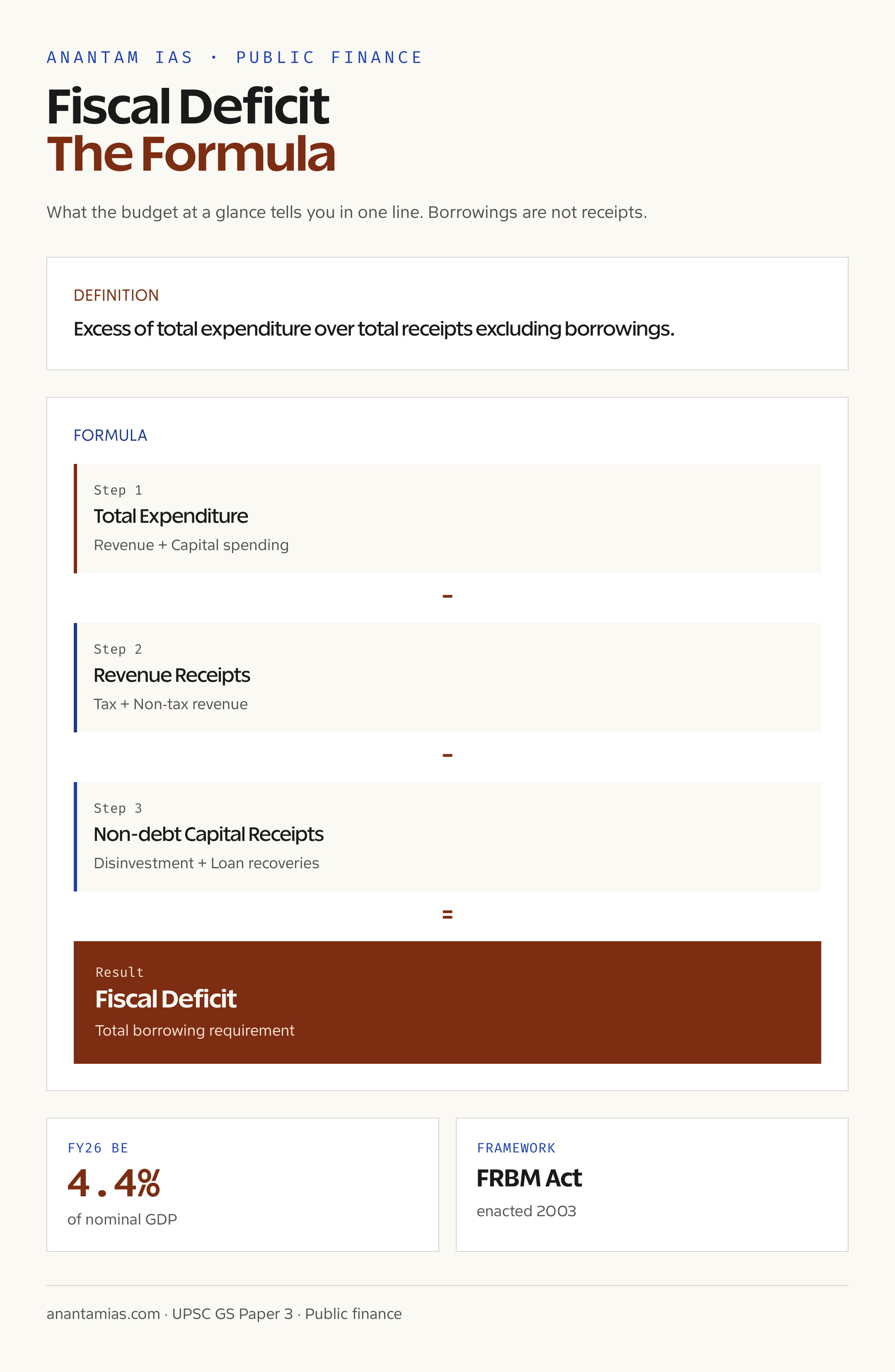
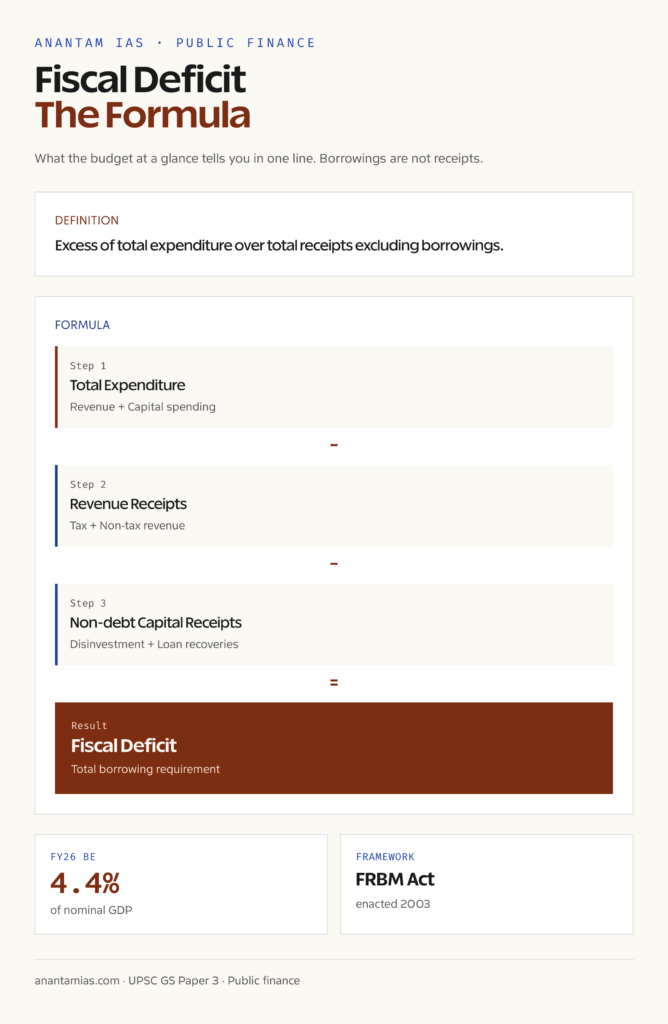
- Definition. Excess of total expenditure over total receipts excluding borrowings.
- Formula. Fiscal Deficit = Total Expenditure − (Revenue Receipts + Non-debt Capital Receipts).
- Governing law. Fiscal Responsibility and Budget Management Act, 2003 (FRBM Act).
- FY26 (Budget Estimate). 4.4% of GDP, down from 4.8% in FY25 (Revised Estimate).
- FRBM glide path. Target of below 4.5% of GDP by FY26 was set in the FY22 budget.
- Financing. Mainly through market borrowings (G-Secs), small savings, and external aid.
What Is the Fiscal Deficit
The fiscal deficit is the gap between what the government spends and what it earns without borrowing. Every rupee of this gap has to be financed by issuing debt. In India, the Union Finance Ministry computes the fiscal deficit using the Budget at a Glance document, and the figure is expressed both in absolute crore and as a percentage of nominal GDP.
The textbook formula is straightforward:
Fiscal Deficit = Total Expenditure − (Revenue Receipts + Non-debt Capital Receipts)
Revenue receipts include tax revenue like GST, income tax, and corporate tax, plus non-tax revenue like interest, dividends from PSUs, and spectrum fees. Non-debt capital receipts include disinvestment proceeds and recoveries of loans. Borrowings are deliberately excluded because they are the financing item, not a genuine receipt.
A focus keyword worth nailing here is “fiscal deficit excludes borrowings.” Many candidates lose a mark in prelims by treating market borrowings as receipts. They aren’t. They’re the way the fiscal deficit gets funded.
Background and Historical Context
India’s fiscal deficit problem is structural, not new. Through the 1980s, the deficit hovered around 7% to 8% of GDP, financed by ad hoc treasury bills and direct borrowing from the RBI. This monetisation of debt fed inflation and contributed to the 1991 balance of payments crisis. The Manmohan Singh reforms in 1991 began the cleanup, and the Fiscal Responsibility and Budget Management Act, 2003 codified discipline into law.
The FRBM Act set out targets for the central government to eliminate the revenue deficit and bring the fiscal deficit below 3% of GDP. The Act has been amended several times, most recently in 2018, to introduce a glide path of 3% by FY21 and a debt anchor of 40% of GDP for the centre and 60% for the combined general government. An escape clause permits the government to deviate from targets during national security crises, calamities, or sharp output slumps.
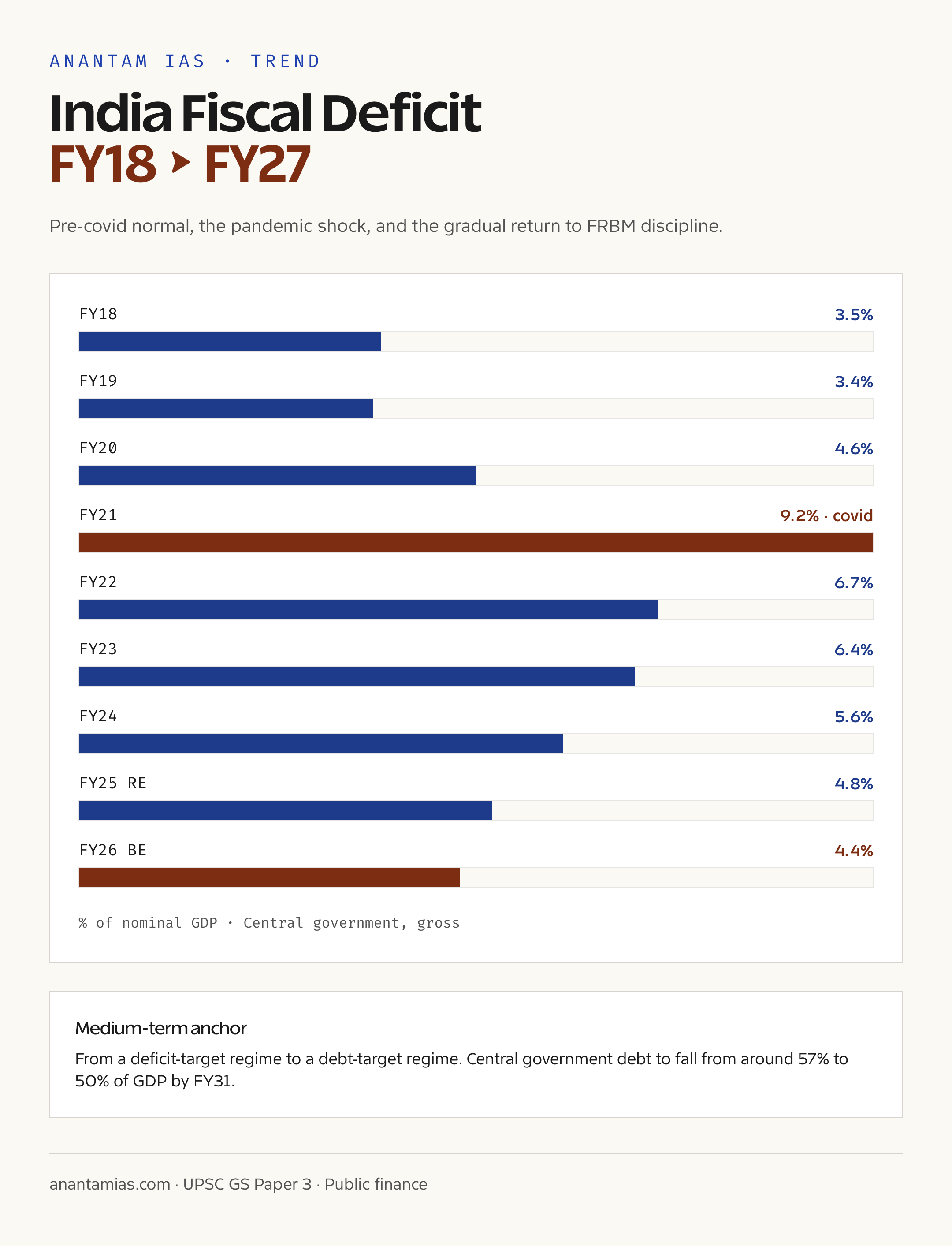
The covid-19 shock blew this discipline apart. The fiscal deficit hit 9.2% of GDP in FY21 because of revenue collapse and emergency transfers. Since then, the government has been on a slow climb back. The fiscal deficit fell to 6.7% in FY22, 6.4% in FY23, 5.6% in FY24, 4.8% in FY25 (Revised Estimate), and is budgeted at 4.4% in FY26.
Key Components and Formula Breakdown
To compute fiscal deficit accurately, you must know what sits on either side of the equation. The Budget breaks expenditure into revenue and capital. It breaks receipts into revenue, non-debt capital, and debt capital.
Total expenditure has two parts:
- Revenue expenditure. Recurring spending that does not create assets, like interest payments, salaries, pensions, subsidies, and grants to states.
- Capital expenditure. One-time spending on assets like highways, railways, defence equipment, and loans to states for capex.
Receipts have three parts:
- Revenue receipts. Tax and non-tax revenue.
- Non-debt capital receipts. Disinvestment, loan recoveries.
- Debt capital receipts. Market borrowings, external borrowings, public account net.
The third category is excluded from the fiscal deficit formula. Including it would make the equation a tautology, since borrowings always equal the deficit by construction.
The fiscal deficit therefore captures the genuine gap that needs financing. If the FY26 numbers say total expenditure is around 50.6 lakh crore and revenue plus non-debt capital receipts are around 34.2 lakh crore, the fiscal deficit lands near 16.4 lakh crore, or 4.4% of estimated nominal GDP.
Why the Fiscal Deficit Matters
The fiscal deficit drives four chains of consequence that examiners love to ask about.
First, interest burden. Every year’s deficit is added to the stock of public debt. Interest payments are now the single largest revenue-expenditure item at the centre, eating up roughly one rupee of every four spent. A higher fiscal deficit today means a higher interest bill tomorrow, which leaves less for health, education, and capex.
Second, crowding out. When the government borrows heavily from the bond market, it absorbs household and corporate savings. Yields rise, and private firms find borrowing costlier. This crowds out private investment, which is precisely the engine India needs for sustained 7%-plus growth.
Third, inflation pressure. Large deficits financed even partly by the RBI’s open market operations or by foreign portfolio inflows can stoke aggregate demand beyond supply capacity. The RBI then has to keep rates higher for longer, which itself slows growth.
Fourth, sovereign rating. International credit rating agencies treat the fiscal deficit and the debt-to-GDP ratio as primary signals. A higher deficit raises the country’s risk premium, makes foreign currency borrowing dearer for Indian firms, and weakens the rupee.
Detailed Analysis of FY18 to FY27 Trend
The trajectory of India’s fiscal deficit since FY18 captures the pre-covid normal, the pandemic shock, and the gradual return to discipline. The path is best read alongside nominal GDP growth, because the ratio shifts mechanically when the denominator moves.
In FY18 and FY19, the fiscal deficit hovered around 3.5% to 3.4% of GDP. FY20 saw it widen to 4.6% as growth slowed even before covid. FY21 was the rupture, with the deficit ballooning to 9.2% as the government rolled out PM Garib Kalyan Yojana, free foodgrain through PMGKAY, and emergency credit guarantees.
The repair has been steady but uneven. FY22 brought it down to 6.7%, helped by a tax revenue rebound. FY23 fell further to 6.4%. FY24 closed at 5.6% on the back of buoyant direct taxes and a record RBI dividend transfer of 2.11 lakh crore. FY25’s Revised Estimate is 4.8%, and FY26’s Budget Estimate is 4.4%. The medium-term framework now targets a fiscal deficit below 4.5% by FY26 and a declining central government debt-to-GDP from FY27 onwards.
The shift from a deficit-target regime to a debt-target regime, signalled in the FY25 budget, is a structural change. The focus is now on lowering central government debt from around 57% to 50% of GDP by FY31. This complements India’s multi-pillar pension landscape reform, where unfunded pension liabilities also stress public finances.
Comparison: Revenue, Primary, and Fiscal Deficit
Three deficit concepts often get conflated. Each tells you something different.
| Deficit type | Formula | What it reveals |
|---|---|---|
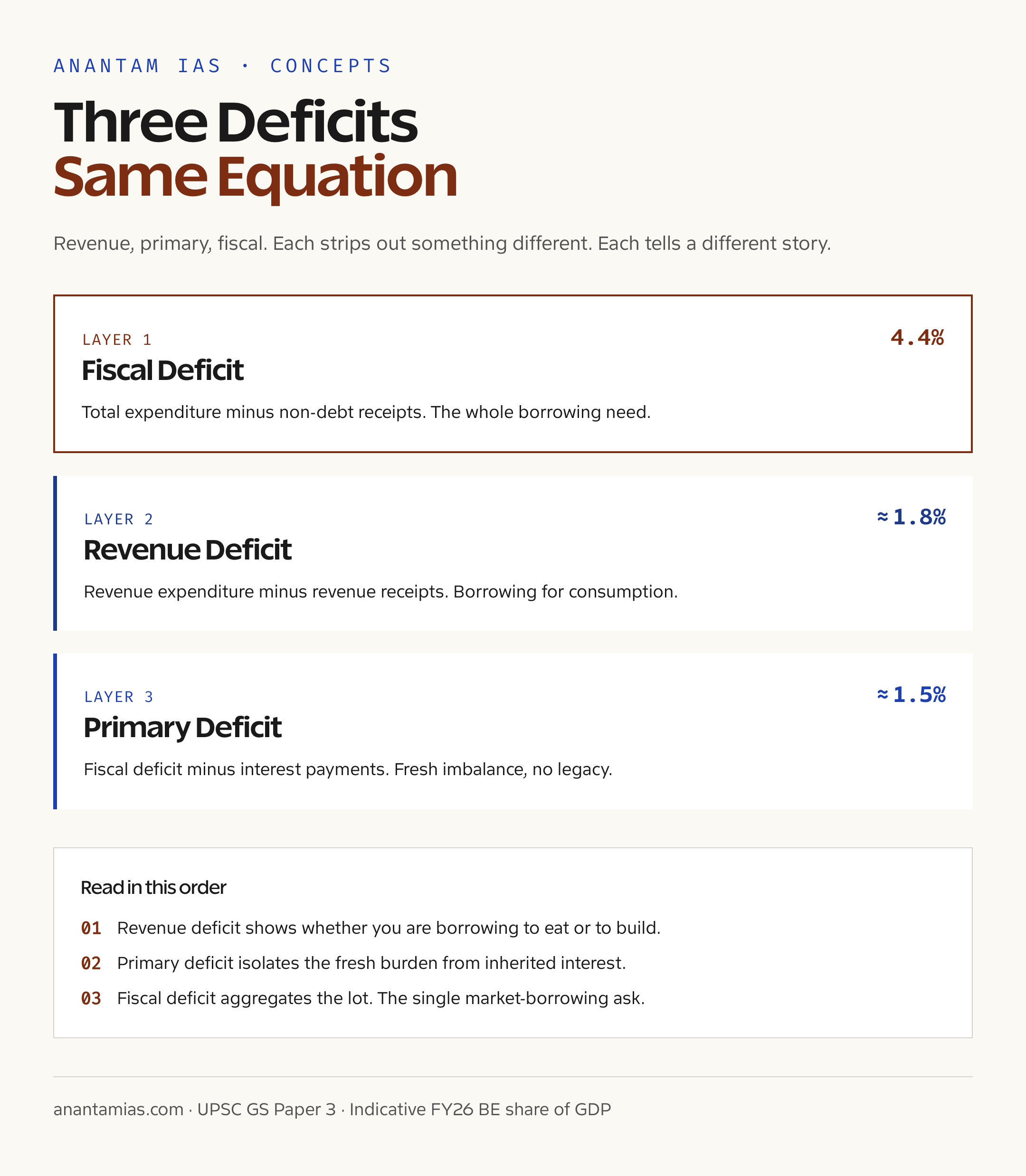
| Revenue deficit | Revenue Expenditure − Revenue Receipts | Borrowing to fund consumption |
| Fiscal deficit | Total Expenditure − Non-debt Receipts | Total borrowing needed |
| Primary deficit | Fiscal Deficit − Interest Payments | Current year’s fresh imbalance |
Revenue deficit is the worst kind because it means the government is borrowing to pay salaries, pensions, and subsidies, none of which build future productive capacity. The FRBM Act originally targeted its elimination, though that goal has been deferred multiple times.
Primary deficit strips out interest payments to show how much of the deficit is caused by current-year imbalances versus the legacy debt burden. A near-zero primary deficit means the country is not adding to its real fiscal stress, only paying for past borrowing. India’s primary deficit was budgeted at 1.5% of GDP in FY26.
The effective revenue deficit, introduced in FY12, excludes grants for the creation of capital assets from revenue expenditure. It tries to capture true consumption-driven borrowing.
Challenges in Managing the Fiscal Deficit
Bringing the fiscal deficit down sounds straightforward — spend less or earn more — but every lever has political and economic costs.
- Subsidy rationalisation. Food, fertiliser, and LPG subsidies cost around 4 lakh crore annually. Cutting them touches vote-bank politics and food security.
- Capex protection. The government has front-loaded capital spending to crowd in private investment. Cutting capex would speed deficit reduction but hurt growth.
- Revenue volatility. GST collections have stabilised, but direct taxes swing with corporate profits and capital gains. One bad year can blow the projection.
- States’ contribution. The combined fiscal deficit of states and centre is what matters for the macro picture. Many states routinely breach the 3% Fiscal Responsibility Legislation cap.
- Off-budget liabilities. Past use of NSSF loans, FCI bonds, and contingent guarantees masked the true deficit. Recent budgets have brought these on-balance-sheet, which improved transparency but raised reported deficits.
- Disinvestment shortfall. Targets are routinely missed, which forces last-minute borrowing or expenditure compression.
The 16th Finance Commission, currently working on its award for FY27 to FY31, will reshape the fiscal architecture between centre and states. Its terms of reference include the path of fiscal consolidation and the sharing of net proceeds of taxes.
Deficit Financing Implications
Deficit financing simply means how the government raises the money to plug the fiscal deficit. The composition matters as much as the size.
- Market borrowings (G-Secs). Around 75% of the gross borrowing. Sold to banks, insurance companies, mutual funds, and FPIs through RBI auctions.
- Small savings. National Small Savings Fund inflows from PPF, NSC, Sukanya Samriddhi, and Senior Citizen Savings Scheme.
- External borrowings. Sovereign loans from World Bank, ADB, and bilateral creditors. Small share, but adds currency risk.
- Public account net. State Provident Funds, special deposits, and other liabilities.
When deficit financing relies too heavily on the captive demand from banks (through SLR requirements), it builds a sovereign-bank loop where any sovereign stress threatens bank balance sheets. India’s inclusion in the JP Morgan EM Bond Index from June 2024 has diversified the buyer base and brought foreign passive flows into G-Secs, easing the domestic absorption pressure.
The link between deficit financing and inflation is sharper than commonly assumed. When the RBI runs Open Market Operations to absorb excess G-Sec supply or to inject liquidity, the central bank’s balance sheet expands. Whether this fuels inflation depends on the output gap. In a slack economy it doesn’t; in a full-capacity economy it does.
Prelims Pointers
- FRBM Act enacted in 2003, came into force on 5 July 2004.
- FRBM Review Committee headed by N. K. Singh submitted its report in January 2017.
- Effective revenue deficit was introduced in FY12.
- Article 292 of the Constitution caps central government borrowing.
- Article 293 governs state borrowings, requiring centre’s consent if indebted to centre.
- FRBM escape clause permits deviation up to 0.5% of GDP.
- The N. K. Singh committee proposed a debt-to-GDP target of 60% for general government by FY23.
- Public Account of India is governed by Article 266(2).
Mains Questions
- Discuss how the Fiscal Responsibility and Budget Management Act, 2003 has shaped India’s fiscal architecture. Evaluate the case for a debt-target regime over a deficit-target regime. GS Paper 3.
- Examine the relationship between fiscal deficit, monetary policy, and inflation in the Indian context. Use examples from the post-pandemic period. GS Paper 3.
- “A high revenue deficit is more worrying than a high fiscal deficit.” Critically analyse with reference to India’s current fiscal profile. GS Paper 3.
- The 16th Finance Commission’s recommendations will shape centre-state fiscal relations for the next five years. Discuss the key issues likely to be addressed. GS Paper 2 and 3.
Way Forward
The fiscal deficit conversation in India is shifting from a single-number obsession to a multi-anchor framework. A debt-to-GDP target, a primary deficit anchor, and a transparent escape clause together provide more flexibility without sacrificing credibility. The medium-term roadmap calls for the central government debt to decline from around 57% to 50% of GDP by FY31.
For aspirants, the practical takeaway is to track the fiscal deficit alongside three companions: nominal GDP growth, the primary deficit, and the combined general government deficit. Watching just the headline number is no longer enough. The 16th Finance Commission award, the rollout of the new Income Tax Act, and the pace of capex execution will together decide whether India’s fiscal deficit reduction is durable or cosmetic.
A credible fiscal deficit trajectory is also what gives the RBI room to support growth without losing the inflation anchor. The two arms of macro policy — fiscal and monetary — work best when they move in sync, and a falling fiscal deficit is what makes that coordination possible.
Frequently Asked Questions
What is the formula for fiscal deficit in India?
Fiscal Deficit = Total Expenditure − (Revenue Receipts + Non-debt Capital Receipts). Borrowings are excluded because they finance the deficit rather than fund spending. The figure is reported in both absolute crore and as a percentage of nominal GDP.
What is the difference between fiscal deficit and revenue deficit?
Fiscal deficit is the total borrowing requirement of the government. Revenue deficit is the gap between revenue expenditure and revenue receipts, which signals borrowing to fund consumption. A high revenue deficit is considered worse because it does not build productive capacity.
What is the FRBM Act 2003?
The Fiscal Responsibility and Budget Management Act, 2003 mandates the central government to follow a path of fiscal discipline, lay annual fiscal policy statements before Parliament, and meet targets on deficit and debt. It was amended in 2018 to introduce a debt anchor of 40% of GDP for the centre.
What is India’s fiscal deficit in FY26?
The Budget Estimate for FY26 places the fiscal deficit at 4.4% of GDP, down from the 4.8% Revised Estimate for FY25. The medium-term plan is to lower the central government debt-to-GDP from around 57% to 50% by FY31.
What is primary deficit?
Primary deficit equals fiscal deficit minus interest payments. It reveals how much of the current-year deficit is fresh imbalance versus the legacy interest burden on past debt. A near-zero primary deficit means the government is no longer adding to real fiscal stress.
How is the fiscal deficit financed?
Around three-fourths of the financing comes from market borrowings through dated G-Sec auctions conducted by the RBI. The rest is met through small savings inflows, external loans from multilateral agencies, and the net public account balance.
What is the FRBM escape clause?
The escape clause permits the government to deviate from FRBM targets by up to 0.5% of GDP in cases of national security, calamity, or output collapse. It was invoked during the covid-19 pandemic when the fiscal deficit widened to 9.2% in FY21.
Why is the fiscal deficit important for UPSC?
It is a recurring topic in GS Paper 3 under public finance, and it links to monetary policy, inflation, sovereign rating, and centre-state relations. Prelims has repeatedly tested the formula, the FRBM provisions, and the distinction between revenue, primary, and fiscal deficit.
What is deficit financing?
Deficit financing is the process of raising money to cover the fiscal deficit, primarily through government borrowing. The composition — domestic market borrowing, small savings, external loans, or RBI accommodation — determines its inflation, interest rate, and sovereign risk effects.
Does a higher fiscal deficit always cause inflation?
Not always. The inflation impact depends on the output gap, how the deficit is financed, and the RBI’s monetary stance. A higher deficit in a slack economy is less inflationary than the same deficit when capacity is fully utilised.
Tell Google you want more of this.
Add Anantam IAS as a preferred sourceOne tap, and this site shows up more often in your own Top Stories, AI Overviews and AI Mode. Remove it any time.