Bicameral Legislature: Meaning, Features and Indian Parliament Structure
Bicameral legislature explained: meaning, features, Indian Parliament structure, differences from unicameral systems, and UPSC relevance with prelims and mains
Introduction
A bicameral legislature is the bedrock of representative government in many of the world’s largest and most diverse democracies. The term describes a law-making body divided into two separate chambers or houses that jointly exercise legislative authority. In India, this system takes the form of Parliament, comprising the Rajya Sabha (Council of States) and the Lok Sabha (House of the People), mirroring arrangements in the United Kingdom, United States, Australia, and Canada.
For a UPSC aspirant, understanding bicameralism is not a mere textbook exercise. It shapes everyday questions about federalism, checks and balances, the passage of Money Bills, joint sittings, and the review function of the upper house. The topic cuts across Prelims factual items and Mains analytical debates on whether a second chamber still earns its keep in the twenty-first century.
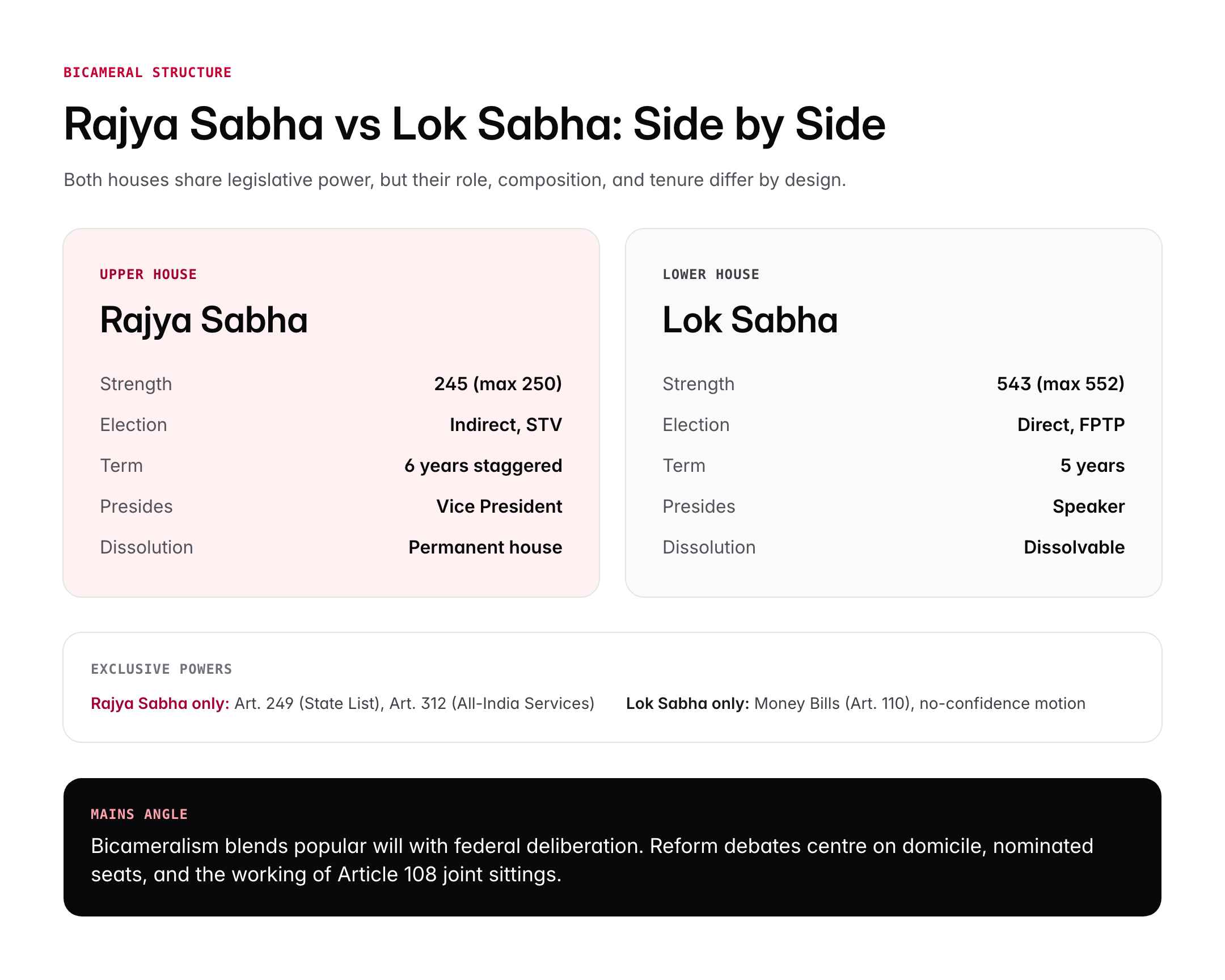
Quick Facts at a Glance
| Attribute | Detail |
|---|---|
| Meaning | Legislature with two chambers that share law-making powers |
| Indian example | Parliament: Rajya Sabha + Lok Sabha |
| Constitutional basis | Article 79 of the Indian Constitution |
| Upper house strength | 245 members (Rajya Sabha, maximum) |
| Lower house strength | 543 elected members (Lok Sabha, current) |
| States with bicameral legislatures | Andhra Pradesh, Bihar, Karnataka, Maharashtra, Telangana, Uttar Pradesh |
| Joint sitting provision | Article 108 |
| Money Bill exclusive to | Lok Sabha (Article 110) |
Background and Historical Context
The idea of a two-chamber legislature has ancient roots. The Roman Republic had the Senate and the popular assemblies; medieval England gradually separated the clergy and nobles from the commons, giving rise to the House of Lords and the House of Commons by the fourteenth century. The modern template emerged with the 1787 United States Constitution, which combined a Senate representing states equally and a House of Representatives based on population. This federal bargain became the model for later federations including Canada, Australia, and India.
In India, the British colonial apparatus experimented with consultative councils from 1861 onwards, but a genuinely bicameral structure appeared only with the Government of India Act, 1919. That Act created a Central Legislative Assembly and a Council of State, laying a direct institutional ancestor for today’s Parliament. The Government of India Act, 1935 deepened this template and envisaged a federal legislature, although the federal portion never took effect.
The Constituent Assembly debated the merit of a second chamber sharply. Stalwarts like Lokanath Misra and Shibban Lal Saksena argued it would delay popular will, while N. Gopalaswami Ayyangar insisted that a revising chamber and state representation were vital in a diverse, federal India. The Assembly eventually adopted bicameralism for the Union under Article 79. For states, Article 168 allowed each state to choose a bicameral or unicameral legislature, reflecting Indian pragmatism rather than doctrinaire uniformity.
Key Features
Bicameral legislatures share a set of recurring design features, although the details vary by country. The Indian variant combines federal logic with parliamentary supremacy.
Two Separate Chambers
The lower house is usually directly elected by universal adult franchise for a fixed term and represents the people at large. The upper house is typically indirectly elected, nominated, or hereditary and represents states, provinces, regions, or specific interests. In India, the Lok Sabha is directly elected for five years; the Rajya Sabha is indirectly elected by state legislative assemblies through a single transferable vote system and has a six-year staggered term with one-third retiring every two years.
Differential Powers
In most bicameral systems the lower house enjoys primacy, especially over financial matters. Article 110 of the Indian Constitution makes Money Bills the exclusive preserve of the Lok Sabha. The Rajya Sabha can only recommend changes within fourteen days. For ordinary bills both houses have equal power, but in case of deadlock Article 108 allows a joint sitting summoned by the President.
Representation of Federal Units
The upper house is the constitutional device by which states are represented at the national level. The Rajya Sabha allocates seats by state and union territory using a formula weighted towards population, while the US Senate gives every state two seats regardless of size. The Rajya Sabha also has a crucial federal power under Article 249, enabling Parliament to legislate on a State List subject if it passes a resolution by a two-thirds majority.
Review and Revision Function
A second chamber acts as a brake on hasty legislation. Members often bring domain expertise, legal training, or seasoned political experience. In India, twelve Rajya Sabha members are nominated by the President for distinction in literature, science, art, and social service, enriching the quality of debate.
Continuous Existence
Unlike the Lok Sabha which can be dissolved, the Rajya Sabha is a permanent house. This continuity ensures legislative memory and institutional stability even during general elections or political turbulence.

Significance for UPSC and General Knowledge
- Directly tested in Prelims through questions on Article 80, Article 108, Money Bill procedure, and composition of the Rajya Sabha.
- Central to Mains GS Paper II topics on Parliament, federalism, and separation of powers.
- Crucial for understanding landmark cases such as Kihoto Hollohan (1992) and the Aadhaar Bill (2016) that turned on Money Bill certification.
- Connects with current affairs debates on abolishing state legislative councils and reforming Rajya Sabha domicile rules.
- Offers comparative insight useful in essay and interview answers on democratic design.
- Illuminates the working of Parliamentary Committees, most of which are bicameral.
Detailed Analysis: Indian Parliament in Practice
The practical working of India’s bicameral Parliament reveals both its strengths and its strains. The Lok Sabha sets the political tone, reflecting the popular mandate of a general election, while the Rajya Sabha often serves as the house of second sober thought. Since 1950, the two houses have held eighteen general elections for the Lok Sabha, and the Rajya Sabha has continuously refreshed itself through biennial elections.
Joint sittings under Article 108 have been rare, invoked only three times: in 1961 for the Dowry Prohibition Bill, in 1978 for the Banking Service Commission (Repeal) Bill, and in 2002 for the Prevention of Terrorism Bill. The rarity signals that most deadlocks resolve through negotiation and conference. When the ruling coalition lacks a Rajya Sabha majority, as happened between 2014 and 2018, the upper house becomes a genuine veto point, forcing compromise or delay.
The federal character of the Rajya Sabha was diluted by the Representation of the People (Amendment) Act, 2003, which removed the domicile requirement for candidates. Critics argue this eroded the house’s state-representation function; defenders call it practical federalism in an era of national parties. Section 3 of the amended Act still requires a candidate to be an elector in a parliamentary constituency in India and to be proposed by members of the relevant state legislative assembly.
At the state level, six states currently have legislative councils: Andhra Pradesh, Bihar, Karnataka, Maharashtra, Telangana, and Uttar Pradesh. West Bengal abolished its council in 1969, Tamil Nadu in 1986, and Andhra Pradesh briefly in 1985 before reviving it in 2007. Article 169 empowers Parliament to create or abolish a state council on resolution by the concerned assembly. Debates over Andhra Pradesh’s attempted abolition in 2020 and Rajasthan’s proposal to create one in 2012 show how bicameralism at the sub-national level remains politically live.
Comparative Perspective
Bicameral systems vary dramatically in upper-house power. The following table captures the spectrum.
| Country | Upper House | Selection | Key Power |
|---|---|---|---|
| India | Rajya Sabha | Indirect by state assemblies + 12 nominated | Equal on ordinary bills, weak on money bills |
| United States | Senate | Direct election, two per state | Equal on all legislation, treaty ratification |
| United Kingdom | House of Lords | Appointed + hereditary peers | Delay only, cannot block Money Bills (Parliament Act 1911) |
| Germany | Bundesrat | State government delegates | Veto on laws affecting states |
| France | Senate | Indirect by local officials | Secondary to National Assembly in deadlock |
| Australia | Senate | Direct election, state-based | Near-equal to House of Representatives |
India’s design sits in the middle: stronger than the British Lords but weaker than the American or Australian Senate. This balance reflects parliamentary supremacy combined with federal accommodation. In unicameral systems like China, Denmark, New Zealand, or Bangladesh, the single chamber concentrates power and enables speed at the cost of internal review.
Challenges and Criticisms
Bicameralism is not without critics. The most common charge is that an upper house delays reform, especially when its political composition diverges from the lower house. In India, reform bills on goods and services tax, agricultural markets, and labour codes have all seen tense journeys through the Rajya Sabha, fuelling arguments that the second chamber frustrates majority rule.
A second criticism focuses on cost and representativeness. Critics note that the Rajya Sabha’s indirect election and the removal of domicile allow parties to parachute outsiders, weakening the state-representation function. The twelve nominated seats, meant for eminent persons, have at times been used for political reward, diluting their original purpose.
Defenders respond that these criticisms misread the chamber’s role. A revising house is supposed to slow the majority when that majority acts hastily. Without such a brake, as Ambedkar warned, democracy risks becoming a tyranny of the majority. The empirical record shows the Rajya Sabha improving bill quality through amendments, committee scrutiny, and expert inputs. The challenge for reform is to strengthen its federal and revisory roles without abolishing the institution.
Prelims Pointers
- Article 79 establishes Parliament consisting of the President, Rajya Sabha, and Lok Sabha.
- Maximum strength of Rajya Sabha: 250 (238 elected + 12 nominated); current 245.
- Maximum strength of Lok Sabha: 552 (530 states + 20 UTs + 2 Anglo-Indian, the last abolished by 104th Amendment).
- Rajya Sabha member term: 6 years; one-third retire every 2 years.
- Lok Sabha term: 5 years, extendable during Emergency (Article 352).
- Joint sitting presided over by the Speaker of the Lok Sabha, not the Chairperson of Rajya Sabha.
- Money Bill is defined in Article 110; Speaker’s certification is final.
- Financial Bills (Articles 117) need presidential recommendation but follow Money Bill route only if they fall under 110.
- Article 249: Rajya Sabha can authorise Parliament to legislate on State List by two-thirds resolution.
- Article 312: Rajya Sabha can create new All-India Services by two-thirds resolution.
- Six Indian states have legislative councils as of 2026.
- Quorum for either house: one-tenth of total membership.
Mains Practice Questions
Q1. “The Rajya Sabha is not merely a revising chamber but a federal second chamber.” Examine this statement in the context of its constitutional powers and evolving political role. (250 words)
- Explain federal chamber role: Articles 249, 312, representation of states.
- Contrast with revising function: committee scrutiny, delay, amendments, second thought.
- Critique 2003 amendment removing domicile and assess net impact on federal character.
Q2. Examine the rationale for and against continuing state legislative councils in India. Should Article 169 be amended to require a referendum? (250 words)
- Arguments for: revising role, expert representation, federal diversity within state.
- Arguments against: cost, political manipulation, low public legitimacy, delay of popular mandate.
- Reform proposals: fixed composition norms, domicile, referendum under Article 169.
Conclusion
Bicameral legislatures exist because modern democracies must balance two goods that often pull in different directions: the direct will of the people and the careful design of lasting law. India’s Parliament embodies this balance by pairing a popularly elected Lok Sabha with a federally grounded Rajya Sabha. Over seventy-five years the two houses have legislated, amended, checked, and occasionally confronted each other, producing a body of constitutional practice that is richer than the text alone would suggest.
For the UPSC aspirant, bicameralism is best understood not as a static diagram of chambers but as a living institutional conversation. Grasping how Article 110 interacts with Speaker certification, how Article 249 expresses federal trust, or how a joint sitting actually unfolds, turns abstract polity into testable knowledge. Whether India eventually reforms the Rajya Sabha’s composition or the states revisit their councils, the principle of a second chamber as a brake, a balance, and a voice for diverse interests will remain central to Indian democracy.
Frequently Asked Questions
What is a bicameral legislature?
A bicameral legislature is a law-making body divided into two separate chambers, usually called the upper and lower houses, that share legislative authority. The lower house typically represents the general population through direct election, while the upper house represents states, regions, or expertise. India’s Parliament, comprising the Lok Sabha and Rajya Sabha, is a prominent example codified in Article 79 of the Constitution.
Why is bicameral legislature important for UPSC?
Bicameralism cuts across Prelims facts on Articles 79, 80, 108, 110, 249, and 312 and Mains analytical questions on federalism, checks and balances, and parliamentary procedure. Case studies like Money Bill certification in Aadhaar and rare joint sittings illustrate constitutional interpretation. Understanding the Rajya Sabha and Lok Sabha also underpins essays on democratic design and current affairs debates on second-chamber reform.
How is bicameralism related to federalism?
In federations, the upper house represents the constituent units and protects their interests in national law-making. The Rajya Sabha in India, the Senate in the United States, and the Bundesrat in Germany all embody this federal principle. Without a second chamber representing states, national legislation could ignore regional diversity, making bicameralism a structural pillar of genuine federalism.
How many Indian states have bicameral legislatures?
Six Indian states currently have bicameral legislatures with a legislative council in addition to the legislative assembly. They are Andhra Pradesh, Bihar, Karnataka, Maharashtra, Telangana, and Uttar Pradesh. Under Article 169, Parliament can create or abolish a state legislative council on a resolution passed by the concerned state legislative assembly by a two-thirds special majority.
What is the difference between bicameral and unicameral legislatures?
A bicameral legislature has two chambers sharing law-making power, while a unicameral legislature has a single chamber. Bicameralism provides review, federal representation, and safeguards against hasty legislation but can slow reform and cost more. Unicameral systems, found in countries like China, New Zealand, and Bangladesh, offer speed and simplicity but concentrate power and lack an internal institutional brake.
What is a joint sitting of Parliament?
A joint sitting is a constitutional mechanism under Article 108 to resolve deadlocks between the Lok Sabha and Rajya Sabha on ordinary bills. The President summons the two houses to sit together, and decisions are taken by a simple majority of members present and voting. The Speaker of the Lok Sabha presides. Only three joint sittings have taken place since 1950.
Can the Rajya Sabha reject a Money Bill?
No, the Rajya Sabha cannot reject or amend a Money Bill under Article 110 of the Indian Constitution. It can only discuss the bill and make recommendations within fourteen days. The Lok Sabha is free to accept or reject those recommendations. If the Rajya Sabha does not return the bill in time, it is deemed passed by both houses in the form originally sent.
Who decides whether a bill is a Money Bill?
The Speaker of the Lok Sabha decides whether a bill qualifies as a Money Bill under Article 110(3), and the Speaker’s certification is final and generally not open to judicial review. This power became contested in the Aadhaar case where the Supreme Court upheld the certification by majority in K.S. Puttaswamy (2018), though a larger bench is still examining the underlying constitutional question.