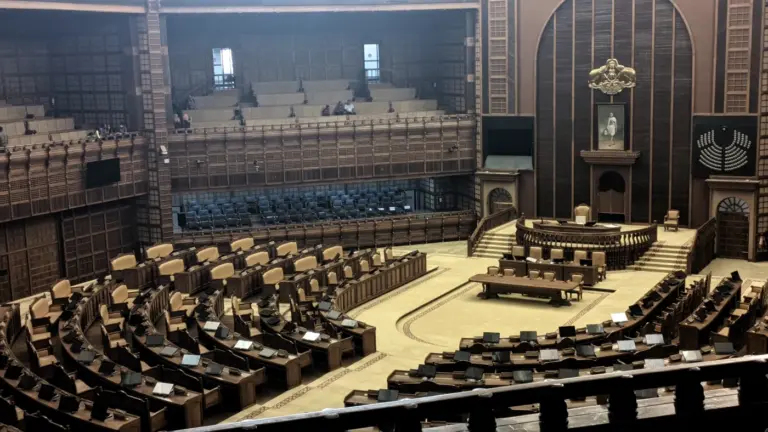
The seventeenth Vice-Presidential election of India was held on September 9, 2025, after the resignation of the previous incumbent earlier that year. The contest sat at the intersection of three constitutional puzzles. Why does the Indian Constitution use proportional representation by single transferable vote in a two horse race that always produces one winner? Why are nominated members of the Rajya Sabha allowed to vote here but barred from the Presidential election? And why is the second highest constitutional office removable on no specified ground at all? This guide answers all three, through Articles 66, 67 and 71 and the Presidential and Vice-Presidential Elections Act 1952.
Beyond the textbook, the 2025 election was also a stress test for the Election Commission‘s operational machinery. The Returning Officer’s chair rotates between the Secretaries General of the two Houses. Anti defection law is suspended for this poll, no whip can be issued, and a single non standard pen invalidates a ballot. These small details matter, both for civics and for the prelims paper.
Quick Facts: Vice-Presidential Election 2025
- Date: September 9, 2025. The seventeenth Vice-Presidential election of India.
- Constitutional source: Article 66 for election, Article 67(b) for removal, Article 71 for disputes.
- Conducting authority: Election Commission of India under Article 324, with the Secretary-General of the Rajya Sabha as Returning Officer for this cycle.
- Electoral college: 788 members, comprising 543 Lok Sabha members, 233 elected Rajya Sabha members, and 12 nominated Rajya Sabha members.
- Voting system: Proportional representation by single transferable vote, secret ballot, ECI provided pen mandatory.
- Nomination: 20 proposers plus 20 seconders, security deposit of ₹15,000, maximum four nomination papers.
- Anti defection: No whip can be issued by political parties for this election.
What Is the Vice-Presidential Election
The Vice-President is the second highest constitutional functionary of the Republic, the ex officio Chairman of the Rajya Sabha, and the person who discharges the functions of the President when that office falls vacant or the incumbent is unable to act. The election therefore staffs both the Council of States and the constitutional reserve battery of the Republic. You can revisit the office itself in our explainer on the Vice-President of India.
The election is held within sixty days of the expiry of the previous term, or as soon as possible after a vacancy through resignation, removal, death or otherwise. The current term, like the President’s, is five years.
Background and Historical Context
The constitutional design of the Vice-Presidential election borrows from the United States but mutates it for Indian conditions. The American Vice-President is elected indirectly through the Electoral College that elects the President, on a single ticket. The Indian Constituent Assembly broke the American link in two ways. It separated the offices of President and Vice-President, requiring two distinct elections. And it gave the Vice-President a different electoral college, restricted to the Union Parliament, on the reasoning that the office is principally a parliamentary functionary.
The first Vice-Presidential election was held in 1952, returning Dr. Sarvepalli Radhakrishnan unopposed. Since then sixteen elections have followed, with only seven actual contests, the rest being uncontested or by acclamation. The 2017 election saw the most recent contested poll before 2025, and the 2025 election follows the unusual trigger of a mid term resignation, attracting fresh attention to the procedural rules.
Key Provisions and the Electoral College
Article 66(1) establishes the election. Article 66(2) sets eligibility, citizenship of India, completion of 35 years of age, and qualification for election as a member of the Rajya Sabha. Article 66(3) bars holders of any office of profit under the Union or any state government, except the offices of President, Vice-President, Governor, and Union or state Minister.
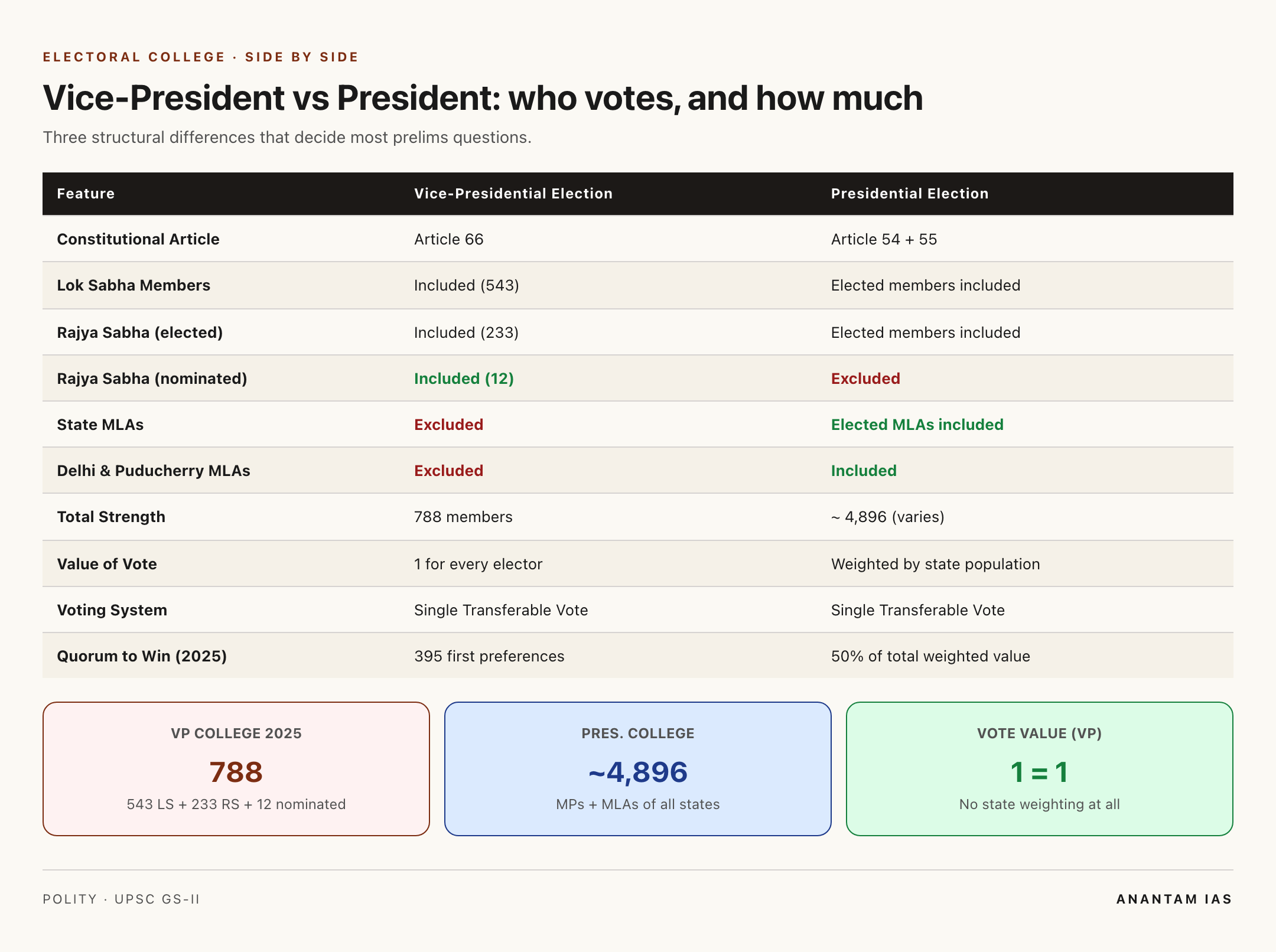
The electoral college is sharply different from the Presidential one. Three features stand out.
Composition. Only members of the two Houses of Parliament vote. State Legislative Assemblies are excluded entirely. The Legislative Assemblies of Delhi and Puducherry are also excluded, even though they vote in the Presidential election.
Inclusion of nominated members. Twelve members nominated to the Rajya Sabha by the President under Article 80(3) vote in the Vice-Presidential election. They are barred from the Presidential election by Article 54.
Value of vote. Every elector has a value of one. No state population weighting, no quota arithmetic. With a strength of 788, the winning candidate needs 395 votes in the first count, the simple majority of valid votes polled.
The voting system is proportional representation by means of the single transferable vote. With only one seat to fill, this collapses in practice to an instant runoff, but the Constitution makers chose the language deliberately to keep the door open for situations with three or more candidates where second preferences would matter.
Why It Matters
Three reasons explain why the Vice-Presidential election deserves more space in the syllabus than it usually gets. The first is constitutional plumbing. The Vice-President fills the gap when the Presidency falls vacant, presides over the Rajya Sabha, and exercises crucial procedural powers, including casting votes in case of a tie. The second is comparative federalism. The exclusion of State Assemblies signals that the Vice-Presidency is a parliamentary office, not a federal one, contrasting with the Presidency, which the Constitution treats as a creature of the entire federal polity. The third is electoral integrity. Each Vice-Presidential election is a live test of how the ECI handles a small, high stakes poll where party whips do not run, second preferences could matter, and the slightest procedural error can void the result. The wider electoral reforms agenda often draws on these stress tests.
Detailed Analysis: The Process Step by Step
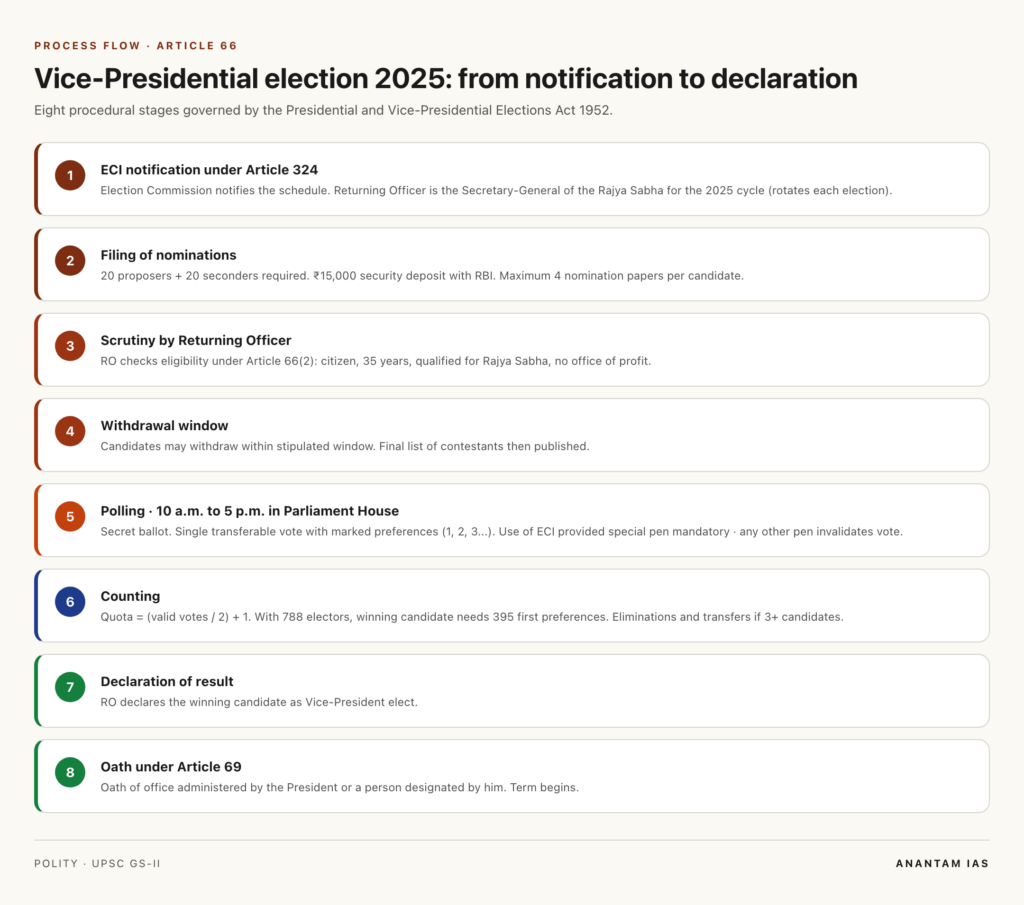
The Election Commission notifies the schedule under the Presidential and Vice-Presidential Elections Act 1952 and the Rules made under it. The Returning Officer, the Secretary-General of the Rajya Sabha for the 2025 cycle, takes operational charge.
Nominations open immediately after notification. A candidate must file at least one nomination paper subscribed by twenty members of the electoral college as proposers and twenty as seconders. A candidate may file up to four sets of nomination papers but each set requires fresh signatures. The contrast with the Presidential election, which requires fifty proposers and fifty seconders, reflects the smaller electoral college. A security deposit of ₹15,000 is payable, refundable if the candidate polls more than one sixth of the votes required to win.
After scrutiny, the RO publishes the list of validly nominated candidates. A withdrawal window follows. On polling day, voting takes place in Parliament House between 10 a.m. and 5 p.m. The ballot paper lists candidates and asks the elector to mark preferences in figures, 1, 2, 3 and so on, against the candidates of choice. Marking with a non standard pen, or with a tick or cross instead of a number, invalidates the ballot. The ballot is then sealed in a secret box.
Counting begins after the polling closes. If only two candidates contest, the count collapses to a simple majority. If three or more contest, the lowest polling candidate is eliminated and her ballots are redistributed by second preference until one candidate exceeds the quota. The RO announces the result, and the Vice-President elect is sworn in by the President or a person designated by him.
Comparative Framework: VP vs President
The two elections are constructed to be different on purpose, and the differences are favourites for prelims questions. We compare them across the same four axes used in our Lok Sabha vs Rajya Sabha comparison.
The first axis is the electoral college. The Presidential college includes elected members of both Houses of Parliament, all elected members of State Legislative Assemblies, and elected members of the Legislative Assemblies of Delhi and Puducherry. The Vice-Presidential college is restricted to all members of both Houses of Parliament and includes the twelve nominated members of the Rajya Sabha.
The second axis is the value of vote. In the Presidential election the value of an MLA’s vote depends on the population of the state divided by the number of MLAs and divided again by 1000. The MP’s vote takes the total MLA value divided equally by the number of elected MPs. In the Vice-Presidential election, every member’s vote is one.
The third axis is the conducting officers. The Presidential election alternates the Returning Officer between the Secretaries-General of the two Houses, currently with the Secretary-General of the Lok Sabha for the 2022 cycle. The Vice-Presidential election follows the same rotation but in the opposite phase, with the Secretary-General of the Rajya Sabha for 2025.
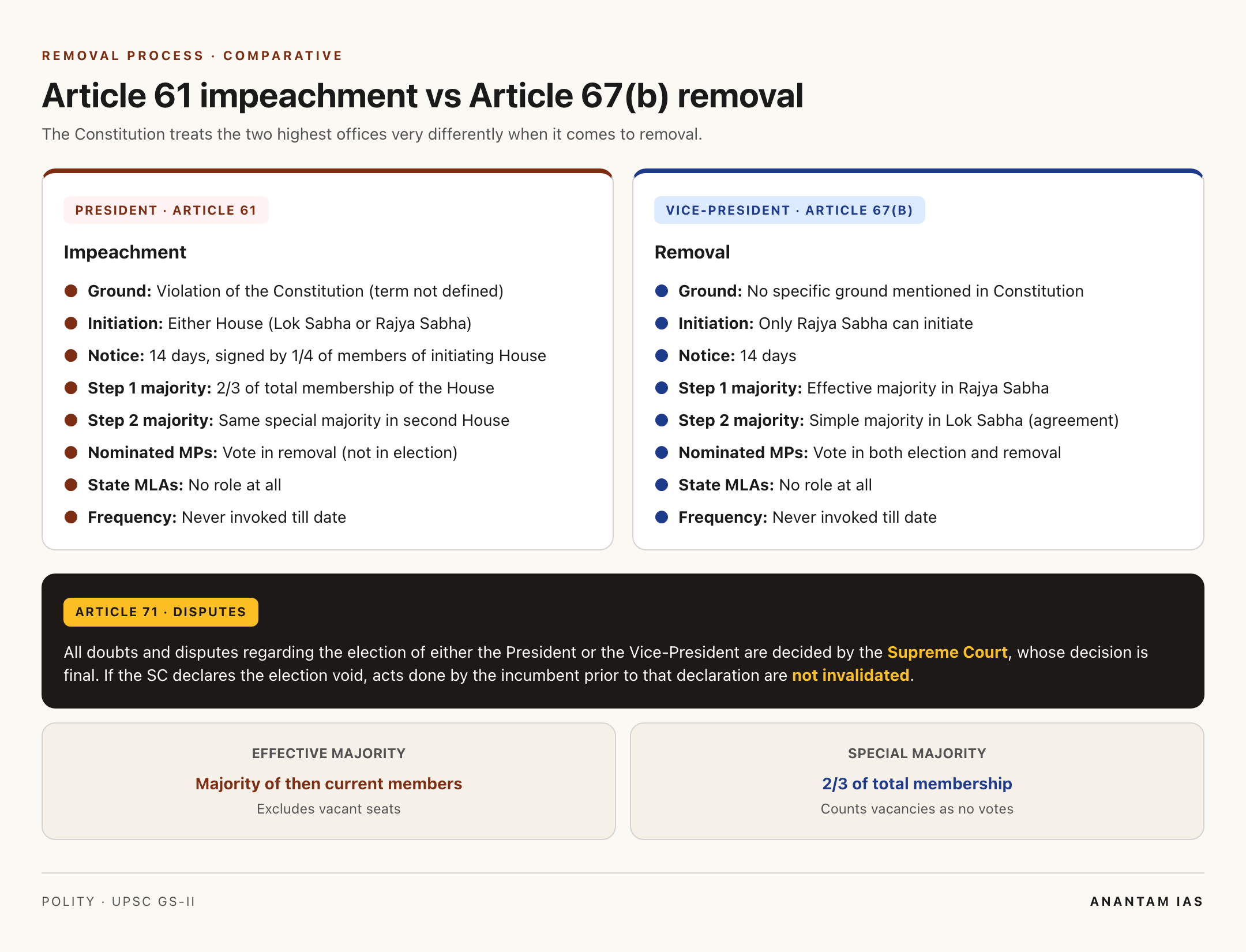
The fourth axis is dispute resolution. Under Article 71, both elections are subject to the original jurisdiction of the Supreme Court for disputes, with the SC’s decision final.
Challenges and Open Questions
The 2025 election surfaced three perennial concerns. The first is the secret ballot versus disclosed conscience tension. Because the anti defection law does not apply, parties cannot whip their MPs, but cross voting can be detected through ballot pattern analysis, which raises questions about the integrity of secrecy. The second is the small electoral college. With 788 voters, a small absentee bloc can swing the outcome. The third is the role of nominated members, who are appointed by the President on the advice of the Council of Ministers. Critics argue that allowing them to vote in an election that, by convention, the Vice-President often presides over, creates a structural conflict.
A separate set of concerns surrounds the technical rules. The mandatory ECI pen rule produces invalid ballots in almost every cycle. The 14 day notice period for removal under Article 67(b) is criticised as too short for a Rajya Sabha to properly debate the issue. None of these has yet attracted Parliamentary or Supreme Court action.
Prelims Pointers
- The electoral college consists of 543 Lok Sabha + 233 elected Rajya Sabha + 12 nominated Rajya Sabha = 788 members.
- Every elector’s vote has a value of one.
- Voting system is proportional representation by single transferable vote, secret ballot.
- Nominations require 20 proposers and 20 seconders, a security deposit of ₹15,000, maximum four papers.
- The Returning Officer rotates between the two Secretaries-General. For the 2025 cycle it was the Secretary-General of the Rajya Sabha.
- Anti defection law does not apply, no whip can be issued by political parties.
- Article 71 confers original jurisdiction on the Supreme Court for election disputes.
- If the SC voids the election, prior acts of the VP are not invalidated.
- Removal grounds under Article 67(b) are not specified in the Constitution.
- Bribery and undue influence as grounds for voiding the election are now read with Sections 170 and 171 of the Bharatiya Nyaya Sanhita 2023.
Mains Practice Questions
- The electoral college for the Vice-Presidential election departs from the Presidential one in three significant ways. Examine these departures and discuss whether they preserve the federal character of the Indian Constitution. (GS Paper 2, 250 words)
- The Constitution does not specify any ground for removal of the Vice-President under Article 67(b), unlike the impeachment of the President under Article 61. Critically discuss the implications of this design choice. (GS Paper 2, 250 words)
- Discuss the role of the Election Commission of India in conducting the Vice-Presidential election with reference to the 2025 cycle. (GS Paper 2, 150 words)
- The single transferable vote in a two horse race produces the same result as a simple majority. Why then does the Constitution mandate STV for the VP election? (GS Paper 2, 150 words)
Way Forward
A few targeted reforms could modernise the framework without disturbing the constitutional balance. Parliament should review the security deposit, frozen at ₹15,000 since 1952, against current rupee value. The ECI should consider electronic counting machines specially designed for STV ballots, with judicial sealing protocols, to reduce the persistent invalid ballot rate. Article 67(b) deserves a parliamentary discussion on whether to specify minimal grounds, even if only by convention, to lend dignity to the removal process. None of these requires constitutional amendment. They could be accomplished through ordinary amendments to the Presidential and Vice-Presidential Elections Act 1952. The wider lesson of the 2025 cycle is that small constitutional offices need the same attention to procedural detail that the bigger ones receive.
Frequently Asked Questions
Who is eligible to be elected Vice-President of India?
A citizen of India who has completed 35 years of age, is qualified for election as a member of the Rajya Sabha, and does not hold any office of profit. The exemptions from the office of profit bar are President, Vice-President, Governor, and Union or state Minister.
Why are nominated members allowed to vote in the Vice-Presidential election?
Article 66(1) defines the electoral college simply as members of both Houses of Parliament. Nominated members are members of the Rajya Sabha. The Constitution does not exclude them, and the Election Commission has accepted this reading throughout.
What is the value of an MP’s vote?
In the Vice-Presidential election the value is one. There is no state population weighting, unlike the Presidential election.
Who is the Returning Officer for the 2025 election?
The Secretary-General of the Rajya Sabha. The post rotates between the two Secretaries-General each cycle.
What happens if a candidate uses a non standard pen?
The ballot is invalid. The ECI provides a special pen for the election and use of any other pen voids the vote.
Can a political party issue a whip?
No. The anti defection law under the Tenth Schedule does not apply to the Vice-Presidential election. MPs vote on conscience.
Where is the dispute over election heard?
The Supreme Court of India under Article 71 has original jurisdiction. Its decision is final.
Are prior acts of the VP valid if the election is voided?
Yes. Article 71(2) explicitly preserves acts done by the Vice-President before the date of the Supreme Court declaration.
What is the difference between the removal of the President and the Vice-President?
The President is impeached for violation of the Constitution under Article 61, requires either House to initiate, and a special majority of two thirds of total membership in both Houses. The Vice-President is removed under Article 67(b) on no specified ground, requires only the Rajya Sabha to initiate by effective majority, and the Lok Sabha to agree by simple majority.
What is an effective majority?
It means a majority of the then current members of the House, that is, members other than those whose seats are vacant for any reason.
Tell Google you want more of this.
Add Anantam IAS as a preferred sourceOne tap, and this site shows up more often in your own Top Stories, AI Overviews and AI Mode. Remove it any time.