Biotechnology in Agriculture (UPSC Science & Tech)
UPSC guide to agricultural biotechnology: GM crops, India's regulatory framework, Bt cotton story, GM mustard, gene editing, benefits, risks and 2024-26 updates.
Agricultural biotechnology is the family of techniques that uses living organisms — or parts of them — to improve plants, animals and microorganisms for farm use. It spans the spectrum from age-old selective breeding and tissue culture to modern tools such as recombinant DNA, marker-assisted selection and the latest CRISPR-based gene editing. For a country that must feed 1.4 billion people on shrinking farmland under climate stress, the question is not whether to use agri-biotech, but how — under what regulation, with what safeguards, and on whose terms.
For UPSC, the topic is a flagship GS III — Agriculture, Science & Technology and Environment issue, with overflow into GS II — Health, Governance and IPR.
What is agricultural biotechnology — the underlying science
Agricultural biotech leverages molecular biology to introduce or modify desirable traits in crops, livestock and microbes. Five major techniques in active use:
- Tissue culture — multiplying disease-free planting material from a single cell or tissue, used for banana, sugarcane, potato, orchid.
- Marker-assisted selection (MAS) — using DNA markers to track desirable traits in conventional breeding; faster than classical breeding without inserting foreign DNA.
- Recombinant DNA / transgenics — moving a specific gene from one organism into another (e.g., the Cry1Ac gene from soil bacterium Bacillus thuringiensis into cotton to give it pest resistance).
- Cisgenesis and intragenesis — inserting genes from sexually compatible relatives.
- Gene editing (CRISPR-Cas9, base editing, prime editing) — precise edits to existing DNA without leaving foreign genes; treated as a distinct regulatory category in many jurisdictions, including India.
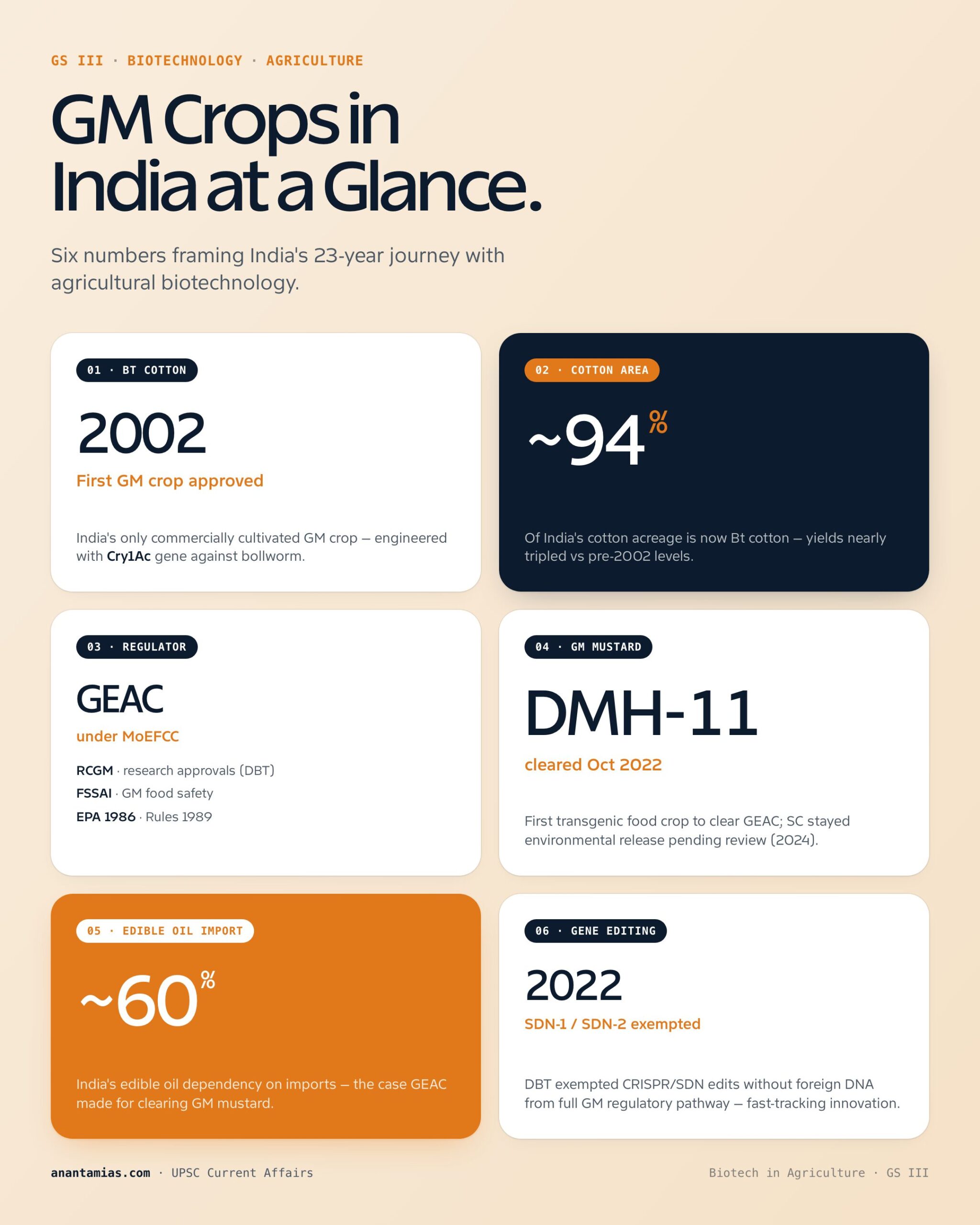
A Genetically Modified (GM) crop is one whose genome has been altered using recombinant DNA technology. Site-directed nuclease (SDN-1 and SDN-2) edits — where no foreign DNA is left behind — are now treated by India as non-GM for regulatory purposes, a major 2022 shift.
Benefits of agri-biotechnology
For producers (farmers)
- Built-in pest control — Bt cotton, Bt brinjal carry insecticidal proteins; reduces pesticide spraying.
- Higher yield and productivity — pest- and disease-resistant varieties protect potential yield.
- Climate resilience — drought-tolerant rice (Sahbhagi Dhan), flood-tolerant Swarna-Sub1, salinity-tolerant rice and wheat.
- Reduced input costs — fewer pesticide rounds; less labour.
- Quality improvements — longer shelf life, oil quality, fibre length.
For consumers
- Bio-fortified foods — Golden Rice with provitamin A, iron-rich pearl millet, zinc-rich wheat.
- Lower toxicants — low aflatoxin groundnut and maize.
- Healthier oils — high-oleic mustard, low-saturated soybean.
- Lasting freshness — FlavrSavr tomato (a historic example of delayed-ripening tech).
For the environment
- Less pesticide load — Bt crops have reduced chemical pesticide use sharply on cotton.
- Soil conservation — herbicide-tolerant crops compatible with no-till; preserves topsoil.
- Phyto-remediation — engineered poplars absorb heavy metals.
- Lower water footprint — drought-tolerant rice and wheat varieties.
- Carbon impact — yield gains can free land for forests and offset agriculture's GHG footprint.
For research and industry
- Vaccines and pharma proteins in plants — molecular farming.
- Better antibiotics and vaccines for crop and livestock disease.
- Biofertilisers and biopesticides — beneficial microbes that fix nitrogen, mobilise phosphorus, suppress pests.
India's GM crop story
| Crop | Status | Detail |
|---|---|---|
| Bt cotton | Commercialised 2002 | Only commercial GM crop in India |
| Bt brinjal | Indefinite moratorium 2010 | Approved by GEAC, blocked by then Environment Minister |
| GM mustard (DMH-11) | GEAC approval Oct 2022 | Litigation ongoing; SC delivered split verdict July 2024, matter referred to larger bench |
| HtBt cotton | Unapproved | Farmers in Maharashtra, Telangana planted illegally; "kisan satyagraha" |
| Golden Rice | R&D | Field trials by ICAR-IIRR |
| GM banana, papaya, brinjal (Bangladesh) | R&D / Bangladesh | Bt brinjal commercial in Bangladesh from 2014 |
| CRISPR-edited rice and banana | R&D | TIFR, IIT Kharagpur, NIPGR active programmes |
The Bt cotton experience
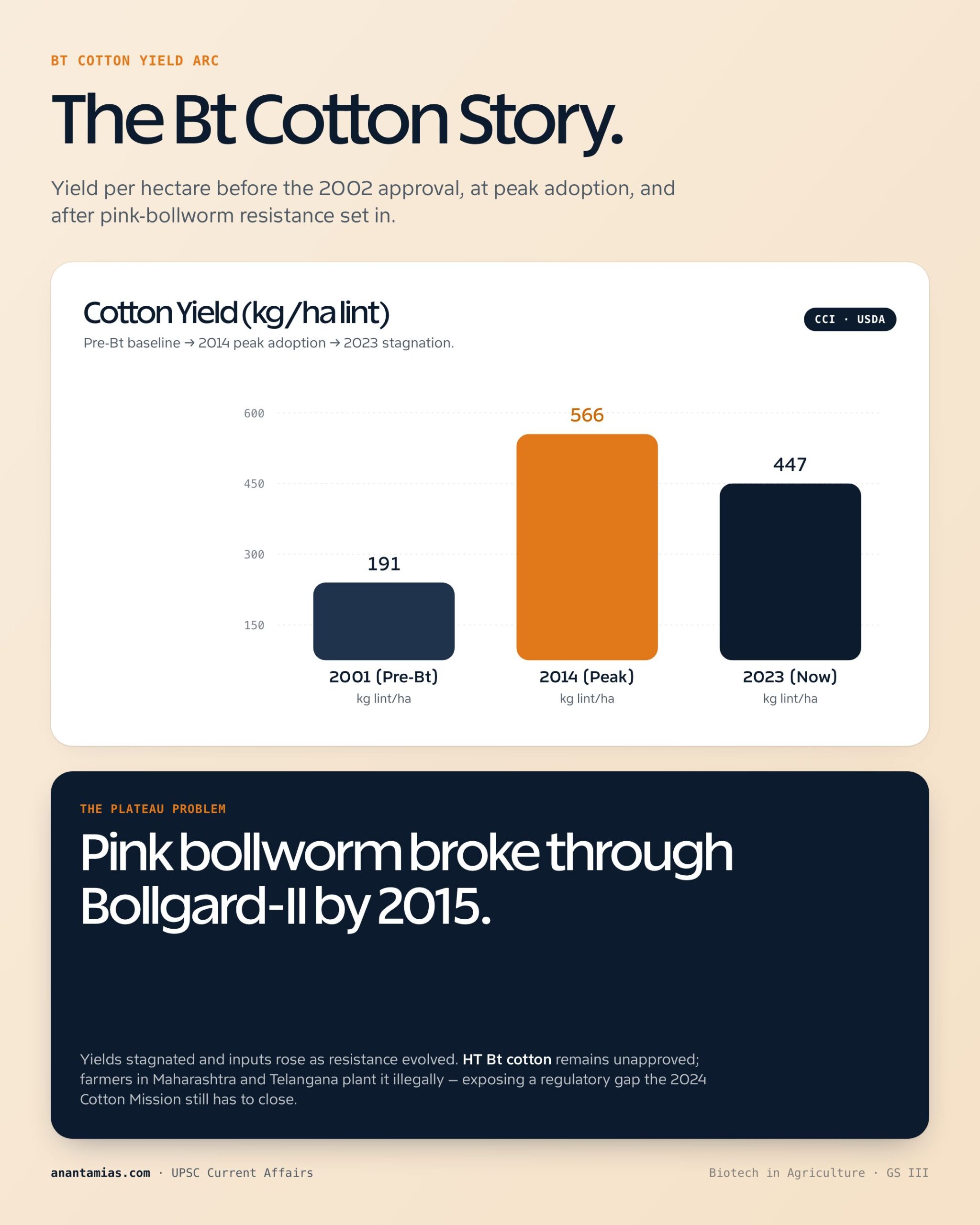
Bt cotton transformed India's cotton economy after its 2002 release. India became the world's largest cotton producer by 2014, with average yields rising from ~300 kg/ha in 2002 to over 500 kg/ha by 2013. Pesticide spending on cotton fell sharply.
But success has faded:
- Pink bollworm resistance — by 2014, pink bollworm had developed resistance to Bt toxin in many regions.
- Yield plateau — yields stagnated then declined; per-hectare yield is below the global average today.
- Cost spiral — second-generation Bollgard II and unauthorised HtBt seeds raised seed costs.
- Refuge non-compliance — the required non-Bt buffer rows were rarely planted, accelerating resistance.
- Litigation over Monsanto royalty has run for years.
The Bt cotton experience captures both the promise and the brittleness of single-trait GM strategies without rigorous resistance management.
Regulatory framework in India
| Body | Role |
|---|---|
| Genetic Engineering Appraisal Committee (GEAC) | Apex body that approves GM organisms; under MoEFCC |
| Review Committee on Genetic Manipulation (RCGM) | Permits research with GMOs; under DBT |
| Institutional Biosafety Committees (IBSC) | At each research institute; oversees compliance |
| Monitoring-cum-Evaluation Committee (MEC) | Field-trial monitoring |
| State Biotechnology Coordination Committee (SBCC) | State-level oversight |
| District Level Committees (DLC) | Local enforcement |
| FSSAI | GM food labelling and safety |
| EPA Rules, 1989 | Statutory backbone — Rules for Manufacture, Use, Import, Export and Storage of Hazardous Microorganisms |
In March 2022, MoEFCC notified that SDN-1 and SDN-2 gene-edited plants are exempt from GM regulations under EPA Rules — a major reform that opens up CRISPR-based varieties to faster commercial release.
Risks and concerns
| Concern | Detail |
|---|---|
| Health | Long-term effects on humans poorly studied; allergenicity testing must be rigorous |
| Allergies | Novel proteins can trigger allergic responses |
| Antimicrobial resistance | Some constructs use antibiotic-resistance markers; can transfer to gut microbes |
| Resistance evolution | Pink bollworm, fall armyworm developing resistance to Bt |
| Biodiversity | Gene flow to wild relatives, displacement of native varieties |
| Monopolisation | A few seed companies control IP; terminator seeds would force annual purchase |
| Indebtedness | Costly seeds + crop failure can push farmers into debt |
| Trade & labelling | Importer rejection (EU); consumer right-to-know via labelling |
| Bio-piracy | Indigenous landraces patented abroad without benefit-sharing |
| Ethics | "Playing God" arguments; public trust deficit |
Global landscape
- United States — largest grower of GM crops (corn, soybean, cotton, alfalfa); regulates by product, not process.
- Brazil and Argentina — major exporters of GM soy and maize.
- EU — restrictive; member states can opt out; gene-editing rules under revision (2023-25 proposal would ease NGT regulations).
- China — large-scale Bt cotton; commercial GM corn and soy approvals in 2023-24.
- Bangladesh — commercial Bt brinjal since 2014.
- Africa — Nigeria, Kenya, Ethiopia rolled out Bt cotton, GM maize, virus-resistant cassava.
Recent developments (2024-26)
- GM mustard (DMH-11) — Supreme Court delivered a split verdict in July 2024; matter referred to a larger bench. ICAR continues field activity under court oversight.
- Genome-edited rice varieties — ICAR launched DRR Dhan 100 ('Kamala') and Pusa DST Rice 1 in 2025, India's first genome-edited rice varieties via SDN-1 route.
- HtBt cotton — debates intensified as farmers in Maharashtra, Telangana planted unauthorised seed; FSII demanded approval pathway.
- National Mission on Edible Oils — Oil Palm and Oilseeds — bio-tech support to raise mustard, soybean yields.
- Anusandhan National Research Foundation funding plant biotech R&D from 2024.
- CGIAR-ICAR partnership — climate-resilient varieties pipeline.
- WTO disputes — India's GM-free organic export claims; need for clear labelling.
- Pesticide Management Bill pending — interface with Bt biocides.
- PMFME and PM-AASHA schemes link agri-biotech to food processing and price support.
- Cartagena Protocol on Biosafety — Indian compliance reviewed at COP-MOPs through 2024-25.
Way forward
- Science-based, transparent regulation — predictable timelines for GEAC; protocols for SDN-1/SDN-2 exemption clearly notified.
- Single-window biosafety clearance — fewer overlapping committees; capacity-building for FSSAI on GM labelling.
- Resistance management — mandatory refuge planting, integrated pest management for any single-trait GM crop.
- Farmer rights — strong implementation of Protection of Plant Varieties and Farmers' Rights Act, 2001 (PPVFR).
- IP balance — compulsory licensing and royalty caps where seed prices are exploitative.
- Public-sector innovation — strengthen ICAR institutes for non-MNC GM and edited varieties.
- Climate-resilient pipeline — drought, heat, salinity, submergence-tolerant varieties as flagship targets.
- Bio-piracy protection — TKDL, Nagoya Protocol implementation.
- Public engagement — lay communication of biosafety data; counter misinformation.
- Trade strategy — clear differentiation of GM/non-GM/organic export tracks for premium markets.
Mains hook
"Agricultural biotechnology is neither a silver bullet nor a Frankenstein; it is a regulated tool whose value depends on the maturity of the regulator and the agency of the farmer." Critically examine. (GS III, 250 words, 15 marks)
Prelims pointers
- Bt cotton — only GM crop commercialised in India (since 2002); contains Cry1Ac gene from Bacillus thuringiensis.
- Bt brinjal — moratorium imposed 2010 in India; commercial in Bangladesh since 2014.
- GM mustard (DMH-11) — GEAC approved Oct 2022; SC split verdict July 2024.
- GEAC — apex GM regulator under MoEFCC.
- RCGM — research approvals under DBT.
- EPA Rules, 1989 — statutory framework for GM organisms.
- SDN-1 & SDN-2 exemption (March 2022) — gene-edited plants without foreign DNA exempt from GM rules.
- Cartagena Protocol — international treaty on biosafety, supplement to CBD.
- PPVFR Act, 2001 — protects plant variety IP and farmers' rights.
- DRR Dhan 100 (Kamala) and Pusa DST Rice 1 — India's first genome-edited rice varieties (2025).
- Bio-fortified varieties — Golden Rice, iron pearl millet, zinc wheat.
- Cry1Ac, Cry2Ab — Bt insecticidal proteins.
Beyond GM — the broader agri-biotech toolkit
GM crops dominate the headlines, but agri-biotech is far broader. Three rapidly growing toolkits deserve equal attention in answers.
- Bio-fertilisers and bio-pesticides — Rhizobium, Azolla, Trichoderma, mycorrhiza, neem-based formulations and entomopathogenic fungi. Push under the PM-PRANAM and National Project on Soil Health & Fertility.
- Tissue culture — clonal propagation of banana, sugarcane, potato, ornamentals; widely used by Indian growers. Central Food Technological Research Institute and BCIL run training centres.
- Genome editing of livestock — disease-resistant chickens, hornless cattle, low-methane buffalo; ICAR-NDRI exploring polled buffalo through gene editing.
- Microbial agri-inputs — bio-stimulants, plant-growth-promoting rhizobacteria (PGPR), endophytes; regulated under FCO 1985 amendments.
- Precision fermentation — lab-grown dairy and protein, "smart proteins" supported under BioE3 Policy 2024.
- Aqua-biotech — disease-free seed for shrimp, vaccinated rohu and catla, salinity-tolerant fish.
These tools, often less politically charged than GM, deliver real productivity, sustainability and nutrition gains today.
For UPSC, agricultural biotechnology is the case study where science, ethics, IPR, environment, farmer welfare and food security collide. The aspirant who can speak to all five — without preaching for or against GM, and recognising the breadth of the agri-biotech toolkit — will write a balanced, mark-fetching answer.