Soil is a non-renewable resource on human timescales. India loses approximately 5,334 million tonnes of topsoil annually, affecting nearly 147 million hectares of land. Soil conservation refers to the set of practices aimed at preventing soil erosion, maintaining soil fertility, and ensuring sustainable agricultural productivity. For UPSC aspirants, soil conservation cuts across Geography, Environment, and Indian Economy papers.
What Is Soil Erosion?
Soil erosion is the removal of the fertile top layer of soil by natural agents such as water, wind, and gravity. The rate of erosion depends on slope, rainfall intensity, vegetation cover, and soil type.
Types of Soil Erosion
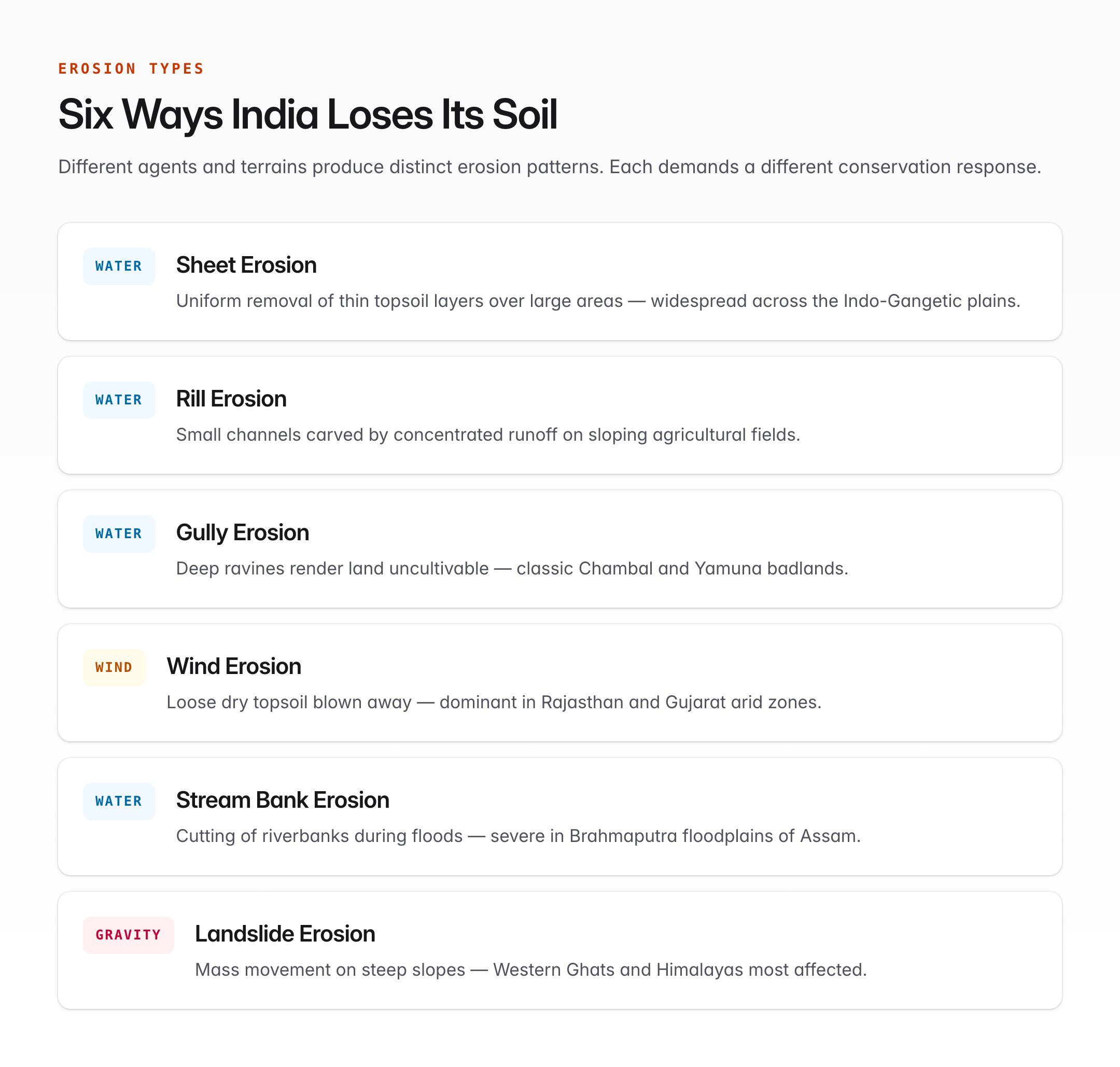
| Type | Agent | Description | Regions Affected |
|---|---|---|---|
| Sheet erosion | Water | Uniform removal of thin layers of topsoil over large areas | Indo-Gangetic plains |
| Rill erosion | Water | Formation of small channels by concentrated surface runoff | Sloping agricultural fields |
| Gully erosion | Water | Deep channels (ravines) carved by water; land becomes uncultivable | Chambal ravines, Yamuna basin |
| Wind erosion | Wind | Blowing away of loose, dry topsoil | Rajasthan, Gujarat (arid zones) |
| Stream bank erosion | Water | Cutting of riverbanks during floods | Brahmaputra floodplains, Assam |
| Landslide erosion | Gravity | Mass movement of soil and rock on steep slopes | Western Ghats, Himalayas |
Causes of Soil Erosion
- Deforestation and removal of natural vegetation cover
- Overgrazing by livestock, especially in semi-arid zones
- Faulty agricultural practices such as ploughing along slopes
- Shifting cultivation (jhum) in northeast India
- Mining and construction activities that expose bare soil
- Excessive irrigation leading to waterlogging and salinisation
Methods of Soil Conservation
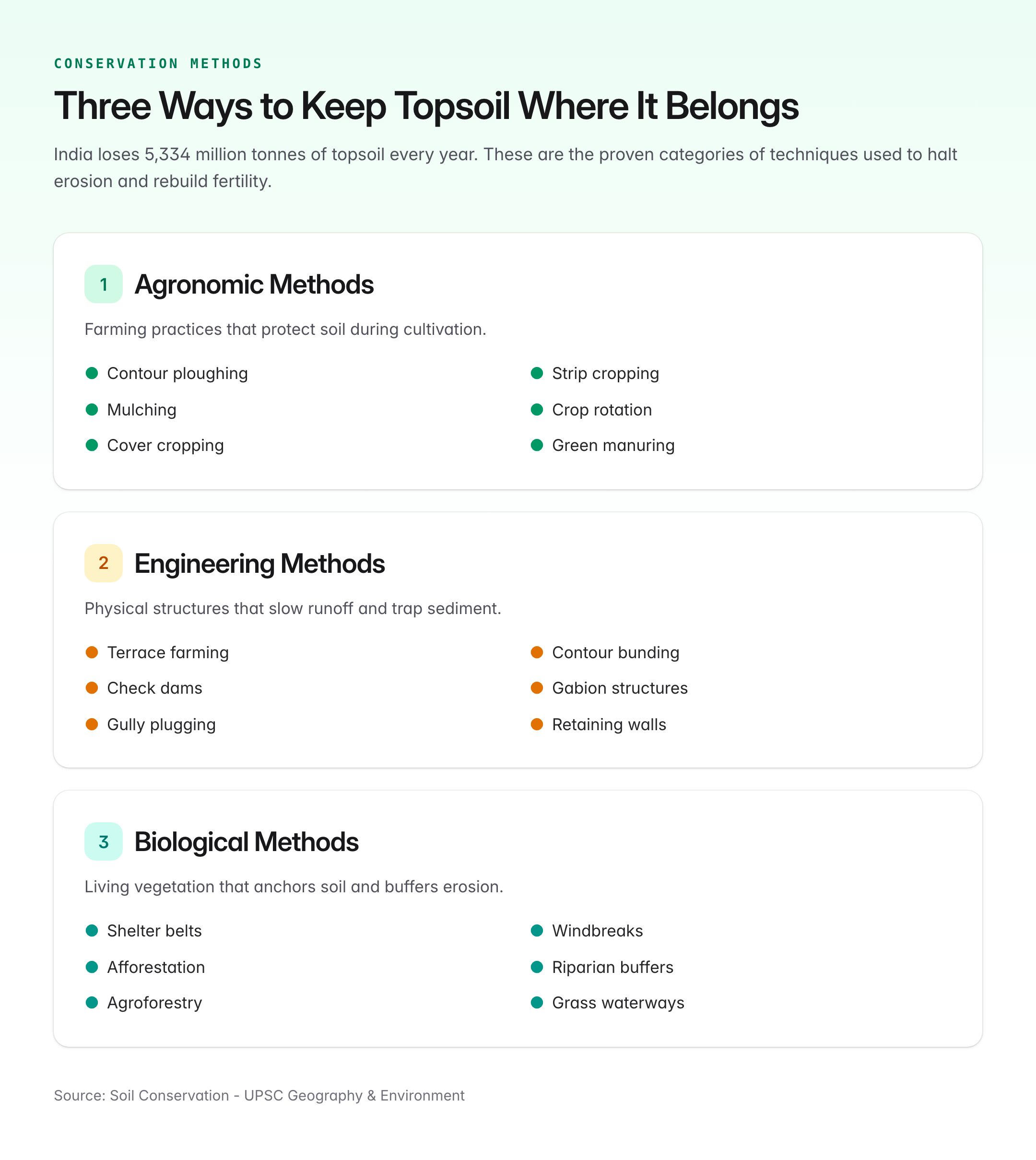
Agronomic Methods
| Method | How It Works | Best Suited For |
|---|---|---|
| Contour ploughing | Ploughing along contour lines (perpendicular to slope) slows water runoff | Gentle to moderate slopes |
| Strip cropping | Alternate strips of erosion-permitting and erosion-resisting crops | Areas prone to wind and water erosion |
| Mulching | Covering soil surface with crop residues, straw, or plastic sheets | All agricultural land; conserves moisture |
| Crop rotation | Alternating deep-rooted and shallow-rooted crops across seasons | Maintaining soil fertility and structure |
| Cover cropping | Growing leguminous or grass crops during off-season to protect bare soil | Fallow periods between main crops |
Engineering Methods
| Method | How It Works | Best Suited For |
|---|---|---|
| Terrace farming | Building step-like flat platforms on hillsides to reduce slope length and runoff velocity | Hilly terrain (e.g., Meghalaya, Uttarakhand) |
| Contour bunding | Constructing earthen embankments along contour lines to trap rainwater | Semi-arid regions |
| Check dams | Small barriers across drainage channels to slow water flow and promote infiltration | Gully-prone areas |
| Gabion structures | Wire mesh baskets filled with stones placed along slopes or streams | Stream bank erosion zones |
Biological Methods
| Method | How It Works | Best Suited For |
|---|---|---|
| Shelter belts (windbreaks) | Rows of trees planted perpendicular to prevailing winds reduce wind speed | Arid and semi-arid plains (Rajasthan) |
| Afforestation | Large-scale tree planting on degraded land | Ravines, wastelands, catchment areas |
| Riparian buffers | Vegetation strips along riverbanks absorb excess nutrients and stabilise banks | Floodplains and river corridors |
Government Schemes and Programmes
Watershed Development Programme
The Integrated Watershed Management Programme (IWMP), now subsumed under the Pradhan Mantri Krishi Sinchayee Yojana (PMKSY) — Watershed Development Component, aims at holistic land and water resource management in degraded areas. Key features:
- Ridge-to-valley approach
- Community participation through Watershed Development Teams
- Focus on soil moisture conservation, groundwater recharge, and afforestation
Other Key Programmes
| Programme | Ministry/Body | Focus |
|---|---|---|
| National Mission for Green India (GIM) | MoEFCC | Afforestation on 10 million hectares of degraded land |
| Soil Health Card Scheme (2015) | Ministry of Agriculture | Soil testing and nutrient management recommendations |
| Rashtriya Krishi Vikas Yojana (RKVY) | Ministry of Agriculture | Flexible funding for states to address soil health |
| Desert Development Programme (DDP) | Ministry of Rural Development | Combating desertification in arid zones |
| National Afforestation Programme | MoEFCC | Afforestation through Joint Forest Management |
Constitutional and Legal Framework
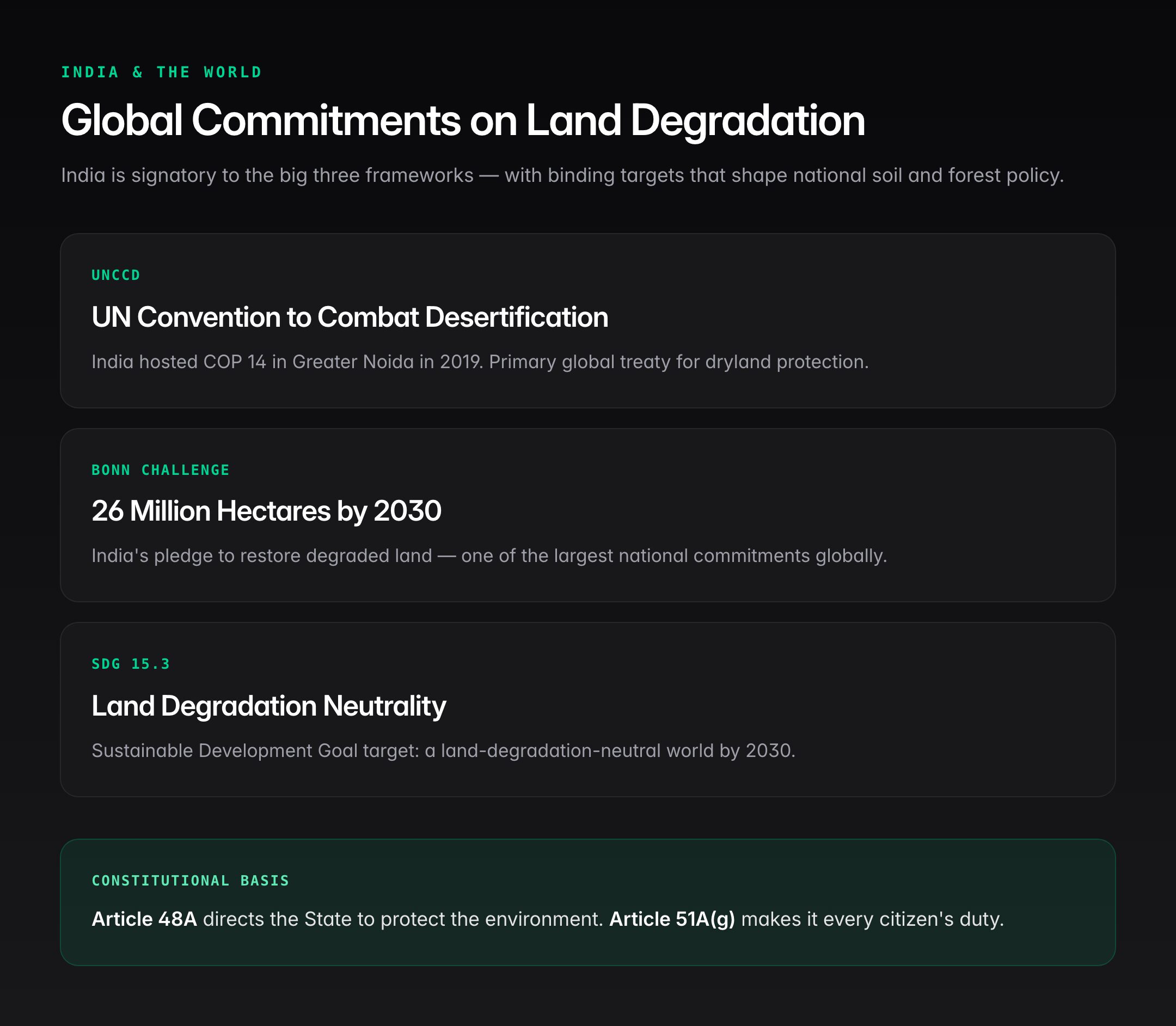
- Article 48A (Directive Principles): The State shall endeavour to protect and improve the environment and to safeguard forests and wildlife.
- Article 51A(g) (Fundamental Duties): Every citizen has a duty to protect and improve the natural environment, including forests, lakes, rivers, and wildlife.
- The Environment Protection Act, 1986 provides an umbrella framework for soil and land protection.
Soil Conservation in India: Regional Challenges
| Region | Primary Challenge | Conservation Strategy |
|---|---|---|
| Chambal-Yamuna ravines | Gully erosion; badland formation | Afforestation, check dams, gully plugging |
| Western Rajasthan | Wind erosion; sand dune encroachment | Shelter belts, sand dune stabilisation |
| Northeast India | Shifting cultivation (jhum) | Settled agriculture promotion, terrace farming |
| Western Ghats | Landslides; heavy rainfall erosion | Contour bunding, riparian buffers |
| Indo-Gangetic plains | Sheet erosion; declining soil organic matter | Crop rotation, mulching, green manuring |
International Frameworks
- United Nations Convention to Combat Desertification (UNCCD): India is a signatory. COP 14 was held in Greater Noida (2019).
- Bonn Challenge: India pledged to restore 26 million hectares of degraded land by 2030.
- Sustainable Development Goal 15 (Life on Land): Target 15.3 focuses on achieving a land degradation-neutral world by 2030.
UPSC Relevance
Soil conservation is a high-frequency topic across UPSC Prelims and Mains.
| Paper | How It Appears |
|---|---|
| Prelims (GS) | Types of erosion, methods of conservation, soil types and their properties |
| Mains GS-I (Geography) | Distribution of soil types in India; regional erosion patterns |
| Mains GS-III (Environment) | Government schemes, watershed management, desertification, international commitments |
| Essay | Sustainable agriculture, food security, environmental degradation themes |
Key terms to remember: contour ploughing, strip cropping, terrace farming, shelter belts, mulching, gully erosion, sheet erosion, watershed development, PMKSY, UNCCD, land degradation neutrality.
Previous Year Questions (Themes)
- Discuss the measures to combat soil erosion in different parts of India. (GS-I)
- What is watershed management? How does it contribute to soil and water conservation? (GS-III)
- Examine the impact of shifting cultivation on the environment of northeastern India. (GS-III)
Soil conservation is not merely an environmental issue — it is a matter of food security, rural livelihoods, and climate resilience. India's ability to feed its growing population depends directly on protecting and restoring its soil resources.
Tell Google you want more of this.
Add Anantam IAS as a preferred sourceOne tap, and this site shows up more often in your own Top Stories, AI Overviews and AI Mode. Remove it any time.