BR Ambedkar: Constitution Maker & Social Reformer
Complete UPSC notes on BR Ambedkar — Columbia and LSE education, Mahad Satyagraha, Poona Pact, drafting the Constitution, Dalit movement, Buddhist conversion 1956, and his enduring legacy.
BR Ambedkar: Constitution Maker & Social Reformer
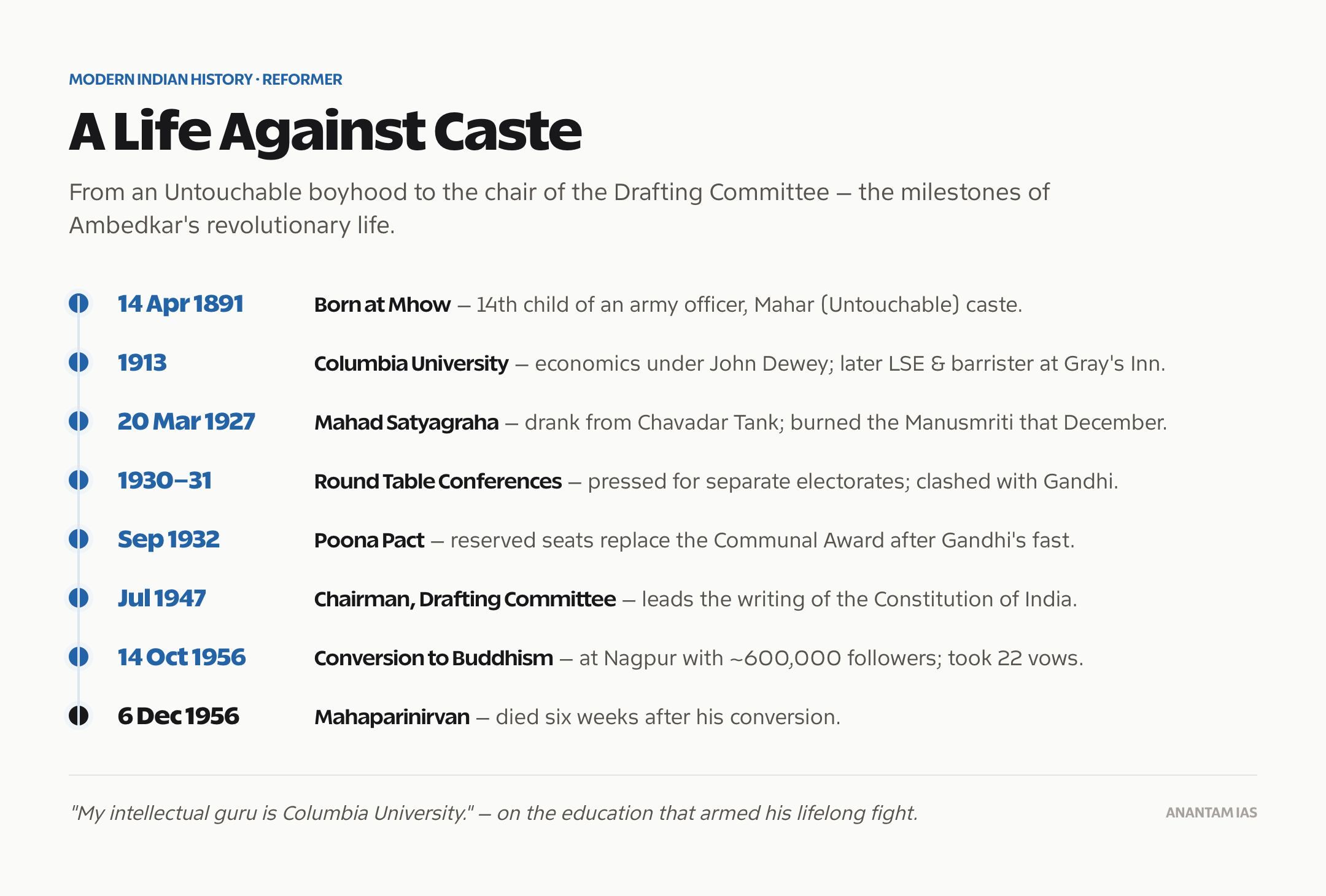
Bhimrao Ramji Ambedkar was born on April 14, 1891, in Mhow (now Dr Ambedkar Nagar), Madhya Pradesh, the 14th and last child of an army officer from the Mahar caste — one of the Untouchable castes of Maharashtra. He died on December 6, 1956, six weeks after formally converting to Buddhism, leaving behind the Constitution of India, a vast body of scholarship, and a social-political movement that continues to reshape Indian society.
Ambedkar’s life is almost impossible to understand without grasping the daily reality of Untouchability in early 20th-century India. Children from Untouchable castes sat on sacks outside classrooms, not inside. They could not draw water from public wells. They walked on certain roads only at certain times. Their presence was considered ritually polluting. Ambedkar experienced every one of these humiliations.
That he rose from this to become the Chairman of the Constitution Drafting Committee — the person more responsible than anyone else for the document that governs 1.4 billion people — is not merely an inspiring story. It is a historical fact of the first order. And understanding how he got there reveals everything about the politics of caste, education, and power in India.
Education: Columbia and the LSE
Ambedkar’s access to education was made possible by an extraordinary patron: Sayajirao Gaekwad III, the Maharaja of Baroda. The Maharaja was one of the most progressive rulers of the princely state period — he had established free primary education in Baroda and supported remarkable individuals from suppressed communities.
Ambedkar received a scholarship from the Baroda State to study in the US. He enrolled at Columbia University in New York in 1913 and studied economics, sociology, history, philosophy, and anthropology. His PhD thesis — The Evolution of Provincial Finance in British India — was supervised by the distinguished economist Edwin Seligman.
Columbia’s intellectual environment was transformative. Ambedkar absorbed progressive American scholarship on democracy, social reform, and constitutional governance. He studied under John Dewey, the philosopher of pragmatic democracy, whose influence on Ambedkar’s thought about constitutional democracy was profound. He later said: “My political guru is Gokhale, my social guru is Jotiba Phule, and my intellectual guru is Columbia University.”
He also studied at the London School of Economics (LSE) under the economist Edwin Cannan, earning a second doctorate (DSc). He was also called to the Bar from Gray’s Inn, qualifying as a barrister.
This education was not merely credentials. It gave Ambedkar access to the world’s best scholarship in economics, law, and political theory — and it meant that when he debated British officials, nationalist leaders, or orthodox Hindus, he could do so from a position of unassailable intellectual authority.
Return and Early Activism
When Ambedkar returned to India, the promise of Baroda State employment awaited. The Maharaja appointed him as a military secretary — but no one would work with him, his peons wouldn’t touch his papers (they dropped them on his desk), and eventually he was forced to resign. The experience of being excluded despite qualifications shaped his politics forever.
He then worked as a private tutor and accountant, and eventually established himself as a professor and lawyer in Bombay. He founded several journals and newspapers — Mooknayak (1920), Bahishkrit Bharat (1927), Janata (1930) — to give voice to Dalit perspectives.
In 1926, he was appointed to the Bombay Legislative Council by the Governor — his first formal political position.
Mahad Satyagraha (1927)
The Mahad Satyagraha of March 20, 1927, was Ambedkar’s first major direct action — and one of the most symbolically powerful acts of the Dalit movement.
The Chavadar Tank
The Mahad municipality (Maharashtra) had passed a resolution in 1924 declaring the Chavadar Tank — a public water tank — open to all. But caste Hindus had prevented Untouchables from using it. The resolution was not being implemented.
Ambedkar called a conference of Untouchables in Mahad. On March 20, 1927, he led a procession to the tank, walked to the water’s edge, and drank from it — the simplest, most human act, turned revolutionary by context. Thousands followed.
The reaction from caste Hindus was swift and violent — crowds attacked Dalit homes, burned food, and beat people. The satyagraha had to be protected.
In December 1927, Ambedkar returned to Mahad for a second conference. At this conference, he publicly burned a copy of the Manusmriti — the ancient text seen as the scriptural basis for caste hierarchy and women’s subjugation. It was a direct challenge to the religious legitimacy of caste.
Significance
The Mahad Satyagraha established several things:
- Ambedkar as a mass leader, not just an intellectual
- The Dalit movement as a rights movement, not a charity case
- The rejection of caste not just through political reform but through direct assertion of equal humanity
The date, March 20, is now observed as Social Empowerment Day (Samata Diwas) in several states.
The Political Framework: Separate Electorates Demand
Ambedkar’s central political demand in the 1920s and early 1930s was separate electorates for Untouchables — the right of Untouchable voters to elect their own representatives, not have them selected by a general Hindu electorate.
His reasoning was clear: in a system where Untouchable candidates had to win votes from caste Hindu voters, caste Hindus would only elect Untouchables acceptable to them — not genuine representatives of Untouchable interests. Separate electorates would give Untouchables genuine political power.
He made this argument forcefully at the Round Table Conferences (1930, 1931) in London. At the Second RTC, he clashed directly with Gandhi — who argued that separate electorates would permanently divide Hindus and harm Untouchable integration into mainstream society.
The Communal Award (August 1932) by British PM Ramsay MacDonald gave Untouchables separate electorates — a political victory for Ambedkar. Gandhi’s hunger strike forced its reversal in the Poona Pact (September 1932). See the Simon Commission article for full details.
Ambedkar later wrote: “What the Congress and Gandhi have done to the Untouchables during the last thirty years is to succour the aggressor and weaken the victim.” His assessment of Gandhi remained deeply critical for the rest of his life.
Key Organisations and Political Activity
| Organisation | Founded | Purpose |
|---|---|---|
| Bahishkrit Hitakarini Sabha | 1924 | Social and educational work for Untouchables |
| Independent Labour Party | 1936 | Political party; won 11 of 13 seats in 1937 Bombay elections |
| Scheduled Castes Federation | 1942 | Focused political party for Scheduled Castes |
| Republican Party of India | Planned before death, formally established 1956 | Successor to SCF; based on Ambedkar’s vision |
| Peoples Education Society | 1945 | Established Siddharth College, Bombay and later colleges |
Temple Entry Movements
Ambedkar supported and led several temple entry campaigns, arguing that the right to worship at Hindu temples (from which Untouchables were excluded) was a question of equal rights, not theological preference.
The Kalaram Temple Satyagraha (Nasik, 1930–1935) was a five-year campaign to allow Untouchables to enter the Kalaram Temple. Despite repeated attempts and arrests, the campaign ultimately failed — the temple remained closed to Untouchables. This failure contributed to Ambedkar’s eventual conclusion that social reform within Hinduism was impossible.
The Constituent Assembly and the Constitution
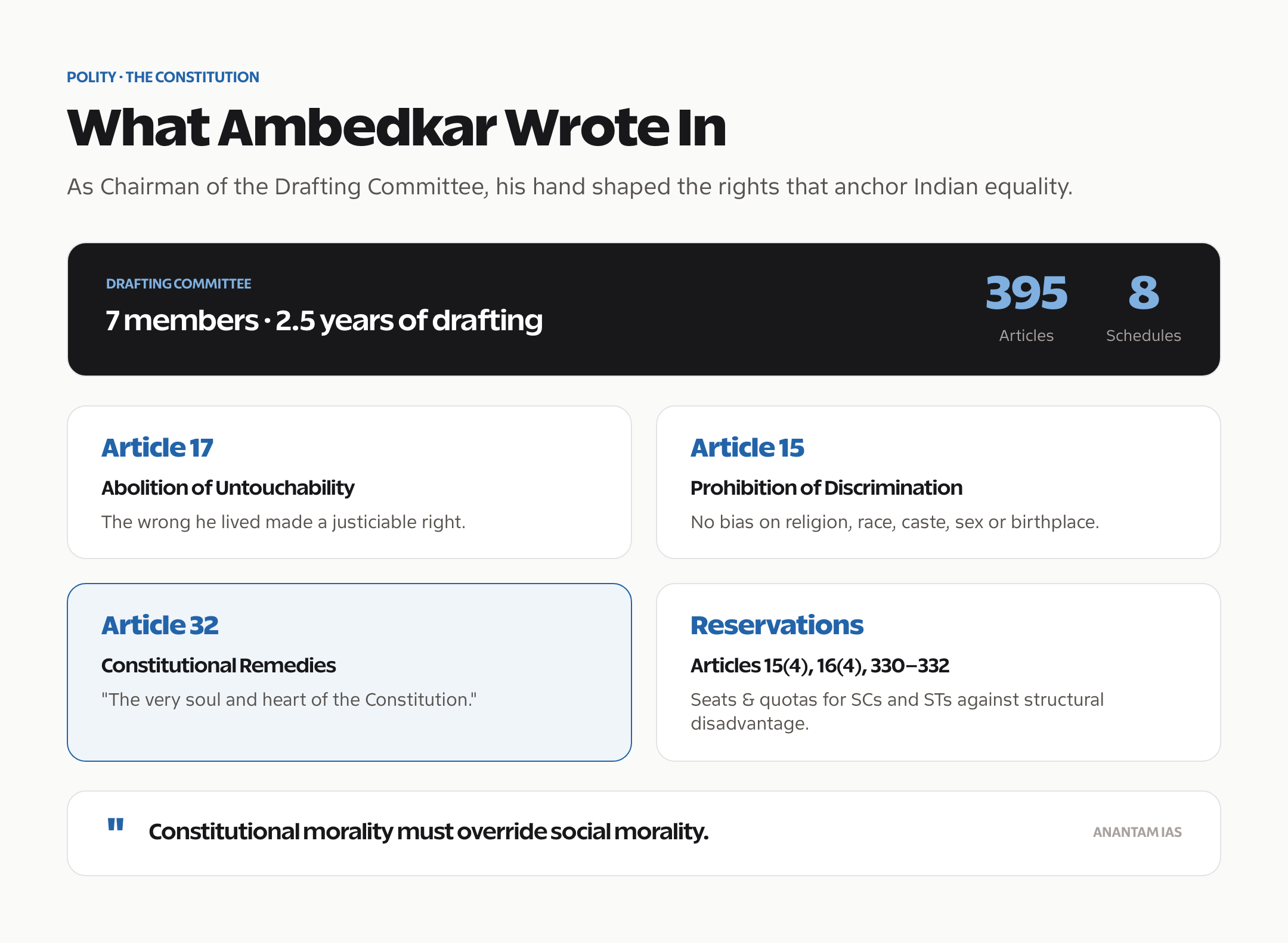
In July 1947, the Constituent Assembly appointed a Drafting Committee of seven members to draft the Constitution of India. BR Ambedkar was elected Chairman of the Drafting Committee — a decision that Nehru and Patel actively supported, recognising Ambedkar’s unmatched legal expertise and his political indispensability for Dalit support.
Ambedkar’s Role
The Drafting Committee’s work was extraordinary — over 2.5 years, they drafted a document of 395 Articles and 8 Schedules (later expanded) in a period of national emergency (Partition, communal violence, mass refugee movements, integration of 562 princely states).
Ambedkar personally drafted much of the Constitution’s text. He was its dominant intellectual force. His specific contributions include:
Constitutional Morality vs Social Morality: Ambedkar argued in a famous speech that the Constitution was committing India to a fundamental reorganisation of its social relations — that constitutional morality (equal rights, non-discrimination) must override social morality (existing caste hierarchies, customs, and practices). This was a direct challenge to the argument that India should simply constitutionalise its existing social structures.
Fundamental Rights (Part III): Ambedkar was the driving force behind the inclusion of strong, justiciable Fundamental Rights — including Article 17 (abolition of Untouchability) and Article 15 (prohibition of discrimination on grounds of religion, race, caste, sex, or place of birth). He wanted these rights enforceable in court, not merely aspirational.
Directive Principles (Part IV): While opposed to the non-justiciable character of DPSPs, Ambedkar argued for including economic rights (right to work, equal pay, living wage) as goals the state must work toward.
Article 32: Ambedkar called Article 32 — the right to constitutional remedies — “the very soul and heart of the Constitution.” It makes Fundamental Rights enforceable by the Supreme Court and is itself a Fundamental Right.
Reservations (Articles 15(4), 16(4), 330-332): The provisions for reservations for Scheduled Castes and Scheduled Tribes in education, public employment, and legislatures reflect Ambedkar’s insistence that formal equality is not enough when historical disadvantage is structural.
The Closing Speech (November 25, 1949)
Ambedkar’s closing speech to the Constituent Assembly on November 25, 1949 — the day before the Constitution was adopted — is one of the greatest speeches in Indian political history.
He said India was entering a life of contradictions: it had political democracy, but not social democracy. It had granted one man one vote, one man one value — but its social structure denied equal value to people based on caste. This contradiction, he warned, would destroy democracy if it was not resolved.
He also warned against hero worship — placing faith in leaders rather than in institutions. And he said: “However good a constitution may be, if those who are implementing it are not good, it will prove to be bad. However bad a constitution may be, if those implementing it are good, it will prove to be good.”
He resigned from Nehru’s cabinet in September 1951 over the Hindu Code Bill — a comprehensive reform of Hindu personal law (marriage, divorce, inheritance) that Ambedkar had drafted but that was being diluted and delayed by conservative opposition. He called it a betrayal of the promise of social reform.
The Dalit Movement and Political Thought
Annihilation of Caste (1936)
In 1936, Ambedkar was invited to preside over the annual conference of the Jat-Pat Todak Mandal — a Hindu reform organisation that worked against caste. He prepared his presidential address — but the organisers, after reading the text, cancelled the conference. They found his arguments too radical: he had argued that caste could not be reformed because it was grounded in Hindu scripture, and the scriptures themselves must be rejected.
Ambedkar published the speech as a pamphlet — Annihilation of Caste — and it became the most important text of the anti-caste movement. He argued:
- Caste is not just a social division of labour — it is a division of labourers, with different grades of dignity
- Caste is grounded in the religious texts of Hinduism (Vedas, Manusmriti) — it cannot be reformed while those texts are treated as sacred authority
- The only way to end caste is to reject the religious framework that justifies it
- Gandhi’s reform approach (anti-untouchability without attacking caste hierarchy) was self-defeating
Gandhi’s response and Ambedkar’s counter-response were published as a famous exchange that remains one of the most important debates in Indian intellectual history.
Thoughts on Pakistan (1940)
Pakistan or the Partition of India (1940) was Ambedkar’s scholarly analysis of the two-nation theory. He argued — controversially — that partition might be preferable to forcing Muslims to live in a Hindu-majority state that could not guarantee their genuine equality. His analysis was based on historical evidence of what had happened to Untouchables in Hindu society — he applied the same standard to Muslim minority concerns.
This text is regularly cited by scholars of partition history. Ambedkar was neither pro-partition nor opposed to it in a simple sense — he was applying his constitutional standard: will minorities have real equality, or formal equality that conceals real subordination?
Buddhist Conversion (1956)
For two decades, Ambedkar had been investigating alternatives to Hinduism. He had publicly stated in 1935 that while he was born a Hindu, he would not die one.
He studied Christianity (rejected as foreign), Islam (rejected as egalitarian in theory but not in practice), and Sikhism (negotiations about conversion were discussed but did not succeed). He turned to Buddhism.
On October 14, 1956 — six weeks before his death — at Nagpur, Ambedkar converted to Buddhism in one of the largest mass religious conversions in history. He took the three refuges and five precepts from a Buddhist monk, then administered the same vows to approximately 600,000 people who had gathered.
He then made 22 vows — a document that is essential reading for understanding his Buddhism. The vows rejected the Hindu deities, the caste system, the Brahmins’ ritual monopoly, and expressed commitment to equality, reason, and Buddhist ethics.
He died on December 6, 1956 — the date now observed as Mahaparinirvan Diwas, a national holiday in Maharashtra and a day of mass pilgrimage to his memorial at Chaityabhoomi, Mumbai.
Legacy of BR Ambedkar
| Area | Contribution | Current Relevance |
|---|---|---|
| Constitution | Chairman, Drafting Committee; Articles 17, 32, 15, 16 | Foundation of all constitutional rights |
| Labour law | Minimum Wages Act 1948, PF Act, Maternity Benefit — he was Labour Member in Viceroy’s Council 1942–46 | Worker protections still operative |
| Water policy | Chaired Central Waterways, Irrigation and Navigation Commission | River valley planning in independent India |
| Economic thought | Doctoral work on Indian finance; critique of agrarian economy | Historical economics scholarship |
| Social reform | Anti-untouchability movement; temple entry; self-respect | SC/ST Act, reservations, Article 17 |
| Buddhism | Mass conversion; Ambedkarite Buddhism | Navayana Buddhism; millions of followers |
| Education | Peoples Education Society; multiple colleges | Siddharth College and others still operate |
Key Dates: BR Ambedkar
| Year | Event |
|---|---|
| 1891 | Born in Mhow, MP, April 14 |
| 1913–17 | Studies at Columbia University |
| 1917–23 | Studies at LSE; Gray’s Inn Bar |
| 1920 | Founds Mooknayak newspaper |
| 1924 | Founds Bahishkrit Hitakarini Sabha |
| 1927 | Mahad Satyagraha; burns Manusmriti |
| 1930–31 | Round Table Conferences; separate electorates demand |
| 1932 | Communal Award; Poona Pact |
| 1936 | Publishes Annihilation of Caste; founds Independent Labour Party |
| 1942–46 | Labour Member in Viceroy’s Executive Council |
| 1947–49 | Chairman, Constitution Drafting Committee |
| 1951 | Resigns from Nehru’s cabinet over Hindu Code Bill |
| 1956 | Converts to Buddhism (October 14); dies December 6 |
Frequently Asked Questions
Where did Ambedkar study and how did his education shape his politics?
Ambedkar earned his PhD from
Columbia University (under John Dewey’s influence) and a DSc from the London School of Economics, and was called to the Bar from Gray’s Inn. His education gave him mastery of economics, law, and political theory. Crucially, it gave him the intellectual tools to argue on equal terms with British officials and nationalist leaders, and exposed him to democratic and constitutional philosophy that shaped his vision for India.nnWhat was the Mahad Satyagraha?
The Mahad Satyagraha (March 20, 1927) was Ambedkar’s first major direct action. He led thousands of Dalits to the Chavadar Tank in Mahad, Maharashtra, to assert their right to drink from a public water tank from which they had been excluded. In December 1927, he also publicly burned a copy of the Manusmriti. It was the founding act of the modern Dalit rights movement.
Chairman of the Drafting Committee of the Constituent Assembly (1947–49). He was the principal drafter of the Constitution’s text and its dominant intellectual force. He championed justiciable Fundamental Rights (especially Article 17 abolishing Untouchability and Article 32 on constitutional remedies), reservations for Scheduled Castes and Tribes, and constitutional morality over social customs.nnWhy did Ambedkar convert to Buddhism?
Ambedkar converted because he concluded that caste was inseparable from Hindu religious scripture and could not be reformed from within. He had studied multiple religions and found Buddhism — with its emphasis on reason, equality, and rejection of caste — most compatible with his values. On October 14, 1956, at Nagpur, he converted along with approximately 600,000 followers. He made 22 vows explicitly rejecting Hinduism’s caste framework.
What is Annihilation of Caste?
Annihilation of Caste (1936) is Ambedkar’s most important social-political text. He argues that caste cannot be reformed because it is grounded in Hindu religious texts, which must therefore be rejected. He challenges both the Congress’s Gandhi-led reform approach and orthodox Hinduism. The pamphlet is the foundational text of the Dalit liberation movement and one of the most important works in Indian social thought.