BrahMos Missile: India’s Supersonic Cruise Missile and the Indo-Russian Defence Story
BrahMos is the world's fastest operational supersonic cruise missile and the flagship of Indo-Russian defence cooperation. Here is the full UPSC explainer — ramjet propulsion, Mach 2.8–3 speed, 290 to 800 km range variants, land, sea, air and submarine launch, BrahMos-NG, BrahMos-II hypersonic plans, Philippines export.
The BrahMos missile is the world’s fastest operational supersonic cruise missile and the most successful Indo-Russian defence project to date. Jointly developed by India’s Defence Research and Development Organisation (DRDO) and Russia’s NPO Mashinostroyeniya (NPOM), the BrahMos missile flies at Mach 2.8 to 3 — roughly three times the speed of sound — and has been adapted for launch from land, sea, air and underwater platforms. The name BrahMos is a portmanteau of the Brahmaputra and Moskva rivers, signalling the partnership at its core. Originally restricted to a 290 km range under the Missile Technology Control Regime (MTCR), the BrahMos missile family has since been extended to 450 km, 800 km and beyond, with the BrahMos-NG and BrahMos-II hypersonic variants under active development. In 2022 India signed a $375 million export contract to supply the BrahMos missile to the Philippines, the first overseas customer, marking a defining moment for Indian defence exports.
For UPSC, the BrahMos missile spans GS-III internal security and defence indigenisation, GS-II India–Russia relations and the MTCR, and GS-III science and technology. It is a frequent Prelims fact-test and a recurring Mains case study on indigenous capability, DRDO’s institutional history and arms exports.
Origins of the BrahMos Missile
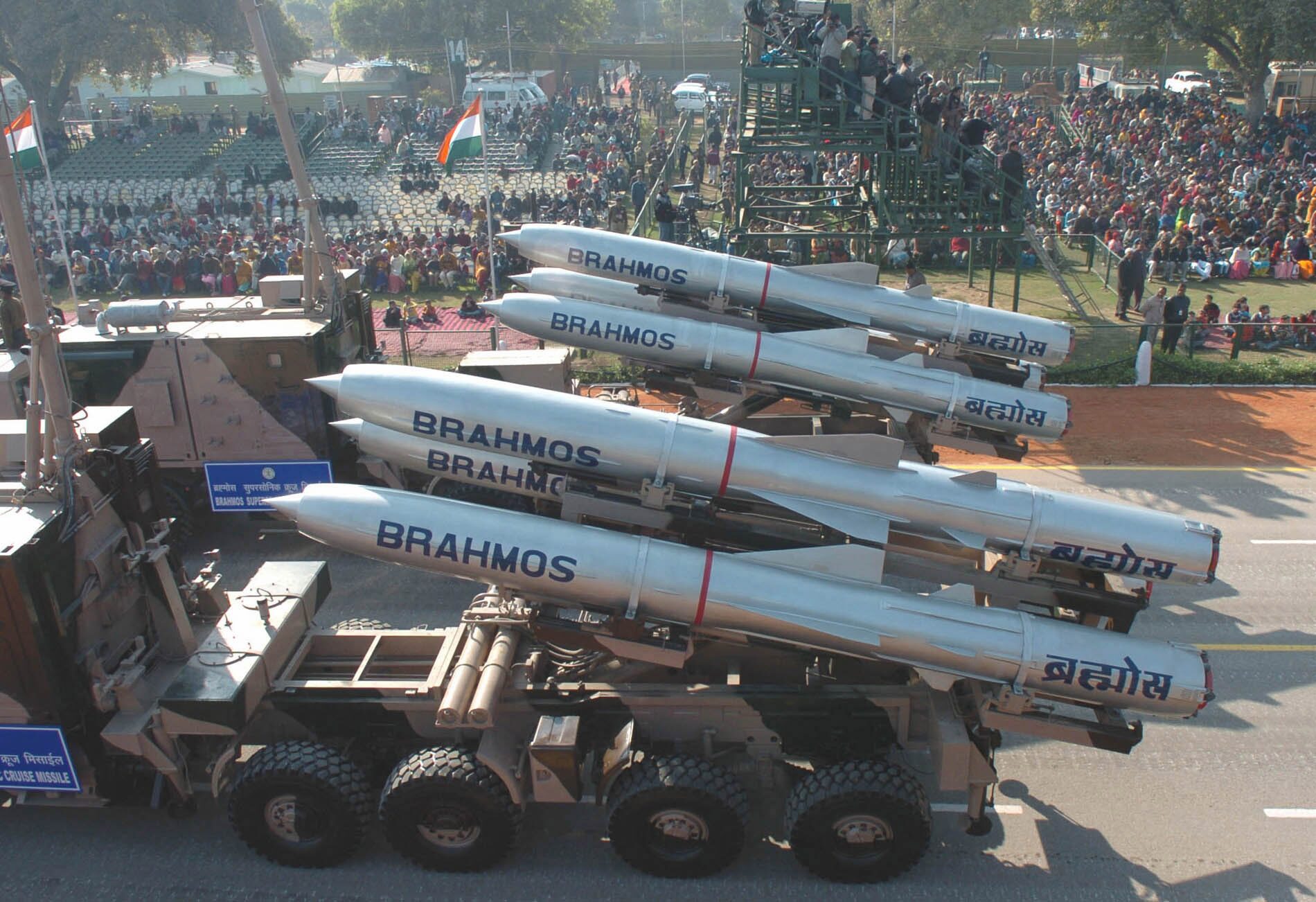
The BrahMos missile traces its origin to a 1998 inter-governmental agreement between India and Russia. India needed a long-range, precision-strike cruise missile that no domestic programme had yet delivered. Russia held the technology for the P-800 Oniks (Yakhont) supersonic anti-ship missile but lacked the capital and the markets to develop it further after the Soviet collapse. The agreement created BrahMos Aerospace Private Limited as a joint venture — 50.5 per cent owned by India (DRDO) and 49.5 per cent by Russia (NPOM).
The 1998 Inter-Governmental Agreement
Signed on 12 February 1998 by India’s then defence minister and Russia’s deputy prime minister, the agreement authorised joint design, development, production and marketing of a supersonic cruise missile derived from the P-800 Oniks. India contributed the airframe modifications, fire-control software, guidance and a significant share of the funding. Russia contributed the ramjet engine, propulsion technology and seekers. The first BrahMos missile test flight was conducted in June 2001 from the Integrated Test Range at Chandipur, Odisha.
Why a Supersonic Cruise Missile
Most cruise missiles in service worldwide — the American Tomahawk, the French SCALP, the Pakistani Babur — are subsonic, flying at around Mach 0.8. The BrahMos missile broke that mould. A supersonic cruise missile delivers three decisive battlefield advantages — it compresses the enemy’s reaction time, it strikes harder due to greater kinetic energy at impact, and it is far more difficult for air defence systems to intercept. The trade-off is range. The same MTCR ceiling of 300 km that constrained early Indian missile exports also applied to BrahMos until India joined the MTCR in 2016.
How the BrahMos Missile Works
The BrahMos missile is a two-stage weapon. A solid-propellant booster lifts it off the launcher and accelerates it to supersonic speed. The booster then separates and a liquid-fuelled ramjet engine sustains cruise at Mach 2.8 to 3 to the target.
Ramjet Propulsion
The ramjet is the heart of the BrahMos missile. Unlike a turbojet, a ramjet has no moving compressor; it uses the missile’s own forward velocity to compress incoming air. This makes it light and powerful but only works at supersonic speeds — which is why the solid booster is needed for take-off. Russia’s NPOM contributed the ramjet design, derived from the P-800 Oniks. The BrahMos ramjet burns kerosene and gives the missile a cruise endurance of several minutes at supersonic speed.
Flight Profile and Accuracy
The BrahMos missile can fly a sea-skimming profile as low as 10 metres above the water, or a high-altitude profile up to 15 km. It uses an inertial navigation system supplemented by satellite guidance (GLONASS, GPS, NavIC) for mid-course updates, and an active radar seeker for terminal homing. Circular error probable is reported to be under one metre, making the BrahMos missile a precision strike weapon.
Warhead
The BrahMos missile carries a 200 to 300 kg conventional warhead. Russia, as a signatory of the MTCR, did not transfer nuclear warhead technology; the BrahMos missile is officially a conventional weapon. The kinetic energy at impact is the primary destructive mechanism — a 3,000 kg missile travelling at Mach 3 carries enormous momentum.
BrahMos Missile Variants
The BrahMos missile has been adapted for every launch platform.
Land-Launched BrahMos
The land-attack version was the first inducted, deployed with the Indian Army from 2007 on a mobile autonomous launcher (MAL) vehicle. Each regiment fields multiple launchers, each carrying three missiles. The land variant strikes both fixed targets and moving formations.
Ship-Launched BrahMos
The Indian Navy was the first user of the BrahMos missile, deploying it on the INS Rajput in 2005 in vertical-launch configuration. Today every new Indian destroyer and frigate carries BrahMos in eight or sixteen-cell vertical launchers. The naval BrahMos is the world’s only supersonic anti-ship cruise missile in active service.
Air-Launched BrahMos-A
The air-launched BrahMos-A weighs 2,500 kg — lighter than the 3,000 kg surface variant. It was integrated on the Sukhoi Su-30MKI fighter and first test-fired in November 2017. The BrahMos-A gives the Indian Air Force a stand-off precision strike capability against high-value targets at sea or on land from over 400 km away. A BrahMos-armed Su-30MKI squadron is now based at Thanjavur in southern India to cover the Indian Ocean.
Submarine-Launched BrahMos
A submarine-launched variant has been tested from a submerged pontoon and is under development for deployment from Indian Navy submarines. It would give Indian submarines a long-range cruise-missile strike option.
BrahMos-NG (Next Generation)
BrahMos-NG is a lighter, smaller, faster successor in advanced development. Weighing about 1,500 kg — half the original — and 5 metres long, BrahMos-NG will fit smaller fighters such as the Tejas Mk1A and Mk2, and on submarine torpedo tubes. It retains the Mach 3.5 speed class and 290 km range with a smaller airframe. First flight tests are expected by 2026–27.
BrahMos-II (Hypersonic)
BrahMos-II is the planned hypersonic version, targeting Mach 7 to 8 speeds using a scramjet engine rather than a ramjet. India and Russia have been working on the design for over a decade; the programme has accelerated since 2022. BrahMos-II will eventually be the only hypersonic cruise missile of its class outside the Russian Zircon and Chinese DF-100. Development timelines remain confidential.
Range Extensions and the MTCR
The original BrahMos missile was capped at 290 km because both India and Russia were operating under the Missile Technology Control Regime cap of 300 km on missile exports. India formally joined the MTCR in 2016, removing that restriction. Within months DRDO test-fired an extended-range BrahMos missile to 400 km in March 2017, then to 450 km. A subsequent test in 2023 demonstrated an 800 km range with land-attack variants. Further range extensions of 1,000 km and beyond are under development, transforming the BrahMos missile from a tactical cruise weapon into a near-strategic one.
BrahMos and the Philippines Export
The BrahMos missile became India’s first major defence export when the Philippines signed a $375 million contract in January 2022 for three coastal-defence batteries. The first battery was delivered in April 2024 and the second in 2025. The deal proved that an Indo-Russian joint venture could export a complex weapon to a third country — a first for India’s defence-export ambitions. Negotiations with Vietnam, Indonesia, Argentina and several Gulf states are reportedly under way.
For data on India’s overall arms-export trajectory and global ranking, see the SIPRI 2025 report on India’s defence and arms data.
BrahMos in Operations
The BrahMos missile has been integrated into Indian Army, Navy and Air Force doctrine and exercised extensively. Reports indicate Indian forces used precision cruise-missile strikes during Operation Sindoor in May 2025; though specific weapons are classified, defence analysts widely point to the BrahMos missile as central to the strike packages. The combination of speed, accuracy and range gave Indian planners a stand-off option that no comparable platform offered.
Strategic Significance
The BrahMos missile is more than a weapon; it is a strategic signal.
Indigenisation
DRDO sources today design and manufacture about 65 per cent of the BrahMos missile in India. Indian industry produces the airframe, mission computer, fire-control software, ground support equipment and propellants. The ramjet remains largely Russian. Successive variants are increasing the Indian content.
Deterrence Architecture
The BrahMos missile, alongside the Agni missile series and the S-400 Triumf air-defence systems, forms the conventional precision-strike layer of India’s deterrence architecture. The Agni series provides strategic strike, BrahMos provides theatre-level precision, and S-400 provides the defensive shield.
Indo-Russian Relations
The BrahMos missile is the showpiece of Indo-Russian defence cooperation. Even amid global sanctions on Russia after 2022, the BrahMos joint venture has continued production and exports. The programme demonstrates that joint-venture defence development — not just import — can work.
Why the BrahMos Missile Matters for UPSC
The BrahMos missile is among the most heavily tested defence topics in UPSC.
Prelims Facts
- Indo-Russian joint venture — DRDO + NPO Mashinostroyeniya
- Name from Brahmaputra + Moskva rivers
- Two-stage — solid booster + liquid ramjet
- Speed — Mach 2.8 to 3 (supersonic)
- Original range 290 km (MTCR cap); extended to 450 km and 800 km after India joined MTCR in 2016
- Variants — land, ship, air (BrahMos-A on Su-30MKI), submarine, BrahMos-NG (lighter), BrahMos-II (hypersonic)
- First export — Philippines, $375 million, January 2022
Mains Angles
- Indigenisation of defence production and Atmanirbhar Bharat
- India–Russia strategic partnership
- MTCR membership and its consequences for exports
- Defence exports as a foreign-policy tool
- Joint-venture model versus import-only procurement
- Hypersonic competition with China and Russia
The BrahMos missile demonstrates that a long-term joint-venture model can deliver a globally competitive weapon system while building domestic engineering depth. It anchors India’s transition from arms importer to arms exporter and remains a Prelims and Mains favourite for the foreseeable future.
Frequently Asked Questions
What is the BrahMos missile?
The BrahMos missile is a supersonic cruise missile jointly developed by India’s DRDO and Russia’s NPO Mashinostroyeniya. It flies at Mach 2.8 to 3 — three times the speed of sound — and can be launched from land, ship, submarine and aircraft platforms. The BrahMos missile is named after the Brahmaputra and Moskva rivers, symbolising the Indo-Russian partnership.
What is the range of the BrahMos missile?
The original BrahMos missile had a 290 km range due to the Missile Technology Control Regime cap of 300 km. After India joined the MTCR in 2016, the range was extended to 450 km and then to 800 km in 2023 tests. Variants with ranges up to 1,500 km are under development. The BrahMos-NG retains the 290 km range in a smaller airframe.
How fast is the BrahMos missile?
The BrahMos missile cruises at Mach 2.8 to 3 — roughly 3,400 to 3,700 kilometres per hour. This makes it the world’s fastest operational supersonic cruise missile and gives it twin advantages of compressed enemy reaction time and high kinetic impact energy. The planned BrahMos-II hypersonic variant will reach Mach 7 to 8.
Who makes the BrahMos missile?
The BrahMos missile is manufactured by BrahMos Aerospace Private Limited, a joint venture established in 1998 between India’s DRDO (50.5 per cent) and Russia’s NPO Mashinostroyeniya (49.5 per cent). About 65 per cent of the missile is now produced in India, including the airframe, mission computer and fire-control software.
Which platforms can launch the BrahMos missile?
The BrahMos missile can be launched from land (mobile autonomous launcher), surface ships (vertical launchers), aircraft (BrahMos-A from the Sukhoi Su-30MKI) and from submarines (variant under development). The land version is operated by the Indian Army, the ship version by the Navy and the air version by the Air Force.
Which country first imported the BrahMos missile?
The Philippines became the first country to import the BrahMos missile after signing a $375 million contract in January 2022 for three coastal-defence batteries. The first battery was delivered in April 2024. Negotiations with Vietnam, Indonesia, Argentina and several other countries are reportedly under way.
What is BrahMos-NG?
BrahMos-NG (Next Generation) is a lighter and smaller successor to the BrahMos missile, weighing about 1,500 kg and 5 metres long. It will fit on smaller fighter aircraft such as the Tejas Mk1A and Mk2, and on submarine torpedo tubes. First flight tests are expected in 2026–27 and induction in the late 2020s.
What is BrahMos-II?
BrahMos-II is the planned hypersonic version of the BrahMos missile, designed to reach Mach 7 to 8 using a scramjet engine. India and Russia have been collaborating on the design for over a decade. BrahMos-II would join a small global hypersonic-cruise category alongside the Russian Zircon and the Chinese DF-100.