BRICS Summit 2024 Kazan: Outcomes, Members & UPSC Notes
BRICS Summit 2024 held in Kazan, Russia expanded the bloc, pushed de-dollarisation, and saw India-China border breakthrough. Full UPSC notes.
The BRICS Summit 2024, the 16th BRICS Summit, was hosted by Russia in the city of Kazan from 22 to 24 October 2024 under the theme "Strengthening Multilateralism for Just Global Development and Security". This was the first summit after the bloc's historic January 2024 expansion, when it admitted Egypt, Ethiopia, Iran, and the UAE as full members, nearly doubling its size. Prime Minister Narendra Modi attended the summit and, on its sidelines, held his first structured bilateral with Chinese President Xi Jinping in five years following the India-China border patrolling agreement on the LAC. For UPSC aspirants, the Kazan Summit is a high-yield topic across GS-II (international groupings), GS-III (global economy, currency, trade), and essay.
What Is BRICS
BRICS is an intergovernmental grouping that began as a concept coined by Goldman Sachs economist Jim O'Neill in 2001 (as "BRIC"). South Africa joined in 2010, turning it into BRICS. Unlike the G7, BRICS is not a treaty-based organisation and has no permanent secretariat; it rotates chairmanship and uses consensus.
Core BRICS mechanisms:
- Annual leaders' summit, rotating across members.
- New Development Bank (NDB) — headquartered in Shanghai, established 2014, inaugurated 2015.
- Contingent Reserve Arrangement (CRA) — a USD 100-billion financial safety net.
- Finance, foreign ministers', national security advisors' and sherpa-level tracks.
BRICS Membership After 2024 Expansion
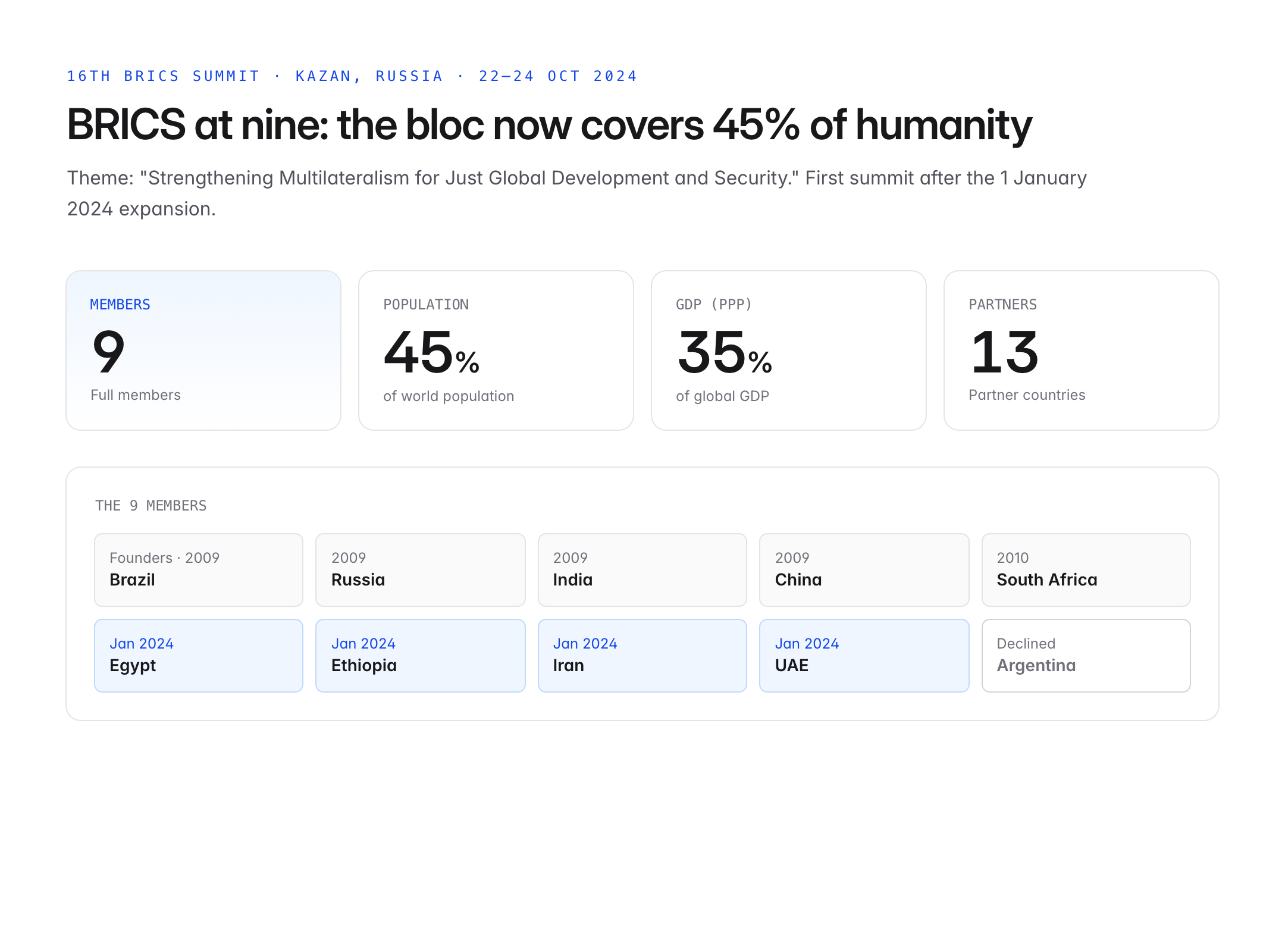
| Stage | Members |
|---|---|
| Founding (2009, Yekaterinburg) | Brazil, Russia, India, China |
| 2010 | + South Africa (BRICS) |
| 1 January 2024 expansion | + Egypt, Ethiopia, Iran, UAE |
| Invited but declined | Saudi Arabia (still under consideration); Argentina (withdrew under new Milei government) |
With 9 full members, BRICS now represents roughly 45% of the world's population and about 35% of global GDP (PPP). At Kazan, a "BRICS partner country" category was introduced, with 13 countries invited as partners (including Belarus, Bolivia, Cuba, Kazakhstan, Malaysia, Nigeria, Thailand, Turkey, Uganda, Uzbekistan, and others).
Kazan Summit 2024: Key Outcomes
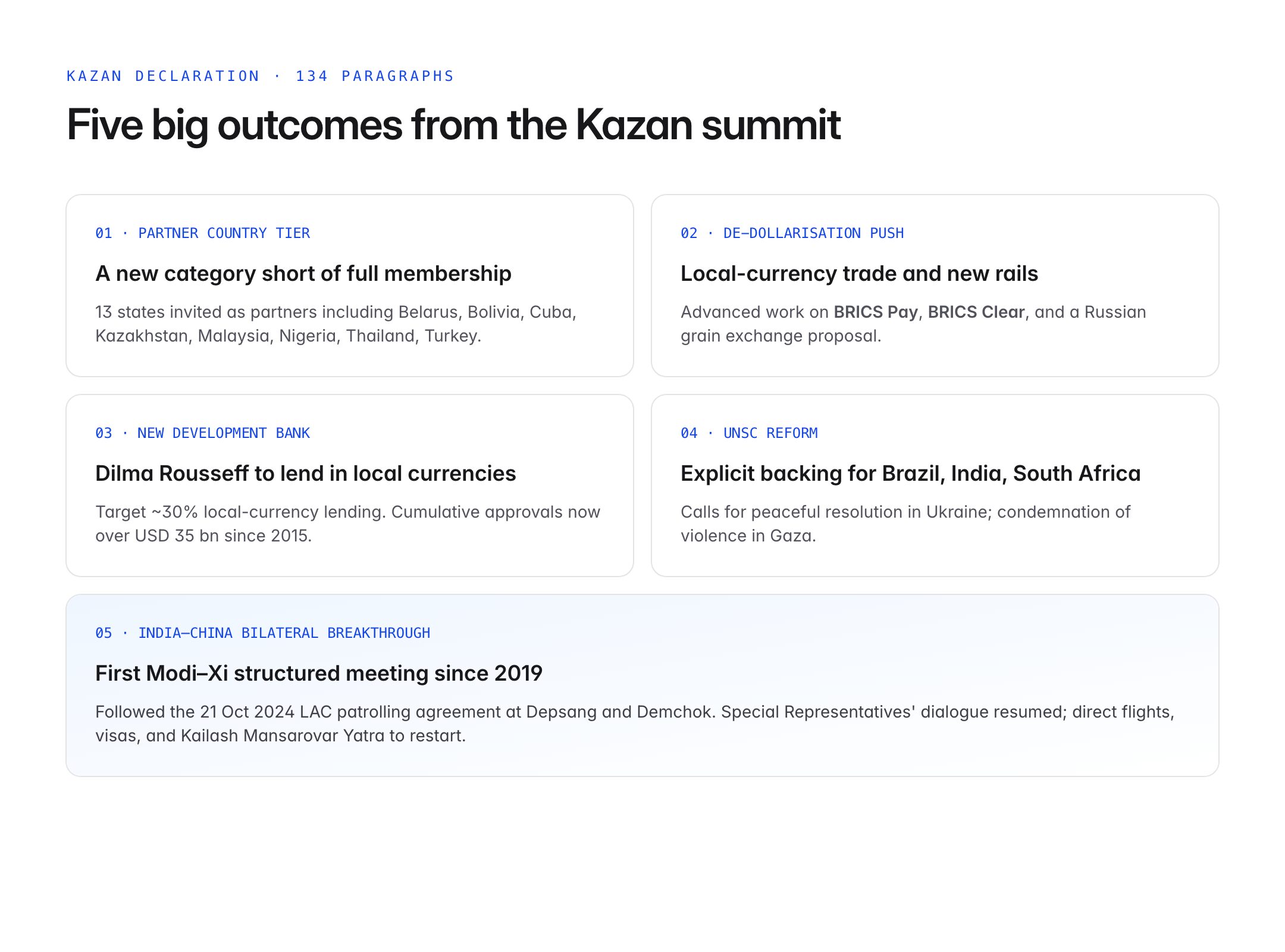
The summit produced the Kazan Declaration, a 134-paragraph document covering geopolitics, economy, and cooperation.
Expansion and partner country category. BRICS formalised the "partner country" tier, a lighter form of association short of full membership. This addresses the queue of over 30 countries that had expressed interest in joining.
Financial architecture and de-dollarisation. Leaders endorsed greater use of local currencies in intra-BRICS trade and advanced work on:
- BRICS Pay — a decentralised retail cross-border payments system.
- BRICS Clear — a settlement and depository platform to reduce reliance on Western clearing systems.
- A BRICS grain exchange proposal by Russia.
- Continued discussion of a potential BRICS common currency (long-term, not imminent).
New Development Bank. The NDB, under President Dilma Rousseff, was tasked to lend more in local currencies (target around 30%), expand sustainable infrastructure, and admit more non-BRICS members.
Ukraine, Gaza, and reform of global governance. The declaration called for peaceful resolution of the Ukraine conflict, condemned violence in Gaza, and pushed for UN Security Council reform, with explicit support for the aspirations of Brazil, India, and South Africa for a greater role.
Climate and SDGs. BRICS members endorsed climate justice, common but differentiated responsibilities (CBDR), and opposed unilateral trade measures like carbon border adjustments.
India at Kazan
Prime Minister Modi delivered a speech that stressed three messages:
- BRICS should not be seen as anti-Western or anti-dollar, but as pro-multipolar.
- It should remain consensus-driven and respect sovereignty.
- Cooperation should focus on reformed multilateralism, counter-terrorism, digital public infrastructure, climate finance, supply chains, and AI governance.
India showcased its Digital Public Infrastructure (DPI) — UPI, Aadhaar, DigiLocker — as a BRICS-ready model, and pushed for cooperation on startups, skill development, and traditional medicine.
India-China Bilateral Breakthrough
Just before the summit, India and China announced (21 October 2024) an agreement on patrolling arrangements in eastern Ladakh at the remaining friction points of Depsang and Demchok. This unlocked the first bilateral meeting between Modi and Xi Jinping since the 2019 Mamallapuram summit, following the 2020 Galwan clash.
Key takeaways from the bilateral:
- Resumption of Special Representatives' dialogue on the boundary question (NSA Doval and FM Wang Yi).
- Restart of direct flights, visas, and people-to-people ties.
- Resumption of the Kailash Mansarovar Yatra.
- Agreement to manage differences without letting them become disputes.
New Development Bank and CRA Update
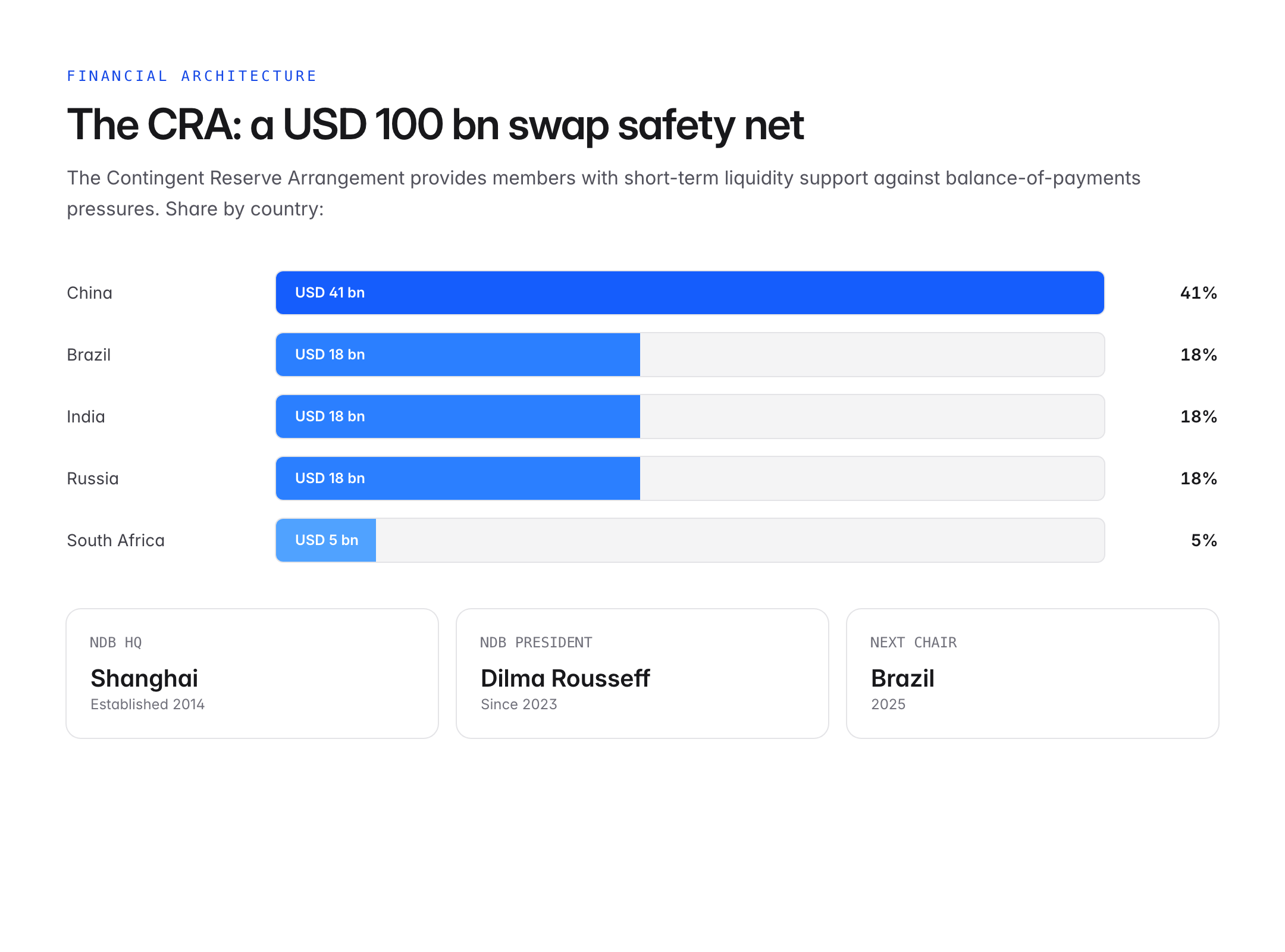
The New Development Bank (NDB) has cumulatively approved over USD 35 billion in projects since inception across infrastructure, clean energy, water, and transport. At Kazan, leaders supported:
- Expanding membership — Egypt, UAE, Bangladesh, Uruguay, and Algeria are among members or prospective members.
- Raising local-currency lending to reduce foreign exchange risk.
- Issuing bonds in member countries' currencies.
The CRA, a swap arrangement, remains a backstop: China USD 41 bn, Brazil, India, Russia USD 18 bn each, South Africa USD 5 bn.
Significance and Critique
Significance:
- BRICS is the most visible non-Western multilateral platform, balancing G7-centric institutions.
- Expansion brings strategic energy producers (Iran, UAE, Egypt) and African representation (Ethiopia, South Africa, Egypt).
- The payments and currency agenda reduces vulnerability to unilateral sanctions.
Critiques and challenges:
- Internal divergence — India-China rivalry, Iran-UAE-Egypt triangular tensions, differing views on Russia's war.
- No binding treaties — decisions remain voluntary.
- De-dollarisation is slow — the US dollar still dominates reserves and invoicing.
- Governance mismatch — China's GDP dwarfs the rest, raising concerns of a Beijing-centric bloc.
UPSC Relevance
Prelims focus:
- 16th BRICS Summit hosted in Kazan, Russia, 22–24 October 2024; theme on multilateralism.
- Four new members from 1 January 2024: Egypt, Ethiopia, Iran, UAE.
- Kazan Declaration; BRICS Pay, BRICS Clear, BRICS partner country category.
- NDB headquarters in Shanghai; President Dilma Rousseff.
- CRA size (USD 100 bn) and country shares.
- Next BRICS chair: Brazil (2025).
Mains GS-II angle:
- Role of BRICS in reforming global governance and push for UNSC reform.
- Implications of BRICS expansion for India's strategic autonomy.
- India-China relations after the 2024 LAC patrolling agreement.
Mains GS-III angle:
- De-dollarisation, local currency trade, and impact on India's trade policy and forex stability.
- NDB as an alternative infrastructure financier to the World Bank and ADB.
Sample PYQ angle: "How will the recent phenomena of protectionism and currency manipulations in world trade affect macroeconomic stability of India?" — candidates can use BRICS de-dollarisation, Kazan outcomes on BRICS Pay/Clear, and NDB local-currency lending as evidence of India's hedging strategy.