Introduction
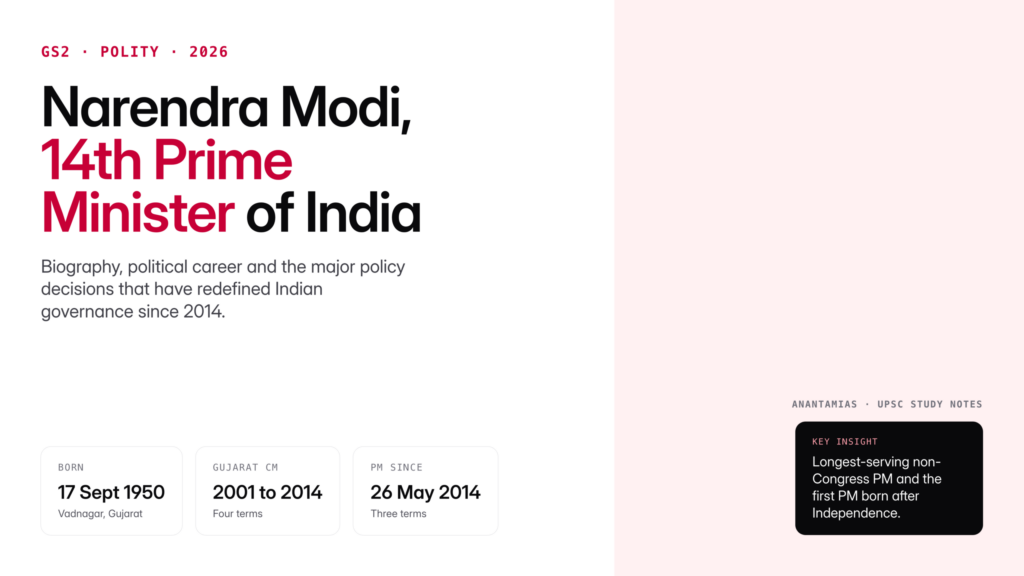
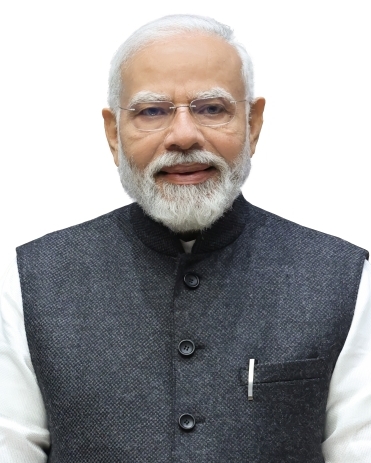
Narendra Damodardas Modi is the 14th Prime Minister of India, a post he has held continuously since May 2014 and to which he was re-elected in 2019 and again in 2024. For an aspirant preparing for the Civil Services Examination, Modi is not merely a political personality but the author of a large share of the policy architecture you will encounter in GS Paper 2 and GS Paper 3. From the Jan Dhan-Aadhaar-Mobile trinity to the Goods and Services Tax, from Ayushman Bharat to the Production Linked Incentive scheme, the Modi years have produced an unusually dense layer of schemes, legislative interventions and institutional reforms.
This study note stitches together the biographical timeline, the political career from Gujarat to the Lok Kalyan Marg, and the major policy decisions of three terms in office. The aim is to give you an exam-ready, syllabus-aligned profile that you can revise quickly before Prelims and quote with confidence in Mains answer writing, without the partisan varnish that colours most popular accounts.
Quick Facts at a Glance
| Attribute | Detail |
|---|---|
| Full Name | Narendra Damodardas Modi |
| Date of Birth | 17 September 1950, Vadnagar, Bombay State (now Gujarat) |
| Political Party | Bharatiya Janata Party (BJP) |
| Parent Organisation | Rashtriya Swayamsevak Sangh (RSS) |
| First Elected Post | Chief Minister of Gujarat, 7 October 2001 |
| Tenure as Gujarat CM | 2001 to 2014 (four consecutive terms) |
| Prime Minister Since | 26 May 2014 (three consecutive terms) |
| Lok Sabha Constituency | Varanasi, Uttar Pradesh |
| Notable Title | Longest-serving non-Congress Prime Minister |
Background and Historical Context
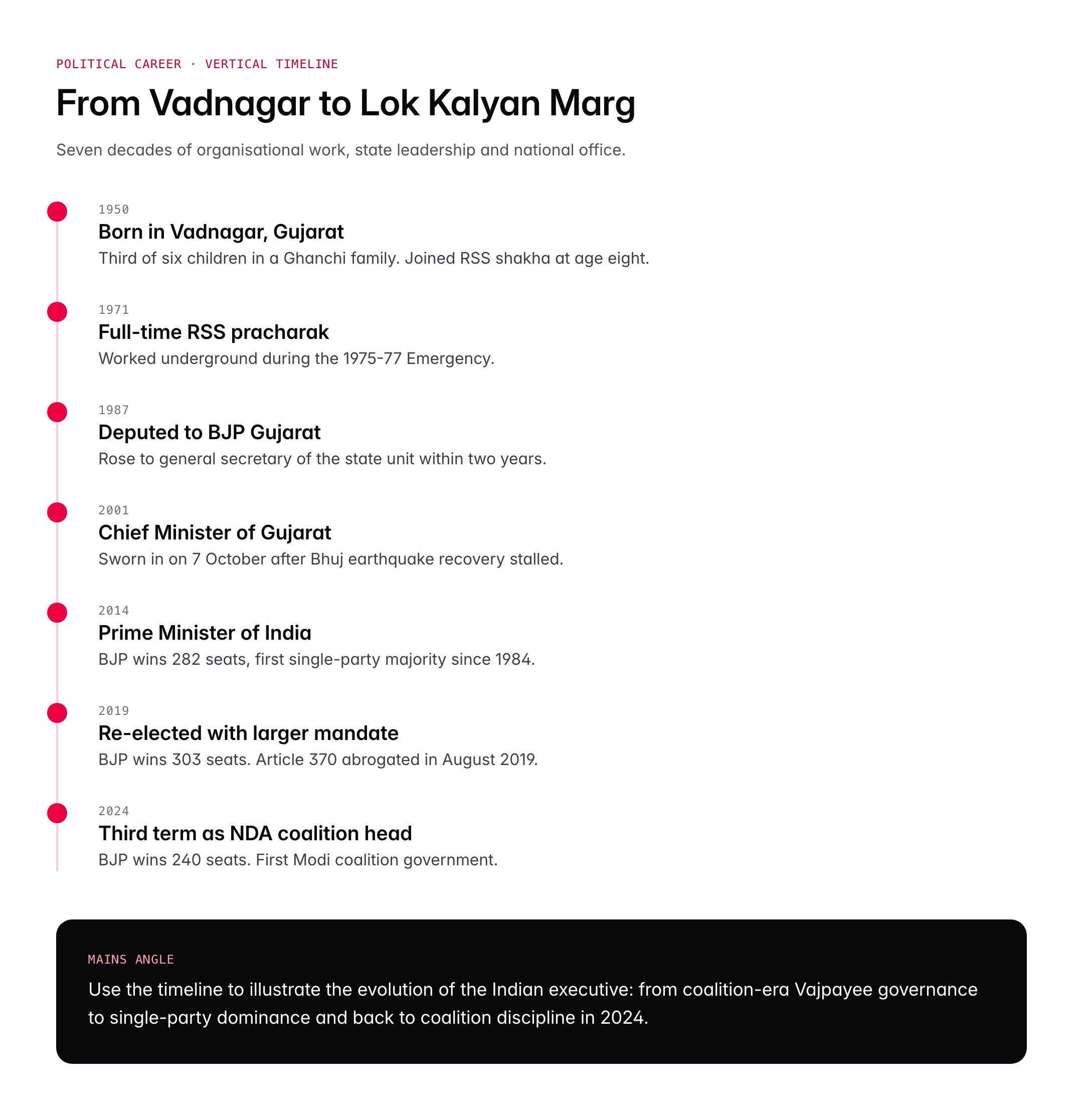
Narendra Modi was born in Vadnagar, a small town in Mehsana district of north Gujarat, in a modest Ghanchi family. His father ran a tea stall at the Vadnagar railway station, an autobiographical detail that has become central to his political self-presentation. He was drawn to the Rashtriya Swayamsevak Sangh as a young boy, attending shakhas in Vadnagar from the age of eight, and became a full-time pracharak in the early 1970s after a brief period of wandering that took him through the Himalayas and various Hindu monastic orders.
The 1970s shaped his political formation. He worked underground during the Emergency of 1975-1977 imposed by Prime Minister Indira Gandhi, distributing banned RSS literature and helping dissidents evade arrest. This period cemented his organisational skills and his critique of the Indian National Congress. In 1987 he was deputed from the RSS to the BJP in Gujarat, rising rapidly through the party machinery as general secretary of the state unit.
His early national role came in the mid-1990s when he was made BJP national secretary and assigned to organise the party in Haryana and Himachal Pradesh. By the time the BJP formed the Atal Bihari Vajpayee government at the Centre in 1998, Modi was one of the principal backroom strategists of the party. His appointment as Chief Minister of Gujarat in October 2001, replacing Keshubhai Patel, was initially a rescue operation after the devastating Bhuj earthquake and a series of by-election losses.
Key Features of His Political Career
Chief Minister of Gujarat, 2001 to 2014
Modi assumed office as Chief Minister of Gujarat on 7 October 2001 without prior experience in the state legislature or any ministerial brief. Within months he faced the most testing episode of his public life, the 2002 Gujarat riots, which broke out after the Godhra train burning of 27 February 2002 killed 59 kar sevaks returning from Ayodhya. The subsequent communal violence and the state’s response drew national and international criticism. A Special Investigation Team appointed by the Supreme Court, led by R K Raghavan, filed a closure report in 2012 stating it had found no prosecutable evidence against Modi; this was upheld by the Supreme Court in 2022.
Electorally, Modi led the BJP to victory in four consecutive Gujarat assembly elections in 2002, 2007, 2012 and, as the face of the campaign though not the candidate, in 2017. His administrative persona was built around the Vibrant Gujarat Global Investors Summit, launched in 2003, and around marketing Gujarat as an investment-friendly state. Economic indicators during his tenure showed high growth in manufacturing, infrastructure and agriculture, although scholars debate how much of this predated his arrival.
Rise to National Leadership
The BJP’s parliamentary board named Modi chairman of the central election campaign committee in June 2013 and prime ministerial candidate in September 2013, in a move that marked the end of L K Advani’s dominance of the party. The 2014 Lok Sabha election delivered an outright majority to the BJP, the first such single-party majority in thirty years, and Modi was sworn in as Prime Minister on 26 May 2014.
Prime Minister, 2014 to present
As Prime Minister he has contested and won three consecutive general elections, in 2014, 2019 and 2024. The first two produced single-party BJP majorities; the third returned the BJP as the largest party but below the halfway mark, making Modi’s third term a coalition government led by the National Democratic Alliance with the Telugu Desam Party and the Janata Dal (United) as critical partners.
Organisational and Oratorical Style
Modi’s style is marked by direct communication with citizens through monthly Mann Ki Baat radio addresses, heavy use of social media, and a preference for branded flagship schemes. He favours a presidential-style campaign in a parliamentary system, a feature that has drawn both praise for accountability and criticism for personalisation.
Significance for UPSC and General Knowledge
- Modi’s career offers the single most useful case study for GS Paper 2 topics on executive functioning, Centre-State relations, cooperative federalism and the role of the Prime Minister’s Office.
- His schemes, from Jan Dhan Yojana to PM Gati Shakti, anchor GS Paper 3 topics on financial inclusion, infrastructure, welfare architecture and the JAM trinity.
- Foreign policy shifts under Modi, particularly the Indo-Pacific strategy, Quad revival and Act East Policy, are standard material in GS Paper 2 international relations.
- The 2002 Gujarat riots and the judicial journey through SIT and the Supreme Court are essential reading for Essay and GS Paper 4 discussions on accountability and institutional processes.
- Flagship legislative acts like the GST, Insolvency and Bankruptcy Code, Aadhaar Act and the three repealed farm laws are high-yield Prelims and Mains material.
Detailed Analysis: Major Policy Decisions
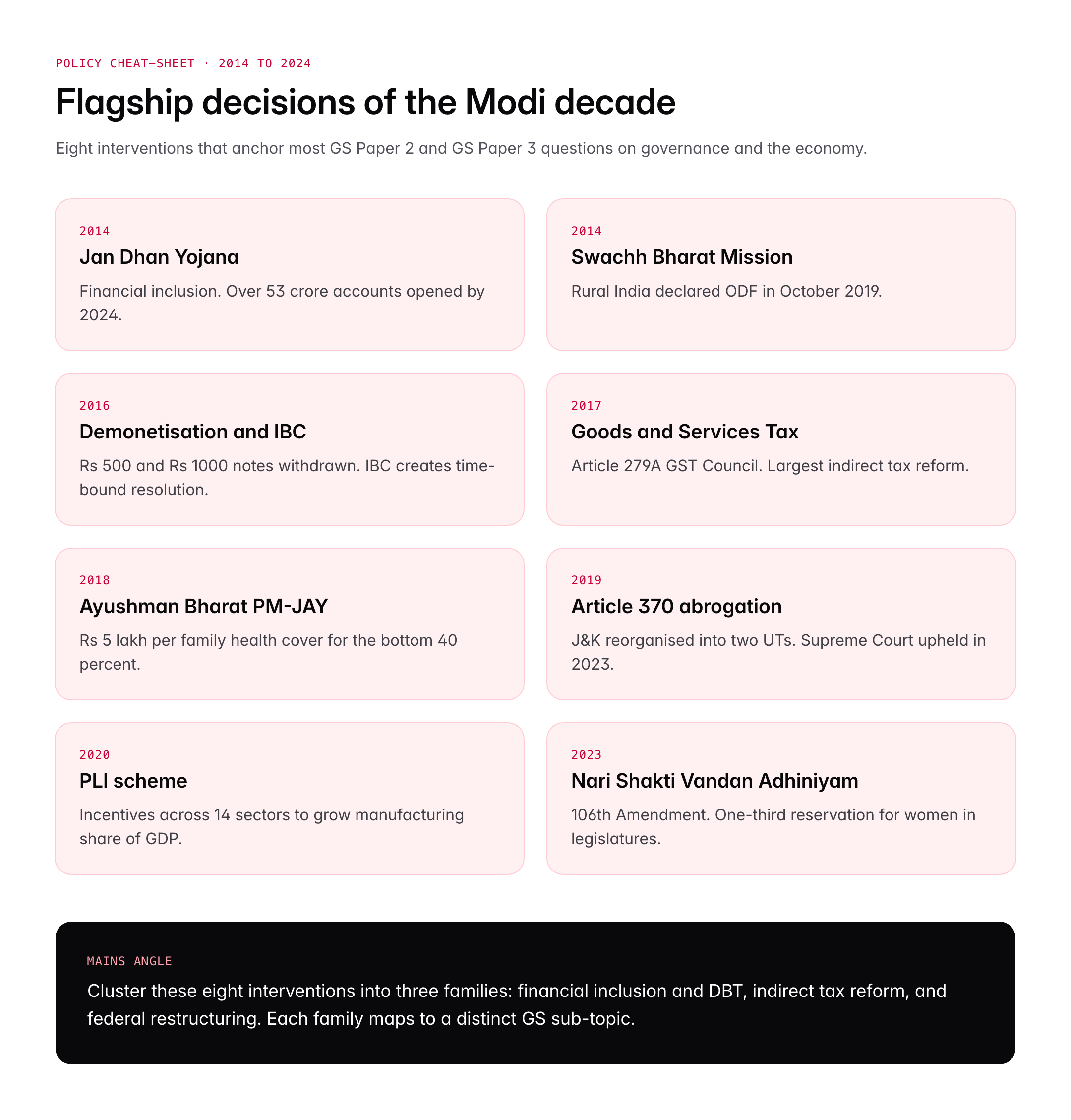
Jan Dhan Yojana (August 2014) was launched to bring every household into the banking net. As of 2024, it has opened more than 53 crore accounts, the bulk of which are held by women and rural households. It forms the first pillar of the JAM trinity, along with Aadhaar and mobile, which together enable direct benefit transfer of subsidies and have replaced a range of in-kind entitlements.
Swachh Bharat Mission (October 2014) pursued universal sanitation through construction of household toilets and behavioural change. By October 2019 the government declared rural India open defecation free, and the mission has since moved into a second phase focused on solid and liquid waste management.
Demonetisation (8 November 2016) withdrew the legal tender status of Rs 500 and Rs 1000 notes overnight. The stated objectives were to curb black money, counterfeit currency and terror financing, and to accelerate digitisation. Its macroeconomic effects, particularly on the informal economy and GDP growth in 2016-17 and 2017-18, remain contested in academic literature.
Goods and Services Tax (1 July 2017) subsumed seventeen central and state indirect taxes into a single levy administered through the GST Council, a constitutional body under Article 279A. It is the most significant indirect tax reform since Independence and a standard case study for cooperative federalism.
Insolvency and Bankruptcy Code, 2016 created a time-bound resolution framework for stressed corporate assets and made India climb sharply in the World Bank’s Ease of Doing Business rankings.
Abrogation of Article 370 (5 August 2019) reorganised the former state of Jammu and Kashmir into two Union Territories and repealed the special status provisions. The Supreme Court upheld the constitutional validity of the move in December 2023.
Ayushman Bharat Pradhan Mantri Jan Arogya Yojana (September 2018) provides health cover of Rs 5 lakh per family per year to the bottom 40 percent of the population, making it one of the largest publicly funded health assurance schemes in the world.
Production Linked Incentive scheme (2020 onwards) offers turnover-based incentives across fourteen sectors, from semiconductors to pharmaceuticals to textiles, with the stated aim of positioning India as a manufacturing hub and cutting the import bill in strategic sectors.
Repeal of the three farm laws (November 2021) followed a year-long farmers’ protest and is a rare instance of a major central government rollback, studied in GS Paper 2 under the limits of executive policy-making.
New Parliament Building and Nari Shakti Vandan Adhiniyam (2023) reserved one-third of seats in the Lok Sabha and state assemblies for women, subject to delimitation after the next Census.
Comparative Perspective
| Dimension | Jawaharlal Nehru | Indira Gandhi | Manmohan Singh | Narendra Modi |
|---|---|---|---|---|
| Tenure | 1947-1964 | 1966-1977, 1980-1984 | 2004-2014 | 2014-present |
| Dominant ideology | Fabian socialism, non-alignment | Statist socialism, Garibi Hatao | Market-friendly liberalisation | Hindutva-infused developmentalism |
| Signature economic move | Planning Commission, Five-Year Plans | Bank nationalisation, 1969 | WTO-era reforms continued, NREGA | GST, demonetisation, PLI |
| Foreign policy axis | Non-Aligned Movement | Indira Doctrine, 1971 Bangladesh war | Indo-US civil nuclear deal | Quad, Indo-Pacific, Act East |
| Institutional change | Built core institutions | Centralised executive power | Rights-based welfare laws | Digital public infrastructure |
The table shows that each long-serving prime minister has shifted the centre of gravity of Indian politics. Modi’s distinctiveness lies in combining a cultural-nationalist idiom with a technology-led welfare delivery system built on biometric identity and direct benefit transfers.
Controversies and Debates
Modi’s tenure has been the subject of substantial democratic debate. The 2002 Gujarat riots, the 2016 demonetisation, the Pegasus spyware allegations of 2021, the electoral bonds scheme struck down by the Supreme Court in 2024, and the handling of the first wave of Covid-19 in 2020 are the episodes most cited by critics. Press-freedom indices published by Reporters Without Borders and V-Dem data on democratic backsliding have registered declines in India since 2014, although the government disputes the methodology of such indices.
Supporters counter that his government has delivered high headline growth, expanded the direct benefit transfer architecture, modernised digital public infrastructure through UPI and CoWIN, and given India a more assertive foreign policy posture. A balanced Mains answer typically acknowledges both the administrative scale of his interventions and the procedural and civil-liberties concerns that have accompanied them.
Prelims Pointers
- Narendra Modi was born on 17 September 1950 in Vadnagar, Mehsana district, Gujarat.
- He became Chief Minister of Gujarat on 7 October 2001 and Prime Minister on 26 May 2014.
- He represents the Varanasi Lok Sabha constituency in Uttar Pradesh.
- Modi led the BJP to outright Lok Sabha majorities in 2014 and 2019, and a coalition NDA win in 2024.
- Jan Dhan Yojana was launched on 28 August 2014.
- Demonetisation of Rs 500 and Rs 1000 notes was announced on 8 November 2016.
- The Goods and Services Tax came into force on 1 July 2017.
- Article 370 was abrogated on 5 August 2019.
- The Ayushman Bharat PM-JAY scheme was launched on 23 September 2018.
- Nari Shakti Vandan Adhiniyam, 106th Constitutional Amendment, was passed in September 2023.
- Modi is the longest-serving non-Congress Prime Minister of India.
- He is the only Prime Minister born after Independence as of 2026.
Mains Practice Questions
Q1. Evaluate the institutional and policy legacy of the Narendra Modi government in the domain of cooperative federalism, with specific reference to the GST Council and the NITI Aayog. (15 marks, 250 words)
- Introduce cooperative federalism and its constitutional basis, especially Article 263.
- Analyse the GST Council under Article 279A and the shift from the Planning Commission to NITI Aayog.
- Conclude with a balanced assessment citing tensions over GST compensation and centre-state fund devolution.
Q2. “The decade of Narendra Modi in office has been defined more by scheme-based welfare delivery than by structural reform.” Critically examine. (15 marks, 250 words)
- Map flagship schemes such as PM-JAY, PM Awas Yojana and PM Kisan against the JAM trinity.
- Distinguish between structural reforms (GST, IBC, PLI) and delivery-side interventions.
- Conclude with a nuanced stance on whether delivery without deeper labour, land and judicial reform is sustainable.
Conclusion
Narendra Modi’s significance for an aspirant lies not in a partisan verdict but in the sheer density of the governance material his tenure has produced. A quarter of the schemes, laws and institutions that populate the GS syllabus between 2014 and 2026 carry his political imprint. Internalising the timeline and the policy catalogue is therefore as much a study of the present Indian state as of one political leader.
The enduring questions will be familiar to students of Indian politics. How durable is the digital public infrastructure built on the JAM trinity? How robust are the institutions that mediate between the executive and the citizen? And how will the Indian federation recalibrate after a decade in which the Union government has been the principal driver of both welfare and regulatory change? A thoughtful answer to any of these will sit well in any interview or Mains paper.
Frequently Asked Questions
Who is Narendra Modi?
Narendra Damodardas Modi is the 14th Prime Minister of India, serving since May 2014 and re-elected in 2019 and 2024. Before that he was Chief Minister of Gujarat from 2001 to 2014. He represents the Varanasi constituency in the Lok Sabha and is a senior leader of the Bharatiya Janata Party, having come to politics through the Rashtriya Swayamsevak Sangh.
Why is Narendra Modi important for UPSC preparation?
Modi’s tenure has produced a large share of the schemes, laws and institutions on the GS Paper 2 and GS Paper 3 syllabus, from GST and the IBC to Ayushman Bharat, Jan Dhan and PLI. Candidates also need to engage with debates on federalism, executive power and digital public infrastructure, which are standard Mains and interview themes.
How is Narendra Modi related to the Gujarat model of development?
The so-called Gujarat model refers to the state’s high growth in manufacturing, infrastructure and power during Modi’s chief ministership from 2001 to 2014. It was marketed through the Vibrant Gujarat summits and became central to his 2014 national campaign. Scholars debate how much of the growth predated him, but politically the model shaped his prime ministerial agenda.
When did Narendra Modi become Prime Minister of India?
Narendra Modi was sworn in as the 14th Prime Minister of India on 26 May 2014 after the Bharatiya Janata Party won 282 seats in the 16th Lok Sabha elections, the first single-party majority in three decades. He was re-elected in 2019 and for a third term in June 2024 as head of a National Democratic Alliance coalition.
What are the flagship schemes of the Modi government?
Major schemes include Jan Dhan Yojana for financial inclusion, Swachh Bharat Mission for sanitation, Ayushman Bharat PM-JAY for health cover, PM Kisan Samman Nidhi for farmer income support, PM Awas Yojana for housing, Ujjwala Yojana for cooking gas, PM Gati Shakti for logistics and the Production Linked Incentive scheme for manufacturing across fourteen sectors.
What was the impact of demonetisation announced by Modi in 2016?
On 8 November 2016 the Modi government withdrew legal tender status from Rs 500 and Rs 1000 notes. Stated goals were curbing black money, counterfeit currency and terror financing, and accelerating digitisation. The Reserve Bank of India later reported that nearly 99 percent of demonetised notes returned to the banking system, and economists continue to debate the move’s effect on informal-sector employment.
How did the Modi government handle Article 370 of the Constitution?
On 5 August 2019 the Modi government moved presidential orders and a resolution in Parliament to read down Article 370 and Article 35A, repealing the special status of Jammu and Kashmir and reorganising the state into two Union Territories. A five-judge bench of the Supreme Court upheld the constitutional validity of the move in December 2023.
What is the significance of the 2024 general election for Modi?
In the 2024 Lok Sabha elections, the Bharatiya Janata Party won 240 seats, short of the 272 majority mark. Modi became Prime Minister for a third consecutive term on 9 June 2024, but as head of a National Democratic Alliance coalition government dependent on the Telugu Desam Party and the Janata Dal (United), ending the era of single-party BJP majorities.
Tell Google you want more of this.
Add Anantam IAS as a preferred sourceOne tap, and this site shows up more often in your own Top Stories, AI Overviews and AI Mode. Remove it any time.