Buddhist Philosophy & Ashoka: UPSC History Notes
Complete UPSC notes on Buddhism — Siddhartha Gautama's life, Four Noble Truths, Eightfold Path, Mahayana vs Hinayana, Buddhist Councils, Ashoka's Dhamma, and major sites like Sanchi and Ajanta.
Buddhist Philosophy & Ashoka: UPSC History Notes
Buddhism is one of the most tested topics in UPSC Ancient History. It appears in Prelims almost every year — on the life of the Buddha, the four councils, the philosophical schools, Ashoka’s contribution, and the major monuments. In Mains, it ties into Art and Culture (Buddhist architecture) and Indian Society (renunciation, social reform, caste challenges).
But before you memorise the councils and the dates, understand why Buddhism emerged when it did. The 6th century BCE in the Gangetic plains was a period of profound social and intellectual ferment — expanding trade creating a new Vaishya class, a rigid Brahminical ritual system that excluded most people, and a dozen new philosophical schools (shramana traditions) questioning everything. Buddhism was the most enduring of those responses.
The Life of Siddhartha Gautama
Siddhartha Gautama was born c. 563 BCE at Lumbini (in present-day Nepal, near the Indian border) into the Shakya clan — a warrior aristocracy. His father was Suddhodana, the chief of the Shakya republic. His mother, Mahamaya, died shortly after his birth. He was raised by his stepmother/aunt Mahapajapati Gotami, who later became the first Buddhist nun.
A court astrologer predicted that Siddhartha would become either a great king or a great renunciant. Suddhodana, wanting a successor, surrounded the boy with luxury and shielded him from suffering.
The Four Sights
Siddhartha married Yashodhara and had a son, Rahula. At around 29, he encountered the Four Sights that shattered his sheltered existence:
- An old man — the inevitability of aging
- A sick man — the reality of disease
- A corpse — the certainty of death
- A wandering ascetic — the possibility of a path beyond suffering
That night he left his palace, wife, and son. This is called the Mahabhinishkramana — the Great Renunciation.
The Path to Enlightenment
For six years Siddhartha practiced extreme asceticism under two teachers — Alara Kalama and Uddaka Ramaputta — and then with a group of five ascetics. He nearly starved himself. But asceticism brought no insight. He abandoned it, accepted food from a woman named Sujata, and the five ascetics abandoned him in disgust.
Alone, he sat under a Pipal tree (later called the Bodhi tree) at Bodh Gaya (Bihar) and meditated until enlightenment. At around 35 years old, after a night of intense meditation, he attained Bodhi (enlightenment). He became the Buddha — the Awakened One.
His first sermon was delivered at Sarnath (near Varanasi) to the five ascetics who had abandoned him — this is the Dhammachakka Pavattana Sutta (Setting the Wheel of Dhamma in Motion), known as the First Sermon or Dhamma Chakra Pravartana. The five ascetics became his first disciples.
He preached for 45 years across the Gangetic plains and died at Kushinagar (UP) at around 483 BCE at age 80. His death is called the Mahaparinirvana.
Four Noble Truths and the Eightfold Path
The Four Noble Truths are the core diagnostic framework of Buddhism — they structure the problem and the solution like a physician’s approach: identify the disease, its cause, the fact that it can be cured, and the treatment.
Four Noble Truths (Chatvari Arya Satyani)
- Dukkha — Life is suffering. Birth, aging, death, not getting what you want, getting what you don’t want — all are forms of suffering (dukkha).
- Samudaya — Suffering has a cause. The cause is tanha (craving/thirst) — craving for sensual pleasure, for existence, for non-existence. This craving arises from avidya (ignorance) about the true nature of reality.
- Nirodha — Suffering can cease. If the cause is removed — if craving is extinguished — suffering ends. This is Nirvana (literally “blowing out” — the extinction of the flame of craving).
- Magga — There is a path to the cessation of suffering. This is the Noble Eightfold Path.
The Noble Eightfold Path (Arya Ashtangika Marga)
The Eightfold Path is a practical program. It’s grouped into three categories:
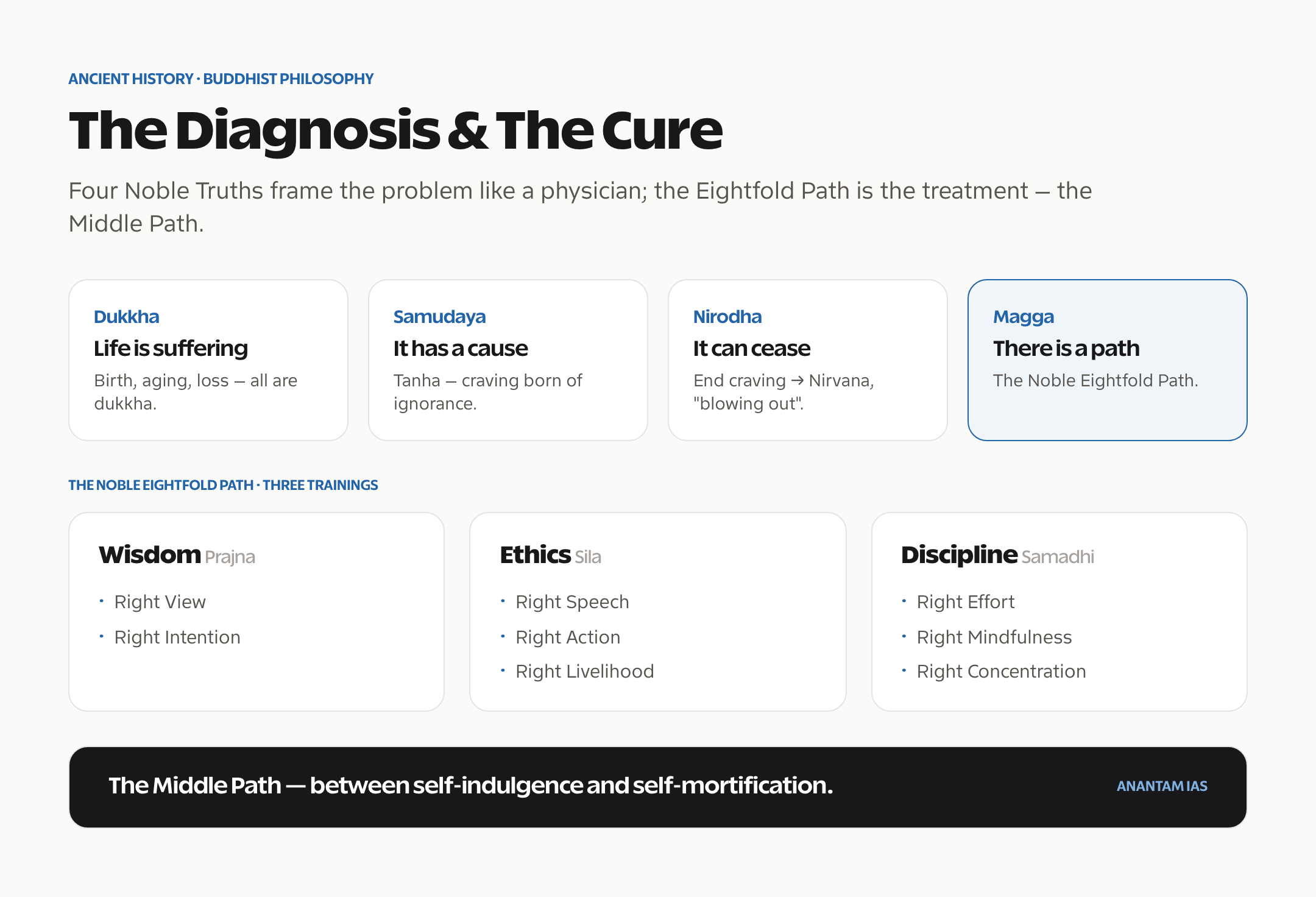
Wisdom (Prajna):
- Right View — Understanding the Four Noble Truths and the nature of reality
- Right Intention — Commitment to renunciation, non-ill-will, and non-cruelty
Ethical Conduct (Sila):
- Right Speech — No lying, no divisive speech, no harsh words, no gossip
- Right Action — No killing, no stealing, no sexual misconduct
- Right Livelihood — Not making a living through harm (weapons trade, slave trade, meat trade, intoxicants, poison)
Mental Discipline (Samadhi):
- Right Effort — Preventing and overcoming unwholesome states; cultivating and maintaining wholesome states
- Right Mindfulness — Clear awareness of body, feelings, mind, mental objects
- Right Concentration — Meditative absorption (jhana) developing one-pointed mind
The Buddha called this the Middle Path — between the extreme of self-indulgence and the extreme of self-mortification. Both extremes, he argued from personal experience, were useless.
Other Key Buddhist Concepts
Three Marks of Existence (Tilakhana):
- Anicca (Impermanence) — Everything changes; nothing is permanent
- Dukkha (Suffering) — All conditioned existence involves suffering
- Anatta (Non-self) — There is no permanent, unchanging self — this was the most radical departure from Brahminical thought
Pratityasamutpada (Dependent Origination) — Nothing exists independently; everything arises in dependence on causes and conditions. Twelve links chain together to produce the cycle of rebirth.
Nirvana — The state of liberation from the cycle of rebirth. The Buddha was deliberately non-specific about what Nirvana is — he said asking what happens to an enlightened being after death is like asking where a flame goes when it’s blown out.
Triratna (Three Jewels): Buddha (the Teacher), Dhamma (the Teaching), Sangha (the Community). Taking refuge in the Three Jewels is the formal act of becoming a Buddhist.
Buddhist Councils: History and Outcomes
The four Buddhist councils are classic UPSC material. Know the location, patron, president, and outcome of each.
| Council | Date | Location | Patron | President | Key Outcome |
|---|---|---|---|---|---|
| First Council | 483 BCE (after Buddha’s death) | Rajagriha (Saptaparni Cave) | Ajatashatru | Mahakassapa | Compiled Vinaya Pitaka (Upali) and Sutta Pitaka (Ananda) |
| Second Council | 383 BCE | Vaishali | Kalasoka | Sabakami | Dispute over 10 monastic rules; Theravada vs Mahasanghika split |
| Third Council | 250 BCE | Pataliputra | Ashoka | Moggaliputta Tissa | Compiled Abhidhamma Pitaka; expelled heretics; sent missionaries abroad |
| Fourth Council | 1st century CE | Kundalavana, Kashmir | Kanishka | Vasumitra (Ashvaghosha as literary head) | Compiled Mahavibhasha; formal Mahayana–Hinayana split |
Note: The Theravada tradition counts only three councils (and does not recognise the Kashmir council under Kanishka). The Kashmir council is Sarvastivada/Mahayana tradition.
The Tripitaka (Three Baskets) — the Pali canon — emerged from these councils:
- Vinaya Pitaka — monastic rules and discipline
- Sutta Pitaka — discourses attributed to the Buddha
- Abhidhamma Pitaka — philosophical and psychological analysis
Mahayana vs Hinayana (Theravada)
The division between Mahayana and Hinayana is one of the most important in Buddhist history. “Hinayana” (Lesser Vehicle) is the Mahayana’s pejorative term for earlier schools — the tradition itself uses “Theravada” (Way of the Elders).
| Feature | Hinayana / Theravada | Mahayana |
|---|---|---|
| Goal | Individual liberation (Arhathood) | Liberation for all beings (Bodhisattvahood) |
| Ideal | Arhat (one who achieves Nirvana) | Bodhisattva (defers Nirvana to help others) |
| The Buddha | Historical teacher, now in Nirvana | Transcendent, cosmic, still accessible |
| Language | Pali | Sanskrit |
| Scriptures | Tripitaka (Pali Canon) | Expanded canon including Prajnaparamita sutras, Lotus Sutra |
| Geography | Sri Lanka, Myanmar, Thailand, Cambodia | Tibet, China, Japan, Korea, Nepal |
| Philosophy | Conservative; close to original teaching | More expansive; Sunyavada (Nagarjuna), Vijnanavada |
| Religious practice | Meditation, monasticism | Devotion, prayer, bodhisattva veneration |
| Art | Aniconism (no images of Buddha) in early period | Elaborate Buddha images, multiple Buddhas and Bodhisattvas |
| Emergence | After Second Council (383 BCE) | Formalised after Fourth Council (1st century CE) |
Vajrayana (Diamond Vehicle) — a third major school — developed in Bengal and Bihar (7th–12th centuries CE), emphasizing tantric practices. It spread to Tibet and became Tibetan Buddhism.
Key Mahayana philosophers:
- Nagarjuna (2nd century CE) — founder of Madhyamaka school; Sunyata (emptiness) philosophy
- Asanga and Vasubandhu (4th century CE) — founders of Yogachara (Vijnanavada) school
- Ashvaghosha (1st century CE) — wrote Buddhacharita (biography of the Buddha in Sanskrit poetry)
Ashoka and the Spread of Buddhism
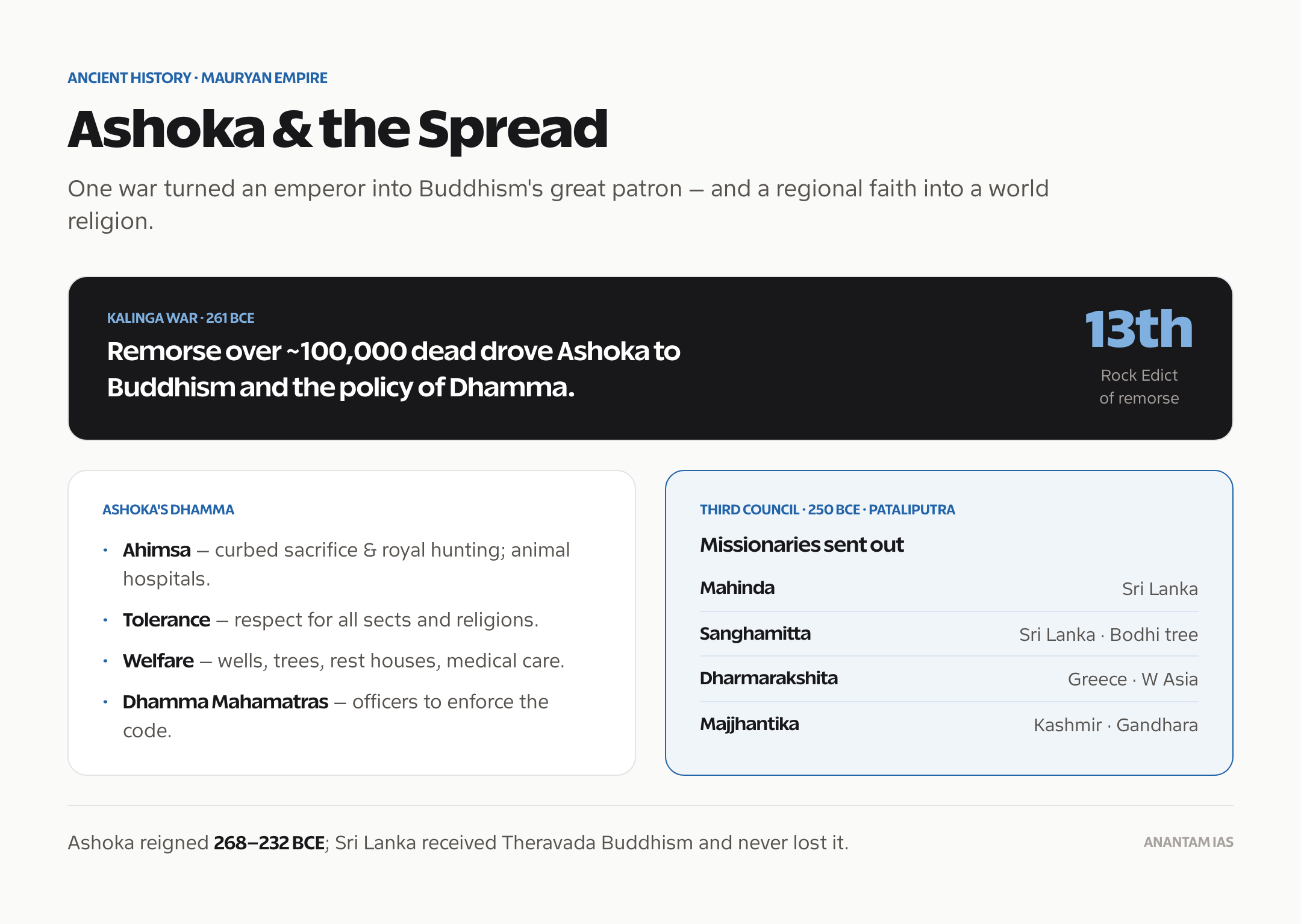
Ashoka (r. 268–232 BCE) is the most important historical figure in the spread of Buddhism. The Kalinga War (261 BCE), in which approximately 100,000 people died and 150,000 were deported, triggered a profound personal transformation. Ashoka converted to Buddhism and proclaimed a policy of Dhamma (moral order based on Buddhist principles).
Ashoka’s Dhamma
Ashoka’s Dhamma — as described in his rock edicts and pillar edicts — was not simply Buddhism exported as state religion. It was a practical moral code designed to govern a diverse empire:
- Ahimsa (non-violence) — reduced animal sacrifice, gave up royal hunting, established animal hospitals
- Tolerance — respect for all sects and religions
- Welfare state — dug wells, planted trees, built rest houses along roads, established medical facilities for humans and animals
- Dhamma Mahamatras — special officers appointed to implement Dhamma policies
- Rock edicts — messages carved on rocks and polished pillars across the empire in local scripts and languages
His 13th Rock Edict expresses remorse for Kalinga — one of the most extraordinary personal statements by any ancient ruler. He says war produces suffering, even in the land of the victor.
Missionary Activity
The Third Buddhist Council (250 BCE, Pataliputra) under Ashoka’s patronage resulted in missionaries being sent across the known world:
- Mahinda (Ashoka’s son) — to Sri Lanka; converted King Devanampiya Tissa; established Theravada Buddhism there
- Sanghamitta (Ashoka’s daughter) — brought a cutting of the Bodhi tree to Sri Lanka
- Dharmarakshita — to Greece and western Asia
- Majjhantika — to Kashmir and Gandhara
Sri Lanka received Buddhism and never lost it — it remains the world centre of Theravada tradition.
Buddhist Architecture and Art
Sanchi Stupa
The Sanchi Stupa (Madhya Pradesh) is the greatest surviving monument of early Indian Buddhism. The original brick stupa was built by Ashoka in the 3rd century BCE. The stone enclosure and elaborate gateways (toranas) were added in the 1st century BCE–1st century CE under the Satavahanas.
The four toranas (north, south, east, west) are covered with carvings depicting the life of the Buddha, the Jataka stories (past lives of the Buddha), and scenes of ordinary life — all in magnificent early Indian art. Crucially, the Buddha himself is not depicted in human form in these early carvings — he is represented by symbols: footprints (paduka), the Bodhi tree, the wheel (dharmachakra), an empty throne, an umbrella.
Sanchi is a UNESCO World Heritage Site.
Ajanta Caves
The Ajanta Caves (Maharashtra) — 29 rock-cut caves in a horseshoe-shaped gorge — represent the pinnacle of ancient Indian painting and sculpture. They were created in two phases:
- Phase 1 (2nd–1st century BCE) — patronised by the Satavahanas; simple halls (chaitya grihas) and monasteries (viharas)
- Phase 2 (5th–6th century CE) — patronised by the Vakatakas during the Gupta period; the great narrative paintings
The Ajanta paintings depict scenes from the Jataka stories and the life of the Buddha in extraordinary detail — expressions of emotion, architectural settings, animals, crowd scenes. The technical achievement, using mineral pigments on prepared mud plaster, has survived 1,500 years. UNESCO World Heritage Site.
Ellora Caves
Ellora (Maharashtra) shows three religions in sequence: Buddhist caves (1–12, c. 5th–7th century CE), Hindu caves (13–29), and Jain caves (30–34). The Buddhist caves at Ellora are large, multi-storeyed viharas with elaborate carved facades. Cave 10 (Vishvakarma Cave) is a magnificent chaitya griha with a rock-cut stupa.
Bodh Gaya and the Mahabodhi Temple
Bodh Gaya — where the Buddha attained enlightenment — is the holiest Buddhist site. The Mahabodhi Temple (a UNESCO World Heritage Site) marks the spot. The original temple was built by Ashoka; the current structure dates to the Gupta period and has been restored multiple times. The Bodhi tree in the temple compound is held to be a descendant of the original.
Key Buddhist Sites in India
| Site | State | Significance |
|---|---|---|
| Lumbini | Nepal (border) | Birth of the Buddha |
| Bodh Gaya | Bihar | Enlightenment; Mahabodhi Temple |
| Sarnath | Uttar Pradesh | First Sermon; Dhamek Stupa |
| Kushinagar | Uttar Pradesh | Mahaparinirvana (death) |
| Sanchi | Madhya Pradesh | Ashoka’s stupa; toranas |
| Ajanta | Maharashtra | Rock-cut paintings (Jataka stories) |
| Ellora | Maharashtra | Rock-cut caves (Buddhist, Hindu, Jain) |
| Nalanda | Bihar | Great Buddhist university |
| Vikramshila | Bihar | Later Buddhist university (Pala period) |
| Amaravati | Andhra Pradesh | Early Buddhist stupa; school of sculpture |
Frequently Asked Questions
What are the Four Noble Truths of Buddhism?
The Four Noble Truths are: (1) Dukkha — life involves suffering; (2) Samudaya — suffering is caused by craving (tanha); (3) Nirodha — suffering can cease through the elimination of craving; (4) Magga — the Noble Eightfold Path leads to this cessation. They form the core diagnostic framework of Buddhist teaching.
What is the difference between Mahayana and Hinayana Buddhism?
Hinayana (Theravada) focuses on individual liberation, with the Arhat as ideal — someone who achieves Nirvana for themselves. Mahayana emphasizes universal liberation, with the Bodhisattva as ideal — a being who delays Nirvana to help all sentient beings. Mahayana views the Buddha as a transcendent cosmic figure, while Theravada treats him as a historical teacher. Theravada spread to Sri Lanka and Southeast Asia; Mahayana to Tibet, China, and East Asia.
What was Ashoka’s Dhamma and how is it different from Buddhism?
Ashoka’s Dhamma was a moral-civic code inspired by Buddhist principles but not identical to orthodox Buddhism. It emphasised non-violence, respect for all religions, welfare measures (wells, hospitals, trees), and tolerant governance. It was designed for all subjects of the empire regardless of their religion. It was Buddhism filtered through statecraft — practical ethics rather than a path to liberation.
Which Buddhist council was held under Ashoka’s patronage?
The Third Buddhist Council was held around 250 BCE at Pataliputra under Ashoka’s patronage, presided over by
Moggaliputta Tissa. It compiled the Abhidhamma Pitaka, expelled heretical monks, and sent missionaries to spread Buddhism across Asia — most importantly Mahinda to Sri Lanka.nnWhy did Buddhism decline in India?
Buddhism declined in India due to multiple factors: revival and reform of Brahminism (leading to Bhakti movements), absorption of Buddhist ideas into Hinduism (the Buddha was incorporated as an avatar of Vishnu), loss of royal patronage after the Guptas and Palas, destruction of monasteries and universities by Bakhtiyar Khilji (c. 1193 CE), and the integration of monastic Buddhism away from the lay community. Buddhism survived outside India in the countries it had spread to.