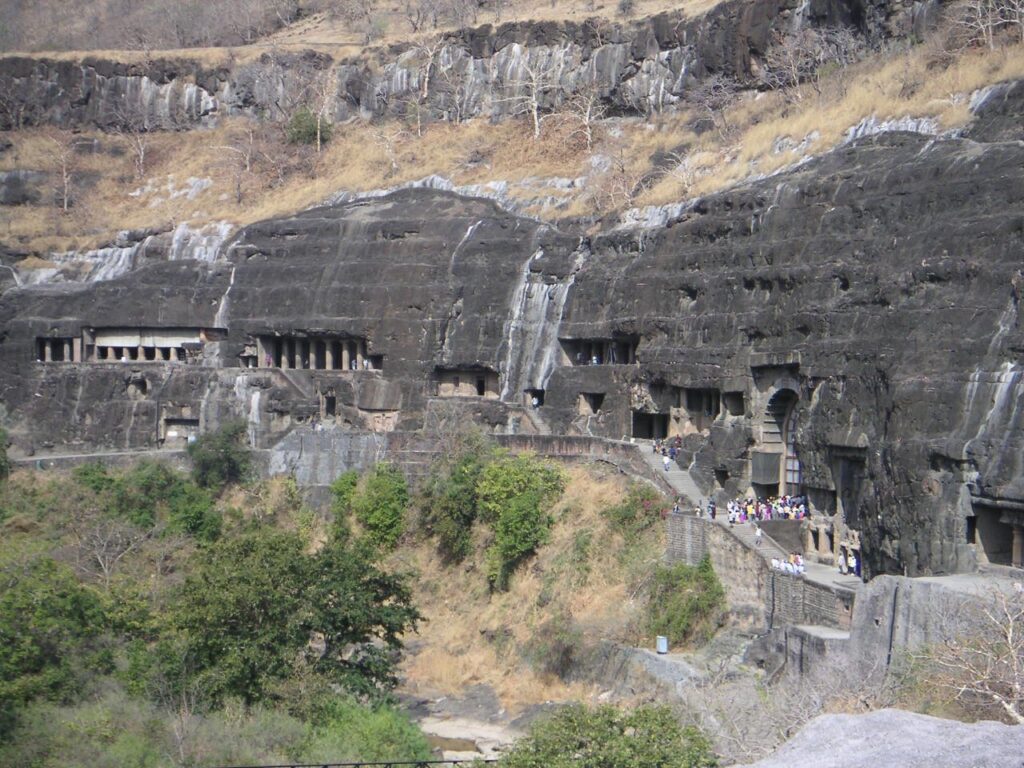
The Ajanta Caves are thirty rock-cut Buddhist monuments carved into the basalt of a horseshoe-shaped cliff above the Waghora river in the Aurangabad district of Maharashtra. The earliest caves date to the second century BCE, the latest to the sixth century CE, and the site preserves a continuous record of Buddhist architecture, sculpture, and painting through roughly eight centuries. The Ajanta Caves are also the best-preserved surviving body of pre-medieval Indian painting anywhere in the country: the murals on the cave walls, executed in tempera on a lime-plastered surface, give us our most complete picture of secular and religious life in late ancient India. UNESCO inscribed the Ajanta Caves on the World Heritage List in 1983, in the first batch of Indian sites to receive the designation.
The caves divide into two broad campaigns. The first, the Hinayana phase, runs from the second century BCE to roughly the first century CE and reflects the patronage of the Satavahana dynasty. The second, the Mahayana phase, runs from the late fifth to the sixth century CE and reflects the patronage of the Vakataka dynasty under Harishena and his feudatories. Between the two phases lies a gap of around four hundred years in which little or no excavation took place at Ajanta. The site was abandoned by the end of the sixth century, sealed by the surrounding jungle, and remained unknown to the outside world until a British hunting party stumbled on it in 1819.
The Site: A Horseshoe Cliff Above the Waghora
The Ajanta Caves are carved into the inside of a sheer basalt cliff that forms the inner curve of a horseshoe bend on the Waghora river. The cliff rises about seventy-five metres above the riverbed, and the caves are excavated along its face at varying heights, connected by a path that runs along the cliff face. The numbering of the caves, from 1 to 29, follows their order along this path from east to west and is not chronological. The geological setting, in horizontal basalt flows of the Deccan Trap, gave the excavators a uniform, durable medium that could be carved into large halls without intermediate supports.
The site was reached from the older Buddhist circuits of central India via the trade routes that crossed the Deccan from the ports of the western coast to the cities of the north. Ajanta sat near one of these routes, and its early patrons included merchants, guilds, and Satavahana officials whose donative inscriptions still survive at the cave entrances. The choice of a remote cliff for the monasteries follows the standard Buddhist preference for secluded sites near, but not in, the centres of trade.
Two Phases, Two Schools
The first phase is associated with Hinayana, the older school of Buddhism in which the Buddha is represented only through symbols, the empty throne, the wheel of the dharma, the stupa, the footprints. The early caves at Ajanta, including Caves 9, 10, 12, and 13, conform to this aniconic tradition. Their interiors contain stupas as the focus of worship but no figural images of the Buddha.
The second phase is Mahayana, the school in which the Buddha is represented in human form and is surrounded by an expanding pantheon of bodhisattvas. The Vakataka-period caves, including Caves 1, 2, 16, 17, 19, and 26, contain large figural images of the Buddha and of bodhisattvas such as Padmapani and Vajrapani. The shift from aniconic to iconic representation is the single most important transition in Indian Buddhist art, and Ajanta records both sides of it.
The Chaitya and the Vihara: Two Cave Types
The thirty caves divide into two architectural types. The chaitya is a prayer hall, longitudinal in plan, with an apsidal end housing a stupa as the focus of worship. The interior is divided by two rows of pillars into a central nave and two flanking aisles, with the aisles continuing around the apse to allow circumambulation of the stupa. The chaitya at Ajanta is modelled on the freestanding wooden prayer halls of an earlier Buddhist tradition, and the rock-cut versions still preserve carved imitations of the rafters and tie-beams of timber construction.
Cave 10 is the earliest chaitya at Ajanta and one of the earliest surviving rock-cut chaityas in India, dating to around the first century BCE. Cave 9 is slightly later. Both have plain stupas, plain pillars, and aniconic decoration. Caves 19 and 26 are the late Mahayana chaityas, with elaborately carved facades, pillars covered in figural sculpture, and stupas that now incorporate a Buddha image carved into the front face. The transition from Cave 10 to Cave 19 sums up the architectural and iconographic history of Indian Buddhism.
The vihara is a residential cave, a monastery for monks. It is square in plan, with a verandah at the front, a central hall, and small cells for individual monks opening off the hall on three sides. The early viharas, such as Caves 12 and 13, are small and unadorned. The Mahayana viharas, especially Caves 1, 2, 16, and 17, expanded the type by adding a shrine cell on the rear wall, opposite the entrance, with a seated Buddha as the focus of worship. The vihara therefore evolved from a purely residential building into a residential-cum-cultic monument.
Cave 1: The Padmapani Mural
Cave 1 is the most famous of the Ajanta Caves because of its murals. It is a Vakataka-period vihara of large dimensions, with a colonnaded verandah, a square central hall, fourteen monks’ cells, and a shrine on the rear wall containing a seated Buddha in the dharmachakra-pravartana mudra. The walls and ceilings of the hall and the verandah are covered with paintings, of which the most reproduced are the bodhisattvas Padmapani and Vajrapani that flank the entrance to the shrine.
The Padmapani is on the left of the shrine doorway. The bodhisattva holds a lotus in his right hand, wears a jewelled crown and a string of pearls across the chest, and looks slightly downward with an expression of compassion that has become emblematic of Indian Buddhist painting. The Vajrapani on the right holds a thunderbolt. The two are personifications of compassion and protective force respectively, and the pairing draws on a long tradition in Mahayana art.
The murals are painted in tempera on a two-layer ground of mud plaster mixed with rice husk and topped with a fine lime wash. The pigments are mineral and vegetable: red ochre, yellow ochre, green from glauconite, blue from lapis lazuli imported from Afghanistan, white from kaolin, and black from soot. The technique is fresco-secco, not true fresco, because the pigments are applied to a dry plaster rather than to a wet ground.
The Vakataka Patronage Under Harishena
Most of the great Mahayana caves at Ajanta belong to a single short period of patronage in the second half of the fifth century, during the reign of the Vakataka king Harishena, who ruled the Vatsagulma branch of the dynasty from around 460 to 478 CE. Harishena’s reign was a brief efflorescence of Vakataka power in the western Deccan, and the major caves, including Caves 1, 2, 16, 17, 19, and 26, were begun in this period, with much of the work completed in the two decades that followed.
The patronage came from Harishena himself and from his ministers, feudatories, and the merchants who served the court. Donative inscriptions at the cave entrances name patrons such as Varahadeva, the prime minister of Harishena, who funded Cave 16, and Buddhabhadra, a wealthy merchant from Andhra, who funded Cave 26. The inscriptions name not only the patrons but also the architects, sculptors, and painters in some cases, giving us a partial glimpse of the workshop organisation behind the caves.
The Jataka Narratives
The painted programmes of the Mahayana caves are dominated by the Jataka tales, the stories of the previous lives of the Buddha. The walls of Caves 1, 2, 16, and 17 carry long narrative cycles of selected Jatakas, painted in continuous bands that move from one episode to the next without strong internal divisions. The Mahajanaka Jataka in Cave 1, the Vidhurapandita Jataka in Cave 2, the Maitribala Jataka in Cave 17, and the great parinirvana scene in Cave 26 are among the most studied paintings in Indian art.
The narrative method is interesting in itself. The painter does not work scene by scene with framed compositions. He uses continuous landscape and architectural backgrounds and lets the same figures reappear at different moments in the same composition. The viewer reads the wall like a long visual text, following the protagonist through episodes that are spatially adjacent rather than temporally distinct.
Sculpture: From Plain Stupas to Iconic Buddhas
The sculpture at Ajanta evolves alongside the painting. The early caves have plain stupas, plain pillar capitals, and a few aniconic symbols. The Mahayana caves are encrusted with figural sculpture: Buddhas seated and standing on the facades, bodhisattvas on the pillar capitals, dvarapalas at the doorways, scenes from the life of the Buddha on the spandrels of the chaitya windows, and elaborate friezes of celestial musicians and dancers across the entablatures.
Cave 26 is the most heavily sculpted of the chaityas. The interior pillars are carved with Buddhas and bodhisattvas; the spandrels of the entrance window carry flying figures; and on the south wall of the cave is the great parinirvana scene, a reclining Buddha around seven metres long, surrounded by mourning disciples and celestial beings rejoicing at his entry into nirvana. The composition is sculptural rather than painted, but it draws on the same narrative imagination as the painted Jatakas of the adjacent caves.
Abandonment and the Long Silence
The patronage at Ajanta ended around the end of the sixth century. Harishena’s successors lost power within a generation, and the political support that funded the caves dried up. The monastic community probably persisted for some time, but without major patronage the caves were not extended or maintained, and over the following centuries the site was overgrown by the jungle of the Deccan plateau and forgotten outside the immediate locality. Some of the cave entrances were still used by villagers and herders, but the larger architectural complex passed out of historical memory.
The Rediscovery of 1819 and Modern Conservation
On 28 April 1819, a hunting party of officers from the Madras Presidency, led by Captain John Smith of the 28th Cavalry, came across the caves while pursuing a tiger. Smith carved his name and the date into the side of a pillar in Cave 10, where the graffito is still visible. The discovery was reported, and over the following decades the caves were surveyed, drawn, and photographed by a succession of scholars and artists. James Fergusson, whose work on Indian rock-cut architecture defined the early academic study of the subject, published the first systematic account in the 1840s.
Major Robert Gill spent twenty years from 1844 to 1864 making copies of the murals for the East India Company. Most of his copies were destroyed in a fire at the Crystal Palace in 1866. A second copying campaign by John Griffiths from 1872 to 1885 also ended in disaster when most of those copies were also lost in a fire at the South Kensington Museum in 1885. The Japanese artist Arai Kampo made another set of copies in the early twentieth century. Despite the losses, enough documentation survives to track the deterioration of the originals over the past two centuries.
UNESCO and Continuing Threats
UNESCO inscribed the Ajanta Caves on the World Heritage List in 1983. The Archaeological Survey of India has primary responsibility for the site, with technical input from international conservation bodies. The paintings face continuous threats from humidity, microbial colonisation, the breath and body heat of visitors, and earlier well-meaning but damaging interventions, including the application of shellac in the nineteenth century that has darkened and embrittled much of the surface.
The Ajanta Caves form a pair with the Ellora Caves just to the south, which extend the rock-cut tradition into the Hindu and Jain periods, and they are part of the wider context of Indian rock-cut architecture that includes the Buddhist viharas at Khajuraho Temples and the Nagara and Dravidian temple traditions of the medieval centuries. Among Maharashtra’s UNESCO sites, the Ajanta Caves remain the most studied, the most photographed, and the most fragile.
Frequently Asked Questions
Who built the Ajanta Caves and when?
The Ajanta Caves were excavated in two distinct phases. The earlier Hinayana caves were built between roughly the second century BCE and the first century CE under the patronage of the Satavahana dynasty. The later Mahayana caves were built in the fifth and sixth centuries CE, mostly during the reign of the Vakataka king Harishena and his ministers and feudatories.
How many caves are there at Ajanta and what types?
There are thirty caves at Ajanta, numbered 1 to 29 with one additional unnumbered cave. They divide into two architectural types: chaityas, which are prayer halls with an apsidal stupa, and viharas, which are monastic residences with a central hall and cells for monks. Most of the caves are viharas; only Caves 9, 10, 19, and 26 are chaityas.
Why are the Ajanta paintings of Padmapani and Vajrapani famous?
The Padmapani and Vajrapani are two bodhisattva figures painted on either side of the shrine doorway in Cave 1. Padmapani holds a lotus and represents compassion; Vajrapani holds a thunderbolt and represents protective force. The Padmapani in particular is celebrated for the contemplative expression of the bodhisattva and is one of the most reproduced images in Indian art.
What is the difference between the Hinayana and Mahayana caves at Ajanta?
The Hinayana caves are earlier and follow the aniconic tradition, in which the Buddha is represented through symbols such as the stupa, the empty throne, or the wheel of the dharma rather than through figural images. The Mahayana caves are later and represent the Buddha in human form, surrounded by bodhisattvas and an expanding pantheon. The shift is a fundamental transition in Indian Buddhism.
How were the Ajanta Caves rediscovered?
The Ajanta Caves were rediscovered on 28 April 1819, when a hunting party of officers from the Madras Presidency, led by Captain John Smith, came across them while pursuing a tiger. Smith carved his name into a pillar in Cave 10. James Fergusson and other scholars subsequently surveyed and published the site, and Major Robert Gill and John Griffiths made early copies of the murals.
What technique was used to make the Ajanta paintings?
The Ajanta paintings are fresco-secco, painted in tempera on a two-layer ground of mud plaster topped with a fine lime wash. The pigments are mineral and vegetable: red and yellow ochre, green from glauconite, blue from imported lapis lazuli, white from kaolin, and black from soot. The technique is applied to dry plaster, not to wet ground as in true Italian fresco.
What are the Jataka tales depicted at Ajanta?
The Jataka tales are stories of the previous lives of the Buddha, in each of which the Bodhisattva exemplifies a particular virtue. The painted walls of Caves 1, 2, 16, and 17 carry long narrative cycles of selected Jatakas, including the Mahajanaka, Vidhurapandita, and Maitribala. The Jatakas served both a religious and a didactic purpose for the monastic community and lay visitors.
When were the Ajanta Caves designated a UNESCO World Heritage Site?
UNESCO inscribed the Ajanta Caves on the World Heritage List in 1983, in the first batch of Indian sites to receive the designation. The Archaeological Survey of India has primary responsibility for the site, with continuing concerns about humidity, microbial colonisation, and the effect of visitor traffic on the painted surfaces.
Tell Google you want more of this.
Add Anantam IAS as a preferred sourceOne tap, and this site shows up more often in your own Top Stories, AI Overviews and AI Mode. Remove it any time.