Central Information Commission and the Vacancy Crisis: RTI Act 2005, 2019 Amendment and the Anjali Bhardwaj Verdict
Central Information Commission explained: composition, appointment, RTI Amendment Act 2019, vacancy crisis, Anjali Bhardwaj v. Union of India and powers under the RTI Act 2005.
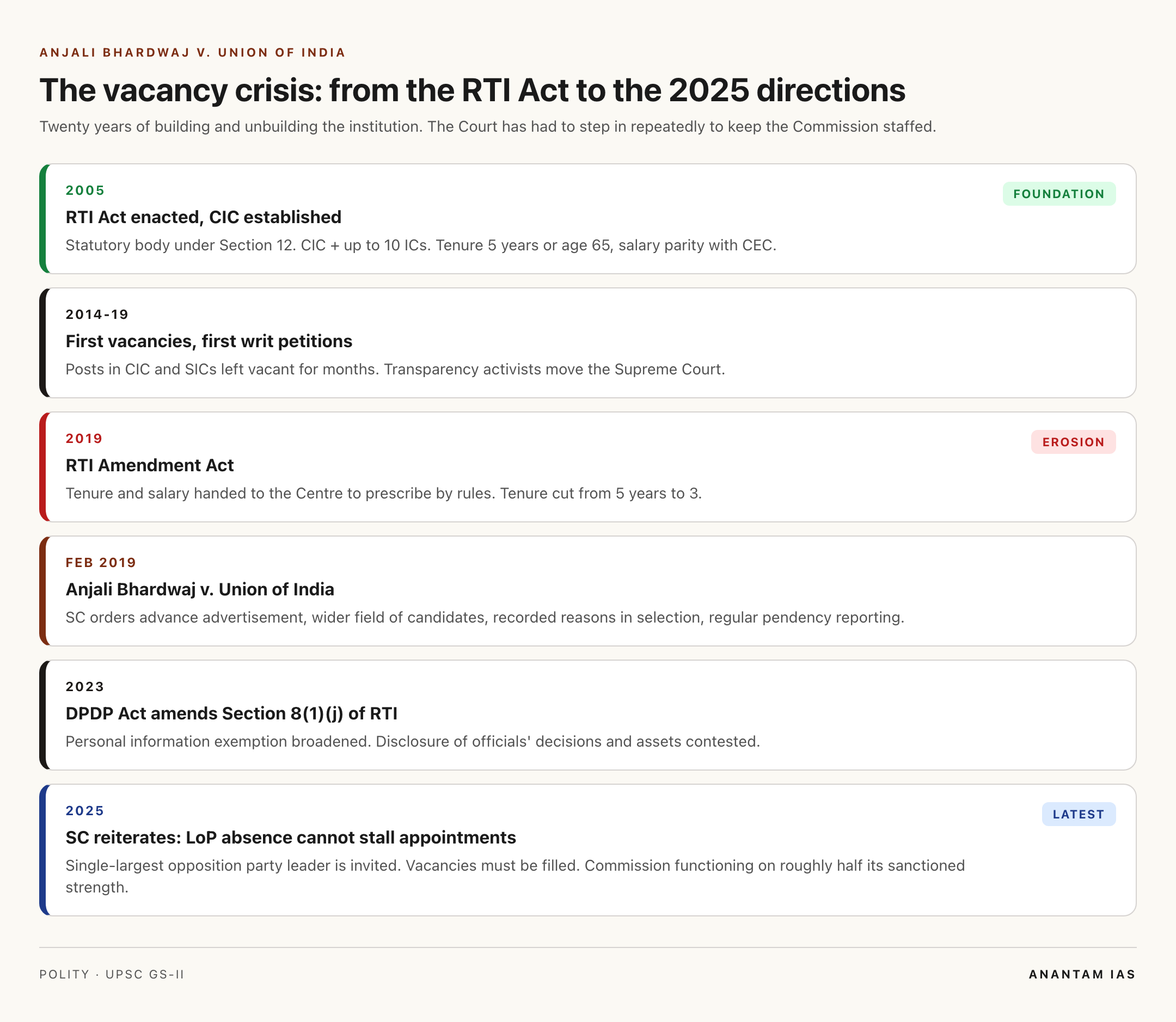
The Central Information Commission was set up in 2005 as the final appellate body under the Right to Information Act, the institution that an ordinary citizen could turn to when a ministry, public sector undertaking or central agency stonewalled an information request. Twenty years on, the Commission spends as much time fighting for its own staff strength as it does deciding appeals. Vacancies have become structural. The Supreme Court, in Anjali Bhardwaj v. Union of India, has had to repeatedly direct the Centre and the states to fill the posts and to do so on schedule.
The 2019 amendment to the RTI Act added a fresh layer of concern. Tenure, salary and conditions of service of the Chief Information Commissioner and Information Commissioners, both at the Centre and in the states, were de-linked from the constitutional benchmarks of the Chief Election Commissioner and Supreme Court judges, and handed over to the central government to be prescribed by rules. Critics argue that the change has weakened the institutional independence of the Commission. Supporters say it merely corrects an anomaly. The dispute over the design of the Commission has become inseparable from the dispute over its independence.
This guide walks through the structure of the CIC under the RTI Act, the 2019 amendments and the rules that followed, the appointment process and the Leader of Opposition question, the Anjali Bhardwaj judgment and the larger vacancy crisis, the Commission’s powers and penalty regime, and the comparative position of state information commissions.
Quick Facts on the Central Information Commission
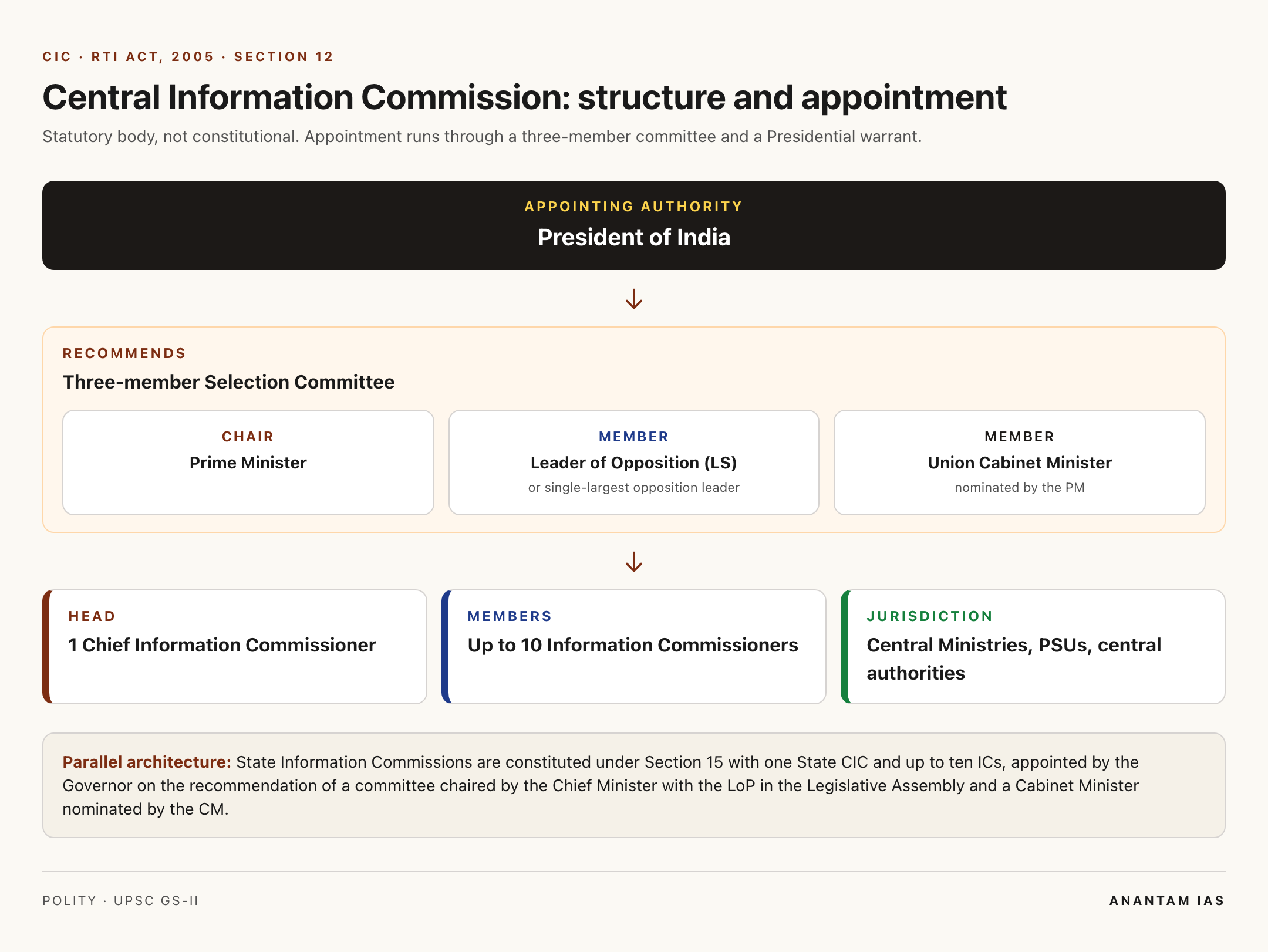
The Central Information Commission is a statutory body constituted under Section 12 of the Right to Information Act, 2005. It is not a constitutional body. It comprises one Chief Information Commissioner and up to ten Information Commissioners, appointed by the President on the recommendation of a committee chaired by the Prime Minister and including the Leader of Opposition in the Lok Sabha and a Union Cabinet Minister nominated by the Prime Minister. Original tenure under the 2005 Act was five years or up to age 65, whichever was earlier; the 2019 amendment empowered the Centre to prescribe tenure, currently set at three years. The Commission has the powers of a civil court in inquiry. It can impose a penalty of up to ₹25,000 on a Public Information Officer for delayed or wrongful denial of information.
What the Central Information Commission Actually Does
The CIC is the second-tier appellate authority under the RTI Act, 2005 for matters relating to central public authorities. The first appeal lies with a senior officer within the public authority. The second appeal lies with the Commission. The Commission also handles complaints against public authorities for refusing to register an RTI application, charging unreasonable fees, or providing incomplete or misleading information.
Beyond appeal and complaint adjudication, the Commission has a proactive role under Section 4 of the RTI Act. Section 4 mandates each public authority to publish a long list of information suo motu, including its organisation, functions and duties, the powers and duties of its officers, the rules and regulations it follows, the budget allocated, and details of contracts and transactions. The Commission can direct public authorities to comply with Section 4 disclosure obligations.
Background and Historical Context
India’s right to information journey runs through three phases. The first phase was judicial. The Supreme Court, in cases beginning with State of UP v. Raj Narain (1975), held that the right to know is implicit in the right to free speech under Article 19(1)(a). The reasoning was simple: a citizen cannot meaningfully participate in democracy without access to government information. The Court extended the same logic to environmental matters, election matters, and state contracts in the 1980s and 1990s.
The second phase was legislative. The Mazdoor Kisan Shakti Sangathan in Rajasthan, led by Aruna Roy, Nikhil Dey and Shankar Singh, demonstrated through public hearings in the 1990s that without the legal right to inspect muster rolls and bills, large-scale corruption in rural employment programmes was impossible to detect. State-level RTI laws followed in Tamil Nadu (1997), Goa (1997), Rajasthan (2000), Karnataka (2000), Delhi (2001) and Maharashtra (2002). The Centre’s Freedom of Information Act, 2002 was a hesitant first attempt that did not even commence. The Right to Information Act, 2005 replaced it with a far stronger framework, modelled on the Freedom of Information Acts of the United States and the United Kingdom but with stricter timelines and a dedicated Information Commission system. The reform sat alongside the broader right to information rti movement that has shaped transparency jurisprudence in India.
The third phase is institutional consolidation, which is where the present vacancy crisis fits. Once the Act was in force, the focus shifted from legal architecture to whether the Commissions had enough Commissioners, whether appointments were timely, and whether the institutional independence of Commissioners matched their growing workload.
Structure and Composition of the Central Information Commission
The Commission has one Chief Information Commissioner and up to ten Information Commissioners. The Chief is the administrative head. All Commissioners participate in the adjudication of cases, usually sitting as single-member benches but occasionally as larger benches for important matters. They are persons of eminence in public life with wide knowledge and experience in law, science and technology, social service, management, journalism, mass media or administration and governance, drawn explicitly from outside the political-bureaucratic-judicial-services hierarchy.
The Commission has its headquarters in New Delhi. Although it is funded out of the Consolidated Fund of India, the salaries and allowances of Commissioners and the administrative expenses of the Commission are charged on the Fund only after the 2019 amendment, with the conditions of service prescribed by the central government through the RTI Rules.
The Commission is independent in the discharge of its functions but is not constitutionally insulated. The 2019 amendment specifically removed the parity in salary and tenure between the CIC and the Chief Election Commissioner that had been written into the original 2005 Act. The change is the single most contested piece of the present design.
The Appointment Process and the LoP Question
Under Section 12(3) of the RTI Act, the President appoints the CIC and ICs on the recommendation of a committee of three: the Prime Minister, who chairs the committee; the Leader of Opposition in the Lok Sabha; and a Union Cabinet Minister nominated by the Prime Minister. The structure is meant to inject pluralism into a politically loaded appointment.
The Leader of Opposition question has come up repeatedly. To formally hold the title of LoP in the Lok Sabha, a party must hold at least one-tenth of the total seats, that is fifty-five in a 543-member Lok Sabha. In the 16th Lok Sabha (2014-19) and again in the 17th Lok Sabha (2019-24), no opposition party met this threshold, and there was no recognised LoP. The government argued that this paralysed the appointment process, because the committee was incomplete.
The Department of Personnel and Training, by office memorandum, clarified that in the absence of a recognised LoP, the leader of the single largest opposition party would be invited to the committee meetings. The Supreme Court endorsed this reading in 2019 and again in 2025. The Court in 2025 went further: it held that the absence of a recognised LoP could not be used as an excuse to delay appointments, and that the committee must function with whichever opposition leader is constitutionally available. The same approach has been adopted for similar appointment committees, including the election commission appointments procedure.
The RTI Amendment Act, 2019: What Changed
The 2019 amendment retained the Commission’s structure but rewired its independence. Three changes matter.
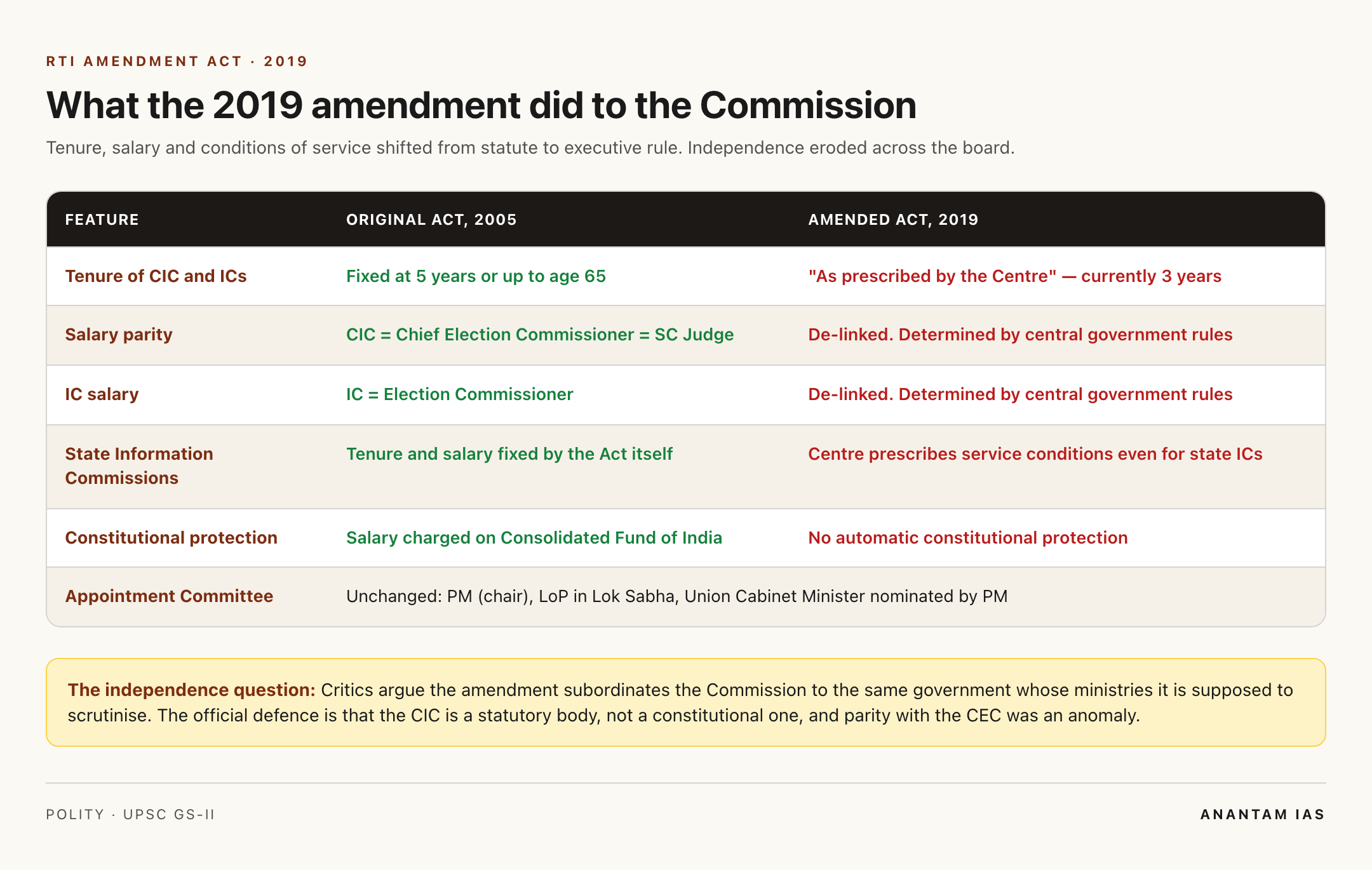
First, tenure. The original Section 13(2) and Section 16(2) fixed the tenure of the CIC and ICs, both at the Centre and in the states, at five years or up to age 65, whichever was earlier. The amendment replaced this with “such term as may be prescribed by the Central Government.” The corresponding rules notified in 2019 fix the tenure at three years for fresh appointments.
Second, salary and allowances. The original Act pegged the salary of the CIC to that of the Chief Election Commissioner, who is in turn paid like a Supreme Court judge, and pegged the salary of an Information Commissioner to that of an Election Commissioner. The amendment de-linked both, leaving salaries to be prescribed by the Centre.
Third, conditions of service of state Information Commissions. The amendment extended central rule-making power not only to the CIC but also to State Information Commissioners. State governments lost the power to determine the tenure and conditions of service of their own Information Commissioners.
The official defence of the amendment was that it corrected an anomaly: the CEC is a constitutional functionary while the CIC is a statutory one, so they should not draw identical salaries and tenures. Critics responded that the original parity was not an anomaly but a deliberate signal of institutional independence, and that the change subordinates the Commission to the very government whose ministries it is supposed to scrutinise.
Why the CIC Matters and Why Vacancies Hurt
Information Commissions decide whether a citizen gets the information they have asked for, whether the public authority faces a penalty, and whether the suo motu disclosure obligations under Section 4 are enforced. Each pending appeal is a piece of governance accountability waiting to be resolved. A typical CIC bench, when fully staffed, disposes of around twelve thousand to fifteen thousand appeals and complaints in a year. As of late 2024 and into 2025, the Commission has been functioning with five or six Commissioners against a sanctioned strength of eleven, and the pendency has crossed twenty thousand cases.
The Anjali Bhardwaj v. Union of India series of orders began in 2018, when the Supreme Court was approached by transparency activists pointing out that the Centre and several states had failed to fill vacancies in their respective Commissions. The Court issued detailed directions in February 2019: vacancies must be advertised in advance, the search committee must include a wider range of fields, the appointment committee must record reasons for its choices, and pendency reports must be tabled regularly. The Court has continued to monitor compliance and has, on multiple occasions, expressed displeasure at the Centre’s pace.
In 2025 the Court reiterated, in a fresh round of hearings, that the absence of a Leader of Opposition in the Lok Sabha cannot be used as a reason to keep posts vacant. The judgment is now the working precedent for similar vacancy disputes in state Information Commissions, the Lokpal, and other statutory adjudicatory bodies.
Powers and Functions of the Commission
Under Section 18 of the RTI Act, the Commission has the powers of a civil court while inquiring into a complaint. It can summon and enforce the attendance of persons, require the discovery and inspection of documents, receive evidence on affidavit, requisition any public record from any court or office, and issue summons for examination of witnesses or documents. These civil court powers extend to all matters under the Act and have been used to enforce compliance against recalcitrant public authorities.
Under Section 19(8), the Commission can direct a public authority to provide the information requested, appoint a Public Information Officer where one has not been designated, publish certain information, make changes to its records management system, provide annual reports as required under Section 4, compensate the complainant for any loss or detriment suffered, and impose penalties as provided under the Act.
Under Section 20, the Commission can impose a penalty of ₹250 per day, subject to a maximum of ₹25,000, on a Public Information Officer for refusing to receive an application, not furnishing information within the timelines, malafidely denying the request, knowingly giving incorrect or misleading information, destroying records, or otherwise obstructing the disclosure regime. The Commission can also recommend disciplinary action against a PIO under the applicable service rules.
The orders of the Commission are binding, subject to writ jurisdiction of the High Courts under Article 226 and the Supreme Court under Article 32. There is no statutory appeal from a Commission order.
Comparative Frame: State Information Commissions
Each state has its own State Information Commission, set up under Section 15 of the RTI Act, with parallel structure: one State Chief Information Commissioner and up to ten State Information Commissioners. The State CIC and SICs are appointed by the Governor on the recommendation of a committee chaired by the Chief Minister and including the Leader of Opposition in the Legislative Assembly and a Cabinet Minister nominated by the CM.
State Information Commissions handle appeals and complaints against state public authorities, including state government departments, state PSUs, panchayati raj institutions, urban local bodies and state-aided institutions. The CIC has, in some early decisions, asserted jurisdiction over High Courts on the ground that High Courts are constituted under Entry 78 of the Union List rather than under state law, but the position remains contested in practice.
After the 2019 amendment, the conditions of service of state ICs are also prescribed by the Centre. The change has been criticised as a centralising move that undermines federal balance, particularly because state ICs handle the vast bulk of RTI appeals, given that most public services touch state authorities.
Challenges and Open Questions
The Commission faces five chronic challenges. The first is structural understaffing. Even when vacancies are filled, the inflow of cases consistently outpaces disposal capacity, and pendency has continued to rise.
The second is the post-2019 erosion of institutional independence. With tenure and salary now defined by the Centre, and with the rules amenable to revision by gazette notification, the Commission’s autonomy is structurally weaker than it was in 2005.
The third is selective compliance with Section 4. Many public authorities still publish only token suo motu disclosures, and the Commission’s enforcement of Section 4 has been uneven.
The fourth is the post-2023 overlap with the Digital Personal Data Protection Act. Section 44(3) of the DPDP Act amends Section 8(1)(j) of the RTI Act to broaden the personal information exemption. Civil society groups have argued that the change effectively narrows the scope of disclosable information, especially in respect of public servants’ assets, decisions and conduct. The full impact will play out as Commissions and courts apply the new exemption.
The fifth is the lack of a defined timeline for hearing appeals. Most Commissions take eighteen to thirty months to schedule a final hearing. Statutory amendments capping disposal times have been proposed by Parliamentary Standing Committees but have not been enacted.
Prelims Pointers
The Central Information Commission is a statutory body constituted under Section 12 of the RTI Act, 2005. It is not a constitutional body. The Commission has one CIC and up to ten ICs. The appointment is made by the President on the recommendation of a committee of three: PM, LoP in Lok Sabha, and a Union Cabinet Minister nominated by the PM. Tenure under the original 2005 Act was five years or until age 65, whichever was earlier. After the 2019 amendment, tenure is “as prescribed by the Central Government,” currently set at three years through the RTI Rules. The salary parity with CEC and Supreme Court judges has been removed. The Commission has powers of a civil court under Section 18. Maximum penalty under Section 20 is ₹25,000. The Anjali Bhardwaj case directed timely filling of vacancies and held that the absence of a recognised LoP cannot stall appointments.
Mains Practice Questions
Critically examine the impact of the RTI Amendment Act, 2019 on the institutional independence of the Central Information Commission and State Information Commissions.
Discuss the role of the Central Information Commission in promoting transparency and accountability in governance, and evaluate its limitations.
Examine the directions issued by the Supreme Court in Anjali Bhardwaj v. Union of India and assess their implementation by the Centre and states.
Analyse the implications of the Digital Personal Data Protection Act, 2023 for the right to information regime in India.
Way Forward
A short list of reforms can move the Commission out of its current crisis. Statutory amendments restoring the parity of tenure and salary with the Chief Election Commissioner and the Election Commissioners would protect institutional independence at the Centre and in the states. A constitutional amendment carving out the Commission as a body whose tenure is fixed by the Constitution itself, on the model of the Election Commission, has been recommended by some Parliamentary Standing Committees and would put the question beyond legislative reach.
Operationally, advance advertisement of vacancies, time-bound appointment processes, and statutory pendency-reduction targets would shrink the backlog. A dedicated digital portal for filing appeals, hearing through video-conferencing, and tracking compliance with Commission orders would modernise the workflow. State Information Commissions need parallel reforms; in many states, the Commission still lacks adequate staff strength even relative to the much larger appeal inflow from local authorities. The deeper transparency commitment that Justice K.S. Puttaswamy and the post-2017 fundamental rights deep dive jurisprudence have built into Indian constitutionalism makes this institutional question a constitutional one too.
Frequently Asked Questions
Is the Central Information Commission a constitutional body?
No. The Central Information Commission is a statutory body constituted under Section 12 of the Right to Information Act, 2005. Constitutional bodies derive their authority directly from the Constitution; statutory bodies derive theirs from a parliamentary statute.
Who appoints the Chief Information Commissioner?
The Chief Information Commissioner is appointed by the President of India on the recommendation of a committee of three: the Prime Minister, who chairs it; the Leader of Opposition in the Lok Sabha; and a Union Cabinet Minister nominated by the Prime Minister. If there is no recognised LoP, the leader of the single largest opposition party is invited.
What is the current tenure of Information Commissioners?
After the 2019 amendment to the RTI Act, the tenure of the CIC and ICs at the Centre and in the states is fixed by rules made by the central government. The current notification fixes the tenure at three years from the date of assumption of office, replacing the earlier statutory term of five years or up to age 65, whichever was earlier.
What did the RTI Amendment Act, 2019 change?
The 2019 amendment empowered the central government to prescribe by rules the tenure, salary, allowances and other conditions of service of the CIC and ICs at the Centre and in the states. The earlier statutory parity with the Chief Election Commissioner and the Election Commissioners was removed.
What is the Anjali Bhardwaj case?
Anjali Bhardwaj v. Union of India is a series of orders of the Supreme Court of India, beginning in 2018-19, dealing with vacancies in the Central Information Commission and State Information Commissions. The Court has issued detailed directions on advance advertisement of vacancies, the composition of the search committee, and timely appointments. In 2025 it reiterated that the absence of a Leader of Opposition cannot stall appointments.
Can the CIC fine a Public Information Officer?
Yes. Under Section 20 of the RTI Act, the Commission can impose a penalty of ₹250 per day, subject to a maximum of ₹25,000, on a Public Information Officer for delay or wrongful refusal to provide information, knowingly giving misleading information, or otherwise obstructing the request. The Commission can also recommend disciplinary action under service rules.
What is the difference between an appeal and a complaint to the CIC?
An appeal is filed against the decision of the first appellate authority within a public authority. A complaint is a direct grievance filed with the Commission against a public authority that has failed to designate a PIO, refused to receive an application, charged unreasonable fees, denied or delayed information, or destroyed records.
Are CIC orders binding?
Yes. Orders of the CIC are binding on public authorities. There is no statutory appeal against a CIC order, but the High Courts under Article 226 and the Supreme Court under Article 32 retain writ jurisdiction.
Does the CIC have jurisdiction over the High Courts?
The CIC has, in early decisions, taken the position that High Courts fall under its jurisdiction because they are constituted under Entry 78 of the Union List and not under state law. The State Information Commissions handle most state-level public authorities. The position on High Courts has been litigated and remains a live issue.
How does the 2023 Digital Personal Data Protection Act affect the RTI regime?
Section 44(3) of the DPDP Act, 2023 amends Section 8(1)(j) of the RTI Act, 2005 to broaden the personal information exemption. Civil society groups have argued that this narrows the scope of disclosable information, especially in respect of public officials’ decisions, conduct and assets. The full impact will be tested as Commissions and courts apply the amended exemption.