Civil Aviation in India: Status, Challenges, Reforms (UPSC Economy)
India is now the world's third-largest domestic aviation market, with operational airports more than doubling since 2014. This refreshed explainer maps the growth, the big reforms, and the structural challenges for UPSC GS III.
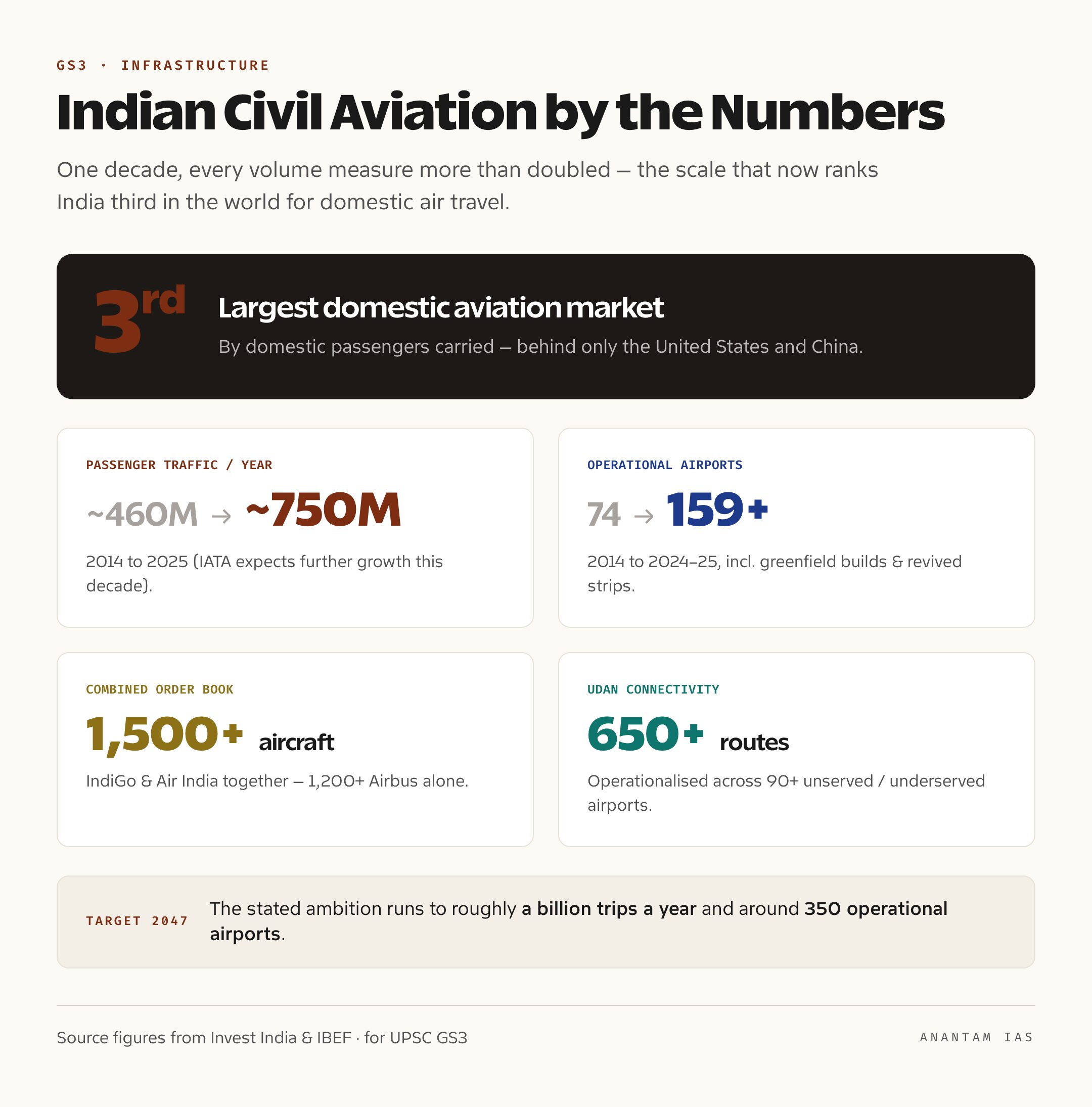
India crossed a threshold most people barely noticed. The country now runs the world’s third-largest domestic aviation market, behind only the United States and China, and passenger traffic has climbed from around 460 million trips in 2014 to nearly 750 million in 2025. The number of operational airports has more than doubled over the same decade, from 74 to more than 159, and the two biggest carriers between them sit on an order book of well over 1,500 new aircraft. By almost any volume measure, this is one of the great growth stories in Indian infrastructure.
But the same decade delivered a sharp reminder of how fragile the business underneath all that growth still is. In December 2025, IndiGo — India’s largest airline — cancelled thousands of flights inside a single week after running short of pilots when stricter duty-and-rest rules took effect, stranding passengers across the country. For UPSC GS III, civil aviation is exactly this kind of topic: where booming demand, thin airline economics, colonial-era law being rewritten, and questions of taxation, regulation and skilled manpower all collide. Get the numbers and the reforms right, and you can write a balanced answer that goes well beyond “India is growing fast.”
The Shape of the Market Today
Start with scale, because it frames everything else. India handles close to 750 million air passengers a year, up from roughly 460 million in 2014, and the International Air Transport Association expects domestic and international traffic together to keep climbing through the decade. Invest India and IBEF both place the country third in the world for domestic air travel. The government’s stated ambition runs much further — towards roughly a billion trips a year and around 350 operational airports by 2047.
The supply side has expanded to match. Operational airports rose from 74 in 2014 to more than 159 by 2024-25, including new greenfield builds and revived regional airstrips. Navi Mumbai International Airport began commercial operations on 25 December 2025, easing the chronic congestion at Mumbai’s single-runway airport, while Noida International Airport at Jewar — meant to relieve Delhi — was inaugurated in March 2026 with scheduled flights following soon after. These two hubs matter because the metros they serve, Delhi and Mumbai, had been running at or near peak slot capacity for years.
The market structure, though, has narrowed even as it has grown. A string of collapses — Kingfisher, then Jet Airways, then Go First in 2023 — has left India with what is effectively a duopoly. IndiGo and the Tata-owned Air India group together control roughly 90% of domestic capacity. That concentration is the backdrop to every reform and every risk discussed below: a handful of carriers carrying a billion-passenger ambition on famously thin margins.
What the Government Has Built and Bought
The policy scaffolding starts with the National Civil Aviation Policy of 2016, which set out to “take flying to the masses” across 22 areas — regional connectivity, safety, cargo, maintenance, ease of doing business and skills. Its most visible child is UDAN — Ude Desh ka Aam Naagrik — the Regional Connectivity Scheme that subsidises a share of seats on routes airlines would otherwise never fly. The first UDAN flight, Shimla to Delhi, took off in April 2017. By late 2025 the scheme had operationalised more than 650 routes connecting 90-plus unserved and underserved airports, heliports and water aerodromes, and the government has announced a modified UDAN aiming to link about 120 more destinations.
Two other strands run alongside connectivity. One is airport privatisation and monetisation. After leasing six AAI airports — Ahmedabad, Jaipur, Lucknow, Guwahati, Thiruvananthapuram and Mangaluru — to the Adani group in 2019-20, the government is preparing a third round in which it wants to hand over about 11 more airports by the end of 2025-26, often bundling loss-making fields with profitable ones to attract bidders. Adani Airport Holdings, already India’s largest private airport operator, has said it will bid aggressively and plans to invest around ₹1 lakh crore in its airports business over five years. This sits inside the wider National Monetisation Pipeline, which targets leasing roughly 25 AAI airports.
The second strand is the order book, and it is staggering. IndiGo’s backlog has grown past 900 aircraft after its record 500-jet Airbus A320neo-family order in 2023, topped up in October 2025 with more wide-body A350s. Air India, post-Tata takeover, ordered hundreds of Airbus and Boeing jets and has kept adding narrow-bodies. Together the two carriers account for well over 1,200 Airbus aircraft alone — making India one of the largest aircraft markets outside the United States and China. The bet is simple: build the fleet and the airports before the billion passengers arrive.
Rewriting the Rulebook: New Laws and the Leasing Push
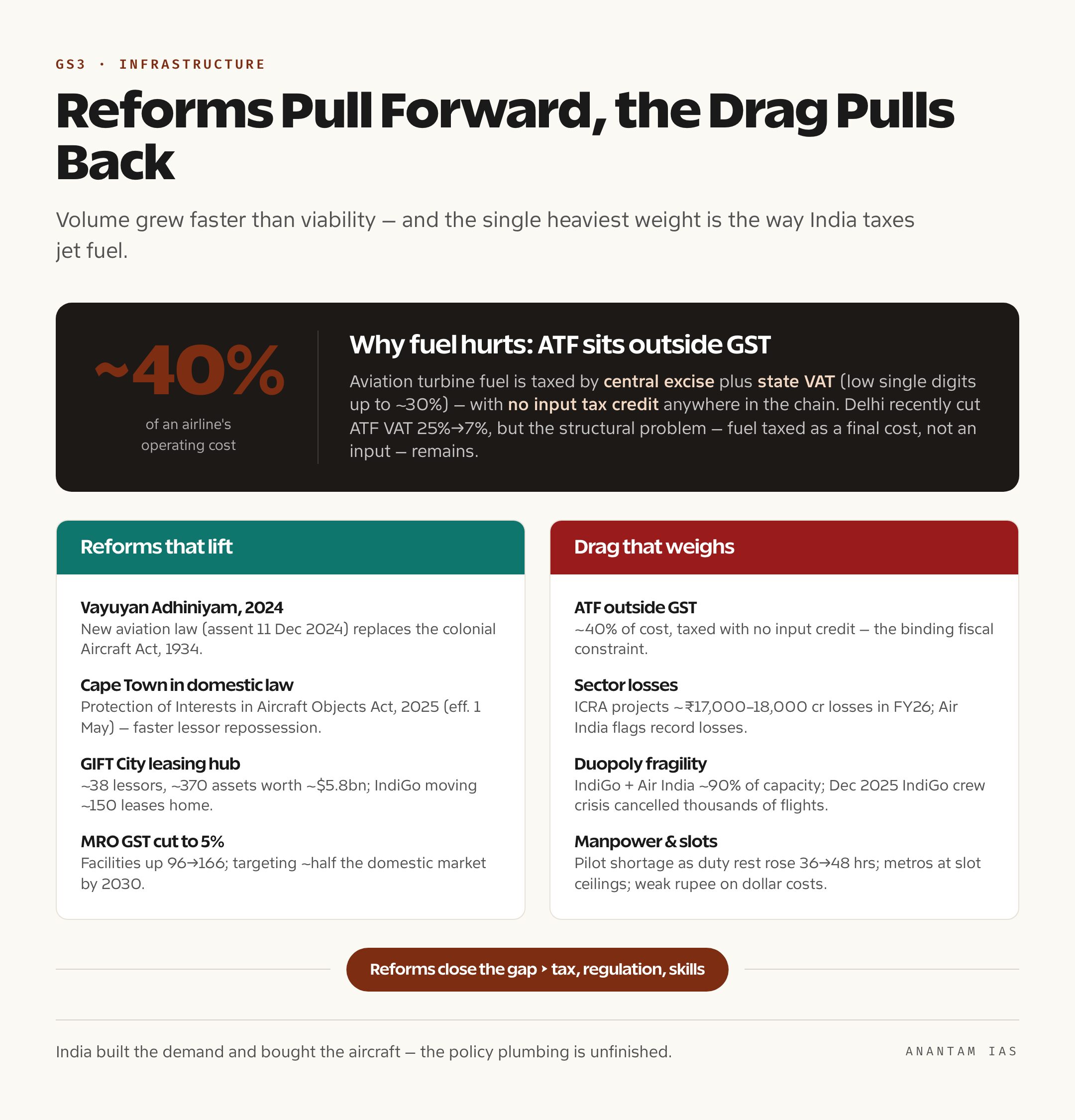
The most under-appreciated reform is legal. For ninety years Indian aviation ran on the Aircraft Act of 1934, a colonial-era statute amended again and again. In December 2024 it was replaced by the Bharatiya Vayuyan Adhiniyam, 2024, which received presidential assent on 11 December 2024. The new law re-states India’s commitment to International Civil Aviation Organization standards, brings design and manufacture of aircraft formally within scope, moves towards single-window clearances under the DGCA, and adds a two-tier appellate mechanism for those aggrieved by regulatory decisions. The change is more than a Hindi renaming — it modernises a 1930s framework for an industry that now thinks about drones, leasing and consumer protection.
The second legal reform targets money, not safety. Aircraft are financed and leased internationally, and lessors need confidence that they can repossess a jet if an airline defaults. India’s failure to do that cleanly during the Go First collapse spooked global lessors. So Parliament enacted the Protection of Interests in Aircraft Objects Act, 2025, effective 1 May 2025, which finally implements the Cape Town Convention in domestic law and gives lessors stronger, faster repossession rights. Lower perceived risk should, over time, mean cheaper leases for Indian carriers.
Tied to this is GIFT City in Gujarat, India’s international financial services centre, which is being groomed as a home-grown aircraft-leasing hub to replace Ireland and other offshore centres. By December 2025 GIFT City had registered around 38 aircraft lessors holding roughly 370 leased assets worth close to 5.8 billion US dollars, and IndiGo has signalled it will move a large block of its leases — towards 150 aircraft — through GIFT City over the next couple of years. If it works, more of the value in financing Indian planes stays in India.
Maintenance is the other localisation story. Indian carriers historically flew abroad for heavy checks because the tax structure punished domestic shops — only around 14% of the MRO (maintenance, repair and overhaul) spend by Indian airlines stayed in India. The government cut GST on MRO services to 5%, moved to a uniform 5% levy on imported aircraft and engine parts to kill the inverted duty structure, and the count of MRO facilities has roughly doubled from 96 in 2014 to about 166 by 2025. India is now targeting a far larger slice of its own maintenance work — towards half the domestic market — by 2030, which keeps both the foreign-exchange outflow and the skilled jobs at home.
The drone economy rides on the same liberalising instinct. The Drone Rules 2021 cut the number of forms from 25 to five and approvals from 72 to four, opened nearly 90% of Indian airspace as a “green zone” for flights up to 400 feet, and replaced pilot licences with simpler DGCA remote-pilot certificates. A Production-Linked Incentive scheme funds domestic manufacturing, GST on drones was cut to 5% in 2025, and the Namo Drone Didi programme puts agricultural drones in the hands of women’s self-help groups — with the government also circulating a draft Civil Drone (Promotion and Regulation) Bill, 2025 to put the whole ecosystem on a firmer legal footing.
The Drag Underneath the Boom
Now the honest part, because aviation’s growth chart hides a balance sheet that bleeds. The single biggest culprit is fuel. Aviation turbine fuel, or ATF, accounts for around 40% of an Indian airline’s operating cost — well above the global norm — and it sits outside GST. So it is taxed by central excise plus state VAT that has ranged from low single digits to nearly 30%, with no input tax credit anywhere in the chain. States compete by cutting it: Delhi recently dropped ATF VAT from 25% to 7% and Maharashtra followed, but the structural problem — fuel taxed as a final cost, not an input — remains unresolved despite repeated GST Council discussions.
The financial fragility shows in the results. Credit-rating agency ICRA has projected sector losses of roughly ₹17,000-18,000 crore in FY26, sharply worse than the year before, as fuel prices and global disruptions bite; Air India alone has flagged record losses for the year. And because consolidation has produced a near-duopoly, a stumble at one carrier ripples nationwide. The December 2025 IndiGo meltdown is the textbook case: when the DGCA’s stricter flight-duty rules extended pilots’ weekly rest from 36 to 48 hours and capped late-night landings, IndiGo discovered it had not trained enough pilots, cancelled thousands of flights in a week, and exposed how a “too big to fail” airline leaves passengers and airports with no backup. That is the skilled-manpower gap made visible — and it extends to cabin crew, technicians and air-traffic controllers as the fleet doubles.
The rest of the challenge list is familiar but real. Metro airports still hit slot ceilings at peak hours; hangar and parking land near cities is scarce and costly; international flying rights are locked inside bilateral air-services agreements that airlines cannot expand unilaterally; and a weak rupee inflates the dollar-denominated half of every airline’s costs — leases, fuel, spares — against rupee revenue. Connectivity has widened, but affordability at the regional end depends on subsidies that don’t always survive the three-year UDAN support window; independent analyses have found that only around seven in ten awarded UDAN routes ever started, and a slice of those did not last the full support period. So the headline of 650-plus operationalised routes hides a churn problem underneath: putting a town on the map is easier than keeping it there once the subsidy tapers.
What Should Change
The cleanest single fix is also the oldest demand: bring ATF under GST so airlines can claim input credit and so fuel stops being taxed like a luxury at the airport gate. Pair that with sustained pressure on state VAT and the cost base eases for everyone. On charges, the Airports Economic Regulatory Authority needs sharper teeth to keep privatised-airport tariffs reasonable, so monetisation doesn’t simply transfer congestion costs to flyers.
On capacity, the answer is execution, not new schemes — finish the greenfield builds at Navi Mumbai and Jewar, hold private operators to their investment commitments, and keep reviving regional airstrips with realistic, time-bound UDAN support. On people, India needs many more flight-training organisations, simulators and MRO technician programmes, with private capital invited in, so that doubling the fleet doesn’t keep colliding with a pilot shortage. And on the leasing and maintenance reforms, the task is follow-through: make the Cape Town Act work in practice, let GIFT City mature into a genuine hub, and push the domestic MRO share towards its 2030 target so maintenance money and skilled jobs stay home. The growth is real. Whether it becomes durable depends on whether the policy plumbing — tax, regulation, skills — finally catches up with the order book.
For Your Mains Answer
Civil aviation maps cleanly onto GS Paper 3, under infrastructure (airports, investment models), the economy (taxation, fiscal support, ease of doing business) and, increasingly, science and technology (drones, MRO localisation). It also touches GS Paper 2 on regulatory bodies and Centre-State fiscal friction (ATF VAT). Mains questions usually take one of two shapes — “examine the constraints on India’s aviation growth” or “evaluate recent reforms” — so keep both a problems frame and a reforms frame ready.
How to Build the Answer
Open with scale and a paradox: third-largest domestic market, airports doubled, a 1,500-plus aircraft order book — and an industry losing money with a near-duopoly. Then split the body into landscape, reforms and constraints, and close with a way-forward. Don’t list everything; pick the highest-value reforms (Bharatiya Vayuyan Adhiniyam 2024, Cape Town Act, GIFT City leasing, MRO GST cut, UDAN) and the sharpest constraints (ATF taxation, financial fragility, manpower).
Common Mistakes to Avoid
Don’t write a one-sided growth essay; the examiner rewards the tension between volume growth and financial weakness. Don’t confuse the schemes — UDAN is regional connectivity, the National Monetisation Pipeline is asset leasing, PLI funds drone manufacturing. Don’t overstate localisation — say domestic MRO is still a small share moving towards a 2030 target, not “solved.” And don’t forget the institutions: DGCA (safety), AERA (tariffs), AAI (state airports).
A Compact Answer Spine
Third-largest market, airports 74 → 159+, traffic ~750 million → constraints (ATF outside GST ~40% of cost, ICRA-projected losses, IndiGo-Air India duopoly, pilot shortage, slot congestion) → reforms (Bharatiya Vayuyan Adhiniyam 2024 replacing the 1934 Act, Cape Town/Protection of Interests in Aircraft Objects Act 2025, GIFT City leasing, 5% MRO GST, UDAN 650+ routes, airport monetisation) → way forward (ATF under GST, AERA oversight, finish greenfield airports, scale pilot and MRO training).
Diagram or Flowchart Idea
Draw a simple two-column balance: on the left “Growth” (traffic ~750m, airports 159+, orders 1,500+, UDAN 650+ routes); on the right “Drag” (ATF tax, ₹17,000-18,000 cr losses, duopoly, pilot shortage). A single arrow at the bottom labelled “Reforms close the gap” pointing to the way-forward box reads fast and signals balance.
A Balanced-Conclusion Line
A strong close: India has built the demand and bought the aircraft; the unfinished work is the policy plumbing — fuel taxation, regulatory capacity and skilled manpower — that decides whether a billion-passenger market is also a viable one.
How to Use Data Without Cramming
Anchor with three or four numbers, not ten: airports 74 → 159+, traffic near 750 million, ATF at roughly 40% of cost, UDAN’s 650-plus routes. Attribute in-prose — “IATA expects,” “ICRA projects” — so the figures read as sourced rather than memorised, and name one date that matters (the Bharatiya Vayuyan Adhiniyam, 2024).
FAQ
Why is India called the third-largest domestic aviation market? By the number of domestic passengers carried, India ranks behind only the United States and China. Traffic has risen from roughly 460 million trips in 2014 to nearly 750 million in 2025, and operational airports have grown from 74 to more than 159 over the same period, which is what places India third globally.
What is the Bharatiya Vayuyan Adhiniyam, 2024? It is the new aviation law that replaced the colonial-era Aircraft Act of 1934, receiving presidential assent in December 2024. It restates India’s alignment with International Civil Aviation Organization standards, brings aircraft design and manufacture within scope, moves towards single-window DGCA clearances, and adds a two-tier appeals mechanism.
Why do Indian airlines lose money despite full flights? Mainly because of cost structure. Aviation turbine fuel is around 40% of operating cost and sits outside GST, so it is taxed by excise plus state VAT with no input credit. Add a weak rupee against dollar-denominated leases and spares, high airport charges and intense fare competition, and even busy airlines run thin or negative margins — ICRA has projected sector losses of ₹17,000-18,000 crore in FY26.
What are UDAN and the airport privatisation push? UDAN, the Regional Connectivity Scheme, subsidises seats to connect smaller cities and remote regions; by late 2025 it had operationalised more than 650 routes linking 90-plus airports. Separately, the government is leasing AAI airports to private operators — six went to the Adani group in 2019-20, with about 11 more planned by 2025-26 — as part of asset monetisation.
Practice Questions
Prelims MCQs
- With reference to civil aviation in India, consider the following: India is the ___ largest domestic aviation market in the world. Which option correctly fills the blank?
(a) first
(b) second
(c) third
(d) fourth.
Answer: (c) India ranks third by domestic passengers carried, after the United States and China. - The Bharatiya Vayuyan Adhiniyam, 2024 replaced which earlier legislation?
(a) The Airports Authority of India Act, 1994
(b) The Aircraft Act, 1934
(c) The Carriage by Air Act, 1972
(d) The Civil Aviation Requirements, 1937.
Answer: (b) It replaced the colonial-era Aircraft Act of 1934, receiving presidential assent in December 2024. - Why does aviation turbine fuel (ATF) significantly raise costs for Indian airlines?
(a) It is fully taxed under GST at 28%
(b) It is kept outside GST and taxed by excise plus state VAT with no input tax credit
(c) It is imported duty-free but priced in dollars
(d) It is subsidised only for international flights.
Answer: (b) ATF sits outside GST, so excise and varying state VAT apply with no input credit, making fuel roughly 40% of operating cost. - Which statements about UDAN (Regional Connectivity Scheme) are correct? 1. It was conceived under the National Civil Aviation Policy, 2016.
2. Its first flight connected Shimla and Delhi.
3. It subsidises a share of seats on select routes. Choose the correct option:
(a) 1 and 2 only
(b) 2 and 3 only
(c) 1 and 3 only
(d) 1, 2 and 3.
Answer: (d) All three are correct; UDAN’s first flight flew Shimla-Delhi in April 2017 under NCAP 2016, using viability-gap support on subsidised seats. - The Protection of Interests in Aircraft Objects Act, 2025 was enacted primarily to implement which international instrument in Indian law?
(a) The Chicago Convention
(b) The Cape Town Convention on aircraft objects
(c) The Warsaw Convention
(d) The Montreal Convention.
Answer: (b) It domestically implements the Cape Town Convention, strengthening lessors’ aircraft repossession rights after the Go First episode.
Mains Practice Questions
- “India’s civil aviation has grown in volume faster than in viability.” Critically examine the structural challenges that keep Indian airlines financially fragile despite record passenger traffic. (15 marks, 250 words)
- Discuss how recent legal and financial reforms — the Bharatiya Vayuyan Adhiniyam 2024, the Cape Town Convention’s implementation, and GIFT City aircraft leasing — aim to modernise India’s aviation ecosystem. (15 marks, 250 words)
- Examine the role of the UDAN scheme and airport privatisation in expanding India’s aviation infrastructure. To what extent have they widened access without straining viability? (15 marks, 250 words)
- “Taxation, not demand, is the binding constraint on Indian aviation.” Analyse this statement with reference to aviation turbine fuel and the case for bringing it under GST. (10 marks, 150 words)
- The December 2025 cancellations crisis exposed risks in India’s airline market structure. Discuss the implications of an aviation duopoly and the skilled-manpower gap for passenger interest and regulatory policy. (15 marks, 250 words)