Civil Services Neutrality: Meaning, Conduct Rules, Criticism and the Indian Debate (UPSC GS IV)
Civil services neutrality — meaning, conduct rules, the committed-bureaucracy debate, criticism, Indian case studies and UPSC GS IV mains framework.
A civil servant takes one oath in her career — to the Constitution. She serves, in succession, governments she may or may not have voted for, ministers she may or may not respect, and policies she may or may not personally agree with. The principle that holds this strange professional life together is civil services neutrality: the commitment to serve any constitutionally elected government with equal professional competence, without partisan attachment, while remaining loyal to constitutional values rather than to any political dispensation.
This article walks through the meaning of neutrality, its conduct rules, the criticism it faces (the "committed-bureaucracy" challenge), the Indian case studies that show what neutrality looks like in practice, and the GS IV framework for writing about it.
What civil services neutrality means
Neutrality is the disposition by which a civil servant remains politically impartial and non-partisan throughout her career. Sometimes called political sterilisation, it means that bureaucracy as an institution is not affected by the changes in the flow of politics — when a new party wins an election, the bureaucracy continues to function with the same standards, the same procedures and the same quality of advice.
Three components clarify the concept.
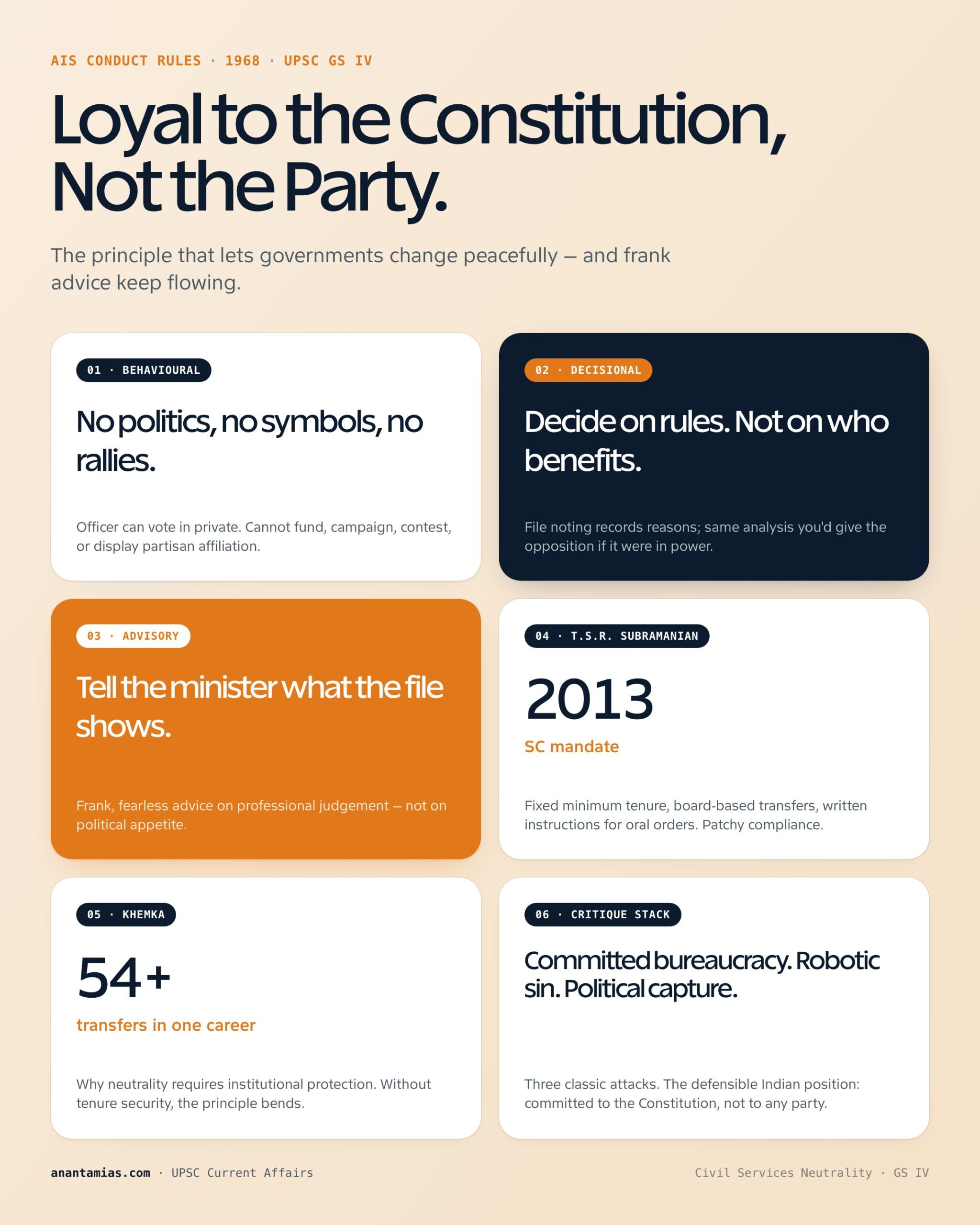
- Behavioural neutrality — the officer does not take part in political activity, does not display partisan symbols, does not campaign or fund parties.
- Decisional neutrality — decisions are made on merit and rules, not on the basis of which party benefits.
- Advisory neutrality — frank, fearless advice is given to the political executive based on professional judgement, regardless of the political appetite for that advice.
Neutrality is not indifference. The neutral officer cares deeply about outcomes — but for the citizen, not the party.
Why neutrality matters
The principle has four structural justifications.
- Continuity of administration. Governments change every five years; the state must run continuously. A bureaucracy that swings with politics produces administrative paralysis on every transfer of power.
- Equal treatment of citizens. A partisan bureaucracy treats supporters of the ruling party better than opponents. Neutrality is the citizen's protection.
- Frank advice. A politically committed civil servant tells the minister what the minister wants to hear; a neutral officer tells the minister what the file actually shows.
- Constitutional balance. The civil service is one of the unelected institutions that balances the elected executive — alongside the judiciary, the CAG, the EC, the UPSC. Neutrality is what makes it a balancing institution.
Conduct rules for neutrality
The All India Services (Conduct) Rules, 1968 and the Central Civil Services (Conduct) Rules, 1964 codify neutrality through a set of behavioural prohibitions and obligations.
- Officers must not take part in politics or in any political activity.
- They must not give election funds or financial assistance to any political party.
- They may exercise their right to vote, but must not publicly disclose their preference or attempt to influence the votes of others.
- They must not display election symbols on their person, vehicle, or home.
- They must not participate in rallies, dharna-pradarshan or demonstrations without government permission.
- They must not contest, or assist anyone in contesting, an election to the legislature or to local bodies.
- They must not publicly criticise government policy in their personal capacity (subject to the academic-freedom carve-out).
These rules are negative — they tell the officer what not to do. The positive content of neutrality — fearless advice, equal service — is supplied by professional culture, training and the example of seniors.
Criticism of bureaucratic neutrality
The principle has not been free of attack. Three major lines of criticism have emerged.
The "committed bureaucracy" critique
In the late 1960s, a strand of Indian political thought (associated with Mohan Kumaramangalam and others) argued that a developing country with constitutional commitments to social transformation cannot be served by an indifferent bureaucracy. The civil servant must be committed — committed to the ideology of social change, of the welfare state, of constitutional values. This was sometimes interpreted (more dangerously) as commitment to a particular ruling ideology.
The 1980s and after saw the Supreme Court reject the dangerous version (S.R. Bommai, the Indira Sawhney line) while accepting the constitutional version: the bureaucracy is committed to the Constitution, not to any party.
The "robotic sin" critique
Some scholars argue that neutrality, taken to extremes, becomes an excuse for inactivity and timidity. The officer who never speaks up, who follows every order, who never advances a position of his own, hides behind "neutrality." This is sometimes called the robotic sin — the moral failure that masquerades as professional virtue.
"Neutrality is not the same as moral abdication. The neutral officer must still speak truth to power, must still record dissent, must still resign rather than execute the unconstitutional."
Max Weber's bureaucracy had this danger built in; thoughtful Indian observers (Nani Palkhivala, Vinod Rai) have warned against it.
The political-capture critique
A third line argues that "neutrality" in practice has often meant servility to whichever party is in power. Officers cultivate political masters rather than serving the office. This is not neutrality but sycophancy mislabelled. The cure is not less neutrality but more — backed by service security, transparent transfer policy, and protection from political vendetta.
The Indian framework today
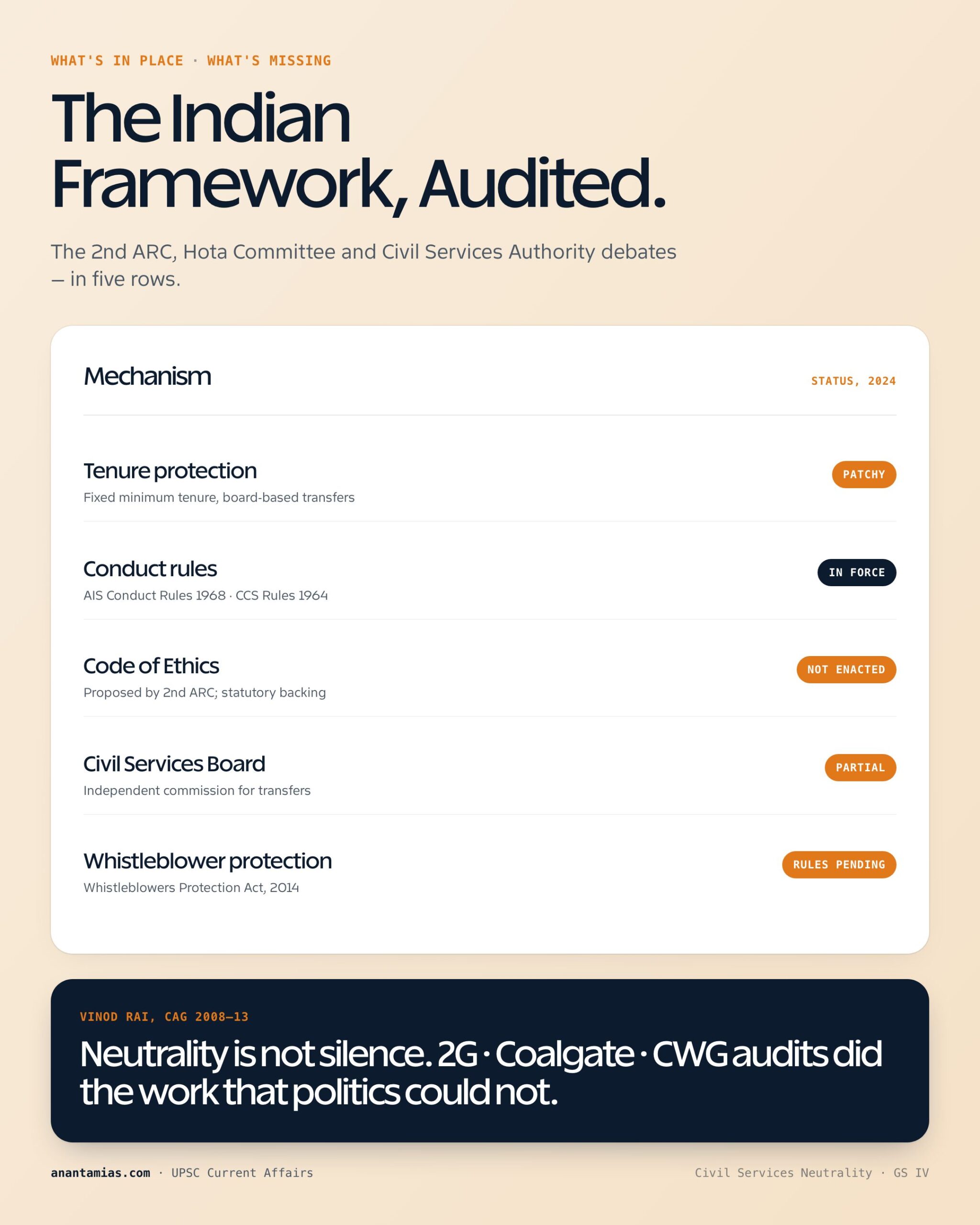
The 2nd ARC, the Hota Committee and the Civil Services Authority debates have produced a working Indian framework.
| Element | Mechanism | Status |
|---|---|---|
| Tenure protection | Fixed minimum tenure, board-based transfers | Patchily implemented; T.S.R. Subramanian judgement (2013) directs implementation |
| Conduct rules | AIS Conduct Rules, CCS Conduct Rules | In force, occasionally enforced |
| Code of Ethics | Proposed by 2nd ARC | Not yet enacted |
| Independent commission for transfers | Civil Services Board at state and centre | Mandated by SC; partial compliance |
| Whistleblower protection | Whistleblowers Protection Act, 2014 | Enacted but rules not fully notified |
Two Indian case studies
Case study 1 — Ashok Khemka
Ashok Khemka, an IAS officer of the Haryana cadre, has been transferred more than 50 times in his career, often shortly after challenging powerful interests on land-deal allotments and other matters. His case is the textbook illustration of why neutrality requires institutional protection — the officer who is professionally neutral can be punished by being moved every few months. The T.S.R. Subramanian judgement of the Supreme Court (2013) explicitly addressed such patterns.
Case study 2 — Vinod Rai and the CAG audits
As Comptroller and Auditor General (2008–13), Vinod Rai conducted audits — 2G spectrum, Coalgate, CWG — that named specific decisions of the ruling government as having caused presumptive losses. The audits were politically explosive; the work was technically neutral. Rai's approach demonstrated that institutional neutrality is not silence — it is professionally rigorous, publicly accountable work that serves the Constitution rather than the government of the day.
Civil services application
What does neutrality look like in routine practice?
- In file-noting: record reasons; never colour the analysis with partisan framing; recommend on merit.
- In oral advice: give the minister the same analysis you would give the opposition if it were in power; identify risks frankly.
- In transfers: do not solicit postings from political patrons; accept assignments without conditions.
- In public conduct: refuse to comment publicly on partisan questions; exercise the vote in private; avoid social media posts that signal partisan affiliation.
- In conflict: when an order is unlawful, record dissent in writing; if the order persists, escalate or resign — never quietly comply.
UPSC past-year question references
- 2017 GS IV: "What is meant by 'public interest'? What are the principles and procedures to be followed by the civil servants in public interest?" — neutrality lies at the heart of this.
- 2018 GS IV: "What is meant by 'objectivity'? Distinguish between objectivity and impartiality." — examines two adjacent values.
- 2014 GS IV case study: an officer pressured by ruling-party functionaries to favour particular contractors — direct neutrality test.
- 2020 GS Paper II: discussion of civil services reforms, including transfer policy and tenure protection.
Mains answer hook
Civil services neutrality is the disposition by which a public servant serves the constitutionally elected government of the day with equal professional competence, while remaining loyal to constitutional values rather than to any political dispensation. It has three components — behavioural, decisional, advisory — and rests on four justifications: continuity of administration, equal treatment of citizens, frank advice and constitutional balance. Its critics, from Mohan Kumaramangalam onwards, have argued for a "committed" bureaucracy; the defensible Indian position commits the civil servant to the Constitution and not to any party. Neutrality is not indifference, not silence, and not robotic compliance. It is the professional discipline that protects democracy from itself.
Prelims pointers
- AIS (Conduct) Rules, 1968; CCS (Conduct) Rules, 1964.
- Nolan Committee — international source.
- 2nd ARC's Ethics in Governance (Fourth Report).
- T.S.R. Subramanian v. Union of India (2013) — Supreme Court directions on tenure and Civil Services Board.
- Hota Committee (2004) — civil-services reform.
FAQ
Can a civil servant be a member of a political party?
No. The Conduct Rules explicitly prohibit civil servants from participating in any political activity, including being a member of a political party.
Can a civil servant criticise government policy?
Not publicly in personal capacity, with limited exceptions for academic and professional fora and only where the criticism does not undermine the service relationship.
Is committed bureaucracy the opposite of neutral bureaucracy?
The dangerous version of "committed bureaucracy" — committed to a particular ruling ideology — is the opposite of neutrality. The defensible version — committed to constitutional values — is what neutrality actually is.
What is the u0022robotic sinu0022?
The moral failure of hiding behind neutrality to avoid speaking up against unconstitutional orders. Genuine neutrality requires speaking truth to power, not silent compliance.
How can neutrality be institutionally protected?
Fixed tenure, board-based transfers, transparent ACR, whistleblower protection, statutory backing through a Civil Services Code.
Civil services neutrality is the principle that does the most invisible work in democratic government. When governments change peacefully, when ministers receive frank advice, when citizens are treated equally regardless of partisan colour — that is neutrality functioning quietly. Strengthening it remains one of the most important unfinished tasks of Indian administrative reform.