Ethics in Governance: Key Concepts for UPSC GS IV
Ethics in governance is not about memorising definitions. It’s about understanding why an honest, well-meaning civil servant might still make wrong decisions — and what frameworks help them make better ones. UPSC GS Paper IV tests your ability to think through these situations, not just recall them.
So start with the question that matters: what makes governance “ethical”? Not just legal. Not just efficient. Ethical — in a way that respects human dignity, serves the public interest, and builds trust between citizens and the state.
What Is Ethics in Governance?
Ethics in governance refers to the application of moral principles to the exercise of public power. It covers:
- How officials make decisions when rules don’t provide a clear answer
- How they behave when self-interest conflicts with public interest
- How institutions are designed to encourage ethical behaviour and check corruption
- How accountability mechanisms ensure officials answer for their choices
Ethics vs Law vs Policy
These three are related but distinct:
| Dimension | What It Governs | Example |
|---|---|---|
| Law | What is permitted/prohibited | IPC, CrPC, Prevention of Corruption Act |
| Policy | What is decided as the right course of action | Reservations, subsidies, infrastructure spending |
| Ethics | What is morally right, especially where law is silent or ambiguous | Whistleblowing when colleagues are corrupt; telling a superior a popular policy is harmful |
Many situations civil servants face are legal but unethical (using technical rules to deny a deserving citizen their right), or policy-compliant but ethically questionable (following orders that cause harm to vulnerable communities). Good governance requires going beyond law and policy to ethical reasoning.
Core Values in Governance
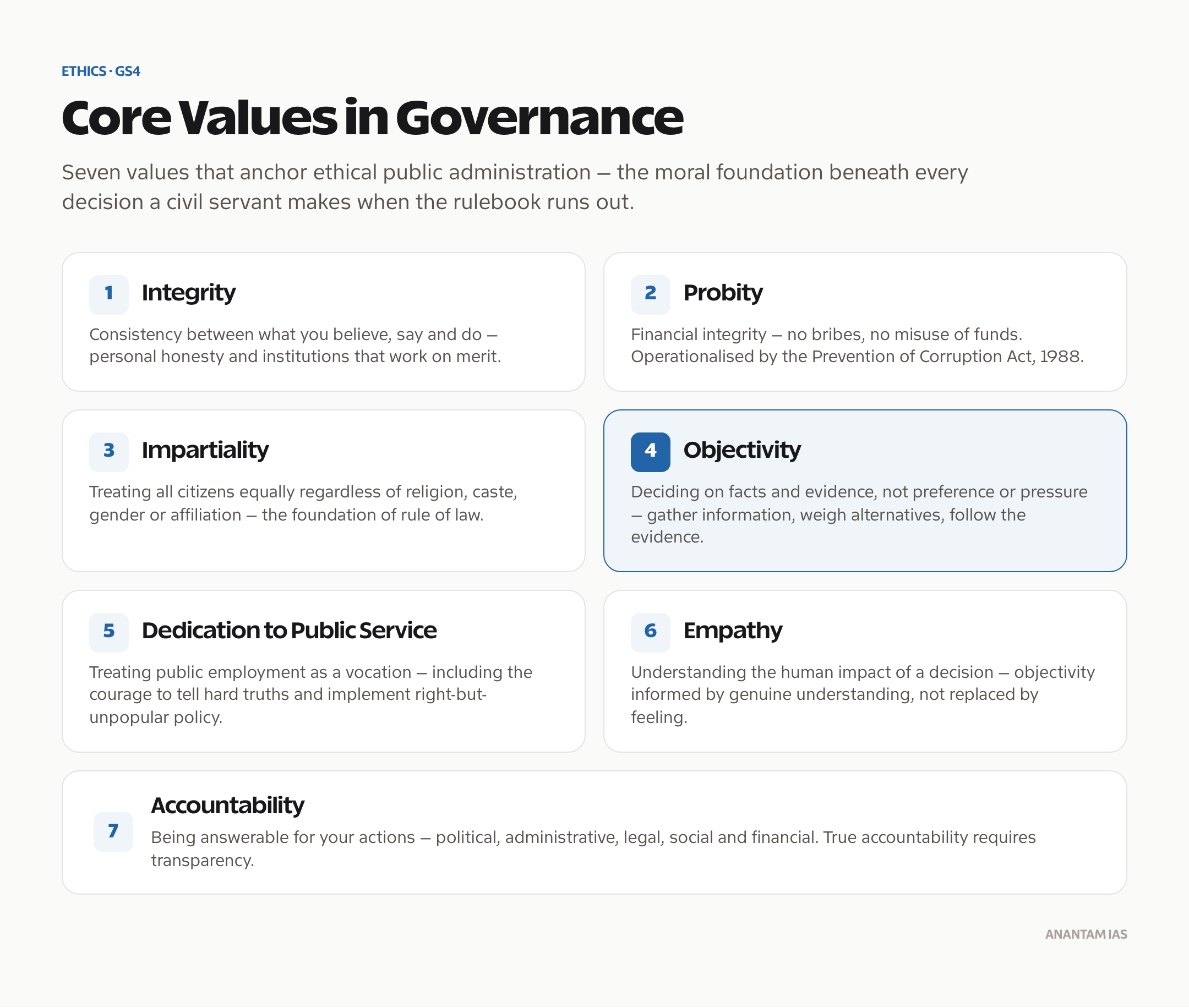
1. Integrity
Integrity means consistency between what you believe, what you say, and what you do. A civil servant with integrity doesn’t say one thing in a committee and another to their superior. They don’t approve a project publicly while recommending against it privately.
Integrity has both personal and institutional dimensions:
- Personal integrity: Individual honesty and consistency
- Institutional integrity: Systems that work as they are supposed to — where selection, promotion, and reward are based on merit, not connections
2. Probity
Probity means strong moral principles; complete honesty. In governance contexts, it specifically refers to financial integrity — not taking bribes, not misusing public funds, not benefiting personally from public position.
The Prevention of Corruption Act, 1988 (amended 2018) operationalises probity through legal provisions. But probity is not merely avoiding prosecution. It means your decisions are genuinely untainted by personal gain.
Probity in financial matters includes:
- Transparent public procurement
- Asset declaration by civil servants
- Proper accounting of public funds
- Avoiding conflict of interest in awarding contracts
3. Impartiality
Impartiality means treating all citizens equally regardless of religion, caste, gender, political affiliation, or socioeconomic status. It is the foundation of rule of law — the same rules apply to everyone.
But impartiality doesn’t mean treating everyone identically. Equity requires treating similar cases similarly and different cases appropriately differently. Giving additional support to a differently-abled person isn’t partiality — it’s equitable treatment.
The challenge for civil servants: political pressure to favour certain groups (electoral constituencies, majority communities, well-connected businesspeople). Resisting that pressure requires courage, which is itself an ethical quality.
4. Objectivity
Objectivity means basing decisions on facts and evidence rather than personal preferences, biases, or external pressures. It requires:
- Gathering relevant information before deciding
- Considering alternative perspectives
- Not letting personal feelings about a person or group colour the assessment of their case
- Being willing to change your position if evidence contradicts your prior belief
In practice, perfect objectivity is impossible (all humans have biases). Ethical governance requires acknowledging your biases and actively working to counteract them.
5. Dedication to Public Service
Dedication to public service means treating public employment as a vocation — a calling to serve — not merely a job. The IAS officer who refuses a lucrative private sector role to stay in governance is demonstrating dedication. So is the health worker who runs the vaccination camp in the rain.
But dedication also has a harder dimension: dedication sometimes means telling superiors difficult truths, implementing unpopular policies that are right, or persisting when the system resists.
6. Empathy
Empathy — the ability to understand and share the feelings of another — is increasingly recognised as essential to good governance. A district collector who can genuinely understand what drought means to a marginal farmer makes better drought relief decisions than one who only understands the statistical parameters.
Empathy does not mean abandoning objectivity. It means that objectivity is informed by genuine understanding of human impact.
7. Accountability
Accountability means being answerable for your actions and decisions. It has multiple forms:
- Political accountability: To elected representatives
- Administrative accountability: To higher officers; through performance assessment
- Legal accountability: To courts, tribunals
- Social accountability: To citizens through transparency, RTI, public hearings
- Financial accountability: Through audits (CAG), procurement rules
True accountability requires transparency — you can’t hold someone accountable for decisions you can’t see.
Nolan Committee: Seven Principles of Public Life
The Committee on Standards in Public Life, established in the UK in 1994 under Lord Michael Nolan, produced a report that defines seven principles for anyone in public service. These are widely used in UPSC because they provide a clear, memorable framework.
| Principle | Definition |
|---|---|
| 1. Selflessness | Holders of public office should act solely in terms of public interest, not personal gain |
| 2. Integrity | Should not place themselves under financial or other obligations that might influence their official duties |
| 3. Objectivity | In carrying out public business (appointments, contracts, recommendations), choices must be on merit |
| 4. Accountability | Must submit to appropriate scrutiny of their actions |
| 5. Openness | Should be as open as possible about all decisions and actions; restrict information only where clearly in public interest |
| 6. Honesty | Must declare any private interests relating to their duties; take steps to resolve conflicts |
| 7. Leadership | Should promote and support these principles by leadership and example |
These seven principles are sometimes abbreviated as SOAOHL (Selflessness, Objectivity, Accountability, Openness, Honesty, Leadership) — or simply remembered as Nolan’s seven.
ARC 4th Report: Ethics in Governance
The Second Administrative Reforms Commission (2nd ARC) produced 15 reports. The 4th Report was titled “Ethics in Governance” (2007) and is the most directly relevant to GS IV.
Key Recommendations of ARC 4th Report
| Recommendation | Content |
|---|---|
| Ethics legislation | Pass comprehensive legislation for civil servants covering conflicts of interest, post-retirement employment, asset disclosure |
| Ombudsman | Strengthen Lokpal/Lokayukta as institutional mechanisms for accountability |
| Whistleblower protection | Effective legal protection for civil servants reporting misconduct |
| Asset disclosure | Compulsory annual disclosure of assets and liabilities; penalties for false disclosure |
| Political neutrality | Strict norms against civil servants engaging in political activities |
| Training | Ethics training must be integrated throughout civil service career, not just at induction |
| Social capital | State must invest in building civic trust — the foundation of ethical governance |
The ARC 4th Report’s central argument: ethics cannot be created by rules alone. Rules prevent the worst behaviour but don’t create genuinely ethical administrators. That requires selection of people with strong values, training, organisational culture, and leadership that models ethical behaviour.
Ethical Dilemmas in Civil Service
An ethical dilemma is a situation where you must choose between two or more options, each of which has significant moral costs or where core ethical principles conflict.
Common Ethical Dilemma Structures
1. Loyalty vs Principle Your superior directs you to take an action you believe is wrong (favouring a connected contractor, denying a legitimate claim). Do you comply (loyalty, stability) or refuse/report (principle, potential career damage)?
2. Efficiency vs Fairness Implementing a scheme quickly means using a flawed process that systematically excludes the most marginalised. A fair process takes three times as long and many die waiting. What do you choose?
3. Rules vs Compassion A family is technically ineligible for drought relief by a few weeks of the eligibility period. They are in genuine distress. Following rules means denying them. Bending rules even once creates precedents.
4. Short-term harm vs Long-term good A development project will displace 500 tribal families but provide clean water and electricity to 50,000. How do you weigh these?
5. Individual privacy vs Public interest A disease surveillance system requires sharing individual health data without explicit consent. The public health benefit is real. So is the privacy violation.
How to Approach Ethical Dilemmas in UPSC Case Studies
UPSC GS IV tests your approach to dilemmas, not just your definition of them. A good answer structure:
- Identify all stakeholders and their interests
- Identify the ethical conflict — which principles clash?
- Apply multiple ethical frameworks (consequentialist, deontological, virtue ethics)
- Consider alternatives — are there options that reduce the trade-off?
- Make a clear decision — don’t be equivocal; UPSC rewards moral clarity
- Acknowledge what you sacrifice in making that choice
Ethical Frameworks for Civil Servants
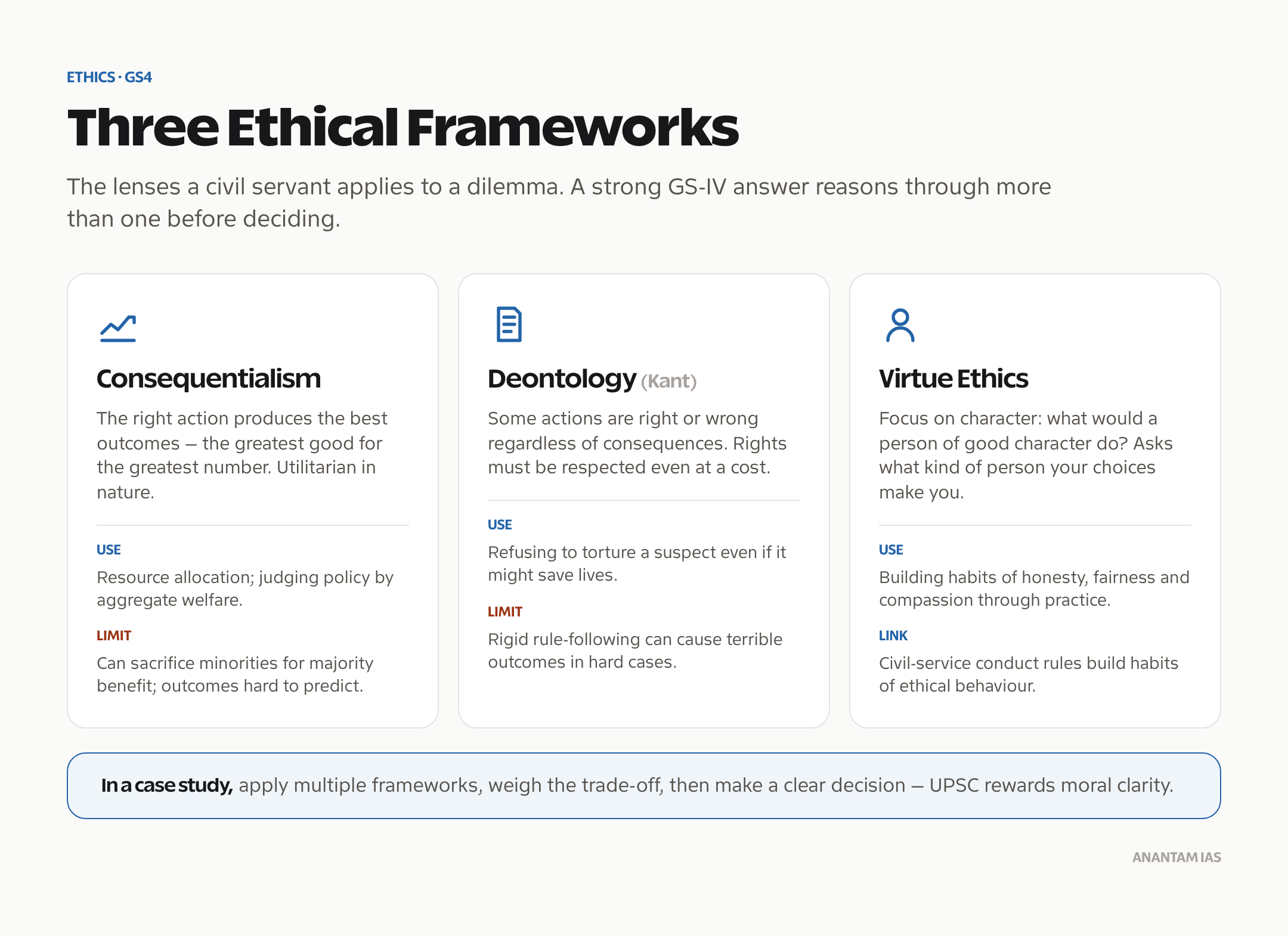
Consequentialism
The right action is the one that produces the best outcomes (greatest good for the greatest number). Utilitarian in nature.
Application: Evaluating a policy by its aggregate impact on welfare. Good for resource allocation decisions.
Limit: Can justify sacrificing minorities for majority benefit; hard to predict consequences accurately.
Deontological Ethics (Kant)
Some actions are right or wrong regardless of their consequences. People have rights that must be respected even if violating them would produce better outcomes.
Application: Refusing to torture a terrorist suspect even if information might save lives.
Limit: Rigid rule-following can lead to terrible outcomes in specific circumstances.
Virtue Ethics
Focus on the character of the moral agent — what would a person of good character do? Asks: “What kind of person am I becoming through my choices?”
Application: Developing habits of honesty, fairness, and compassion through consistent practice.
Link to civil service: The conduct rules for civil servants (not accepting gifts, not taking positions that create conflicts of interest) are partly about building habits of ethical behaviour.
Sources of Ethical Guidance
| Source | What It Provides |
|---|---|
| Constitutional morality | Fundamental Rights, Directive Principles, Preamble values (justice, liberty, equality, fraternity) |
| Indian philosophical traditions | Gandhi (satya, ahimsa, trusteeship), Buddhism (compassion, right action), Vedanta (duty without attachment) |
| International frameworks | UN conventions, OECD ethics principles |
| Civil service conduct rules | All India Services (Conduct) Rules 1968 |
| Departmental codes | Ministry-specific guidelines |
| Precedent | How previous difficult decisions were handled |
Conscience as a Guide
The conscience — your internal moral compass — is a legitimate guide in ethical decision-making, especially where rules and frameworks don’t provide clear answers. But conscience can be wrong (shaped by cultural biases, prejudices, limited information). Effective ethical reasoning combines:
- Trained conscience (shaped by ethical education and reflection)
- Deliberation (thinking through all sides)
- Consultation (with trusted, principled colleagues)
- Humility (willingness to be wrong and learn)
Accountability Mechanisms in India
| Mechanism | Description |
|---|---|
| Lokpal and Lokayuktas | Anti-corruption ombudsmen at national and state level (Lokpal Act 2013; state variations) |
| Right to Information (RTI) | Citizens can request government information; promotes transparency |
| CAG (Comptroller and Auditor General) | Audits government accounts; reports to Parliament |
| Parliamentary Committees | Public Accounts Committee, Estimates Committee scrutinise government functioning |
| Citizens’ Charter | Commitments by government departments on service delivery standards |
| Social Audit | Community-based verification of development scheme implementation (MGNREGA) |
| Whistleblower Protection Act 2014 | Protects those who report corruption and misconduct in public authorities |
Frequently Asked Questions
Q1. What is the difference between probity and integrity in governance?
Integrity is a broader concept — consistency between beliefs, words, and actions; overall moral uprightness in all aspects of conduct. Probity is more specific — it refers particularly to financial honesty and incorruptibility in public service: not taking bribes, not misusing public funds, not benefiting personally from official position. Think of probity as integrity applied specifically to money and resources. Both are essential qualities for civil servants and are tested in UPSC GS IV through case studies involving conflict of interest and corruption.
Q2. What are the Nolan Committee’s seven principles of public life?
Lord Nolan’s Committee on Standards in Public Life (UK, 1994) identified seven principles: (1) Selflessness — act only in public interest; (2) Integrity — no outside obligations that could influence duty; (3) Objectivity — decisions on merit; (4) Accountability — submit to appropriate scrutiny; (5) Openness — be as open as possible about decisions; (6) Honesty — declare private interests; (7) Leadership — promote these principles by example. These are widely cited in UPSC GS IV as a universal framework for governance ethics.
Q3. What is the ARC 4th Report on Ethics in Governance?
The Second Administrative Reforms Commission’s 4th Report (2007), titled u0022Ethics in Governance,u0022 examined institutional and individual ethical failures in Indian public administration. Key recommendations: comprehensive ethics legislation for civil servants, stronger Lokpal/Lokayukta mechanisms, effective whistleblower protection, mandatory asset disclosure with penalties, strict political neutrality norms, and ethics training integrated throughout civil service careers — not just at induction. The report’s central argument is that rules alone can’t create ethics; selection of right people, organisational culture, and leadership modelling are equally important.
Q4. How should you approach an ethical dilemma in a UPSC case study?
For an ethical dilemma case study: (1) Identify all stakeholders and their interests; (2) Precisely identify the ethical conflict — which principles or values are in tension; (3) Apply multiple ethical frameworks — consequentialist (outcomes), deontological (duties and rights), virtue ethics (character); (4) Look for alternatives that reduce the moral trade-off; (5) Make a clear, reasoned decision — don’t hedge; UPSC rewards moral clarity backed by reasoning; (6) Acknowledge what you sacrifice in making that choice. The quality of your reasoning matters more than which choice you make.
Q5. What is the role of conscience in civil service ethics?
Conscience — your internal moral compass — is a legitimate and important guide in governance ethics, particularly in situations where rules and frameworks don’t give clear answers. But conscience can be corrupted by bias, limited perspective, or poor moral education. The UPSC GS IV syllabus emphasises developing an u0022informed conscienceu0022 — one shaped by knowledge of ethical frameworks, awareness of one’s own biases, and practice in moral reasoning. Effective ethical decision-making combines trained conscience with deliberation, consultation, and intellectual humility.
Tell Google you want more of this.
Add Anantam IAS as a preferred sourceOne tap, and this site shows up more often in your own Top Stories, AI Overviews and AI Mode. Remove it any time.