Constitutional Amendment Process in India
Constitutional amendment process in India under Article 368 — types, procedures, special majority, and landmark amendments explained for UPSC preparation.
The Indian Constitution is amended under Article 368, which lays down three routes — a simple majority, a special majority, and a special majority plus ratification by at least half the state legislatures. As of 2026 the Constitution has been amended 106 times, the most recent being the 106th Amendment (2023), which reserves one-third of seats for women in the Lok Sabha and state assemblies. The much-searched 61st Amendment (1989) used the special-majority route to lower the voting age from 21 to 18 years.
Constitutional Amendment Process in India
The Indian Constitution can be amended through the procedure laid down in Article 368, which provides for three types of amendments — simple majority, special majority, and special majority plus state ratification. This flexibility makes the Indian Constitution neither rigid like the American Constitution nor entirely flexible like the British one. The amendment power is a critical topic for UPSC, linking constitutional law, federalism, and the Basic Structure doctrine.
Article 368: The Amendment Provision
Article 368 in Part XX of the Constitution deals with the power of Parliament to amend the Constitution and the procedure for doing so. It specifies that Parliament may, in exercise of its constituent power, amend by way of addition, variation, or repeal any provision of the Constitution.
Key Features of Article 368
- Amendment bills can be introduced in either House of Parliament (Lok Sabha or Rajya Sabha)
- No prior permission of the President is needed to introduce the bill
- The bill can be introduced by a minister or a private member
- The bill must be passed in each House separately — no provision for a joint sitting
- The President shall give assent to the amendment bill (no discretion to withhold)
- After Presidential assent, the Constitution stands amended
The words “shall give his assent” are crucial. Unlike ordinary bills where the President may return the bill or withhold assent, amendment bills under Article 368 must receive assent. This was clarified after the 24th Amendment (1971), which was a response to the Golaknath case.
Three Types of Amendment Procedures
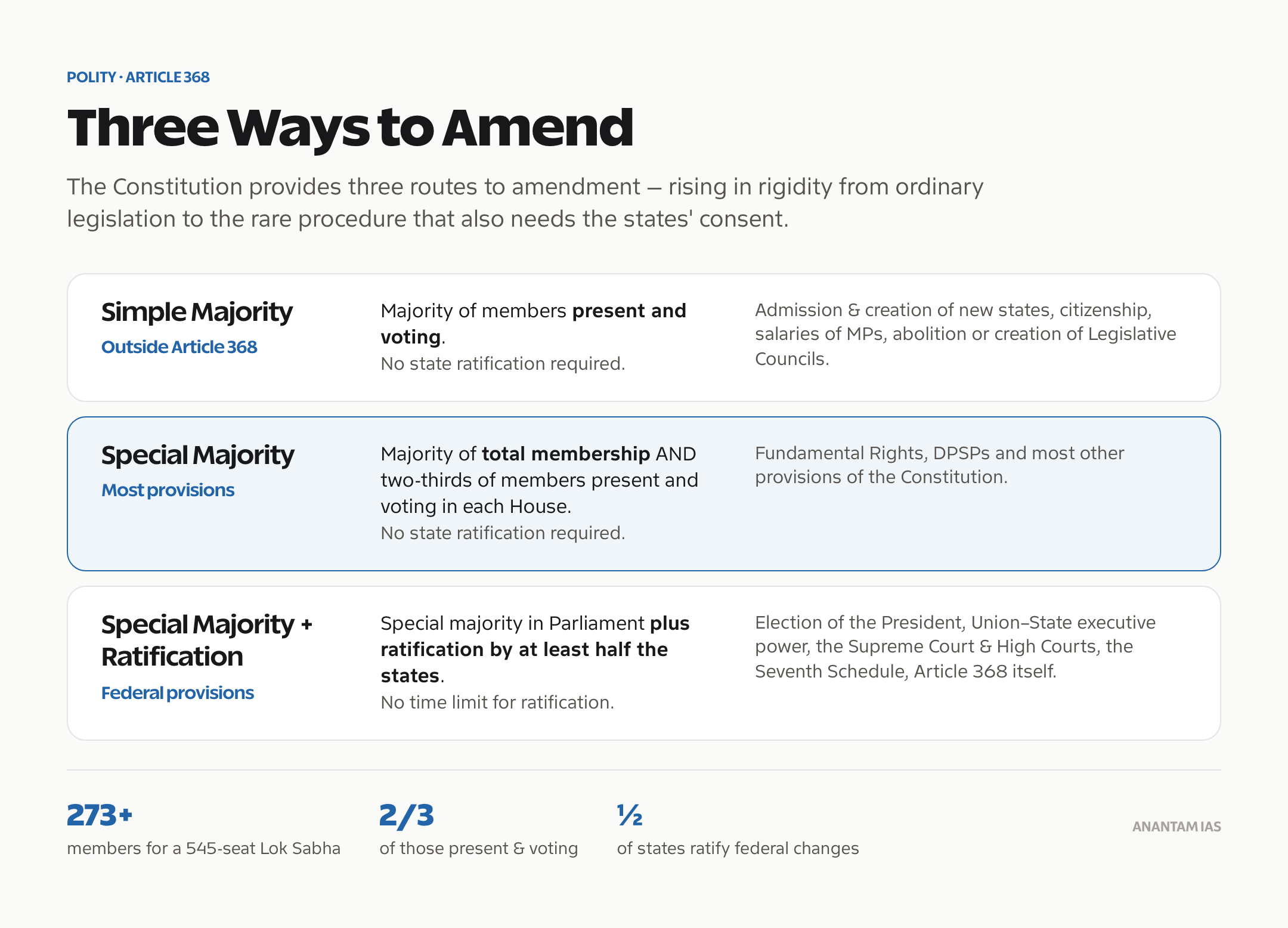
| Type | Majority Required | State Ratification | Examples |
|---|---|---|---|
| Simple Majority | Majority of members present and voting | Not required | Admission of new states, creation of new states, citizenship, salaries of MPs |
| Special Majority | Majority of total membership + 2/3 of members present and voting in each House | Not required | Fundamental Rights, DPSPs, most other provisions |
| Special Majority + State Ratification | Special majority in Parliament + ratification by legislatures of half the states | Required | Election of President, federal provisions, Article 368 itself |
Simple Majority Amendments
These aren’t technically amendments under Article 368. They’re provisions that Parliament can change through ordinary legislative process:
- Article 2: Admission or establishment of new states
- Article 3: Formation of new states, alteration of boundaries
- Article 4: Laws made under Articles 2 and 3
- Articles 169: Abolition or creation of Legislative Councils
- Second Schedule: Salaries and allowances
- Fifth Schedule: Administration of Scheduled Areas
- Sixth Schedule: Administration of Tribal Areas
Special Majority Amendments
Most constitutional provisions fall here. “Special majority” means:
- Majority of total membership of the House (not just those present), AND
- A majority of not less than two-thirds of members present and voting
For example, if Lok Sabha has 545 members: the bill needs support of at least 273 members (total membership majority) AND at least two-thirds of those present and voting.
Special Majority + State Ratification
The most rigorous procedure applies to provisions affecting the federal structure:
- Article 54, 55: Election of President
- Article 73, 162: Extent of executive power of Union and States
- Article 124–147, 214–231: Supreme Court and High Courts
- Article 245–255: Legislative relations between Union and States
- Seventh Schedule: Union, State, and Concurrent Lists
- Representation of states in Parliament
- Article 368: Amendment procedure itself
Ratification requires a simple majority in the legislature of at least half the states. There’s no time limit for ratification.
Landmark Constitutional Amendments
| Amendment | Year | Key Change |
|---|---|---|
| 1st | 1951 | Added Ninth Schedule; restrictions on Fundamental Rights for land reform |
| 7th | 1956 | Reorganisation of states on linguistic basis |
| 24th | 1971 | Affirmed Parliament’s power to amend any part of Constitution |
| 25th | 1971 | Curtailed right to property; added Article 31C |
| 42nd | 1976 | “Mini Constitution” — added Fundamental Duties, changed Preamble, restricted judicial review |
| 44th | 1978 | Reversed many 42nd Amendment changes; right to property made legal right |
| 52nd | 1985 | Anti-defection law (Tenth Schedule) |
| 61st | 1989 | Reduced voting age from 21 to 18 years |
| 73rd | 1992 | Panchayati Raj institutions constitutionalised |
| 74th | 1992 | Municipalities constitutionalised |
| 86th | 2002 | Right to Education (Article 21A) |
| 91st | 2003 | Limited Council of Ministers to 15% of Lok Sabha strength |
| 101st | 2016 | Goods and Services Tax (GST) |
| 103rd | 2019 | 10% EWS reservation |
| 104th | 2020 | Extended SC/ST reservation in Lok Sabha and state assemblies by 10 years |
| 106th | 2023 | Women’s Reservation — one-third seats in Lok Sabha and state assemblies |
The Basic Structure Doctrine
The most significant limitation on Parliament’s amendment power didn’t come from the Constitution’s text — it came from judicial interpretation.
Evolution Through Key Cases
Shankari Prasad v. Union of India (1951): The Supreme Court held that Parliament could amend any part of the Constitution, including Fundamental Rights.
Sajjan Singh v. State of Rajasthan (1965): Reaffirmed the Shankari Prasad position.
Golaknath v. State of Punjab (1967): In a dramatic reversal, an 11-judge bench held that Parliament couldn’t amend Fundamental Rights. This led to the 24th and 25th Amendments.
Kesavananda Bharati v. State of Kerala (1973): The landmark 13-judge bench ruling established the Basic Structure doctrine. Parliament can amend any provision, but cannot destroy the “basic structure” of the Constitution. This case is the cornerstone of Indian constitutional law.
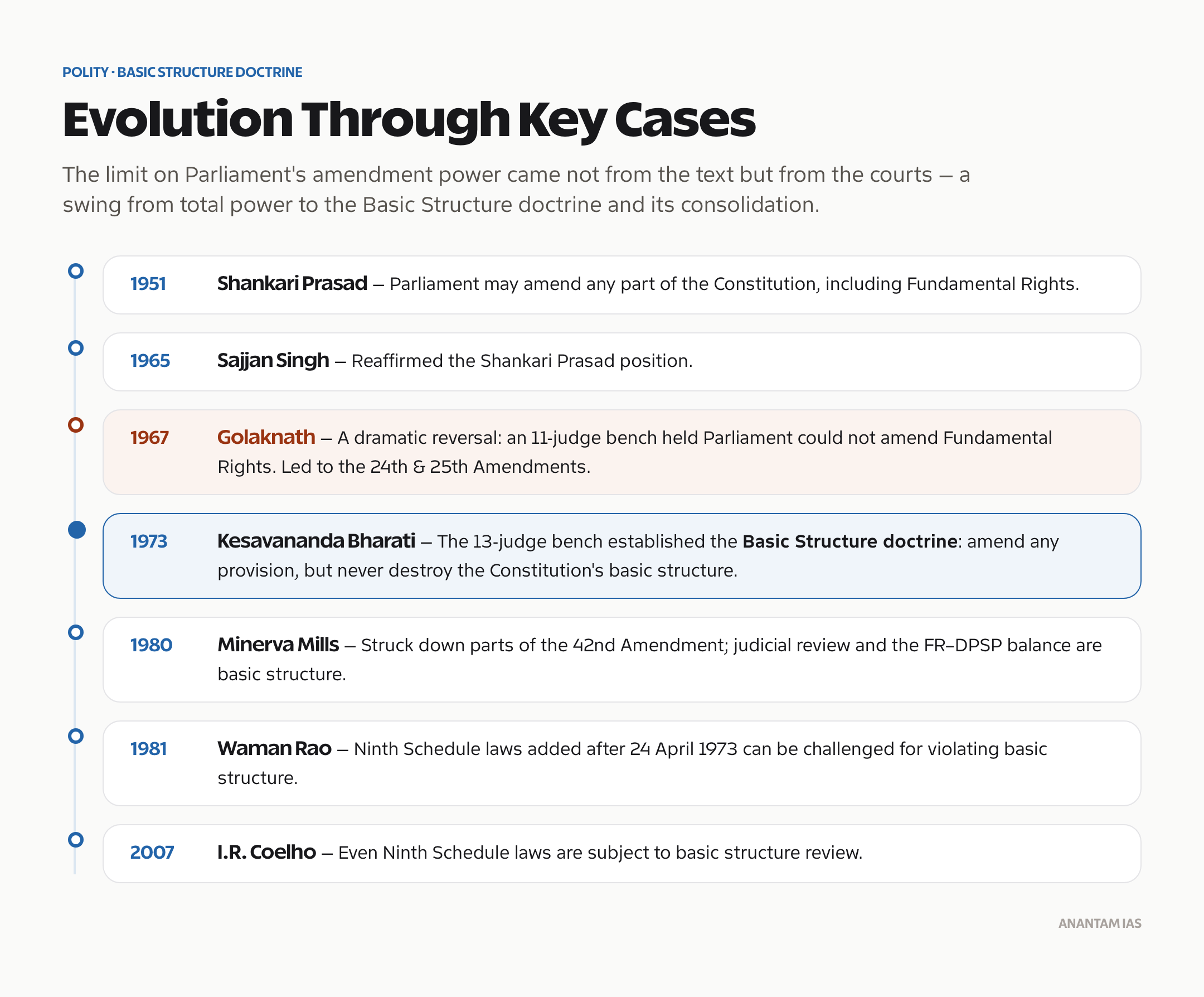
Minerva Mills v. Union of India (1980): Struck down parts of the 42nd Amendment. Confirmed that judicial review and the balance between Fundamental Rights and DPSPs are part of the basic structure.
Waman Rao v. Union of India (1981): Laws placed in the Ninth Schedule after 24 April 1973 can be challenged if they violate basic structure.
I.R. Coelho v. State of Tamil Nadu (2007): Even Ninth Schedule laws are subject to basic structure review.
What Constitutes Basic Structure?
The Supreme Court hasn’t provided an exhaustive list. Through various judgments, the following have been identified:
- Supremacy of the Constitution
- Republican and democratic form of government
- Secular character
- Separation of powers
- Federal character
- Sovereignty and integrity of India
- Judicial review
- Rule of law
- Harmony between Fundamental Rights and DPSPs
- Free and fair elections
- Limited power of Parliament to amend
Comparison: Indian vs Other Amendment Processes
| Feature | India | USA | UK |
|---|---|---|---|
| Written procedure | Article 368 | Article V | No written constitution |
| Rigidity | Flexible to rigid (varies) | Rigid | Completely flexible |
| Types of procedure | Three types | One type | Ordinary legislation |
| State role | Half states for federal provisions | Three-fourths of states for all | Not applicable |
| Judicial review | Basic Structure limits | Constitutional limits | Parliamentary sovereignty |
| Amendments so far | 106 (as of 2026) | 27 (since 1789) | N/A |
Critical Analysis
Strengths
The amendment process balances flexibility with stability. Simple majority provisions allow quick adaptation. Special majority ensures broad political consensus for significant changes. State ratification protects federal provisions.
Weaknesses
No time limit for state ratification creates uncertainty. The absence of a referendum mechanism means citizens don’t directly participate. The dominance of a single party in both Houses can make amendments easier than intended. The Rajya Sabha‘s role is weaker since money bills and certain financial matters bypass it.
The 42nd Amendment demonstrated how a government with brute majority can radically alter the Constitution. The corrective 44th Amendment showed that the system can self-correct — but only when political conditions allow.
Fundamental Rights Indian Parliament Supreme Court of India
Frequently Asked Questions
How many types of amendments are there in the Indian Constitution?
There are three types: amendments by simple majority of Parliament (for provisions like admission of new states), amendments by special majority under Article 368 (for most provisions including Fundamental Rights), and amendments by special majority plus ratification by half the state legislatures (for federal provisions like distribution of powers and the amendment process itself).
Can Parliament amend the Basic Structure of the Constitution?
No. The Supreme Court in Kesavananda Bharati v. State of Kerala (1973) established that Parliament cannot destroy or abrogate the basic structure of the Constitution through amendments under Article 368. Features like democracy, secularism, federalism, judicial review, and separation of powers form the basic structure and are beyond Parliament’s amending power.
What is the difference between the 42nd and 44th Amendments?
The 42nd Amendment (1976), passed during the Emergency, expanded government power by curtailing judicial review, adding Fundamental Duties, and changing the Preamble. The 44th Amendment (1978) reversed many of these changes — restoring judicial powers, removing the right to property from Fundamental Rights, and strengthening civil liberties. Together, they represent the Constitution’s resilience.
Can a Constitutional Amendment Bill be introduced in Rajya Sabha?
Yes. Unlike Money Bills (which can only be introduced in Lok Sabha), Constitutional Amendment Bills can be introduced in either House of Parliament. The bill must be passed by both Houses separately with the required majority. There’s no provision for a joint sitting of both Houses to resolve disagreements on amendment bills.