Convention on Biological Diversity (CBD): Rio 1992 to COP 16 — Full UPSC Guide
The CBD is the legally binding global treaty on biodiversity. Cartagena, Nagoya, KMGBF 30x30, COP 16 Cali Fund — full UPSC guide with India's role and prelims pointers.
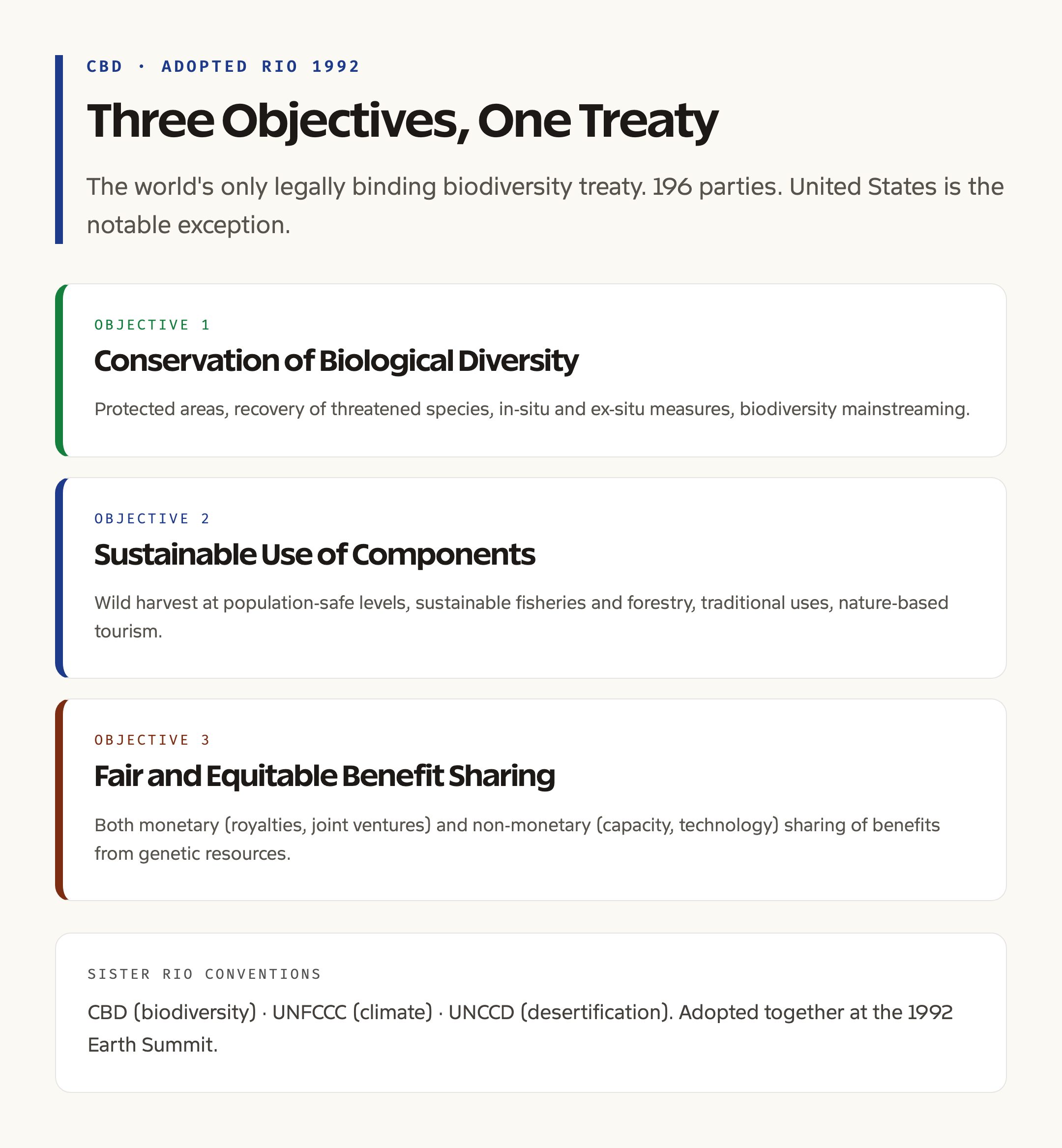
The Convention on Biological Diversity, almost always abbreviated to CBD, is the world’s only legally binding treaty dedicated entirely to biodiversity. It was opened for signature at the 1992 Rio Earth Summit alongside the climate convention and the desertification convention, the three sister treaties often called the Rio conventions. Today the CBD has 196 parties (almost all UN members except the United States), three objectives, two protocols, and a successor target framework that has redefined global biodiversity ambition.
For UPSC, the CBD is non-negotiable territory. It threads through GS-III environment questions, GS-II international relations, the Biological Diversity Act, and the politics of access and benefit sharing. Recent additions like the Kunming-Montreal Global Biodiversity Framework (2022) and the Cali Fund (2024) have made the convention even more current. This guide walks through everything an aspirant needs, from foundational facts to mains-ready angles.
Quick Facts
- Full name: Convention on Biological Diversity
- Adopted at: UN Conference on Environment and Development (Rio Earth Summit), 1992
- Entered into force: 29 December 1993
- Status: Legally binding
- Parties: 196 (USA is a notable non-party)
- Secretariat: Montreal, Canada
- Three objectives: Conservation of biological diversity; sustainable use of components; fair and equitable sharing of benefits arising from genetic resources
- Sister conventions: UNFCCC (climate), UNCCD (desertification)
- Major protocols: Cartagena (2000) on biosafety, Nagoya (2010) on access and benefit sharing
- Current strategic plan: Kunming-Montreal Global Biodiversity Framework (KMGBF), 2022
- Latest COP: COP 16, Cali, Colombia, 2024-25
What is the Convention on Biological Diversity?
The CBD is the umbrella international treaty that frames how the world conserves and uses living diversity. It defines biological diversity as variability among living organisms at three levels: genes, species, and ecosystems. By treating all three together, the convention closed gaps that earlier treaties like CITES (focused on species trade) or Ramsar (focused on wetlands) could not address.
The treaty rests on three objectives that must always be read together. First, the conservation of biological diversity, recognising biodiversity as common concern of humankind but reaffirming national sovereignty over natural resources. Second, the sustainable use of components, including renewable harvest and ecosystem services. Third, the fair and equitable sharing of benefits arising from the utilisation of genetic resources, the principle that drove the development of the Nagoya Protocol and the Biological Diversity Act, 2002 in India.
Background and Origins
By the 1980s, the limitations of fragmented species and habitat treaties were obvious. Tropical deforestation, the looming extinction crisis, and the rise of biotechnology, which raised new questions about who owns genetic material, created political pressure for a comprehensive global treaty. The UN General Assembly mandated the United Nations Environment Programme to begin negotiations, and the resulting text was finalised in time for Rio 1992.
What made the CBD distinctive was its insistence on national sovereignty over genetic resources. Earlier instruments had treated biodiversity as the common heritage of mankind, a framing that the global South found extractive given that most genetic diversity sits in tropical countries while most biotechnology capacity sits in industrialised ones. The CBD reversed this. Genetic resources belong to the country in which they occur, and access by foreign users requires prior informed consent and equitable benefit sharing. This is the political DNA of the convention.
The Three Objectives Explained
The three objectives are sometimes treated as separate goals, but the convention treats them as inseparable.
- Conservation: Establishment of protected areas, recovery of threatened species, in-situ and ex-situ measures, and integration of biodiversity into sectoral planning.
- Sustainable use: Wild harvest at population-safe levels, sustainable fisheries and forestry, traditional uses by indigenous communities, and nature-based tourism.
- Fair and equitable benefit sharing: Both monetary (royalties, fees, joint ventures) and non-monetary (capacity building, technology transfer, joint research). This is where the Nagoya Protocol and India’s biodiversity legislation operate.
The conservation objective alone cannot work without sustainable use, since pure exclusion creates communities that resent protection. Sustainable use without conservation collapses ecosystems. Both fail without fair benefit sharing, which determines whether countries with rich biodiversity stay engaged with the treaty regime.
The Cartagena Protocol on Biosafety (2000)
The Cartagena Protocol governs the safe transboundary movement, handling, and use of Living Modified Organisms (LMOs). LMOs are organisms whose genetic material has been altered using modern biotechnology, the most familiar examples being genetically modified crops like Bt cotton, GM soybean, and GM maize. The protocol entered into force in 2003 and currently has over 170 parties.
The protocol’s core mechanism is the Advance Informed Agreement procedure. Before a country imports an LMO intended for environmental release, it must receive notification, conduct a risk assessment, and provide informed consent. The Biosafety Clearing House supports information exchange among parties. India ratified the protocol in 2003 and operationalised it through the Genetic Engineering Appraisal Committee under the MoEFCC and the Department of Biotechnology.
The Nagoya Protocol on Access and Benefit Sharing (2010)
The Nagoya Protocol gave concrete operational form to the third objective of the CBD. Adopted at COP 10 in Nagoya, Japan, and in force since 2014, it requires that access to genetic resources be conditional on prior informed consent of the providing country and on mutually agreed terms. Benefits arising from utilisation, whether monetary royalties or capacity-sharing, must flow back to the country of origin and, where applicable, to indigenous and local communities holding traditional knowledge.
Imagine a multinational pharmaceutical company isolating a compound from an Indian medicinal plant. Under Nagoya, the company must obtain Indian permission, share commercial returns, and where the plant is associated with a particular community’s traditional knowledge, share benefits with that community. India’s National Biodiversity Authority was set up under the Biological Diversity Act, 2002, to implement these obligations domestically.
Aichi Targets to Kunming-Montreal Global Biodiversity Framework
| Era | Strategic Plan | Headline Target | Status |
|---|---|---|---|
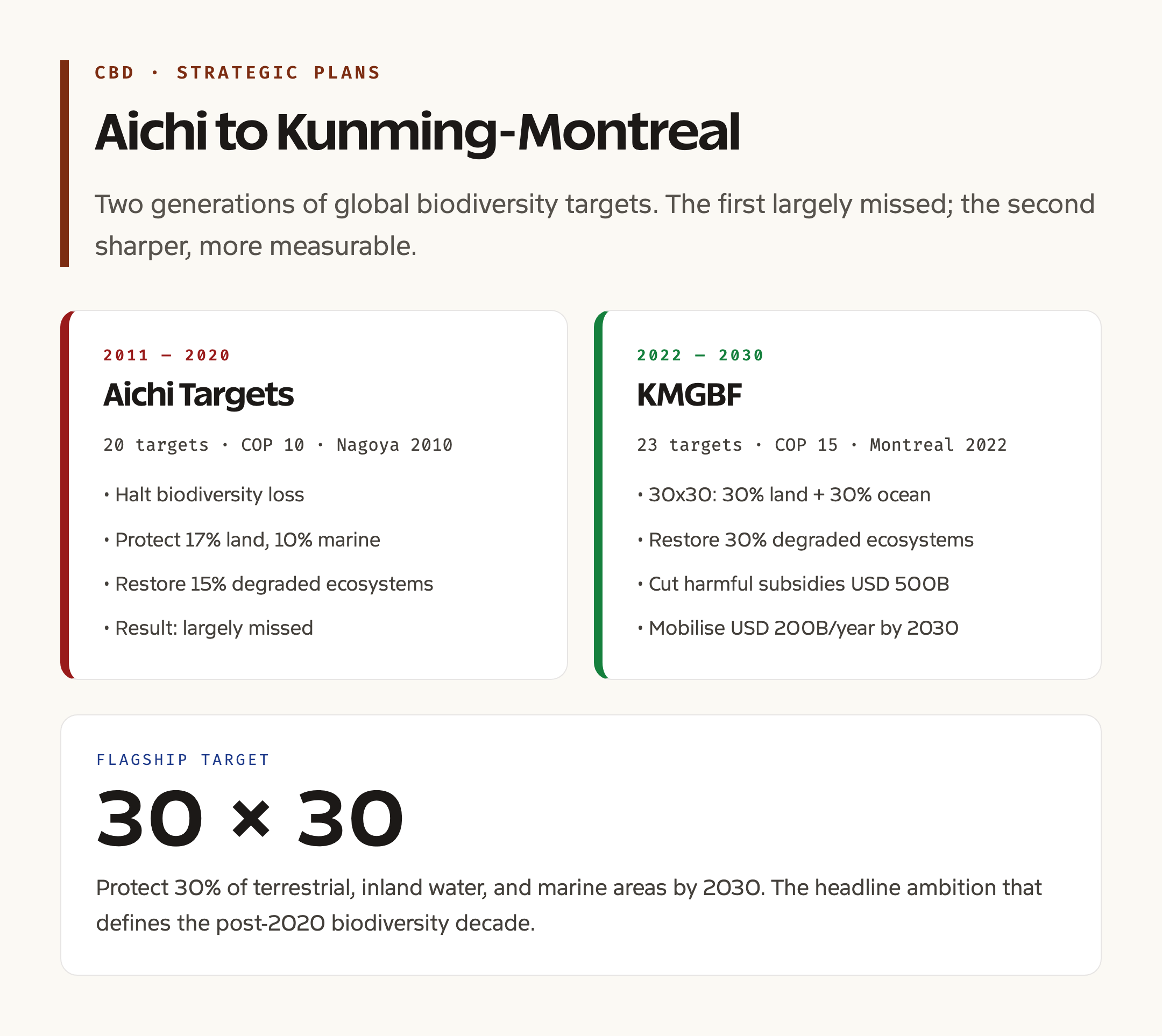
| 2011-2020 | Aichi Biodiversity Targets (20 targets) | Halt loss, expand PAs to 17% land, 10% marine | Largely missed |
| 2022-2030 | Kunming-Montreal Global Biodiversity Framework (23 targets) | 30×30 (30% land + 30% ocean by 2030), restore 30% of degraded ecosystems | Implementation underway |
The Aichi Targets, adopted at COP 10 in 2010, were the first comprehensive global biodiversity targets. By 2020, only 6 of the 20 targets were partially achieved. The KMGBF, adopted at COP 15 in Montreal in 2022, replaced Aichi with sharper, more measurable goals. Its flagship target is 30×30: protect at least 30 per cent of terrestrial, inland water, and marine areas by 2030. Other key targets include restoring 30 per cent of degraded ecosystems, reducing harmful subsidies by USD 500 billion per year, and mobilising USD 200 billion per year in biodiversity finance by 2030.
COP 16 (Cali, Colombia, 2024-25) and the Cali Fund
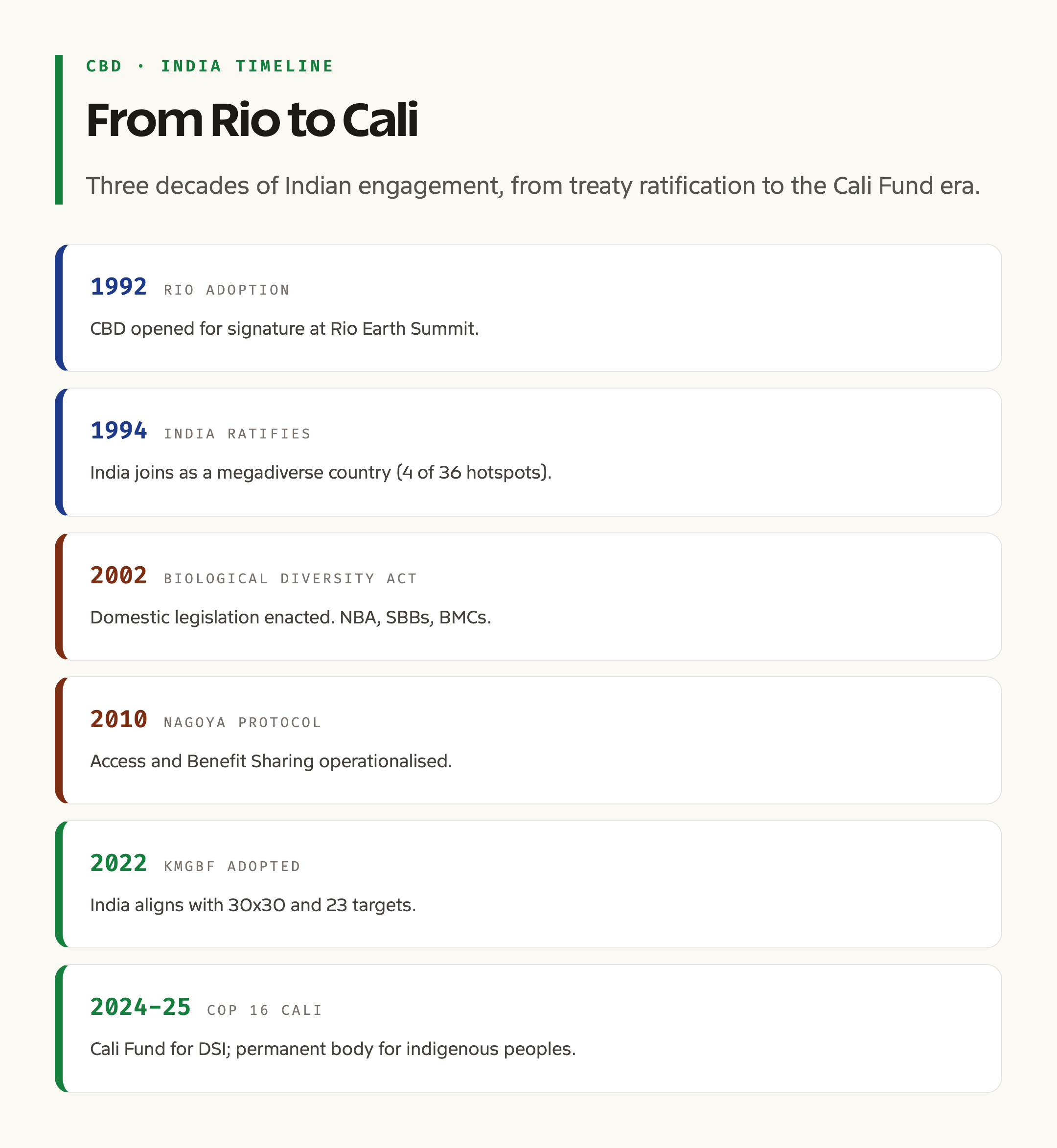
COP 16 in Cali was the first conference of parties under the new KMGBF. Two outcomes stand out for UPSC. First, the establishment of the Cali Fund, a global financing mechanism under which companies that benefit from Digital Sequence Information (DSI) on genetic resources contribute a portion of profits to support biodiversity conservation. DSI is the digital data derived from sequencing genetic material, and major biotech, pharmaceutical, cosmetic, and food sectors rely on it. The Cali Fund operationalises benefit sharing in the digital age, going beyond the physical-sample focus of the Nagoya Protocol.
Second, the establishment of a permanent body for indigenous peoples and local communities under the CBD. This subsidiary body gives formal voice to indigenous peoples in convention decisions, recognising that the largest remaining intact ecosystems sit on indigenous lands. COP 16 also pushed forward the National Biodiversity Strategy and Action Plan submissions through which countries align domestic policy with KMGBF targets.
India and the CBD
India ratified the CBD in 1994 and has been one of the most active developing-country voices in the negotiations. Domestic implementation rests on the Biological Diversity Act, 2002, which created the National Biodiversity Authority at the central level, State Biodiversity Boards at state level, and Biodiversity Management Committees at local level. The Act requires foreign access to Indian genetic resources to go through the NBA, while domestic Indian users notify State Boards.
India is a megadiverse country, hosting four of the world’s 36 biodiversity hotspots: the Western Ghats, the Eastern Himalaya, the Indo-Burma region, and the Sundaland. India’s contributions to the KMGBF include strong positions on resource mobilisation, on the rights of indigenous and local communities, and on technology transfer. For prelims, link the CBD to the Biological Diversity Act, the National Biodiversity Authority, and the People’s Biodiversity Registers maintained by Biodiversity Management Committees.
Why the CBD Matters
The CBD matters because biodiversity loss is now widely recognised as a planetary crisis comparable to climate change. The Living Planet Index shows wildlife population declines of around 70 per cent since 1970. The IPBES Global Assessment estimates that around one million species face extinction risk. Without a binding global instrument, individual country efforts would be uncoordinated, and the asymmetry between biodiversity-rich and biotechnology-rich countries would have produced sustained conflict.
The CBD also matters as the only major UN environmental treaty without United States ratification. The political consequences of this gap are real, since US biotechnology and pharmaceutical industries operate outside the formal protocol regime. For India, the CBD is also a soft-power lever, allowing it to push for South-South cooperation, equitable benefit sharing, and capacity building in line with its broader climate diplomacy positions.
Challenges
Implementation is uneven. Most parties missed the Aichi targets, and the funding architecture for KMGBF remains incomplete. The Cali Fund is a step forward, but DSI benefit sharing is technically and politically complex. Defining what counts as a use, what counts as a derived product, and how payments flow back through long biotechnology value chains are unsettled questions.
Indigenous and local community engagement, while improved by the COP 16 permanent body, still varies hugely across countries. Compliance with Cartagena and Nagoya is patchy, and several countries have weak national legislation. Tradeoffs with food security, agricultural intensification, and infrastructure expansion continue to drive ecosystem conversion. And in international fora, the CBD competes for attention and funding with the climate convention, often losing out despite the recognised links between climate and biodiversity loss.
Prelims Pointers
- The CBD was adopted at the Rio Earth Summit in 1992 and entered into force on 29 December 1993.
- It is legally binding, with 196 parties. The United States is not a party.
- The secretariat is in Montreal, Canada.
- The three objectives: conservation, sustainable use, fair and equitable benefit sharing.
- The Cartagena Protocol (2000) deals with biosafety and Living Modified Organisms (LMOs).
- The Nagoya Protocol (2010) deals with Access and Benefit Sharing (ABS).
- The Kunming-Montreal Global Biodiversity Framework (KMGBF, 2022) replaced the Aichi Targets.
- The KMGBF flagship target is 30×30: protect 30% of land and 30% of oceans by 2030.
- COP 16 in Cali, Colombia (2024-25) established the Cali Fund for Digital Sequence Information (DSI).
- COP 16 also created a permanent body for indigenous peoples under the CBD.
- India is a party since 1994 and implements through the Biological Diversity Act, 2002 and the National Biodiversity Authority.
Mains Angles
- GS-III, Environment: Discuss how the Convention on Biological Diversity addresses the asymmetry between biodiversity-rich developing countries and biotechnology-rich developed ones. Use the Nagoya Protocol and the Cali Fund to illustrate.
- GS-II, International Relations: Examine India’s role in CBD negotiations and the link between domestic biodiversity legislation and international commitments.
- GS-III, Conservation: Critically evaluate the Kunming-Montreal Global Biodiversity Framework as a successor to the Aichi targets. Will 30×30 succeed where Aichi did not?
- GS-II, Governance: Analyse the multi-level governance structure under India’s Biological Diversity Act, 2002, particularly the role of Biodiversity Management Committees and People’s Biodiversity Registers.
- Essay: “Biodiversity is the silent emergency. Climate change is the loud one.” Examine in light of the CBD and UNFCCC.
Way Forward
The convention’s next phase needs three things. First, predictable finance, including delivery on the USD 200 billion per year target and rapid operationalisation of the Cali Fund. Second, robust implementation of the KMGBF through transparent National Biodiversity Strategy and Action Plans with clear indicators and review mechanisms. Third, integration with climate negotiations under UNFCCC, since climate change is a major driver of biodiversity loss and biodiversity loss undermines climate adaptation.
For India, the way forward involves strengthening State Biodiversity Boards and BMCs, completing People’s Biodiversity Registers across the country, fast-tracking benefit-sharing payouts, and ensuring that conservation finance reaches the local communities and indigenous peoples who actually steward biodiversity. Done well, the CBD framework can finally close the gap between global ambition and on-ground outcomes that has defined biodiversity policy for three decades.
Frequently Asked Questions
What is the Convention on Biological Diversity?
The CBD is the legally binding international treaty adopted at the 1992 Rio Earth Summit. It has three objectives: conservation of biological diversity, sustainable use of components, and fair and equitable sharing of benefits from genetic resources.
When did the CBD enter into force?
The convention entered into force on 29 December 1993, after the required minimum number of parties had ratified it.
Why is the United States not a party to the CBD?
The United States signed the convention but has never ratified it, primarily due to domestic political concerns about implications for intellectual property rights and biotechnology regulation. It is the only major country outside the treaty.
What is the Cartagena Protocol?
The Cartagena Protocol on Biosafety, adopted in 2000 under the CBD, governs the safe transboundary movement of Living Modified Organisms (LMOs). It established the Advance Informed Agreement procedure and the Biosafety Clearing House.
What is the Nagoya Protocol?
The Nagoya Protocol on Access and Benefit Sharing, adopted in 2010, operationalises the third objective of the CBD. It requires prior informed consent and mutually agreed terms for access to genetic resources, with benefits flowing back to providing countries and communities.
What is the Kunming-Montreal Global Biodiversity Framework?
The KMGBF is the post-2020 strategic plan adopted at COP 15 in Montreal in 2022. Its 23 targets include the flagship 30×30 commitment to protect 30 per cent of land and 30 per cent of oceans by 2030.
What is the Cali Fund?
The Cali Fund was established at COP 16 in Cali, Colombia (2024-25). It is a global mechanism under which companies that benefit from Digital Sequence Information (DSI) on genetic resources contribute a portion of their profits to support biodiversity conservation.
What does 30×30 mean?
30×30 is the target to protect at least 30 per cent of the world’s terrestrial, inland water, and marine areas by 2030. It is the headline biodiversity ambition under the KMGBF.
How does India implement the CBD?
India ratified the CBD in 1994 and implements it primarily through the Biological Diversity Act, 2002. The National Biodiversity Authority handles foreign access, State Biodiversity Boards oversee domestic implementation, and Biodiversity Management Committees operate at the local level with People’s Biodiversity Registers.
What is the difference between CBD, UNFCCC, and UNCCD?
All three are Rio conventions adopted at the 1992 Earth Summit. The CBD covers biological diversity, the UNFCCC covers climate change, and the UNCCD covers desertification and land degradation.