Cryptocurrencies (UPSC Science & Tech)
UPSC guide to cryptocurrencies: how they work, blockchain underpinnings, India's regulatory journey, RBI's e-Rupee, taxation, and 2024-26 developments.
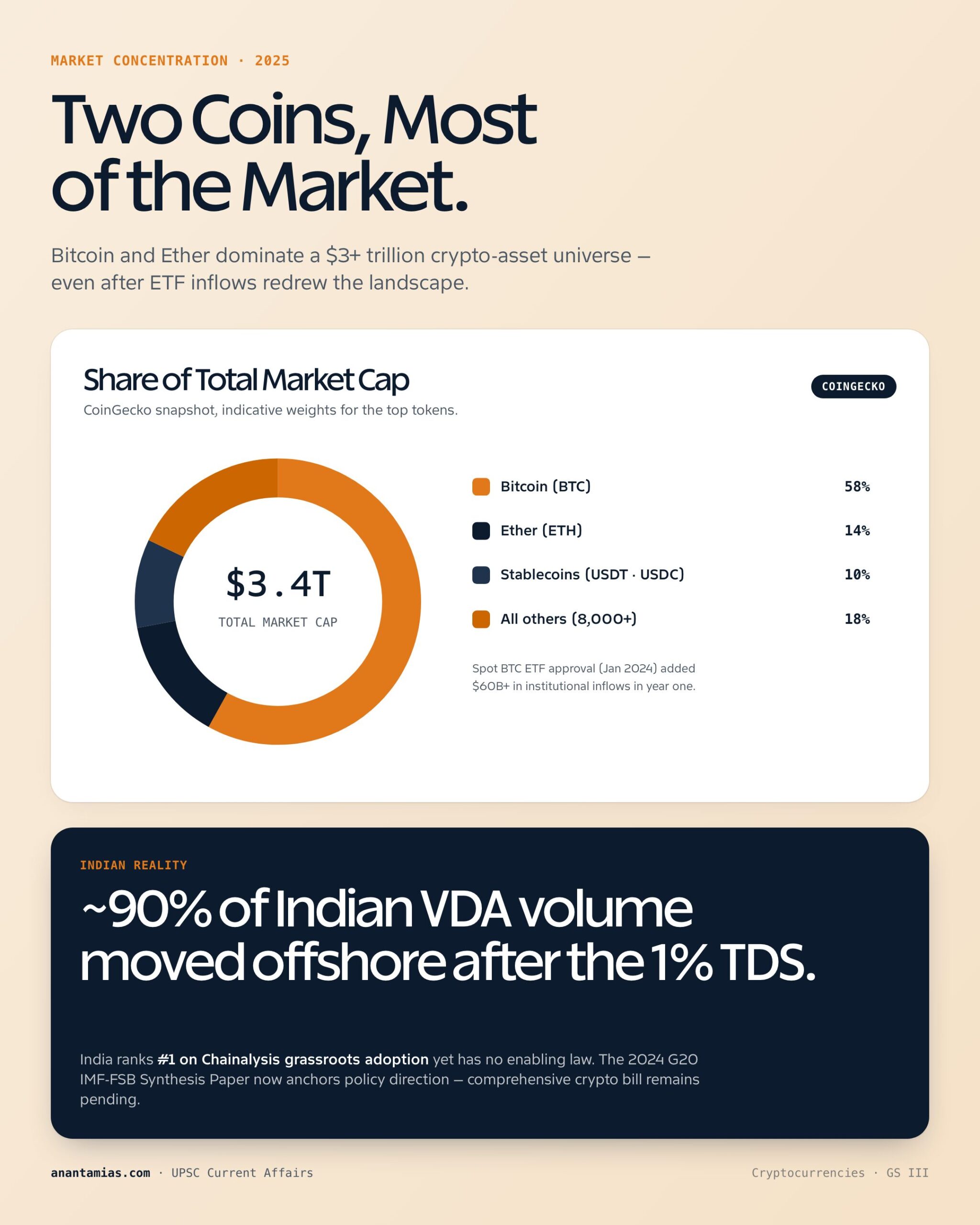
A cryptocurrency is a digital, decentralised representation of value that uses cryptography for security and a distributed ledger — almost always a blockchain — for transaction recording. Unlike the rupee, dollar or yen, no central bank issues it, no government guarantees it, and no single institution controls it. Bitcoin, the first cryptocurrency, appeared in 2009 in the wake of the global financial crisis as a libertarian experiment in trustless money. A decade and a half later, the global crypto market has crossed USD 3 trillion in market capitalisation at peak, attracted serious institutional capital, and forced regulators across the world to rewrite the rules of finance.
For UPSC, cryptocurrencies sit at the intersection of GS III (Science & Tech, Economy, Internal Security), with overflow into GS II (Governance and International Relations) and the Essay paper.
What is a cryptocurrency — the underlying science
A cryptocurrency is a subset of the broader category of virtual digital assets (VDAs). Three properties define it:
- Digital — exists only as bits on a network, with no physical form.
- Decentralised — issued, validated and recorded across thousands of nodes rather than by a central authority.
- Cryptographically secured — transactions are signed with public-private key pairs and chained using cryptographic hash functions (typically SHA-256 for Bitcoin, Keccak-256 for Ethereum).
The breakthrough that made Bitcoin possible was Satoshi Nakamoto's 2008 white paper, which solved the double-spend problem without a trusted intermediary. The solution combined three pre-existing ideas — public-key cryptography, hash-linked timestamping and proof-of-work consensus — into a self-policing peer-to-peer system.
Coin vs token
| Type | Native to its own chain? | Example |
|---|---|---|
| Coin | Yes — has own blockchain | Bitcoin (BTC), Ether (ETH), Solana (SOL) |
| Token | No — runs on another chain | USDT, USDC, most NFTs (on Ethereum) |
| Stablecoin | Pegged to fiat or asset | USDT, USDC, DAI |
| CBDC | State-issued digital currency | India's e₹, China's e-CNY |
How cryptocurrency works
A simplified end-to-end flow:
- The user generates a wallet — a public address (like a bank account number) and a private key (like a password that must never be shared).
- To send crypto, the user signs a transaction with their private key and broadcasts it to the network.
- Validators (miners in Proof-of-Work, stakers in Proof-of-Stake) bundle pending transactions into a block and compete or rotate to add it to the chain.
- Once the block is added, every node updates its copy of the ledger. After a few confirmations the transaction is treated as final.
- The validator earns block rewards (newly minted coins) plus transaction fees.
Consensus — who decides what is true?
- Proof-of-Work (PoW) — used by Bitcoin. Miners burn electricity solving a hash puzzle. Tamper-proof, but energy-intensive.
- Proof-of-Stake (PoS) — used by Ethereum since the 2022 Merge. Validators lock up tokens as collateral; bad actors are slashed. Roughly 99.9% less energy-intensive than PoW.
Major cryptocurrencies
| Coin | Launched | Consensus | Notable feature |
|---|---|---|---|
| Bitcoin (BTC) | 2009 | PoW | Hard cap of 21 million; "digital gold" |
| Ethereum (ETH) | 2015 | PoS (since 2022) | Smart contracts; powers DeFi & NFTs |
| Tether (USDT) | 2014 | Token on multiple chains | USD-pegged stablecoin; settlement rail |
| Solana (SOL) | 2020 | Proof-of-History + PoS | High throughput (~65,000 tps theoretical) |
| XRP | 2012 | Federated consensus | Targeted at cross-border bank settlement |
India's regulatory journey
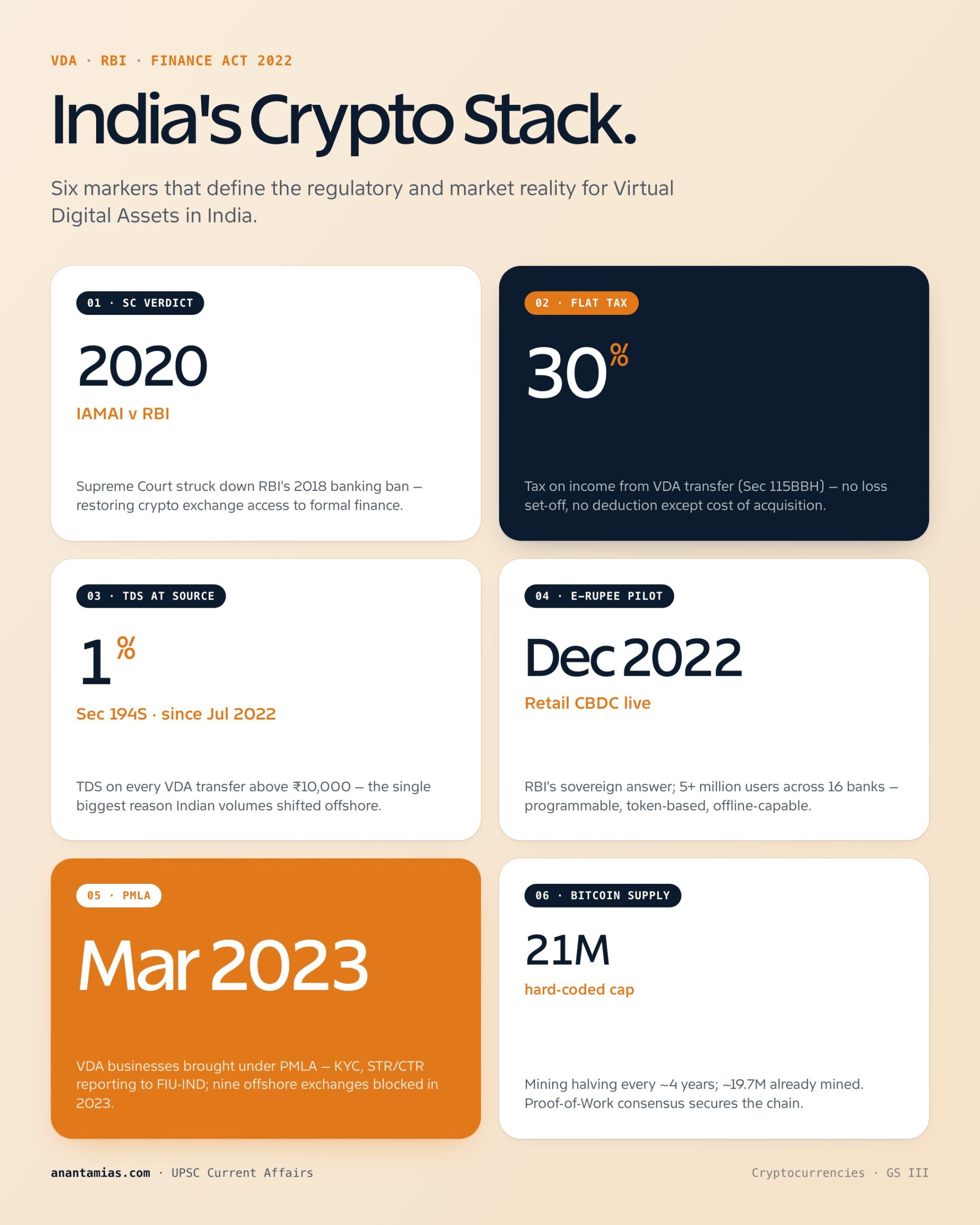
India's relationship with crypto has moved through three phases:
Phase 1 — Caution (2013-2017). RBI repeatedly warned users about volatility, fraud and AML risk.
Phase 2 — Ban (2018-2020). In April 2018 RBI barred regulated entities from dealing with crypto businesses, effectively cutting exchanges off from banking. In March 2020, the Supreme Court in Internet and Mobile Association of India v. RBI struck down the circular as disproportionate.
Phase 3 — Tax-then-regulate (2022-present). Budget 2022 introduced a punishing tax architecture for VDAs and the Finance Act, 2022 created Section 115BBH (30% tax on income from VDAs) and Section 194S (1% TDS on every transfer).
India's VDA tax framework
| Provision | Rule |
|---|---|
| Section 115BBH | Flat 30% tax on gains from VDAs (no slab benefit) |
| Section 194S | 1% TDS on transfer of VDAs above threshold |
| Set-off | Losses cannot be set off against any other income |
| Carry-forward | VDA losses cannot be carried forward |
| Gifts | VDAs received as gifts taxable in recipient's hands |
| PMLA, 2002 | VDA service providers brought under PMLA via March 2023 notification |
RBI's e-Rupee — the sovereign answer
In contrast to its hostility towards private cryptocurrencies, the RBI has actively built a sovereign digital currency, the Digital Rupee (e₹):
- Wholesale e₹ — pilot launched November 2022 for inter-bank G-Sec settlement.
- Retail e₹ — pilot launched December 2022; now operational across 18+ banks.
- 2025 milestones — over 1 million retail users; programmable e₹ for agricultural subsidies; offline e₹ for feature phones.
- Cross-border — RBI tied up with UAE, Bhutan and Sri Lanka for cross-border CBDC corridors via Project Nexus / mBridge experiments.
Global landscape
The world is converging on regulate-don't-ban:
- United States — January 2024 SEC approved spot Bitcoin ETFs, followed by Ether ETFs in July 2024. The 2025 GENIUS Act and CLARITY Act seek to formalise stablecoin and digital-asset oversight.
- European Union — MiCA (Markets in Crypto-Assets) regulation became fully applicable on 30 December 2024. Sets licensing, reserves, disclosures and market-abuse rules.
- China — bans private crypto and mining, but is the world leader in CBDC with e-CNY at scale.
- El Salvador & CAR — declared Bitcoin legal tender (El Salvador rolled this back in 2025 under IMF pressure).
- G20 (under India's 2023 presidency) — endorsed the IMF-FSB Synthesis Paper advocating a coordinated, risk-based approach rather than blanket bans.
Challenges of cryptocurrencies
| Challenge | Detail |
|---|---|
| Volatility | Bitcoin has moved from USD 1 to over USD 100,000; a single tweet can swing prices |
| Energy consumption | Bitcoin alone consumes more electricity than several mid-sized economies |
| Money laundering & terror financing | Mixers, privacy coins, peer-to-peer transfers complicate tracing |
| Cybercrime | Exchange hacks (Mt Gox, Bitfinex, FTX), wallet theft, ransomware demands in BTC |
| Investor protection | Pump-and-dump schemes, fake exchanges, rug pulls |
| Sovereignty erosion | Dollarisation risk for emerging economies if citizens shift to USD-stablecoins |
| Tax evasion | Pseudonymity makes enforcement difficult |
| Regulatory arbitrage | Firms relocate to lax jurisdictions |
| Quantum threat | Future quantum computers could break ECDSA signatures securing wallets |
Recent developments (2024-26)
- Spot Bitcoin and Ether ETFs approved in the US (2024) — institutional flood-gates opened.
- MiCA fully applicable in EU from December 2024.
- India's PMLA notification (March 2023) brought VDA service providers under reporting obligations to FIU-IND.
- FIU-IND blocked nine offshore exchanges in late 2023 for non-compliance, including Binance and KuCoin; Binance later registered with FIU-IND in 2024.
- DEA + RBI discussion paper on VDAs — expected in FY 2025-26 to lay out a comprehensive regulatory architecture.
- e₹ programmability — RBI piloted programmable e₹ in 2024-25 for end-use-locked agricultural subsidies.
- G20 Roadmap implementation — IMF-FSB joint workplan continued under Brazil (2024) and South Africa (2025) presidencies.
- Bitcoin halving (April 2024) — block reward dropped to 3.125 BTC, fuelling the 2024-25 bull run.
- Stablecoin scrutiny — globally, stablecoins now move more daily volume than Visa; regulators worried about reserve quality and run risk.
- Quantum-resistant cryptography research — NIST finalised post-quantum signature standards in 2024 that future blockchains will need to migrate to.
Way forward for India
- Regulate, don't ban — bring exchanges under SEBI-style market regulator with full KYC/AML.
- Tax reform — reduce 30% to align with capital gains; permit loss set-off to bring activity back on-shore.
- CBDC scale-up — push e₹ to 100 million users with offline and programmable variants.
- Sandbox — RBI/SEBI sandbox for tokenisation, asset-backed tokens, settlement experiments.
- International coordination — operationalise the G20 IMF-FSB roadmap; close the regulatory-arbitrage gap.
- Consumer protection — risk warnings, exchange audits, segregation of customer funds.
- Cyber-security mandate — exchanges to follow CERT-In incident reporting; hot/cold wallet ratios.
- Skilling — blockchain forensics for ED, CBI, FIU; judicial training on smart-contract enforceability.
- Post-quantum migration — coordinate with the National Quantum Mission for cryptographic transition.
Mains hook
"Cryptocurrencies cannot be wished away. The challenge is to build a regulatory architecture that contains the risks without strangling the innovation." Discuss in the context of India's evolving stance on virtual digital assets. (GS III, 250 words, 15 marks)
Prelims pointers
- Section 115BBH — 30% tax on VDAs; Section 194S — 1% TDS.
- Internet and Mobile Association of India v. RBI (2020) — SC struck down RBI's banking ban on crypto.
- e₹ — India's CBDC; wholesale (Nov 2022) and retail (Dec 2022) pilots.
- MiCA — EU's crypto regulation, fully applicable December 2024.
- FIU-IND — financial intelligence agency; VDA service providers report to it under PMLA.
- Bitcoin halving — every 210,000 blocks (~4 years); April 2024 halving cut block reward to 3.125 BTC.
- PoW vs PoS — Bitcoin uses PoW; Ethereum migrated to PoS in September 2022 (the Merge).
- G20 Synthesis Paper — IMF-FSB joint document on global crypto framework, endorsed under India's presidency.
- Project mBridge / Nexus — cross-border CBDC settlement experiments involving RBI.
Crypto vs CBDC vs stablecoin — clearing the confusion
Aspirants frequently confuse three terms that look similar but are very different in design and policy.
| Feature | Cryptocurrency | CBDC (e.g., e₹) | Stablecoin (e.g., USDT) |
|---|---|---|---|
| Issuer | Decentralised network | Central bank | Private firm |
| Backing | None (or algorithmic) | Sovereign liability | Fiat reserves / assets |
| Volatility | High | None (= rupee) | Low (peg) |
| Legal tender | Generally not | Yes (in issuing country) | No |
| Privacy | Pseudonymous | Tiered, KYC at higher levels | Pseudonymous |
| Use case | Speculation, store of value | Payments, programmable subsidy | Settlement rail, dollar access |
The policy stance differs accordingly. India embraces CBDCs, regulates crypto through tax and anti-money-laundering rules, and is wary of dollar-pegged stablecoins that could erode rupee demand if widely adopted.
For India, cryptocurrencies are not a passing fad. They are a stress-test for how a 21st-century state regulates an internet-native asset class without either crushing innovation or surrendering sovereignty. The aspirant who can articulate that tension cleanly — and distinguish CBDC from crypto from stablecoin — will be miles ahead in the GS III answer booklet.