For most of the last decade, the question of what cryptocurrencies are in India was answered by silence. There was no statute that defined them, no agency that regulated them, and no clear position on whether they were currency, commodity, or contraband. That ambiguity is now gone. The Finance Act has introduced a precise legal category called Virtual Digital Assets, the Income Tax Act taxes them at a flat rate, the Prevention of Money Laundering Act brings exchanges into a reporting regime, and a new international framework for automatic exchange of information is being adopted.
For a UPSC aspirant, this is one of the cleanest case studies in modern regulatory design. India did not ban crypto. India did not legalize it as currency. India did something more interesting. It built a tax regime first, a money-laundering regime second, and is now plugging into a global information-sharing regime third. The result is a country where holding Bitcoin is lawful, profits are taxable at thirty percent, every meaningful transaction is reported to a financial intelligence unit, and the government will soon receive automatic data on any wallets Indians hold abroad.
This article walks through the architecture step by step, separates the legal status from the tax treatment, and places India inside the wider global comparison.
Quick Facts on Virtual Digital Assets
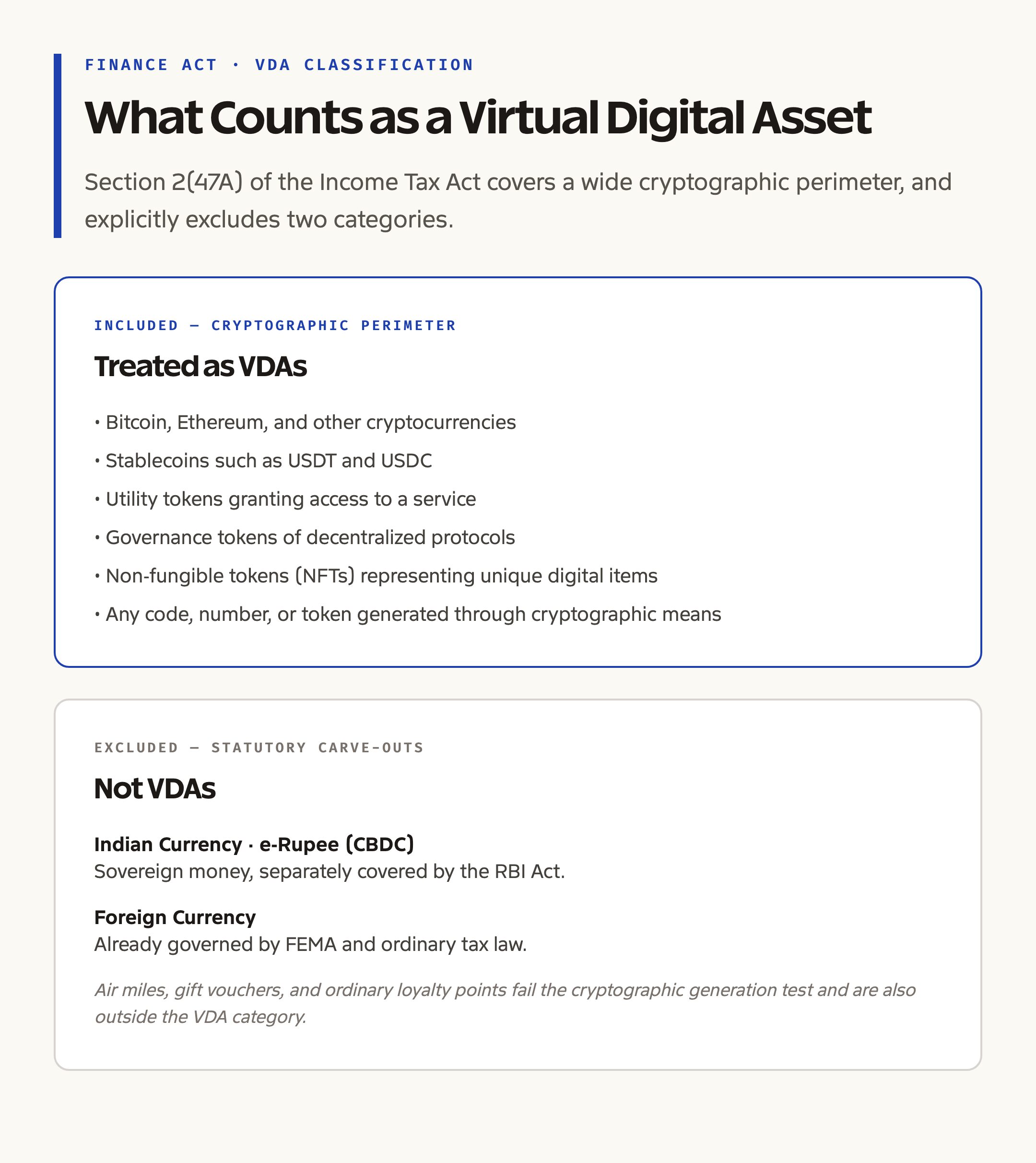
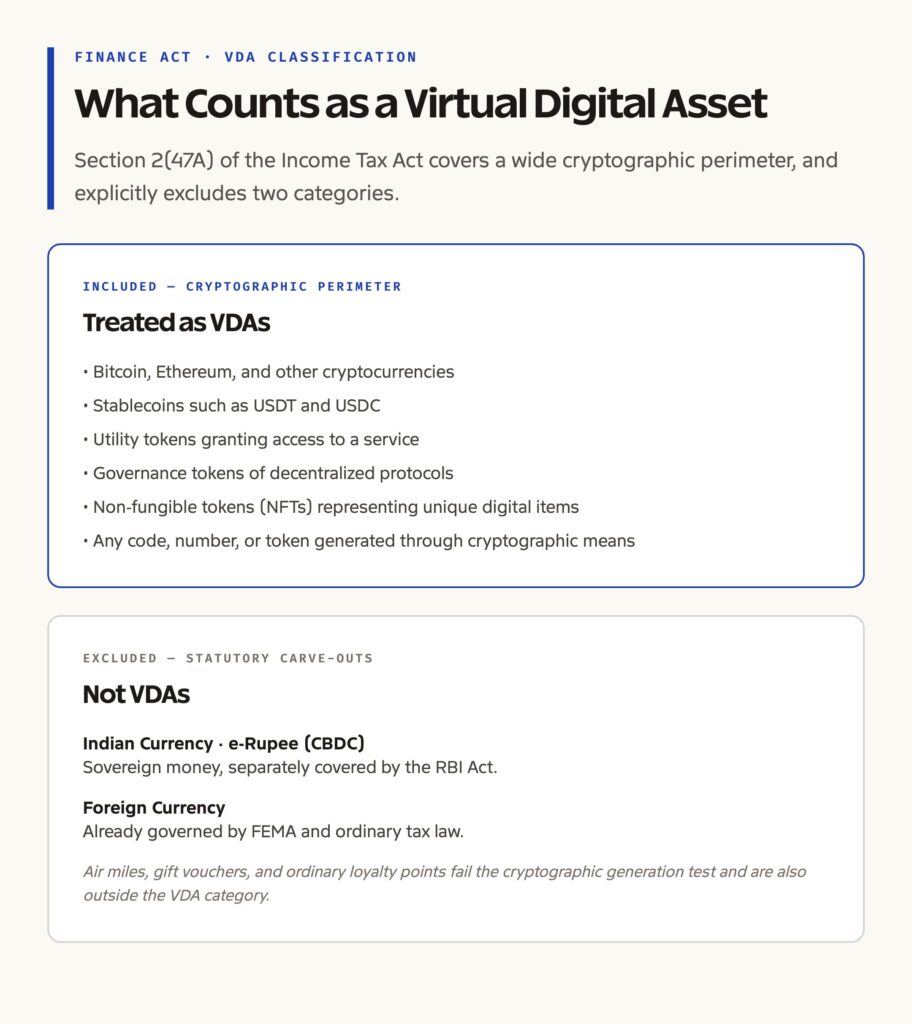
The official Indian term is Virtual Digital Assets, abbreviated VDA. The category was introduced through the Finance Act and now sits in the Income Tax Act under section 2(47A). A VDA is any information, code, number, or token generated through cryptographic means that provides a digital representation of value. Non-fungible tokens are explicitly included.
VDAs are not legal tender in India. They cannot be used to settle debts in the way the rupee can. The Reserve Bank of India’s own digital currency, the e-rupee, is excluded from the VDA definition because it is sovereign money. Foreign currency is also excluded.
Income from the transfer of a VDA is taxed at a flat thirty percent plus surcharge and cess. Losses on one VDA cannot be set off against profits on another or against any other head of income. A one percent tax is deducted at source on transactions above ten thousand rupees. Crypto exchanges and wallet providers are reporting entities under the Prevention of Money Laundering Act, with the Financial Intelligence Unit India as the nodal agency.
What a Virtual Digital Asset Actually Is
The statutory definition is broader than the popular usage. People say crypto and mean Bitcoin. The law says VDA and means any cryptographically generated token, coin, or number that represents value. Bitcoin and Ethereum are obvious examples. Stablecoins like USDT and USDC are also covered. Utility tokens that grant access to a service, governance tokens that give voting rights in a decentralized protocol, and non-fungible tokens that represent unique digital items all fall inside the definition. So do most newer asset categories that the law could not have named in advance, because the definition is functional rather than enumerative.
Two exclusions matter. The first is Indian currency, which includes the central bank digital currency now circulating as the digital rupee. The second is foreign currency. Both are excluded because they are already covered by other statutes. A third quiet exclusion sits inside the rules. Air miles, gift vouchers, and reward points issued by ordinary commercial loyalty programs are not VDAs even though they are digital and have value, because they fail the cryptographic generation test.
Background and Historical Context
The Indian state’s relationship with crypto has gone through three phases. The first phase, from roughly 2013 to 2018, was watchful inaction. The Reserve Bank issued a series of cautionary notices warning users that crypto was unregulated and risky, but stopped short of banning it. Indian exchanges grew, retail volume rose, and the technology question was largely outsourced to the market.
The second phase began in April 2018 with an RBI circular that prohibited regulated banks from servicing crypto businesses. The order effectively cut Indian exchanges off from the banking system. The Internet and Mobile Association of India challenged the circular. In March 2020, in IAMAI versus RBI, the Supreme Court struck down the ban on grounds of disproportionality. The court did not endorse crypto. It only held that the RBI had not shown that a complete service ban was a proportionate response to the risks identified.
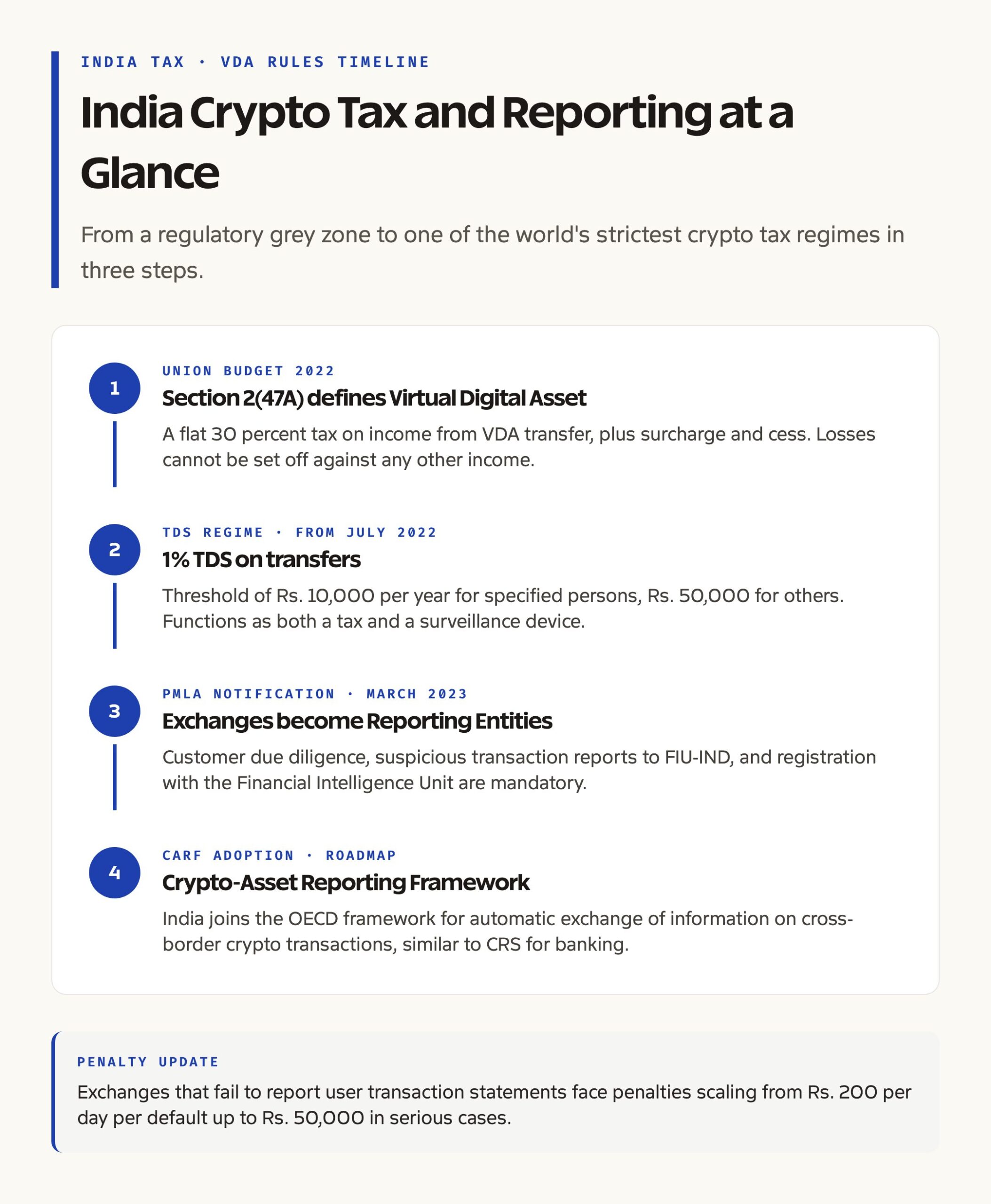
The third phase began with the Union Budget of 2022, which introduced the VDA category, the thirty percent tax, and the one percent TDS. From that point on, the policy direction has been clear. India would not ban crypto. India would tax it heavily, monitor it closely, and integrate it into international information sharing. Subsequent steps, including the PMLA notification of March 2023 and the announced move toward the OECD’s Crypto-Asset Reporting Framework, have all followed that template.
Key Features of the Indian Tax Regime
The tax architecture has four moving parts. The first is the flat thirty percent rate on income from transfer of a VDA. There is no slab benefit, which means a small investor pays the same marginal rate as a high-income trader. The second is the prohibition on set-off and carry-forward of losses. A loss on one coin cannot reduce the tax on the gain from another. A loss this year cannot reduce the gain next year. This is far stricter than the treatment of equities or even speculative income.
The third is the one percent TDS at source on transactions above ten thousand rupees, which functions as a surveillance device as much as a tax. The TDS report from each exchange gives the Income Tax Department a near-real-time picture of who is trading what. The fourth is a recently introduced penalty regime. Exchanges that fail to report user transaction statements to the department face penalties scaling from two hundred rupees per day per default up to fifty thousand rupees in serious cases. The intent is to make non-reporting more expensive than reporting.
There is also a gift dimension. A VDA received as a gift is taxable in the recipient’s hands above a threshold, and the cost of acquisition for further transfer is the value at which the gift was taxed. The rule closes a loophole that would have allowed crypto to circulate untaxed inside families.
Why It Matters
The policy matters for three reasons. The first is fiscal. The thirty percent rate combined with TDS converts a previously invisible asset class into a measurable tax base. The second is anti-money-laundering. Once exchanges are reporting entities, every meaningful crypto transaction in India leaves a paper trail. Suspicious transaction reports flow to the Financial Intelligence Unit and feed investigations into hawala-style remittance, drug payments, and terror financing. This connects directly to broader blockchain technology governance.
The third is geopolitical. By aligning with the OECD’s Crypto-Asset Reporting Framework, India is signaling that crypto will be brought into the same global tax-information architecture that already covers conventional banking through the Common Reporting Standard. That makes it harder for high-net-worth individuals to park wealth in offshore wallets the way they once parked it in offshore accounts.
Detailed Analysis of the PMLA Notification
The March 2023 PMLA notification is the most consequential single regulatory step after the tax. It brings four categories of crypto activity inside the act. Exchange of VDAs for fiat currency. Exchange between different VDAs. Transfer of VDAs. Safekeeping of VDAs and the instruments controlling them, which captures custodial wallets.
Each entity engaged in any of these activities must register with the Financial Intelligence Unit India, appoint a principal officer, conduct customer due diligence at onboarding, monitor transactions for suspicious patterns, and file suspicious transaction reports and cash transaction reports as required. The compliance burden is comparable to that on a small bank.
The FIU has used its powers actively. In December 2023, it issued show-cause notices to several offshore exchanges including Binance, Kraken, and OKX for serving Indian users without registering as reporting entities, and asked the Ministry of Electronics and Information Technology to block their websites. Several of these exchanges have since registered with the FIU and resumed Indian operations. The episode signaled that offshore status is no protection from Indian regulatory reach when Indian users are involved.
Comparative Snapshot: India vs the World
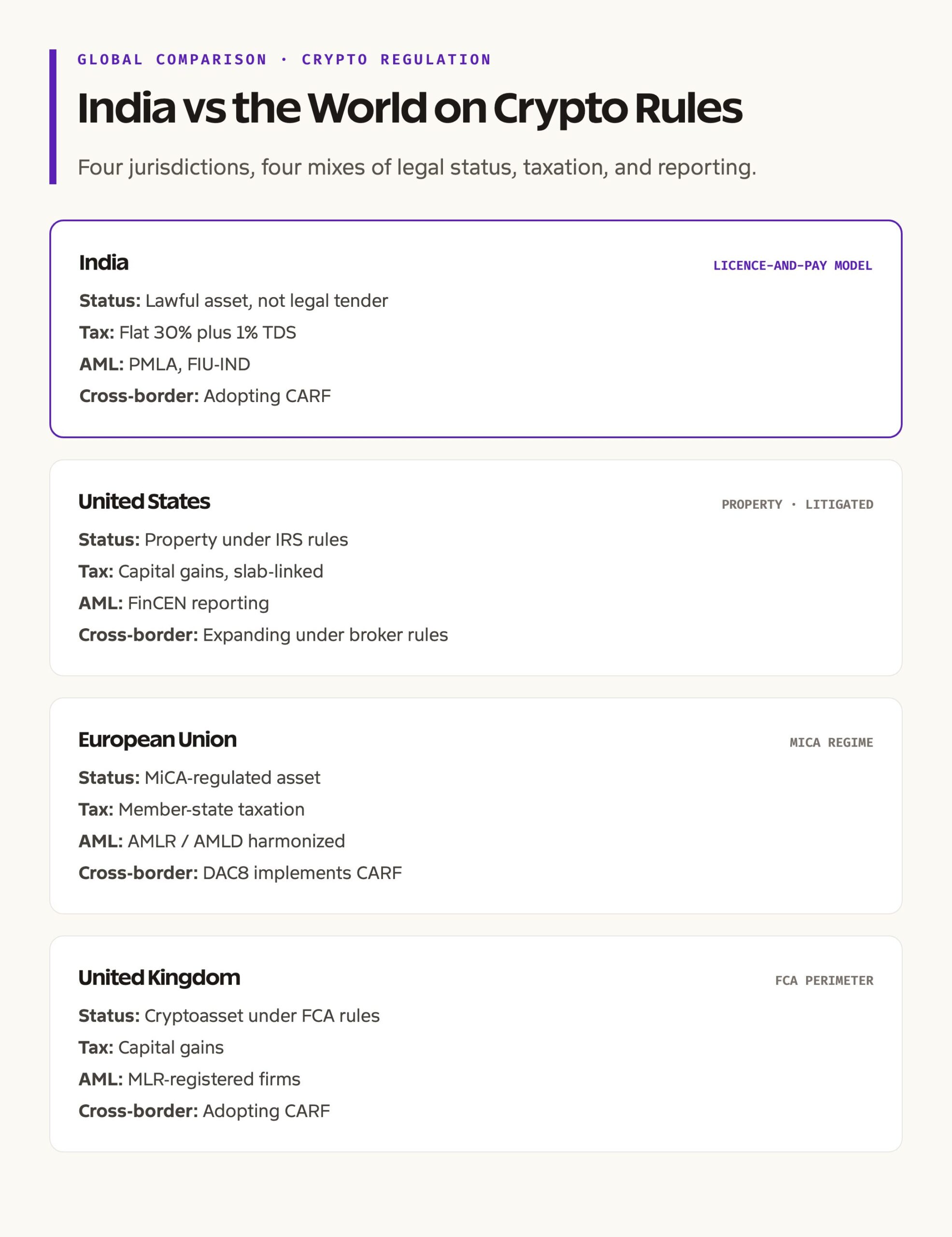
The four big approaches to crypto taxation and regulation can be compared on a single axis.
| Jurisdiction | Legal Status | Tax Rate | AML Regime | Cross-Border Reporting |
|---|---|---|---|---|
| India | Lawful asset, not legal tender | 30 percent flat plus 1 percent TDS | PMLA reporting, FIU-IND | Adopting CARF |
| United States | Property | Capital gains, slab-linked | FinCEN reporting | Reporting expanding under broker rules |
| European Union | MiCA-regulated asset | Member-state taxation | AMLR and AMLD harmonized | DAC8 implementing CARF |
| United Kingdom | Cryptoasset under FCA perimeter | Capital gains | MLR-registered firms | Adopting CARF |
India is closer to the European model on AML and the American model on tax aggressiveness, but more centralized than either on enforcement.
Challenges and Open Questions
The first challenge is the disincentive effect of the tax. A flat thirty percent rate plus the bar on loss set-off has pushed retail volume away from Indian exchanges and toward offshore platforms and peer-to-peer channels. Some of this offshore migration is captured by the FIU’s enforcement, but a portion is genuinely outside the system. The tax is producing revenue, but it may also be producing a parallel grey market.
The second challenge is regulatory clarity for innovation. India has a tax regime and an AML regime, but no securities regime. Whether a particular token is a security, a commodity, or a payment instrument remains undecided in many cases. This blocks legitimate token-based fundraising by Indian startups and pushes early-stage activity to Singapore and Dubai.
The third challenge is consumer protection. The collapse of FTX in 2022 wiped out Indian retail investors with no recourse. The current Indian framework has nothing equivalent to the deposit insurance, fiduciary duty, and prudential supervision that protect bank depositors. The need for an Indian crypto consumer-protection statute is widely acknowledged but has not yet been met.
A fourth challenge is the energy and environmental dimension of proof-of-work mining, which sits adjacent to the financial regulation question. India has taken no clear position on whether mining is to be encouraged, taxed, or restricted.
Prelims Pointers
- Virtual Digital Assets are defined in the Income Tax Act under section 2(47A) as introduced by the Finance Act 2022.
- The e-rupee, India’s central bank digital currency, is explicitly excluded from the VDA definition.
- Income from transfer of a VDA is taxed at a flat thirty percent plus surcharge and cess.
- A one percent TDS applies on VDA transactions above ten thousand rupees in a financial year for specified persons, and above fifty thousand rupees for others.
- Crypto exchanges and wallet providers are reporting entities under the Prevention of Money Laundering Act.
- The nodal agency is the Financial Intelligence Unit India, attached to the Department of Revenue.
- The Supreme Court’s IAMAI versus RBI judgment of 2020 struck down the RBI’s banking-services ban on crypto firms.
- The OECD’s Crypto-Asset Reporting Framework, CARF, is the global standard for automatic exchange of information on crypto.
- Non-fungible tokens are included within the VDA definition.
- Losses on one VDA cannot be set off against gains on another VDA or any other income.
Mains Practice Questions
- Examine the regulatory framework for Virtual Digital Assets in India. Discuss the rationale for the thirty percent flat tax and the one percent TDS, and evaluate whether the design has produced the intended fiscal and anti-money-laundering outcomes.
- The Indian approach to cryptocurrencies has been described as taxation without legalization. Critically examine this characterization, comparing the Indian model with the regulatory approaches of the United States, the European Union, and the United Kingdom.
- Discuss the implications of bringing crypto exchanges and wallet providers under the Prevention of Money Laundering Act. How does this connect with India’s adoption of the OECD’s Crypto-Asset Reporting Framework, and what are the gaps that remain in consumer protection?
Way Forward
A coherent next phase has four components. First, a dedicated Crypto Asset Regulation Bill that addresses the gaps the tax and AML regimes leave open, including consumer protection, conduct rules for exchanges, and a securities-like regime for token offerings. Second, a calibrated review of the thirty percent rate and the loss set-off bar, with the goal of keeping volume onshore without losing the surveillance benefits of TDS. Third, full operationalization of the Crypto-Asset Reporting Framework, with bilateral activations starting from major financial centres including Singapore, the UAE, and the United States. Fourth, an expanded role for the Reserve Bank in monitoring stablecoin issuers and any rupee-pegged tokens that emerge, given the systemic risks they could pose to monetary control. The goal is a regime that taxes and watches without throttling, and that pulls Indian users back into onshore platforms where they can be both protected and observed. The next two budgets will tell whether the balance has been struck.
Frequently Asked Questions
Are cryptocurrencies legal in India?
Cryptocurrencies are not legal tender in India, but holding, buying, selling, and transferring them is lawful. They are classified as Virtual Digital Assets and treated as a taxable asset class. The acts performed with them, however, remain subject to ordinary criminal and tax law.
What is the tax rate on crypto in India?
Income from the transfer of a Virtual Digital Asset is taxed at a flat thirty percent, plus surcharge and cess. There is no slab benefit and no deduction other than the cost of acquisition. Losses on one VDA cannot be set off against gains on another or against any other head of income.
What is the TDS on crypto transactions?
A one percent tax is deducted at source on transactions in Virtual Digital Assets above ten thousand rupees in a financial year for specified persons, and above fifty thousand rupees for ordinary individuals and Hindu Undivided Families. The deduction is collected by the exchange or the buyer.
Is the e-rupee a Virtual Digital Asset?
No. The Reserve Bank of India’s central bank digital currency, the e-rupee, is explicitly excluded from the Virtual Digital Asset definition because it is sovereign currency. It is treated for tax and legal purposes the same way as ordinary rupee balances.
What does PMLA reporting mean for crypto exchanges?
It means exchanges and wallet providers must register with the Financial Intelligence Unit India, conduct customer due diligence, maintain transaction records, monitor for suspicious patterns, and file suspicious transaction reports. The compliance regime is similar to that imposed on banks.
What is CARF?
CARF is the OECD’s Crypto-Asset Reporting Framework, a global standard for automatic exchange of information on crypto transactions between tax authorities. It functions for crypto the way the Common Reporting Standard functions for ordinary banking. India is among the jurisdictions adopting it.
Can I claim a loss on Bitcoin against my salary income?
No. The Income Tax Act bars set-off of losses from one Virtual Digital Asset against gains from another or against any other head of income, including salary, business, and capital gains. The loss is stranded.
What happened in IAMAI versus RBI?
In March 2020, the Supreme Court struck down the RBI’s 2018 circular that had prohibited regulated banks from servicing crypto businesses. The court held that the ban was disproportionate. The judgment did not endorse crypto but cleared the way for exchanges to access banking services again.
Are NFTs taxed the same way as cryptocurrencies?
Yes. Non-fungible tokens are treated as Virtual Digital Assets under the Income Tax Act and are subject to the same flat thirty percent rate and the same one percent TDS where applicable. Transfers of NFTs are reported by registered exchanges in the same way as other VDA transfers.
How does India’s approach compare with the United States?
The United States classifies crypto as property and taxes it under capital gains rules at slab-linked rates, with FinCEN handling AML reporting. India taxes at a flat thirty percent regardless of holding period, integrates exchanges into PMLA, and is moving toward the OECD’s CARF framework. The US approach is more nuanced on tax but less centralized on AML. India is more aggressive on tax and more centralized on enforcement. Both jurisdictions are converging on cross-border information sharing through CARF-style mechanisms, which connects to broader cryptocurrency in India policy questions.
Tell Google you want more of this.
Add Anantam IAS as a preferred sourceOne tap, and this site shows up more often in your own Top Stories, AI Overviews and AI Mode. Remove it any time.