Cultural and Educational Rights: Articles 29 and 30 of the Indian Constitution
Cultural and Educational Rights under Articles 29 and 30 of Indian Constitution explained: provisions, case laws, scope for minorities and UPSC relevance.
Introduction
Cultural and Educational Rights, enshrined in Articles 29 and 30 of the Indian Constitution, form the sixth category of Fundamental Rights in Part III. They protect the distinct language, script and culture of citizens and guarantee religious and linguistic minorities the right to establish and administer their own educational institutions. In a diverse polity with 22 scheduled languages, six major religions and over a thousand dialects, these two articles knit together India’s constitutional promise of pluralism with practical safeguards against majoritarian erosion.
For UPSC aspirants, Articles 29 and 30 are a high-frequency Mains topic on minority rights, secularism and federalism. They sit at the intersection of GS Paper 2 (Polity), Essay and the ethics of group rights versus individual rights. This note unpacks the text of both articles, landmark judgments like Kerala Education Bill, St. Stephen’s, TMA Pai Foundation and P.A. Inamdar, and the contemporary debates on minority institution status, the Right to Education Act and majority-community institutions.
Quick Facts at a Glance
| Attribute | Detail |
|---|---|
| Part of Constitution | Part III (Fundamental Rights), Articles 29 & 30 |
| Category | Cultural and Educational Rights |
| Article 29 | Protection of interests of minorities |
| Article 30 | Right of minorities to establish and administer educational institutions |
| Scope of Article 29 | Available to all citizens (any section with distinct language, script or culture) |
| Scope of Article 30 | Available only to religious and linguistic minorities |
| 44th Amendment | Clause 1A added to Article 30 — compensation for compulsory acquisition |
| Key Commission | National Commission for Minority Educational Institutions (NCMEI) Act, 2004 |
| Landmark Cases | Kerala Education Bill (1958), St. Stephen’s (1992), TMA Pai (2002), P.A. Inamdar (2005) |
| Recognised Minorities (Central) | Muslims, Christians, Sikhs, Buddhists, Jains, Parsis |
Background and Historical Context
The framers of the Indian Constitution wrote Articles 29 and 30 against the backdrop of Partition and the trauma of communal violence that accompanied independence. The Minorities Sub-Committee of the Constituent Assembly, chaired by H.C. Mookerjee, and the Advisory Committee headed by Sardar Vallabhbhai Patel, grappled with how to protect numerical minorities in a democracy where majority rule could slide into majoritarian rule. Separate electorates, the instrument used under the Government of India Act 1935, were rejected, but substantive safeguards for language, culture and education were deemed essential.
Dr. B.R. Ambedkar defended the clauses on the floor of the Assembly, arguing that the right to conserve one’s culture was a precondition for meaningful citizenship. The original draft linked these protections to religious minorities alone; the final version broadened Article 29 to cover any section of citizens with a distinct language, script or culture, and reserved Article 30 specifically for religious and linguistic minorities.
The articles drew partly from the Motilal Nehru Report of 1928, which proposed language and cultural safeguards, and from comparative models such as the minority treaties under the League of Nations after World War I. The Constitution of Ireland (1937), which protected Irish-medium schools, also influenced the Indian framers.
Post-adoption, Articles 29 and 30 became flashpoints in several contested policy terrains. The reorganisation of states on linguistic lines (1956), the three-language formula in education policy (1968), the contest over Hindi imposition in South India, and the ongoing debate over the Right of Children to Free and Compulsory Education Act (RTE) 2009 all turn on how these articles are interpreted. Courts have progressively expanded and circumscribed their scope, producing one of the richest bodies of minority-rights jurisprudence in the world.
Key Provisions
Article 29: Protection of Interests of Minorities
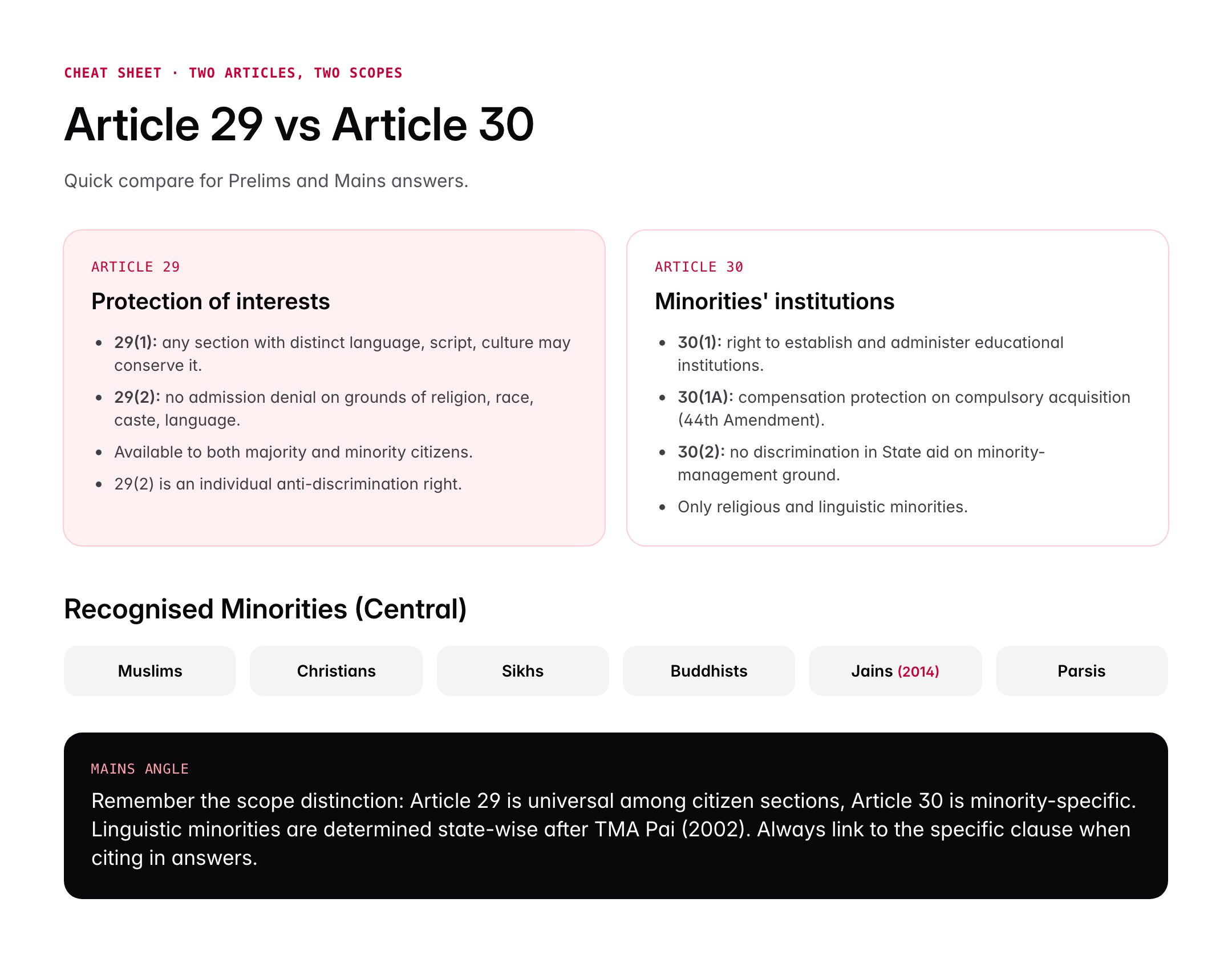
Article 29(1) states that any section of citizens residing in India having a distinct language, script or culture of its own shall have the right to conserve the same. Although titled “Protection of Interests of Minorities”, the text extends the right to any section — majority or minority — that possesses a distinct linguistic or cultural identity.
Article 29(2) prohibits denial of admission to any citizen into any educational institution maintained by the State or receiving aid out of State funds on grounds only of religion, race, caste, language or any of them. This is an individual right against discrimination in state-funded education. In State of Madras v. Champakam Dorairajan (1951), the Supreme Court struck down the Madras communal General Order that reserved medical college seats by caste-religious quotas, citing Article 29(2). This ruling triggered the First Constitutional Amendment, which added Article 15(4) to enable reservation for backward classes.
Article 30: Minorities’ Right to Establish Educational Institutions
Article 30(1) grants all religious and linguistic minorities the right to establish and administer educational institutions of their choice.
Article 30(1A), inserted by the 44th Constitutional Amendment (1978), provides that in any law providing for the compulsory acquisition of property of a minority educational institution, the State shall ensure that the compensation fixed does not restrict or abrogate the right guaranteed under Article 30(1).
Article 30(2) bars the State from discriminating against any educational institution on the ground that it is under the management of a minority — whether religious or linguistic — while granting aid.
Who is a Minority?
The Constitution does not define “minority”. The National Commission for Minorities Act, 1992 and subsequent notifications under it declare six communities as minorities at the central level: Muslims, Christians, Sikhs, Buddhists, Jains (added in 2014) and Parsis. Linguistic minorities are determined at the state level — for instance, Tamil speakers in Karnataka or Kannada speakers in Maharashtra qualify as linguistic minorities in the respective state.
In TMA Pai Foundation v. State of Karnataka (2002), an 11-judge bench clarified that for purposes of Article 30, the unit for determining minority status is the state, not the country. A Hindu-run institution in Jammu & Kashmir (before it became a Union Territory) could claim minority status because Hindus were a minority in that state.
Scope of “Administer”
The right to administer covers selection of students, appointment of teachers, fee structure and day-to-day management. In St. Stephen’s College v. University of Delhi (1992), the Supreme Court permitted minority institutions to reserve up to 50 per cent of seats for the community they serve. Regulations of general application — qualification of teachers, academic standards, measures to prevent maladministration — are permissible, but they cannot destroy the minority character.
Aided, Unaided and Recognition
The TMA Pai ruling distinguished between aided, unaided and recognised institutions. Unaided minority institutions enjoy the fullest autonomy in admissions and fees; aided institutions must accept greater regulation. Recognition or affiliation to a university triggers additional compliance, but cannot be used to erode the essential minority character.
Significance for UPSC and General Knowledge
- Articles 29 and 30 are a direct expression of India’s commitment to pluralism and a defence against majoritarian drift.
- They form the most litigated cluster of Fundamental Rights, generating landmark constitutional benches — Kerala Education Bill (1958), St. Stephen’s (1992), TMA Pai (2002), P.A. Inamdar (2005), Pramati Educational Trust (2014).
- They intersect with RTE Act exemption: Section 12(1)(c) of RTE does not apply to minority schools after the Pramati ruling.
- They link to the National Commission for Minority Educational Institutions (NCMEI), a statutory body under the 2004 Act.
- They connect to debates on Hindu community institutions — is a Hindu-run trust in Kerala or J&K a minority for Article 30 purposes?
- They underpin exam-relevant cases on reservation, fee regulation and state aid.
Detailed Analysis: Landmark Case Laws and Evolving Jurisprudence
The judicial interpretation of Articles 29 and 30 has shifted dramatically across seven decades, balancing minority autonomy against the state’s regulatory interest and the anti-discrimination mandate.
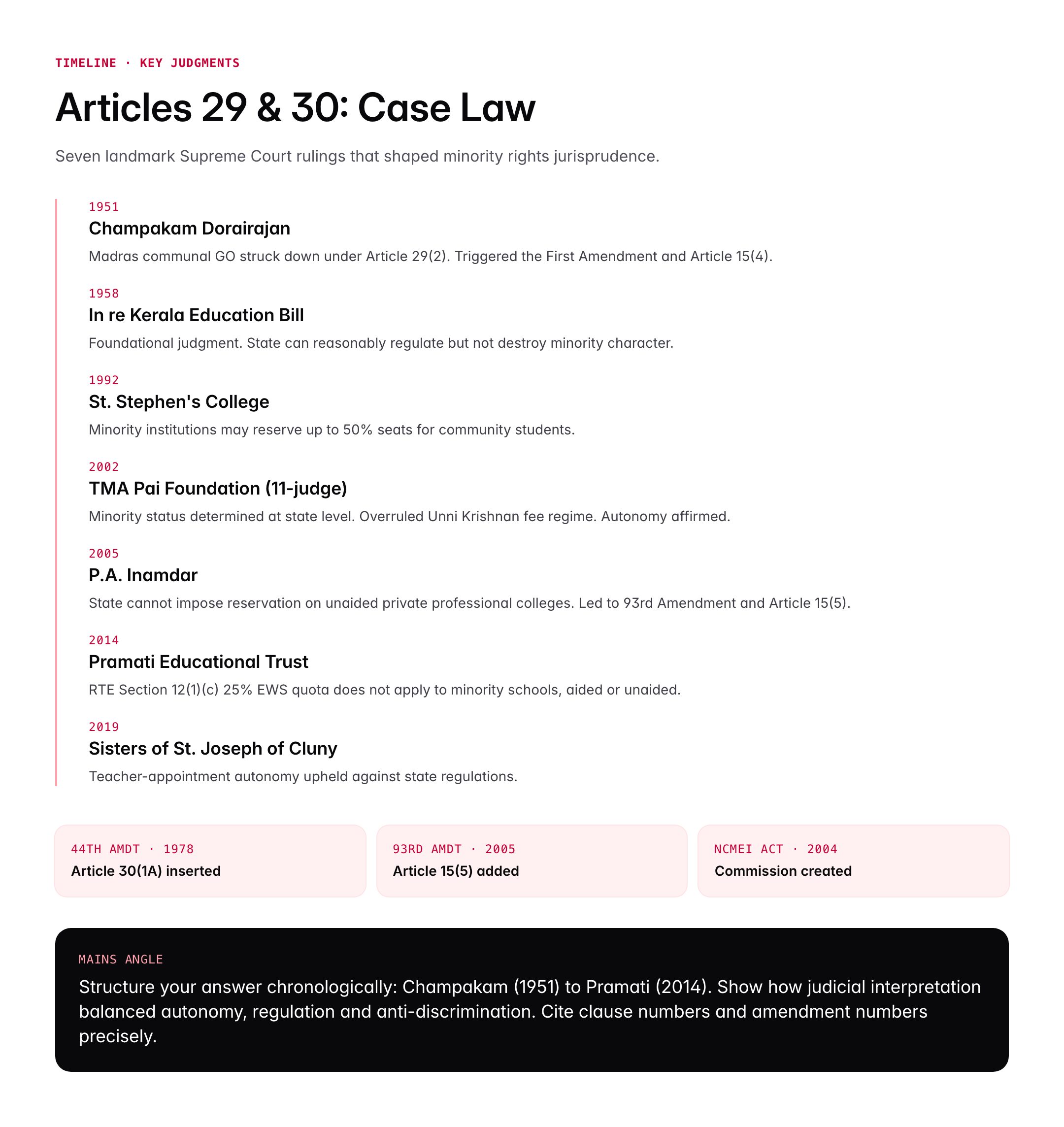
In re Kerala Education Bill (1958): The Supreme Court held that the right under Article 30(1) includes the right to admit students from the minority community and to establish institutions using the minority language. Reasonable state regulation was permitted, but regulation could not destroy the institution’s minority character. This was the foundational judgment that shaped the field.
State of Madras v. Champakam Dorairajan (1951): This pre-Kerala Education Bill case held that the communal General Order violated Article 29(2). It directly led to the First Amendment (1951) that inserted Article 15(4).
St. Stephen’s College v. University of Delhi (1992): A Christian minority college was allowed to reserve up to 50 per cent of seats for Christian applicants, subject to minimum eligibility. The judgment affirmed that community-preference admissions do not violate Article 29(2) when made by a minority institution under Article 30.
TMA Pai Foundation v. State of Karnataka (2002): The 11-judge constitution bench redefined the field. It held that minority status is determined at the state level, that all institutions (minority and non-minority) have autonomy in admission and fees, and that state regulation must not cripple essential administrative rights. It overruled Unni Krishnan (1993) which had imposed a rigid fee and admission scheme on private colleges.
Islamic Academy of Education v. State of Karnataka (2003): Clarified TMA Pai by empowering state-appointed committees to supervise fees and admissions in professional colleges.
P.A. Inamdar v. State of Maharashtra (2005): A seven-judge bench held that the state cannot impose reservation policy on unaided private professional colleges (including minority ones). This prompted Parliament to enact the 93rd Constitutional Amendment (2005) and Article 15(5), which allows reservation in private unaided institutions except minority ones.
Pramati Educational Trust v. Union of India (2014): Upheld the 93rd Amendment but ruled that the RTE Act’s 25 per cent neighbourhood admission quota does not apply to minority schools, aided or unaided. This significantly insulated minority institutions from RTE compliance.
Sisters of St. Joseph of Cluny v. State of West Bengal (2019): Reaffirmed that government regulations on teacher appointments cannot override the minority institution’s autonomy to select staff as long as academic standards are met.
Comparative Perspective
Minority educational rights are protected across many democracies, though their constitutional architecture varies. Comparing India’s framework with key peers shows both convergence and unique elements.
| Country | Constitutional Basis | Scope | Key Feature |
|---|---|---|---|
| India | Articles 29 & 30 (FR) | Religious + linguistic minorities | Right to establish + administer institutions |
| USA | First Amendment (free exercise) + Pierce v. Society of Sisters | Religious groups | Right to operate private schools; no state funding |
| Canada | Section 23, Charter of Rights | Official language minorities | Right to minority-language education funded by state |
| UK | Education Act 1944 (Voluntary Aided schools) | Religious denominations | State aid to faith schools with community admissions |
| Ireland | Article 42, Constitution | Parents / religious communities | State funding for denominational schools |
| Germany | Article 7, Basic Law | Religious communities | State supervises but respects private schools |
India’s Article 30 is notable for combining the right to establish and administer with explicit protection against discrimination in state aid — a combination few other constitutions achieve.
Controversies and Debates
The most persistent debate concerns whether the Hindu community can claim minority status in states where it is numerically smaller — Jammu & Kashmir (before Article 370 abrogation), Punjab, Mizoram, Nagaland, Lakshadweep. In Bal Patil v. Union of India (2005) and subsequent PILs, petitioners have argued for notification of Hindus as minorities in such states. The Supreme Court has consistently left the question to the Union government. In 2022, the Ministry of Minority Affairs told the court that state governments can notify linguistic or religious minorities within their jurisdiction — pushing the political decision downwards.
A second flashpoint is the RTE exemption for minority schools after Pramati. Critics argue that exempting minority schools from the 25 per cent EWS quota creates unequal burdens — government and non-minority private schools must admit EWS students, but minority private schools need not. Supporters respond that without the exemption, Article 30’s core would be hollowed out.
A third debate centres on religious versus linguistic minorities. Religious minority institutions have been more visible, but linguistic minority institutions — Urdu, Tamil, Tulu, Konkani — are equally protected. State reorganisation has made many linguistic groups numerical minorities in reorganised states, expanding Article 30’s reach.
Finally, the definition of minority remains legally underdetermined. The 1992 Act notifications, the TMA Pai state-level test and the Ministry of Home Affairs notifications do not always align. The NCMEI, set up under the 2004 Act, is often the first port of call but its decisions are subject to appeal to High Courts.
Prelims Pointers
- Articles 29 and 30 are placed under the heading “Cultural and Educational Rights” in Part III.
- Article 29(1) is available to any section of citizens, not just minorities.
- Article 29(2) prohibits discrimination in state-funded educational admission.
- Article 30(1) is available only to religious and linguistic minorities.
- Article 30(1A) was added by the 44th Constitutional Amendment (1978).
- Six central minorities: Muslims, Christians, Sikhs, Buddhists, Jains, Parsis. Jains added in 2014.
- Minority status is determined at state level per TMA Pai Foundation (2002).
- TMA Pai Foundation was an 11-judge bench judgment.
- St. Stephen’s (1992) allowed up to 50% community-preference admission.
- P.A. Inamdar (2005) barred reservation in unaided private professional colleges.
- 93rd Constitutional Amendment (2005) added Article 15(5) after P.A. Inamdar.
- Pramati (2014) exempted minority schools from RTE Section 12(1)(c) quota.
- NCMEI is set up under the National Commission for Minority Educational Institutions Act 2004.
Mains Practice Questions
- Critically examine the evolution of judicial interpretation of Articles 29 and 30 of the Constitution with reference to landmark Supreme Court judgments. (250 words, GS2)
- Trace Kerala Education Bill (1958), St. Stephen’s (1992), TMA Pai (2002), P.A. Inamdar (2005), Pramati (2014).
- Show how autonomy versus regulation has been balanced.
- Conclude with the current settled position and pending questions on Hindu minority status.
- “Articles 29 and 30 are the constitutional guarantee of India’s pluralism”. Discuss with reference to recent debates on minority educational institution status. (250 words, GS2)
- Contextualise in India’s diversity and framers’ intent.
- Discuss controversies: RTE exemption, Hindu minority PILs, state-level minority notifications.
- Conclude with the need for balance between group rights and individual rights.
Conclusion
Articles 29 and 30 stand as the constitutional charter of cultural pluralism, granting every section of India’s citizens the right to conserve their distinct linguistic and cultural heritage and giving religious and linguistic minorities the right to shape their own educational futures. The seven-decade journey from the Kerala Education Bill reference to Pramati Educational Trust shows a judiciary that has steadily refined the balance between minority autonomy, state regulation and anti-discrimination norms.
For UPSC aspirants, these articles are indispensable — not as abstract provisions but as living constitutional instruments that touch the RTE Act, state-level minority notifications, reservation in unaided colleges and the wider question of how a diverse democracy can remain equal without becoming assimilationist. Mastering their text, jurisprudence and current debates is essential for both Prelims and Mains answers on Polity, Governance and Indian Society.
Frequently Asked Questions
What are Cultural and Educational Rights in the Indian Constitution?
Cultural and Educational Rights are contained in Articles 29 and 30 of Part III of the Indian Constitution. They protect the distinct language, script and culture of any section of citizens (Article 29) and guarantee religious and linguistic minorities the right to establish and administer educational institutions of their choice (Article 30). Together they form the sixth category of Fundamental Rights.
Why are Articles 29 and 30 important for UPSC?
Articles 29 and 30 are a high-frequency UPSC topic under GS Paper 2 (Polity and Governance) and Indian Society. They generate landmark constitutional bench judgments (Kerala Education Bill, TMA Pai, P.A. Inamdar, Pramati), connect to the RTE Act, National Commission for Minorities and NCMEI, and anchor debates on pluralism, reservation and minority rights that recur in both Prelims and Mains.
How is Article 29 different from Article 30?
Article 29 protects the right of any section of citizens with a distinct language, script or culture to conserve it — available to both majority and minority groups. Article 30 is narrower: it applies only to religious and linguistic minorities and grants them the right to establish and administer educational institutions. Article 29(2) is an individual anti-discrimination right; Article 30(1) is a group-institutional right.
Who is considered a minority under Article 30?
The Constitution does not define minority. The National Commission for Minorities Act 1992 notifies six religious minorities at the central level: Muslims, Christians, Sikhs, Buddhists, Jains (added in 2014) and Parsis. Linguistic minorities are determined at the state level. Per TMA Pai Foundation (2002), minority status for Article 30 is assessed state-wise, not nationally.
What is the TMA Pai Foundation case about?
TMA Pai Foundation v. State of Karnataka (2002) was an 11-judge Supreme Court bench that redefined Article 30 jurisprudence. It held that minority status is state-level, all educational institutions (minority and non-minority) enjoy autonomy in admissions and fees, and state regulation is permissible but cannot destroy the minority character. It overruled the rigid fee regulation imposed by Unni Krishnan (1993).
Does the Right to Education Act apply to minority schools?
No, the 25 per cent EWS neighbourhood admission quota under Section 12(1)(c) of the RTE Act does not apply to minority schools, aided or unaided. The Supreme Court ruled this in Pramati Educational Trust v. Union of India (2014), holding that applying RTE to minority schools would violate Article 30. This exemption remains a contested policy issue.
Can Hindus be declared a minority in any Indian state?
The question is constitutionally open. In states like Punjab, Mizoram, Nagaland, Lakshadweep and pre-2019 Jammu & Kashmir, Hindus are numerically smaller. Per TMA Pai, minority status is state-level. The Supreme Court has asked the Union government to decide, and in 2022 the Ministry of Minority Affairs noted that state governments can notify minorities within their jurisdiction. No state has formally notified Hindus as a minority yet.
What was added by the 44th Constitutional Amendment to Article 30?
The 44th Constitutional Amendment (1978) inserted Article 30(1A). It provides that in any law for compulsory acquisition of property of a minority educational institution, the State shall ensure that the compensation fixed does not restrict or abrogate the right guaranteed under Article 30(1). This was enacted to insulate minority institutions from arbitrary land acquisition.