The Government of India Act 1935 was the longest and most elaborate statute ever passed by the British Parliament — more than 450 sections and 16 schedules — and the single most important source of the Indian Constitution of 1950. The Government of India Act 1935 introduced an all-India federation, provincial autonomy with responsible government in eleven provinces, bicameralism at the centre and in six provinces, a three-fold distribution of legislative powers between Federation and Provinces, dyarchy at the centre, a federal court, a Reserve Bank, and an expanded but still communal franchise. Although the federal portion of the Government of India Act 1935 was never brought into force, the provincial portion ran from 1 April 1937 to 14 August 1947 and provided the working template for the Constituent Assembly. B. N. Rau and B. R. Ambedkar treated it as the “Blueprint of the Indian Constitution”.
Background: From Simon to White Paper
The Government of India Act 1935 was the climax of a decade-long constitutional process triggered by the Montagu-Chelmsford Reforms 1919.
Simon Commission 1927
The Government of India Act 1919 had promised a statutory commission after ten years. Lord Birkenhead advanced the date to 1927 and appointed the Simon Commission — seven British MPs with no Indian member. The all-white composition produced the slogan “Simon Go Back” and triggered nationwide protests in which Lala Lajpat Rai was fatally injured in Lahore. The Simon Report (1930) recommended provincial autonomy, retention of communal electorates and abolition of dyarchy in provinces — but kept the centre firmly British.
Nehru Report 1928
In reply to Birkenhead’s challenge to produce an agreed constitution, the All Parties Conference produced the Nehru Report drafted by Motilal Nehru. It demanded dominion status, universal adult franchise, joint electorates with reserved seats, and a federation of provinces. Muhammad Ali Jinnah‘s “Fourteen Points” of 1929 set out the Muslim League’s counter-position — separate electorates, one-third Muslim representation at the centre, and residuary powers in the provinces.
Round Table Conferences 1930-32
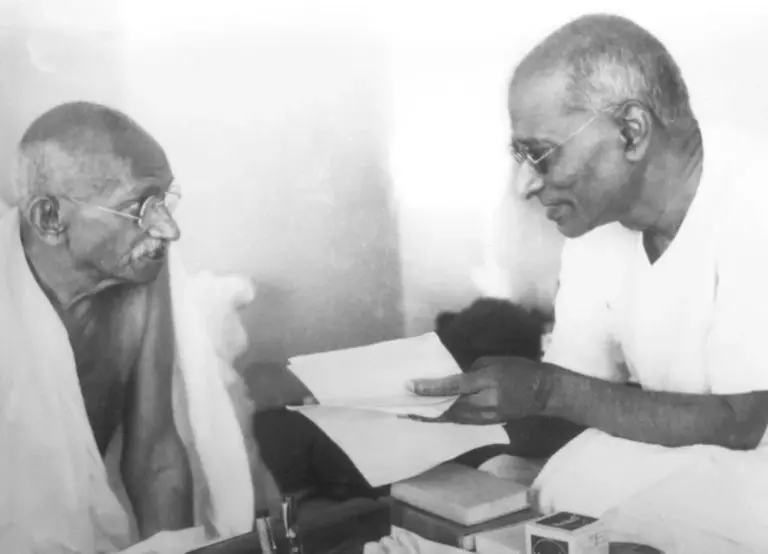
Three Round Table Conferences in London debated the future constitution. The first (1930) was boycotted by the Congress. The second (1931) saw Gandhi attend as the sole Congress representative; the conference deadlocked on the communal question. The third (1932) was reduced to a rump.
Communal Award and Poona Pact 1932
Ramsay MacDonald announced the Communal Award in August 1932, granting separate electorates to Muslims, Sikhs, Indian Christians, Anglo-Indians, Europeans and — most controversially — to the Depressed Classes. Gandhi launched a fast-unto-death at Yerwada Jail. The Poona Pact between Gandhi and Ambedkar substituted reserved seats within the general electorate for separate electorates for the Depressed Classes.
White Paper and Joint Select Committee
The Government of India White Paper (1933) embodied the proposals. A Joint Select Committee of Parliament chaired by Lord Linlithgow scrutinised it through 1933-34, took evidence from 120 witnesses and produced the Bill that became the Government of India Act 1935.
Federal Structure: The Unrealised All-India Federation
The most ambitious part of the Government of India Act 1935 was the federal scheme.
Two Tiers and Two Categories of Units
The proposed Federation comprised two categories of units: eleven Governor’s Provinces and the Princely States. The provinces were to be brought in automatically. The princely states were to accede voluntarily by signing Instruments of Accession. The Federation was to come into existence only when princes representing half the aggregate population of the states and entitled to half the seats in the Council of State had acceded. This condition was never met. The federation never came into force; the central government continued to operate under the Government of India Act 1919 (as amended) until 1947.
Three Lists
The legislative powers of the Federation and the Provinces were distributed by three lists in the Seventh Schedule:
- Federal List — 59 items including defence, external affairs, currency, railways, federal taxes.
- Provincial List — 54 items including police, public order, justice, education, public health, agriculture.
- Concurrent List — 36 items on which both could legislate, with federal law prevailing in case of conflict.
Residuary powers were vested in the Governor-General, not in either tier — a feature the 1950 Constitution would reverse for the Union but the underlying scheme of three lists was preserved as the Seventh Schedule of the Indian Constitution.
Bicameral Federal Legislature
The Federal Legislature was to have two houses:
- Council of State — 260 members (156 from provinces, 104 from princely states), permanent body, one-third retiring every three years.
- Federal Assembly — 375 members (250 from provinces, 125 from princely states), five-year term.
Members from provinces were to be directly elected; members from princely states were to be nominated by the rulers.
Dyarchy at the Centre
The Act introduced dyarchy at the centre — the very mechanism whose failure at the provincial level the Act was abolishing. Federal subjects were divided into:
- Reserved subjects — defence, external affairs, ecclesiastical affairs, tribal areas — administered by the Governor-General with councillors he appointed.
- Transferred subjects — all others — administered by a Council of Ministers responsible to the Federal Assembly.
The Governor-General retained extensive special responsibilities, override powers and discretionary powers, making the responsibility of ministers nominal even on transferred subjects.
Provincial Autonomy: The Working Half
The provincial half of the Government of India Act 1935 was brought into force on 1 April 1937 and operated until 14 August 1947.
Abolition of Dyarchy in Provinces
The dyarchy of the Government of India Act 1919, under which provincial subjects had been split between “reserved” subjects controlled by the Governor and “transferred” subjects under Indian ministers, was abolished. All provincial subjects were transferred to a Council of Ministers responsible to the provincial legislature.
Governor’s Discretionary and Special Powers
The Governor was no longer merely a constitutional head. He retained:
- Special responsibilities — for minorities, public order, financial stability, services, partially excluded areas.
- Discretionary powers — to summon and dissolve the legislature, give or withhold assent, certify bills, promulgate ordinances.
- Power to issue Proclamations of Emergency in the province.
These reserve powers produced friction throughout the 1937-39 Congress ministries.
Bicameralism in Six Provinces
Bicameral legislatures were established in Madras, Bombay, Bengal, United Provinces, Bihar and Assam. The remaining five provinces — Punjab, Central Provinces, North-West Frontier Province, Orissa and Sindh (carved out of Bombay in 1936) — had unicameral legislatures.
Expanded Franchise
The franchise was expanded to approximately 35 million — about one-sixth of the adult population — based on property, taxation, educational qualifications and women’s special franchises. It remained far short of universal adult suffrage but was the largest electorate ever in India to that date.
Congress Ministries 1937-39
In the 1937 elections the Indian National Congress won absolute majorities in Madras, Bombay, United Provinces, Bihar, Central Provinces and Orissa, and emerged as the largest party in NWFP and Assam. Congress ministries took office in eight provinces. They resigned in October-November 1939 in protest at the Viceroy’s unilateral declaration of war on Germany without consulting Indian opinion.
Communal Electorates and Communal Representation
The Government of India Act 1935 entrenched and extended communal electorates already introduced by the Morley-Minto Reforms 1909 and broadened by the Montagu-Chelmsford Reforms 1919.
Categories of Separate Electorates
The Act recognised separate electorates for: Muslims, Sikhs, Anglo-Indians, Indian Christians, Europeans, and — through reservation of seats within the general electorate, in line with the Poona Pact — for the Scheduled Castes. Special constituencies were also provided for women, labour, commerce, industry, mining, planting and landholders.
Weightage
In provinces where Muslims were a minority (UP, Bihar, Madras, Bombay) they received representation greater than their population share; in provinces where they were a majority (Punjab, Bengal) their share was less than their population. This “weightage” was a feature inherited from 1909 and 1919 and would distort every subsequent election.
Other Major Institutions
The Government of India Act 1935 established three institutions of lasting importance.
Federal Court 1937
A Federal Court was established at Delhi in October 1937 with original jurisdiction in inter-governmental disputes, appellate jurisdiction from High Courts, and advisory jurisdiction at the instance of the Governor-General. Sir Maurice Gwyer was the first Chief Justice. The Federal Court was the direct ancestor of the Supreme Court of India established under Article 124 of the Constitution.
Reserve Bank of India 1935
The Reserve Bank of India was constituted under the Reserve Bank of India Act 1934 and commenced operations on 1 April 1935 as the central bank — initially a shareholders’ bank, nationalised in 1949.
Public Service Commissions
Section 264 of the Government of India Act 1935 provided for a Federal Public Service Commission and Provincial Public Service Commissions, with security of tenure for their members. This is the origin of the Union Public Service Commission and State Public Service Commissions under Articles 315-323 of the Constitution.
Burma and Aden Separated
The Act formally separated Burma from India (effective 1937), and Aden (1937). It created two new Governor’s Provinces — Sindh (separated from Bombay) and Orissa (separated from Bihar).
Defects of the Government of India Act 1935
Indian nationalists denounced the Act in strong terms. Nehru called it “a machine with strong brakes and no engine”. The principal defects were:
- The proposed Federation was never enacted because the princes refused to accede.
- The franchise covered only one-sixth of adults, against the Nehru Report demand of adult suffrage.
- Separate electorates were retained and extended, deepening communal politics that would culminate in Partition.
- The Governor-General and Governors retained sweeping discretionary, special-responsibility and emergency powers, making responsible government nominal.
- The Act contained no Bill of Rights — a striking omission given that the Nehru Report (1928) and the Karachi Resolution of the Congress (1931) had both demanded one.
- Defence, external affairs and a third of federal revenue (income tax, customs) remained outside ministerial control even on paper.
Blueprint of the Indian Constitution
Despite its defects the Government of India Act 1935 is the single largest source of the Indian Constitution of 1950.
Provisions Borrowed
The Constituent Assembly borrowed from the Government of India Act 1935: the federal structure and the three lists in the Seventh Schedule, the office and powers of the Governor (Articles 153-167), much of the structure of the Union and State legislatures, the system of public service commissions (Articles 315-323), the Federal Court (refashioned as the Supreme Court), emergency provisions (Part XVIII, especially Articles 352-360), and the financial provisions (Part XII). Granville Austin estimated that nearly 250 articles of the Constitution were lifted, often verbatim, from the Act of 1935.
Working Experience
Between 1937 and 1947 Indian leaders gained ten years of hands-on experience of cabinet government in eight provinces. This shaped the Constituent Assembly’s preference for a Westminster-style parliamentary system over the American presidential model.
Continuity After 1947
The Indian Independence Act 1947 retained the Government of India Act 1935 as the working constitution of both dominions until their constituent assemblies framed their own — a continuity that explains the remarkable smoothness of administrative transition through Partition and integration of the Princely States.
UPSC Relevance
For UPSC Civil Services aspirants, the Government of India Act 1935 is the single most heavily examined statute of British constitutional law.
Prelims
Common prelims questions cover: the three lists and number of items, the abolition of dyarchy in provinces and its introduction at the centre, the date of Federal Court (1937), the date of commencement of provincial autonomy (1 April 1937), the bicameral provinces, separation of Burma and Sindh, and the conditions for federation that were never met.
Mains GS-II
The Government of India Act 1935 is examined under “evolution of the Indian Constitution” alongside the Regulating Act 1773, Charter Acts, Morley-Minto Reforms 1909, Montagu-Chelmsford Reforms 1919 and Indian Independence Act 1947. Standard mains questions ask aspirants to evaluate the claim that the Act of 1935 was the blueprint of the Constitution, or to compare and contrast dyarchy in 1919 and 1935.
Mains GS-I
Under “Modern Indian History” the Act is connected with the Simon Commission, Round Table Conferences, Jallianwala Bagh Massacre, Civil Disobedience Movement, Chauri Chaura Incident and the road to Independence.
Frequently Asked Questions
What was the Government of India Act 1935?
The Government of India Act 1935 was a British parliamentary statute of more than 450 sections and 16 schedules that provided a new constitution for India. It proposed an all-India federation, introduced provincial autonomy with responsible government in eleven provinces, bicameralism at the centre and in six provinces, a three-list distribution of legislative powers, dyarchy at the centre, a Federal Court and an expanded franchise.
Why is the Government of India Act 1935 called the blueprint of the Indian Constitution?
Because the Constituent Assembly borrowed nearly 250 articles of the Indian Constitution from it — including the three lists in the Seventh Schedule, the office and powers of the Governor, the system of public service commissions, the Federal Court (refashioned as the Supreme Court), and most emergency and financial provisions. B. N. Rau and B. R. Ambedkar drew on the Act as their working template.
Was the federation under the Government of India Act 1935 ever established?
No. The federal portion of the Act required princes representing half the aggregate population and entitled to half the Council of State seats to sign Instruments of Accession. The condition was never met. The federation never came into force; the centre continued to operate under the Government of India Act 1919 (as amended) until 14 August 1947.
What was provincial autonomy under the Government of India Act 1935?
Provincial autonomy meant the abolition of dyarchy in provinces — all provincial subjects were transferred to a Council of Ministers responsible to a directly-elected provincial legislature. Provincial autonomy commenced on 1 April 1937. Governors retained substantial discretionary and special-responsibility powers, but day-to-day administration was in Indian hands.
What were the three lists under the Government of India Act 1935?
The three lists in the Seventh Schedule were the Federal List (59 items including defence, external affairs, currency), the Provincial List (54 items including police, public order, education) and the Concurrent List (36 items on which both legislatures could act, with federal law prevailing in conflict). Residuary powers were vested in the Governor-General.
What was dyarchy at the centre under the Government of India Act 1935?
The Act divided federal subjects into reserved subjects (defence, external affairs, ecclesiastical affairs, tribal areas) administered by the Governor-General with councillors he appointed, and transferred subjects administered by a Council of Ministers responsible to the Federal Assembly. Dyarchy at the centre never came into operation because the federation itself was never inaugurated.
Which institutions established by the Government of India Act 1935 are still functioning today?
The Reserve Bank of India (operational from 1 April 1935), the Federal Court (1937, refashioned as the Supreme Court of India in 1950) and the Public Service Commissions (UPSC and State PSCs under Articles 315-323) are direct lineal descendants of institutions created by the Act.
Did the Government of India Act 1935 abolish separate electorates?
No. The Act retained and extended separate electorates for Muslims, Sikhs, Anglo-Indians, Indian Christians and Europeans, and provided reserved seats within the general electorate for Scheduled Castes in line with the Poona Pact of 1932. The continued recognition of communal electorates was one of the Act’s most criticised features and is widely seen as having deepened the communal politics that culminated in Partition.
Tell Google you want more of this.
Add Anantam IAS as a preferred sourceOne tap, and this site shows up more often in your own Top Stories, AI Overviews and AI Mode. Remove it any time.