Daily Digest
UPSC · Civil Services Examination
Current Affairs · Wednesday, 1 April 2026
Current affairs curated and edited by Anantam IAS faculty — pulled from The Hindu, PIB, IDSA, Foreign Affairs and the ministries. Read, annotate, revise.
Old Rajinder Nagar · Delhi 110005 · anantamias.com
Ambedkar’s Mahad Satyagraha, a ‘watershed moment of Dalit assertion’
Why in News?
The historic Mahad Satyagraha marked its 99th anniversary and the beginning of its centenary year on 20 March 2026, which is also officially observed across India as Social Empowerment Day
UPSC Relevance:
GS-I: Caste System, GS-II: Social Justice.
The Mahad Satyagraha (1927)
- The Mahad Satyagraha, also known as the Chavdar Tale Satyagraha, was one of the most significant civil rights movements in Indian history. Led by Dr. B.R. Ambedkar on 20 March 1927, it was a nonviolent protest to allow untouchables to use water from a public tank in Mahad (in present-day Raigad district, Maharashtra).
- The day is now observed as Social Empowerment Day in India. Its 99th anniversary just passed on 20 March 2026.
Background and Cause
- The oppressed castes — called “Depressed Classes” during the colonial era — had faced severe discrimination, segregation, and social ostracism for centuries. Access to public resources such as water bodies, temples, and schools was routinely denied to them, perpetuating their social, political, and economic marginalization.
- A key legal trigger came in 1923. Social reformer S.K. Bole passed the Bole Resolution in the Bombay Legislative Council, mandating that public water sources, wells, and dharamshalas be opened to the Depressed Classes.
- The Mahad Municipal Council adopted this resolution in 1924, but severe resistance from dominant-caste Hindus prevented Dalits from actually accessing the town’s Chavdar Tank.
The March of 20 March 1927 — Phase One
- Ambedkar conducted meetings with local Dalit leaders, stressed on creating “a wave of awakening” among the lower caste people of Konkan, and directed organisers to spread news of the conference.
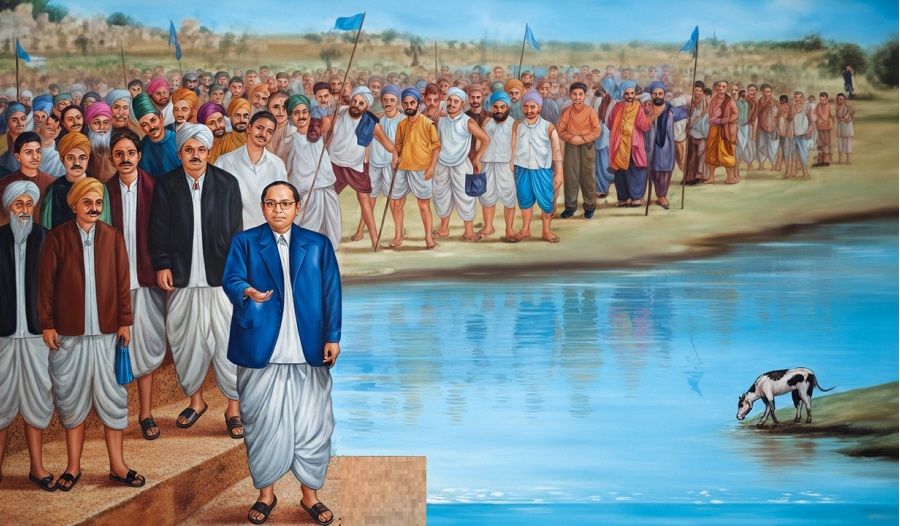
- On 20 March 1927, Ambedkar led thousands of Dalits in a peaceful march to the Chavdar Tank. In a historic and symbolic act, he drank water from the tank, asserting the right of untouchables to access public resources. This act directly challenged centuries-old caste taboos and transformed a basic necessity into a powerful symbol of equality and human dignity.
- The backlash was immediate. Upper-caste Hindus conducted a purification ritual of the tank by “emptying out 108 earthen pots full of cow’s urine into it.” Under pressure from the oppressor castes, the Mahad Municipality on 4 August 1927 revoked its 1924 resolution that had declared the Chavdar Tank open to the Depressed Classes.
Ambedkar’s Address and the Women’s Assertion
- The Mahad Satyagraha was not just about water — it also had a feminist dimension. Ambedkar asked Dalit women to abandon old customs that served as recognizable markers of untouchability and to wear saris like high-caste women. Before that time, Dalit women were not allowed to drape saris completely.
- Immediately after Ambedkar’s speech, Dalit women readily decided to do so, and upper-caste women like Lakshmibai Tipnis helped them dress accordingly.
Phase Two and the Burning of Manusmriti — December 1927
- Ambedkar announced a second, larger conference for December 1927. However, the oppressor castes initiated legal action, and on 14 December 1927, the Mahad civil court issued a temporary injunction prohibiting Ambedkar and his colleagues from accessing the Chavdar Tank until further orders.
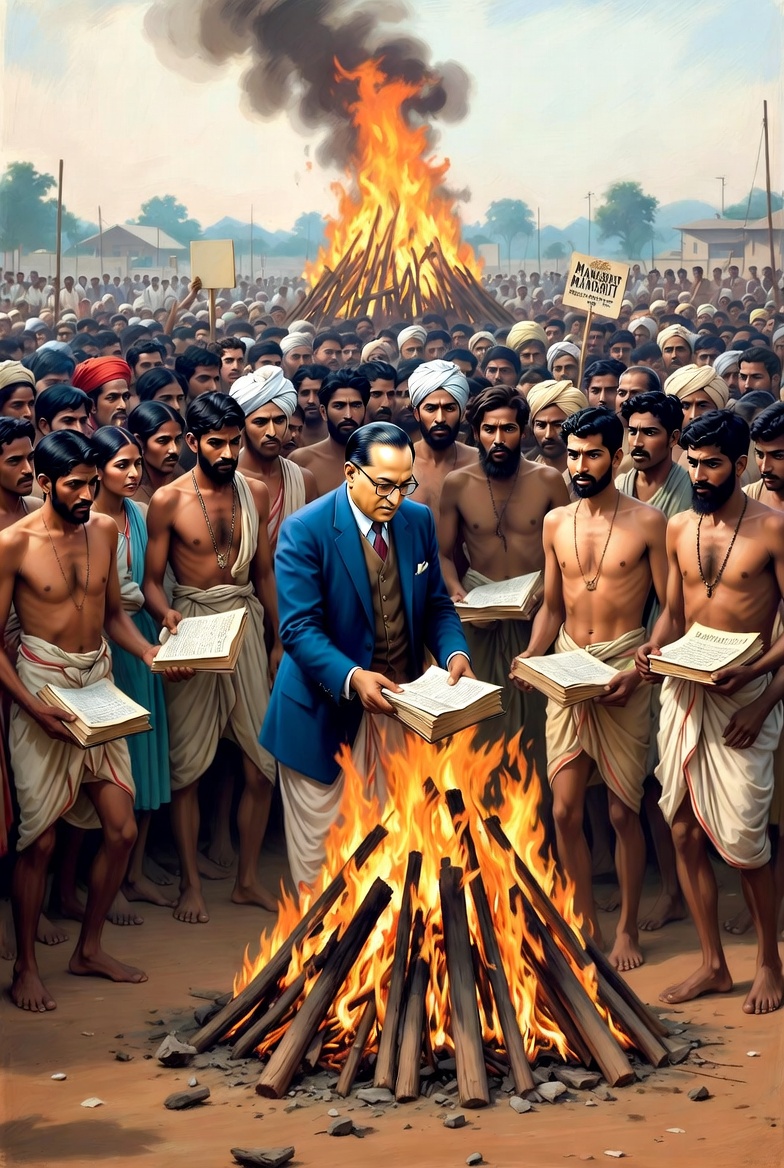
- Rather than violate the court order, Ambedkar responded with a powerful symbolic gesture. On 25 December 1927, Ambedkar burned the Manusmriti — one of the most influential Hindu law texts that provided scriptural justification for the caste system, prescribing severe punishments for those who violated caste boundaries.
- In his address, Ambedkar said: “It is not as if drinking the water of the Chavdar Lake will make us immortal. We have survived well enough all these days without drinking it. We are going to the Lake to assert that we too are human beings like others. This meeting has been called to set up the norm of equality.”
This day, 25 December, is commemorated as Manusmriti Dahan Din.
The Legal Victory (1937)
- In the civil suit, Ambedkar argued that the tank belonged to the Mahad Municipality and should be open to all. The trial court ruled against the upper-caste plaintiffs, stating they failed to prove any longstanding legal custom of exclusion.
- After appeals by both sides, the Bombay High Court also dismissed the case in 1937 — thus, after almost 10 years of struggle, Ambedkar secured legal victory for his people.
Significance and Legacy
1. Shift from petitions to direct action: Mahad marked a paradigm shift in Dalit politics — moving from submitting petitions to the British government, to taking direct, mass-mobilized civic action.
2. Water as dignity: The Mahad Satyagraha reframed access to water as a question of human dignity. By denying Dalits access to water, society effectively denied them their basic humanity.
3. “Before salt, there was water”: A powerful parallel is often drawn between Mahad (1927) and Gandhi’s Dandi March (1930). While Gandhi used salt to mobilize people against the external colonizer (British imperialism), Ambedkar used water to fight what he called internal colonialism — the caste system itself.
4. Constitutional influence: The Mahad Satyagraha influenced Article 15 (non-discrimination) and Article 17 (abolition of untouchability) of the Indian Constitution.
5. Ideological rejection of caste: The burning of the Manusmriti was not an isolated act but part of Ambedkar’s broader project of annihilating caste — challenging not just contemporary social practices but the scriptural authority that undergirded caste discrimination.
Practice MCQs:
The Mahad Satyagraha of 1927 was led to assert the right of untouchables to access which public resource?
A. A temple in Mahad
B. Chavdar Tank (a public water tank)
C. A public school in Raigad
D. A government dharamshala
Answer: C.
Which constitutional articles are most directly linked to the spirit of the Mahad Satyagraha?
A. Articles 12 and 13
B. Articles 15 and 17
C. Articles 19 and 21
D. Articles 25 and 26
Answer: B.
G7 Leaders’ Summit 2026
Why in News?
The G7 Summit is in news as France, the 2026 host, has begun preparatory ministerial meetings and diplomatic consultations ahead of the June 2026 summit in Evian (France).
UPSC Relevance:
GS-II: International Relations, Multilateralism
Basic Structure of G7
- Members: USA, UK, Canada, France, Germany, Italy, Japan + EU (as non-enumerated member)
- NOT a treaty-based organization — no charter, no permanent secretariat
- Presidency rotates annually among members
- Originally formed as G6 in 1975 (Rambouillet, France); Canada joined in 1976 making it G7
- Russia joined in 1998 → G8, then expelled in 2014 after annexing Crimea → back to G7
Data:
- G7 nations represent ~10% of world population but ~45% of global GDP
- Meets annually at Heads of Government level (the “Summit”)
- Finance Ministers and Foreign Ministers meet separately through the year
Difference between G7 and G20
| G7 | G20 | |
| Members | 7 advanced economies + EU | 19 countries + EU + AU |
| Nature | Informal forum | Larger, includes emerging economies |
| India | NOT a member | Member (hosted in 2023) |
India’s relationship with G7
- India is NOT a G7 member but is regularly invited as a guest — this reflects India’s growing strategic importance
- At Kananaskis 2025, PM Modi participated in working sessions
- France has invited Modi to the 2026 summit at Évian
Why India is not a member but keeps getting invited:
- India is the 5th largest economy (soon 3rd) but is a developing nation — G7 is a club of advanced economies
- India’s presence signals the G7’s acknowledgment that global problems can’t be solved without the Global South
- India uses these invitations to push its positions on climate finance, WTO reform, digital governance, and multipolarity
Criticisms of G7:
- Legitimacy deficit — an exclusive club of wealthy nations making decisions that affect the whole world
- No enforcement mechanism — commitments are not legally binding; compliance is voluntary
- Declining relevance — G20 (which includes China, India, Brazil) is seen as more representative
- Western-centric worldview — G7 positions on Ukraine, sanctions, and trade often reflect Western interests
- No final communiqué in 2025 — signals internal fractures, especially US vs rest on Ukraine and trade
Arguments in favour of G7’s continued relevance:
- Speed and informality — can coordinate quickly on crises (pandemics, financial shocks)
- Shared democratic values — unlike G20, G7 is a values-based grouping
- Sets agenda for G20 — many G7 ideas get adopted by the broader G20 framework
Practice MCQ
Consider the following statements about the G7:
1. G7 nations represent about 45% of global GDP
2. G7 decisions are legally binding on member nations
3. The G7 presidency rotates annually among members
Which of the above statement are correct?
A. 1 and 2 only
B. 1 and 3 only
C. 2 and 3 only
D. All three
Answer: B.
Source: https://anantamias.com/current-affairs/g7-leaders-summit-2026/
MC14 opens in Yaounde with call to reinvigorate WTO in time of crisis
Why in News?
The 14th Ministerial Conference (MC14) of the World Trade Organization (WTO) is in news due to:
- Ongoing negotiations on fisheries subsidies, agriculture, and dispute settlement reforms
- Developing countries, including India, pushing for food security and policy space
- Continued global debate over reforming multilateral trade rules
UPSC Relevance:
GS-II: International Relations, Multilateralism and GS-III: Economy, Food Security, Agriculture.
What is WTO?
The World Trade Organization (WTO) is:
- A global international organization dealing with rules of trade between nations
- Established in 1995, replacing General Agreement on Tariffs and Trade (GATT)
- Headquarters: Geneva
Core Functions of WTO
- Facilitates global trade liberalisation
- Resolves disputes between countries
- Provides a platform for negotiations
What is Ministerial Conference (MC)?
The Ministerial Conference is:
- The highest decision-making body of WTO
- Held every 2 years
- Comprises trade ministers of all member countries
It takes major policy decisions and negotiates agreements.
What is MC14?
- MC14 = 14th Ministerial Conference taking place from March 26–29, 2026, in Yaounde, Cameroon.
- Comes after MC13 (Abu Dhabi, 2024)
- Expected to address unresolved issues of global trade
- The conference is being held against a backdrop of “polycrisis”—geopolitical tensions (US-China), rising protectionism, and climate change.
- It is crucial because WTO is currently facing a crisis of relevance
Key Issues in MC14
1. Fisheries Subsidies
Background:
- Countries give subsidies to fishing sector
- Leads to overfishing and depletion of marine resources.
Status:
- Partial agreement reached earlier
- MC14 aims to finalize rules on:
- Illegal fishing
- Overcapacity
- Aligned with SDG 14.6.
- Negotiations aim to eliminate subsidies for “Illegal, Unreported, and Unregulated” (IUU) fishing.
India’s Stand:
- India seeks a 25-year transition period to protect its small-scale, traditional fishers.
- India demands Special and Differential Treatment (S&DT) to protect its 9 million small-scale, traditional fishers. It argues that “distant water fishing nations” (like China, EU) should take more responsibility
2. Agriculture & Food Security
- Public Stockholding (PSH): India is pushing for a permanent solution for its PSH programs (like MSP for wheat/paddy).
- The Conflict: Current WTO rules (Agreement on Agriculture) limit subsidies to 10% of production value based on 1986-88 prices. India argues these benchmarks are outdated and threaten its food security for 800 million people.
3. Dispute Settlement Crisis
- The Problem: The Appellate Body (the “Supreme Court” of trade) has been paralyzed since 2019 because the US blocked the appointment of new judges.
- MC14 Goal: Restoring a fully functional, binding dispute settlement mechanism.
- Developed nations want “reforms” that might dilute the consensus-based model, which India opposes
4. E-commerce & Digital Trade
The Issue: Since 1998, members have agreed not to impose customs duties on electronic transmissions – covers electronic transmissions, including software, music, movies, and video games.
India’s View: India opposes a permanent moratorium. It argues that developing nations lose billions in potential revenue and need “policy space” to grow their domestic digital industries.
5. Investment Facilitation for Development (IFD)
- Investment Facilitation means making it easier for foreign companies to invest (FDI) in a country by reducing red tape.
- This is being discussed under: Investment Facilitation for Development (IFD) Agreement
- Proposed within the World Trade Organization
- Supported by 100+ countries (mostly developing countries)
- Status: A China-led “plurilateral” (subset of members) agreement.
- Why is it Controversial?
- Plurilateral vs Multilateral Issue
- This agreement is not supported by all countries
- It is a plurilateral agreement (only some countries)
- Concern: It may undermine WTO’s consensus-based system
- Developed vs Developing Divide
- Developed countries support it (to expand investment opportunities)
- Some developing countries fear:
- Loss of sovereignty
- Unequal benefits
- Plurilateral vs Multilateral Issue
- India’s Opposition: India opposes its inclusion in the WTO rulebook, arguing that investment is not a “trade” issue and bypasses consensus and should not be part of the WTO mandate. India also opposes the “plurilateral” route as it bypasses the consensus of the whole body
India’s Strategic Position: “The Global South Champion”
India’s approach at MC14 is described as “constructive, balanced, and development-oriented. India is building coalitions (e.g., with the G-33 and Africa Group) to defend Special and Differential Treatment (S&DT) — rules that give developing nations more time and flexibility.
India is focusing on:
- Food security (public stockholding)
- Protection of small farmers and fishermen
- Opposing unfair rules by developed countries
- Maintaining policy space for development
Significance of MC14
- Determines future of multilateral trade system
- Opportunity to:
- Reform WTO
- Address inequalities
- Important for Global South voice
Way Forward:
1. Revive Multilateralism and Consensus-Based Decision Making
The World Trade Organization must restore faith in its consensus-based system, ensuring that all members, especially developing countries, participate meaningfully in decision-making.
2. Restore the Dispute Settlement Mechanism
There is an urgent need to revive the Appellate Body, so that WTO can function as a rules-based dispute resolution system rather than a negotiation-only forum.
3. Provide a Permanent Solution on Agriculture
WTO members should reach a permanent solution on public stockholding, allowing countries like India to ensure food security without violating subsidy rules.
4. Ensure Fair and Equitable Fisheries Rules
Rules on fisheries subsidies should:
- Curb illegal and large-scale industrial fishing
- Protect small and traditional fishermen in developing countries
5. Strengthen Special & Differential Treatment (S&DT)
Developing countries must be given:
- Greater flexibility
- Longer timelines
- Policy space
to pursue their developmental goals without being constrained by uniform rules.
6. Balance Trade Liberalisation with Development Needs
Trade rules should not be purely market-driven; they must incorporate:
- Poverty reduction
- Employment generation
- Inclusive growth
7. Reform Approach to Plurilateral Agreements
Plurilateral initiatives (like investment facilitation) should:
- Remain open, transparent, and inclusive
- Not undermine the multilateral framework
8. Address Digital Trade and E-commerce Issues Carefully
Countries should retain the ability to:
- Tax digital trade
- Regulate data flows
while ensuring that developing nations are not disadvantaged in the digital economy.
9. Promote Sustainable and Green Trade
WTO rules should integrate:
- Environmental sustainability
- Climate commitments
while avoiding green protectionism by developed countries.
10. Enhance Capacity Building for Developing Countries
WTO should support developing nations through:
- Technical assistance
- Institutional strengthening
- Trade facilitation support
to help them effectively participate in global trade.
11. Reduce Protectionism and Trade Distortions
Developed countries must:
- Reduce subsidies
- Avoid unilateral trade measures
to ensure a level playing field in global trade.
12. Encourage Regional and Bilateral Cooperation as Complementary
Regional and bilateral trade agreements should complement—not replace—the WTO, ensuring that multilateralism remains central.
| Challenge | Way Forward |
| Institutional Crisis | Restore Appellate Body; explore voting for judge appointments. |
| Food Security | Replace Bali Peace Clause with a permanent legal solution for PSH. |
| Digital Divide | Negotiate a sunset clause for the E-commerce Moratorium. |
| Sustainability | Challenge “Green Tariffs” (CBAM) under the CBDR principle. |
| Governance | Balance “Consensus” with inclusive Plurilateral initiatives. |
Conclusion
“Revitalising the WTO requires balancing trade liberalisation with development concerns, restoring trust in multilateralism, and ensuring that global trade rules are equitable, inclusive, and responsive to contemporary challenges.”
Practice Questions
Consider the following statements:
- WTO was established after replacing GATT.
- Ministerial Conference is the highest decision-making body of WTO.
- WTO dispute settlement system is fully functional currently.
Which of the above are correct?
(a) 1 and 2 only
(b) 2 and 3 only
(c) 1 and 3 only
(d) 1, 2 and 3
Answer: (a)
Mains Questions
- “The WTO is facing a crisis of relevance in the 21st century.” Discuss in the context of recent Ministerial Conferences.
- Examine India’s position on agriculture and fisheries negotiations in WTO.
Musi Riverfront Development Project (MRDP)
Why in News?
The Musi Riverfront Development Project in Hyderabad is in news due to Government of Telangana plans to rejuvenate the polluted Musi River
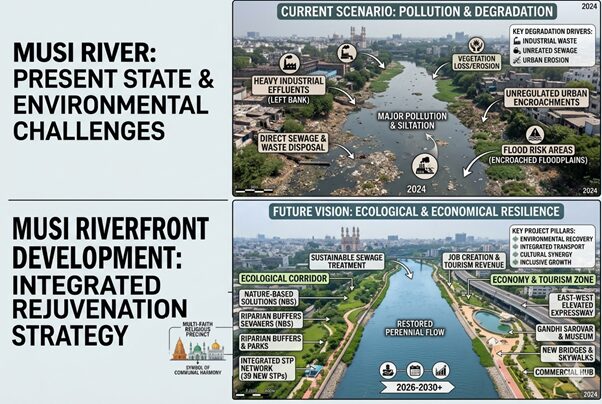
- The Musi Riverfront Development Project (MRDP) is a flagship urban rejuvenation initiative by the Telangana government. It aims to transform the Musi River —the lifeline of Hyderabad— from a polluted “open sewer” into a vibrant, ecologically healthy, and economically productive urban corridor
UPSC Relevance:
GS-I: Geography, GS-II: Governance, GS-III: Environment & Economy, GS-IV Ethics: Balancing development vs. displacement;
What is Musi River?
- The Musi River is a tributary of the Krishna River.
- Source: Originates in the Ananthagiri Hills (Vikarabad district, Telangana).
- It flows through Hyderabad
Today, it is one of the most polluted urban rivers in India
Historical Significance: Known for the Great Musi Flood of 1908, which led to the birth of modern Hyderabad’s city planning and the construction of twin reservoirs: Osman Sagar and Himayat Sagar
Current State: Severely degraded due to unchecked industrial effluents, domestic sewage, and urban encroachments.
What is the Musi Riverfront Development Project?
It is a large urban renewal and river rejuvenation project aimed at:
- Cleaning and restoring the river
- Developing riverfront infrastructure
- Improving urban living conditions
Objectives of the Project
- Ecological restoration: Ensure perennial flow and pollution-free water; transform the river into a living urban asset.
- Flood mitigation: Reduce man-made flooding disasters through engineering solutions.
- Urban development and economy: Create public spaces, tourism, heritage zones, commercial areas, and a 24×7 economy along the riverbanks — aiming for the world’s longest riverfront (55 km).
- Sustainability and livability: Improve Hyderabad’s environment, mobility, green cover, and quality of life.
- Heritage and recreation: Revitalize historical sites along the river corridor.
Key Components
- Sewage Treatment Plants (STPs)
- River cleaning and desilting
- Construction of riverfront infrastructure
- Development of transport corridors and public spaces
Major Issues & Challenges
| Challenge | Context |
| Social Justice | Over 10,000 households in the riverbed face displacement. The “Musi Jan Andolan” protest highlights concerns over rehabilitation and livelihood loss. |
| Environmental Risk | Experts warn that “concretization” (riverfront beautification) might interfere with the river’s natural flood-absorption capacity. |
| Legal Issues | Cases are pending in the National Green Tribunal (NGT) regarding environmental clearances and land acquisition. |
| Hydrological Engineering | Diverting Godavari water is energy-intensive and raises questions about the long-term sustainability of artificial flow. |
Comparation with Sabbarmato Riverfront (Ahmedabad)
| Aspect | Musi Riverfront Project | Sabarmati Riverfront Project |
|---|---|---|
| Location | Hyderabad | Ahmedabad |
| River | Musi River (tributary of Krishna) | Sabarmati River |
| Stage | Proposed / Under development | Completed (operational model) |
| Primary Objective | Pollution control + urban renewal | Urban beautification + flood control |
| Pollution Level | Extremely high (sewage-dominated river) | Initially polluted but improved |
| Core Strategy | STPs + river cleaning + redevelopment | Channelisation + embankments + regulated flow |
| Water Source | Natural + sewage (currently degraded) | Largely dependent on Narmada canal water |
| Ecological Approach | Focus on rejuvenation (yet debated) | Criticised for artificial river flow |
| Flood Management | Important objective (Hyderabad floods history) | Major success (controlled flooding) |
| Displacement Issue | Significant concern (slum eviction) | Large-scale displacement happened |
| Economic Impact | Expected (tourism, real estate) | Already boosted tourism & land value |
| Environmental Criticism | Risk of over-concretisation | Loss of natural river ecosystem |
| Model Value | Still evolving | Considered a “model project” |
Lessons: Success depends on pollution control + sustainable planning
Significance for India
- Model for urban river rejuvenation
- Improves urban ecology and public health
- Supports sustainable urbanisation
Way Forward for the Project
- Inclusive Rehabilitation: Strictly adhering to the LARR Act, 2013, ensuring that displacement is followed by “upgrade” in living standards, not just relocation.
- Nature-Based Solutions: Prioritizing bioremediation, permeable pavements, and “sponge city” concepts over heavy concrete embankments.
- Transparency: Making the Detailed Project Report (DPR) public to build trust and mitigate political friction.
Practice Questions
The Musi River is a tributary of which of the following rivers?
(a) Godavari
(b) Krishna
(c) Tungabhadra
(d) Cauvery
Answer: (b)
Mains Question
“Riverfront development projects in India often face a trade-off between urban development and ecological sustainability.” Discuss with reference to the Musi Riverfront Development Project.
Source: https://anantamias.com/current-affairs/musi-riverfront-development-project-mrdp/
India eyes Rupee currency payments for West Asian Oil
Why in News?
The Indian economy is facing a “Twin Shock”: a spike in global crude oil prices (surging past $115–123/barrel) and a record fall in the Rupee (breaching Rs 94/$1). To counter this, India is intensifying efforts to settle trade in local currencies (Rupee-Dirham, etc.)
India is exploring settling oil trade with West Asian countries in local currencies (Rupee instead of Dollar) due to:
- Rising global oil prices
- Depreciation of the Indian Rupee
- Pressure on India’s import bill and foreign exchange reserves
UPSC Relevance:
GS III: Economy, Energy Security
GS II: International Relations
How Oil Trade Normally Happens
- Global crude oil trade is conducted mainly in US Dollars ($)
- This system is called the “Petrodollar System”
- Petrodollars are U.S. dollars paid to oil-exporting countries in exchange for oil, a system established in the 1970s that requires global oil trade to be priced in USD.
- Origin: Following the 1971 end of the gold standard, the U.S. struck deals with Saudi Arabia and other OPEC nations to price oil exclusively in dollars, creating massive, consistent global demand for the U.S. currency.
So, India must:
- Convert Rupee → Dollar
- Then pay oil-exporting countries
What is the Problem Now?
1. Rupee Depreciation
When Rupee weakens against Dollar, India has to pay more rupees for the same oil
Example:
- Earlier: $1 = 75 Rs
- Now: $1 = 85 Rs
Oil becomes costlier even if global prices remain same
2. Rising Oil Prices
- Due to geopolitical tensions (especially in West Asia)
- Increases India’s import bill
3. Pressure on Forex Reserves
- India needs large amounts of dollars
- This puts pressure on:
- Foreign exchange reserves
- Current Account Deficit (CAD)
What is India Proposing?
India is exploring:
Local Currency Trade (Rupee based trade)
- Pay oil exporters in Indian Rupees instead of dollars
- Reduce dependence on US dollar
How Would This Work?
- India pays Rupee to exporting country
- That country:
- Uses Rupee to buy Indian goods OR
- Invests in Indian assets
Already attempted with countries like:
- Russia (after sanctions)
- UAE discussions ongoing
What are the Advantages for India?
1. Reduces Dollar Dependence
- Less need to hold large $ reserves
2. Protects Against Rupee Depreciation
- No conversion loss
3. Improves Trade Balance
- Encourages exports (since partner must spend Rupee)
4. Strategic Autonomy
- Reduces vulnerability to global financial shocks
Economic Implications
- Current Account Deficit (CAD): High oil prices usually widen the CAD. Local currency trade helps “de-link” the CAD from Dollar volatility.
- Imported Inflation: Expensive oil leads to higher transport costs, raising prices of food and essential goods. The RBI recently had to revise its inflation projections upward due to this.
- Fiscal Deficit: The government may have to increase subsidies (Fertilizers/LPG) to protect consumers, stretching the budget.
Geopolitical Implications
- Strategic Autonomy: Settling trade in local currencies is a form of “De-dollarization.”
- The “Trump Factor”: The US has previously threatened 100% tariffs on countries that move away from the Dollar. India must navigate this carefully to avoid trade friction with the US.
- Energy Security: With 50% of oil passing through the Strait of Hormuz (a major chokepoint currently under tension), local currency deals strengthen bilateral “sticky” ties with suppliers like the UAE.
Challenges to Consider
- Trade Imbalance: India imports much more from West Asia (Oil/Gas) than it exports to them. This leaves the partner country with a “surplus” of Rupees they might not know how to spend.
- Global Acceptability: Most global oil benchmarks (Brent/Dubai) are priced in Dollars, making it hard to fix a “Rupee price” for oil. In addition to that, Indian Rupee is Not Fully Convertible which limits global acceptance
- US Sanctions/Pressure: Avoiding the Dollar can sometimes be seen as bypassing the US-led financial system (SWIFT).
Global Context
This move is part of a broader trend:
- Countries like China promoting Yuan-based trade
- Growing discussions on de-dollarisation
India’s Previous Steps
- RBI allowed International Trade Settlement in INR (2022)
- Use of Vostro accounts for trade settlement
Practice Questions
Consider the following statements:
- Global crude oil trade is primarily conducted in US dollars.
- Local currency trade can reduce pressure on foreign exchange reserves.
- Indian Rupee is fully convertible on the capital account.
Which of the above are correct?
(a) 1 and 2 only
(b) 2 and 3 only
(c) 1 and 3 only
(d) 1, 2 and 3
Answer: (a)
Mains Question
“India’s push for local currency trade in crude oil reflects both economic necessity and strategic ambition.” Discuss.
Source: https://anantamias.com/current-affairs/india-eyes-rupee-currency-payments-for-west-asian-oil/
Helium Shortage amid West Asia Conflict
Why in News?
- The raging war in West Asia has hit Natural gas production and associated Helium production. This unlikely shortage is threatening to halt production in major, critical high-end industries such as semiconductor manufacturing and healthcare.


| UPSC Relevance: GS-3 Science and Technology: Frontier Technology; GS-3 Economy: Energy Prelims: Helium gas & its applications. |
Why is Helium important?
About Helium:
- Helium is a colourless, odourless, and non-toxic noble gas.
- It is the second most common element in the universe after Hydrogen. But it is rare on Earth, where it mainly exists in small concentrations in pockets of natural gas.
- Helium has the lowest boiling point among all elements (−269°C).
How is Helium obtained?
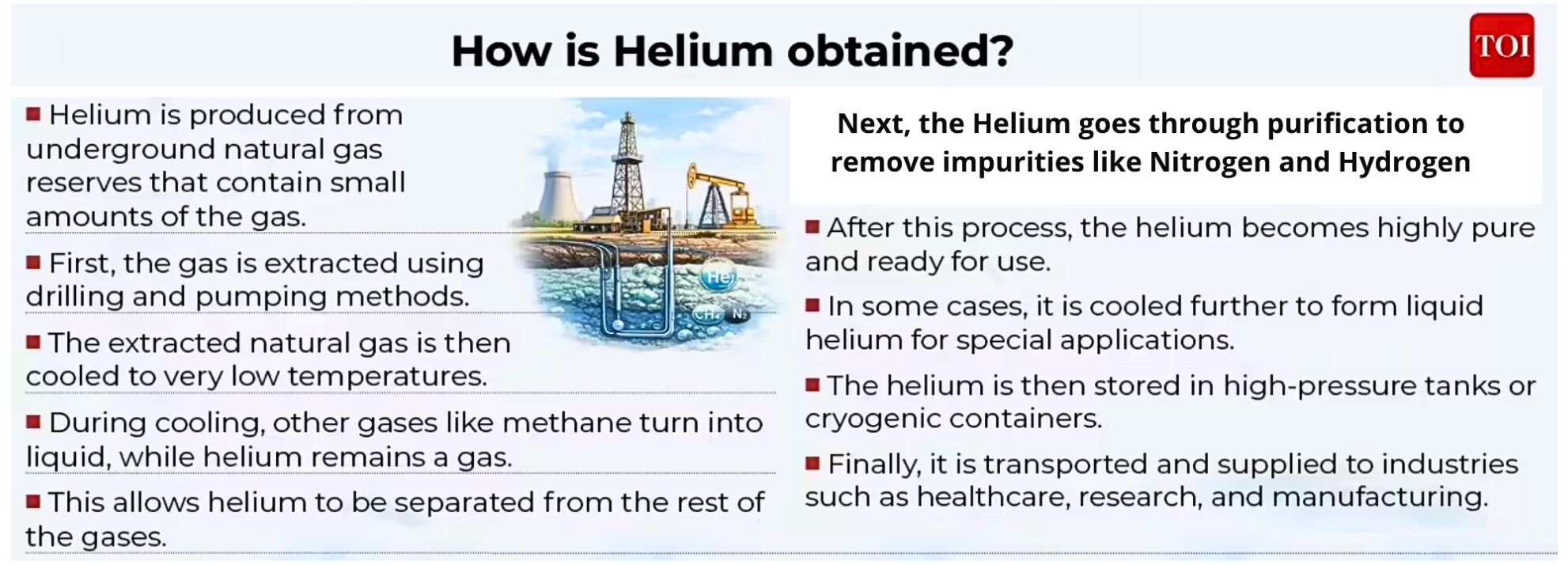
Helium is not extracted independently but as a by-product of LNG (liquefied natural gas). During LNG production, Helium is separated from methane, nitrogen, and other gases using cryogenic distillation and then shipped as a supercooled liquid.
Applications of Helium:
- Cryogenics: Widely used as a cryogenic coolant, as it remains liquid at extremely low temperatures. It is used to cool superconducting magnets, maintaining ultra-low temperatures in research labs and in nuclear and particle physics experiments.
- Semiconductor manufacturing: Used in the semiconductor industry due to its inert nature and high thermal conductivity. It is used to cool silicon wafers and other manufacturing processes (E.g., Wafer Etching process- a microfabrication process in chip manufacturing)
- Space Industry:
- Pressurising rocket fuel systems: Helium is used in rocket systems because it is non-reactive and lightweight. As fuel and oxidiser are burned in the rocket’s engines, Helium fills the resulting empty space in the tanks, maintaining the overall pressure inside.
- Purging fuel tanks: Helium purging in rocket fuel tanks involves flushing the tanks with inert Helium gas to remove moisture, air, or reactive impurities.
- Used in the production of Fibre optic cables for rapidly cooling molten glass to prevent defects in the optical fibre cables.
- Healthcare Applications: Used to cool superconducting magnets in MRI (Magnetic Resonance Imaging) machines.
- Leak detection in pipelines: Helium has very small atoms that can escape through extremely tiny cracks. Used to detect very small leaks in pipelines carrying gases or liquids such as natural gas, petroleum, chemicals, or refrigerants.
- Used as a lifting gas in balloons and airships. E.g., party balloons, hot air balloon.
Helium Shortage amid West Asia Conflict:
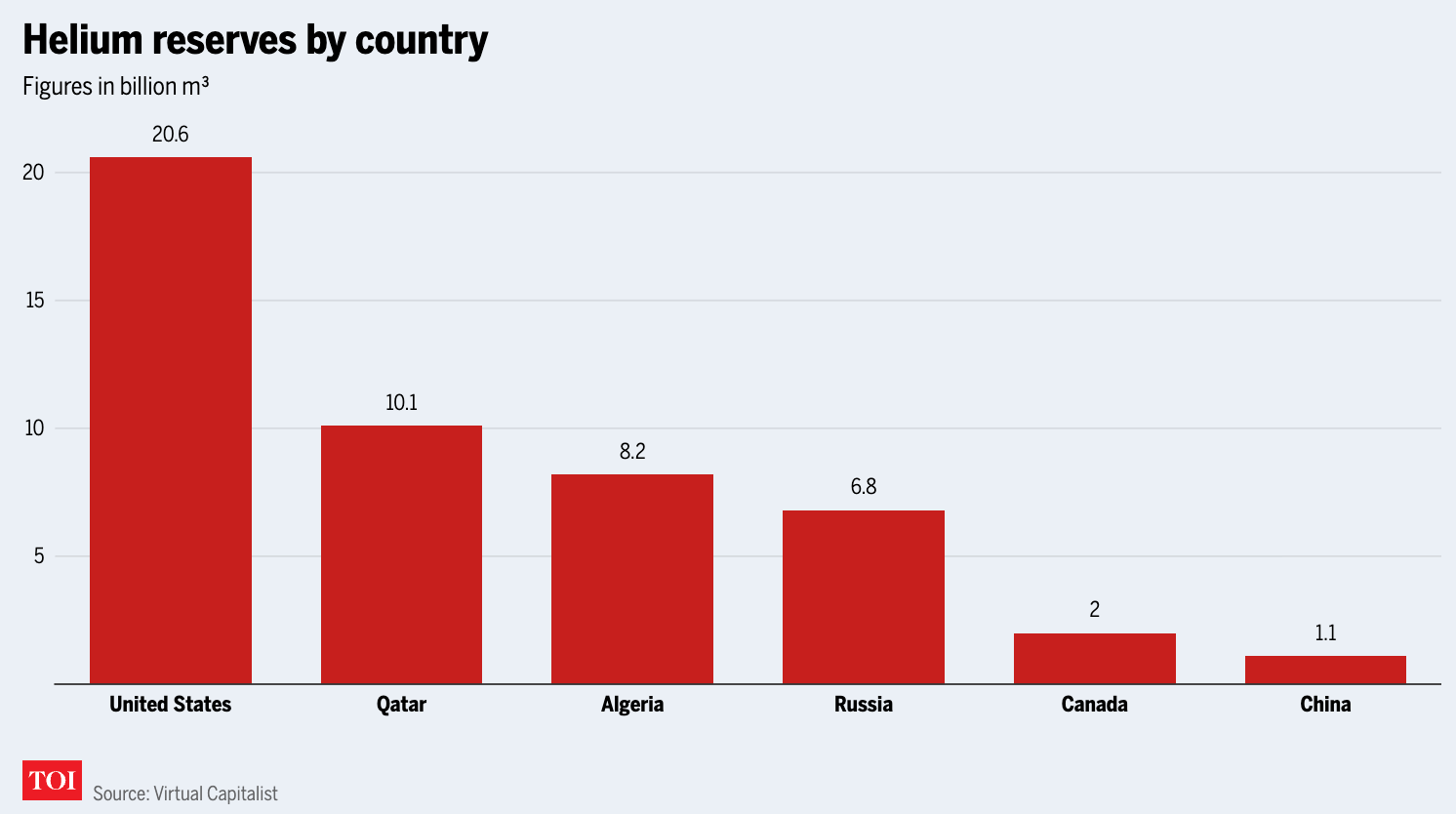
- Qatar’s Ras Laffan facility (the world’s largest liquefied natural gas plant) halted production of LNG and “associated products” after Iranian strikes on Qatari natural gas plants. This cut off roughly 30% of helium’s global supply. The damaged production lines could take years to repair.
- Bottleneck in Strait of Hormuz (effectively closed since early March 2026): Helium’s tiny molecules can easily escape containers by leaking through even the smallest of gaps. Helium is typically chilled into the liquid form and stored in insulated containers for transport through the Strait of Hormuz. The specialised containers can store Helium for 35 to 48 days. Any longer and they start warming up, letting the liquid Helium transform into gas that can eventually escape through pressure-release valves.
Helium shortage is threatening semiconductor chip production and driving up manufacturing costs. Under current semiconductor manufacturing processes, there is no viable replacement for Helium to cool wafers. Prolonged shortages could force production cuts and ripple through industries from electronics and AI to automobiles.
Practice MCQ:
Q. Which of the following are the applications of Helium?
1. Cryogenic coolant in MRI machines
2. Filling weather balloons
3. Used as fuel in rockets
4. Leak detection in pipelines
Select the correct answer:
(a) 1, 2 and 4 only
(b) 1 and 3 only
(c) 2, 3 and 4 only
(d) 1, 2, 3 and 4
Answer: (a)
Explanation: Helium is not used as a fuel to provide thrust in rockets. However, it is used to pressurise fuel tanks, ensuring fuel flows to the rocket’s engines without interruption, detecting leaks in rocket components and systems and purging.
UPSC PYQ 2023
Q. Consider the following heavy industries:
1. Fertiliser plants
2. Oil refineries
3. Steel plants
Green Hydrogen is expected to play a significant role in decarbonising how many of the above industries.
(a) Only one
(b) Only two
(c) All three
(d) None
Answer: (c)
Source: https://anantamias.com/current-affairs/helium-shortage-amid-west-asia-conflict/
US Threat to Seize Kharg Island
Why in News?
Recent statements by Donald Trump suggested a possible US military move to seize Kharg Island (Iran), raising global concerns about oil supply, war escalation, and international law.
UPSC Relevance:
GS-II: IR, US-Iran relations, West Asia geopolitics, Militarization
GS-III: Economy, energy security, oil price volatility
What is Kharg Island?
Location
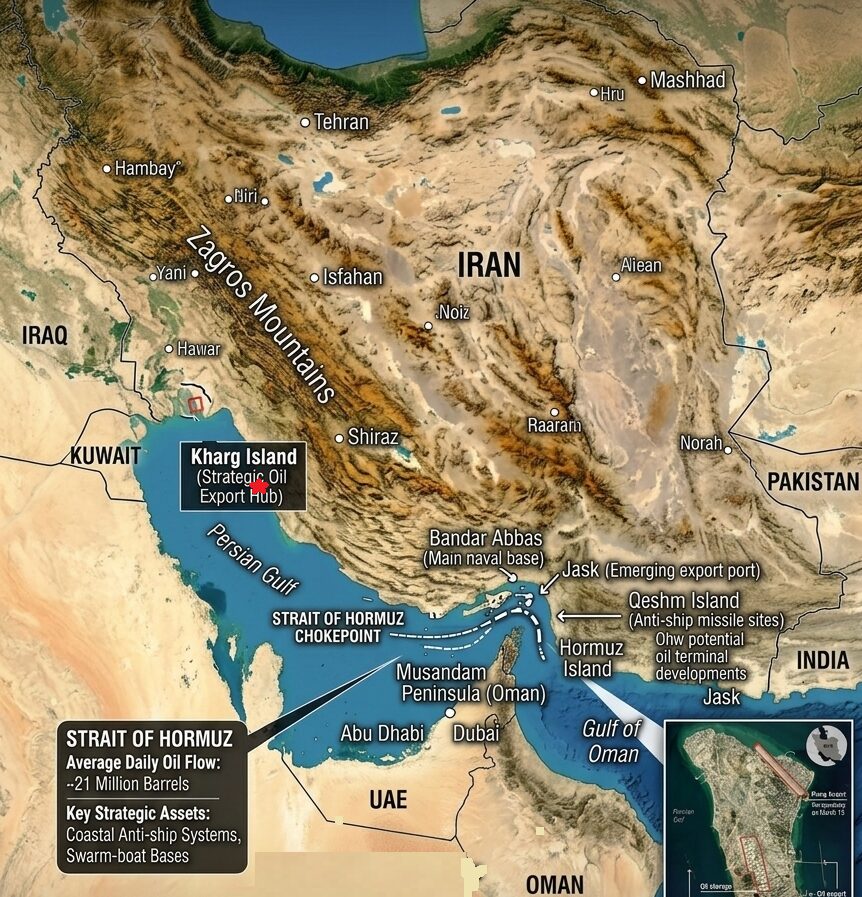
- Kharg Island is a small coral island in the Persian Gulf.
- It lies about 50 km off Iran’s mainland.
Strategic Importance
- It is Iran’s main oil export terminal.
- Around 1.5–3 million barrels/day of oil pass through it.
- Stores about 18 million barrels of oil.
Therefore, Kharg Island = Economic lifeline of Iran
Related Strategic Region: Strait of Hormuz
- Nearby lies the Strait of Hormuz.
- It handles ~20% of global oil trade.
- Kharg is NOT controlling the Strait directly.
- It is important only because of oil infrastructure, not geography.
Three Major Problems in US Plan
1. Oil Price Backfire — Seizing Kharg would immediately remove almost all of Iran’s daily crude output from world markets. Oil prices would spike sharply — and that spike would hurt American consumers and Trump’s approval far more than it would hurt the Iranian government.
2. Tehran Just Turns the Taps Off — Oil has to travel from the Iranian mainland through pipelines to reach Kharg. Iran can simply shut those valves, making the entire operation pointless. The US would occupy an island with no oil flowing through it.
3. Impossible to Hold — US troops on Kharg would be within easy range of Iranian artillery on the mainland and Iranian naval vessels in the Gulf — exactly the same problem Russia had on Snake Island.
Historical Precedent: Snake Island Case
Before Kharg, there was Snake Island in the Black Sea during the Russia-Ukraine war. Russia seized it in February 2022 thinking it gave strategic control over the western Black Sea. After relentless Ukrainian counterattacks, Russia lost soldiers, air defences, and supply ships — and quietly abandoned it by June 2022. Holding a small, exposed island close to enemy territory is a tactical nightmare. That lesson directly applies to Kharg.
Comparision Snake Island Vs Kharg Island
Snake Island genuinely helped control the western Black Sea — it had real strategic value. Kharg, by contrast, is upstream in the Persian Gulf. It does not give control over the Strait of Hormuz (the real global oil chokepoint), which lies far downstream. So Kharg’s value is limited purely to its pipeline and storage infrastructure — and Iran can neutralise that value by cutting the supply from the mainland.
| Factor | Snake Island | Kharg Island |
| Geographic Control | High (Black Sea control) | Low |
| Economic Role | Limited | Very High (oil hub) |
| Holding Feasibility | Failed | Likely difficult |
| Strategic Depth | Important | Limited |
Kharg is economically critical but militarily vulnerable.
What International Relations Issues involved?
- Violation of sovereignty of Iran
- Risk of regional war in Middle East
- Impact on global energy security
- Escalation of US-Iran tensions
Way Forward
- Diplomatic resolution between US and Iran should be prioritised.
- Strengthening global energy diversification to reduce chokepoint dependency.
- Avoid militarisation of economic infrastructure.
- Promote multilateral engagement via institutions like United Nations.
Practice Questions
Consider the following statements regarding Kharg Island:
- It directly controls maritime traffic through the Strait of Hormuz.
- It is crucial for Iran’s oil exports.
Which of the statements given above is/are correct?
A. 1 only
B. 2 only
C. Both 1 and 2
D. Neither 1 nor 2
Answer: B
Which of the following are potential consequences of a military seizure of Kharg Island?
- Increase in global oil prices
- Disruption of Iran’s oil exports
- Direct control over the Strait of Hormuz
- Escalation of regional conflict
Select the correct answer using the code below:
A. 1 and 2 only
B. 1, 2 and 4 only
C. 2 and 3 only
D. 1, 2, 3 and 4
Answer: B
Source: https://anantamias.com/current-affairs/us-threat-to-seize-kharg-island/
India must reboot neighbourhood policy – Trade is the key
Why in News?
India’s relations with neighbours like Bangladesh, Nepal, and Sri Lanka are undergoing political transitions, creating an opportunity to reset (reboot) India’s neighbourhood policy, with trade as the central tool.
UPSC Relevance:
GS-II: India’s neighbourhood policy, SAARC, South Asia geopolitics
GS-III: Regional trade, NTBs, connectivity, energy security, export-led growth vs. domestic demand
What is India’s Neighbourhood Policy?
Core Idea
- India’s approach towards immediate neighbours is called “Neighbourhood First Policy.”
Objectives
- Ensure regional stability
- Improve economic integration
- Counter external influence (especially China)
- Promote connectivity and development
Recent Challenges (Why “Reboot” is Needed)
Bangladesh Issue
- Political change after decline of Sheikh Hasina.
- Rise of Tarique Rahman.
- Shift towards “Bangladesh First” policy.
- Bangladesh’sfocus is now on unsentimental, interest-based ties rather than historical emotional baggage
Nepal Issue
- Rise of new political forces like Rastriya Swatantra Party.
- Leaders like Balendra Shah symbolize generational change.
- Demand for a relationship based on “equality” and sovereignty over “special status” rhetoric
Sri Lanka Issue
- New leadership after economic crisis.
- Moving towards pragmatic engagement with India.
Conclusion:
Entire neighbourhood is shifting from:
- Dependency → Partnership
- Emotion → Pragmatism
Problems with India’s Current Trade Policy
Despite geographical proximity, India’s trade policy has often been “self-defeating”:
- Infrastructure & Barriers: Extraordinary open-border legacies (like with Nepal) are neutralized by poor infrastructure and non-tariff barriers.
- Trade Imbalance: India criticizes its trade deficit with China but runs massive surpluses with its own smaller neighbors, refusing them the market access it demands from others.
- Dominance of Outsiders: China remains the dominant source of imports for these nations, while the West remains their primary export destination.
What Should India Do? (Key Solutions)
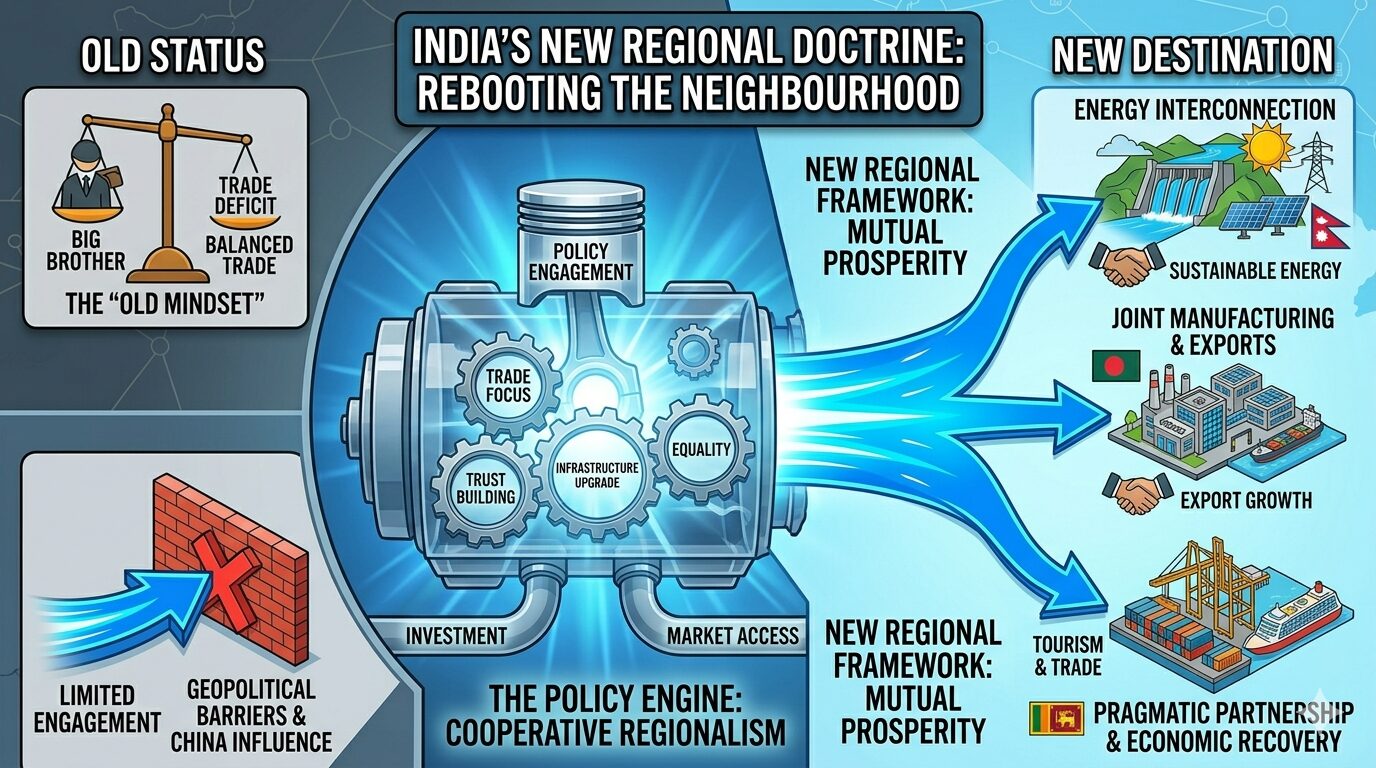
- Shift from Patronage to Partnership: Move away from the assumption that India is doing “favors.” Focus on measurable, shared economic benefits.
- Import more, not less: India should open its market to Bangladesh, Nepal, and Sri Lanka — not out of generosity, but because it’s in India’s own economic interest. More trade = more growth on both sides.
- Fix the borders: An India–Bangladesh–Nepal connectivity corridor would transform the poorest parts of the eastern Subcontinent. Roads, railways, customs — all need modernisation.
- Energy cooperation: Gulf instability is already affecting South Asia (jobs, remittances, fuel). India has begun supplying hydrocarbons to neighbours. This should become a formal cooperation framework.
- Investment + rules of origin guardrails: So Chinese goods don’t simply re-enter India via Bangladesh with a sticker change.
The Global Imperative (Why Now?)
- Fragmentation of Global Trade: The return of tariffs and sanctions globally makes export-led growth uncertain for small economies. The Indian market offers a stable, high-scale alternative.
- Gulf Turbulence: Economic stress in the Gulf impacts the South Asian diaspora and energy supply, making regional cooperation on energy security urgent.
| Feature | Old Policy Mindset | New Proposed Policy (“Reboot”) |
| Philosophy | Patronage/Generosity (“Big Brother”) | Interest-based Partnership (Equality) |
| Trade Focus | Protectionism & Trade Surpluses | Market Access & Investment Ties |
| Connectivity | Rhetorical/Strategic | Physical Infrastructure & Trade Facilitation |
| Engagement | Political Deference/Gratitude | Mutual Growth, Jobs, and Exports |
Regional Cooperation Without SAARC
- Revival of SAARC not necessary
- Focus on:
- Bilateral agreements
- Sub-regional cooperation (BBIN, etc.)
Way Forward
- Adopt reciprocal trade openness
- Build trust through visible economic gains
- Invest in border infrastructure
- Promote regional value chains
- Respect sovereignty of neighbours
Main Question Practice:
- Evaluate the shift from ‘geopolitics’ to ‘geoeconomics’ in India’s Neighborhood First policy.
- How can a trade-led approach help India mitigate the rising influence of extra-regional powers in South Asia?
Source: https://anantamias.com/current-affairs/india-must-reboot-neighbourhood-policy-trade-is-the-key/