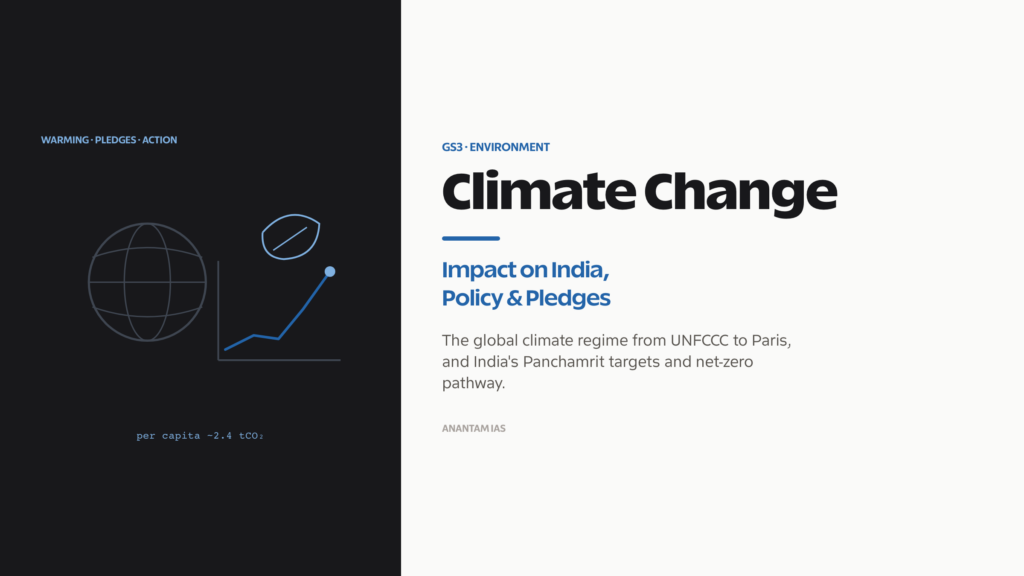
Climate Change: Impact on India & UPSC Notes
India is both a major contributor to climate change and one of its most vulnerable victims. The country’s 1.4 billion people depend on monsoons that climate models consistently predict will become more erratic. Its 7,500 km coastline is exposed to rising seas. Its mountains supply water through glaciers that are retreating. And yet India’s per capita emissions are one-third of the global average — which makes every negotiation table where India sits a study in the tension between development rights and global responsibility.
Understanding climate change for UPSC means understanding the science, the international agreements, India’s specific commitments, and the domestic policy architecture that translates pledges into action.
The Science: IPCC AR6 Key Findings
The Intergovernmental Panel on Climate Change (IPCC) released its Sixth Assessment Report (AR6) between 2021 and 2023. It is the most comprehensive scientific assessment of climate change and its implications. Key findings relevant to India:
- Global average temperature has already risen by approximately 1.1°C above pre-industrial (1850–1900) levels
- Human influence is “unequivocal” as the cause of observed warming
- At 1.5°C warming: intense heatwaves, heavier monsoon precipitation, more frequent extreme events
- At 2°C warming: significant increase in deadly heat-humidity combinations in South Asia; crop yield declines of 2–6% per decade in India
- South Asian monsoon intensification: AR6 projects a wetter but more variable monsoon — more intense rainfall events but longer dry spells between them
- Sea level rise: Global mean sea level rose 20 cm in the 20th century; projected to rise 0.3–1 m by 2100 under different scenarios; threatens coastal cities including Mumbai, Chennai, Kolkata
The Carbon Budget
The remaining carbon budget (how much CO₂ humanity can still emit while keeping warming to 1.5°C) is approximately 380–500 GtCO₂ from 2024 — which, at current emission rates (~40 GtCO₂/year), would be exhausted in roughly 10–12 years.
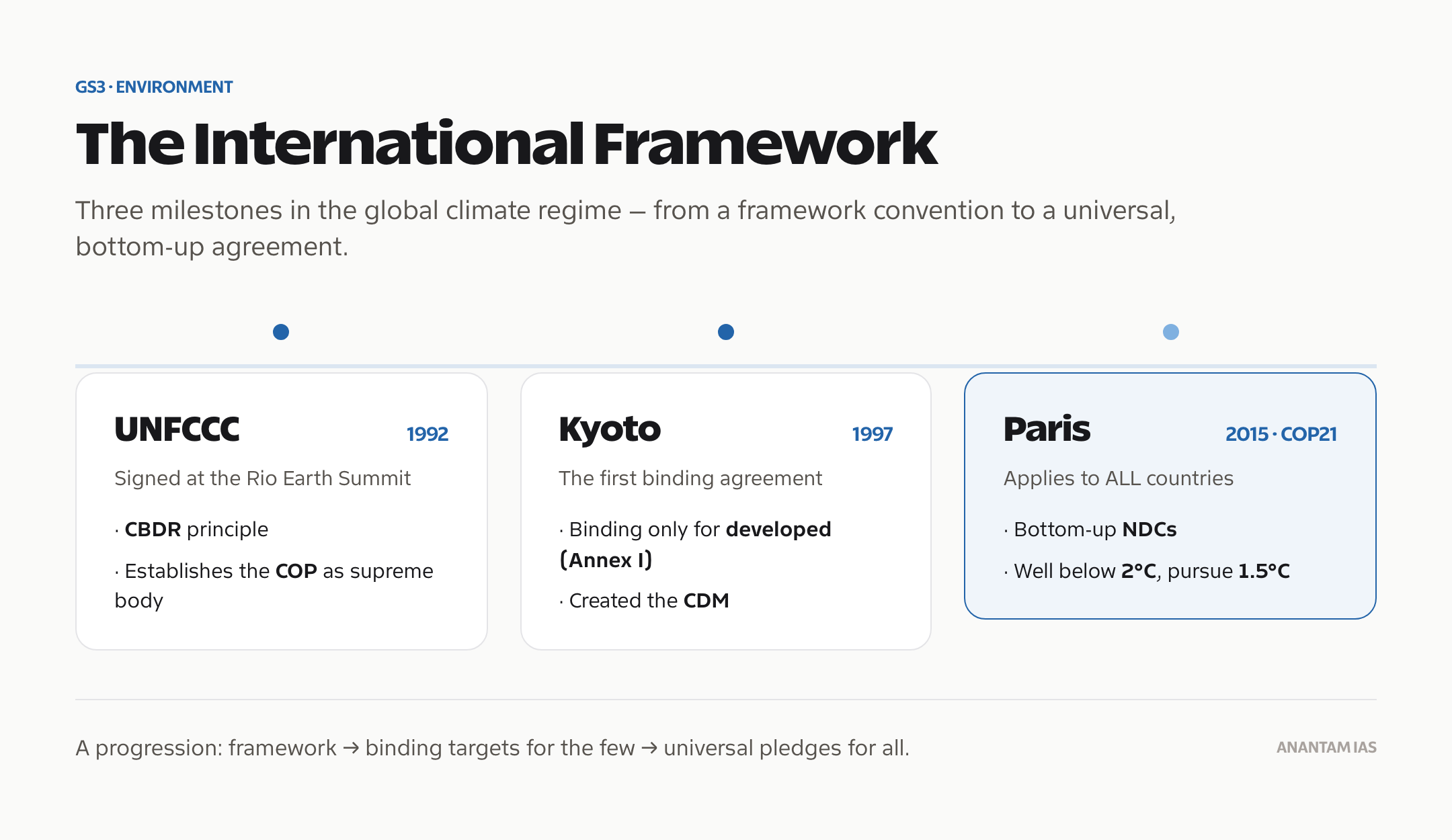
International Framework: UNFCCC and Paris Agreement
UNFCCC (1992)
The United Nations Framework Convention on Climate Change was signed at the Earth Summit in Rio de Janeiro in 1992. It entered into force in 1994. India ratified it in 1993.
Key principles of UNFCCC:
- Common but Differentiated Responsibilities (CBDR): All countries share responsibility for climate action but historical emitters (developed countries) bear greater responsibility
- Precautionary principle: Lack of full scientific certainty shouldn’t prevent action
- Sustainable development: Countries have the right to development
The UNFCCC established the COP (Conference of Parties) as its supreme body.
Kyoto Protocol (1997)
The first binding climate agreement — but only binding for developed countries (Annex I parties). It established the Clean Development Mechanism (CDM) — allowing developed countries to earn carbon credits by investing in emission-reduction projects in developing countries. India benefited significantly from CDM projects.
The USA never ratified Kyoto. Canada withdrew. It was succeeded by the Paris Agreement.
Paris Agreement (2015)
The Paris Agreement was adopted at COP21 in Paris in December 2015. Unlike Kyoto, it applies to all countries (both developed and developing) and entered into force in November 2016.
Key features:
| Element | Details |
|---|---|
| Temperature goal | Hold warming to well below 2°C; pursue 1.5°C limit |
| NDCs | Nationally Determined Contributions — each country sets its own targets (bottom-up architecture) |
| 5-year review cycle | Countries submit progressively ambitious NDCs every 5 years (ratchet mechanism) |
| Finance | Developed countries committed $100 billion/year by 2020 (NCQG to be set by COP29 for post-2025) |
| Transparency | Enhanced Transparency Framework (ETF) for reporting and review |
| Loss and Damage | Article 8 — acknowledges the need to address loss and damage from climate impacts |
The Paris Agreement’s bottom-up NDC architecture is both its strength (universal participation) and weakness (NDCs are not legally binding in terms of targets — only the process of submission is binding).
India’s NDCs (Nationally Determined Contributions)
India submitted its updated NDCs in August 2022. The key commitments:
| Commitment | Target | Status (2024) |
|---|---|---|
| Non-fossil fuel electricity capacity | 50% of installed capacity by 2030 | ~45% achieved in some months; on track |
| Emissions intensity reduction | 45% reduction in emissions intensity of GDP from 2005 levels by 2030 | ~33% achieved by 2020; on track |
| Carbon sink | Create additional carbon sink of 2.5–3 billion tonnes of CO₂ equivalent through forest cover | Partially on track |
| Net Zero | Net zero emissions by 2070 | Long-term commitment |
India’s NDCs do not include an absolute emission cap — they use intensity targets (emissions per unit of GDP), which allows emissions to grow in absolute terms as long as GDP grows faster. This reflects the development rights argument.
India’s Position in Climate Negotiations
India consistently argues:
- Per capita emissions of ~2.4 tCO₂ (compared to ~15 for USA, ~7 for China) mean India has not used its “fair share” of the atmosphere
- Historical emissions by developed countries are responsible for current atmospheric CO₂
- India needs climate finance and technology transfer from developed nations to transition
- The right to development (coal-based electricity for energy access) must be respected
- “Phasing down” (not “phasing out”) coal — India’s successful insistence at COP26 Glasgow
NAPCC: National Action Plan on Climate Change
The National Action Plan on Climate Change (NAPCC) was launched by the Indian government in 2008. It comprises eight national missions as the core of India’s domestic climate policy.
The Eight Missions
| Mission | Ministry | Key Objective |
|---|---|---|
| 1. National Solar Mission (Jawaharlal Nehru National Solar Mission) | MNRE | 100 GW solar capacity (original target); now part of 500 GW RE goal |
| 2. National Mission for Enhanced Energy Efficiency (NMEEE) | BEE/MoP | PAT (Perform Achieve Trade) scheme; energy efficiency in industry |
| 3. National Mission on Sustainable Habitat | MoHUA | Green buildings, waste management, urban planning |
| 4. National Water Mission | MoJSH | 20% improvement in water use efficiency; integrated water management |
| 5. National Mission for Sustaining the Himalayan Ecosystem | DST | Glacier monitoring, Himalayan ecology preservation |
| 6. National Mission for a “Green India” | MoEFCC | Increase forest/tree cover by 5 million ha; improve ecosystem quality |
| 7. National Mission for Sustainable Agriculture | MoA&FW | Climate-resilient farming; soil health; water use in agriculture |
| 8. National Mission on Strategic Knowledge for Climate Change | DST | Research networks, data systems, risk assessment |
PAT Scheme (Perform, Achieve and Trade)
Under Mission 2 (NMEEE), the PAT scheme is India’s market-based energy efficiency mechanism. Energy-intensive industries (steel, cement, aluminium, textiles, paper, fertiliser, power, railways) are given specific energy consumption targets. Those that overachieve earn Energy Saving Certificates (ESCerts) that can be traded with those who underachieve. It’s essentially India’s domestic carbon market for energy efficiency.
Net Zero 2070: India’s Long-Term Strategy
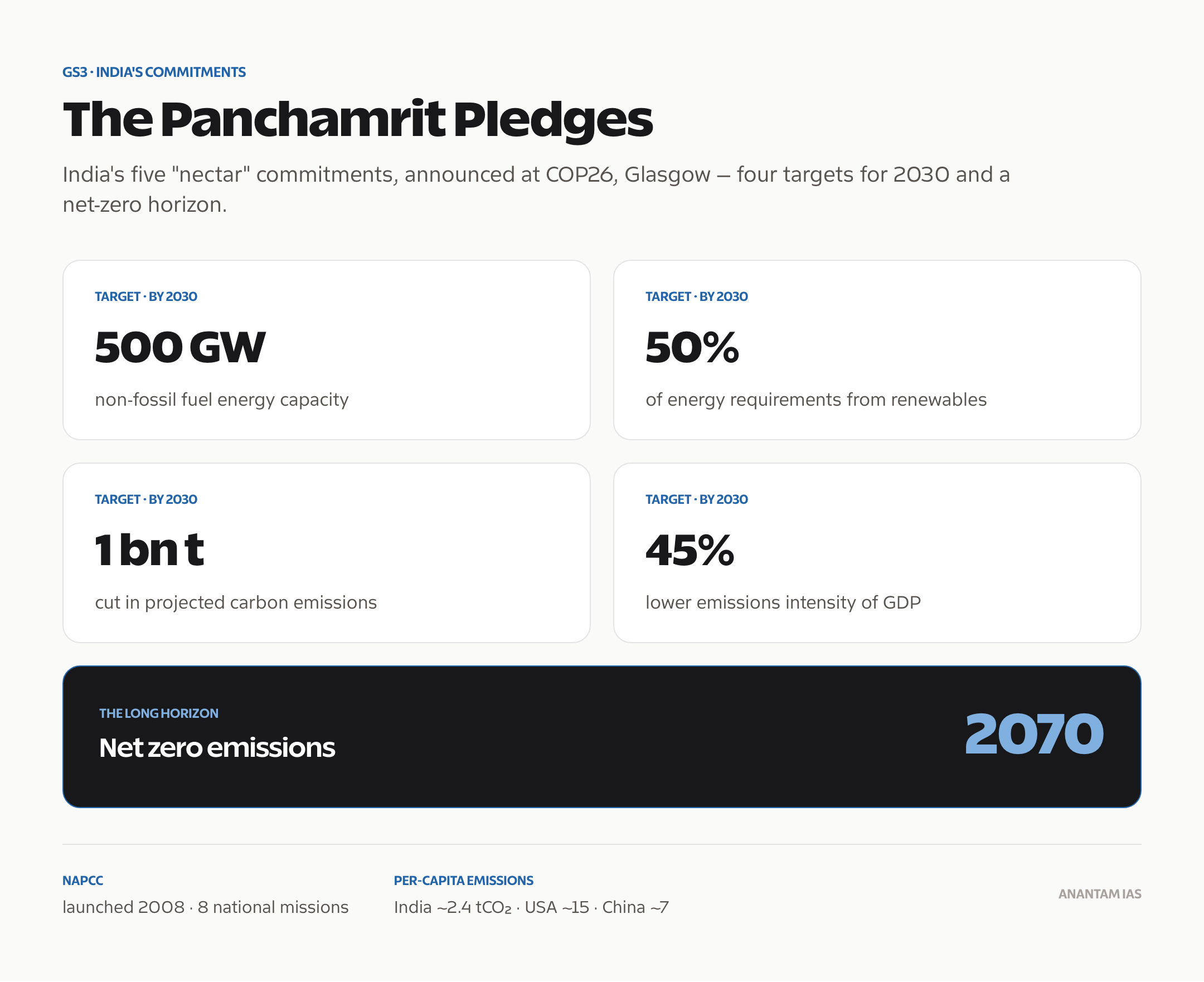
At COP26 in Glasgow (November 2021), PM Modi announced India’s Panchamrit (five nectar) commitments:
- Reach 500 GW non-fossil fuel energy capacity by 2030
- Meet 50% energy requirements from renewable energy by 2030
- Reduce total projected carbon emissions by 1 billion tonnes by 2030
- Reduce emissions intensity of GDP by 45% by 2030
- Achieve net zero emissions by 2070
India’s 2070 net zero target is later than the USA (2050), EU (2050), and China (2060). India argues this is consistent with equity — developed nations must reach net zero earlier to make space for developing nations’ growth.
India’s Long-Term Low Emissions Development Strategy (LT-LEDS)
India submitted its Long-Term Low Emissions Development Strategy to the UNFCCC in 2022. Key pathways:
- Electricity sector decarbonisation (largest single lever)
- Industry decarbonisation (steel, cement, chemicals)
- Green hydrogen for hard-to-abate sectors
- Carbon removal through forests and carbon capture technology (eventually)
- Sustainable urban development and transport
Loss and Damage Fund
Loss and Damage refers to climate impacts that cannot be adapted to — permanent loss of territory to rising seas, biodiversity loss, damage to cultural heritage, loss of life in extreme weather events.
Article 8 of the Paris Agreement acknowledged the concept but developed nations long resisted creating a dedicated fund. The breakthrough came at:
- COP27 (Sharm el-Sheikh, 2022): Parties agreed to establish a dedicated Loss and Damage Fund — a historic first
- COP28 (Dubai, 2023): The fund was officially operationalised; initial pledges of approximately $700 million were made (considered inadequate given the scale of need — climate impacts in vulnerable countries cost hundreds of billions annually)
India’s position on Loss and Damage: India is a strong advocate for the fund, arguing that developing countries bearing the costs of emissions they didn’t primarily cause is a matter of climate justice. India sits in a complex position — it is both a vulnerable developing nation and a G20 economy with growing emissions.
Carbon Credit Market
Carbon credits (or carbon offsets) are tradeable certificates representing reduction or removal of one tonne of CO₂ equivalent. They come in two forms:
Compliance Markets (Regulated)
Under the Paris Agreement’s Article 6, an international carbon market allows countries to trade “internationally transferred mitigation outcomes (ITMOs).” India can generate ITMOs from its emission reductions and trade them with other countries.
Voluntary Carbon Market
Companies and individuals voluntarily purchase offsets to claim carbon neutrality. India has been a significant seller of voluntary carbon credits — from clean cookstove projects, solar, afforestation.
Carbon Credit Trading Scheme (India)
India’s Carbon Credit Trading Scheme (CCTS) was notified in June 2023 under the Energy Conservation (Amendment) Act 2022. It creates a domestic carbon market:
- Obligated entities (large emitters) will be given emission targets
- Those who outperform can sell credits; those who underperform must buy
- The Bureau of Energy Efficiency (BEE) is the administrator
- Linked to existing PAT scheme
Climate Finance
Climate finance is money flowing from developed to developing countries to support mitigation and adaptation.
The $100 Billion Commitment
Developed countries committed to mobilise $100 billion per year for developing countries from 2020 onwards. This target was not met in 2020 (achieved around 2022, but much of it was loans, not grants). Developing countries consistently criticise the quality and delivery of climate finance.
New Collective Quantified Goal (NCQG)
At COP29 (Baku, 2024), a new climate finance goal was agreed — the NCQG replaces the $100 billion commitment from 2025 onwards. The core target is $300 billion per year from developed countries to developing countries by 2035 (a modest increase that disappointed developing nations who pushed for $1 trillion+).
Adaptation Finance
India’s climate change adaptation needs are enormous — protecting coastlines, climate-resilient agriculture, water management, disaster preparedness. India’s National Adaptation Fund for Climate Change (NAFCC) provides dedicated funds, but the scale is insufficient.
Impacts of Climate Change on India
| Sector | Projected Impact | Evidence |
|---|---|---|
| Monsoon | More variable; intense rainfall events; longer dry spells | IPCC AR6 confirms Indian monsoon intensification with higher variability |
| Agriculture | 2–6% yield decline per decade for major crops; heat stress on livestock | Rabi crop stress in late-arriving winters; erratic kharif rains |
| Water | Glacial retreat threatens water security for 500 million+ people dependent on Himalayan rivers | Gangotri, Siachen, Zemu glaciers retreating; river flows changing |
| Coasts | 7,500 km coastline; 250+ million coastal people; sea level rise threatens Mumbai, Chennai, Kolkata | Odisha and West Bengal coasts already experiencing submergence |
| Extreme Events | More intense cyclones, heatwaves, floods | Super Cyclone Amphan (2020), record heatwaves (2022), Sikkim glacier lake outburst (2023) |
| Health | Expanded malaria and dengue range; heatwave mortality; air quality decline | Rise in vector-borne diseases in previously unaffected hill areas |
| Biodiversity | Species range shifts; coral bleaching; high-altitude ecosystem disruption | Indian coral bleaching events of 2016, 2020 |
Key Climate Institutions in India
| Institution | Role |
|---|---|
| Ministry of Environment, Forest and Climate Change (MoEFCC) | Nodal ministry for climate change; submits NDCs |
| Indian Meteorological Department (IMD) | Weather forecasting, cyclone tracking, climate data |
| Indian Council of Forestry Research and Education (ICFRE) | Forest carbon sink research |
| TERI (The Energy and Resources Institute) | Research and policy advocacy |
| National Institute for Transforming India (NITI Aayog) | SDG monitoring, climate policy coordination |
| Bureau of Energy Efficiency (BEE) | PAT scheme, energy efficiency standards |
Frequently Asked Questions
Q1. What are India’s NDC commitments under the Paris Agreement?
India’s updated NDCs (submitted August 2022) commit to: achieving 50% of installed electricity capacity from non-fossil fuel sources by 2030; reducing emissions intensity of GDP by 45% from 2005 levels by 2030; creating an additional carbon sink of 2.5–3 billion tonnes of CO₂ equivalent through forest and tree cover. India also committed to net zero emissions by 2070 (announced at COP26). India uses intensity targets (not absolute caps) reflecting its development rights position.
Q2. What are the 8 missions under India’s NAPCC?
The National Action Plan on Climate Change (2008) has eight national missions: (1) National Solar Mission, (2) National Mission for Enhanced Energy Efficiency (NMEEE — includes the PAT scheme), (3) National Mission on Sustainable Habitat, (4) National Water Mission, (5) National Mission for Sustaining the Himalayan Ecosystem, (6) National Mission for a u0022Green India,u0022 (7) National Mission for Sustainable Agriculture, and (8) National Mission on Strategic Knowledge for Climate Change.
Q3. What is the Loss and Damage Fund and what was agreed at COP27?
Loss and Damage refers to climate impacts that cannot be adapted to — permanent loss of territory, biodiversity, cultural heritage, and human lives due to climate change. At COP27 (Sharm el-Sheikh, 2022), countries agreed for the first time to establish a dedicated Loss and Damage Fund for vulnerable developing nations. At COP28 (Dubai, 2023), the fund was operationalised with initial pledges of ~$700 million — widely considered insufficient. India supports the fund as a matter of climate justice, arguing that vulnerable nations shouldn’t bear costs for emissions primarily caused by developed nations.
Q4. What does IPCC AR6 say about India’s climate vulnerability?
IPCC AR6 (2021–2023) finds that South Asia, including India, faces severe climate risks. Key projections for India: more intense but variable monsoon rainfall (heavier events, longer dry spells); deadly heat-humidity combinations becoming more frequent and severe; crop yield declines of 2–6% per decade; glacial retreat in the Himalayas threatening water security for hundreds of millions; sea level rise threatening coastal megacities (Mumbai, Chennai, Kolkata); and expanded range of vector-borne diseases. At 2°C warming, human habitability of parts of South Asia becomes a serious concern.
Q5. What is India’s net zero target and why is it 2070?
India committed to net zero emissions by 2070 at COP26 Glasgow in November 2021. The 2070 date is later than developed nations (USA, EU: 2050; China: 2060) because India argues for equity: its current per capita emissions (~2.4 tCO₂) are far below developed nations (~15 for USA), its contribution to historical atmospheric CO₂ is minimal, and it still needs economic growth to lift hundreds of millions out of poverty. India’s position is that developed nations must decarbonise faster to create u0022carbon spaceu0022 for developing nations’ legitimate development needs.
Tell Google you want more of this.
Add Anantam IAS as a preferred sourceOne tap, and this site shows up more often in your own Top Stories, AI Overviews and AI Mode. Remove it any time.