Daily Digest
UPSC · Civil Services Examination
Current Affairs · Thursday, 11 December 2025
Current affairs curated and edited by Anantam IAS faculty — pulled from The Hindu, PIB, IDSA, Foreign Affairs and the ministries. Read, annotate, revise.
Old Rajinder Nagar · Delhi 110005 · anantamias.com
Macaulay legacy in India
Context:
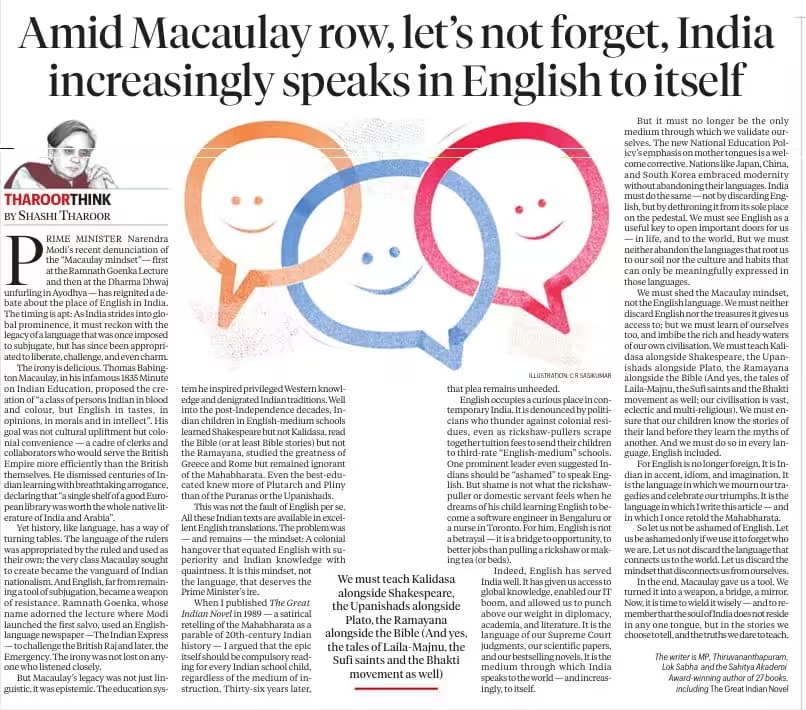
M Modi’s recent criticism of the “Macaulay mindset” and colonial hangover. Shashi Tharoor argues that English is no longer just a colonial legacy, but an Indian language that India now “speaks to itself.” The debate is connected to nationalism, education reforms (NEP), decolonisation, and linguistic identity.
Macaulay Mindset:
- Advocated creating a class of Indians “English in tastes, opinions, morals, and intellect.”
- Promoted English and dismissed Indian knowledge systems.
- Aimed to create intermediaries for the British administration.
- PM Modi’s argument:
- India must reject colonial mental chains and restore civilizational confidence.
- Tharoor’s counter-point:
- India has already appropriated English; it is no longer a foreign tool of domination.
THAROOR’S CENTRAL ARGUMENTS:
- Irony in attacking Macaulay now:
- English was meant to be an elitist tool.
- Macaulay did not envision English becoming a mass language in India.
- But Indians democratised it: rickshaw-pullers, migrant workers, domestic workers, and lower-middle class parents demand English education for upward mobility.
- India increasingly uses English for self-communication:
- India no longer uses English just to talk to the world, but also to itself.
- English is the language of:
- courts and contracts
- science and technology
- business
- higher education
- competitive exams
- media
- internal policy discourse
- English is now an Indian language, not a colonial imposition
- Nations like China, Japan, South Korea retained cultural confidence while embracing modernity.
- India’s problem was not English but the pedestal English was placed on.
- NEP rightly wants Indian languages to flourish but without discarding English.
- English enables access to global knowledge:
- Indian students would be handicapped without English access to science, philosophy, literature.
- English allows India to “unlock important doors” domestically and globally.
➡️ Teach Kalidasa + Shakespeare,
➡️ Ramayana + Bible,
➡️ Upanishads + Plato,
➡️ Laila-Majnu + Sufi thinkers + Bhakti movement.
Balanced civilizational education, not cultural isolation.
Reality:
- India’s economy needs English.
- India’s global ambition needs English.
- Students and parents WANT English.
Thus, anti-English speeches do not match societal aspirations.
Solution:
- Adopt multilingualism, not English abolition
- Keep English + strengthen Indian languages
- Increase mother-tongue education WITHOUT reducing English exposure
- NEP’s direction is correct but must be implemented realistically.
- Cultural confidence must be rooted in knowledge of:
- Indian texts
- Indian philosophies
- Western and global knowledge too
- Use English as a tool, not a marker of superiority
- Dethrone English from privilege, not from usefulness.
For Reference:
Source: https://anantamias.com/current-affairs/macaulay-legacy-in-india/
Deepavali on UNESCO Intangible Cultural Heritage List

Context:
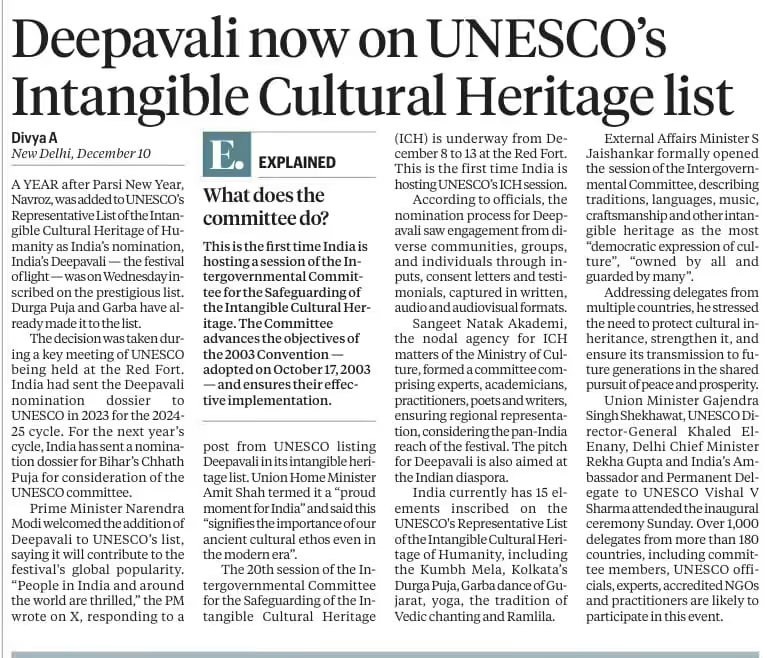
Deepavali (Diwali), India’s major festival of lights, has been added to UNESCO’s Representative List of the Intangible Cultural Heritage of Humanity. This comes a year after Parsi New Year Navroz was added. Other Indian elements already on the list include Durga Puja, Garba, Kumbh Mela, Ramlila, Vedic chanting, etc.
UPSC Relevance:
UPSC PYQ:
Q. Which one of the following was the latest inclusion in the Intangible Cultural Heritage List of UNESCO?
[A] Chhau dance
[B] Durga puja.
[C] Garba dance
[D] Kumbh mela
About:
Decision at UNESCO Meeting:
- Decision taken during UNESCO’s ICH Committee session, being hosted by India for the first time, in Delhi’s Red Fort.
India’s Nomination Process:
- India submitted the Deepavali dossier in 2023 for 2024–25 cycle.
- For next year, India has nominated Bihar’s Chhath Puja for consideration.
Sangeet Natak Akademi (nodal agency for ICH in India) coordinated the nomination.
UNESCO’s Intangible Cultural Heritage:
- According to UNESCO’s 2003 Convention for the Safeguarding of the Intangible Cultural Heritage, ICH is manifested into five broad domains:
- Oral traditions and expressions, including language as a vehicle of the intangible cultural heritage.
- Performing arts
- Social practices, rituals and festive events
- Knowledge and practices concerning nature and the universe
- Traditional craftsmanship
ICH list India:
| S.No. | Intangible Cultural Heritage Element | Year of Inscription |
| 1. | Kutiyattam, Sanskrit Theater | 2008 |
| 2. | Tradition of Vedic Chanting | 2008 |
| 3. | Ramlila, the Traditional Performance of the Ramayana | 2008 |
| 4. | Ramman, Religious Festival and Ritual Theatre of the Garhwal Himalayas, India | 2009 |
| 5. | Chhau Dance | 2010 |
| 6. | Kalbelia Folk Songs and Dances of Rajasthan | 2010 |
| 7. | Mudiyettu, Ritual Theatre and Dance Drama of Kerala | 2010 |
| 8. | Buddhist Chanting of Ladakh: Recitation of Sacred Buddhist Texts in the Trans-Himalayan Ladakh region, Jammu and Kashmir, India | 2012 |
| 9. | Sankirtana, ritual singing, drumming and dancing of Manipur | 2013 |
| 10. | Traditional Brass and Copper Craft of Utensil Making among the Thatheras of Jandiala Guru, Punjab, India | 2014 |
| 11. | Nowruz | 2016 |
| 12. | Yoga | 2016 |
| 13. | Kumbh Mela | 2017 |
| 14. | Durga Puja in Kolkata | 2021 |
| 15. | Garba of Gujarat | 2023 |

Source: https://anantamias.com/current-affairs/deepavali-on-unesco-intangible-cultural-heritage-list/