Context:
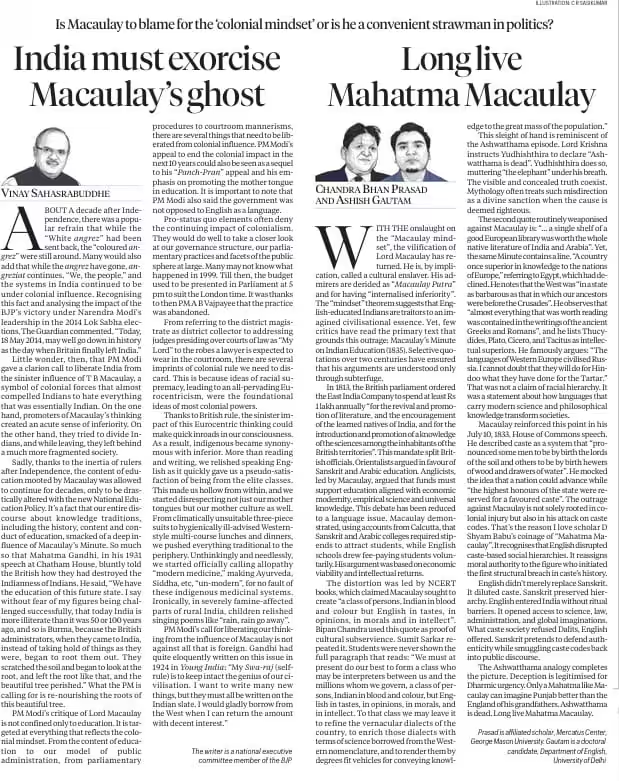
- One article — “India must exorcise Macaulay’s ghost” — argues that Macaulay’s influence still shapes Indian culture and education.
- The other — “Long Live Mahatma Macaulay” — counters that Macaulay is unfairly blamed and in fact played a role in expanding modern, liberal education.
UPSC Relevance:
Modern Indian History, Governance & Education, Social Justice and Ethics
UPSC PYQ:
Q. With reference to Lord Macaulay’s Minute on Education (1835), consider the following statements:
1.It advocated the use of English as the medium of instruction for teaching Western sciences and literature in India.
2.It led to the establishment of a large number of elementary schools to promote mass education.
3.It introduced the idea of educating a small elite class to act as a bridge between the British administration and Indian society.
Which of the above statements is/are correct?
[A] 1 and 2 only
[B] 1 and 3 only
[C] 2 and 3 only
[D] 1, 2 and 3
About Lord Macaulay:
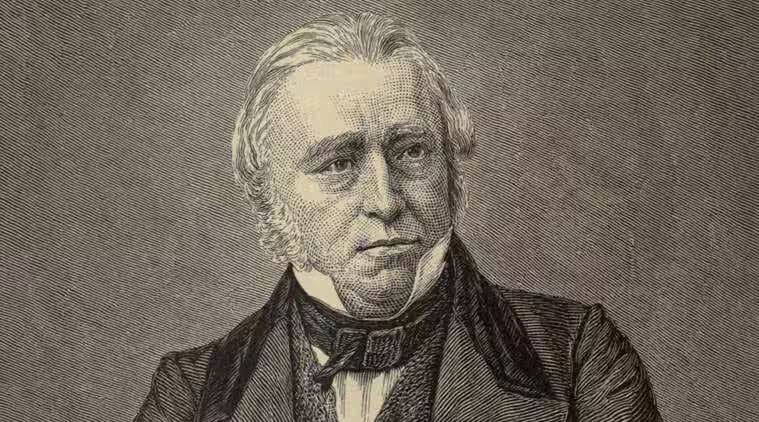
- William Babington Macaulay was a British Whig politician and historian who lived from 25 October 1800 to 28 December 1859. He is credited as being the main architect of India’s shift to a Western-style educational system.
- A single shelf of a decent European library was worth the entirety of the native literature of India and Arabia, according to Macaulay, who stated this in his February 1835 Minute on Indian Education.
- Lord Macaulay put forth the Downward Filtration Theory in his renowned Macaulay’s Minutes of 1835, which were delivered to the then Governor General of British India. The difficulty British India encountered implementing the new educational system was addressed by the downward filtration theory. It implied that the solution lay in educating a select number of people who would subsequently inform the larger populace. The individual who will disseminate the knowledge to the general public would be provided it in this way.
The 1835 Macaulay Minute:
- Indian languages such as Sanskrit, Arabic, Persian, Hindi, Tamil, and Telugu were deemed useless.
- English was presented as the only medium for “high knowledge.”
- Government funds were proposed to be spent exclusively on English education.
- Indian literature, philosophy, medicine, mathematics, and sciences were depicted as inferior to Western knowledge.
- A “mediating class” was envisioned: “Indian in blood and colour, but English in tastes, opinions, morals and intellect.”
Arguments claiming Macaulay’s negative legacy continues?
- British left behind a psychological hierarchy: Western over Indian.
- English-medium education privileged the “brown sahib”; Indian languages sidelined.
Persistence of colonial hangover:
- The “white approval syndrome”
- Obsession with English speech & mannerisms
- Bureaucratic red tape built on colonial practices
Arguments defending or reinterpreting Macaulay?
- Critics often misquote or selectively quote Macaulay’s Minute.
- Macaulay advocated liberal, modern education:
- Science, mathematics, analytical thinking.
- Sanskrit and Persian systems were exclusionary and accessible only to upper castes; Macaulay believed English would democratize learning.
- Macaulay’s views have been simplified for ideological battles rather than examined historically.
Reforms after independence?
critical of continuing colonial influence:
- Post-1947, India’s education system remained English-heavy.
- PM Modi’s BHASHA initiative & NEP attempt to promote Indian languages.
Colonial legacy continues through:
- Classroom: exam-centric rote learning
- Judiciary: language & dress codes
- Administration: hierarchical attitudes
Positive reinterpretation:
Macaulay introduced:
- Modern sciences
- Constitutional principles
- Secular liberal values
Education in English enabled:
- Pan-Indian communication
- Access to modern global ideas
- Social mobility for lower castes
Caste Dimension?
- Pre-colonial education was dominated by upper castes.
- Access to knowledge in Sanskrit was limited.
- English education opened gates for:
- Dalits
- Backward castes
- Social reformers (Ambedkar, Phule, etc.)
- Macaulay’s framework ironically assisted democratization of learning.
Contemporary Policy:
1. NEP 2020
- Revival of Indian languages.
- Reducing English dominance.
- Promotion of mother-tongue education.
2. Judiciary Reforms
- Language of courts still English.
- Colonial etiquette persists.
3. Administrative Reforms
- Reducing colonial legacy in governance.
- Citizen-centric vs. bureaucratic-centric administration.
4. Culture Wars
- Contestations over historical narratives and decolonisation.
- Identity politics over “authentic Indian tradition.”
Practice Question:
Q: Analyse how the colonial education system reshaped Indian society’s class and caste hierarchies.
Tell Google you want more of this.
Add Anantam IAS as a preferred sourceOne tap, and this site shows up more often in your own Top Stories, AI Overviews and AI Mode. Remove it any time.