Daily Digest
UPSC · Civil Services Examination
Current Affairs · Friday, 11 September 2026
Current affairs curated and edited by Anantam IAS faculty — pulled from The Hindu, PIB, IDSA, Foreign Affairs and the ministries. Read, annotate, revise.
Old Rajinder Nagar · Delhi 110005 · anantamias.com
E-Commerce Rules 2026: Prior Prices, Dark Patterns and Consumer Redress
Why in News?
On 10 September 2026, the Department of Consumer Affairs announced the E-Commerce Rules 2026 amendments, which commence on 1 January 2027.
- The prior price for an announced reduction will mean the lowest offer price during the preceding 30 days.
- Entities must join National Consumer Helpline convergence and give complainants a copy of the complaint recorded by the grievance officer.
- Sponsored listings require prominent identification; entities must undertake a yearly dark-pattern self-audit and prominently display a compliance certificate.
- The changes also address marketplace disclosures, specified uses of consumer information and unrelated bundled fees.
- Information asymmetry increases when platforms control the displayed reference price, search order and complaint record simultaneously.
- The policy question is whether verifiable disclosures and usable remedies can make digital choice meaningful without unnecessarily burdening legitimate commerce.
UPSC Relevance
Prelims Relevance
- The amended rules commence on 1 January 2027; announcement does not mean immediate operation.
- The prior price is the lowest offer price in the preceding 30 days, not simply the immediately previous price.
- Sponsored listings must be clearly and prominently identified.
- Dark-pattern compliance combines a yearly self-audit with prominent certificate display.
- National Consumer Helpline convergence connects entities to the national grievance mechanism.
Mains Relevance
GS Paper 2
- Consumer governance: complaint records, platform accountability and implementation of delegated rules.
GS Paper 3
- Digital markets: information asymmetry, fair price comparisons and transparent commercial influence.
Essay
- Meaningful choice depends on how options are presented, not merely on how many options exist.
Background and Context
Prior price: making a discount claim testable
A discount is informative only when its comparison price reflects a genuine recent offer rather than an inflated reference.
- When announcing a price reduction, an entity must display both the reduced price and the prior price. The rule addresses the comparison presented to shoppers, rather than fixing the selling price itself.
- The prior-price benchmark looks back over the preceding 30 days and selects the lowest price at which the goods or services were offered. A higher intervening price cannot replace that minimum.
- A temporary price increase immediately before a sale would not, by itself, establish the required reference price. This limits the scope for making a modest reduction appear much larger through selective comparison.
- The exam distinction is between price transparency and price control: displaying a historically grounded comparator helps consumers assess an offer, while the release does not announce a government ceiling on selling prices.
Search and dark patterns: protecting the choice process
The amendment addresses what users see before purchase, including whether commercial influence is visible and search results remain relevant.
- Search-result manipulation is prohibited when it misleads users or adversely affects relevance to their query. Read that qualification carefully: the release does not prohibit every ranking method or require identical ordering across platforms.
- Sponsored listings need clear, prominent identification so users can recognise commercial promotion. Disclosure addresses how placement is presented; it does not establish that every advertised product is unsuitable or every unsponsored result superior.
- Entities must comply with the dark-pattern guidelines, conduct a yearly self-audit and prominently display a compliance certificate. These requirements connect interface design to an ongoing compliance process, rather than a general promise of fairness.
- For analysis, self-audit creates an internal review obligation but should not be confused with independent verification of every screen. Effective implementation depends on whether actual purchase and cancellation journeys match the displayed compliance claim.
Complaint records: connecting platforms with consumer redress
A complaint system works better when the consumer and the business can refer to the same recorded grievance.
- Every e-commerce entity must become a partner in the National Consumer Helpline convergence process. The announced change links platforms with the national grievance mechanism; membership alone should not be treated as proof of satisfactory resolution.
- The complainant must receive a copy of the complaint recorded by the grievance officer. This lets the consumer check whether the actual problem was captured, especially when support staff summarise a longer account.
- A preserved record can help identify mismatches between the complaint submitted and the response received. This is an accountability benefit of documentation, not a claim that the amendment guarantees compensation whenever a complaint is filed.
- The related restaurant service-charge case illustrates the importance of transaction evidence. For digital markets, the useful connection is documentary accountability; this amendment concerns platform conduct rather than restaurant billing rules.
Consent and marketplace information: reading the qualifications
The additional marketplace duties concern informed purchasing, while the release leaves some operational scope to the detailed legal text.
- Marketplace disclosures include best-before or use-before dates and return, refund, warranty, delivery and payment information. These details let consumers assess practical conditions of purchase instead of relying only on promotional descriptions and price.
- Consumer information cannot be used for specified purposes without express and affirmative consent. The release does not enumerate those purposes, so it cannot support a categorical claim that all consumer-data use is prohibited.
- Unrelated bundled fees are restricted, subject to the specified loyalty or membership-programme exception. Imported goods require importer details and country of origin; neither provision should be expanded into an unsupported blanket ban on such programmes.
- The AI agents and consumer-control explainer offers a connected question: whether permission matches the action performed. Here, retain the amendment’s specific consent qualification rather than importing broader claims from another regulatory discussion.
Way Forward
Make compliance visible in actual transactions
- Platforms should retain auditable price histories and make sponsored labels readable on mobile screens, not only in detailed terms.
- Grievance teams should provide accurate complaint copies and connect recurring complaints with corrections to product pages, checkout flows and support processes.
- Implementation guidance should clarify specified consent purposes and the membership exception, while explaining the distinction between announcement and commencement.
Conclusion
- E-Commerce Rules 2026 connect price comparisons, search presentation and grievance records through a common principle: consumers should be able to verify the information shaping their purchase decisions.
- In an answer, distinguish announced obligations from demonstrated outcomes. The commencement date is future, and the value of self-audits and disclosures depends on how consistently they operate in actual consumer journeys.
UPSC Practice Questions
Prelims MCQ 1
With reference to the E-Commerce Rules 2026 amendments, consider the following statements:
- They commence on 1 January 2027.
- Prior price means the highest offer price during the preceding 30 days.
- Sponsored listings must be clearly and prominently identified.
How many of the above statements are correct?
(a) Only one (b) Only two (c) All three (d) None
Answer: (b) Only two
Explanation:
Statements 1 and 3 are correct. Prior price means the lowest price at which the goods or services were offered during the preceding 30 days.
Prelims MCQ 2
What is the central purpose of requiring both the reduced price and the prior price to be displayed?
(a) To establish a government ceiling for online prices (b) To prohibit all sponsored product listings (c) To make the claimed price reduction assessable against a recent benchmark (d) To guarantee compensation for every complaint
Answer: (c) To make the claimed price reduction assessable against a recent benchmark
Explanation:
The prior-price requirement makes the discount comparison more transparent. It is not an announced selling-price ceiling or a guarantee of compensation.
UPSC Mains Questions
- How can price-history disclosure and sponsored-listing transparency reduce information asymmetry in digital markets? Discuss with reference to the E-Commerce Rules 2026 amendments.
- Assess the potential and limitations of yearly self-audits and complaint-record requirements in strengthening platform accountability.
Source: PIB, Ministry of Consumer Affairs, Food and Public Distribution.
Frequently Asked Questions
When do the E-Commerce Rules 2026 amendments take effect?
The official announcement was issued on 10 September 2026, but the amended rules commence on 1 January 2027. The announcement date should not be mistaken for the start of the new obligations.
What does prior price mean?
For an announced price reduction, prior price means the lowest price at which the goods or services were offered during the preceding 30 days. Both the reduced price and this benchmark must be displayed.
Are sponsored listings banned?
No. The release requires sponsored listings to be clearly and prominently identified. It separately prohibits search manipulation that misleads users or adversely affects relevance to their query, rather than banning every ranking method.
Does the amendment ban all uses of consumer information?
The release describes express and affirmative consent for specified purposes. It does not enumerate those purposes, so its summary cannot establish a blanket ban on every use of consumer information.
Source: https://anantamias.com/current-affairs/ecommerce-amendment-prior-price-dark-patterns/
ASUSE District Estimates: Mapping the Unincorporated Economy
Why in News?
On 10 September 2026, NSO released its first district-level report on the unincorporated non-agricultural sector, presenting ASUSE district estimates drawn from the 2025 survey.
- The report presents estimates for 757 of 770 sampling-frame districts, rather than every district in the current administrative map.
- The indicators cover establishments, employment and economic performance, including women’s participation, registration status and productivity measures.
- District figures include the million-plus cities within those districts; adding city and district totals would double-count their overlapping activity.
- State averages can conceal local enterprise concentrations and differences in the kinds of work available. District evidence can help identify where closer investigation is needed.
- Sampling uncertainty limits how confidently neighbouring estimates can be compared. A detailed table does not automatically justify a precise policy ranking.
UPSC Relevance
Prelims Relevance
- ASUSE: Annual Survey of Unincorporated Sector Enterprises.
- NSO: National Statistics Office under MoSPI.
- Coverage: Unincorporated manufacturing, trade and other services, excluding construction.
- RSE: Relative Standard Error, expressing sampling uncertainty relative to an estimate.
- GVA per worker: A productivity measure, distinct from emoluments per hired worker.
Mains Relevance
GS Paper 3
- Local enterprise development informed by district-level economic evidence.
- Employment quality and the limits of aggregate productivity comparisons.
GS Paper 2
- Evidence-based planning that makes statistical uncertainty visible.
Essay
- What gets measured becomes actionable only when its limits are understood.
Background and Context
What the unincorporated sector includes
A small tailoring workshop makes the survey’s subject concrete, but size alone does not determine whether an enterprise belongs within its scope.
- ASUSE studies unincorporated non-agricultural establishments in manufacturing, trade and other services. Construction is excluded, so the findings cannot describe every enterprise or every form of non-farm employment in a district.
- Ownership coverage includes proprietorships, partnerships other than limited liability partnerships, and specified bodies such as cooperatives, societies and trusts. An incorporated company does not become unincorporated merely because it employs few people.
- Consider a hypothetical proprietor-run tailoring workshop: its production, workers and purchased inputs help describe enterprise activity. The example explains the survey unit; it does not identify a particular establishment actually surveyed.
- Unincorporated does not automatically mean unregistered. Registration status is itself an indicator in the report, so users should avoid treating every covered establishment as invisible to all government registration systems.
- The enterprise perspective complements the household employment perspective discussed in our PLFS explainer. The surveys answer different questions, and their worker counts should not be casually substituted for one another.

How a sample becomes a district estimate
Survey estimates describe a wider population through a designed sample; they are not a complete administrative list of every business.
- Multi-stage stratified sampling selects local areas and then establishments within them. Listing businesses in selected areas allows the survey to reach activity beyond enterprises already present in a particular registration database.
- District geography follows the frame used when the sample was selected. Later boundary changes, renamed districts or newly created districts can prevent a direct match with today’s administrative map.
- Delhi illustrates a design constraint: its districts were combined into a single stratum separately for rural and urban sampling. The report could not generate separate district estimates for the territory.
- Chandigarh and Lakshadweep each have one district, whose estimates coincide with the previously published union-territory estimates. Their absence as separate district entries must not be interpreted as an absence of enterprise activity.
Productivity is not a worker’s pay packet
The same establishment can generate several useful indicators, but each indicator has a different denominator and answers a different economic question.
- Gross Value Added measures production value after deducting intermediate consumption. For a tailoring enterprise, purchased production inputs matter when distinguishing the value created by the workshop from the value of its sales.
- GVA per worker relates value added to workers and serves as a productivity indicator. It is not the amount each worker receives, because value added is not distributed entirely as employee wages.
- Emoluments per hired worker address hired labour remuneration more directly. Mixing that measure with GVA per worker confuses compensation with production and can misrepresent whether workers share in an enterprise’s performance.
- Industrial composition can shape district averages: unlike mixes of manufacturing, trade and services need not generate identical productivity. A higher average alone does not establish better policy, higher wages or more secure jobs.
Read uncertainty before making local policy
Statistical reliability determines how confidently a district estimate can inform comparisons and local allocation decisions.
- Relative Standard Error scales the standard error against the estimate. A higher RSE signals greater sampling uncertainty relative to the reported value, weakening confidence in fine distinctions between district results.
- The official caveat explicitly identifies high RSEs in some cases. Small differences should trigger examination of reliability and context, rather than an immediate claim that one district decisively outperforms another.
- Comparability also requires consistent definitions and geography, as our administrative-data explainer discusses. Combining survey results with local records can inform investigation, but differences in coverage must remain visible.
Way Forward
Use estimates to diagnose local constraints
- Publish interpretation aids alongside district indicators, showing coverage, geography and reliability before users compare outcomes or allocate resources.
- Investigate plausible constraints through local consultation and complementary evidence before prescribing credit, training or infrastructure interventions from an aggregate estimate.
- Assess worker outcomes separately: combine productivity analysis with remuneration and employment structure instead of assuming that higher value added proves better livelihoods.
Conclusion
- ASUSE district estimates provide a valuable local enterprise lens, provided users keep coverage, sampling reliability and administrative geography attached to the figures.
- For an answer on inclusive local development, connect evidence to diagnosis and intervention, while separating productivity from pay and statistical differences from proven policy success.
UPSC Practice Questions
Prelims MCQ 1
With reference to ASUSE district estimates, consider the following statements:
- The survey covers construction establishments.
- GVA per worker is identical to average wages per hired worker.
- District geography may differ from the current administrative configuration.
How many of the above statements are correct?
(a) Only one (b) Only two (c) All three (d) None
Answer: (a) Only one
Explanation:
Only statement three is correct. Construction is excluded, and GVA per worker measures productivity rather than hired-worker wages.
Prelims MCQ 2
A district estimate has a high Relative Standard Error. Which interpretation is most appropriate?
(a) Every establishment was enumerated (b) Sampling uncertainty is relatively large (c) District wages must be high (d) The estimate measures only registered firms
Answer: (b) Sampling uncertainty is relatively large
Explanation:
RSE expresses sampling uncertainty relative to the estimate. A high value calls for caution when drawing fine comparisons.
UPSC Mains Questions
- Explain how ASUSE district estimates can support local enterprise policy. What statistical limitations must administrators recognise? (150 words)
- Higher GVA per worker does not necessarily mean better livelihoods for hired workers. Discuss with reference to enterprise statistics. (250 words)
Source: PIB, Ministry of Statistics and Programme Implementation.
Frequently Asked Questions
What are ASUSE district estimates?
They are district-level statistical estimates of unincorporated non-agricultural enterprise activity derived from ASUSE 2025. The report covers establishments, workers and economic performance, with reliability caveats for interpreting local differences.
Does ASUSE cover construction?
No. Its sectoral scope covers unincorporated manufacturing, trade and other services, excluding construction. Users should not present these findings as a complete account of all non-agricultural businesses or employment.
Is GVA per worker the same as wages?
No. GVA per worker indicates value added relative to workers. Emoluments per hired worker relate more directly to remuneration. Productivity and pay differ because value added is not entirely employee compensation.
Why do district boundaries matter?
The survey uses the district configuration in its sampling frame. Subsequent boundary changes, renaming or new districts can break direct comparisons with current administrative records unless users first reconcile the geography.
Source: https://anantamias.com/current-affairs/asuse-district-estimates-unincorporated-sector/
Proposed Seeds Law: Traceability, Farmer Rights and Compensation
Why in News?
On 10 September 2026, the Agriculture Ministry consulted farmer organisations on a proposed seeds law covering traceability, farmer protections and compensation.
- The proposed seeds law remains under consultation; the government has fixed no deadline for finalising it.
- The minister said around 70% of seeds fall outside the existing law; this is an attributed assessment, not a new survey finding.
- The proposal connects registration and packet-level QR codes with identifying responsibility for fake or substandard seeds.
- A state Seed Security Fund and compensation within 15 days are proposed; these are not newly operative entitlements.
- Seed quality affects the start of the crop cycle, making timely identification of a defective supply more useful than an unexplained promise of stricter punishment.
- Accountability and farmer seed autonomy must be designed together: commercial supply-chain oversight should not erase the exemptions described for traditional seed practices.
UPSC Relevance
Prelims Relevance
- Seeds Act, 1966: the existing legislation identified in the consultation.
- QR traceability: proposed access to origin, manufacturer, laboratory clearance and supply-chain information.
- Traditional seeds: mandatory registration exemption described by the minister.
- State committees: proposed recommendations for releasing locally suitable varieties, subject to national standards.
- Seed Security Fund: proposed state-managed mechanism receiving penalties and recoveries.
Mains Relevance
GS Paper 3
- Agricultural inputs: quality assurance, counterfeit seeds and farmer risk.
- Seed systems: balancing commercial accountability with traditional farmer practices.
GS Paper 2
- Regulatory design: Centre-state coordination and accessible compensation mechanisms.
Essay
- Trust in markets depends on enforceable responsibility as much as information.
Background and Context
Seed quality: identifying the problem before fixing liability
Seed regulation must connect the input a farmer buys with evidence about its quality and the actors responsible for supplying it.
- Fake seeds and substandard seeds raise different concerns: misleading identity and inadequate quality. Enforcement must establish what went wrong, rather than treating every complaint as identical.
- Laboratory clearance is among the records the proposal would make traceable. Linking that record to the supplied seed helps investigators examine the quality claim instead of relying only on packaging.
- Seed failure should trigger evidence gathering, not an automatic assumption about culpability. The proposal describes a verification committee, making the quality of investigation central to the credibility of compensation.
- Registration identifies regulated seed offerings; it does not itself explain why a particular crop failed. For analysis, separate the administrative record from the evidence needed to determine responsibility in a complaint.
- Deterrence requires a credible prospect of detection. The proposed distinction between minor violations, deliberate violations and serious fraud makes proportional enforcement a separate design question from the size of penalties.

How proposed traceability would connect a packet to responsibility
The useful mechanism is a connected evidence trail, not the QR symbol alone.
- The proposal describes a national register for seeds and planting material entering the regulated market. Read this commercial registration architecture alongside the expressly stated exemptions for traditional seeds and farmer activities.
- A packet QR code would provide access to origin, manufacturer, laboratory clearance and supply-chain movement. These are complementary records: an identity record and a testing record answer different questions.
- Traceability lets an inquiry work backwards from the supplied packet through recorded actors. Its purpose is to help identify responsibility when seeds fail, rather than leaving the farmer without a verifiable trail.
- Data integrity remains essential: a readable code containing inaccurate information cannot establish accountability. This is an implementation inference, not an additional statutory requirement announced in the consultation.
- Commercial oversight should follow the relevant business and product records. The consultation specifically exempts a farmer producing seeds for personal use, village distribution or a company from the described digital-registration requirement.

Farmer rights and the proposed role of states
The consultation combines exemptions for farmer seed practices with a shared framework for releasing and recording varieties.
- The minister said farmers would remain free to use, exchange and sell traditional and farmers’ seed varieties. Treat this assurance as part of the proposed design, not evidence that consultation has concluded.
- Traditional seeds would not require mandatory registration; farmers could voluntarily register their varieties. The release does not support a blanket claim that every farmer must digitally register every seed they retain.
- State governments would be empowered to release new varieties on state-level committee recommendations. The stated objective is to respond more efficiently to local climate and regional agricultural requirements.
- National standards would remain applicable while states exercise the proposed release powers. This links locally responsive decision-making with common quality expectations, rather than describing completely separate state seed regimes.
- A single national online register, accessible to the Centre and states, is proposed to record varieties and avoid duplication. Shared visibility and local suitability perform different functions within this arrangement.
Compensation: the distinct farmer-remedy mechanism
Punishing a supplier and compensating an affected farmer are separate outcomes; the proposal addresses both.
- A Seed Security Fund is proposed in each state, managed by the respective state government. Penalties and recoveries under the proposed framework would feed this fund, connecting enforcement receipts with the remedy architecture.
- The release describes a verification committee ensuring compensation within 15 days in cases of seed failure or farmer loss. This is a proposed remedy, not a current guaranteed payment deadline.
- The consultation says farmers would retain the route to seek compensation under the Consumer Protection Act. The proposed seed mechanism is presented alongside that route, rather than as its announced replacement.
- Operational detail still matters: how evidence is collected, claims are assessed and funds remain adequate will affect delivery. These are questions for the continuing consultation, not settled procedures established by this release.
- Legal status is the central exam safeguard: consultation statements explain intended provisions. They do not establish enactment, commencement or final wording, and the minister explicitly said no finalisation deadline has been fixed.
Way Forward
Make responsibility and remedies usable
- Clarify exemptions in the final text so officials and farmers can distinguish protected seed practices from registration duties in the commercial chain.
- Test the evidence trail across manufacturers, laboratories and sellers; provide assisted access where farmers cannot independently retrieve digital records.
- Specify claim procedures, verification responsibilities and fund replenishment before promising dependable compensation; publish decisions in a form farmers can understand.
- Continue consultation on disputed provisions and implementation capacity, keeping proposed protections clearly separate from currently enforceable rights.
Conclusion
- The proposed seeds law should be assessed as a chain: reliable records help locate responsibility, while verification and financing determine whether an affected farmer receives a meaningful remedy.
- In an answer, balance commercial seed accountability with protected farmer practices and state responsiveness. Keep every proposed registration duty, penalty and compensation timeline distinct from law already in force.
UPSC Practice Questions
Prelims MCQ 1
With reference to the seeds-law proposals described in the September 2026 consultation, consider the following statements:
- Traditional seeds would require mandatory registration in every case.
- Packet QR codes are intended to link seed origin, manufacturer and laboratory-clearance information.
- States would release varieties on committee recommendations while national standards remain applicable.
How many of the above statements are correct?
(a) Only one (b) Only two (c) All three (d) None
Answer: (b) Only two
Explanation:
Statements 2 and 3 match the proposal. Statement 1 is incorrect: the minister described an exemption from mandatory registration for traditional seeds.
Prelims MCQ 2
Which interpretation of the proposed compensation mechanism is correct?
(a) Every crop loss already guarantees payment within 15 days. (b) The proposal abolishes the consumer-protection compensation route. (c) A state-managed fund and verification mechanism are proposed, while consultation continues. (d) QR registration alone establishes that a supplier caused every crop failure.
Answer: (c) A state-managed fund and verification mechanism are proposed, while consultation continues.
Explanation:
The release describes a proposed Seed Security Fund and verification committee. It does not announce a commenced law or an automatic remedy for every crop loss.
UPSC Mains Questions
- Explain how seed traceability can improve agricultural input accountability. What implementation safeguards are needed to convert information into effective farmer remedies?
- Discuss the balance between commercial seed regulation, traditional farmer seed practices and state-level responsiveness in the proposed seeds-law framework.
Source: PIB, Ministry of Agriculture and Farmers Welfare.
Frequently Asked Questions
Has the proposed seeds law already come into force?
No. The September consultation described intended provisions, with further stakeholder inputs still being considered. The minister stated that no deadline had been fixed for finalising the law.
Would every farmer have to register traditional seeds?
The minister described an exemption from mandatory registration for traditional seeds and allowed voluntary registration of farmers’ varieties. The commercial registration proposal must be read alongside these stated farmer protections.
What would a seed-packet QR code show?
The proposal would connect a packet with its origin, manufacturer, laboratory clearance and movement through the supply chain. This information is intended to support traceability and help identify responsibility.
Is compensation within 15 days a current guaranteed right?
No. That timeline is part of the proposed verification and compensation arrangement. The consultation also describes state-managed Seed Security Funds, but does not establish that these new provisions are already operative.
Source: https://anantamias.com/current-affairs/seeds-law-proposal-traceability-farmers-rights/
Television Advertising: Why TRAI Repealed Its Duration Rules
Why in News?
TRAI issued television advertising duration repealing regulations on 10 September 2026, following the government’s removal of the underlying advertisement-duration ceiling.
- The earlier ceiling limited advertisements to twelve minutes per clock hour during programme broadcasts.
- The Ministry of Information and Broadcasting omitted Rule 7(11) through a Gazette notification published on 21 August 2026.
- TRAI’s repeal covers its duration regulations and orders and directions issued under them; commencement is tied to Official Gazette notification.
- The change connects regulatory coordination with the balance between broadcaster flexibility and the viewer’s experience.
- The key distinction is between removing a duration ceiling and removing every restriction on advertising.
UPSC Relevance
Prelims Relevance
- TRAI: Telecom Regulatory Authority of India.
- MIB: Ministry of Information and Broadcasting.
- Rule 7(11) of the Cable Television Networks Rules: omitted duration provision.
- Clock-hour ceiling: twelve minutes under the earlier framework.
- Repeal commencement: Official Gazette notification, as specified in the release.
Mains Relevance
GS Paper 2
- Coordination between government rules and sector-regulator instruments.
- Consumer interests and evidence-based regulatory reform.
GS Paper 3
- Competition, advertising revenue and the quality of broadcasting services.
Essay
- When does greater market choice justify lighter regulation?
Background and Context
What the earlier duration framework did
The earlier framework treated advertising time as a quality-of-service issue for television viewers.
- The twelve-minute ceiling concerned time occupied by advertisements within a clock hour. It was a duration restriction, rather than an assessment of whether an individual advertisement made truthful claims.
- TRAI’s duration regulations primarily monitored and enforced the ceiling prescribed under Rule 7(11) of the Cable Television Networks Rules. The government provision and regulator framework addressed the same duration requirement.
- The framework allowed TRAI to issue orders or directions to service providers for subscriber protection or compliance. These instruments supported enforcement of the regulations rather than standing outside their scope.
- For a viewer, the relevant service-quality issue was the amount of advertising interrupting a programme. Regulating minutes addresses this experience through a measurable limit, rather than judging the programme’s artistic quality.
- A useful distinction separates advertisement duration from advertisement content: an advertisement could fit within a time allowance while still raising a different question about its claims or presentation.

Why two regulatory steps were needed
The ministry removed its duration provision first; TRAI subsequently aligned its corresponding framework.
- The MIB notification omitted the relevant sub-rule in August. The official account identifies changes in broadcasting, increased competition and consumer choice as reasons for removing the duration cap.
- TRAI then issued the repealing regulations in September. Its stated reason was to maintain consistency with the Central Government’s decision after removal of the ceiling in the ministry’s rules.
- This sequence illustrates regulatory coordination: when connected instruments address the same requirement, changing one creates a need to review the others. Leaving conflicting signals can make compliance harder to understand.
- The scope of repeal includes TRAI’s duration regulations and the orders and directions issued under them. The release does not describe a repeal of every regulation governing television broadcasting.
- The commencement clause matters separately from the announcement. TRAI links legal effect to Official Gazette notification; an answer should preserve that condition rather than treat the press-release date as automatic proof.
How the change could affect broadcasting
The policy rationale is greater commercial flexibility; its effect on viewers requires evidence.
- The official rationale includes fair competition and ease of doing business. These are the government’s stated objectives; they should not be presented as independently demonstrated outcomes of the repeal.
- Without this fixed ceiling, broadcasters have greater flexibility over advertising duration. A possible commercial response is longer advertising breaks, but the announcement supplies no evidence that every channel will take that route.
- Consumer choice can create pressure against excessive interruptions when viewers can switch to alternatives. This is an economic mechanism for analysis, not a guarantee that each viewer has equally attractive substitutes.
- The trade-off concerns commercial flexibility and viewing quality. More advertising opportunities may benefit a broadcaster while longer interruptions could reduce the appeal of its programmes to some audiences.
- Evaluating the reform would require evidence on advertising loads, viewer complaints and switching behaviour. The release explains the decision; it does not establish whether consumer satisfaction will improve or deteriorate.
What the repeal does not establish
Read the change narrowly enough to avoid turning a specific repeal into an unsupported deregulation claim.
- No blanket exemption: removal of this time ceiling does not establish permission for misleading or otherwise prohibited advertising. Questions about other restrictions require checking their own applicable legal provisions.
- No automatic price effect: the announcement does not establish cheaper subscriptions, higher advertising prices or improved programme quality. These possible market outcomes should remain separate from the verified regulatory change.
- No universal media claim: the cited regulations concern television-channel advertisement duration. Their repeal does not, by itself, establish a corresponding change for advertising across every digital platform.
Way Forward
Evaluate the viewer experience
- Publish clear guidance identifying the repealed instruments and distinguishing duration changes from other obligations.
- Monitor advertising loads and viewer complaints before concluding that additional commercial flexibility has improved service quality.
- Assess whether effective consumer choice disciplines excessive interruptions, including where attractive substitutes are limited.
Conclusion
- The repeal aligns TRAI’s duration framework with the government’s removal of the underlying cap; its significance lies in the relationship between connected regulatory instruments.
- An analytical answer should distinguish the verified legal change, the government’s stated rationale and possible market effects that still require evidence.
UPSC Practice Questions
Prelims MCQ 1
With reference to the television advertisement duration repeal, consider the following statements:
- The earlier ceiling was twelve minutes of advertisements in a clock hour.
- MIB omitted the underlying duration sub-rule before TRAI issued its repealing regulations.
- The repeal establishes that every restriction on advertisement content has been removed.
How many of the above statements are correct?
(a) Only one (b) Only two (c) All three (d) None
Answer: (b) Only two
Explanation:
The first two statements match the official release. The repeal concerns the duration framework and associated instruments, not every restriction on advertisement content.
Prelims MCQ 2
According to the official announcement, when do TRAI’s repealing regulations take effect?
(a) Automatically when a broadcaster changes its schedule (b) When viewer complaints decline (c) From notification in the Official Gazette (d) Only after every channel changes its subscription price
Answer: (c) From notification in the Official Gazette
Explanation:
The official release expressly ties the repeal to notification in the Official Gazette.
UPSC Mains Questions
- Explain how the television advertisement duration repeal illustrates the need for coordination between government rules and sector-regulator instruments.
- Discuss the trade-off between commercial flexibility and viewer interests when broadcasting regulation relies more heavily on competition.
Sources: PIB, Ministry of Communications / TRAI and TRAI regulations register.
Frequently Asked Questions
What was the earlier television advertising ceiling?
The earlier framework prescribed a maximum of twelve minutes of advertisements in a clock hour during programme broadcasts. TRAI used its duration regulations to monitor and enforce the corresponding government rule.
Why did TRAI issue repealing regulations?
MIB had omitted the underlying duration provision. TRAI stated that retaining its corresponding regulations would be inconsistent with that change, and issued the repeal to maintain alignment with the government decision.
Does the repeal remove all advertising restrictions?
No. The announced repeal concerns television advertising duration regulations and instruments issued under them. It does not establish a blanket exemption from other applicable restrictions on advertising content or claims.
Will television channels necessarily show more advertisements?
The change permits greater flexibility under this duration framework, but the announcement does not demonstrate how every broadcaster will respond. Actual advertising loads and viewer reactions need observation before drawing conclusions.
Source: https://anantamias.com/current-affairs/trai-television-ad-duration-regulations-repeal/
Bakhira Lake Sediments: Reconstructing the Monsoon Before Rain Gauges
Why in News?
On 10 September 2026, the Department of Science and Technology highlighted research using Bakhira Lake sediments to reconstruct long-term Indian Summer Monsoon variability.
- Researchers at the Birbal Sahni Institute of Palaeosciences, an autonomous DST institute, examined an archive extending back approximately 25,000 years.
- The reconstruction combines environmental magnetic properties with grain-size, geochemical and clay-mineral evidence from the sediment sequence.
- Seven AMS radiocarbon dates constrain its chronology; this does not mean every sediment layer received a separate radiocarbon date.
- The official communication describes published research, offering a longer climate baseline rather than a new operational monsoon forecast.
- The Central Ganga Plain depends heavily on monsoon rainfall, while long, high-resolution regional palaeoclimate records remain scarce.
- Lake sediments preserve environmental evidence predating rain-gauge observations, connecting climate history with river processes and water-resource planning.
UPSC Relevance
Prelims Relevance
- Bakhira Lake: Sant Kabir Nagar, Uttar Pradesh; Ghaghara–Rapti alluvial system.
- Environmental magnetism: sediment properties used as indirect climate evidence.
- AMS radiocarbon dating: chronological constraints for the sediment sequence.
- Multi-proxy reconstruction: magnetic, grain-size, geochemical and clay-mineral records.
- Pedogenesis: soil-forming processes that can influence sediment properties.
Mains Relevance
GS Paper 1
- Monsoon variability, river migration and floodplain-lake formation.
GS Paper 3
- Scientific evidence for climate adaptation and water-resource management.
- Wetland conservation and the limitations of proxy-based climate reconstruction.
Essay
- Natural archives expand the evidence available for decisions about the future.
Background and Context
Why Bakhira Lake preserves a climate archive
A lake can preserve the environmental history of its catchment because material arriving with runoff settles and accumulates in its basin.
- Bakhira Lake lies in Sant Kabir Nagar, Uttar Pradesh, within the Ghaghara–Rapti alluvial system. Its setting connects the sediment record to a monsoon-sensitive part of the Central Ganga Plain.
- Its oxbow/floodplain origin reflects migration and subsequent cut-off of the Rapti River. The resulting wetland receives material from its surroundings while also recording processes occurring within the lake itself.
- Monsoon-driven runoff affects erosion and sediment transport from the catchment. Changes in the deposited material can preserve clues about those processes after the weather conditions themselves have passed.
- The sequence extends beyond the Holocene, broadening the regional evidence base. The official account identifies a gap because earlier investigations often covered shorter periods or concentrated on biological proxies.
- Wetland conservation protects this environmental archive alongside other ecosystem functions. Compare this scientific value with the conservation framework discussed in the Glaw Lake Ramsar note.
How magnetic properties become monsoon evidence
The method measures sediments directly, then interprets their properties as indirect evidence of past environmental conditions. The distinction is central to reading the findings.
- Environmental magnetism studies magnetic properties preserved in natural materials. Here, magnetic minerals accumulated in lake sediments provide information about changes in sediment supply, weathering and lake processes through time.
- Soil formation, also called pedogenesis, can influence the material entering the lake. Runoff and erosion connect catchment processes with the minerals eventually preserved in the sediment sequence below water.
- A proxy is an indirect indicator: the measured magnetic property is not rainfall itself. Researchers must interpret the connection between environmental processes, sediment characteristics and past monsoon variability.
- The reconstruction uses multiple magnetic parameters, rather than treating one property as a universal rainfall meter. Changes require interpretation within the catchment and lake setting that produced the archive.
- The study describes shifts between relatively wetter and drier conditions. This supports a history of environmental variability, not a direct reading of annual rainfall totals from individual sediment layers.

Why supporting proxies and an age model matter
A convincing reconstruction needs both an environmental interpretation and a chronology. Different forms of evidence answer different parts of that problem.
- Grain-size evidence helps examine changes in sediment characteristics and transport. Reading it with magnetic observations can strengthen interpretation instead of assuming every magnetic change has the same climatic cause.
- Geochemical and clay-mineral records provide additional evidence about the sediment sequence. Their integration lets researchers compare signals and assess whether an environmental explanation fits more than one measured property.
- The magnetic results were integrated with previously published datasets from the same core. This shared sediment context matters because comparisons concern a common archive rather than unrelated records from distant sites.
- AMS radiocarbon dating supplies chronological constraints. The seven reported dates anchor an age model; ages assigned between dated levels depend on how the sediment sequence is interpreted.
- Keep dating uncertainty separate from proxy uncertainty. One concerns when a layer formed; the other concerns what its measured properties imply about the environment when that material accumulated.

What the reconstruction can and cannot tell planners
The practical contribution is a longer regional baseline against which scientists can investigate monsoon behaviour and evaluate climate explanations.
- Instrumental observations and sediment archives operate differently. Rain gauges record precipitation directly at observation locations; the lake study reconstructs past conditions through material deposited by interacting environmental processes.
- Climate models can benefit from evidence about past monsoon responses, but the study does not itself deliver a seasonal forecast. Model improvement is a potential application requiring additional scientific work.
- For present-day monsoon drivers, read the Indian Ocean Dipole explainer. A sediment archive complements such climate knowledge without replacing contemporary observations and forecasting systems.
- Water-resource planning can draw on longer histories of variability when considering flood and drought exposure. Converting a reconstruction into local decisions still requires present hydrology, demand and vulnerability evidence.
- Natural variability provides historical context for investigating recent change. This archive alone cannot assign every modern rainfall shift to human activity or dismiss human influence because past climates also varied.
Way Forward
Build usable evidence without overstating precision
- Expand regional comparisons across independently dated archives to test whether an apparent climate signal extends beyond a single lake and its catchment.
- Report chronological and proxy uncertainty alongside reconstructions so model developers and planners can judge what the evidence supports.
- Combine palaeoclimate evidence with current rainfall observations, hydrological assessments and wetland protection when developing practical adaptation measures.
Conclusion
- Bakhira Lake sediments show how dated natural archives can extend monsoon knowledge beyond direct observations. Their value comes from connecting magnetic evidence with supporting proxies and a defensible chronology.
- In a Mains answer, connect climate reconstruction to adaptation and wetland conservation, while stating the limit: an indirect regional archive is neither a rain gauge nor an operational forecast.
UPSC Practice Questions
Prelims MCQ 1
With reference to the Bakhira Lake sediment study, consider the following statements:
- Environmental magnetic measurements are used as indirect evidence of past environmental conditions.
- Seven AMS radiocarbon dates mean that every sediment layer was separately dated.
- Grain-size, geochemical and clay-mineral records support interpretation of the magnetic evidence.
How many of the above statements are correct?
(a) Only one (b) Only two (c) All three (d) None
Answer: (b) Only two
Explanation:
Statements 1 and 3 are correct. The seven dates constrain an age model; they do not imply independent radiocarbon dating of every layer.
Prelims MCQ 2
Which statement best describes the scientific role of Bakhira Lake sediments?
(a) They directly record daily rainfall in millimetres. (b) They replace operational seasonal monsoon forecasts. (c) They provide a dated proxy archive of past environmental variability. (d) They independently establish the cause of every recent rainfall anomaly.
Answer: (c) They provide a dated proxy archive of past environmental variability.
Explanation:
The sediments preserve indirect evidence interpreted through magnetic properties, supporting proxies and chronology. They are not direct rain-gauge measurements or operational forecasts.
UPSC Mains Questions
- Explain how environmental magnetic properties and supporting sediment proxies help reconstruct past Indian Summer Monsoon variability. Why is a reliable chronology necessary? (150 words)
- Discuss the contribution and limitations of palaeoclimate records in water-resource planning in the Ganga Plain. (250 words)
Source: PIB, Ministry of Science and Technology / DST.
Frequently Asked Questions
Where is Bakhira Lake located?
Bakhira Lake is in Sant Kabir Nagar, Uttar Pradesh, within the Ghaghara–Rapti alluvial system. Its oxbow and floodplain setting reflects migration and subsequent cut-off of the Rapti River.
What is a magnetic climate proxy?
A magnetic climate proxy is an indirect environmental indicator derived from magnetic properties in natural materials. Researchers interpret these properties alongside sediment context to investigate past weathering, transport, hydrology and climate variability.
Why were seven AMS radiocarbon dates important?
The seven dates constrain the sediment sequence chronology and help construct its age model. They do not mean that every layer was separately radiocarbon dated or that inferred ages have no uncertainty.
Can this study predict the next monsoon?
The study reconstructs past environmental variability rather than issuing an operational forecast. Its longer baseline may support climate-model development, but contemporary observations and further modelling remain necessary for seasonal prediction.
Source: https://anantamias.com/current-affairs/bakhira-sediments-monsoon-magnetic-proxies/
NIDM Review: Turning Disaster Lessons Into Preparedness
Why in News?
On 10 September 2026, the NIDM Governing Body meeting called for joint disaster reviews, departmental implementation cells and quarterly monitoring to strengthen disaster preparedness.
- Joint teams involving NDMA, NIDM, NDRF and state response forces were proposed to study damage causes after every disaster.
- Departmental heads were directed to review dedicated implementation cells at least once every three months.
- Guidance and training should connect disaster-specific instructions with practical implementation by response forces and other concerned agencies.
- These are directions announced at a meeting, not evidence that every cell, report or revised training programme already exists.
- Rescue experience can expose weaknesses in infrastructure, warnings and coordination that should inform preparedness before another emergency.
- Institutional learning requires departments to act on findings; producing a report alone does not establish that risk has fallen.
UPSC Relevance
Prelims Relevance
- NDMA: National Disaster Management Authority, associated with disaster-management policy and guidance.
- NIDM: National Institute of Disaster Management, associated with research, training and capacity building.
- NDRF: National Disaster Response Force in the operational context discussed here.
- SDRF: State Disaster Response Force in this article; distinguish response forces from similarly abbreviated response funds.
- Post-disaster damage analysis, preparedness and departmental monitoring.
Mains Relevance
GS Paper 3
- Link post-disaster reviews with risk reduction and practical preparedness.
- Explain why coordinated learning must accompany operational rescue capacity.
GS Paper 2
- Departmental accountability and coordination across institutions with different responsibilities.
Essay
- Public institutions learn when experience changes their routine decisions.
Background and Context
Why examine damage after rescue?
A damage review should explain why losses occurred, so the next preparedness decision addresses the weakness that actually mattered.
- A hazard is the potentially damaging event; a review should also examine the people, assets and services exposed to it, rather than treating weather alone as the explanation.
- For example, flood damage near a culvert could involve erosion, blocked drainage or vulnerable road placement. These are illustrative questions for investigation, not findings from the meeting.
- A useful causal report separates observed damage from assumptions about its cause. Photographs show what failed; engineering inspection and local accounts can help explain the sequence of failure.
- Response experience can reveal inaccessible routes, unclear responsibilities or warnings that did not reach intended recipients. Reviewing these possibilities makes operational experience useful beyond the immediate rescue effort.
- The meeting called for joint damage studies after disasters. The educational point is to connect investigation with prevention and rescue improvements, rather than compile another descriptive account of losses.

Which institution does what?
The proposed cooperation brings policy, research and field experience together without making the participating institutions interchangeable.
- NDMA provides the policy and guidance dimension. In this meeting, it was asked to work with NIDM on disaster-specific instructions and joint studies of damage causes.
- NIDM contributes research, training and capacity building. The directions specifically assigned it the training component, helping translate guidance into the knowledge and skills required by practitioners.
- NDRF and State Disaster Response Forces bring operational experience. The meeting envisaged their participation in joint studies and implementation alongside other agencies concerned with the particular disaster.
- Departmental cells would provide an implementation point within participating departments. Their purpose is to keep agreed disaster-management work connected to the departments responsible for carrying it forward.
- The abbreviations NDRF and SDRF also appear in disaster-finance discussions. Here they denote response forces; their involvement in field reviews should not be confused with financial allocations.
How lessons become preparedness
The directions can be understood as a learning cycle, although the release does not establish that this cycle is already operating everywhere.
- Investigation supplies the starting evidence: joint teams examine causes of damage. A practical review should identify correctable weaknesses rather than assume that every loss was unavoidable.
- Guidance translates learning into instructions about what to do, what to avoid and how to respond to particular disasters. Such instructions should remain specific enough for field use.
- Training helps people apply instructions under realistic conditions. For example, a drill can test whether an evacuation route remains usable when the usual road connection is disrupted.
- Departmental action connects learning to routine responsibilities. In the culvert example, inspecting drainage or revising access arrangements would require the relevant departments, not the training institution alone.
- Local adaptation matters when importing research or international practices. The meeting explicitly called for applying findings according to Indian requirements, rather than copying an approach without examining its suitability.

What quarterly monitoring must establish
Monitoring adds accountability: it asks whether a recommendation changed action and whether unresolved weaknesses have been addressed.
- The announced three-month review creates a recurring occasion for departmental heads to examine progress. It is an administrative direction, not proof that the first review has taken place.
- A useful progress measure would distinguish an instruction issued from a weakness corrected. Completing a training session does not by itself establish that participants can perform the required task.
- Feedback should return unresolved problems to guidance and training. This is the analytical learning cycle suggested by the directions, not a separately notified scheme described in the release.
Way Forward
Track a finding through to correction
- Assign each significant review finding to a responsible department, with a clear corrective action and a realistic completion date.
- Use drills and inspections to test whether the action works; retain evidence of what remains unresolved for the next departmental review.
- Keep local experience in the evidence base so that guidance reflects access constraints and community needs, not only institutional procedures.
Conclusion
- Disaster preparedness improves when investigated failures change guidance, skills and departmental decisions; a report becomes useful through the action it informs.
- Treat the September directions as an implementation agenda. Judge progress through corrected weaknesses and tested readiness, while treating zero casualties as an aspiration rather than an assured outcome.
UPSC Practice Questions
Prelims MCQ 1
With reference to the disaster-management directions announced on 10 September 2026, consider the following statements:
- NIDM was assigned the training component.
- Joint studies of damage causes were to involve NDMA, NIDM and response forces.
- The announcement established that all departmental implementation cells had already completed quarterly reviews.
How many of the above statements are correct?
(a) Only one (b) Only two (c) All three (d) None
Answer: (b) Only two
Explanation:
The first two statements reflect the directions. The release called for cells and periodic reviews; it did not establish that they had already completed those reviews.
Prelims MCQ 2
Which outcome best demonstrates that a post-disaster review has improved preparedness?
(a) A report reproduces photographs of every damaged building (b) A department circulates the report without assigning responsibility (c) A documented access failure leads to a revised evacuation route tested in a drill (d) Training attendance is recorded without assessing practical readiness
Answer: (c) A documented access failure leads to a revised evacuation route tested in a drill
Explanation:
This connects an observed weakness to corrective action and verification. Documentation and attendance alone do not demonstrate improved readiness.
UPSC Mains Questions
- Explain how joint post-disaster damage reviews can strengthen preparedness. Discuss the different contributions of policy institutions, training institutions and response forces.
- Departmental monitoring must track corrected weaknesses, not only completed activities. Discuss in the context of disaster-management capacity building.
Source: PIB, Ministry of Home Affairs.
Frequently Asked Questions
What did the September 2026 NIDM meeting direct?
The meeting called for joint studies of disaster damage, dedicated departmental implementation cells, periodic reviews and coordinated guidance and training. These were directions for action, not confirmation of completed implementation.
How do NIDM and NDMA differ in this context?
NIDM contributes research, training and capacity building, while NDMA contributes policy and guidance. The directions envisaged cooperation on guidelines and damage studies, with NIDM handling the training component.
Do NDRF and SDRF mean funds in the joint-review proposal?
No. In this operational proposal, NDRF and SDRF refer to national and state disaster response forces. Disaster response funds share similar abbreviations, so the full institutional name matters.
Why is a disaster damage report insufficient on its own?
A report identifies lessons but does not automatically change preparedness. Its findings need responsible departments, corrective action and practical checks, followed by review of unresolved weaknesses and feedback into guidance or training.
Source: https://anantamias.com/current-affairs/nidm-joint-disaster-reviews-preparedness/
Forest Rights Review: From Recognised Titles to Community Governance
Why in News?
On 10 September 2026, the Ministry of Tribal Affairs reviewed Forest Rights Act implementation with southern states in Bengaluru, prioritising pending claims, community governance and habitat rights.
- The regional review sought state-specific roadmaps for pending and rejected claims, community forest resource rights and habitat rights.
- The ministry linked recognition of rights with tenure security, livelihoods and access to development schemes.
- Officials referred to a joint advisory on integrating community forest resource management plans with Forest Department plans.
- A title records a recognised right; effective implementation also requires institutions that let communities exercise that right.
- The policy question joins social justice and conservation: who makes forest-use decisions, and how are customary livelihoods protected?
UPSC Relevance
Prelims Relevance
- FRA: Scheduled Tribes and Other Traditional Forest Dwellers (Recognition of Forest Rights) Act, 2006.
- Gram Sabha: initiates determination of individual and community forest rights.
- District Level Committee: finally approves the record of forest rights.
- Community forest resource rights: include protection, regeneration, conservation and management for sustainable use.
- Habitat rights: distinct from an individual habitation plot.
Mains Relevance
GS Paper 2
- Tribal justice, rights recognition and accountable local institutions.
GS Paper 3
- Community forest governance, sustainable livelihoods and biodiversity conservation.
Essay
- Conservation works differently when communities hold recognised decision-making rights.
Background and Context
Different rights answer different questions
The FRA recognises several kinds of forest rights; treating every title as the same obscures what a community can actually do.
- Individual rights include eligible occupation for habitation or self-cultivation for livelihood. They should not be mistaken for recognition of every shared forest resource used by a village.
- Community rights include customary uses such as grazing and rights over minor forest produce. These address shared access and livelihoods rather than only household cultivation plots.
- Community forest resource rights concern protecting, regenerating, conserving or managing resources traditionally protected for sustainable use. The key distinction is collective stewardship, beyond permission to collect produce.
- Habitat rights concern community tenures of habitat and habitation for Particularly Vulnerable Tribal Groups and pre-agricultural communities. Their scope cannot be reduced to an individual house site.
- The review stressed that PVTG habitats embody culture, livelihood and traditional knowledge. Recognition needs community participation because administrative boundaries alone cannot explain these living relationships with forests.
How a claim becomes a recognised right
Recognition starts locally but moves through statutory committees, making both community participation and functioning administration essential.
- The Gram Sabha initiates the process by receiving, consolidating and verifying claims. It identifies the nature and extent of rights, including a map of recommended claim areas.
- A Gram Sabha resolution goes to the Sub-Divisional Level Committee, which examines it and prepares the record of forest rights for the next stage of scrutiny.
- The District Level Committee considers and finally approves that record. A community meeting alone does not complete the entire recognition procedure, even though local determination begins there.
- The Act provides petition routes against Gram Sabha and sub-divisional decisions. An aggrieved claimant must receive a reasonable opportunity to present the case before an adverse decision.
- Karnataka reported that delayed constitution of local elected bodies had affected committee functioning. This illustrates how institutional vacancies can obstruct recognition even when claims have already been submitted.
From forest access to community management
A community forest resource is a landscape of shared use and responsibility, not merely a parcel awaiting an ownership entry.
- A forest may support grazing, produce collection and ecological protection together. Management must address competing uses across the shared resource rather than view each household in isolation.
- The FRA assigns Gram Sabhas and rights holders responsibilities for wildlife, forest and biodiversity protection. Recognition and conservation are connected within the law rather than treated as separate objectives.
- Local management includes regulating access and stopping activities that damage wildlife, forests or biodiversity. This gives collective decisions practical relevance after the claim-recognition process has ended.
- According to the review, the recent joint ministerial advisory enables integration of community management plans with Forest Department plans. This is an implementation direction, not a newly enacted right.
- A useful implementation test is whether community priorities shape the resulting plan. Integration should coordinate responsibilities and support sustainable use without reducing the Gram Sabha to a ceremonial participant.

Why implementation needs more than title counts
The review identified administrative follow-through as a separate challenge after rights are recognised.
- Pending and rejected claims require different scrutiny: one awaits determination, while the other needs examination of the decision and available remedies. A single disposal target can hide this distinction.
- The ministry sought incorporation of recognised rights in revenue and forest records. Consistent records help different departments work from the same recognition decision when arranging subsequent services.
- Livelihood convergence links recognised rights with relevant development schemes. It should support the exercise of rights rather than turn access to welfare into a substitute for recognition.
- The proposed national FRA portal was under development at the review. It should not be described as an operational service already receiving every community claim nationwide.
- This was an implementation review under the existing FRA. It did not announce an amendment or new eligibility rules; students should distinguish administrative roadmaps from changes in statutory rights.
Way Forward
Track whether rights can be exercised
- Publish claim-stage reasons and repair committee bottlenecks so faster disposal does not replace meaningful scrutiny.
- Support community-led management plans with technical assistance while preserving Gram Sabha participation in decisions.
- Document PVTG habitat claims through culturally appropriate consultations that capture livelihood and customary relationships.
- Measure implementation quality through record consistency, functioning management institutions and access to livelihood support, alongside title issuance.
Conclusion
- Forest rights implementation succeeds when recognised entitlements become usable authority over livelihoods, shared resources and community habitats. Counting titles alone cannot show whether this transition has occurred.
- In a Mains answer, connect recognition, institutions and conservation: explain the right involved, identify the decision-making body, and examine whether implementation allows communities to exercise it.
UPSC Practice Questions
Prelims MCQ 1
With reference to the Forest Rights Act, consider the following statements:
- The Gram Sabha initiates the process of determining individual and community forest rights.
- Community forest resource rights include management for sustainable use.
- The September 2026 regional review enacted new statutory eligibility rules.
How many of the above statements are correct?
(a) Only one (b) Only two (c) All three (d) None
Answer: (b) Only two
Explanation:
The first two statements reflect the existing Act. The regional meeting reviewed implementation; it did not enact new eligibility rules.
Prelims MCQ 2
Which body finally approves the record of forest rights under the FRA?
(a) Gram Sabha alone (b) State Forest Department alone (c) District Level Committee (d) Ministry of Environment, Forest and Climate Change
Answer: (c) District Level Committee
Explanation:
The Gram Sabha initiates determination, the Sub-Divisional Level Committee examines its resolution, and the District Level Committee finally approves the record.
UPSC Mains Questions
- Recognition of forest rights must translate into community governance. Discuss the institutional conditions required for this transition.
- Distinguish community forest rights, community forest resource rights and habitat rights. Explain why this distinction matters for tribal development.
Sources: PIB, Ministry of Tribal Affairs and Ministry of Tribal Affairs: Forest Rights Act, Rules and Guidelines.
Frequently Asked Questions
What was new in the September 2026 forest rights review?
The meeting sought state-specific implementation roadmaps for pending and rejected claims, community forest resource rights and PVTG habitat rights. It reviewed the existing law rather than announcing a statutory amendment.
How do community rights differ from community forest resource rights?
Community rights cover shared customary uses, including grazing and minor forest produce. Community forest resource rights specifically concern protecting, regenerating, conserving or managing traditionally protected resources for sustainable use.
Why do PVTG habitat rights need separate attention?
Habitat rights concern community tenures linked to customary habitats and habitation. The review emphasised culture, livelihoods and traditional knowledge, making active community participation essential rather than treating recognition as household plot allocation.
Who initiates recognition of forest rights?
The Gram Sabha receives and verifies claims and forwards its resolution. The Sub-Divisional Level Committee examines it, while the District Level Committee considers and finally approves the record of rights.
Source: https://anantamias.com/current-affairs/forest-rights-community-management-implementation/
ASEAN-India Agriculture: A Results-Based Cooperation Work Programme
Why in News?
ASEAN-India agriculture cooperation discussions in New Delhi on 9 September 2026 tasked officials with preparing a results-oriented rolling work programme, according to the ministry release published the following day.
- The meeting looked forward to adoption and implementation of the cooperation plan for 2026-2030; its account does not establish completed adoption.
- Officials must identify priorities, lead agencies and expected outputs, alongside timelines and possible support.
- Priorities include food and input supply chains, post-harvest management, low-emission rice and water productivity.
- Support may draw on existing funding mechanisms and voluntary national resources, subject to applicable procedures.
- Food security depends on agricultural inputs reaching farms and harvested food reaching consumers, alongside production itself.
- Regional cooperation becomes useful when shared priorities become assigned tasks whose practical results can be reviewed.
UPSC Relevance
Prelims Relevance
- ASEAN-India Ministerial Meeting on Agriculture and Forestry.
- Results-oriented rolling work programme: agencies, outputs and timelines.
- Food supply chains versus agricultural input supply chains.
- Post-harvest management and preservation technologies.
- Low-emission rice and water productivity as cooperation priorities.
Mains Relevance
GS Paper 2
- Regional institutions and practical India-Southeast Asia cooperation.
- Implementation and accountability in international cooperation.
GS Paper 3
- Food security, agricultural logistics and post-harvest losses.
- Resilience of essential agricultural input supplies.
Essay
- Cooperation is tested by the public problems it helps solve.
Background and Context
Food security has an upstream and downstream chain
A harvest depends on supplies arriving before cultivation and reliable distribution after it.
- Upstream inputs include fertilisers, seeds and pesticides. Disruptions can constrain timely farm operations even when land, labour and demand are available; protecting food supply also requires attention to these inputs.
- Downstream food chains connect farms with storage, processing, transport and markets. A production increase alone cannot ensure accessible food if handling or distribution breaks down between the producer and consumer.
- The meeting identified climate extremes, geopolitical tensions and market volatility as risks. These can interact: an energy disruption may affect both input availability and the cost of moving harvested produce.
- Supply diversification reduces dependence on a narrow set of sources. Regional monitoring and early warning can help participants recognise emerging shortages; they do not automatically create alternative supplies or transport capacity.
- Smallholders and vulnerable groups were specifically recognised. Assessing resilience requires asking whether support reaches these groups, rather than assuming that stronger aggregate trade flows benefit every producer and household equally.
Post-harvest cooperation connects quality with market access
Preserving the crop after harvest is a separate task from increasing the crop in the field.
- Post-harvest management concerns handling produce after collection, including preservation and movement. The meeting linked it with food loss reduction, better product quality, processing and stronger access to markets.
- Preservation technologies can help keep produce usable while it moves between locations. Their value depends on the commodity and handling conditions; one storage or packaging solution cannot suit every agricultural product.
- Value-added processing changes produce into products with different uses or market opportunities. It should be evaluated alongside the cost of inputs, reliable demand and the share of benefits reaching producers.
- Logistics connectivity concerns movement and distribution, while market access concerns reaching buyers. Better handling has limited value if a shipment still faces an unreliable route or lacks a viable market.
- For example, a fruit-handling pilot could compare spoilage and saleable quality before and after changed handling practices. This illustrates a possible evaluation approach, not a project announced in the meeting account.

A rolling work programme assigns responsibility
The programme is intended to turn broad cooperation areas into actions that officials can track and revise.
- Lead agencies make responsibility identifiable. Without a named institution, a shared priority such as reducing food loss can remain a general commitment that no participant is clearly responsible for advancing.
- Expected outputs describe what an activity will deliver; timelines specify when delivery is due. Together, these allow reviewers to distinguish an unfinished task from a completed meeting or research exchange.
- Outputs and benefits are different. A tested preservation method is an output; lower losses or better returns are possible benefits requiring evidence. Counting activities alone cannot establish improved food security.
- Regular monitoring is intended to support timely implementation and wider use of successful initiatives. A rolling programme can adjust priorities as evidence, implementation constraints or available support change.
Cooperation priorities are not an adopted funding guarantee
The legal and financial status of the announcement limits what can be claimed from it.
- The release looks forward to adoption of the new plan. It should not be described as proof of an already adopted, legally binding treaty or a newly operational entitlement for farmers.
- Possible sources of support still require mobilisation under applicable rules. Naming funding mechanisms and voluntary resources does not establish an approved budget, automatic disbursement or a guaranteed allocation for each activity.
- Low-emission rice and water productivity are possible cooperation priorities. The meeting account does not prescribe one cultivation technique or claim that a particular emissions reduction has already been achieved.
Way Forward
Review delivery and farmer benefits separately
- Assign each retained priority a lead agency, deliverable and review date before expanding the activity list.
- Select commodity-specific indicators, such as handling losses or delivery reliability, and establish a baseline before assessing a pilot.
- Include farmer organisations and cooperatives in practical design so that costs and access barriers enter the review.
- Publish implementation progress that distinguishes completed activities, measured benefits and unresolved financing needs.
Conclusion
- ASEAN-India agricultural cooperation connects food diplomacy with practical supply-chain problems; its strength will depend on identifiable responsibilities and evidence of benefits.
- Use this example to distinguish political direction, operational delivery and measured outcomes, while preserving the announced plan’s actual adoption and funding status.
UPSC Practice Questions
Prelims MCQ 1
With reference to the ASEAN-India agriculture meeting account released in September 2026, consider the following statements:
- It tasked relevant officials with preparing a results-oriented rolling work programme.
- It identified food and essential agricultural input supply chains as cooperation concerns.
- It established an automatic funding entitlement for every participating farmer.
How many of the above statements are correct?
(a) Only one (b) Only two (c) All three (d) None
Answer: (b) Only two
Explanation:
The first two statements reflect the meeting account. Support depends on available mechanisms, voluntary resources and applicable procedures; no automatic farmer entitlement was established.
Prelims MCQ 2
Which example best distinguishes an output from an outcome in post-harvest cooperation?
(a) A published training manual versus a measured reduction in handling losses (b) A meeting agenda versus a participant attendance sheet (c) A proposed budget versus a proposed timetable (d) A designated agency versus another designated agency
Answer: (a) A published training manual versus a measured reduction in handling losses
Explanation:
A manual is a deliverable or output. Measurably reduced losses represent a change in performance or outcome; producing the manual alone does not prove that change.
UPSC Mains Questions
- How can a results-oriented work programme improve ASEAN-India agricultural cooperation? Discuss responsibilities, financing and outcome measurement. (150 words)
- Explain why food security cooperation must address agricultural inputs, post-harvest management and logistics alongside production. (250 words)
Source: PIB, Ministry of Agriculture and Farmers Welfare.
Frequently Asked Questions
What did the ASEAN-India agriculture meeting decide about implementation?
The meeting tasked relevant officials and working mechanisms with translating the cooperation plan into a rolling programme identifying priorities, lead agencies, expected outputs, timelines and possible support, with regular progress monitoring.
Was the new cooperation plan already adopted at the meeting?
The ministry account said the meeting looked forward to adoption and implementation of the new plan. That wording should not be converted into a claim of completed adoption or a binding treaty.
Why do agricultural input chains matter for food security?
Fertilisers, seeds and pesticides are upstream agricultural inputs. Disrupted availability can constrain farm operations, while food logistics operate downstream. Resilience requires attention to both sides of production and distribution.
Did the meeting announce a guaranteed new funding scheme?
The account encouraged mobilisation of available ASEAN-India funding mechanisms, voluntary national resources and other agreed support under applicable procedures. It did not establish an automatic funding entitlement or confirm allocations for every proposed activity.
Source: https://anantamias.com/current-affairs/asean-india-agriculture-results-work-programme/
Middle Income Trap
Why in news?
According to the author, India faces a “middle-income, low-productivity trap” where jobless growth, low wages, and stagnant private investment reinforce each other, driven by socio-institutional norms that undervalue vocational skills and manual labor.
UPSC relevance
GS3 Mains, Indian Economy
What is the Middle Income Trap?
The Middle-Income Trap refers to an economic development situation where a nation rapidly grows out of low-income status, reaches a middle-income level (as defined by the World Bank, currently between $1,136 and $13,845 per capita GNI), but fails to transition into a high-income economy.
- Loss of Competitive Advantage: Cheap labor and basic resource exploitation drive initial growth. Once wages rise, the country loses its price edge to lower-cost nations.
- Inability to Innovate: The country lacks the advanced skills, proprietary technology, strong institutions, and productivity growth needed to compete with high-income economies.
- Growth Squeeze: Stuck in the middle, growth slows significantly, and per-capita GDP plateaus.
Global Examples of Economies Facing the Trap
| Region / Economy | Trajectory & Trap Status | Drivers of Stagnation |
| Latin America (e.g., Brazil, Argentina, Mexico) | Classic Trap Example: Reached middle-income status by mid-20th century but remained stuck for decades. | Over-reliance on primary commodity exports, low R&D investment, volatile fiscal policies, and persistent inequality. |
| Southeast Asia (e.g., Thailand, Malaysia, South Africa) | Protracted Middle-Income Status: Successfully industrialized, but struggle to breach high-income thresholds. | Dependence on foreign technology transfers, skill shortages, political instability, and failure to transition to domestic innovation. |
| South Korea & Taiwan (Success Stories / Escaped the Trap) | Successfully Escaped: Transitioned from low-income to fully developed, high-income economies. | Heavy state investment in secondary and tertiary education, massive private R&D spending, global brand creation (e.g., Samsung, TSMC), and deep export integration. |
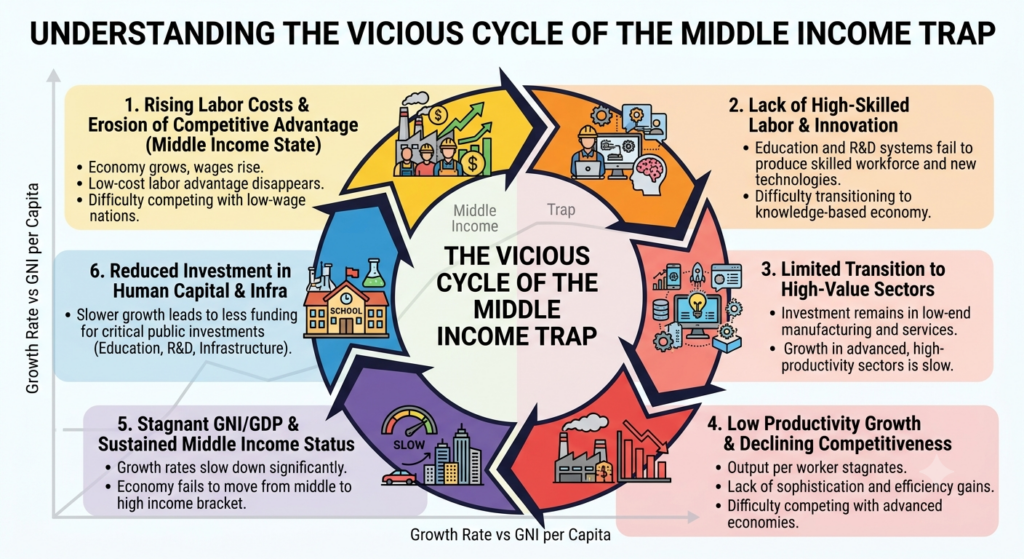
Causes of the Middle-Income Trap in developing countries like India
- Premature Deindustrialization: Economies like India skipped the labor-intensive manufacturing phase (textiles, simple electronics assembly) and jumped straight into services (IT, finance).
- Because services require skilled labor, millions of low-skilled workers remain trapped in low-productivity agriculture (~45% of India’s workforce) rather than transitioning to high-productivity factory jobs.
- The Dual Engine Failure: Neither market-led reforms (1991 model) nor Keynesian state-led interventions have solved structural bottlenecks; capital intensive industries receive subsidies while labor-intensive sectors lack productivity growth.
- The Human Capital & Employability Gap: Inadequate investment in foundational education, vocational training, and health creates a structural skill deficit where graduates lack market-relevant capabilities, capping total factor productivity (TFP).
- According to the India Skills Report 2026, overall youth employability is 56.35%.
- Premature Automation Risk: AI and capital-intensive technologies threaten labor intensity, risking lower employment generation even in traditional labor-heavy sectors.
- Low R&D Spending and Weak Domestic Innovation: Research and development (R&D) expenditure in developing nations often lingers under 1% of GDP (India spends 0.65%, compared to South Korea’s 4.8% or China’s 2.4%). Without proprietary IP, advanced manufacturing capabilities, and global tech brands, economies remain dependent on low-margin foreign tech imports.
- Missing “Scale” and Missing Middle Enterprises: High regulatory friction, compliance burdens, and land/labor bottlenecks encourage firms to stay small and informal.
- A dual economy forms: a few highly productive global conglomerates alongside millions of micro-enterprises that lack access to capital, tech adoption, and economies of scale.
- Automation & AI: Low-cost back-office outsourcing and basic software coding face automation threats, squeezing the service-led growth model.
- Global Protectionism: Unlike East Asian economies during 1970–2000, current developing nations operate under rising tariffs, friend-shoring, and stricter climate-compliance demands (e.g., carbon border adjustments), making export-led industrialization significantly harder.
What Has the Economic Survey of India Said?
The Economic Survey of India (2023–24) directly addresses the structural hurdles that expose lower-middle-income nations like India to the middle-income trap. The Survey underscores several key insights and strategic mandates:
- The Skill & Human Capital Gap: Pointing to data showing that only around 51% (now 56%) of Indian graduates are employable and a minimal fraction of the workforce has undergo formal skill training, the Survey warns that poor human capital quality limits transition to high-value industrial and service sectors.
- The AI and De-Globalization Threat: Unlike early-industrializing East Asian nations, India faces headwinds such as rising global protectionism, friend-shoring, and AI-driven automation. These factors threaten traditional growth pathways like low-end service outsourcing (e.g., BPOs) and low-tech manufacturing.
- Missing “Middle Layers” in Manufacturing: The Survey emphasizes that moving beyond lower-middle-income status requires building dense, high-productivity manufacturing ecosystems—such as specialized component suppliers and precision engineering—rather than relying solely on high-level IT or low-productivity informal work.
- The “3Is” Strategy for Growth: To avoid falling into the trap, the Survey advocates for a 3Is strategy: Investment, Innovation, and Infusion (of technology). It calls for a tripartite compact between government, private enterprise, and academia to re-skill the workforce and scale up R&D.
India Can Avoid the Trap
- Demographic Dividend & High Domestic Demand: Unlike aging middle-income nations in East Asia or Eastern Europe, India possesses a young, expanding workforce. When paired with a large domestic consumer market, this provides high long-term growth resilience and high domestic savings potential.
- Public Infrastructure & Institutional Momentum: Massive state-led expansion in physical infrastructure (highways, ports, renewable energy) and public digital infrastructure (UPI, Aadhaar, ONDC) has drastically reduced transaction costs and integrated the national economy.
- Proactive Structural Policy Shift (The “3I Strategy”): India is actively pivoting from pure investment (1i) toward technology Infusion and domestic Innovation (3i)—the exact formula recommended by the World Bank to escape the trap. Initiatives like the Production-Linked Incentive (PLI) scheme, National Skill Development Mission, and semiconductor policy aim to construct dense manufacturing ecosystems.
- Global Tech & Service Leadership: India is moving up the services value chain beyond basic BPOs toward high-end Global Capability Centers (GCCs), software design, and pharmaceutical R&D, showing strong momentum toward high-value growth.
UPSC Mains Practice Question
Q. “To escape the ‘Middle-Income Trap’, developing economies must transition from a strategy based purely on investment to one driven by infusion of technology and innovation.” In light of this statement, critically evaluate India’s readiness to avoid the Middle-Income Trap. (10 Marks / 150 Words)
Source: https://anantamias.com/current-affairs/middle-income-trap/
Maritime Chokepoints
Why in news?
Recent conflicts over Strait of Hormuz over transit of vessels in context of US-Iran-Israel conflict.
What are maritime chokepoints?
A maritime chokepoint is a narrow, strategic waterway—such as a strait, canal, or sound—that connects larger bodies of water and carries a disproportionately high volume of global sea trade.
Because these channels are naturally constrained in width and depth, any disruption—whether from geopolitical conflict, piracy, mechanical blockages, or extreme weather—can cause immediate global supply chain delays, spike energy prices, and force ships onto long, expensive detours.
Major Maritime Chokepoints

| Chokepoint | Location | Connects | Primary Significance & Facts |
| Strait of Hormuz | Between Iran and Oman/UAE | Persian Gulf to the Gulf of Oman / Arabian Sea | • Most critical oil chokepoint globally, handling over 20% of the world’s petroleum supply (~20+ million barrels/day). • At its narrowest, the shipping lane is only 2 miles wide in each direction. • Highly sensitive to geopolitical tensions in the Middle East. |
| Strait of Malacca | Between Malaysia, Indonesia, and Singapore | Indian Ocean to the South China Sea / Pacific Ocean | • Busiest energy passage in Asia, carrying nearly 30% of global seaborne oil trade and over 90,000 ships per year. • Main supply route for East Asian economies (China, Japan, South Korea). • Features the narrow Phillips Channel (just 1.5 nautical miles wide). |
| Suez Canal | Egypt | Red Sea to the Mediterranean Sea | • Shortest maritime route between Europe and Asia, saving ~10–14 days compared to rounding Africa. • Handles roughly 12% of overall global trade and ~15% of global container shipping. • Famous for the 6-day Ever Given container ship blockage in March 2021. |
| Bab el-Mandeb | Between Yemen (Arabian Peninsula) and Djibouti/Eritrea (Horn of Africa) | Red Sea to the Gulf of Aden / Indian Ocean | • Southern gateway to the Suez Canal. • Crucial for Middle Eastern oil moving to Europe and European goods moving to Asia. • Highly vulnerable to regional unrest and maritime security threats (such as regional conflict and piracy). |
| Panama Canal | Panama | Atlantic Ocean (Caribbean Sea) to the Pacific Ocean | • Vital link for the Americas, handling ~5–6% of global trade and connecting East Coast US/South America to Asian markets. • Uses a freshwater lock system; severe droughts directly reduce daily ship transits and maximum cargo weights. |
| Strait of Gibraltar | Between Spain/Gibraltar and Morocco | Atlantic Ocean to the Mediterranean Sea | • Key western gateway into the Mediterranean basin. • Over 100,000 vessels transit annually, making it one of the busiest maritime passages on Earth. |
| Turkish Straits (Bosporus & Dardanelles) | Turkey | Black Sea to the Aegean / Mediterranean Sea | • Primary maritime export corridor for Black Sea nations (including grain and oil from Russia, Ukraine, and Central Asia). • Highly hazardous navigation due to sharp turns, narrow points (Bosporus is only ~700 meters wide at its narrowest), and dense urban traffic in Istanbul. |
| Danish Straits | Between Denmark and Sweden | Baltic Sea to the North Sea / Atlantic Ocean | • Essential export route for Russian oil terminals and Baltic Sea commerce. |
Why Do They Matter?
- High Concentration Risk: About 80% of all internationally traded goods move via sea transport. Because millions of tons of cargo pass through a handful of narrow channels every day, a single point of failure can disrupt entire industries worldwide.
- No Quick Alternatives: Rerouting around a blocked chokepoint (such as taking the Cape of Good Hope around the southern tip of Africa instead of passing through Suez/Bab el-Mandeb) adds roughly 3,500–5,000 nautical miles, 10–14 days of travel time, and millions of dollars in fuel costs per journey.
- Energy Security: A vast portion of the world’s crude oil, refined fuels, and Liquefied Natural Gas (LNG) flows through just a few passages. For instance, over 20% of global petroleum transits the Strait of Hormuz alone.
- Global Supply Chain Efficiency: Routes like the Suez and Panama Canals drastically shorten trade journeys. Skipping the Suez Canal forces ships to navigate around Africa’s Cape of Good Hope, adding 10–14 days of travel, increasing fuel costs, and driving up consumer inflation.
- Food & Fertilizer Security: Critical commodities like Ukrainian grain, Russian fertilizer, and American soybeans pass through the Turkish Straits, Bab el-Mandeb, and Malacca Strait. Disruption quickly leads to global food shortages.
- Manufacturing Dependencies: Modern manufacturing relies on “just-in-time” supply chains. A delay at a chokepoint starves factories of semiconductor chips, raw materials, and components thousands of miles away.
Why They Become Centers of Conflict and Disputes?
The very characteristics that make chokepoints efficient also turn them into prime targets for geopolitical conflict, coercion, and dispute.
1. Asymmetric Warfare & “Geopolitical Coercion” Small states or non-state actors can leverage inexpensive weaponry (such as sea mines, anti-ship missiles, or low-cost attack drones) to threaten billions of dollars in trade.
- Houthi forces in Yemen used drone and missile attacks around the Bab el-Mandeb Strait to disrupt global Red Sea trade, forcing major shipping lines to reroute.
2. Strategic Chokepoints as Economic Levers A nation controlling a chokepoint can use it as a political bargaining chip or a tool to impose sanctions and blockades.
- Iran has repeatedly threatened to close or disrupt the Strait of Hormuz during periods of high tension with Western nations to trigger oil price surges.
3. Overlapping Territorial & Maritime Claims Chokepoints often lie in enclosed waters surrounded by multiple nations with competing sovereignty claims.
- In the South China Sea and Taiwan Strait, overlapping claims involving China, Taiwan, the Philippines, Vietnam, and Malaysia turn vital shipping passages into militarized hotspots.
4. Power Projection and Naval Hegemony Major global powers (such as the US, China, and NATO allies) compete to maintain naval presence near key straits to ensure “freedom of navigation” and project military force worldwide. The establishment of military bases in littoral states—like foreign power bases in Djibouti near Bab el-Mandeb—reflects this strategic rivalry.
5. Non-State Threats (Piracy & Terrorism) The narrowness and slow transit speeds required in straits make commercial vessels vulnerable targets for piracy, hijacking, and maritime terrorism.
- The Strait of Malacca and the Gulf of Guinea have historically required international naval patrols to counter active piracy risks.
Way Ahead
- Naval & Joint Patrol Coalitions: Strengthen multilateral alliances (e.g., Combined Maritime Forces, CTF 151) to conduct maritime security operations. These coalitions ensure freedom of navigation and protect merchant shipping against asymmetric threats like piracy, low-cost drones, and anti-ship missiles.
- Alternative Route Infrastructure: Invest in bypass options—such as overland crude pipelines, regional rail corridors (e.g., the India-Middle East-Europe Economic Corridor), and expanded canal capacities—to lessen systemic dependency on a single geographic funnel.
- Real-time Maritime Domain Awareness (MDA): Deploy shared satellite tracking, coastal radar, and AI-driven intelligence networks across friendly nations to detect and intercept emerging threats before transits are compromised.
- Strategic Commodities Reserves: Maintain robust national emergency reserves for critical supplies—like crude oil, natural gas, and grain—to buffer against immediate price shocks and domestic inflation caused by short-term blockages.
- Diplomatic Treaties & Neutrality Frameworks: Reaffirm and enforce international maritime law under UNCLOS (UN Convention on the Law of the Sea) to guarantee safe commercial passage through international straits, alongside active crisis diplomacy to prevent regional spillover.
- Supply Chain Redundancy for Businesses: Shift corporate supply strategies away from strict “just-in-time” systems toward flexible inventory models, allowing logistics operators to rapidly alter sea-lanes without causing systemic economic collapses.
Source: https://anantamias.com/current-affairs/maritime-chokepoints/
Ladakh to get a Unique Elected Body under Article 371K
Why in News?
The Union Ministry of Home Affairs has discussed a directly elected Union Territory-level body for Ladakh, through a proposed special constitutional provision referred to as Article 371K.
The administration described the proposal as a sui generis (unique) governance model. It would involve legislative, executive and financial powers, while Ladakh would remain a UT without being placed in the conventional category of a UT with a legislature.
However, local representatives expressed dissatisfaction because a detailed draft and precise allocation of powers had not been provided. The arrangement remains under negotiation and has not been enacted yet.
| UPSC Relevance: GS-2 Polity and Governance: Federalism, constitutional amendments and tribal safeguards Prelims: Article 371, Sixth Schedule Mains: Ladakh: Constitutional Safeguards and the Autonomy Debate. |
What has been proposed?
The central government has agreed to grant Constitutional safeguards under Article 371 to Ladakh. A unique (sui generis) governance model for Ladakh via a new Article 371(K) has been proposed, introducing a directly elected Union Territory-level body with specific legislative powers. Its broad features are:
- Directly elected representatives: The proposed UT-level body would be elected through territorial constituencies, giving residents a direct role in choosing representatives responsible for Ladakh-wide matters. Constituency boundaries, membership and electoral arrangements remain to be worked out.
- Legislative powers over specified subjects: The body would be empowered to make laws concerning land, culture, language, forests, environment and natural resources.
- Legislative, executive and financial authority: The administration has described an institution combining law-making, implementation and financial powers. However, its actual control over officials, development planning, expenditure and revenue has not been settled in a detailed draft.
- Coexistence with existing hill councils: The institution would operate at the UT level, alongside the Leh and Kargil Autonomous Hill Development Councils. Discussions are examining how responsibilities and resources would be divided among these bodies to avoid overlapping authority.
- Distinct constitutional arrangement: The proposal would confer neither statehood nor the conventional status of a UT with a legislature. Instead, a specially designed constitutional body would exercise defined powers while Ladakh retains its UT status. Its name and the designation of its elected head remain undecided.
- Unresolved control over police and bureaucracy: Local representatives have sought authority over the police and administrative machinery. The Centre has agreed to examine these demands, but no firm commitment has been reported. The Lieutenant Governor’s powers and relationship with the elected leadership also require clarification.
Why Is Ladakh seeking Constitutional Safeguards?
- Gap in democratic representation: Ladakh became a Union Territory without a legislature on October 31, 2019, under the Jammu and Kashmir Reorganisation Act, 2019. Local representatives consequently seek a UT-wide elected institution with meaningful authority over policy and administration.
- Protection of land and livelihoods: Communities fear that inadequately regulated land transfers, commercial investment and infrastructure projects could affect agricultural land, grazing areas and traditional livelihoods, including Changpa pastoralism.
- Preservation of tribal and cultural identity: Ladakh has a predominantly tribal population with distinct languages, customary practices and cultural traditions. In 2019, the National Commission for Scheduled Tribes recommended its inclusion under the Sixth Schedule, citing the need to protect tribal interests and cultural heritage.
- Ecological vulnerability: Its cold-desert environment, limited water resources and fragile mountain ecosystems require development decisions that account for carrying capacity and local knowledge.
- Limited reach of existing hill councils: The Leh and Kargil hill councils operate under the Ladakh Autonomous Hill Development Council Act, 1997. They are statutory institutions, rather than Sixth Schedule councils, and do not substitute for UT-wide legislative government.
What would Article 371K mean?
- Articles 371 and 371A-371J are separate constitutional provisions within Article 371. They provide differentiated arrangements for particular States under Part XXI. For example:
- Article 371A (Nagaland): Protects specified customary practices and land-and-resource interests.
- Article 371G (Mizoram): Provides safeguards concerning customary practices and ownership and transfer of land.
- A proposed Article 371K would require a constitutional amendment. Its protections cannot be assumed to match those of existing provisions until the draft is available.
How does it differ from the Sixth Schedule?
- The Sixth Schedule, read with Article 244(2), currently applies to specified tribal areas in Assam, Meghalaya, Tripura and Mizoram. It establishes autonomous district and regional councils with constitutionally defined powers over specified local matters, including land, customary practices and certain administrative and judicial functions.
- The Ladakh proposal instead envisages a directly elected UT-level institution with specially designed powers. Its relationship with district-level councils would need explicit definition.
However, neither arrangement (Article 371K and Sixth Schedule) automatically confers statehood. Extending the Sixth Schedule to Ladakh would also require constitutional changes.
A detailed draft must specify the institutional structure and safeguards, followed by the necessary constitutional amendment required. The central issue is whether the new institution will exercise effective self-government or remain dependent on the Lieutenant Governor and Union administration.
UPSC PYQ 2015:
Q. The provisions in Fifth Schedule and Sixth Schedule in the Constitution of India are made in order to:
(a) protect the interests of Scheduled Tribes
(b) determine the boundaries between States
(c) determine the powers, authority and responsibilities of Panchayats
(d) protect the interests of all the border States
Answer: (a)
Source: https://anantamias.com/current-affairs/ladakh-to-get-a-unique-elected-body-under-article-371k/
SC seeks clarity on FSSAI’s warning label norms
Why in News?
The Supreme Court questioned the Food Safety and Standards Authority of India (FSSAI) about the scientific thresholds for classifying packaged foods as high in sugar, salt or fat. It sought clarity on the proposed warning labels, emphasising public health, particularly children’s health.
| UPSC Relevance: GS-2 Social Justice: Health Prelims: India’s regulatory framework; FSSAI Mains: Public health and government interventions. |
What has FSSAI proposed?
- FSSAI has proposed a red hexagonal front-of-pack warning for packaged foods that are high in specified nutrients of concern. The proposed warnings could indicate: High Fat, High Sugar, High Salt and Highly Sweetened Beverage.
- The proposal draws on the Dietary Guidelines for Indians, 2024, issued by the ICMR-National Institute of Nutrition (NIN), for determining the relevant thresholds.
- FSSAI initially proposed a two-phase implementation:
- Phase I: Warning where a product is high in at least two specified nutrients.
- Phase II: Warning extended to products high in any one of the specified nutrients.
FSSAI has now indicated before the Supreme Court that it is open to implementing warnings for excess levels of even one nutrient in a single phase.
How does the proposal differ from FSSAI’s earlier approach?
- FSSAI’s 2022 draft Indian Nutrition Rating (INR) proposed ½ to 5 stars, balancing nutrients such as sugar, saturated fat and sodium against positive components such as fibre, protein, fruits and vegetables.
| What is Front-of-Pack Nutrition Labelling? Front-of-Pack Nutrition Labelling (FOPNL) provides simplified nutritional information on the front rather than only the back of packaged food. Its objective is to allow consumers to make a quick and informed decision without having to interpret complicated nutritional tables. It may communicate: High levels of sugar, salt or fat; calorie content; percentage contribution to recommended dietary allowances. Overall nutritional quality through symbols, colours or ratings. |
What exactly must FSSAI clarify?
1. Daily dietary guidance versus product thresholds:
- A recommendation for an individual’s whole-day intake does not automatically determine whether a particular packaged food is “high” in a nutrient.
- For context, WHO recommends limiting adults’ salt intake to less than 5 grams daily and free sugars to less than 10% of daily energy, preferably below 5%. These are dietary recommendations, not India’s final warning-label cut-offs.
- FSSAI must explain how dietary guidance translates into measurable product-level thresholds, including the units, scientific rationale and treatment of different food categories.
2. Per 100 grams/ml versus per serving:
- FSSAI’s proposed framework uses a standardised per 100 g/ ml basis. The food industry seeks a per-serving benchmark, contending that this better reflects actual consumption patterns.
- Per 100 g/ml:
- Allows easier comparison between products.
- Prevents manufacturers from manipulating declared serving sizes.
- Provides a uniform regulatory benchmark.
- Per serving: May better reflect what consumers actually eat or drink at one time. Could be more intuitive for certain products.
3. One nutrient versus two nutrients:
- A product may contain excessive sugar while having little fat or salt. Under a two-nutrient trigger, it could escape a warning. E.g., A sugar-sweetened beverage could be high in sugar alone. Its nutritional concern does not disappear because the other two nutrients are below their thresholds. The FSSAI has indicated willingness to assess each nutrient independently.
4. Precise definitions of nutrients:
- Total fat is different from saturated fat: The type of fat matters; unsaturated fats should not be treated as nutritionally identical to saturated or trans fats.
- Added sugar is narrower than free sugar: WHO’s definition of free sugars also covers sugars naturally present in honey, syrups and fruit juices.
- Salt is different from sodium: Sodium may come from ingredients other than common salt, so the regulatory metric must be clearly specified.
5. Clear and accessible design
- FSSAI must explain why a red hexagon is appropriate and ensure that its size, wording and placement communicate clearly. Consumer testing should address readability and possible confusion with existing food symbols.
India’s regulatory framework:
- Food Safety and Standards Act, 2006: The Act provides the statutory framework for regulating food safety and standards in India. It created the Food Safety and Standards Authority of India (FSSAI) as the central food regulator. FSSAI is responsible for:
- laying down science-based food standards
- regulating manufacture, storage, distribution, sale and import of food
- regulating food labelling
- monitoring compliance; and
- facilitating consumer awareness.
- Food Safety and Standards (Labelling and Display) Regulations, 2020: These regulations establish requirements relating to nutritional information and labelling of packaged foods.
FSSAI has continued to amend the framework. Its official regulatory page records amendments in 2021, 2022, 2025 and 2026. The regulatory trajectory reflects a shift from simply providing information towards making important nutritional information more visible and actionable.
Legal and institutional dimensions:
- Article 21: Protection of health forms part of the constitutional understanding of the right to life.
- Article 47: Directs the State to improve nutrition, living standards and public health.
- FSSAI: A statutory authority established under the Food Safety and Standards Act, 2006, with the Ministry of Health and Family Welfare as its administrative ministry.
- Existing school-food regulation: The 2020 regulations on safe food and balanced diets for children in schools restrict the sale of specified HFSS foods to school children on school premises and within 50 metres of the school gate.
Why are warning labels needed?
- Growing burden of diet-related diseases: The ICMR-INDIAB study published in 2023 estimated 10.1 crore people with diabetes and 13.6 crore with prediabetes in India, underscoring the need for preventive nutrition policies.
- Information asymmetry: Manufacturers understand product composition better than consumers, while detailed nutritional calculations are difficult during routine purchases.
- Children’s vulnerability: Children have limited capacity to evaluate nutritional claims and are exposed to attractive packaging, celebrity endorsements and digital marketing.
- Misleading health impressions: Claims such as “multigrain”, “with vitamins” or “high protein” may draw attention away from excessive sugar, sodium or saturated fat.
- Incentive for reformulation: Prominent warnings can encourage producers to reduce nutrients of concern to avoid the label. WHO documents such reformulation following Chile’s warning-label legislation.
- Wider economic benefits: Prevention can reduce treatment costs, productivity losses and pressure on public-health systems.
The FSSAI’s proposed front-of-pack warning labels represent a shift from “information available to consumers” to “information made meaningful to consumers.” The challenge is to ensure that the warning system is neither scientifically arbitrary nor commercially diluted.
Effective warning labels should make nutritional risks understandable at the point of purchase, while wider food policies make healthier choices affordable and accessible.
UPSC Mains PYQs:
Q. How do you account for the growing fast food industry given that there are increased health concerns in modern society? Illustrate your answer with the Indian experience. (GS1, 2025)
Q. In a crucial domain like the public healthcare system, the Indian State should play a vital role to contain the adverse impact of marketisation of the system. Suggest some measures through which the State can enhance the reach of public healthcare at the grassroots level. (GS2, 2024)
Source: https://anantamias.com/current-affairs/sc-seeks-clarity-on-fssais-warning-label-norms/
How should RUPPs be regulated?
Why in News?
A recent investigation has highlighted concerns over the functioning and financial transparency of Registered Unrecognised Political Parties (RUPPs). Six RUPPs based in Gujarat reportedly received around ₹1,700 crore in donations in 2023-24, exceeding the combined donations received by five nationally recognised parties other than the BJP.
The issue is significant because India has over 2800 RUPPs, while only a fraction actively contest elections.
| UPSC Relevance: GS-2 Polity and Governance: Representation of the People Act; Pluralism Prelims: Representation of the People Act; Registered Unrecognised Political Parties Mains: Electoral reforms, ECI, and democratic accountability. |
What are Registered Unrecognised Political Parties?
- Under Section 29A of the Representation of the People Act (RPA), 1951, an association of Indian citizens can apply to the Election Commission for registration as a political party.
- A newly registered party generally remains an RUPP until it satisfies the conditions for recognition as a State or National Party under the Election Symbols (Reservation and Allotment) Order, 1968. “Unrecognised” does not mean illegal. It simply means that the party has not acquired the electoral support required for recognition.
- After satisfactory scrutiny of the documents submitted, the EC registered a political party as a RUPP.
| Why do parties seek registration? Registration provides several institutional advantages, including: –> Eligibility to seek common symbols under the applicable ECI framework. –> The ability to participate formally in the electoral process.Certain tax-related benefits, subject to statutory conditions. –> Recognition as a political entity for purposes of receiving political contributions. |
- The RUPPs enjoy the following benefits:
- Tax exemption for donations received under Section 12 of the Income Tax Act, 2025.
- Common symbol for contesting general elections to the Lok Sabha/State Assemblies.
- 20 star campaigners during the election campaign.
- The RUPPs are required to maintain details of individual donors above twenty thousand rupees in a financial year and submit them to the poll body every year. As per section 29C of the Representation of the People Act, failure to furnish these details will result in losing income tax exemption.
- Under the Income Tax Act, 2025, the RUPPs are required to accept donations above two thousand rupees only through cheque or bank transfers.
Why are RUPPs becoming a concern?
1. Proliferation of non-serious political parties:
- India has witnessed a sharp expansion in the number of registered parties, but registration does not necessarily translate into meaningful electoral activity.
- As per the ECI, till June 2025, more than 2,800 RUPPs existed, and it initiated proceedings against 345 parties that had not contested even a single election since 2019, and whose offices could not be physically located. The parties were given show-cause notices and an opportunity of hearing before final decisions. The ECI subsequently undertook delisting of 808 RUPPs for continually failing to meet essential conditions of registration.
2. Letter pad parties and regulatory arbitrage:
- Some parties may exist primarily on paper, with minimal political activity but continued access to the institutional framework available to registered parties.
- Such entities can potentially be exploited for routing suspicious donations, tax evasion, generation or accommodation of fictitious expenditure, money laundering, layering of financial transactions, and creating artificial political expenditure trails.
Why do some RUPPs remain active despite poor compliance?
- Weakness in the deregistration framework:
- In Indian National Congress (I) v. Institute of Social Welfare (2002), the Supreme Court held that the ECI does not possess a general power under Section 29A of the RPA to deregister a political party for subsequent violations.
- The Court recognised only exceptional circumstances, such as registration having been obtained through fraud, a party ceasing to have allegiance to the Constitution, or the party being declared unlawful. The limited nature of the ECI’s deregistration power has therefore created a regulatory gap.
- Token electoral participation: Fielding a few candidates helps parties avoid action based on prolonged non-contestation, without establishing genuine organisational activity or financial integrity.
- Fragmented oversight: Registration, financial reporting, tax assessment and criminal investigation involve different authorities. Weak coordination can allow discrepancies between donations, tax claims and expenditure to remain undetected.
- Weak financial transparency: ADR found that 73.26% of RUPPs had neither audit nor contribution reports available online for FY 2022-23, limiting public scrutiny.
Constitutional and Democratic concerns:
Regulating RUPPs involves a delicate balance. Excessive regulation may harm:
- Freedom of political association under Article 19(1)(c).
- Political pluralism.
- Representation of marginalised or emerging social groups.
- The ability of new political movements to challenge established parties.
A new party may have genuine political significance despite receiving very few votes initially. Therefore, electoral success alone cannot be the sole criterion for determining whether a party deserves legal existence.
Way Forward:
- Provide explicit deregistration powers: Amend the RP Act to specify objective grounds, including prolonged inactivity and persistent serious non-compliance. The Law Commission’s 255th Report proposed deregistration for failure to contest parliamentary or State elections for ten consecutive years.
- Introduce proportionate sanctions: Establish a statutory progression from notice and an opportunity to rectify defaults to financial penalties, withdrawal of applicable benefits and deregistration for serious or repeated violations.
- Create a unified disclosure portal: Publish audited accounts, contribution reports, election expenditure and filing status in searchable, downloadable formats, with clear submission and publication dates.
- Strengthen independent auditing: Require disclosure of major vendors and related-party transactions, alongside scrutiny of unusually large receipts and expenditure. The Law Commission recommended audits by qualified accountants drawn from a CAG-maintained panel.
- Coordinate financial scrutiny: Enable lawful matching of party filings with bank records, donor tax claims and vendor information; investigate suspicious patterns rather than relying only on electoral performance.
- Improve internal accountability: Require updated office-bearer details, verifiable addresses, periodic organisational elections and transparent authorisation of expenditure.
The proliferation of RUPPs reflects both India’s democratic pluralism and a regulatory vulnerability. However, inadequate regulation may harm electoral integrity, equality among political actors, transparency in political finance, public trust, tax administration, and the fight against money laundering.
Hence, the objective should be not to eliminate small parties, but to distinguish genuine small parties from non-functional or fraudulent entities.
Practice MCQ:
Q. With reference to Registered Unrecognised Political Parties (RUPPs) in India, consider the following statements:
1. Registration of a political party under Section 29A of the Representation of the People Act, 1951 automatically makes it a recognised State or National Party
2. The Election Commission of India has unrestricted power to deregister any political party that fails to contest elections.
3. Failure to furnish the contribution report prescribed under Section 29C can result in loss of income-tax relief to RUPPs.
Which of the statements given above is/are correct?
(a) 1 and 2 only
(b) 3 only
(c) 1 and 3 only
(d) 2 and 3 only
Answer: (b) 3 only
Practice Mains Question:
Q. “Political pluralism requires easy entry into the electoral arena, but public privileges must be accompanied by public accountability.” In the context of Registered Unrecognised Political Parties (RUPPs), examine the need for regulatory reforms to ensure transparency while protecting freedom of political association.
Source: https://anantamias.com/current-affairs/how-should-rupps-be-regulated/
India, U.S. armies commence Bilateral exercise Yudh Abhyas
Why in News?
The Indian and US armies commenced the 22nd edition of Exercise Yudh Abhyas, scheduled from September 9-28, 2026, at Bikaner, Rajasthan, and Auli, Uttarakhand. The exercise features the deployment of an advanced US counter-drone system to India.
| UPSC Relevance: GS-2 International Relations: Bilateral Relations Prelims: India-US: Bilateral defence and security exercise |
About Yudh Abhyas:
- Nature: Annual bilateral Army exercise between India and the United States.
- Objective: Improve interoperability, i.e, the ability of both armies to communicate, plan and operate together and exchange operational experience.
- Training: Includes a command-post exercise, field training and a combined live-fire demonstration.
- Technology focus:
- Integration of long-range precision firepower, rocket systems and command-and-control networks.
- Introduce the Mobile Low, Slow, Small Unmanned Aircraft Integrated Defeat System (MLIDS), designed to counter threats from small and low-flying drones.
India-US Bilateral Defence and Security Exercises:
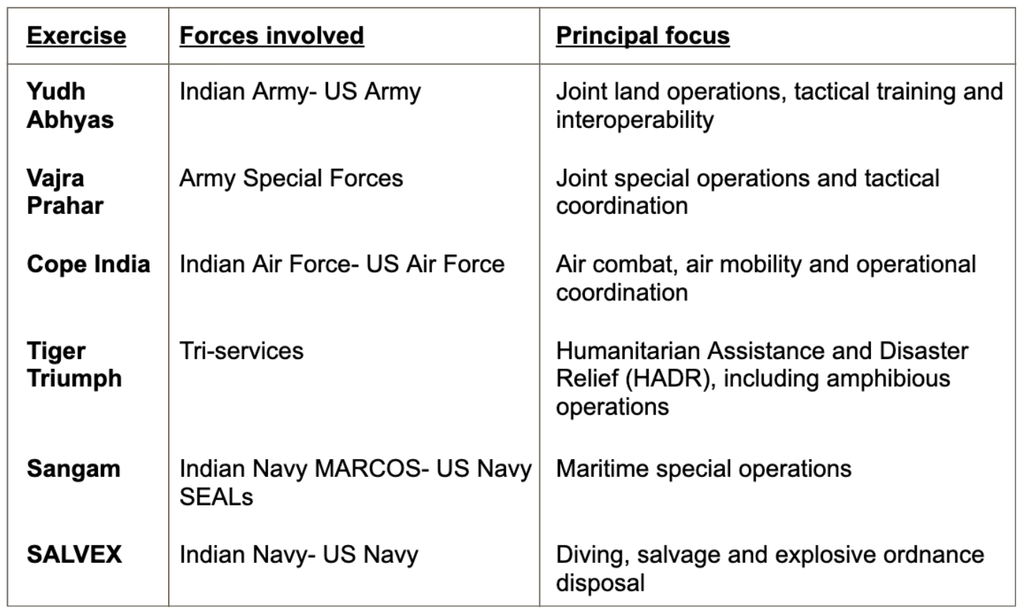
UPSC PYQ 2024:
Q. Which of the following statements about ‘Exercise Mitra Shakti-2023’ are correct?
1. This was a joint military exercise between India and Bangladesh.
2. It commenced in Aundh (Pune).
3. Joint response during counter-terrorism operations was a goal of this operation.
4. Indian Air Force was a part of this exercise
Select the answer using the code given below:
(a) 1, 2 and 3
(b) 1, 2 and 4
(c) 1, 3 and 4
(d) 2, 3 and 4
Answer: (d)
Source: https://anantamias.com/current-affairs/india-u-s-armies-commence-bilateral-exercise-yudh-abhyas/
Houthis seize key city on Red Sea, advance towards Bab el-Mandeb
Why in News?
Yemen’s Houthi rebels have reportedly captured Mokha port and Zuqar Island in the southern Red Sea, advancing towards Bab al-Mandeb. The militant group has already declared a naval blockade against Saudi Arabia, the world’s largest oil exporter. Houthi dominance over the Bab el-Mandeb waterway would further isolate Gulf oil producers from their main shipping routes.
| UPSC Relevance: GS-2 International Relations: West Asia; Locations in News Prelims: Location of Bab-el-Mandeb, Houthis |
About Bab-al-Mandeb:
- Location: A narrow strait at the southern entrance to the Red Sea, between Yemen in Asia and Djibouti and Eritrea in Africa.
- Connects: The Red Sea and the Gulf of Aden, providing access to the Arabian Sea and Indian Ocean.
- Width and island: About 29 km wide at its narrowest point. Yemen’s Perim Island (also called Mayyun) divides it into eastern and western channels.
- Gateway to the Suez Canal: Ships travelling from the Indian Ocean towards Europe enter the Red Sea through Bab-al-Mandeb, then sail north to the Suez Canal and the Mediterranean Sea.
- Meaning: Its Arabic name means “Gate of Tears”, traditionally associated with the dangers of navigating the passage.
- Distinction from Hormuz: Bab-al-Mandeb lies southwest of the Arabian Peninsula; Hormuz lies on its northeastern side, connecting the Persian Gulf with the Gulf of Oman.
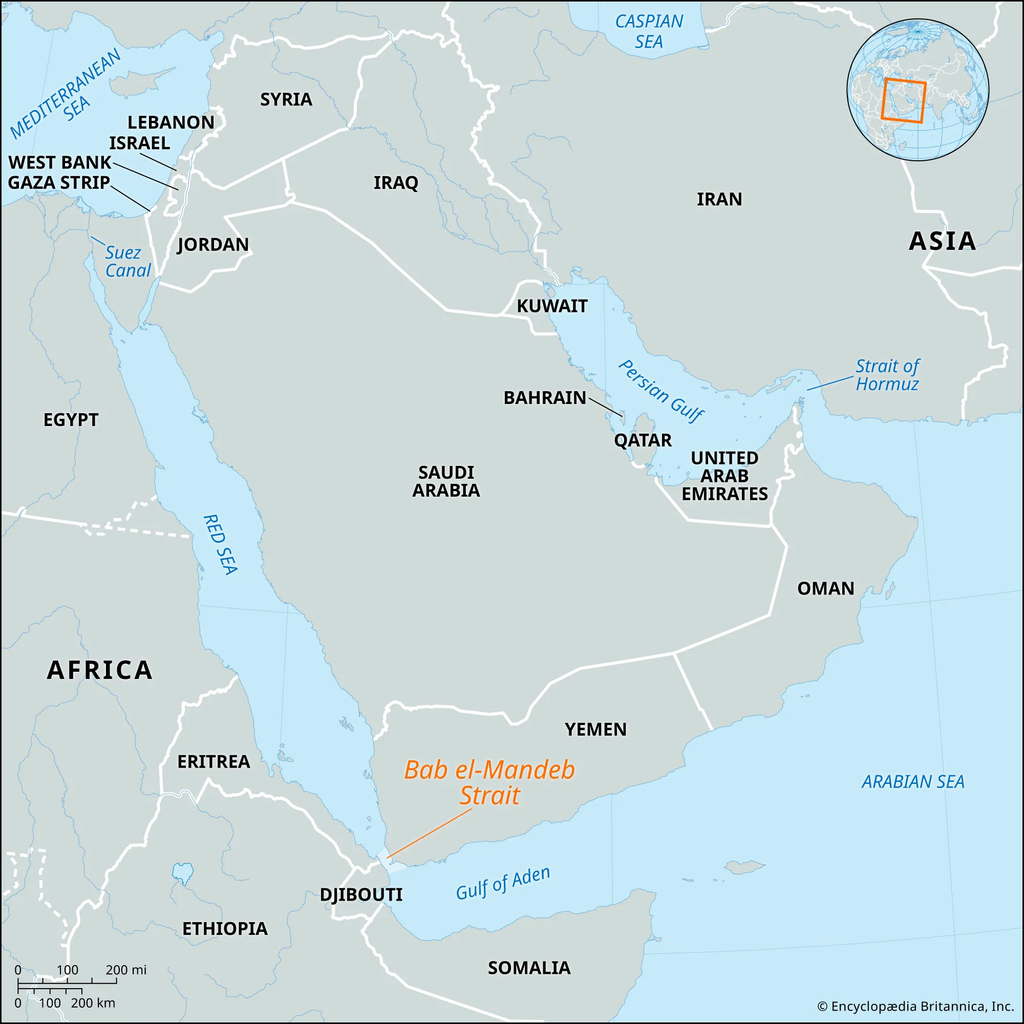
Why is it Strategically Important?
- Gateway to the Suez route: It forms the southern entrance to the Red Sea, making it indispensable for the shortest major maritime route between Asia and Europe.
- Energy-security chokepoint: Large volumes of oil and petroleum products pass through it. EIA estimates put oil flows at 8.1 million barrels per day in April-June 2026, compared with 5.4 million in October-December 2025.
- Military and geopolitical leverage: Positions near its narrow approaches enable surveillance and potential attacks using missiles, drones, mines and small boats. Even limited attacks can disrupt commerce without physically closing the strait.
- Costly alternative route: Ships avoiding the Red Sea-Suez corridor must generally sail around Africa’s Cape of Good Hope, increasing travel time, fuel consumption, freight charges and insurance costs.
- Importance during Hormuz disruption: Saudi Arabia can transport oil through its East-West pipeline to Yanbu on the Red Sea. Shipments from Yanbu towards Asian markets must then pass through Bab-al-Mandeb, making simultaneous disruption of both chokepoints particularly serious.
Who are the Houthis?
- Identity: A Yemeni political and armed movement formally known as Ansar Allah.
- Origins: Emerged from a Zaydi Shia revivalist movement in northern Yemen; named after Hussein Badreddin al-Houthi.
- Leadership: Led by Abdul-Malik al-Houthi.
- Territorial base: Captured Sanaa in 2014 and controls substantial parts of northwestern Yemen.
- External support: Backed by Iran and fighting forces aligned with Yemen’s internationally recognised government.
- Maritime relevance: Their missile and drone attacks on shipping since late 2023 have demonstrated how a non-state armed group can disrupt global supply chains.
Significance to India:
- Trade: Disruption affects India’s shipping links with Europe and Mediterranean markets.
- Energy and inflation: Higher oil prices, freight rates and insurance premiums increase import costs.
- Seafarer safety: Attacks endanger Indian crew members and merchant vessels. Under Operation Sankalp, the Indian Navy expanded maritime-security operations from late 2023 across the Gulf of Aden, Arabian Sea and waters off Somalia.
Restoring dependable navigation and preventing further spillover are essential to both regional stability and global economic security.
Practice MCQ:
Q. With reference to the Bab-al-Mandeb Strait, consider the following statements:
1. It connects the Red Sea with the Gulf of Aden.
2. It separates the Arabian Peninsula from the Horn of Africa.
3. Ships travelling from the Indian Ocean to the Mediterranean Sea through the Suez Canal must pass through it.
Which of the statements given above are correct?
(a) 1 and 2 only
(b) 2 and 3 only
(c) 1 and 3 only
(d) 1, 2 and 3
Answer: (d)
