Why in News?
On 8 September, MoSPI launched a progress-reporting mechanism for administrative-data harmonisation, covering dataset inventories, metadata, common standards and quality checks across Central ministries and departments.
- The Quarterly Progress Report mechanism records progress in identifying and cataloguing datasets prepared for dissemination, documenting metadata and applying common standards.
- It covers classifications and common unique identifiers in machine-readable data, alongside departmental quality checks using the Statistical Quality Assurance Framework.
- The mechanism includes automated validation and cross-verification with the NMDS portal; these functions support monitoring, rather than proving that every dataset is already harmonised.
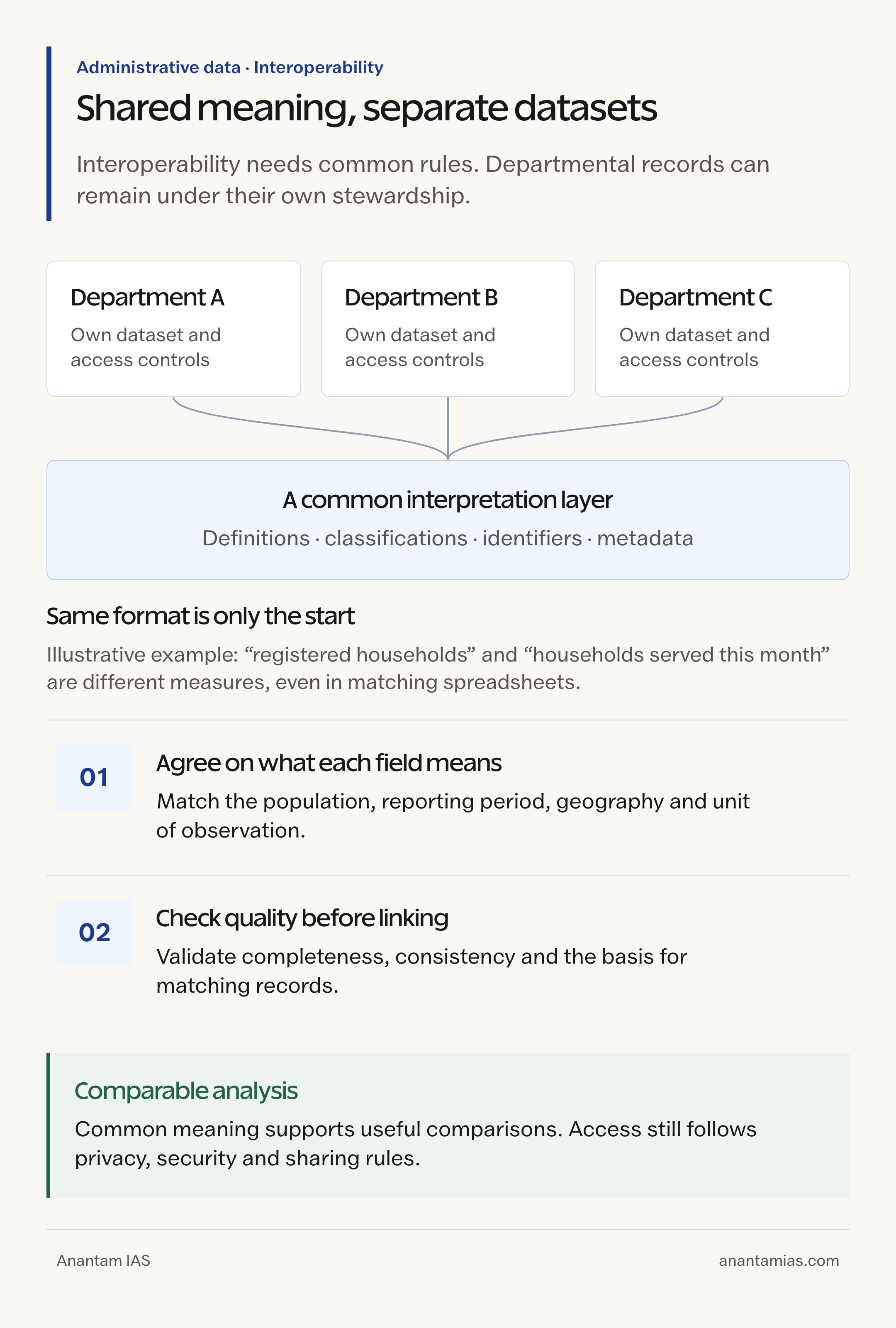
- The workshop explicitly supported distributed data systems, preserving departmental ownership while enabling responsible sharing through common standards and governance arrangements.
- Data exchange can move records between departments without resolving differences in definitions, reporting periods or geography. Policy analysis needs agreement about what those records mean.
- Administrative data can support service monitoring and outcome assessment, but information gathered for operating a programme needs scrutiny before being reused for wider statistical conclusions.
UPSC Relevance
Prelims Relevance
- MoSPI: Ministry of Statistics and Programme Implementation.
- Structural interoperability: Compatible organisation and formats that allow systems to exchange and process data.
- Semantic interoperability: Shared meaning of concepts, definitions and classifications across systems.
- Metadata: Documentation explaining a dataset’s content, scope, definitions and other interpretive details.
- SQAF: Statistical Quality Assurance Framework, referenced for departmental quality checks.
- Distributed interoperability: Data can remain with departments while agreed standards enable useful linkage and sharing.
Mains Relevance
GS Paper 2
- Administrative-data quality in welfare monitoring and evidence-based governance.
- Departmental ownership, privacy and accountability in government data sharing.
GS Paper 3
- Semantic interoperability and the foundations of reliable AI-assisted public analysis.
Essay
- More information improves governance only when its meaning and limitations are understood.
Background and Context
Why administrative records need harmonisation
A record useful for running one programme does not automatically become a comparable statistic for another department.
- Administrative data arises from operating services and programmes. Reusing these records can support policy formulation, monitoring and assessment, but requires understanding the purpose and coverage of the original collection.
- Data harmonisation aligns concepts, definitions, classifications, identifiers, geographies, metadata and structures. MoSPI’s workshop connected these elements because compatibility depends on more than making a file downloadable or machine-readable.
- A dataset inventory helps departments discover existing information before requesting it again. A useful catalogue must describe available data sufficiently for another department to assess whether it fits the intended question.
- Metadata makes interpretation possible by documenting what fields represent. Without definitions and coverage information, an analyst may treat unlike records as equivalent merely because their column headings look similar.
- Reuse requires judgment: a programme’s registered participants are not automatically the entire population eligible for support. Analysts should establish who is represented before drawing conclusions about wider social conditions.
Structural versus semantic interoperability
Structural compatibility lets systems process each other’s records; semantic compatibility helps users interpret those records consistently.
- Structural interoperability concerns compatible data organisation and formats. Systems might exchange records successfully while still applying different definitions to an apparently identical field, leaving the statistical comparison misleading.
- Semantic interoperability concerns shared meaning. Agreement about definitions, classifications and reporting geography is needed before observations from separate departments can support a coherent comparison or combined policy assessment.
- In a hypothetical example, one department’s beneficiary count means registered people while another means people actually served. Identical spreadsheets would not make these different measures directly comparable without further qualification.
- Common identifiers help recognise the same entity across systems. They do not, by themselves, resolve differences between registration and service receipt; the linked variables still require clear definitions and interpretation.
- Harmonisation may reveal that two measures should remain separate. The correct analytical result can be an explicit distinction, rather than forcing unlike categories into a combined total that conceals their differences.
What quality assurance adds
Shared terminology improves comparability, but analysts must also assess whether the underlying records are dependable for their intended use.
- The new mechanism records departmental progress on quality checks under SQAF. It also supports automated validation and cross-verification with NMDS, linking reporting on harmonisation with checks on the submitted information.
- Automated validation can support consistency checks, but the release does not specify every rule. It should not be presented as certification that all underlying administrative records are accurate or complete.
- Statistical Advisers provide statistical leadership and quality assurance, while Chief Data Officers contribute data governance and interoperability. These complementary roles connect interpretive expertise with the organisation of data systems.
- AI readiness requires well-documented, quality-assured information. Feeding inconsistent categories into an automated system does not solve their meaning; it can spread the original ambiguity into more analyses and decisions.
Interoperability without centralising ownership
Shared standards can connect departmental systems without requiring all government data to be placed in one central repository.
- The workshop explicitly stated that data need not be centralised to generate value. Common standards, identifiers, APIs and governance mechanisms can support interoperability while information remains in distributed departmental systems.
- Departmental ownership remains compatible with responsible sharing. Decisions about access must still account for privacy and security; technical ability to retrieve a record is not itself permission to disclose it.
- Calls to establish Data Governance Committees and publish sharing frameworks were workshop recommendations. The release does not establish a new statutory mandate or show that every department has completed these steps.
- The evidence boundary matters: launching progress reporting does not prove universal interoperability, open access to all datasets or completion of statistical-framework transitions discussed during the workshop’s technical sessions.
Way Forward
Define meaning before combining records
- Maintain live inventories and metadata that document definitions, coverage and revisions, helping users identify suitable data and avoid requesting information already available through authorised channels.
- Agree on definitions and identifiers for priority use cases, explicitly recording measures that cannot be combined. Test a limited linkage before extending it across more departments.
- Combine automated checks with statistical review, assign responsibility for corrections and specify authorised access. Report unresolved quality limitations alongside analytical results instead of hiding them.
Conclusion
- Government data becomes comparable through shared meaning, not merely compatible files. Definitions, metadata, identifiers and quality assurance perform different but connected functions.
- Use this case to show how distributed ownership and interoperability can coexist. A progress-reporting mechanism supports that transition; reliable analysis remains a result to establish through continuing checks.
UPSC Practice Questions
Prelims MCQ 1
With reference to administrative-data harmonisation, consider the following statements:
- Structural compatibility alone guarantees that two datasets use identical definitions.
- Common identifiers can help recognise the same entity across systems.
- Interoperability can function while departments retain ownership of their datasets.
How many of the above statements are correct?
(a) Only one (b) Only two (c) All three (d) None
Answer: (b) Only two
Explanation:
Statements two and three are correct. Compatible structures enable exchange, but semantic interoperability additionally requires consistent meaning, definitions and classifications.
Prelims MCQ 2
Two departments exchange identically formatted files, but one counts registrations and the other counts completed services. Which issue most directly prevents comparison?
(a) Absence of a single central database (b) Excessive machine readability (c) Different meanings of the reported measure (d) Departmental ownership itself
Answer: (c) Different meanings of the reported measure
Explanation:
The problem is semantic: registration and completed service are different concepts. Centralising or reformatting the files would not by itself resolve that difference.
UPSC Mains Questions
- Distinguish structural and semantic interoperability in government data systems. Explain their significance for using administrative data in policy assessment. (150 words)
- Can government datasets become interoperable without centralising their ownership? Discuss standards, quality assurance and responsible access with reference to administrative-data harmonisation. (250 words)
Source: PIB, Ministry of Statistics and Programme Implementation.
Frequently Asked Questions
What is administrative-data harmonisation?
It aligns definitions, classifications, identifiers, geography, metadata and data structures so records from different systems can be interpreted appropriately. Its purpose is useful comparability, rather than simply transferring files between departments.
How is semantic interoperability different from structural interoperability?
Structural interoperability concerns compatible formats and organisation for exchanging data. Semantic interoperability concerns shared meaning, such as whether a beneficiary field represents registration or actual service receipt across the systems being compared.
Does harmonisation require a central government database?
No. The workshop explicitly recognised that common standards, identifiers, APIs and governance mechanisms can connect distributed systems. Departmental ownership can remain intact while authorised sharing supports analysis, subject to privacy and security.
What does the new progress mechanism monitor?
It covers dataset identification and cataloguing, metadata preparation, common standards, classifications, identifiers and departmental quality checks. Automated validation and cross-verification support monitoring; launch alone does not prove that all datasets are already harmonised.
Tell Google you want more of this.
Add Anantam IAS as a preferred sourceOne tap, and this site shows up more often in your own Top Stories, AI Overviews and AI Mode. Remove it any time.