Daily Digest
UPSC · Civil Services Examination
Current Affairs · Monday, 12 October 2026
Current affairs curated and edited by Anantam IAS faculty — pulled from The Hindu, PIB, IDSA, Foreign Affairs and the ministries. Read, annotate, revise.
Old Rajinder Nagar · Delhi 110005 · anantamias.com
ICC Sanctions: Judicial Independence and State Cooperation
Why in News?
The International Criminal Court rejected US institutional sanctions announced on 9 October 2026, followed by a statement defending judicial independence from the Assembly of States Parties Bureau on 10 October.
- The new institutional designation follows earlier sanctions against individual judges and prosecutors; the ICC said the measures threaten its operations and those cooperating with it.
- The Assembly Bureau called for revocation of the sanctions and reaffirmed support for the Court, its personnel and cooperation under the Rome Statute.
- The Court said it would continue its judicial mandate; its criticism of the sanctions is an institutional position, not a reported judgment invalidating them.
- The immediate issue is whether operational pressure can obstruct a court whose investigations and judgments depend on cooperation beyond its own premises.
- For India, the debate connects sovereignty, accountability for grave crimes and the limits of institutions operating without universal treaty membership.
UPSC Relevance
Prelims Relevance
- Rome Statute: treaty establishing the ICC.
- Complementarity: relationship between national proceedings and ICC admissibility.
- ICC: criminal responsibility of individuals; ICJ: interstate disputes and advisory opinions.
- Territorial and nationality links, special acceptance and Security Council referral.
- India is not a party to the Rome Statute.
Mains Relevance
GS Paper 2
- Judicial independence, state cooperation and the effectiveness of international institutions.
- Sovereignty and accountability where treaty membership is not universal.
Essay
- Legal authority needs institutions capable of turning decisions into action.
Background and Context
What the ICC Can Decide
The Rome Statute creates criminal jurisdiction over individuals, while national systems retain the primary role in investigating and prosecuting grave crimes.
- The ICC addresses genocide, crimes against humanity, war crimes and aggression. These are defined legal categories requiring proof of their elements, not interchangeable labels for every violent event or alleged human-rights violation.
- Individual criminal responsibility means establishing a person’s conduct and responsibility through judicial proceedings. A charge or arrest warrant is not a conviction; defendants retain procedural rights and the presumption of innocence throughout proceedings.
- Under complementarity, a case being genuinely investigated or prosecuted nationally is generally inadmissible before the ICC. The Court examines unwillingness or inability genuinely to proceed, rather than automatically replacing the domestic justice system.
- Unwillingness can involve proceedings designed to shield a suspect; inability can involve a collapsed or unavailable national judicial system. The relevant inquiry concerns the actual case, not a general ranking of national courts.
- The ICJ, by comparison, settles legal disputes between states and gives advisory opinions requested by authorized UN bodies. It does not conduct ICC-style criminal trials of individuals or impose prison sentences on defendants.
Jurisdiction Is Different From Enforcement
A court’s legal power to consider a case does not itself deliver the evidence, custody or practical assistance required for a trial.
- For genocide, crimes against humanity and war crimes, a territorial or nationality link to a State Party generally supplies a jurisdictional basis. Applicable time limits and other statutory requirements must still be satisfied.
- A non-party state may accept jurisdiction for the relevant crimes through a declaration. A Security Council referral under Chapter VII provides another route; neither route makes the ICC a court of unrestricted universal jurisdiction.
- Aggression has additional jurisdictional conditions and exceptions. Do not mechanically apply the ordinary territorial and nationality explanation to this crime; the route by which the Court exercises jurisdiction matters to the legal analysis.
- State cooperation supplies arrests, surrender of suspects, access to evidence and witness assistance. The ICC’s judicial orders operate within a cooperation system; the Court cannot assume national enforcement machinery will automatically execute them.
- The Rome Statute requires States Parties to cooperate fully in investigations and prosecutions within its jurisdiction. Practical compliance matters: a valid warrant and an available courtroom cannot substitute for obtaining custody of a suspect.
What Sanctions Change, and What They Do Not
Institutional sanctions test the Court’s ability to work; they do not, by themselves, rewrite its founding treaty or determine a defendant’s guilt.
- The ICC’s stated concern is disruption and intimidation affecting its work and cooperation. The institutional designation broadens the target beyond named officials, but specific transaction restrictions require examination of the applicable sanctions instruments.
- Operational independence includes reliable resources and the ability to support investigations and hearings. Judicial independence means deciding on law and evidence; neither principle guarantees immunity from external pressure or practical disruption to services.
- The Assembly of States Parties provides management oversight and legislative functions within the treaty system. Its Bureau supports the Assembly; political backing and administrative support must not become directions about the outcome of cases.
- India is not a Rome Statute party. That status does not categorically exclude every Indian national from ICC jurisdiction: alleged conduct on State Party territory may supply a basis, subject to the relevant legal conditions.
- Jurisdiction and cooperation obligations are separate questions. Non-membership, a territorial link, a Security Council referral and a particular assistance request need distinct legal assessment; none should be collapsed into a blanket claim of universal immunity.
Way Forward
Protect the Capacity to Administer Justice
- States Parties should translate cooperation duties into timely assistance for evidence, witnesses and lawful surrender requests, with judicial safeguards.
- Supporters should assess specific operational vulnerabilities and applicable legal restrictions before choosing continuity measures; do not assume that all transactions are prohibited or exempt.
- Preserve independent adjudication: policy criticism and oversight should remain separate from attempts to dictate case outcomes or treat allegations as proven guilt.
Conclusion
- The ICC illustrates the gap between legal authority and practical enforcement: a treaty can establish jurisdiction, but investigations and trials also require sustained cooperation, resources and respect for judicial decisions.
- For an answer on international institutions, distinguish jurisdiction, admissibility and execution. Sanctions may pressure operations without erasing treaty powers; non-party status requires careful qualification rather than a blanket claim that nationals are beyond accountability.
UPSC Practice Questions
Prelims MCQ 1
With reference to the International Criminal Court, consider the following statements:
- It determines the criminal responsibility of individuals.
- Complementarity makes every ICC case admissible whenever a national prosecution exists.
- India is a party to the Rome Statute.
How many of the above statements are correct?
(a) Only one (b) Only two (c) All three (d) None
Answer: (a) Only one
Explanation:
Only statement 1 is correct. Genuine national proceedings generally make a case inadmissible before the ICC, subject to statutory tests. India is not a Rome Statute party.
Prelims MCQ 2
Which statement best explains the distinction between the ICC and the ICJ?
(a) Both prosecute individuals for war crimes. (b) The ICC hears only interstate boundary disputes. (c) The ICC prosecutes individuals, while the ICJ settles interstate disputes and gives authorized advisory opinions. (d) The ICJ is an appellate court above the ICC.
Answer: (c) The ICC prosecutes individuals, while the ICJ settles interstate disputes and gives authorized advisory opinions.
Explanation:
The two courts have different mandates. The ICJ is not an appellate court reviewing ICC criminal judgments.
UPSC Mains Questions
- Explain how complementarity balances national criminal jurisdiction with international accountability.
- Institutional sanctions expose the dependence of international courts on state cooperation. Discuss with reference to the ICC.
Sources: International Criminal Court and ICC Assembly of States Parties Bureau.
Frequently Asked Questions
What is the International Criminal Court?
The ICC is a treaty-based court that prosecutes individuals for genocide, crimes against humanity, war crimes and aggression, subject to jurisdictional conditions. It does not replace all national criminal courts.
What does complementarity mean?
National authorities have the primary role in investigating and prosecuting crimes. Genuine national proceedings generally make a case inadmissible before the ICC; unwillingness or inability genuinely to proceed can change that assessment.
Is India a member of the ICC?
India is not a party to the Rome Statute. However, non-party nationality is not an absolute bar to jurisdiction where another valid basis, such as relevant conduct on State Party territory, exists.
Do US sanctions cancel ICC jurisdiction?
Sanctions do not by themselves amend the Rome Statute or decide whether a particular case falls within ICC jurisdiction. Their operational effects must be assessed separately from the Court’s legal authority.
How is the ICC different from the ICJ?
The ICC prosecutes individuals for specified international crimes. The ICJ settles legal disputes between states and provides advisory opinions on questions submitted by authorized UN bodies. Neither is an appellate court over the other.
High-Altitude Health: Why Mountain Populations Need Field Research
Why in News?
On 11 October 2026, the Health Ministry announced ICMR’s Centre for High Altitude Medicine and Public Health Research at Keylong, Himachal Pradesh, with its foundation ceremony scheduled for 12 October.
- ICMR-CHAMP is being established under the Department of Health Research, Ministry of Health and Family Welfare.
- The announced mandate combines high-altitude physiology with public health research involving Himalayan and tribal populations.
- Telemedicine, drone logistics and surveillance are proposed research areas; the announcement does not establish that these services are operational.
- The PIB curtain raiser reports a scheduled foundation ceremony, not completed facilities or demonstrated health improvements.
- Mountain health includes everyday care, maternal health and chronic disease, alongside altitude-related physiological stress.
- Place-based evidence can test whether interventions remain useful when terrain, weather and referral access differ from plains settings.
UPSC Relevance
Prelims Relevance
- Keylong: Lahaul and Spiti district, Himachal Pradesh.
- ICMR: Indian Council of Medical Research.
- Hypoxia: inadequate oxygen availability to tissues; reduced inspired oxygen pressure is the central altitude-related stress.
- Acclimatisation: physiological adjustment during exposure to a changed environment.
- Longitudinal research: repeated observation over time, rather than a single snapshot.
Mains Relevance
GS Paper 2
- Research priorities for equitable healthcare in remote and tribal regions.
- Connecting specialist advice with reliable primary care and referrals.
GS Paper 3
- Climate-sensitive health surveillance and disaster preparedness.
Essay
- Equal access may require different service designs for different geographies.
Background and Context
Altitude Changes Physiology; Terrain Changes Access
Mountain health links an environmental exposure with the ability to obtain care, but the two mechanisms must remain distinguishable.
- Lower atmospheric pressure reduces the partial pressure of inspired oxygen at altitude. The resulting physiological stress differs from poor access to a clinic: one concerns exposure, the other concerns healthcare delivery.
- Acclimatisation involves adjustment over time, including increased ventilation. The CDC Yellow Book explains that altitude, ascent rate and exposure duration shape hypoxic stress; mountain populations cannot be treated as one uniform group.
- Residents and new arrivals require distinct research questions. An observation among people arriving rapidly at altitude cannot automatically describe the experience of long-settled communities living and working in the same landscape.
- Geographical isolation is a separate public-health problem identified in the announcement. Researchers should examine how journeys, seasonal disruption and referral arrangements affect access, rather than assuming a nearby consultation guarantees completed care.
- Research scope extends beyond mountaineering illness to maternal and child health, nutrition, mental health and chronic disease. This matters because a specialised mountain programme must still study ordinary healthcare needs in difficult settings.

Why Follow Communities Over Time?
The proposed field-research location makes repeated observation central to the research case, rather than treating the foundation ceremony as a health outcome.
- Longitudinal studies observe health and relevant conditions repeatedly over time. They can investigate whether changes in exposure precede changes in outcomes, a question that a single survey cannot answer equally well.
- Climate variability belongs in the announced research mandate alongside infectious and non-communicable diseases. The research task is to test relationships with health outcomes, not assume every observed illness is caused by climate change.
- Comparability needs careful design: age, occupation, prior residence and access to services may differ between groups. Otherwise, an apparent altitude-related pattern could partly reflect who was studied or how care was recorded.
- Repeated measurement brings its own challenge when participants move or cannot return. Researchers should account for missing observations, because the hardest-to-reach households may also be those whose health needs are least visible.
- Community participation should shape research questions and communication. For tribal and remote populations, consent, understandable explanations and feedback about findings are practical requirements for a useful programme, rather than optional publicity activities.
A Research Platform Is Not Yet a Working Service
The announcement identifies intended capabilities; implementation and effectiveness remain questions for later evidence.
- Telemedicine is proposed for exploration, not reported as a completed service. Its evaluation should examine whether remote advice leads to assessment, follow-up and referral when required, rather than count digital contacts alone.
- Drone-enabled logistics is another intended research field. A credible study would examine delivery reliability under local conditions and integration with health facilities before treating an experimental transport option as a dependable supply system.
- Public-health surveillance can connect repeated observations to preparedness only when information reaches people able to respond. The relevant question is whether a signal changes action, not simply whether a monitoring platform exists.
- Translational research connects findings to decisions about services and policy. The announced collaborations with medical and research institutions offer a potential route, but institutional partnership alone does not demonstrate that communities benefit.
- Implementation assessment should separate a foundation stone, usable research capacity, completed studies and improved care. These are different milestones; reporting one as proof of the next would turn an announced programme into an unsupported success claim.
Way Forward
Test Whether Research Changes Care
- Define local outcomes: track referral completion and continuity of care alongside research outputs.
- Design for seasons: evaluate proposed services across locally relevant weather and access conditions.
- Return findings: involve communities and district health teams in deciding which results can inform feasible service changes.
Conclusion
- Mountain health combines physiological exposure with service access and environmental change. A research centre earns public-health value when it distinguishes these mechanisms and tests locally workable responses.
- ICMR-CHAMP remains an announced research initiative at this stage. Its UPSC relevance lies in the field-evidence approach, while operational readiness and health benefits require later verification.
UPSC Practice Questions
Prelims MCQ 1
With reference to high-altitude health, consider the following statements:
- Lower atmospheric pressure reduces the partial pressure of inspired oxygen.
- Acclimatisation and access to referral care describe the same mechanism.
- A longitudinal study involves repeated observation over time.
How many of the above statements are correct?
(a) Only one (b) Only two (c) All three (d) None
Answer: (b) Only two
Explanation:
Statements 1 and 3 are correct. Acclimatisation concerns physiological adjustment; referral access concerns the delivery of healthcare.
Prelims MCQ 2
Which finding would most directly support the effectiveness of a proposed mountain telemedicine service?
(a) A foundation stone has been laid (b) An institutional website has been launched (c) Patients consistently receive needed follow-up and complete appropriate referrals (d) A research collaboration has been announced
Answer: (c) Patients consistently receive needed follow-up and complete appropriate referrals
Explanation:
Service effectiveness requires evidence about care delivered and its continuity. Announcements and infrastructure milestones do not establish those outcomes.
UPSC Mains Questions
- Explain why high-altitude public health requires research on both physiological exposure and healthcare access. (150 words)
- How can longitudinal field research strengthen climate-resilient healthcare for remote Himalayan communities? Discuss the implementation limits of digital health and logistics innovations. (250 words)
Sources: PIB Ministry of Health and CDC Yellow Book.
Frequently Asked Questions
What is ICMR-CHAMP?
It is the planned ICMR Centre for High Altitude Medicine and Public Health Research at Keylong, Himachal Pradesh. Its announced remit joins mountain physiology with broader public-health research involving Himalayan populations.
Was the centre already operational in the announcement?
No. The 11 October announcement scheduled a foundation-stone ceremony for 12 October. It described intended research capabilities and collaborations, without establishing that facilities or proposed services were already operational.
Why does altitude create physiological stress?
Lower atmospheric pressure reduces inspired oxygen pressure. The resulting hypoxic stress depends on factors including altitude, ascent rate and duration of exposure; it is distinct from the difficulty of reaching healthcare.
What can longitudinal research contribute?
Repeated observation helps researchers examine how environmental conditions and health outcomes change over time. Careful comparisons and attention to missing observations remain necessary; observing a relationship alone does not establish causation.
Are telemedicine and drone deliveries confirmed services?
The announcement identifies them as areas to explore. Their reliability, integration with existing care and practical value for remote communities require evaluation before they can be described as established benefits.
Source: https://anantamias.com/current-affairs/icmr-champ-high-altitude-health-field-research/
Invasive Species: Preventing Entry Before Managing Spread
Why in News?
The Hindu reported on October 12, 2026, that the Kerala State Biodiversity Board had submitted a policy document recommending prevention, monitoring and management of invasive alien species.
- The reported recommendations include quarantine, risk assessment, scientific identification and community participation.
- The document proposes economic use where eradication is infeasible; this is a management option, not a guarantee of ecological benefit.
- This is a reported policy submission, not evidence that a new invasive-species law has been enacted.
- Prevention addresses the routes that carry organisms; repeated removal treats an invasion after it has already arrived.
- A useful response distinguishes identity, pathway and invasion stage before selecting an intervention.
UPSC Relevance
Prelims Relevance
- Alien species versus invasive alien species.
- Intentional introduction, escape and accidental transport.
- Taxonomic identification and invasion-risk assessment.
- Eradication, containment and long-term control.
Mains Relevance
GS Paper 3
- Biodiversity protection through prevention and early detection.
- Tradeoffs in economic utilisation of invasive biomass.
GS Paper 2
- Coordination between biodiversity, agriculture, fisheries and transport authorities.
Essay
- Preventing ecological damage can be less visible, but more valuable, than repairing it.
Background and Context
Alien Does Not Automatically Mean Invasive
The first decision is biological: establish what the organism is, where it belongs naturally and whether its introduction threatens biodiversity.
- An alien species occurs outside its natural range after introduction; the additional label invasive concerns biodiversity harm associated with establishment or spread, rather than foreign origin alone.
- The Convention on Biological Diversity explanation covers plants, animals and microorganisms: a fish or insect can create an invasion problem just as a visibly spreading weed can.
- Scientific identification establishes the species; risk assessment asks a different question: whether its biology, invasion history and receiving habitat indicate a credible threat needing preventive action.
- The Kerala report identifies lantana among invasive forest plants that obstruct native regeneration; the concern is the replacement of ecological relationships, not simply the presence of unfamiliar vegetation.
- Habitat context matters: the same species may face different competitors or constraints elsewhere, so a photograph or popular name alone cannot establish either reliable identity or local ecological impact.

Close the Pathway Before an Invasion Establishes
A pathway is the route by which an organism crosses a barrier; managing that route can prevent repeated arrivals of multiple unwanted species.
- Intentional movement includes bringing organisms for aquaculture or horticulture; escape into surrounding habitats may be unintended, even when importing or cultivating the original organism was a deliberate commercial decision.
- Accidental transport can carry organisms with nursery material or ships’ ballast water; inspecting only the advertised commodity misses accompanying organisms that may survive the journey and establish after unloading.
- The CBD pathway guidance distinguishes deliberate imports from contamination and transport vectors; this helps match preventive checks to the actual route instead of treating all introductions alike.
- Quarantine and risk assessment work upstream, before release; monitoring nurseries, farms and receiving ecosystems works downstream, helping identify escapes that controls at the original entry point did not prevent.
- As a practical policy test, traceability should connect a verified detection with its likely route; removing organisms while leaving repeated introductions unchecked can turn a local clearance into an endless cycle.
Match the Response to the Invasion Stage
Prevention, eradication and control solve different problems; the appropriate objective changes as the population becomes established and spreads across a larger area.
- The CBD guiding principles put prevention first; after establishment, they distinguish eradication, containment and control, with feasibility determining the appropriate management objective rather than an automatic promise of complete removal.
- Early detection preserves the possibility of eradication while an occurrence remains limited; verified identification and rapid assessment help authorities decide whether complete removal is still a credible objective locally.
- Containment aims to restrict spread beyond an affected area, while control reduces abundance or damage; neither should be described as eradication merely because a visible patch has been cleared.
- The proposed economic utilisation creates an analytical tradeoff: using removed biomass may offset costs, but a dependable market could encourage people to retain or propagate the organism that management seeks to suppress.
- A sensible performance measure would track recurrence, spread and ecological damage alongside removal activity; counting harvested biomass alone cannot establish that native habitats are safer or the invasion is retreating.
Way Forward
Connect Detection to a Responsible Response
- Give verified field reports a named receiving authority and a response pathway, rather than collecting sightings without follow-up.
- Prioritise high-risk pathways and vulnerable habitats; coordinate inspections with fisheries, nurseries, transport operators and local communities.
- Tie any biomass-use project to containment safeguards, no propagation and monitoring for renewed spread.
Conclusion
- Invasive-species policy works best when it prevents repeated entry and matches intervention to the stage of invasion; removal campaigns alone cannot substitute for pathway management.
- Kerala’s submission supplies a useful governance case, but its recommendations remain proposals; distinguish reported policy advice from enacted legal duties and demonstrated ecological results.
UPSC Practice Questions
Prelims MCQ 1
With reference to invasive alien species, consider the following statements:
- Every alien species is necessarily invasive.
- An organism can be deliberately imported but unintentionally escape into the wild.
- Containment and eradication have different management objectives.
How many of the above statements are correct?
(a) Only one (b) Only two (c) All three (d) None
Answer: (b) Only two
Explanation:
Statements 2 and 3 are correct. Alien origin alone does not establish invasiveness; biodiversity harm matters.
Prelims MCQ 2
Which measure most directly addresses repeated introduction through a transport pathway?
(a) Counting biomass removed after establishment (b) Inspecting and managing contaminated nursery consignments (c) Promoting cultivation of the invasive plant (d) Renaming the affected habitat
Answer: (b) Inspecting and managing contaminated nursery consignments
Explanation:
Pathway management targets the route of arrival. Biomass removal acts after arrival and does not itself prevent new introductions.
UPSC Mains Questions
- Why should prevention and early detection receive priority in invasive-species management? Explain using entry pathways and invasion stages. (150 words)
- Evaluate the proposal to use invasive species economically when eradication is infeasible. What safeguards would prevent commercial demand from undermining ecological objectives? (250 words)
Sources: The Hindu and Convention on Biological Diversity.
Frequently Asked Questions
Are all alien species invasive?
No. Alien describes introduction outside a species’ natural range. Invasiveness additionally concerns threats to biodiversity from its introduction or spread; unfamiliar origin alone is not enough to establish that threat.
What is an introduction pathway?
It is the route carrying an organism into a new area, such as deliberate introduction, escape from cultivation or accidental transport with goods. Identifying the pathway helps prevent repeated arrivals.
How does containment differ from eradication?
Eradication seeks complete removal from the relevant area. Containment aims to prevent further spread, while control reduces abundance or damage. A successful containment programme need not eliminate the established population.
Has Kerala enacted a new invasive-species law?
The October 12 report describes a policy document submitted by the Kerala State Biodiversity Board. A submission or recommendation does not, by itself, demonstrate that a new law has been enacted.
Source: https://anantamias.com/current-affairs/kerala-invasive-species-prevention-pathways-policy/
Oil Dollar Window: Rerouting Demand Without Ending Import Costs
Why in News?
RBI’s special dollar window, announced on October 10, 2026, takes effect on October 12 to meet the daily dollar requirements of three public sector oil marketing companies through designated banks.
- The named companies are Indian Oil Corporation, Hindustan Petroleum Corporation and Bharat Petroleum Corporation; the announcement does not extend the facility to every importer.
- RBI will sell US dollars through designated banks to meet these companies’ entire daily dollar requirements.
- The facility continues until further notice; no fixed closing date is stated in the announcement.
- The release specifies no preferential exchange rate, subsidy, daily dollar amount or swap tenor; these cannot be assumed.
- Large, concentrated import-payment demand can affect foreign-exchange market conditions; the window changes the channel through which eligible demand is supplied.
- A separate supply channel can ease market pressure, but its effectiveness must be established from subsequent evidence rather than inferred from the announcement.
UPSC Relevance
Prelims Relevance
- RBI as the supplier of dollars through designated banks.
- The three named public sector oil marketing companies.
- Foreign-exchange demand arising from import payments.
- Market intervention versus an exchange-rate guarantee.
- Dollar sale versus a derivative hedge.
Mains Relevance
GS Paper 3
- Explain how targeted foreign-exchange supply can address concentrated market demand.
- Evaluate market stability alongside reserve use and continuing dependence on imported energy.
Essay
- Managing the immediate pressure does not remove the underlying vulnerability.
Background and Context
Why Oil Payments Create Dollar Demand
An oil purchase and the currency needed to pay for it are connected transactions, but changing one does not automatically change the other.
- An oil importer with a dollar payment needs access to dollars when settlement falls due; holding rupees alone does not discharge that foreign-currency obligation to the supplier under the agreed payment terms.
- The real import bill reflects what is purchased and its agreed price; redirecting the currency purchase through a special window does not itself reduce the quantity imported or renegotiate the supplier’s invoice.
- The rupee cost of a dollar obligation depends on the applicable exchange rate; the facility’s announcement provides no discounted rate, so cheaper foreign exchange for participating companies cannot be presented as an established benefit.
- When substantial purchases arrive together, concentrated dollar demand can add pressure to ordinary market trading; a separate supplier may absorb that immediate requirement without making the country’s overall demand for imported oil disappear.
- A payment channel addresses access to the required currency, while energy diversification addresses the underlying need for imports; these are different policy tasks, and success in one cannot establish success in the other.

How the Designated-Bank Channel Works
The announced chain has three roles: RBI supplies dollars, designated banks intermediate, and the named oil companies receive the currency they require.
- The RBI announcement identifies a sale of US dollars through designated banks; it does not describe an unrestricted foreign-currency facility that any household, business or financial institution may access.
- The designated bank is the intermediary between RBI and the eligible company; its presence does not mean the company must obtain the same dollars from ordinary market counterparties before using this channel.
- The coverage is the named companies’ entire daily dollar requirements, rather than a publicly stated fixed allotment; the announcement does not supply a numerical daily ceiling from which total reserve use could be calculated.
- The demand-routing mechanism is the important analytical inference: RBI becomes the source for eligible purchases that would otherwise seek dollars through market channels, changing where this demand is met rather than extinguishing it.
- The facility remains in place until further notice, allowing its continuation to be reviewed; this wording establishes neither a permanent entitlement for oil companies nor a preannounced timetable for withdrawing the special supply channel.
What the Window Cannot Establish
The distinction between supplying currency and guaranteeing an outcome is essential when assessing the policy’s benefits and limits.
- A dollar sale is not automatically a swap: a swap includes an agreed reverse exchange, while this release specifies no reversal or maturity; importing those features from older oil facilities would misdescribe this announcement.
- The separate Foreign Exchange Risk Reserve concerns derivative hedging rules; the oil window concerns dollar provisioning, so a change in one does not explain the operational requirements of the other.
- RBI’s explanation of intervention distinguishes orderly market conditions from targeting a particular exchange-rate level; a special supply channel is not a guarantee that the rupee will appreciate or remain fixed.
- Using official foreign-currency resources has an opportunity cost because those resources also support resilience to other external pressures; this general tradeoff does not reveal the window’s actual daily volume or its eventual cumulative cost.
- A change in headline reserves cannot alone measure this facility’s transactions, because other flows and valuation changes also affect reserves; similarly, calmer trading would require analysis before being attributed entirely to the new window.
Way Forward
Assess the Channel, Not Just the Announcement
- Track implementation and market conditions after commencement, distinguishing operational access for eligible companies from claims about economy-wide exchange-rate stability.
- Explain eligibility and transaction terms clearly enough to prevent businesses from mistaking a targeted supply channel for a general subsidy or exchange-rate guarantee.
- Evaluate reserve resilience and energy exposure together; smoothing payment pressure should accompany measures that reduce vulnerability to external energy-price and supply shocks.
Conclusion
- The oil dollar window reroutes eligible demand through RBI and designated banks; it changes the source of currency for payment while leaving the underlying commercial obligation and energy exposure in place.
- A sound assessment separates operational design, plausible effects and demonstrated results: the first is announced, the second follows from economic reasoning, and the third needs evidence after implementation.
UPSC Practice Questions
Prelims MCQ 1
With reference to RBI’s special dollar window effective October 12, 2026, consider the following statements:
- RBI supplies US dollars through designated banks.
- The announcement names three public sector oil marketing companies.
- The announcement guarantees a preferential exchange rate to all oil importers.
How many of the above statements are correct?
(a) Only one (b) Only two (c) All three (d) None
Answer: (b) Only two
Explanation:
Statements 1 and 2 are correct. The release names IOC, HPCL and BPCL and specifies dollar sales through designated banks. It does not guarantee a preferential rate or include all importers.
Prelims MCQ 2
Which best describes the immediate mechanism of the oil dollar window?
(a) It cancels the eligible companies’ foreign suppliers’ invoices. (b) It replaces all oil imports with domestic production. (c) It channels eligible dollar requirements to RBI supply through designated banks. (d) It establishes a permanently fixed rupee-dollar exchange rate.
Answer: (c) It channels eligible dollar requirements to RBI supply through designated banks.
Explanation:
The facility changes the dollar-supply channel for the named companies. It does not cancel import payments, create domestic oil output or announce a fixed exchange rate.
UPSC Mains Questions
- Explain how a special dollar window for public sector oil marketing companies can change foreign-exchange market demand without reducing the underlying import bill.
- Assess the limits of targeted foreign-exchange supply as a response to external-sector pressure, with reference to reserve resilience and energy dependence.
Sources: Reserve Bank of India and RBI Bulletin, State of the Economy.
Frequently Asked Questions
When does the special oil dollar window take effect?
The facility takes effect on October 12, 2026, following RBI’s October 10 announcement. It remains available until further notice; the release does not specify a fixed closing date.
Which oil companies are covered?
The announcement names Indian Oil Corporation, Hindustan Petroleum Corporation and Bharat Petroleum Corporation. RBI will meet their entire daily dollar requirements through designated banks; it does not announce access for every importer.
Does the facility make imported oil cheaper?
The announcement does not provide a preferential exchange rate or subsidy. It changes how participating companies obtain dollars, while the commercial import obligation remains; a reduction in their costs cannot be assumed.
Is this the same as the Foreign Exchange Risk Reserve?
No. The oil window supplies dollars through designated banks to named public oil companies. The Foreign Exchange Risk Reserve concerns specified currency derivatives and associated dealer cash requirements, a separate regulatory mechanism.
Does the window guarantee a stronger rupee?
No exchange-rate guarantee is announced. Supplying eligible dollar demand through a separate channel may ease market pressure, but the rupee also responds to other flows and conditions; actual effects need subsequent evidence.
Source: https://anantamias.com/current-affairs/rbi-oil-dollar-window-market-demand-channel/
State Inflation Gaps: Using Surveys Without Replacing Price Data
Why in News?
On 9 October 2026, the RBI released a working paper using household inflation surveys to estimate missing state-level urban inflation during pandemic disruptions.
- The paper addresses missing state-wise inflation figures for April and May in both 2020 and 2021.
- It combines urban households’ inflation perceptions, three-month-ahead expectations and earlier state-wise realised CPI-U inflation.
- The RBI announcement says aggregated state estimates closely follow the all-India official CPI inflation series.
- This is research in progress reflecting the authors’ views; publication does not make its estimates a revised official CPI series.
- Missing observations interrupt state-level time series precisely when researchers need to understand the effects of a major economic shock.
- Survey information can support reconstruction, but estimated prices and households’ beliefs must remain clearly distinguished.
UPSC Relevance
Prelims Relevance
- CPI-U: Consumer Price Index for urban consumers.
- Inflation perception: a household’s assessment of current inflation.
- Inflation expectation: a household’s assessment of future inflation.
- IESH: RBI’s Inflation Expectations Survey of Households.
- Imputation: estimating an unavailable observation using other information.
Mains Relevance
GS Paper 3
- Statistical resilience during economic shocks.
- Benefits and limits of combining survey information with official price series.
Essay
- Reliable public decisions require both evidence and an honest account of uncertainty.
Background and Context
What Was Missing in the Pandemic Data?
The problem was a break in a statistical series, not evidence that prices had stopped changing.
- Movement restrictions affected the collection and compilation of official statistics. Missing state observations leave researchers without a continuous record for examining how price pressures differed across locations during the disruption.
- The RBI announcement distinguishes aggregate availability from state gaps: imputed aggregate price indices were released for April and May 2020, while the specified state-wise figures remained unavailable.
- CPI-U refers to the urban consumer price index. Estimates reconstructed for this series should not automatically be described as rural inflation or a complete rural-and-urban measure for every state.
- A price index tracks changes in the cost of a specified basket; inflation describes its change over time. A household’s opinion about inflation is a different kind of observation.
- A missing observation is not zero inflation. Treating an unavailable value as zero would insert a claim about unchanged prices where the evidence actually records an absence of a published figure.

How Can Household Surveys Help Fill the Gap?
The study uses survey distributions alongside previous realised inflation; it does not simply rename household expectations as measured price changes.
- RBI’s Inflation Expectations Survey of Households continued bimonthly during the pandemic. Its continued availability provided a separate information source when the official state-wise inflation series had gaps for the specified months.
- Inflation perceptions describe how respondents assess current price pressures. Expectations look ahead; the paper uses a three-month horizon. Neither is identical to prices collected for compiling an official consumer price index.
- The researchers use centre-wise distributions of urban consumers’ responses. A distribution preserves differences across respondents instead of reducing the available survey information to a single undifferentiated opinion about the economy.
- Past realised CPI-U inflation supplies the historical price-series information used alongside the surveys. The method derives missing state estimates from these inputs, rather than assuming that every state experienced the national rate.
- Imputation makes an incomplete series more usable by estimating absent observations. Its usefulness depends on the relationship between inputs and the missing outcome; reconstructed values remain estimates, not newly collected price quotations.
What Does Agreement With National Inflation Prove?
Agreement with a published aggregate is a useful check, but it cannot establish that every underlying state estimate is correct.
- The announcement reports that aggregated state estimates closely follow the all-India official CPI inflation series. This supports broad consistency with a known benchmark, not exact agreement for each state and month.
- Aggregation can conceal offsetting errors: overestimation in one component may counter underestimation elsewhere. This statistical limitation explains why a good national match cannot independently validate every state’s reconstructed inflation path.
- Household perceptions and measured inflation answer different questions. Respondents’ assessments provide information about experienced or anticipated price pressure; they are not a substitute for directly observing the prices included in an index.
- For researchers, completed time series can enable analysis that missing months obstruct. Results should still distinguish recorded values from reconstructed ones and test whether conclusions depend heavily on the estimated observations.
- The working paper has provisional research status. Its release does not announce a policy change or official revision; avoid presenting the authors’ statistical exercise as an RBI decision about inflation targeting.
Way Forward
Make Reconstruction Transparent
- Label estimated observations separately from published values so later users can identify precisely where statistical reconstruction enters their analysis.
- Test robustness against alternative assumptions and available local evidence; an aggregate match should start validation rather than end it.
- Maintain complementary surveys during disruptions while rebuilding reliable price collection; the two sources serve related but different purposes.
Conclusion
- Survey-based reconstruction can rescue useful information from a broken inflation series, but it cannot turn beliefs into directly observed prices or remove uncertainty from missing data.
- In an answer, separate the data gap, the estimation method and the validation limit. The strongest lesson is transparent statistical repair, not a claim that official inflation measurement has been replaced.
UPSC Practice Questions
Prelims MCQ 1
With reference to inflation statistics, consider the following statements:
- CPI-U relates to urban consumers.
- Inflation expectations refer to assessments of future price changes.
- A close match with national inflation proves that every reconstructed state estimate is accurate.
How many of the above statements are correct?
(a) Only one (b) Only two (c) All three (d) None
Answer: (b) Only two
Explanation:
The first two statements are correct. Aggregate agreement cannot rule out offsetting errors among individual state estimates.
Prelims MCQ 2
What is the most appropriate interpretation of an estimated value used to fill a missing inflation observation?
(a) A directly observed price quotation (b) Evidence that inflation was zero (c) A reconstruction based on available information and assumptions (d) An automatic revision of the official series
Answer: (c) A reconstruction based on available information and assumptions
Explanation:
Imputation estimates missing information. It is distinct from direct observation and does not by itself revise an official statistical series.
UPSC Mains Questions
- Explain how household surveys can help address gaps in official inflation statistics. What safeguards are needed when using reconstructed state-level data?
- Why is agreement with an aggregate benchmark insufficient to validate all underlying estimates? Discuss with reference to state-level inflation.
Sources: Reserve Bank of India and RBI Working Paper.
Frequently Asked Questions
What does CPI-U mean?
CPI-U is the Consumer Price Index for urban consumers. The working paper estimates missing state-level urban inflation; its results should not be described as a separate estimate of rural inflation.
Which missing observations does the study address?
The RBI announcement identifies unavailable state-wise inflation figures for April and May 2020 and April and May 2021. The paper uses household survey information and past realised inflation to derive estimates.
Are inflation expectations the same as measured inflation?
No. Expectations concern what households think will happen to prices, while measured inflation is derived from price-index changes. Survey responses may help estimation without becoming equivalent to collected price data.
Did the RBI replace the official CPI series?
No such replacement is announced. The publication is a working paper presenting research in progress, and its views belong to the authors rather than necessarily representing the institution’s position.
Why is a national comparison not enough?
A close aggregate match can coexist with errors in individual components. Overestimates and underestimates may offset, so state-level accuracy needs additional checks rather than being inferred from national agreement alone.
Source: https://anantamias.com/current-affairs/rbi-state-inflation-missing-data-survey-estimation/
UNCTAD Trade Report: Why Export Growth May Not Mean Development
Why in News?
UNCTAD released its Trade and Development Report on 9 October 2026, warning that expanding trade does not automatically translate into broader development gains.
- The 2026 report, titled The Geoeconomics of Development, examines how strategic competition is changing opportunities for economic development.
- UNCTAD projects global growth of 2.6% alongside trade growth of about 4% at constant prices; both figures are forecasts, not final outcomes.
- The report identifies concentrated gains from AI trade and recommends strengthening local supplier connections and domestic value creation.
- An export shipment can combine production performed in several countries; its final invoice cannot identify each country’s contribution.
- For India, the analytical question is whether export capacity also builds supplier capabilities and better jobs, rather than assuming those outcomes from shipment totals.
UPSC Relevance
Prelims Relevance
- UNCTAD: UN Trade and Development.
- Global value chains: production stages distributed across economies.
- Gross exports versus domestic and foreign value added.
- Supplier linkages and technological learning.
- Productivity growth versus employment growth.
Mains Relevance
GS Paper 3
- Assessing export-led industrialization through domestic capabilities and employment.
- Industrial policy that connects smaller suppliers with international production networks.
GS Paper 2
- Geoeconomic fragmentation and developing countries’ access to technology.
Essay
- Participation in global markets is an opportunity; development depends on what societies gain from it.
Background and Context
Gross Exports and Domestic Value Added
The distinction is between the value crossing a border and the value generated within the exporting economy along its production chain.
- Gross exports record the full shipment value. A finished electronic device can include imported components, so the exporting country cannot treat the entire invoice as income created through domestic production.
- Domestic value added tracks the contribution generated within an economy. It includes contributions from domestic upstream suppliers, not just the factory that assembles and dispatches the final product abroad.
- Imported inputs can cross borders repeatedly as production progresses. The WTO’s value-added explanation shows why gross trade totals can count previously created value again at successive stages.
- Services also contribute to manufactured exports. Design, transport and other services supplied domestically can create value even when the final item appears in trade statistics as a manufactured good.
- Do not confuse share with amount. A smaller domestic share of a much larger export base can still mean greater domestic value in total; both measures are needed for assessment.

How Supplier Linkages Turn Participation Into Learning
An export factory becomes more useful to the wider economy when domestic firms can meet its needs and improve their own capabilities.
- Supplier linkages connect local businesses to the firms organizing international production. The World Bank explains that domestic firms can enter these networks as suppliers before becoming direct exporters themselves.
- Learning requires interaction. Repeated work with demanding buyers can improve production capabilities and knowledge of foreign markets. The presence of a multinational enterprise alone does not guarantee those improvements across nearby firms.
- Capability gaps can prevent a small firm from winning orders even when a large exporter operates nearby. Supplier development should address production quality, information gaps and the ability to meet required standards.
- Skills and finance support upgrading together: workers need training to operate better processes, while firms need resources to adopt them. Supplying only one can leave the other constraint unresolved.
- Upgrading changes the work performed. Moving into product development or distribution can create opportunities beyond assembly. Policy should examine actual changes in tasks and capabilities, rather than count supplier registrations as success.
Technology Gains Need Not Become Broad-Based Gains
A production network can become more sophisticated while leaving many workers or potential suppliers outside its most rewarding activities.
- UNCTAD’s AI finding concerns uneven gains within a rapidly expanding trade segment. Its advanced server-rack example is a case study; it cannot be read as the income distribution of the entire world economy.
- Automation changes location advantages. The World Bank’s manufacturing analysis explains that low wages become less decisive when production relies more on technology, reliable infrastructure and firms able to use it.
- Different sectors offer different entry points. Labor-intensive manufacturing and related services need not follow the trajectory of advanced computing equipment. One technology-intensive industry cannot establish that manufacturing-led development has become impossible everywhere.
- Worker outcomes require separate evidence. More efficient production need not expand employment proportionately. Wages, working conditions and access to training must be assessed alongside company performance to judge whether upgrading improves livelihoods.
- India’s policy lesson is a test, not a forecast: examine whether export expansion deepens local production capabilities and improves employment quality. The report does not prove a predetermined outcome for every Indian industry.
Way Forward
Measure Capabilities Alongside Shipments
- Track domestic value added alongside gross exports, distinguishing changes in its share from changes in its absolute amount.
- Use supplier-development programs to connect buyer requirements with practical help on standards, workforce training and access to production finance.
- Include job quality in program evaluation: assess worker training and conditions, rather than treating every rise in factory productivity as a matching employment gain.
Conclusion
- Export growth is valuable evidence of market participation, not a complete development scorecard. The stronger assessment follows domestic value creation, supplier learning and worker outcomes together.
- Domestic capability and international connectedness can reinforce each other. The policy task is to help firms and workers perform more valuable activities, while checking who actually benefits from the resulting growth.
UPSC Practice Questions
Prelims MCQ 1
With reference to trade in value added, consider the following statements:
- Gross exports can contain value created in other countries.
- Domestic value added includes contributions from domestic upstream suppliers.
- A rise in gross exports necessarily produces an equal rise in domestic value added.
How many of the above statements are correct?
(a) Only one (b) Only two (c) All three (d) None
Answer: (b) Only two
Explanation:
The first two statements are correct. Imported content can change, so gross exports and domestic value added need not increase equally.
Prelims MCQ 2
Which policy most directly supports domestic firms learning through global value chains?
(a) Recording larger shipment totals without examining their composition (b) Assuming foreign investment automatically transfers knowledge (c) Helping suppliers meet buyer standards through training and production support (d) Treating factory registrations as proof of technological upgrading
Answer: (c) Helping suppliers meet buyer standards through training and production support
Explanation:
Practical supplier assistance addresses capability constraints. Shipment totals, investment presence and registrations alone do not establish learning.
UPSC Mains Questions
- Why can growth in gross exports coexist with limited domestic development gains? Discuss using domestic value added and supplier linkages.
- Examine how industrial policy can improve the distribution of gains from participation in technology-intensive global value chains.
Sources: UN Trade and Development (UNCTAD) and World Bank.
Frequently Asked Questions
What is domestic value added in exports?
It is the value generated within an economy that is embodied in its exports. It covers the exporting activity and domestic upstream contributions, separating these from value supplied by foreign producers.
Does a high import content make exports useless?
No. Imported inputs can support participation in international production. The relevant assessment considers domestic value created, capabilities gained and worker outcomes; import content alone cannot establish whether export activity benefits development.
Why do supplier linkages matter?
They give domestic firms opportunities to supply international production networks and learn buyer requirements. Benefits depend on firms developing capabilities, including production quality and standards compliance; proximity to an exporter is insufficient.
Is technological upgrading the same as employment growth?
No. Technology can increase output per worker without a proportionate increase in jobs. A development assessment must examine employment, skills and working conditions separately from factory productivity or shipment growth.
Source: https://anantamias.com/current-affairs/unctad-geoeconomics-trade-domestic-value-added/
Education Gender Parity: Why Equal Enrolment Can Hide Exclusion
Why in News?
UNESCO’s 2026 GEM Gender Report, launched on 9 October, examines why progress towards gender parity in education can coexist with unequal completion and persistent exclusion.
- UNESCO reports global enrolment parity from pre-primary through upper secondary education, while warning that participation alone does not establish equal educational opportunity.
- For rural India, its release describes 59 girls completing upper secondary education for every 100 boys, alongside urban parity; this is a comparison, not a female completion percentage.
- The GEM report examines how gender, location and wealth overlap, using the World Inequality Database on Education.
- Marriage and early motherhood remain barriers; UNESCO stresses that permission to resume education must be accompanied by practical support.
- National averages can improve while a disadvantaged subgroup remains excluded; the policy question is who progresses through school and who does not.
- Equal treatment and equal opportunity differ when students face unequal costs of reaching, attending and completing school.
UPSC Relevance
Prelims Relevance
- GEM: Global Education Monitoring Report.
- Gender parity index: female value divided by male value of the same indicator.
- Completion rate: a population-based attainment measure, distinct from current enrolment.
- Disaggregation: examining an indicator separately across relevant population groups.
- SDG 4: inclusive and equitable quality education.
Mains Relevance
GS Paper 2
- Evaluate education policy through access, continued participation and completion.
- Connect formal educational rights with practical support for disadvantaged students.
GS Paper 1
- Analyse intersecting gender, household wealth and rural disadvantage.
Essay
- An open school door is only the beginning of an equal opportunity.
Background and Context
Enrolment, Completion and Parity Measure Different Things
Read the indicator before interpreting the achievement: a comparison between groups does not reveal how well either group is doing.
- Enrolment concerns participation in an education programme. Completion concerns reaching the end of a specified education level; a child can enter school without subsequently completing it, making the distinction essential for assessment.
- Under the SDG completion indicator, the denominator is a specified population age group, not merely enrolled pupils. It includes those who never enrolled, helping avoid an overly reassuring assessment based only on school records.
- The unadjusted gender parity index compares the female indicator value with its male counterpart. Read both underlying values alongside the ratio: comparable outcomes can reflect shared success, but they can also reflect shared educational deprivation.
- Parity is relative; universal access is absolute. Equal participation between girls and boys does not establish that every child attends school, just as an equal completion comparison cannot establish that everyone finishes.
- Learning asks another question: what can students understand and do? Neither being enrolled nor receiving a completion credential, considered alone, establishes equal learning opportunities or mastery across different groups of students.
Why a National Average Can Hide Rural Disadvantage
An aggregate describes the population as a whole; a subgroup comparison tests whether that apparent progress is widely shared.
- India’s rural comparison in the UNESCO release must retain its denominator: girls completing relative to boys completing. Rewriting it as a percentage of all rural girls changes the statistic and produces an unsupported claim.
- Location and wealth should be examined together with gender. A single rural average cannot reveal whether poorer girls face the same circumstances as better-off girls living in the same broad geographical category.
- Disaggregation is a diagnostic step, not a causal explanation. Finding a gap identifies where investigation is needed; it does not establish that one particular household practice or public policy caused the observed difference.
- Comparable measurement matters before judging progress. Check education level, population coverage and reference period; a recent publication can contain older observations, so its publication year must not automatically become the data year.
- Policy targeting should respond to the identified subgroup and barrier. An intervention designed around the national average may miss students whose circumstances are poorly represented by that average, even when overall indicators improve.

Turn Formal Access Into a Feasible Schooling Path
The administrative test is practical: can a student enter, remain, return after interruption and finish, rather than merely qualify on paper?
- Re-entry permission removes a formal obstacle but does not automatically make attendance feasible. UNESCO identifies costs, stigma and inadequate practical support as continuing constraints even where policies permit students to return.
- Barrier matching should guide local assessment: establish the reason for interruption before choosing assistance. Treating every absence as the same problem risks funding a convenient response that does not address the student’s actual difficulty.
- Continuity needs attention after admission or readmission. As a policy recommendation, track whether students continue attending and progress academically; counting a return once can overstate success if another interruption follows soon afterwards.
- Student participation can improve the diagnosis. As an implementation principle, consult affected learners confidentially about school conditions and support needs instead of assuming that administrative eligibility captures their everyday experience of access.
- Evaluation should distinguish a rule change, delivery of support and educational outcomes. Each is a separate claim requiring evidence; announcing a policy alone cannot demonstrate improved completion among the students it intends to reach.
Way Forward
Measure the Gap and Match the Response
- Publish disaggregated indicators with clear denominators and reference periods, then identify where participation fails to translate into completion.
- Connect re-entry rules with a locally verified package of practical support; assign responsibility for resolving barriers rather than only recording readmissions.
- Evaluate continued attendance and completion among intended students, while protecting their privacy and reviewing whether assistance reaches those with the greatest need.
Conclusion
- Gender parity is a valuable milestone, not a complete verdict on inclusion. An education system must examine how many children participate and finish, who remains excluded, and whether learning opportunities are genuinely available.
- For policy analysis, move from the headline average to the relevant subgroup, then from a documented barrier to a specific response. Judge that response through sustained educational participation rather than its announcement alone.
UPSC Practice Questions
Prelims MCQ 1
With reference to education indicators, consider the following statements:
- A gender parity index compares female and male values of the same indicator.
- Gender parity necessarily establishes universal school participation.
- An enrolment measure alone establishes that enrolled students completed their education.
How many of the above statements are correct?
(a) Only one (b) Only two (c) All three (d) None
Answer: (a) Only one
Explanation:
Only the first statement is correct. Parity is a relative comparison; it does not establish universal participation, and enrolment does not establish completion.
Prelims MCQ 2
Which approach best tests whether a national education average conceals unequal outcomes?
(a) Treat the publication year as the observation year (b) Examine comparable indicators by gender, location and household wealth (c) Replace completion data with admission totals (d) Assume that equal enrolment establishes equal learning
Answer: (b) Examine comparable indicators by gender, location and household wealth
Explanation:
Disaggregated, comparable indicators reveal subgroup differences that national averages can conceal. Further investigation is needed to identify causes.
UPSC Mains Questions
- Why can gender parity in school enrolment coexist with educational exclusion? Discuss the importance of completion and disaggregated evidence.
- A formal right to return to school is insufficient without practical support. Explain how education administrators should design and evaluate a response.
Sources: UNESCO GEM Gender Report and UNESCO Institute for Statistics.
Frequently Asked Questions
What is a gender parity index?
It compares the female value of an education indicator with the male value. It measures relative equality on that indicator; the underlying levels are needed to judge overall educational achievement.
Does enrolment parity mean every child attends school?
No. Equal participation between groups can coexist with exclusion affecting both groups. Universal participation requires looking at how much of the relevant population actually attends, rather than relying only on the comparison.
Why should completion be measured separately?
Entry into school does not guarantee finishing a level of education. A completion measure examines educational attainment, while enrolment concerns participation; using both provides a more useful account of students’ schooling paths.
Why disaggregate education data?
Separate results for relevant groups can reveal disadvantage hidden by an overall average. Comparable definitions and reference periods remain necessary, and a measured gap still requires investigation before attributing it to a cause.
Source: https://anantamias.com/current-affairs/unesco-gender-parity-completion-hidden-disadvantage/
Community Mental Healthcare: Supported Discharge, Not Abandonment
Why in News?
On 9 October 2026, WHO released a practical guide for moving adults from prolonged psychiatric hospital stays into supported community mental healthcare.
- The new guidance addresses psychiatric hospital leaders and decision-makers; it provides adaptable actions rather than a single institutional closure timetable.
- Its phases are plan, prepare and provide, covering hospital reform as well as the transition to life outside institutions.
- People with lived experience are partners in designing services, not merely recipients of discharge decisions.
- Discharge alone measures an administrative event; sustained access to care and meaningful participation determine whether reform has worked.
- Housing and social support connect mental health policy with welfare administration, employment and local service delivery.
UPSC Relevance
Prelims Relevance
- Deinstitutionalization: transition from prolonged institutional residence to supported community living.
- Person-centred care: care organized around the individual’s needs, preferences and choices.
- Continuity of care: maintaining support across service and location changes.
- Lived experience: knowledge gained through personal experience of mental health conditions or services.
Mains Relevance
GS Paper 2
- Coordination between healthcare, housing and social protection in mental health reform.
- Participation, dignity and accountability in the design of public services.
Essay
- Freedom and care as mutually reinforcing conditions of social inclusion.
Background and Context
What Changes When Care Moves Into the Community?
The central shift concerns where and how people live, receive support and exercise choice; it is wider than moving treatment outside hospital buildings.
- Deinstitutionalization means enabling people who have lived in psychiatric hospitals for prolonged periods to return to community life with support. The destination matters as much as departure from the institution itself.
- Person-centred services should respect the individual’s preferences, dignity and participation. A programme cannot claim success merely because it has moved residents elsewhere while retaining routines that deny meaningful choice over everyday life.
- Community support includes healthcare alongside housing, education, employment opportunities and social connections. These are complementary supports: a clinical appointment cannot by itself secure a home or remove barriers to participation in ordinary life.
- Continuity of care is essential during the transition. Leaving hospital must not be treated as the end of responsibility; support needs to remain accessible after the person returns to a community setting.
- Supported discharge differs from abandonment: the former organizes the conditions for living outside an institution, while the latter simply transfers unresolved needs to the person or family without dependable support arrangements.

How the WHO Framework Organizes Reform
The WHO guide combines transition phases with changes that hospitals can influence, while recognizing responsibilities beyond hospital management.
- Plan, prepare and provide are the guide’s organizing phases. Read them as a structured reform framework, not a claim that every country can use an identical timetable or sequence of institutional closures.
- Admissions and lengths of stay form one area of hospital influence. The policy question is how services can reduce reliance on prolonged institutional residence while ensuring that people continue receiving appropriate support.
- Hospital practices and cultures form another area. Rights protection cannot wait until discharge: changing how people are treated inside institutions is part of the reform, alongside developing alternatives in the community.
- Supported discharge and community participation form the third area. This links the hospital’s transition work with what happens afterwards, rather than separating discharge targets from people’s ability to sustain their everyday lives.
- Shared responsibility brings together hospital leaders, public authorities, workers, families, community services and people with lived experience. Coordination is necessary because no hospital can independently supply every housing, livelihood or social support service.
What Should Count as Successful Reform?
The practical test is whether people gain dependable support and greater control over their lives, rather than whether an institution reports fewer residents.
- Outcome assessment should examine continued care, secure living arrangements and participation. This is an analytical implication of WHO’s approach: counting discharges alone leaves the quality and durability of the transition largely invisible.
- Family involvement is valuable, but support for families is also part of WHO’s framework. Treating unpaid relatives as the automatic replacement for public services risks shifting the burden rather than improving care.
- Lived-experience participation needs influence over policies and service decisions. Consultation becomes weak when administrators collect personal accounts but retain designs that ignore what people identify as obstacles to recovery and inclusion.
- Funding alignment matters because community services and housing supports need resources. WHO describes system-wide reform involving policy, law and finance; changing hospital procedures alone cannot create the wider service network required.
- Guidance is not domestic legislation. The publication offers adaptable international recommendations; it does not itself amend Indian law, establish an Indian discharge mandate or demonstrate that a local implementation has already succeeded.
Way Forward
Build Support Before Measuring Discharge
- Map responsibilities across hospitals, community services and housing authorities so a transition does not leave essential support without an accountable provider.
- Include lived experience in service design and review, with accessible ways to challenge arrangements that undermine choice or dignity.
- Review outcomes after discharge, including continuity, living conditions and participation, instead of treating reduced institutional occupancy as sufficient evidence of success.
Conclusion
- Community mental healthcare joins continued support with the ability to participate in ordinary life. Its value depends on the quality of that combination, not on discharge numbers alone.
- For a governance answer, connect rights, resources and coordination: freedom without support risks neglect, while care that removes choice can reproduce institutional dependence outside a hospital.
UPSC Practice Questions
Prelims MCQ 1
With reference to WHO’s October 2026 guide on deinstitutionalization, consider the following statements:
- It includes changes to practices within psychiatric hospitals.
- It treats housing and social support as relevant to community living.
- It automatically changes the domestic mental health law of WHO member states.
How many of the above statements are correct?
(a) Only one (b) Only two (c) All three (d) None
Answer: (b) Only two
Explanation:
The guide covers institutional practice reform and community supports. It is adaptable guidance, not an automatic amendment to domestic legislation.
Prelims MCQ 2
Which approach best reflects supported discharge in community mental healthcare?
(a) Measuring reform only by the number of hospital beds removed (b) Ending service responsibility once the person leaves hospital (c) Coordinating continued care, housing support and participation according to the person’s needs (d) Assigning all continuing support exclusively to relatives
Answer: (c) Coordinating continued care, housing support and participation according to the person’s needs
Explanation:
Supported discharge connects the transition with ongoing healthcare and social support. Administrative discharge or exclusive reliance on families does not establish that these needs have been met.
UPSC Mains Questions
- Explain why deinstitutionalization in mental healthcare requires reform beyond psychiatric hospitals. Discuss the role of housing, social care and continuity of support.
- How can participation by people with lived experience improve accountability in mental health services? Suggest criteria for evaluating a transition to community care.
Sources: World Health Organization and WHO practical guide.
Frequently Asked Questions
What is deinstitutionalization in mental healthcare?
It is the transition from prolonged institutional residence towards supported community living. The aim combines continued care, opportunities to participate and respect for personal choice; simply moving someone out of hospital is insufficient.
What is new in WHO’s October 2026 guide?
The guide gives psychiatric hospital leaders and decision-makers an adaptable framework organized around plan, prepare and provide. It links hospital practice changes with supported discharge, continuity of care and participation in community life.
Why does housing matter for community mental healthcare?
A person needs a dependable place to live as well as access to healthcare. Housing support helps make community living possible; treatment access alone cannot resolve the practical problems created by an insecure living arrangement.
Does WHO’s guide make new Indian law?
No. It is international guidance that countries can adapt to their circumstances. Its publication does not itself amend Indian legislation or show that particular recommendations have already been implemented in India.
Source: https://anantamias.com/current-affairs/who-community-mental-health-supported-discharge/
Wildlife enthusiasts call for release of black panther cub caught in Keralam
Why in news?
A black panther cub, around two years old, walked into a cage trap in Kerala. Forest officials say it is probably the first time a black panther has been caught in a cage in the State. Wildlife enthusiasts argue that, given its age, it may not be the animal involved in conflicts and should be released as per protocol.
UPSC Relevance
Prelims – Species in news (black panther).

What is a Black Panther?
- Not a separate species: A ‘black panther’ is not a species. In India and Asia, it is a melanistic (black-coloured) form of the common leopard (Panthera pardus). In the Americas, the term is used for a melanistic jaguar (Panthera onca).
- Melanism: It is the excess production of the dark pigment melanin, which makes the skin and fur black. In leopards it is caused by a recessive gene, so both parents must carry it. A normal spotted mother can give birth to a black cub and vice versa.
- Ghost rosettes: The rosettes (spots) are still present. They become visible in bright sunlight or in infrared camera trap images.
- Same behaviour: Black leopards can mate with spotted leopards and have the same diet, behaviour and legal status as any other leopard.
- Why black?: Melanistic leopards are more common in dense, humid tropical forests. The dark coat is believed to give better camouflage in low light. This fits Gloger’s rule, i.e. animals in warm, humid regions tend to be darker.
- Global fact: Roughly one in ten leopards worldwide is estimated to be melanistic. In the southern Malay Peninsula, almost all leopards are black.
- Where in India: Mostly in the Western Ghats, e.g. Kabini (Nagarhole TR), Kali (Dandeli-Anshi) TR, Bhadra TR, Nilgiris, Periyar and Goa’s forests. Records also come from the Northeast, Odisha and Tadoba (Maharashtra).
- Popular culture: Bagheera of Rudyard Kipling’s The Jungle Book (set in Seoni, Madhya Pradesh) is a black panther.
Practice MCQ
Q1. Consider the following statements:
- The black panther found in India is a distinct species of the genus Panthera.
- The black colour of a black panther is due to melanism, and its rosettes can be seen under certain light conditions.
- The black tigers of Similipal Tiger Reserve are an example of pseudo-melanism.
- The clouded leopard and the snow leopard belong to the same genus as the Indian leopard.
Which of the statements given above are correct?
(a) 1 and 2 only (b) 2 and 3 only (c) 3 and 4 only (d) 2, 3 and 4 only
Answer: (b) The black panther is a melanistic leopard, not a separate species. The clouded leopard belongs to the genus Neofelis, while the leopard and snow leopard are in Panthera.
Q2. With reference to the ‘Status of Leopards in India 2022’ report, consider the following statements:
- Madhya Pradesh has the highest leopard population in the country.
- The leopard population declined compared to the 2018 estimate.
- The Central India and Eastern Ghats landscape holds the largest number of leopards.
How many of the above statements are correct?
(a) Only one (b) Only two (c) All three (d) None
Answer: (b) Statement 2 is incorrect. The population rose from 12,852 in 2018 to 13,874 in 2022.
Stop illegal detentions, says SC amid crackdown in Delhi
Why in news?
In a special Sunday hearing, the Supreme Court directed the Centre and Delhi Police to stop illegal detentions of protesters.
UPSC Relevance
Prelims – Articles 19, 21, 22 and 32; Preventive detention; Writ of habeas corpus; Section 163 BNSS; Landmark judgments
Mains, GS2 – Fundamental Rights
GS4 / Essay – Dissent, non-violence and the ethics of state power
Gandhi on Dissent, Protest and Detention
On October 10, youth groups protesting in Delhi chose to court detention rather than resist the police. This brings back Mahatma Gandhi’s famous statement in the 1922 sedition trial before Judge C.N. Broomfield under Section 124A IPC (sedition) for three articles in his journal Young India. He pleaded guilty and was sentenced to six years’ simple imprisonment.
- Gandhi argued that affection cannot be manufactured or regulated by law. If a person has no affection for a system, he should be free to express his disaffection fully, as long as he does not plan, promote or incite violence.
- Detention as part of protest: He saw willing acceptance of punishment as the core of non-violent non-cooperation. Instead of hitting back, a satyagrahi accepts arrest or jail and thereby exposes the injustice of the law.
- He rejected ‘violent non-cooperation’ because it only multiplied evil. The legitimacy of protest therefore comes from its peaceful nature.
- Constitutional echo: Free India turned this idea into Article 19. The line Gandhi drew in 1922, i.e. full freedom to criticise but no incitement to violence, is broadly the same line the Constitution draws through ‘reasonable restrictions’ on grounds like public order.
What is Detention?
Detention simply means keeping a person in custody by the State, restricting his liberty. It can be of two types:
- Punitive detention: Custody as punishment for an offence already committed, after trial and conviction (or during trial).
- Preventive detention: Custody to stop a person from doing something in the future that may harm public order, security of the State, etc. There is no trial and no proven offence. It is based on the ‘subjective satisfaction’ of the executive.
Arrest vs Detention
| Basis of Difference | Arrest | Detention |
| 1. Definition & Cause | Deprivation of personal liberty because a person is suspected or accused of having committed a crime. To investigate a cognizable offense, secure evidence, and bring the offender before a court of law. | Restriction of personal liberty or keeping a person in custody, often as a preventive measure without formal criminal charges. |
| 2. Procedural Safeguards & Duration | Attracts strict constitutional safeguards, including the right to know the grounds of arrest and mandatory production before a magistrate within 24 hours (Article 22(1)). | Subject to restricted safeguards; can extend for prolonged periods without trial under specific preventive detention laws (governed by Article 22(4)–(7)). |
Why are Detentions Needed in the First Place?
- Historical reason: The Constituent Assembly accepted preventive detention due to Partition violence and fragile security. Dr. Ambedkar defended it as a necessary evil, while adding safeguards in Article 22.
- National security: Threats from insurgency, cross-border terrorism and espionage need quick action.
- Maintaining public order: Short-term detention helps police manage large crowds, protect VIP routes, critical infrastructure and vulnerable groups.
- Prevention is better than cure: In cases like communal riots, terror attacks or mob violence, waiting for the crime to happen can cost lives.
- Evidence gaps: In smuggling, organised crime and terror networks, witnesses often turn hostile, making normal trials difficult.
Constitutional Provisions
- Article 21: No person shall be deprived of life or personal liberty except according to procedure established by law. After Maneka Gandhi (1978), this procedure must be fair, just and reasonable.
- Article 22(1) and (2): An arrested person must be told the grounds of arrest, can consult a lawyer of his choice, and must be produced before the nearest magistrate within 24 hours (excluding travel time).
- Article 22(3): These protections do not apply to (a) an enemy alien and (b) a person detained under a preventive detention law.
- Article 22(4) to (7) – safeguards for preventive detention:
- Detention beyond 3 months needs a report from an Advisory Board (persons qualified to be High Court judges).
- Grounds of detention must be communicated as soon as possible, and the detenu must get the earliest chance to make a representation.
- Facts against public interest need not be disclosed.
- Parliament can prescribe the maximum period and the cases where detention beyond 3 months is possible without the Board.
- The 44th Amendment (1978) reduced the period to 2 months, but this part has not been notified till date. So, 3 months still applies.
- Seventh Schedule: Parliament can make preventive detention laws for defence, foreign affairs and security of India (Union List, Entry 9). Both Parliament and States can legislate for security of a State, public order and essential supplies (Concurrent List, Entry 3).
- Article 19: 19(1)(a) speech and expression, 19(1)(b) peaceful assembly without arms, 19(1)(c) association, 19(1)(d) free movement. Restrictions under 19(2), (3), (4) and (5) must be ‘reasonable’.
- Articles 32 and 226: Habeas corpus (‘produce the body’) is the main remedy against illegal detention.
- Article 359 (after 44th Amendment): Articles 20 and 21 cannot be suspended even during a National Emergency, a lesson from 1975-77.
Legal Provisions
- BNSS, 2023:
- Section 58 – no detention beyond 24 hours without magistrate’s order.
- Section 170 (old Section 151 CrPC) – police can arrest to prevent a cognizable offence. Such a person cannot be kept beyond 24 hours unless needed under any other law.
- Section 172 – police can detain or remove a person who resists lawful directions; produce before magistrate or release within 24 hours in petty cases.
- Section 163 (old Section 144 CrPC) – prohibitory orders by magistrate in urgent cases of nuisance or apprehended danger.
- Preventive detention laws: National Security Act, 1980 (up to 12 months); COFEPOSA, 1974 (smuggling); PIT-NDPS Act, 1988 (drug trafficking); State laws like the J&K Public Safety Act, 1978 and Tamil Nadu Goondas Act, 1982.
- International angle: Article 9 of ICCPR protects against arbitrary detention and Article 21 recognises peaceful assembly. India ratified ICCPR in 1979 but made a reservation on Article 9 to protect its preventive detention regime.
How Illegal detention of protestors violates Fundamental Rights
Detention is legal only when it follows due process and is proportionate. When it is blanket, pre-emptive and without legal basis, it hits several rights together.
- Article 21 – Personal liberty: Detention without legal authority or beyond 24 hours, or without informing grounds, is a direct breach of liberty.
- Article 22 – Procedural safeguards: Not telling grounds, denying access to a lawyer or not producing detainees before a magistrate.
- Article 19(1)(b) – Peaceful assembly: Rounding up people before they assemble converts a regulatory power into a total ban on protest.
- Article 19(1)(d) – Free movement: Shutting Metro stations, stopping trains and barricading roads restrict lakhs of people, including non-protesters.
- Article 19(1)(a) – Speech and expression: Protest is a form of expression. Internet shutdowns and detaining journalists also affect the public’s right to know.
- Article 19(1)(c) – Association: Targeting members of particular organisations discourages collective political activity.
- Article 14 – Arbitrariness: Selective detention of some groups or leaders, without objective criteria, is arbitrary state action.
- Access to justice (Art 21 and 32): Prohibitory orders around courts block litigants from reaching lawyers and courts, which itself is a fundamental right.
- Chilling effect: Even short detentions create fear and discourage citizens from future participation in democratic life.
Judicial Position on Detention and Protest
| Case | What the Court Held |
| A.K. Gopalan v. State of Madras (1950) | Upheld preventive detention; read Articles 19 and 21 separately (narrow view). |
| Ram Manohar Lohia v. State of Bihar (1966) | Three concentric circles: law and order (largest), public order, security of State (smallest). Detention for ‘public order’ cannot rest on a mere law and order problem. |
| ADM Jabalpur v. Shivkant Shukla (1976) | No habeas corpus during Emergency. |
| Maneka Gandhi v. Union of India (1978) | Articles 14, 19, and 21 form a ‘golden triangle’; procedure must be fair, just, and reasonable. |
| Joginder Kumar v. State of UP (1994) | Power to arrest is not a reason to arrest; arrest must be justified. |
| D.K. Basu v. State of West Bengal (1997) | Arrest guidelines: clear identification and name tags, arrest memo, informing family, etc. |
| Anita Thakur v. Govt. of J&K (2016) | Peaceful demonstration to air grievances is a fundamental right; police excesses compensated. |
| Mazdoor Kisan Shakti Sangathan v. UoI (2018) | No complete ban on protests at Jantar Mantar and Boat Club; balance between protesters and residents. |
| Anuradha Bhasin v. UoI (2020) | Internet shutdowns must be proportionate and periodically reviewed; Section 144 cannot suppress legitimate expression of grievance. |
| Banka Sneha Sheela v. State of Telangana (2021) | Preventive detention cannot substitute for ordinary criminal law. |
| Pankaj Bansal (2023), Prabir Purkayastha (2024), Mihir Rajesh Shah (2025) | Grounds of arrest must be given in writing; failure makes the arrest illegal. |
Takeaway from the latest SC orders: The Court did not question the prohibitory zone as such. It reaffirmed that the State can regulate but cannot impose a blanket ban, and every detention must be ‘by law’. This is the proportionality test in action.
Concerns
- Routine use of ‘preventive’ powers: Short-term detentions under BNSS are often used to stop protests before they begin, with little record-keeping.
- No accountability: Police personnel operating without name tags violate D.K. Basu guidelines. Compensation remains discretionary as there is no statutory law.
- Weak judicial follow-up: Contempt and compliance often take months, by which time the protest is over and the remedy loses value.
- Overuse of long-term detention: Courts have repeatedly quashed NSA and Goonda Act orders for non-application of mind and delay in deciding representations.
- Collateral damage: Metro closures and Internet shutdowns affect ordinary citizens, workers and students, and have an economic cost.
Way Forward
- Proportionality first: Use the least restrictive measure, i.e. designated sites, time limits and traffic plans, instead of mass round-ups.
- Transparency: Maintain a public record of every detention with time, place, grounds and release; mandatory body cameras and visible name tags.
- Statutory compensation: Enact a law for compensation in cases of wrongful detention and prosecution, as suggested by the Law Commission’s 277th Report (2018).
- Police reforms: Implement Prakash Singh (2006) directions, including Police Complaints Authorities, to separate policing from political pressures.
- Dialogue with protesters: Early engagement with organisers, as seen in some farmer protests, reduces confrontation.
Practice MCQ
Q1. Consider the following statements regarding Article 22 of the Constitution of India:
- The rights to be informed of the grounds of arrest and to consult a legal practitioner do not apply to a person detained under a preventive detention law.
- No preventive detention law can authorise detention beyond three months unless an Advisory Board reports sufficient cause, subject to a law made by Parliament under Article 22(7).
- The 44th Constitutional Amendment Act, 1978 reduced the period of detention without Advisory Board review to two months, which is currently in force.
How many of the above statements are correct?
(a) Only one (b) Only two (c) All three (d) None
Answer: (b) Statement 3 is incorrect. The provision reducing the period to two months has not been notified, so the three-month period continues.
Mains Practice Question
“The State may regulate the right to protest, but it cannot extinguish it.” Distinguish between arrest and preventive detention, and examine how the judiciary has balanced personal liberty and public order in cases of protest-related detentions. (15 Marks, 250 words)
Source: https://anantamias.com/current-affairs/stop-illegal-detentions-says-sc-amid-crackdown-in-delhi/
Make Data Protection Board active in 8 weeks, HC tells Centre
Why in news?
Kerala HC directed the Centre to make the Data Protection Board under the DPDP Act functional within eight weeks.
UPSC Relevance
Prelims: DPDP Act 2023, Data Protection Board, DPDP Rules 2025
Mains: GS2 – Fundamental Rights (right to privacy), Statutory and regulatory bodies, Government policies and interventions.
GS3 – Cyber security.
Data Protection Board of India
- Establishment : Set up under the Section 18 of the Digital Personal Data Protection Act, 2023.
- Set up by the Central Government as a body corporate, with perpetual succession and a common seal.
- Composition (Section 19): A Chairperson and such number of Members as the Centre notifies, all appointed by the Central Government. Members must have special knowledge in fields like data governance, dispute resolution, ICT, digital economy, law or consumer protection; at least one must be an expert in law.
- Selection (DPDP Rules, 2025): Appointments are made on the recommendation of a search-cum-selection committee headed by the Cabinet Secretary.
- Term (Section 20): Two years, with eligibility for reappointment. Salary and service conditions are set by the Centre.
- Functions (Section 27):
- Direct urgent measures to contain a personal data breach and reduce harm.
- Inquire into breaches and complaints by Data Principals, or matters referred by the Centre, a State or a court.
- Impose penalties for violations of the Act.
- Inquire into breaches by Consent Managers and suspend or cancel their registration.
- Procedure (Section 28): Works as an independent body and as a ‘digital office’, with complaints, hearings and orders handled online. It has powers of a civil court for summoning people, examining them on oath and inspecting documents.
- Mediation and settlement: May refer disputes to mediation (Section 31) and may accept a voluntary undertaking from a company, which then bars further proceedings on that matter (Section 32).
- Penalties (Section 33 and Schedule):
- Up to ₹250 crore for failure to take reasonable security safeguards.
- Up to ₹200 crore each for failure to notify a breach and for violating obligations on children’s data.
- Up to ₹10,000 for breach of duties by individuals.
- Penalties go to the Consolidated Fund of India (Section 34), not to the affected person.
- Appeals (Section 29): Lie to the Telecom Disputes Settlement and Appellate Tribunal (TDSAT) within 60 days; further appeal to the Supreme Court.
- Blocking (Section 37): If a company is penalised in two or more cases, the Board can advise the Centre to block public access to its platform in India.
- Bar on civil courts (Section 39): No civil court can hear matters falling under the Board’s powers.
The Digi Yatra Angle
- About Digi Yatra: Facial recognition-based paperless boarding at airports, run by the Digi Yatra Foundation. Use is voluntary.
- Concerns raised: Collection of biometric and identity data of passengers, possible sharing, and insistence on Aadhaar for registration.
- Court’s view: The Kerala HC held Digi Yatra cannot insist on Aadhaar alone to verify identity. This is in line with the Aadhaar judgment (Puttaswamy, 2018), which struck down Section 57 of the Aadhaar Act that allowed private entities to demand Aadhaar. The court also expects Voter ID to be accepted as valid proof.
- Why the Board matters here: Without a functional Board, passengers have no specialised forum to complain if their airport data is misused.
- Delay in operationalisation: Although the legal framework and the board were established on paper in late 2025, the Search-cum-Selection Committees have faced delays in making final, active personnel appointments. Without seated members, the board cannot officially form benches or adjudicate disputes. Without a working Board, the Act’s rights and penalties cannot be enforced, as the Kerala High Court has pointed out.
Practice MCQ
Q1. With reference to the Data Protection Board of India, consider the following statements:
- It is established under the Digital Personal Data Protection Act, 2023 as a body corporate.
- Appeals against its orders lie with the concerned High Court.
- Its Chairperson and Members hold office for a term of five years.
How many of the statements given above are correct?
(a) Only one (b) Only two (c) All three (d) None
Answer: (a)
Explanation: Statement 2 is incorrect, as appeals lie with the Telecom Disputes Settlement and Appellate Tribunal (TDSAT). Statement 3 is incorrect, as the term is two years with eligibility for reappointment.
Q2. Consider the following statements:
Statement-I: The Digital Personal Data Protection Act, 2023 has amended the Right to Information Act, 2005 with respect to disclosure of personal information.
Statement-II: The Digital Personal Data Protection Act, 2023 allows the Central Government to exempt any instrumentality of the State from its provisions in the interest of the security of the State.
Which one of the following is correct in respect of the above statements?
(a) Both Statement-I and Statement-II are correct and Statement-II explains Statement-I
(b) Both Statement-I and Statement-II are correct, but Statement-II does not explain Statement-I
(c) Statement-I is correct, but Statement-II is incorrect
(d) Statement-I is incorrect, but Statement-II is correct
Answer: (b)
Explanation: Both statements are correct. The RTI amendment (Section 44(3)) and the power to exempt State agencies (Section 17) are separate provisions; one does not explain the other.
Source: https://anantamias.com/current-affairs/make-data-protection-board-active-in-8-weeks-hc-tells-centre/
Smart Glasses: Privacy, Surveillance and Regulatory Challenges
Why in News?
Norway has announced plans to propose a temporary restriction on AI-enabled smart glasses in selected public and sensitive spaces, citing risks of covert recording. The scope remains under consideration; it is not an enacted blanket ban.
| UPSC Relevance: GS-3 Science and Technology: Emerging Technologies; GS-2: Polity and Governance: Right to Privacy Prelims: Wearable technology, Artificial Intelligence, Augmented Reality. |
What are Smart Glasses?
Smart glasses are wearable electronic devices engineered in the form factor of conventional spectacles. They integrate Computing, Artificial Intelligence (AI), Ambient Sensing, and Edge Connectivity to seamlessly merge digital functionality with the human visual and auditory field. Unlike smartphones, they capture data directly from the wearer’s natural field of view in real time.
Smart glasses operate on a three-tier architecture:
- Data Acquisition (Sensors): Employs miniaturised Complementary Metal-Oxide-Semiconductor (CMOS) cameras, Directional microphones, and Inertial Measurement Units (IMUs) for spatial tracking.
- Edge & Cloud Processing: Utilises low-power onboard system-on-chips (SoCs), pairing with smartphones or cloud infrastructure to run Multimodal AI models for Computer Vision, Natural Language Processing (NLP), and facial/object recognition.
- Information Delivery (Output): Premium models leverage Augmented Reality (AR) using optical waveguides or micro-LED displays to project digital overlays directly onto the user’s retina.
Note: Technological asymmetry exists across models. Not all smart glasses feature integrated cameras, facial recognition, or Augmented Reality displays.

Strategic Applications:
- Governance & Digital Inclusion (Accessibility): Acts as assistive tech for the visually impaired by employing AI to narrate ambient surroundings, read textual signs, and aid autonomous navigation.
- Healthcare Delivery: Facilitates real-time telemedicine and remote surgical guidance, allowing rural healthcare workers to stream live clinical views to urban specialists hands-free.
- Industrial Efficiency & Skilling: Enhances Industry 4.0 workflows. Field technicians in aviation, manufacturing, and logistics can access real-time schematics and remote expert troubleshooting, boosting productivity.
- Law Enforcement & Security: Integration with facial recognition and secure databases can assist tactical personnel in situational awareness and crowd management.
Associated Risks & Policy Challenges:
| Risk Dimension | Technical Manifestation | Governance & Policy Implication |
| Privacy & Surveillance | Ubiquitous, non-consensual capture of third-party audio, video, and biometric data. | Violates fundamental privacy rights (e.g., Article 21 in India); challenges DPDP Act implementation regarding explicit consent. |
| Cybersecurity | Vulnerability to spyware, unauthorised data exfiltration to third-party cloud servers, and location tracking. | Threatens critical data sovereignty; requires strict hardware compliance standards from regulators like BIS or CERT-In. |
| Cognitive Load | Constant visual/auditory stimuli leading to attentional fragmentation and delayed reaction times. | Increases public safety risks, particularly regarding distracted driving or heavy machinery operation. |
Existing Legal and Policy Safeguards in India:
- Digital Personal Data Protection (DPDP) Act, 2023: Establishes a framework governing the processing of digital personal data, including obligations of data fiduciaries and protections for individuals. Its relevance depends on the nature of the data processing and applicable statutory provisions.
- Existing Criminal Provisions:
- Section 66E of the IT Act, 2000 addresses non-consensual capture or transmission of images of private body areas in privacy-violating circumstances.
- Section 77 of the Bharatiya Nyaya Sanhita, 2023 addresses voyeurism involving women. These are targeted protections, not a general prohibition on every instance of public recording.
- Constitutional Protection of Privacy: Article 21, as interpreted in the Puttaswamy judgment, provides the constitutional foundation for protecting privacy and informational autonomy.
- Child Data Protection: The DPDP Act contains specific provisions concerning children’s personal data, including parental-consent requirements and restrictions on certain processing practices, subject to statutory provisions and applicable exemptions.
Way Forward:
For smart glasses to achieve sustainable adoption, a balanced approach is required:
- Privacy by Design: Manufacturers must embed clear, unalterable visual indicators (e.g., recording LEDs) to alert the public when data is being captured.
- Robust Regulatory Frameworks: Formulating clear guidelines under IT rules to govern data retention periods, biometric storage, and usage limits in public spaces.
- Risk-based restrictions: Establish clear recording rules for schools, healthcare facilities, examination centres and sensitive workplaces, with suitable accommodations for assistive uses.
The policy objective should be to preserve useful wearable innovation while making bystander privacy an essential design and governance requirement.
Source: https://anantamias.com/current-affairs/smart-glasses-privacy-surveillance-and-regulatory-challenges/
Gaps in the Implementation of the RTI Act
Why in News?
The Right to Information (RTI) Act, 2005, completed 21 years of operation in October 2026.
Recent Central Information Commission (CIC) data reveals significant bottlenecks in Section 4 implementation (Proactive Disclosure). This deficit forces citizens to file formal applications for information that public authorities are legally mandated to publish voluntarily, leading to an increased burden of pendency across Information Commissions.
| UPSC Relevance: GS-2: Polity and Governance: Fundamental Rights, Right to Information, Governance Prelims & Mains: Right to Information: Provisions and Concerns |
What is the RTI Act, 2005?
The Right to Information (RTI) Act, 2005 is India’s landmark transparency law that codifies the citizen’s fundamental right to know.
- It empowers Indian citizens to secure time-bound access to data held by public authorities, subject only to strict, narrow exemptions under Section 8.
- Its ambit covers all branches of government, constitutional bodies, and entities owned, controlled, or substantially financed by the state- including substantially funded non-governmental organizations (NGOs). Access includes inspection of records, certified copies and information in electronic form.
Key institutional pillars:
- Public Information Officers (PIOs): Process applications and ordinarily respond within 30 days, or 48 hours where information concerns a person’s life or liberty.
- First Appellate Authority: An officer senior to the PIO hears appeals against rejection, inadequate responses or failure to respond.
- Central and State Information Commissions: Hear second appeals and specified complaints, and monitor implementation. Ordinary RTI applications are submitted to public authorities; the Commissions primarily handle appellate and complaint functions.
Constitutional & Judicial Foundations:
The right to know is not explicitly mentioned in the Constitution but has been recognized as an intrinsic part of fundamental rights by the judiciary:
- Article 19(1)(a): Implied under the Freedom of Speech and Expression, as a citizen cannot form an informed opinion without accurate facts.
- Article 21: Directly linked to the Right to Life and Liberty, as informational access is vital for ensuring dignity, tracking entitlements, and enforcing accountability.
- State of UP v. Raj Narain (1975): The Supreme Court recognised the “Right to Know” as an intrinsic part of Article 19(1)(a). Citizens have a right to know every public act done by their public functionaries.
- PUCL v. Union of India (2003): Affirmed voters’ right to information about electoral candidates as a facet of Article 19(1)(a). The Court reinforced that a baseline level of informational transparency is a prerequisite for a functional democracy.
Section 4: The Underused Foundation of Transparency
Section 4 of the Right to Information (RTI) Act, 2005 legally binds every public authority in India to proactively publish 17 specific categories of information (suo motu). Suo motu disclosure means disclosure without waiting for an RTI application. It is a statutory obligation.
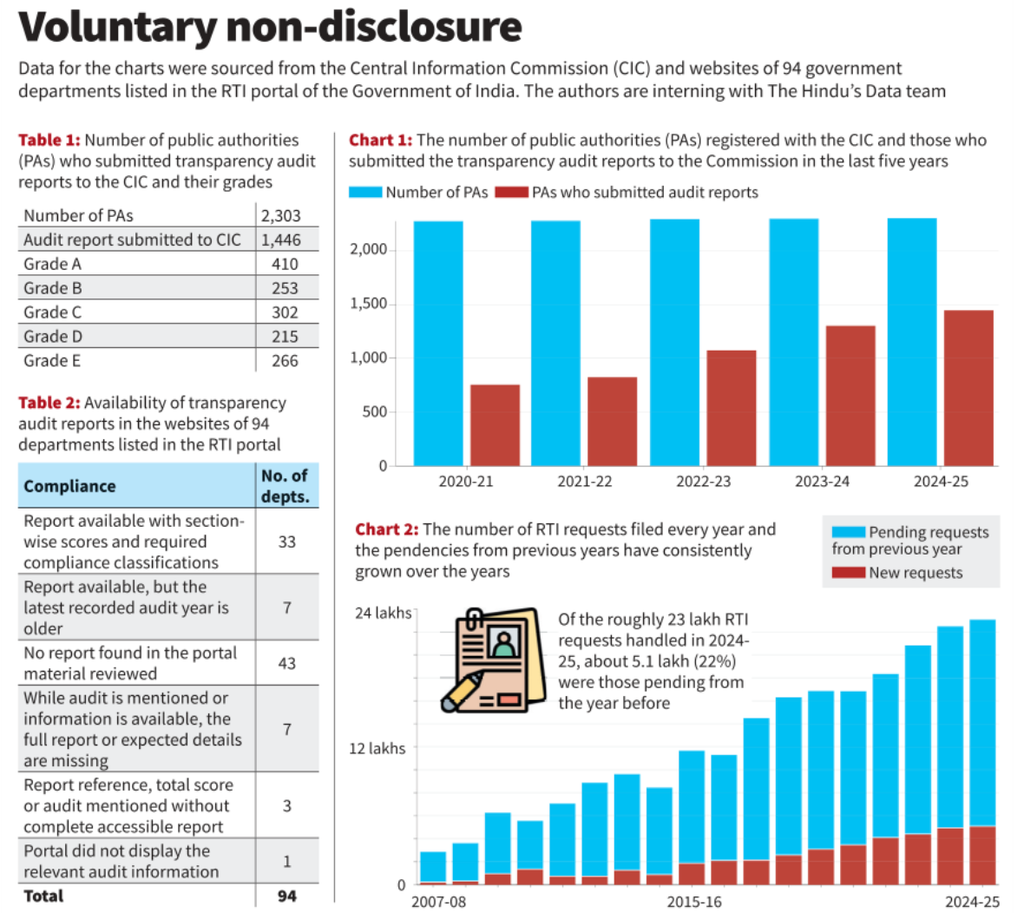
Recent Audit Trends (2024-25):
- Incomplete Audit Registration: Out of 2303 public authorities registered with the CIC, only 62.7% (1,446) submitted third-party audit reports.
- Subpar Compliance Quality: Out of the submitted audits, 783 authorities scored in Grades C, D, or E (signifying performance scores at or below 80%).
- Poor Digital Availability: Out of 94 key government department portals evaluated, only 33 hosted updated transparency audits, while 43 portals had no accessible audit materials whatsoever.
- Systemic Spillover: Deficient proactive disclosures forced an avoidable volume of 23 lakh applications, resulting in a 22% (5.1 lakh) legacy backlog.
Comprehensive Institutional and Legal Challenges:
1. Institutional Weaknesses (Information Commissions):
- Vacancy Crisis: Chronic delays in appointing Information Commissioners lead to functional paralysis.
- High Pendency Trait: Of the 23 lakh requests handled in the 2024-25 cycle, 22% (5.1 lakh) were carried over as backlog, compromising the value of time-sensitive queries.
2. Legal Amendments and Dilutions:
- RTI (Amendment) Act, 2019: Transferred the authority to set tenures, salaries, and service conditions of Central and State Information Commissioners directly to the Executive. Critics argue this undermines the institutional parity they shared with statutory constitutional authorities, weakening autonomy.
- Digital Personal Data Protection (DPDP) Act, 2023: Completely replaced the balanced public-interest exemption clause under Section 8(1)(j) with a rigid blanket exemption on personal data. This creates a firewall protecting public officials’ track records, asset disclosures, and discretionary spending profiles.
3. Behavioural and Infrastructure Barriers:
- Culture of Secrecy: Public Information Officers (PIOs) frequently treat disclosure as an adversarial vulnerability rather than a baseline democratic responsibility. This institutional resistance often manifests as arbitrary demands for an applicant’s motives – a direct violation of Section 6(2) of the RTI Act, which explicitly states that applicants need not give reasons for requesting information.
- Deficient Digital Management: Digital portals remain structurally weak, suffering from dead hyperlinks, unsearchable non-machine-readable PDFs, and unarchived, obsolete datasets.
Ethical Dimensions:
- Breach of the Democratic Social Contract: Transparency is the foundational bedrock of a social contract. When a government insulates its law and order machinery from public accountability, it fosters systemic public distrust.
- Information Asymmetry as Disempowerment: True citizen empowerment relies on symmetric access to data. Curtailing this limits public participation, grassroots social audits, and locks citizens out of governance.
Way Forward:
- Proactive Disclosure (Section 4): Governments must aggressively pursue Section 4(2) of the RTI Act to publicise maximum data automatically via online channels, minimizing the need for citizens to file formal requests.
- Standardised Digital Registries: Deploy machine-readable, indexable, and searchable templates for Section 4 compliance across all departments.
- Performance Auditing Linked to Appraisals: Tie departmental Section 4 audit marks directly to annual civil service evaluation rankings.
- Strengthening Infrastructure: Urgent, time-bound filling of vacancies in both State and Central Information Commissions (CIC/SICs) as regularly emphasised by the Supreme Court.
- Harmonisation of Laws: An institutional balance must be struck between personal privacy under the DPDP Act and public accountability under the RTI Act, ensuring privacy is not weaponised to shield institutional corruption.
- Modernising Records Access: Replace archaic sorting with automated document management systems and provide regular proactive transparency training to PIOs.
Regular proactive disclosure, independent oversight and a responsive administrative culture are essential to make transparency the norm rather than an exception.
Mains Practice Question:
Q. The Right to Information (RTI) Act, 2005 was envisioned to transition Indian governance from official secrecy to structural transparency. However, institutional bottlenecks, legal friction, and bureaucratic resistance continue to dilute its efficacy. Evaluate.
Prelims Practice MCQ:
Q. Consider the following statements regarding the Right to Information (RTI) Act, 2005:
- Under Section 6(2) of the Act, an applicant seeking information from a public authority is legally bound to provide brief reasons or motives for making the request if demanded by the Public Information Officer (PIO).
- The Digital Personal Data Protection (DPDP) Act, 2023 amended Section 8(1)(j) of the RTI Act to remove the provision that allowed personal information to be disclosed if it served a larger public interest.
Which of the statements given above is/are correct?
(a) 1 only
(b) 2 only
(c) Both 1 and 2
(d) Neither 1 nor 2
Answer: (b)
Explanation:
- Statement 1 is incorrect: Section 6(2) of the RTI Act explicitly states that “An applicant making a request for information shall not be required to give any reason for requesting the information or any other personal details except those that may be necessary for contacting him.” A PIO cannot legally demand the motive behind a request.
- Statement 2 is correct: The DPDP Act, 2023 amended Section 8(1)(j) of the RTI Act by substituting the earlier provision with a strict blanket exemption for personal information. Previously, Section 8(1)(j) allowed the disclosure of personal data if the PIO was satisfied that a larger public interest justified it. The new amendment removed this public interest exception, making personal data strictly exempt from disclosure.
Source: https://anantamias.com/current-affairs/gaps-in-the-implementation-of-the-rti-act/
Why does UAPA demand urgent reform?
Why in News?
October 12, 2026 marks the second death anniversary of Professor G.N. Saibaba, renewing debate over prolonged imprisonment, stringent bail conditions and procedural safeguards under the Unlawful Activities (Prevention) Act, 1967 (UAPA).
| UPSC Relevance: GS-2 Polity and Governance: Human Rights; GS-3 Internal Security: Terrorism Prelims: Key facts about UAPA Mains: UAPA: Provisions, Significance and Challenges posed. |
What is UAPA?
- The Unlawful Activities (Prevention) Act, 1967 is India’s principal anti-terrorism legislation. Initially enacted to prevent unlawful activities threatening India’s sovereignty and territorial integrity, it has gradually expanded to cover terrorism, terrorist organisations, individual terrorist designations and terror financing.
- Major amendments: The 2004 amendment incorporated terrorism-related provisions following the repeal of the Prevention of Terrorism Act (POTA). The 2008 and 2012 amendments strengthened the framework, while the 2019 amendment empowered the government to designate individuals as terrorists and expanded the investigative powers of the National Investigation Agency (NIA).
Key Provisions of the UAPA:
- Unlawful activities and associations: Section 2(o) broadly defines unlawful activity, while Section 3 empowers the Central Government to declare an association unlawful, subject to statutory review.
- Terrorist acts: Section 15 defines a terrorist act, while Sections 16-18 prescribe punishments for terrorist acts, conspiracy and related activities.
- Terrorist organisations and individuals: The Act permits the government to notify terrorist organisations. Following the 2019 amendment, individuals can also be designated as terrorists, subject to statutory review and removal mechanisms.
- Membership and support: The Act criminalises specified activities relating to membership, support, recruitment, harbouring, conspiracy and financing associated with unlawful or terrorist organisations.
- Extended investigation period: Subject to statutory conditions and judicial scrutiny, the period for completing an investigation and detaining an accused can be extended from 90 to 180 days.
- Stringent bail conditions: Under Section 43D(5), bail is restricted where, after examining the case diary or police report, the court finds reasonable grounds for believing that the accusation is prima facie true.
- Investigation and prosecution: The Act provides powers of arrest, search and seizure, while specified offences require prior governmental sanction for prosecution.
These provisions serve legitimate national-security objectives, but their breadth and interaction with stringent bail restrictions create significant concerns about individual liberty and due process.
Major Concerns and Challenges:
(i) Prolonged Pre-trial Incarceration and Delayed Justice:
The combination of stringent bail provisions, extended investigation periods and lengthy trials can result in years of imprisonment before conviction. This undermines the presumption of innocence and risks turning pre-trial detention into punishment.
- G.N. Saibaba case: He spent nearly a decade in prison before being acquitted by the Bombay High Court in 2024.
- Bhima Koregaon case: Sixteen scholars and activists were arrested following the 2018 case. The trial has yet to begin eight years later.
- Delhi riots case: Several student leaders and activists faced UAPA charges following the 2020 riots. In early 2026, the Supreme Court granted bail to five of seven appellants after more than five years in prison.
In Union of India v. K.A. Najeeb (2021), the Supreme Court recognised that prolonged incarceration and the unlikelihood of an early conclusion of trial could justify constitutional intervention despite statutory restrictions on bail.
Even where an accused is eventually acquitted or granted bail, years of lost liberty, deteriorating health, financial hardship and reputational damage may be irreversible.
(ii) Vague and Expansive Definitions:
- Overbroad Language: Section 2(1)(o) (unlawful activity) and Section 15 (terrorist act) use expansive phrasing, leading to subjective interpretations by enforcement agencies.
- Proportionality Blur: The Act fails to clearly distinguish between passive association, ideological sympathy, and active participation in violence, overriding the judicial standard set in Arup Bhuyan v. State of Assam.
- Excessive Executive discretion: Imprecise statutory language grants wide powers to investigative bodies, allowing them to conflate legitimate dissent, speech, and protests with terrorism.
- Constitutional Infringement: This lack of precision risks creating a chilling effect on the freedom of speech and expression, directly undermining Article 19(1)(a) and the right to assemble peacefully under Article 19(1)(b).
(iii) Inconsistent Judicial Interpretation:
Judicial interpretation has not always provided a consistent safeguard against expansive application of the UAPA. Section 43D(5) places a significant restriction on bail by requiring courts to examine whether the accusation is prima facie true.
- Restrictive Prima Facie Standard: In NIA v. Zahoor Ahmad Shah Watali (2019), the Supreme Court barred detailed evaluation of evidence at the bail stage, dictating that prosecution documents must be accepted at face value, making bail nearly impossible.
- Constitutional Overlook Exception: In Union of India v. K.A. Najeeb (2021), the Court carved out an exception, ruling that statutory barriers under Section 43D(5) cannot override constitutional courts’ power to protect Article 21 in cases of prolonged incarceration without trial.
The coexistence of these conflicting doctrines leaves trial courts without a uniform guideline on whether to prioritise statutory restrictions (Watali) or constitutional protections (Najeeb).
(iv) Chilling effect on Speech and Association
- The use of counter-terrorism provisions against activists, scholars and journalists can discourage legitimate dissent, reporting, research and civil-society work. The resulting chilling effect can weaken democratic participation, freedom of association, academic freedom and the ability of civil society to hold public authorities accountable.
Constitutional and Judicial Safeguards:
| Constitutional Provision / Judgment | Significance |
| Article 14 | Requires non-arbitrary State action and equal protection of the laws. |
| Article 19(1)(a) | Protects freedom of speech and expression, subject to constitutionally permitted restrictions. |
| Article 21 & 22(1) | Forms the bedrock of due process; ensures the right to a speedy trial and the mandatory right to be informed of the grounds of arrest upon detention. |
| UOI v. K.A. Najeeb (2021) | Formulated the Constitutional Exception: Statutory bail bars (Sec 43D(5)) cannot override Judicial powers to protect Article 21 against prolonged pre-trial incarceration. |
| Arup Bhuyan v. State of Assam (2023) | Expanded state overreach by reversing the 2011 ruling; established that mere association or membership in a banned organisation can attract criminal liability. |
| Prabir Purkayastha v. State (2024) | Mandated that communicating the “grounds of arrest” in writing to the accused is an inviolable constitutional right under Article 22(1). |
Way Forward:
- Narrow and precise statutory definitions: Parliament should clarify the scope of unlawful activity, organisational membership and terrorist acts to distinguish genuine participation in terrorism from peaceful dissent, ideological association and legitimate political activity.
- Reform bail provisions: The application of Section 43D(5) should incorporate meaningful judicial scrutiny of the quality and credibility of prosecution material, while preserving the legitimate requirements of national security investigations.
- Prevent indefinite pre-trial detention: Courts should periodically assess the necessity of continued incarceration, taking into account the length of detention, progress of the trial, nature of evidence and likelihood of an early conclusion.
- Ensure time-bound trials: Special Courts should receive adequate judges, prosecutors, forensic facilities and technological support. Case management and periodic review of pending cases can reduce avoidable delays.
- Strengthen procedural safeguards: Arrests, remand extensions, searches, seizures and prosecution sanctions should comply with statutory requirements and constitutional protections. Accused persons must have meaningful access to legal remedies.
- Ensure consistency in judicial interpretation: The Supreme Court should develop clear and predictable standards for applying the UAPA, particularly regarding membership, the definition of terrorism, evidentiary scrutiny at the bail stage and excessive trial delays.
The UAPA addresses a legitimate and serious national-security challenge. However, a law intended to protect the country must itself remain subject to the Constitution. UAPA reform should ensure that extraordinary investigative powers remain accountable to constitutional guarantees of liberty and fair procedure.
UPSC Mains Practice Question:
Q. “The effectiveness of counter-terrorism legislation depends as much on procedural fairness as on investigative powers.” Discuss with reference to the Unlawful Activities (Prevention) Act, 1967.
Practice MCQ:
Q. With reference to the Unlawful Activities (Prevention) Act, 1967 (UAPA), consider the following statements:
1. The Central Government can designate both individuals and organisations as terrorists.
2. The extension of the investigation-related custody period beyond 90 days, up to 180 days, requires judicial approval.
3. The Act applies to Indian citizens irrespective of where the crime mentioned in the Act is committed.
How many of the above statements is/are correct?
(a) Only one
(b) Only two
(c) All three
(d) None
Answer: (c)
Explanation:
- Statement 1 is correct: Following the 2019 amendment, the Central Government can designate both organisations and individuals as terrorists under Section 35.
- Statement 2 is correct: Under Section 43D(2), the investigation period can be extended beyond 90 days up to 180 days by the Court, provided it is satisfied with the Public Prosecutor’s report indicating the progress of the investigation and specific reasons for continued detention. Thus, judicial approval is required.
- Statement 3 is correct: UAPA applies to Indian citizens outside India. Therefore, an Indian citizen can be proceeded against under the Act for an offence committed outside India, subject to its provisions.
Source: https://anantamias.com/current-affairs/why-does-uapa-demand-urgent-reform/
