Why in News?
Norway has announced plans to propose a temporary restriction on AI-enabled smart glasses in selected public and sensitive spaces, citing risks of covert recording. The scope remains under consideration; it is not an enacted blanket ban.
| UPSC Relevance: GS-3 Science and Technology: Emerging Technologies; GS-2: Polity and Governance: Right to Privacy Prelims: Wearable technology, Artificial Intelligence, Augmented Reality. |
What are Smart Glasses?
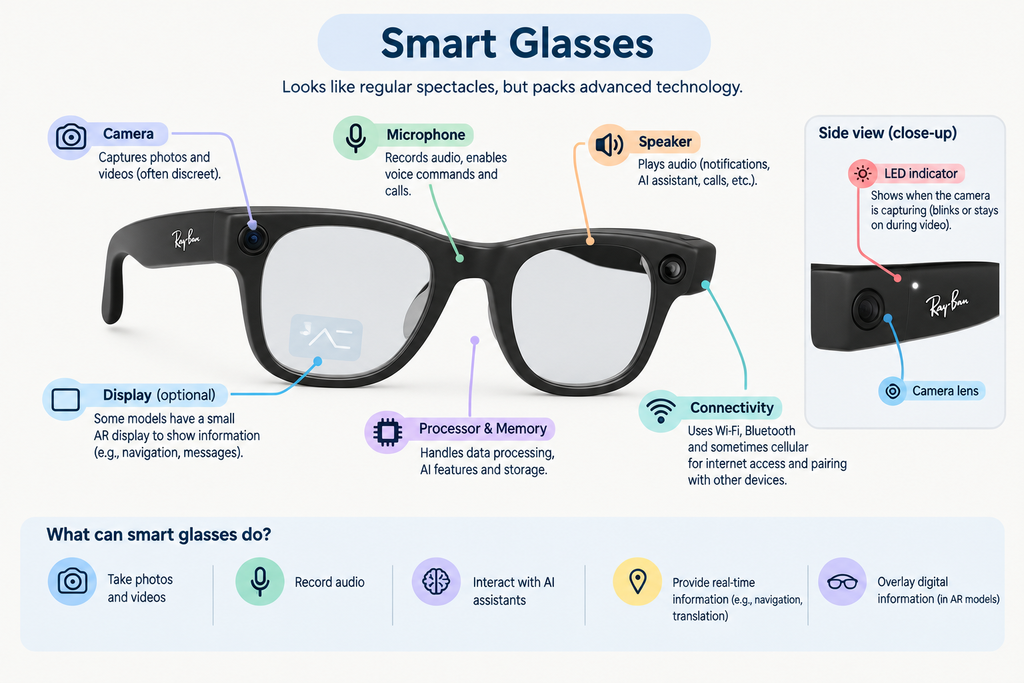
Smart glasses are wearable electronic devices engineered in the form factor of conventional spectacles. They integrate Computing, Artificial Intelligence (AI), Ambient Sensing, and Edge Connectivity to seamlessly merge digital functionality with the human visual and auditory field. Unlike smartphones, they capture data directly from the wearer’s natural field of view in real time.
Smart glasses operate on a three-tier architecture:
- Data Acquisition (Sensors): Employs miniaturised Complementary Metal-Oxide-Semiconductor (CMOS) cameras, Directional microphones, and Inertial Measurement Units (IMUs) for spatial tracking.
- Edge & Cloud Processing: Utilises low-power onboard system-on-chips (SoCs), pairing with smartphones or cloud infrastructure to run Multimodal AI models for Computer Vision, Natural Language Processing (NLP), and facial/object recognition.
- Information Delivery (Output): Premium models leverage Augmented Reality (AR) using optical waveguides or micro-LED displays to project digital overlays directly onto the user’s retina.
Note: Technological asymmetry exists across models. Not all smart glasses feature integrated cameras, facial recognition, or Augmented Reality displays.
Strategic Applications:
- Governance & Digital Inclusion (Accessibility): Acts as assistive tech for the visually impaired by employing AI to narrate ambient surroundings, read textual signs, and aid autonomous navigation.
- Healthcare Delivery: Facilitates real-time telemedicine and remote surgical guidance, allowing rural healthcare workers to stream live clinical views to urban specialists hands-free.
- Industrial Efficiency & Skilling: Enhances Industry 4.0 workflows. Field technicians in aviation, manufacturing, and logistics can access real-time schematics and remote expert troubleshooting, boosting productivity.
- Law Enforcement & Security: Integration with facial recognition and secure databases can assist tactical personnel in situational awareness and crowd management.
Associated Risks & Policy Challenges:
| Risk Dimension | Technical Manifestation | Governance & Policy Implication |
| Privacy & Surveillance | Ubiquitous, non-consensual capture of third-party audio, video, and biometric data. | Violates fundamental privacy rights (e.g., Article 21 in India); challenges DPDP Act implementation regarding explicit consent. |
| Cybersecurity | Vulnerability to spyware, unauthorised data exfiltration to third-party cloud servers, and location tracking. | Threatens critical data sovereignty; requires strict hardware compliance standards from regulators like BIS or CERT-In. |
| Cognitive Load | Constant visual/auditory stimuli leading to attentional fragmentation and delayed reaction times. | Increases public safety risks, particularly regarding distracted driving or heavy machinery operation. |
Existing Legal and Policy Safeguards in India:
- Digital Personal Data Protection (DPDP) Act, 2023: Establishes a framework governing the processing of digital personal data, including obligations of data fiduciaries and protections for individuals. Its relevance depends on the nature of the data processing and applicable statutory provisions.
- Existing Criminal Provisions:
- Section 66E of the IT Act, 2000 addresses non-consensual capture or transmission of images of private body areas in privacy-violating circumstances.
- Section 77 of the Bharatiya Nyaya Sanhita, 2023 addresses voyeurism involving women. These are targeted protections, not a general prohibition on every instance of public recording.
- Constitutional Protection of Privacy: Article 21, as interpreted in the Puttaswamy judgment, provides the constitutional foundation for protecting privacy and informational autonomy.
- Child Data Protection: The DPDP Act contains specific provisions concerning children’s personal data, including parental-consent requirements and restrictions on certain processing practices, subject to statutory provisions and applicable exemptions.
Way Forward:
For smart glasses to achieve sustainable adoption, a balanced approach is required:
- Privacy by Design: Manufacturers must embed clear, unalterable visual indicators (e.g., recording LEDs) to alert the public when data is being captured.
- Robust Regulatory Frameworks: Formulating clear guidelines under IT rules to govern data retention periods, biometric storage, and usage limits in public spaces.
- Risk-based restrictions: Establish clear recording rules for schools, healthcare facilities, examination centres and sensitive workplaces, with suitable accommodations for assistive uses.
The policy objective should be to preserve useful wearable innovation while making bystander privacy an essential design and governance requirement.
Tell Google you want more of this.
Add Anantam IAS as a preferred sourceOne tap, and this site shows up more often in your own Top Stories, AI Overviews and AI Mode. Remove it any time.