Daily Digest
UPSC · Civil Services Examination
Current Affairs · Tuesday, 14 October 2025
Current affairs curated and edited by Anantam IAS faculty — pulled from The Hindu, PIB, IDSA, Foreign Affairs and the ministries. Read, annotate, revise.
Old Rajinder Nagar · Delhi 110005 · anantamias.com
Snow Leopards

Context:
The snow leopard, the agile “ghost of the mountains” that inhabits the rugged ranges of 12
Asian countries, including India, has the lowest genetic diversity of any big cat species in the world, even lower than that of the dwindling cheetah.
UPSC Relevance:
Species in news
UPSC PYQ:
Q. Which one of the following National Parks lies completely in the temperate alpine zone? (2019)
(a) Manas National Park
(b) Namdapha National Park
(c) Neora Valley National Park
(d) Valley of Flowers National Park
About Snow Leopard
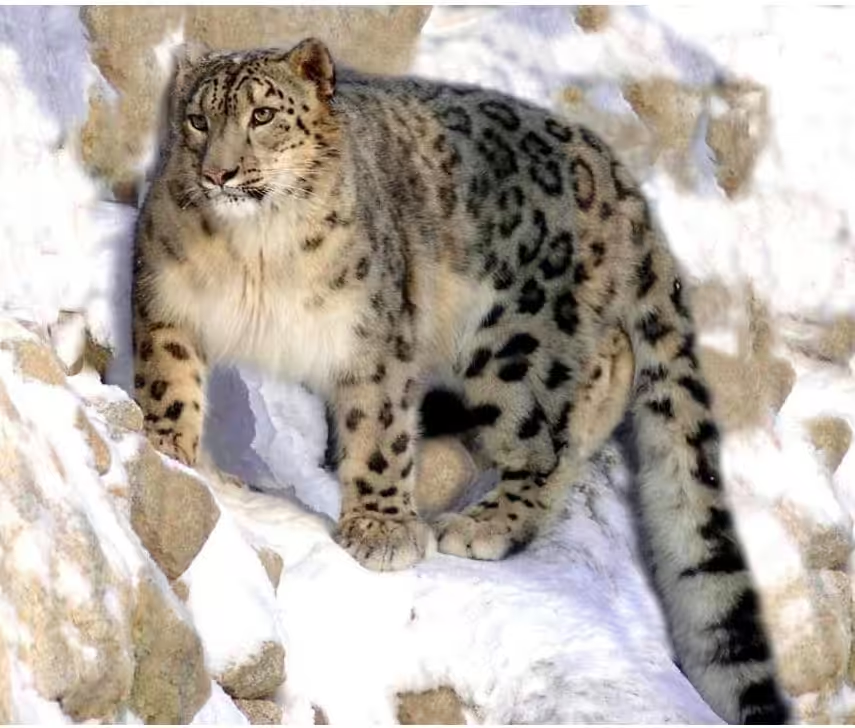
About Snow Leopard:
- The strikingly beautiful snow leopard remains one of the most mysterious cats in the world. Very rarely seen by humans, it has come to be known as the ‘ghost of the mountains.
- Range: including in Afghanistan, Bhutan, China, India, Kazakhstan, Kyrgyzstan, Mongolia, Nepal, Pakistan, the Russian Federation, Tajikistan and Uzbekistan.
- Habitat in India: Snow leopards live in the mountainous regions of Central and Southern Asia. In India, their geographical range encompasses a large part of the western Himalayas, including the Union Territories of Jammu and Kashmir and Ladakh, Himachal Pradesh, Uttarakhand and Sikkim and Arunachal Pradesh in the eastern Himalayas.

- The snow leopard has been listed in appendix I to the Convention on International Trade in Endangered Species of Wild Fauna and Flora (CITES) since 1975, and in appendix I to the Convention on the Conservation of Migratory Species of Wild Animals since 1986.
- In 2024, the General Assembly proclaimed 23 October as International Day of the Snow Leopard
- The species usually mate between January and March, a time when both sexes mark their territories intensively leaving signs such as scrapes, faeces, urine and scent-spray in prominent locations along their travel routes.
- The breeding pattern of the animal itself also makes it a highly vulnerable species, as a female snow leopard generally gives birth to only one or two cubs once in two years.
Snow leopards are active at night
Source: https://anantamias.com/current-affairs/snow-leopards/
India-Canada Relations

Context:
India and Canada have agreed on a series of measures to restore bilateral ties and enhance cooperation across trade, energy, technology, and agriculture.
UPSC Relevance:
International relations; important bilateral relations.
Key Agreements and Announcements:
- Relaunch of Trade Talks
- Both countries agreed to restart ministerial-level discussions on bilateral trade and investment, with a view to framing a new Comprehensive Economic Partnership Agreement (CEPA). The plan aims to replace earlier, stalled negotiations and align with India’s newer FTAs signed with partners like the UAE and EFTA nations.
- Re-establishment of Energy Dialogue
- The Canada-India Ministerial Energy Dialogue (CIMED) has been revived to deepen cooperation in clean energy, including green hydrogen, carbon capture technologies (CCUS), biofuels, and electric mobility. The two sides also agreed to promote LNG and LPG trade and strengthen critical mineral supply chains, vital for clean technology development.
- Civil Nuclear Cooperation
- Talks will continue on civil nuclear collaboration, with a focus on the supply of Canadian uranium to support India’s clean energy transition. A Critical Minerals Annual Dialogue will also be held in Toronto in March 2026 to further cooperation in this sector.
- Agricultural and Food Systems Collaboration
- Both nations are committed to enhancing cooperation in climate-resilient agriculture, agri-value chains, and nutritional security. The agreement emphasises recycling of agricultural waste, technology exchange, and improving food system sustainability.
- Science, Technology, and AI Cooperation
- A major highlight was the relaunch of the Joint Science and Technology Cooperation Committee, focusing on AI, digital infrastructure, and cybersecurity.
- Canada was invited to participate in India’s AI Impact Summit (February 2026). Additionally, Canada’s AI companies and researchers will collaborate on digital public infrastructure and inclusive AI initiatives.
Diplomatic and Strategic Significance:
- The meeting underscored a mutual desire to rebuild trust and de-risk the bilateral relationship from the fallout of earlier controversies.
- The joint statement highlighted “respect for each other’s concerns and sensitivities”, a veiled acknowledgement of India’s stance on Khalistan-related extremism on Canadian soil.
- The leaders also discussed Canada’s possible participation in India’s upcoming AI Summit, and an invitation for Prime Minister Mark Carney to visit India in early 2026.
Broader Context and Global Implications:
- Both sides emphasised that the revival of India-Canada relations comes at a crucial time amid global geopolitical uncertainty and shifting economic alliances.
- As members of the G20 and the Commonwealth, India and Canada share common interests in multilateral reform, climate action, and Indo-Pacific stability.
- By strengthening trade, technology, and clean energy partnerships, the two democracies aim to restore strategic stability, create resilient supply chains, and expand opportunities for mutual growth and innovation.
Source: https://anantamias.com/current-affairs/india-canada-relations/
IUCN World Congress

Context:
The International Union for Conservation of Nature (IUCN) has updated its Red List of Threatened Species, highlighting that Arctic seals and several bird species are under rising threat due to climate change and human activity.
UPSC Relevance:
Environment Organization
Q. Which one of the following is not a site for in-situ method of conservation of flora? (2011)
(a) Biosphere Reserve
(b) Botanical Garden
(c) National Park
(d) Wildlife Sanctuary
About IUCN World Congress:
Held once every four years, the IUCN World Conservation Congress brings together several thousand leaders and decision-makers from government, civil society, indigenous peoples, business, and academia, with the goal of conserving the environment and harnessing the solutions nature offers to global challenges.
- The next IUCN World Conservation Congress will take place in Abu Dhabi, United Arab Emirates, from 9 to 15 October 2025.
A Congress with three components:
- The Forum is a hub of public debate, bringing together people from all walks of life to discuss the world’s most pressing conservation and sustainability challenges.
- The Members’ Assembly is IUCN’s highest decision-making body. A unique global environmental parliament, it involves governments and NGOs – large and small, national and international – taking joint decisions on conservation and sustainability.
- In the Exhibition, IUCN Members and Commissions, businesses, partners, and academia host stands and events.
Congress history:
- The Congress only consisted of the Members’ Assembly of all IUCN member organizations.
- Since 1996, the Congress has grown to include the Forum, open to all, to debate major sustainable development issues, propose solutions and facilitate the sharing of information and experiences.
India Initiative in IUCN World Congress:
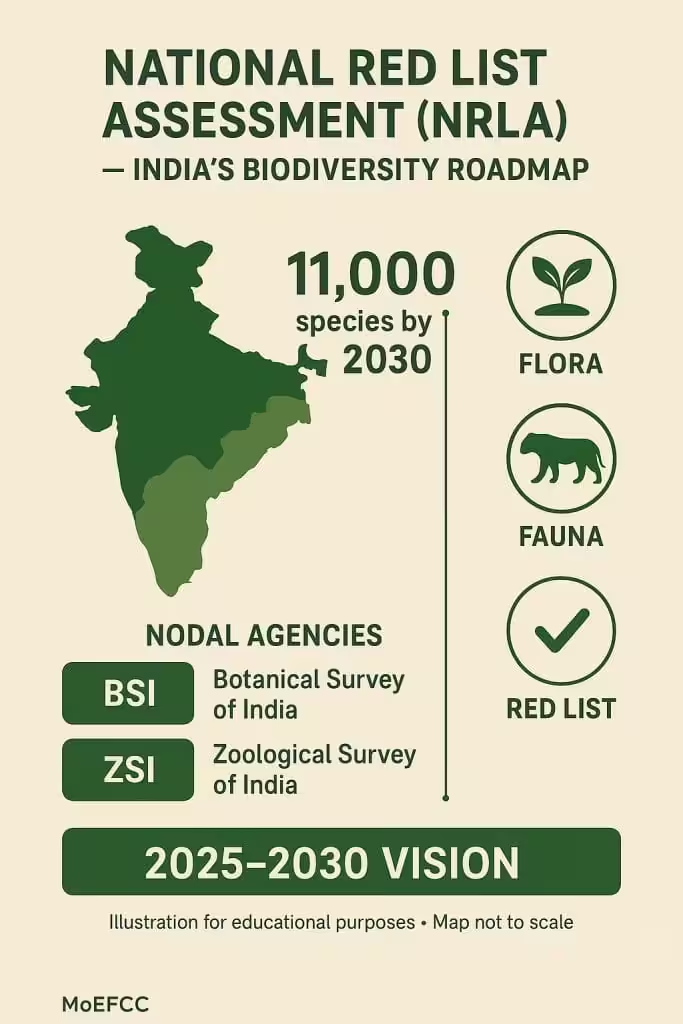
- Union MoS Shri Kirti Vardhan Singh leads Indian Delegation at the IUCN World Conservation Congress in Abu Dhabi and launches India’s National Red List Roadmap.
- India has launched the National Red List Assessment initiative to fulfil commitments under the Convention on Biological Diversity (CBD) and the Kunming–Montreal Global Biodiversity Framework.
- Aim: To develop a National Red List of threatened species in line with IUCN Red List standards.
- Roadmap: The National Red List Roadmap and Vision 2025–2030 provide strategic direction for the programme.
Source: https://anantamias.com/current-affairs/iucn-world-congress/