Daily Digest
UPSC · Civil Services Examination
Current Affairs · Monday, 18 May 2026
Current affairs curated and edited by Anantam IAS faculty — pulled from The Hindu, PIB, IDSA, Foreign Affairs and the ministries. Read, annotate, revise.
Old Rajinder Nagar · Delhi 110005 · anantamias.com
Nalanda University revives Śāstrārtha, an ancient debate tradition
Why in News?
Nalanda University organised “Shastrarth 2026” ahead of its third convocation, reviving the ancient tradition of scholarly debate linked to the historic Nalanda Mahavihara.
| UPSC Relevance: GS-1: History: Medieval India, Heritage Prelims: Nalanda Mahavihara, Śāstrārtha (key idea) |
What is Śāstrārtha?
- Śāstrārtha (Sanskrit: शास्त्रार्थ) refers to the tradition of formal, rigorous debate on philosophical and scriptural questions, rooted in the guru-shishya (teacher-student) tradition of ancient India.
- It was a defining feature of the intellectual culture at historic centres of learning like Nalanda, Takshashila, and Vikramashila.
For the first time, the university has formally included Shastrarth in its academic calendar to promote intellectual dialogue, logical reasoning and research-based discussions.
About the Modern Nalanda University:
- Location: Rajgir, Nalanda district, Bihar (close to the ruins of the ancient Mahavihara)
- The University was established under the Nalanda University Act 2010, by the Ministry of External Affairs. The new campus was inaugurated in 2024.
- It is an Institution of National Importance, supported by 18 East Asia Summit member countries. The University now has over 1200 students.
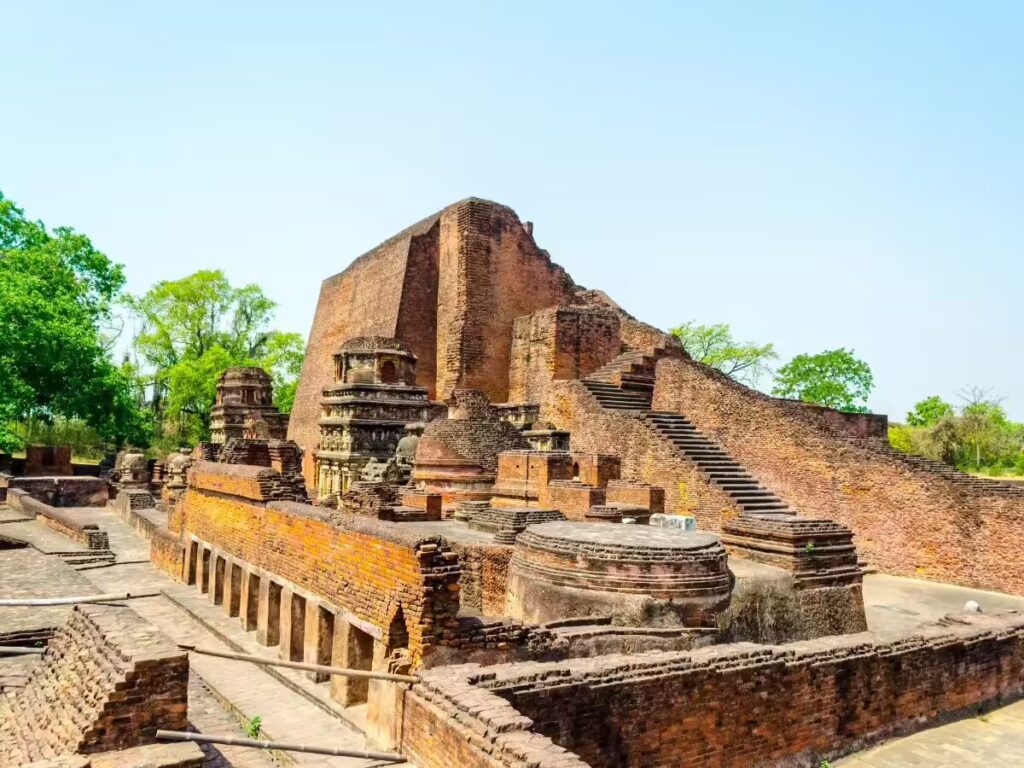
About Nalanda Mahavihara (Ancient University):
- Nalanda Mahavihara (5th-12th century CE) was one of the world’s greatest residential centres of learning, located near Rajagriha (modern Rajgir) in the ancient kingdom of Magadha (present-day Bihar). It operated for nearly a thousand years, from approximately 427 CE to around 1200 CE.
- Founder Patron:
- Numismatic evidence suggests Kumaragupta I of the Gupta Empire (5th century CE) was the founder patron. He is sometimes referred to as Shakraditya in inscriptions linked to Nalanda.
- Kumaragupta’s successors, Budhagupta, Tathagatagupta, Baladitya, and Vajra, extended and expanded the institution by constructing additional monasteries and temples.
- Patronage continued under King Harshavardhana of Kannauj (7th century CE) and reached a second peak under the Pala rulers (8th-12th century CE).
- After the decline of the Palas, monks were patronised by the Pithipatis of Bodh Gaya.
Key facts about Nalanda Mahavihara:
- Curriculum and Scholarship:
- Buddhist Philosophies taught: Mahayana, Madhyamaka, Yogachara, Sarvastivada, and Hinayana (all students studied Mahayana alongside the 18 Hinayana sects).
- Other subjects included: the Vedas, Sanskrit grammar, logic, medicine, mathematics, astronomy, Samkhya philosophy, and alchemy.
- The Mahavihara maintained a vast library known as Dharma Gunj (Mountain of Knowledge) that was a key repository for Sanskrit texts transmitted to East Asia by pilgrim-scholars.
- Notable Texts Composed at Nalanda: These texts played crucial roles in the development of both Mahayana and Vajrayana Buddhism across Asia.
- Works of Dharmakirti (Buddhist logician)
- Bodhisattvacharyavatara of Shantideva
- Mahavairocana Tantra
- Famous Scholars Associated with Nalanda: Nagarjuna, Aryadeva, Vasubandhu, Asanga, Dharmakirti, Shantideva, Chandrakirti, Śīlabhadra, and Vajrabodhi. Nalanda was famed for its learned professors or Upajjhaya (Upadhaya).
- Scale and International Character: At its height (7th century CE), Nalanda housed approximately 10,000 students and 1,500-2,000 teachers, according to the accounts of Chinese pilgrim Xuanzang (also known as Huang Tsang).
- Nalanda attracted students from Korea, Japan, China, Tibet, Sri Lanka, and other parts of Asia.
- Entry was highly competitive: oral examinations were conducted at the gates of the institution.
Decline and Destruction:
Nalanda was reportedly destroyed three times in its history, but was rebuilt after the first two attacks:
- First destruction: By the Huns under Mihirakula.
- Second destruction: During the 7th century CE by the Gaudas.
- Third and final destruction (c. 1200 CE): By forces under Muhammad Bakhtiyar Khilji, a military commander serving under Qutb al-Din Aibak of the Ghurid Sultanate.
Nalanda gradually ceased to function by around 1400 CE. The ruins of Nalanda were declared a UNESCO World Cultural Heritage Site in 2016.
Practice MCQ:
Q. With reference to Śāstrārtha in ancient India, consider the following statements:
1. It referred to a formal tradition of philosophical and scriptural debate.
2. It was associated with centres of learning such as Nalanda and Vikramashila.
3. It primarily focused on military strategy and statecraft discussions.
Which of the statements given above is/are correct?
(a) 1 and 2 only
(b) 2 only
(c) 1 and 3 only
(d) 2 and 3 only
Answer: (a)
Drone Strike near the UAE’s Barakah Nuclear Power Plant
Why in News?
A fire caused by a drone strike broke out in an electrical generator outside the inner perimeter of the Barakah Nuclear Power Plant in the United Arab Emirates. No injuries were reported, and radiological safety levels remained unaffected.
| UPSC Relevance: GS-2 International Relations: Locations in News, West Asia Prelims: Barakah Nuclear Power Plant (Location) |
UAE’s Barakah Nuclear Power Plant:
- Location: Al Dhafra Region. The facility is located 200 kilometres west of Abu Dhabi, the capital of the UAE, near the borders of Saudi Arabia and Qatar.
- The nuclear plant features four APR-1400 (Advanced Pressurised Water) reactor units and is built with technical collaboration from South Korea. It began operations in 2020.
- It became the first nuclear plant on the Arabian Peninsula. The UAE became the second country in the region to build a nuclear power station after Iran and the first Arab nation to do so.
- It supplies approximately 25% of the UAE’s total electricity, making it a cornerstone of the nation’s clean energy and net-zero strategy.
The UAE signed the US-UAE 123 Agreement (named after Section 123 of the US Atomic Energy Act), in which it agreed to forego domestic uranium enrichment and reprocessing of spent fuel to ease any proliferation concerns. Its uranium comes from abroad.
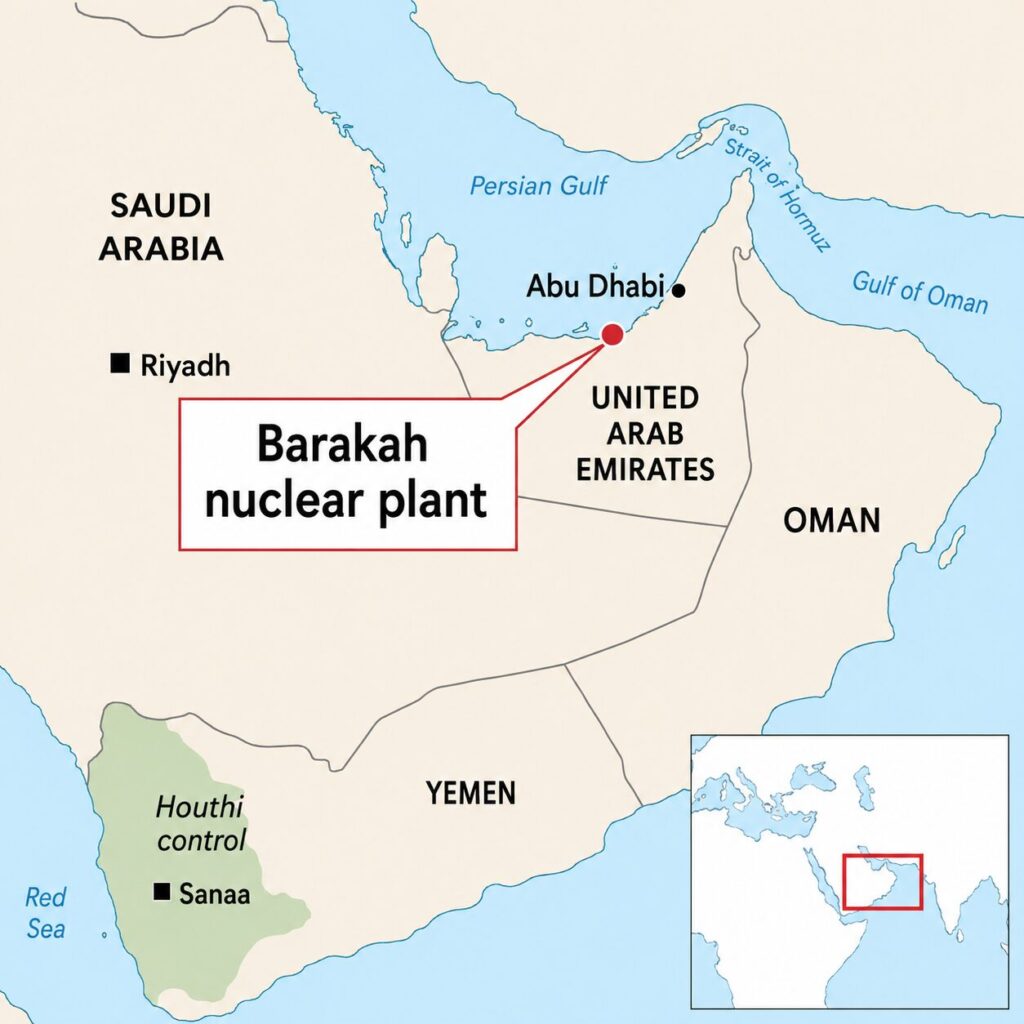
The latest drone attack comes amid stalled negotiations between the United States and Iran. The US halted its attacks last month but later imposed a port blockade.
Iran has effectively closed the Strait of Hormuz, which previously handled one-fifth of the world’s oil and liquefied natural gas supplies, before the US and Israel launched attacks on February 28, 2026.
India’s Strategic Interests in the UAE:
India’s Ministry of External Affairs expressed deep concern and urged restraint and a return to dialogue and diplomacy.
- Energy Vulnerability: India imports ~85% of its crude oil needs; the Gulf is a major source. The Hormuz crisis has driven fuel prices higher globally, impacting India’s Current Account Deficit and inflation management.
- Indian Diaspora: ~3.5 million Indians live in the UAE — the largest expatriate community in the UAE. Any escalation affecting UAE stability poses direct risks to this diaspora.
- Remittances: The UAE is a top source of remittances to India (~$15 billion annually).
- India-UAE Comprehensive Economic Partnership Agreement (CEPA): Signed in 2022. The bilateral trade target of $100 billion by 2030 depends on the stability in the UAE directly.
India maintains ties with both Iran (Chabahar Port, connectivity projects) and the UAE/Gulf states, calling for dialogue reflects India’s traditional non-alignment and multi-alignment strategy.
Source: https://anantamias.com/current-affairs/drone-strike-near-the-uaes-barakah-nuclear-power-plant/
President Promulgates Ordinance to Increase Number of Supreme Court Judges
Why in News?
The President of India has promulgated the Supreme Court (Number of Judges) Amendment Ordinance, 2026, increasing the sanctioned strength of judges in the Supreme Court from 33 to 37, excluding the Chief Justice of India.
The move is aimed at addressing the growing pendency of cases and ensuring faster delivery of justice in the country’s highest court. The current backlog is over 93,000 cases.
| UPSC Relevance: GS-2 Polity and Governance: Judiciary Prelims: Article 123, Article 124, Appointment process of the Judiciary Mains: Issues facing the Indian Judicial System. |
Supreme Court (Number of Judges) Amendment Ordinance, 2026:
- The Supreme Court (Number of Judges) Amendment Ordinance, 2026, has been promulgated in accordance with the powers of the President under Article 123 of the Constitution.
- The ordinance will be placed in both Houses of Parliament when it convenes.
- It will cease to operate if six weeks expire without any resolution passed on it after the reassembly of Parliament or if resolutions are passed in both Houses of Parliament disapproving the ordinance. The President can withdraw the ordinance at any time.
The ordinance has amended Section 2 of the Supreme Court (Number of Judges) Act, 1956, to replace the word “thirtythree” with “thirtyseven”. The Gazette notification specifically mentioned that Parliament was not in session and immediate action was necessary.
| Article 123 of the Indian Constitution: Under Article 123, the President can promulgate an Ordinance when the Parliament is not in session, and Immediate action is necessary. The ordinance has the same force as an Act of Parliament, but it must be laid before both Houses of Parliament. It ceases to operate six weeks after Parliament reassembles unless approved. |
With the latest amendment ordinance, the total sanctioned strength of the Supreme Court will now rise to 38 judges, including the Chief Justice of India. The move is being seen as a significant step towards strengthening judicial infrastructure and enhancing access to timely justice across the country.
Constitutional Basis: Article 124
- Article 124(1) of the Indian Constitution: “There shall be a Supreme Court of India consisting of a Chief Justice of India and, until Parliament by law prescribes a larger number, of not more than seven other Judges.”
- This article gives Parliament the power to expand judicial strength through legislation, without requiring a constitutional amendment under Article 368. The Bill requires to be passed by both the Houses of Parliament with a simple majority.
The Salaries and allowances of SC judges are charged to the Consolidated Fund of India, a non-votable expenditure.
Timeline of Evolution of Judicial Strength:
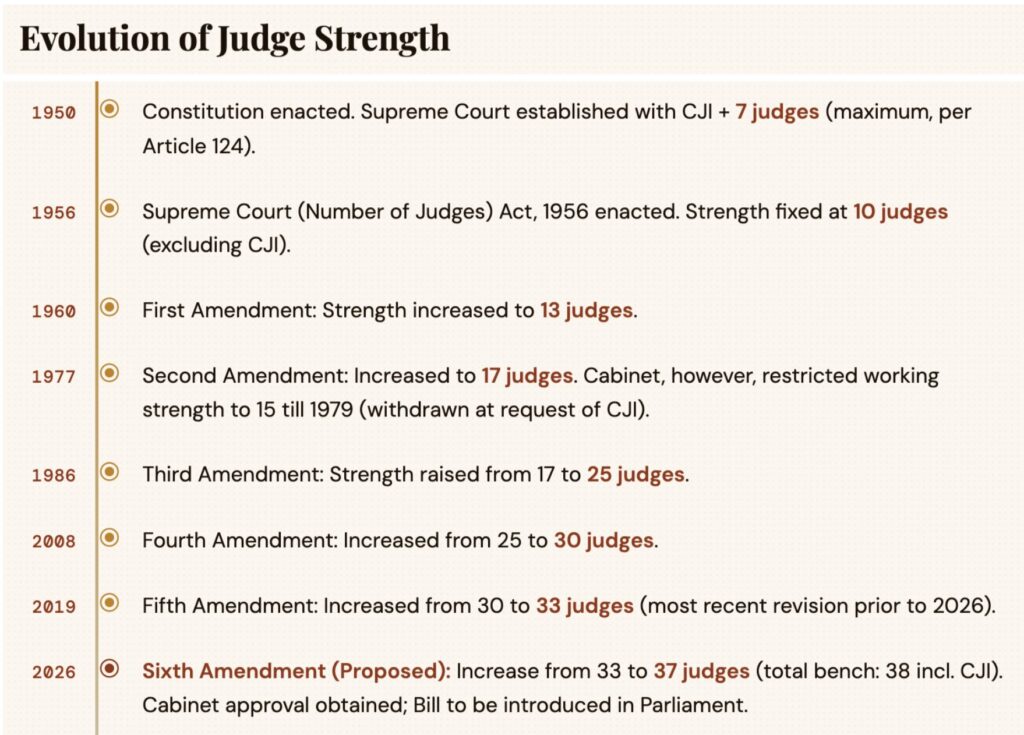
Significance of Expanded Sanctioned Strength:
- Reduction in Judicial Pendency: Over 92,000 cases are pending in the Supreme Court, spanning constitutional disputes, criminal appeals, civil matters, and PILs. The expansion aims to enhance the Court’s adjudicatory capacity and improve disposal rates.
- Strengthening Constitutional Benches: A larger bench strength can facilitate: Frequent Constitution Bench formation, faster adjudication rate, and enhanced specialisation in commercial, technological, and environmental matters.
- Rule of Law & Access to Justice: The Supreme Court has held the right to speedy trial as a component of Article 21. Thus, delays in justice delivery violate the fundamental right. Larger benches enable faster hearing of bail matters, habeas corpus, and fundamental rights cases.
- Greater scope for Diversity: Additional vacancies create an opportunity to improve representation in the higher judiciary by including: Women judges, Judges from underrepresented High Courts, SC/ST/OBC and minority communities and experts from specialised branches of law.
Associated Challenges:
- Insufficient numbers: Even at 38, India has one SC judge per ~3.7 crore people, which is far below global standards. Former CJIs have called for a strength of 70+ judges.
- Structural delays in appointments: The sanctioned strength increase is meaningful only if vacancies are filled swiftly. The collegium system (Second Judges Case 1993) controls appointments. Structural delays in the collegium-government interface remain unresolved. This can neutralise the benefit of increased sanctioned strength.
- Collegium opacity: The process of recommending names lacks statutory transparency, which raises concerns about accountability in judicial appointments. This can neutralise the scope for increasing diversity in judicial strength.
- Infrastructure gap: The existing Supreme Court building has been operating at near-capacity with 17 courtrooms and two registrar courts. Increased judges create an immediate need for additional dedicated support staff, specialised technical staff for digital, virtual, and hybrid hearing infrastructure.
- Bottleneck at High Courts: Pendency in High Courts exceeds 60 lakh cases; District courts hold over 4 crore cases. The expansion of judicial strength alone is just a partial fix.
The expansion of SC’s sanctioned strength offers an opportunity to improve judicial efficiency and representation. However, the need of the hour is to address systemic issues in the collegium process (opacity, delays, and inadequate accountability) to strengthen the justice delivery system.
UPSC Mains PYQ 2021:
Q. Discuss the desirability of greater representation of women in the higher judiciary to ensure diversity, equity and inclusiveness.
UPSC Mains PYQ 2017:
Q. Critically examine the Supreme Court’s judgment on ‘National Judicial Appointments Commission Act, 2014’ with reference to the appointment of judges of the higher judiciary in India.
Great Nicobar Mega-Project and Forest Rights Act
Why in News?
The ₹81,000-crore Great Nicobar Island (GNI) Mega Project has come under judicial scrutiny before the Port Blair Circuit Bench of the Calcutta High Court, over alleged violations of the Forest Rights Act (FRA), 2006, while obtaining tribal consent for diversion of forest land.
Public Interest Litigations (PILs) allege that the Andaman and Nicobar administration bypassed mandatory procedures under the FRA through flawed Gram Sabha resolutions, inadequate tribal representation, and failure to meet the legally required quorum.
| UPSC Relevance: GS-3 Economy: Infrastructure; GS-3 Environment and Biodiversity: Conservation, Forest Rights Prelims: Forest Rights Act (FRA), 2006, Shompen Tribe Mains: Great Nicobar Project: Location, concerns & significance. |
The Great Nicobar Project is a large-scale infrastructure initiative proposed by the Union Government to transform Great Nicobar Island into a strategic and economic hub in the Indo-Pacific region.
Read more: https://anantamias.com/current-affairs/the-great-nicobar-project/
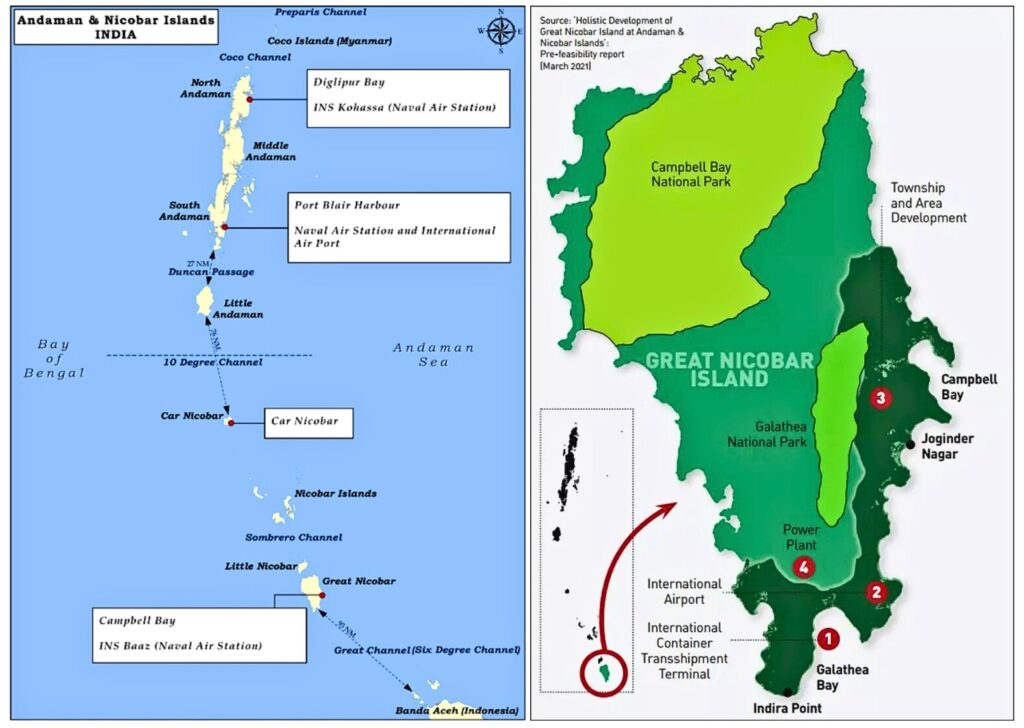
Forest Rights Act (FRA), 2006:
- The Forest Rights Act (FRA), 2006, recognises the rights of the forest-dwelling tribal communities and other traditional forest dwellers, who have lived in forests for at least three generations, to forest resources and other socio-cultural needs.
- The rights recognised under the FRA:
- Individual forest rights
- Community forest rights
- Rights over minor forest produce
- Grazing and fishing rights
- Rights to protect and conserve forests
- Habitat rights for PVTGs
- Before forest land can be diverted for projects, the Forest rights claims must be identified and settled. Gram Sabha consent is mandatory. The consent must be free, prior, and informed.
Key Issues before the Calcutta High Court:
- Alleged Violation of Gram Sabha Procedures: The petition alleges that gram sabhas lacked legal validity. Meetings failed to achieve the mandatory 50% quorum. Attendance reportedly ranged between only 1% and 12%.
- Questionable Tribal Representation:
- Shompen Tribe Consent: The petition argues that the consent for the Shompen tribe was allegedly provided by an officer of the Andaman Adim Janjati Vikas Samiti (AAJVS), not by tribe members themselves.
- Nicobarese Tribal Council Issue: Consent allegedly obtained through the Tribal Council Chairperson is contested. Petitioners argue that the chairperson cannot legally represent the entire community without collective approval.
- Non-Settlement of Forest Rights: The plea argues that no proper settlement of forest rights claims took place before granting forest clearance. The Recognition of Forest Rights (RoFR) certificates were issued without due process.
- Legality of the Sub-Divisional Level Committee (SDLC): The FRA Rules require adequate Scheduled Tribe representation in SDLCs. The petition alleges the committee lacked the mandated tribal representation. The required inclusion of women and tribal members was inadequate.
Who are the Shompen Tribe?
- The Shompen are a Particularly Vulnerable Tribal Group (PVTG) and are largely isolated from mainstream administration. Numbering only about 237-300 individuals, they are semi-nomadic hunter-gatherers who inhabit the interior forests of Great Nicobar. Their language has not been fully deciphered. They have no immunity to diseases common in the outside world.
- Existential Risk: The project is projected to increase the island’s population from ~9,000 to over 3,50,000 by 2050. Three Shompen settlements lie within the proposed development area, including their foraging and hunting territories. The 1972 settlement of ex-servicemen on the island’s east coast already forced the Shompen deeper into the forests, a precedent that raises serious concerns about further displacement.

The government states that no displacement of tribal communities is proposed. The project claims to be aligned with the Shompen Policy of 2015 and the Jarawa Policy of 2004, with consultations conducted through the Ministry of Tribal Affairs, AAJVS, and the Anthropological Survey of India.
Source: https://anantamias.com/current-affairs/great-nicobar-mega-project-and-forest-rights/