Daily Digest
UPSC · Civil Services Examination
Current Affairs · Friday, 19 September 2025
Current affairs curated and edited by Anantam IAS faculty — pulled from The Hindu, PIB, IDSA, Foreign Affairs and the ministries. Read, annotate, revise.
Old Rajinder Nagar · Delhi 110005 · anantamias.com
Chabahar Port
Context:
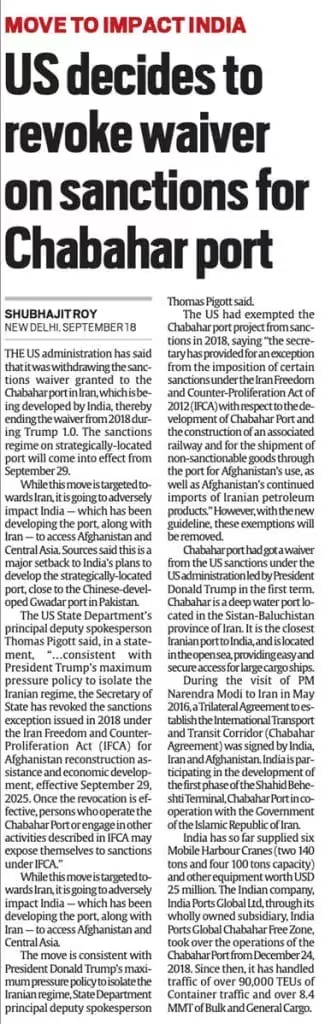
The Chabahar port had been granted waiver on sanctions by the united states of America in 2018. This waiver has been revoked as of now in order to further pressurize Iranian regime into conceding to USA’s demands. But, this revocation of waiver may have negative impact on India as India had been jointly operating this port with Iran as per the 2016 agreement.
UPSC Relevance: International Relations
PYQ:
Q. What is the importance of developing Chabahar Port by India? (2017)
(a) India’s trade with African countries will enormously increase.
(b) India’s relations with oil-producing Arab countries will be strengthened.
(c) India will not depend on Pakistan for access to Afghanistan and Central Asia.
(d) Pakistan will facilitate and protect the installation of a gas pipeline between Iraq and India.
About Chabahar port:
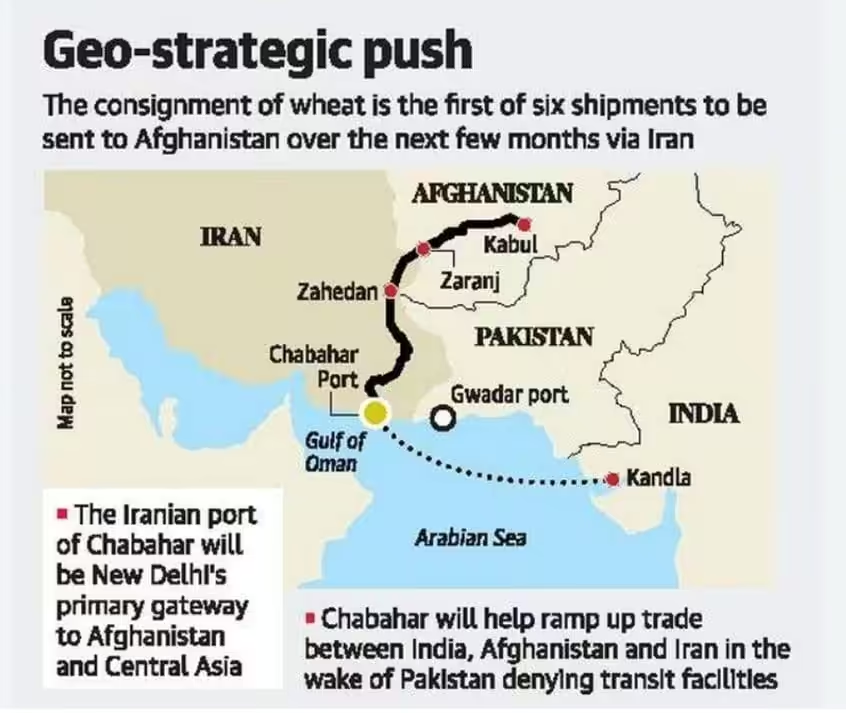
- Chabahar is Iran’s oceanic port nearest to India. It is situated in Sistan and Baluchistan Province, on the Makran coast. It lies in the Gulf of Oman.
- Chabahar Port project has two main ports called the Shahid Kalantari Port and the Shahid Beheshti Port.
- Iran had offered India the project of developing the Shahid Beheshti port which was well received by India.
Significance of Chabahar Port:
- Alternative Trade Route: Historically, India’s access to Afghanistan and Central Asia has been largely dependent on transit routes through Pakistan.
- Chabahar Port offers an alternative route that bypasses Pakistan, reducing India’s reliance on its neighbour for trade with Afghanistan and beyond.
- Also, Chabahar port will boost India’s access to Iran, the key gateway to the International North-South Transport Corridor (INSTC) that has sea, rail and road routes between India, Iran, Russia, Central Asia and Europe.
- Economic Benefits: Chabahar will play a crucial role in India’s efforts to enhance connections with the resource-rich Central Asian countries and Afghanistan.
- It will allow India to diversify its trading routes and gain enhanced access to the markets of Russia, Eurasia and Europe, apart from Iran and Afghanistan.
- Cargo movement through INSTC route is expected to save 30% in cost and 40% in transportation time, ensuring quick turnaround at a competitive cost.
- Central Asian nations, rich in resources but without direct access to the sea like Kazakhstan and Uzbekistan, have shown interest in utilising Chabahar to connect to the Indian Ocean Regions and tap into the Indian market.
- Humanitarian Assistance: Chabahar Port can serve as a crucial entry point for humanitarian assistance and reconstruction efforts in Afghanistan.
- Port has played a crucial role in supplying humanitarian aid, notably during the covid-19 pandemic.
- 2.5 million tonnes of wheat and 2,000 tonnes of pulses have been trans-shipped from India to Afghanistan via Chabahar port.
- In 2021, India provided 40,000 litres of the eco-friendly pesticide malathion to Iran through the port to combat locust attacks.
- Strategic Influence and Regional Stability: By developing and operating Chabahar Port, India can enhance its strategic influence in the Indian Ocean region, thus strengthening India’s geopolitical position.
- The Chabahar port will act as a counter to China’s development of the Gwadar port in Pakistan.
- Also, India can effectively respond to cases of sea piracy and serve as a first line of defence in the Arabian Sea, due to the docking facilities available at Chabahar.
Potential impact of revocation of waiver of sanctions on India:
- Issues of energy security as Iran and its Chabahar port have also been acting as channel for India to import energy resources and meet its energy security.
- Political impact in the form of potential turbulent relations with Iran if India abides to USA’s conditions on sanctions on the port. This may be seen by Iranian regime as India allying to USA’s policies towards Iran.
- Economic impact in the form of curtailment of trade opportunities in the markets of Central Asian countries, which presently India has been accessing through Chabahar port.
- Diplomatic fallouts such as downturn in India-Afghanistan relations and India-Central Asia relations as the Chabahar port has also been acting as a diplomatic bridge for India vis-à-vis these countries.
Source: https://anantamias.com/current-affairs/chabahar-port/
Secularism

Context:
The article is about Chief Justice of India (CJI) B.R. Gavai’s clarification after a controversy over his oral remarks made during a hearing on a damaged Lord Vishnu idol.
UPSC Relevance:
Indian Constitution—historical underpinnings, evolution, features, amendments, significant provisions and basic structure.
UPSC PYQ’s
Q. What was the exact constitutional status of India on 26th January, 1950? (2021)
(a) A Democratic Republic
(b) A Sovereign Democratic Republic
(c) A Sovereign Secular Democratic Republic
(d) A Sovereign Socialist Secular Democratic Republic
Q. Discuss each adjective attached to the word ‘Republic’ in the ‘Preamble’. Are they defendable in the present circumstances? (2016)
Secularism:
Secularism is a political idea concerned with the best way to govern religiously pluralist societies. The model of secularism we advocate for defends the civil liberties of all, whatever your personal beliefs.
The principles of secularism which protect and underpin liberal democracy and many of the freedoms we enjoy are:
- Separation of religious institutions from state institutions and a public sphere where religion may participate, but not dominate.
- Equality so that our religious beliefs or lack of them doesn’t put any of us at an advantage or a disadvantage.
- Freedom to practise one’s religion or belief without harming others, or to change it or not have one, according to one’s own conscience.
Secularism fosters a society where individuals are free to practise their religions and to express their beliefs freely, but where no single religion dominates or influences the decisions and policies of the government. It is the best chance we have to create a society in which people of all religions or none can live together fairly and peacefully.
SECULARISM IN THE HISTORY OF INDIA:
- Secular traditions are very deep rooted in the history of India. Indian culture is a composite one which is based on the blending of various spiritual traditions and social movements. In ancient India, the Santam Dharma (Hinduism) was basically allowed to develop as a holistic religion by welcoming different spiritual traditions and trying to integrate them into a common mainstream.
- Emperor Ashoka was the first great emperor to announce, as early as third century B.C. that, the state would not prosecute any religious sect. In his 12th Rock Edit, Ashoka made an appeal not only for the toleration of all religion sects but also to develop a spirit of great respect toward them.
- In medieval India the Sufi and Bhakti movements bond the people of various communities together with love and peace.
- The remarks of Guru Nanak, when he says that ‘There is no Hindu and no Musalman, as there is no distinction between man and man’ give support to the roots of secularism.
SECULARISM IN THE CONSTITUTION OF INDIA:
- It is true that the word ‘secular’ did not first occurs either in article 25 or 26 or in any other article of Preamble of the constitution. By the forty-second Constitution Amendment Act of 1976, the preamble was amended. Since then India becomes a sovereign, socialist, secular and democratic republic. The constitution says that, there shall be no ‘state religion’ in India.
- The state will not compel any citizen to pay any taxes for the promotion or maintenance of any particular religion or religious institution (Article 27).
- No religious instruction shall be provided in any educational institution wholly provided by state funds Article 28(1).
Role of Indian Judiciary:
- Kesavananda Bharati Case, 1973: The Supreme Court ruled that Secularism is a fundamental aspect of the Constitution’s basic structure.
- SR Bommai Case, 1994: The Court stated that secularism signifies equal treatment of all religions.
CHALLENGES OF SECULARISM IN INDIA:
Communalism
- One of the most significant challenges to secularism in India is communalism, which involves the mobilization of religious identities for political purposes. Communal tensions between religious communities, particularly between Hindus and Muslims, have periodically erupted into violence, undermining the secular fabric of the nation.
Religious Polarization
Political parties and groups often exploit religious differences to create vote banks, leading to the polarization of society along religious lines. This polarization not only threatens communal harmony but also erodes the secular character of Indian politics.
Hindutva Ideology
The rise of Hindutva, an ideology that promotes the idea of India as a Hindu nation, poses a direct challenge to secularism. Hindutva advocates argue for the primacy of Hindu culture and religion in public life, often at the expense of minority rights and secular principles.
Majoritarianism
The increasing influence of majoritarian politics, where the interests of the majority community are prioritized over those of minorities, has led to the marginalization of religious minorities. This trend undermines the inclusive and pluralistic ideals of secularism in India.
Vote Bank Politics
The use of religion-based vote banks by political parties has contributed to the communalization of politics. This practice encourages political leaders to cater to specific religious groups, often at the cost of secular governance and equal treatment for all citizens.
Hate Speech
- The rise of hate speech and inflammatory rhetoric targeting religious minorities is another challenge to secularism.
After a long history of communal incident in India, still now, Secularism is seen as the only
possible option that would be able to provide harmonious and peaceful survival for the different religions and casts of Indian society.
E-governance


Context:
The recent rise in penetration of digital governance in India is seen as transforming the governance landscape in Indian governance system, which has enabled ease of life for citizens and promotion of citizen-centric governance.
UPSC Relevance:
Important aspects of governance, transparency and accountability, e-governance- applications, models, successes, limitations, and potential.
UPSC PYQ:
Q. In order to ensure success of e-governance, India needs to bridge the digital divide. Examine. (150 words)
E-governance:
Definition:
World bank defines e-governance as the use by government agencies of information technologies that have the ability to transform relations with citizens, businesses and other arms if government. Hence, e-governance is the use of power of information technology by the government to ease the process of governance.
Features of e-governance:
- S-simple: Government rules and procedures need to be simplified to make them more user-friendly.
- M-moral: Since anti-corruption and vigilance agencies have improved, officers are being instilled with ethics and values.
- A-accountable: ICT raids in the establishment of performance criteria and effective measurement of those standards.
- R-Responsive: Service delivery that is efficient and government that is responsive to the people.
- T-transparent: Information that was once kept secret is now available to the public, bringing equity and the rule of law in government departments.
Components of e-governance:
- Government to citizen (G2C): It involves the direct delivery of government services and information to citizens through digital platforms, ensuring transparency and efficiency. Ex: UMANG (multi-service app), DigiLocker.
- Government to Business (G2B): It focuses on simplifying business interactions with the government by digitizing regulatory and service processes. Ex: GST portal, GeM portal.
- Government to Government (G2G): It refers to digital collaboration and information exchange between various government bodies to enhance governance efficiency. Ex: e-Samiksha (project monitoring), Sandes (official messaging).
Initiatives by government to promote e-governance:
- Public service delivery:
- Aadhar system
- Digi Locker
- E-Courts Integrated mission mode project increase judicial efficiency and its public outreach through its digitalization.
- Healthcare:
- Ayushman Bharat digital mission to establish essential infrastructure required for the integrated digital health ecosystem in the country.
- Education:
- SWAYAM (Study webs of active learning for young aspiring minds): It is an online platform that offers free courses and resources from various universities and institutions across India.
- DIKSHA (Digital Infrastructure for Knowledge Sharing): It is a national digital platform that provides teachers with access to e-content and teaching resources. It offers interactive textbooks, lesson plans,etc.
- Agriculture and Rural development:
- e-NAM (National Agriculture Market): It is an online trading platform that facilitates transparent and competitive bidding for agriculture produce. It connects agricultural markets across the country.
- Soil Health Card scheme: It provides digital soil health cards to farmers, containing information about soil nutrients, fertilizers, and recommendations for crop-specific nutrient management.
- Financial development and Inclusion:
- Unified Payments Interface (UPI) for ease of financial transactions.
- e-RUPI as a prepaid voucher-based system that enables seamless and contactless digital transactions, ensuring transparency and eliminating leakages in the distribution of government benefits.
- Urban and Rural governance:
- Pradhan Mantri Gramin Digital Saksharta Abhiyan (PMGDISHA): It aims at inculcating digital literacy among six crore individuals in rural areas.
- E-gram swaraj: For digitalization of panchayats.
Challenges of e-governance:
- Digital divide: Rural/marginalized groups lack access to internet and digital literacy.
- Data privacy: Incidents like data breach of Aadhar.
- Poor Infrastructure: Inadequate broadband and tech access, especially in remote areas.
- Resistance to change: Government officials and citizens often resist shifting from paper-based to digital systems.
- Technical complexity: limited expertise/resources to handle technical advancements. Ex: GSTN glitches during rollout.
Way Forward:
- Improving digital infrastructure: expand projects like BharatNet to provide high-speed connectivity to all gram panchayats.
- Increasing Digital Literacy: Continue and expand initiatives like PMGDISHA to improve digital skills among rural households.
- Ensuring data security and privacy: Implement robust cybersecurity measures and legislative frameworks, like personal data protection act.
- Promoting Inclusivity and Accessibility: Make e-governance tools accessible in multiple regional languages and adapted for differently abled users to ensure wider inclusivity.
Source: https://anantamias.com/current-affairs/e-governance/