Daily Digest
UPSC · Civil Services Examination
Current Affairs · Thursday, 21 August 2025
Current affairs curated and edited by Anantam IAS faculty — pulled from The Hindu, PIB, IDSA, Foreign Affairs and the ministries. Read, annotate, revise.
Old Rajinder Nagar · Delhi 110005 · anantamias.com
Ban on Real Money Gaming

Context:
The Lok Sabha passed the Promotion and Regulation of Online Gaming Bill, 2025 offering a legal framework to regulate online gaming companies in India.
UPSC Relevance:
Questions are asked on recent rules and regulations in the economic sector in Prelims.
PYQ 2022:
Q: With reference to foreign-owned e-commerce firms, operating in India, which of the following statements is/are correct?
1. They can sell their own goods in addition to offering their platforms as market-places.
2. The degree to which they can own big sellers on their platforms is limited.
Select the correct answer using the code given below:
A) 1 only
B) 2 only
C) Both 1 and 2
D) Neither 1 nor 2
Status of Online Gaming in India:
- The online gaming industry is a sunrise sector in the country, with a collective enterprise valuation of over Rs 2 lakh crore.
- Projected $9 billion market by 2029
- According to a report by FICCI and EY from March 2025, online gaming companies in India collectively earned a revenue of close to $2.7 billion in 2024.
- These companies typically make money by taking a cut from a user’s winnings.
- As per the report, more than 155 million Indians engaged with real money gaming 2024, marking a 10 per cent increase over 2023.
- It currently supports over 2 lakh direct and indirect jobs.
- CEA Nageswaran has highlighted recently that as per the NPCI data released earlier this week, UPI payments for digital games amounted to Rs 40,992 crore in April-July, which is almost equal to the amount spent in drug stores and pharmacies via UPI. So, Indian’s spending on real money games is not small. This number may go higher once we include credit and debit card transactions.
- According to a PwC report, with one of the cheapest internet mobile data prices in the world, Indian smartphone users, exceeding 650 million, have developed a robust culture of data consumption for the purposes of entertainment and playing games. In 2023, an average Indian citizen was consuming 24.1 GB of data per month – an increase of 24 per cent over 2022.
Regulation in India
- “Betting and gambling” is a state subject under entry 34 of the List II (State List) of the Seventh Schedule of the Indian Constitution and state legislations define betting and gambling related offences.
- Note : Lotteries fall under Union List.
- However, since online money games are concerned with digital space , the central government may regulate them via financial and technological regulations.
- Further ‘Police’ and ‘Public Order’ are State subjects as per the Seventh Schedule of the Constitution of India. The States/UTs are primarily responsible for the prevention, detection, investigation and prosecution of crimes including for action on illegal betting and gambling through their Law Enforcement Agencies (LEAs).
- Section 112(1) of the Bharatiya Nyaya Sanhita, 2023 (“BNS”) which came into effect from July 1, 2024, punishes unauthorised betting and gambling with minimum 1 year of imprisonment that may extend to 7 years and with fine.
- Online money gaming suppliers must register under the IGST Act, 2017. The Directorate General of GST Intelligence can direct intermediaries to block unregistered platforms violating the IGST Act. These apply to offshore suppliers of these games also.
- They are further Regulated under IT Act and the Digital Personal Data Protection Act, 2023.
- The industry also faces a 28 % Goods and Services Tax (GST) with proposals to increase the rate to as high as 40 %.
- Government vide Finance Act, 2023 has introduced income tax at the rate of 30 % on the net winnings in the online games with effect from assessment year 2024-25.
Rationale of banning the online gaming:
- Mounting national security worries – these platforms serve as potential messaging and communication grounds for terror organisations.
- The industry was increasingly accused of fuelling money laundering and law evasion including the use of digital wallets and cryptocurrencies for money laundering and offshore entities circumventing Indian tax and legal obligations.
- Addictive tendency of gambling and betting against social well being.
Impact:
- If the Bill is implemented in its current form, experts say it will be a death blow to the online real money gaming industry, which is projected to be a $9 billion market by 2029.
- The government has calculated that banning online money games will result in a revenue loss of about Rs 15,000 crore to Rs 20,000 crore.
Highlights of the Bill:
- An ‘online money game’ has been defined as a service played by a user by paying fees, depositing money or other stakes in expectation of winning which entails monetary and other enrichment in return of money or other stakes; but shall not include any e-sports. This is an expansive definition, and is likely to cover all major gaming platforms like Dream II, Winzo, MPL etc.
- The Online Gaming Bill, 2025 classifies online games into four types—e-sports, social games, educational games, and online money games.
- E-sports are competitive video games played in tournaments, similar to traditional sports. Games like PUBG, FIFA, or Valorant are examples. The government wants to promote e-sports as a skill-based activity that can create careers.
- Social games are casual games played for fun and entertainment, often with friends such as Ludo King, Candy Crush, and online chess. These games are safe but will still be regulated for user safety, age-appropriate access, and data protection.
- Educational games are designed for learning and skill-building. They include math quizzes, coding games for kids, or apps like Duolingo. The Bill supports such games for their positive value.
- Online money games, where players deposit money and play for cash rewards, will be completely banned because of their addictive and harmful effects.
- The government will prohibit any person from offering online games in India, failing which they could be imprisoned for up to three years, and penalised Rs 1 crore.
- Prohibition on promoting such platforms, by social media influencers. They will lso face jail time of two years, and a penalty of Rs 50 lakh.
- The government will also prohibit banks and financial institutions from facilitating financial trans-actions on such platforms.
- The Bill has envisioned the creation of a central authority to promote competitive e-sports, while ensuring overall compliance with the law.
- The online gaming Bill too allows for authorised officials to carry out search operations at physical and virtual places, even without a warrant.
- The Bill applies to all online money gaming platforms irrespective of whether they are games of skill or chance, a distinction the industry had lobbied hard for in the past.
| Aspect | Game of Skill | Game of Chance |
| Definition | Outcome predominantly determined by player’s skill, knowledge, strategy, and expertise | Outcome largely based on luck, randomness, or chance |
| Role of Player | Active involvement requiring practice, experience, tactics | Minimal control; result depends mostly on chance |
| Predictability of Result | Relatively certain based on skill | Uncertain and unpredictable |
| Legal Status in India | Generally legal and exempt from gambling laws in most states | Mostly prohibited under gambling laws in most states |
| Judicial Interpretation | Courts recognize as business activities entitled to constitutional protection (e.g., Supreme Court rulings on rummy and horse racing) | Considered gambling and subject to prohibition |
| Examples | Rummy, Poker, Fantasy Sports, Chess, Horse Racing (betting based on skill) | Lottery, Slot Machines, Roulette, Dice games, Teen Patti (3-card game) |
State-wise Online Gambling and Betting Status:
| State | Status |
| Goa | Legal and Regulated |
| Sikkim | Legal and Regulated |
| Nagaland | Legal for skill-based games |
| Meghalaya | Legal and Regulated |
| West Bengal | Legal for skill-based games |
| Andhra Pradesh | Illegal |
| Telangana | Illegal |
| Tamil Nadu | Illegal |
| Karnataka | Illegal |
| Maharashtra | Illegal |
| Kerala | Illegal |
| Gujarat | Illegal |
| Odisha | Illegal |
| Assam | Illegal |
| Others | Undefined/No specific laws |
- States like Goa, Sikkim, and Nagaland present regulated frameworks permitting legal online gambling within defined conditions.
- Bans in states like Andhra Pradesh, Telangana, and Tamil Nadu extend even to skill-based games.
- The diversified legal landscape has created regulatory uncertainty and compliance challenges for online gaming operators.
- The central government’s 2025 online gaming bill proposes a country-wide ban on real-money gaming, which could override state variations if enacted fully.
Source: https://anantamias.com/current-affairs/ban-on-real-money-gaming/
Brain Eating Amoeba / Naegleria fowleri

Context:
The Kerala Health Department has brushed aside speculation that there is an inordinate delay in diagnosing amoebic meningoencephalitis as samples are being sent to the State Public Health Lab. There has been reporting of multiple cases of the infection and a death in recent days in Kozhikode.
UPSC Relevance:
Diseases and Treatment therapies are often asked in Prelims.
PYQ 2023:
Q: ‘Wolbachia method’ is sometimes talked about with reference to which one of the following?
a) Controlling the viral diseases spread by mosquitoes
b) Converting crop residues into packing material
c) Producing biodegradable plastics
d) Producing biochar from thermo- chemical conversion of biomass.
Naegleria fowleri Infections:
- Naegleria fowleri is a free-living amoeba, a kind of one-celled organism.
- It is often called the “brain-eating amoeba” because it can infect the brain and destroy brain tissue.
- Naegleria fowleri lives in soil and warm freshwater lakes, rivers, ponds, and hot springs around the world.
- In very rare cases, Naegleria fowleri has been found in poorly maintained swimming pools, splash pads, and other recreational venues. The ameba also has been found in tap water.
- If water containing the ameba goes up the nose and to the brain, it can cause an infection called primary amoebic meningoencephalitis (PAM).
- The infection is not spread from swallowing water containing the ameba. One can’t get an infection from someone else or pass it on to others.
- Early symptoms of PAM include headache, fever, nausea, vomiting, and stiff neck, which can appear within one to nine days after exposure.
- As the infection progresses, symptoms may escalate to confusion, altered behavior, seizures, and eventually coma and death.
- Diagnosing PAM is challenging due to its rarity and symptom similarity to other conditions like bacterial meningitis. A high clinical suspicion, combined with cerebrospinal fluid analysis and PCR tests, is essential for timely diagnosis.
- Treating PAM is extremely difficult, and the infection is almost always fatal. The standard treatment includes antifungal and antibiotic medications, often administered an antiparasitic drug.
- Despite aggressive therapy, the survival rate remains very low, making early diagnosis and prompt treatment crucial.
- Prevention Tips
- Avoid Warm Freshwater: Limit activities in warm freshwater bodies, especially during periods of high temperatures.
- Use Nose Clips: When swimming or engaging in water sports, use nose clips to prevent water from entering the nasal passages.
- Clean Noses After Swimming: Rinse your child’s nose with hot water after swimming.
- Monitor Water Activities: Keep a close eye on children’s activities in water.
Source: https://anantamias.com/current-affairs/brain-eating-amoeba-naegleria-fowleri/
Agni-5 Missile

Context:
India has successfully tested Agni-5 Missile.
UPSC Relevance:
UPSC CSE has focused on Defence Technology in prelims examination.
PYQ2023 Prelims:
Consider the following statements:
1. Ballistic missiles are jet-propelled at subsonic speeds throughout their flights, while cruise missiles are rocket powered only in the initial phase of flight.
2. Agni-V is a medium-range supersonic cruise missile, while BrahMos is a solid-fuelled intercontinental ballistic missile.
Which of the statements given above is/are correct?
(a) 1 only
(b) 2 only
(c) Both 1 and 2
(d) Neither 1 nor 2
About Agni-5 Missile:
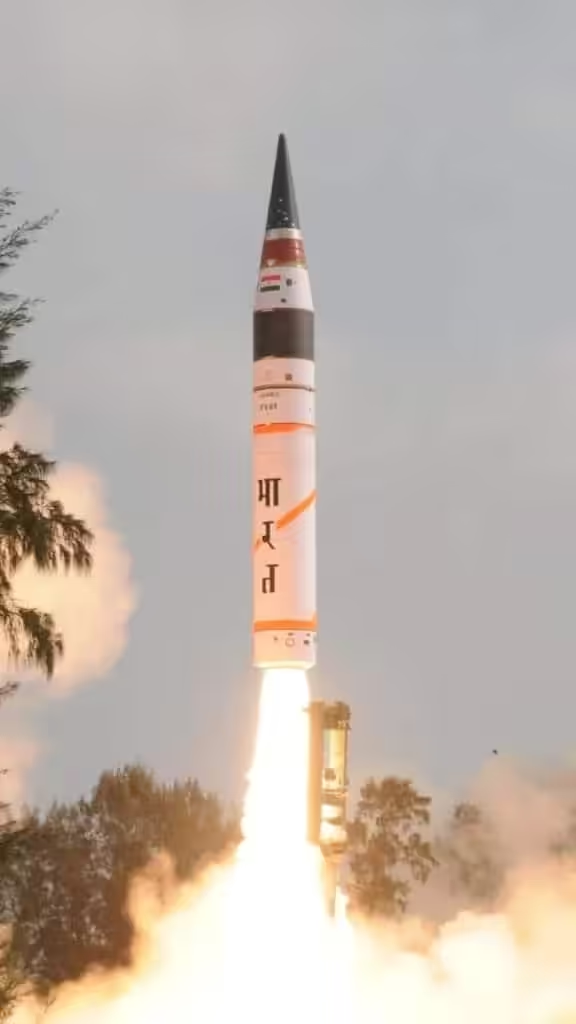
- Agni-5 is an advanced intermediate-range ballistic missile (IRBM)
- It is developed by India under the Integrated Guided Missile Development Programme (IGMDP).
- It is designed to carry nuclear warheads with long-range capability and is a key part of India’s strategic nuclear deterrence arsenal.
- It covers almost the entire Asian continent, including northern China, as well as parts of Europe.
- The missile enhances India’s capability to penetrate missile defense systems and respond decisively in case of nuclear aggression with a credible and flexible second-strike capability.
- Its development has raised concerns in neighboring countries regarding regional stability and nuclear balance.
Features:
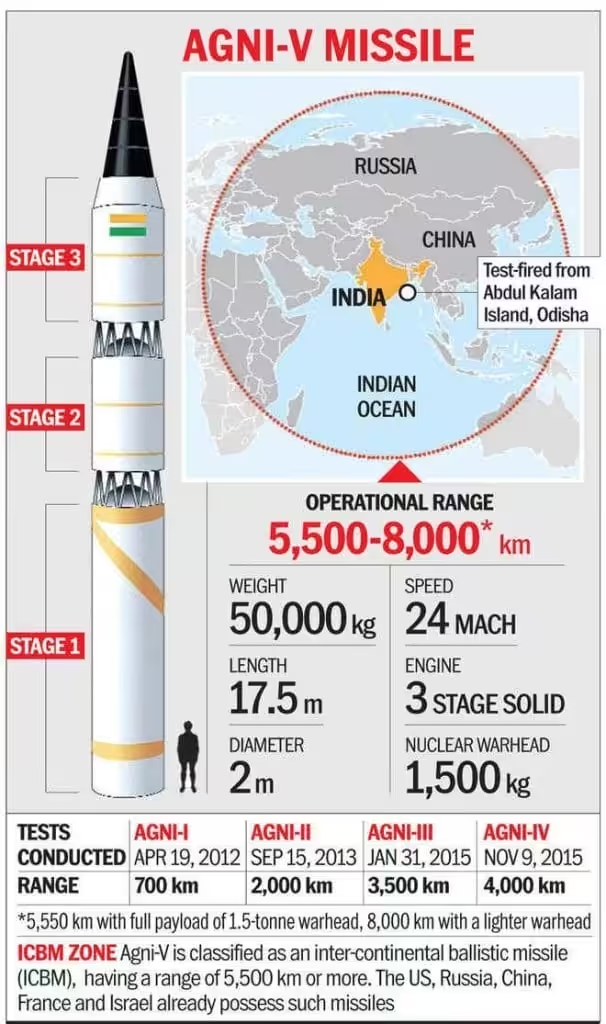
- Range: Over 5,000 km, potentially extendable up to 7,500 km or more in upgraded variants.
- Payload: Capable of carrying nuclear warheads with up to 1.5 tonnes of payload capacity, including Multiple Independently Targetable Re-entry Vehicle (MIRV) technology, which allows it to strike multiple targets with a single missile.
- An MIRV is a ‘missile bus’ whose passengers are nuclear bombs and which facilitates a single booster to deliver them to different targets.
- Mission Divyastra was conducted by DRDO in 2024 led by a woman director . It was the first successful flight test of the indigenously developed Agni-5 missile equipped with (MIRV) Multiple Independently Targetable Re-entry Vehicle technology.
- Today, the United States, the United Kingdom, and France use MIRV technology on SLBMs.
- China has MIRVed ICBMs, while Russia deploys both MIRVed ICBMs and SLBMs.
- The use of MIRVs on submarines is considered less destabilizing than on land-based missiles because the difficulty of finding nuclear submarines makes strikes against them unlikely.
- In January 2017 Pakistan reportedly tested a MIRVed missile, the Ababeel.

- Propulsion: Three-stage solid-fuel rocket motor for enhanced range, reliability, and faster launch capabilities.
- Guidance: Equipped with advanced guidance systems, combining gyroscope-based inertial navigation with satellite navigation systems such as India’s NavIC and American GPS, ensuring high accuracy over long distances.
- Launch system: Canisterized cold-launch system from mobile platforms for quick deployment and protection from harsh environmental conditions.
- Speed: Among the fastest missiles, reaching speeds up to Mach 24.
Comparison with Other Agni Missiles:
| Missile | Range (km) | Role |
| Agni-1 | 700–900 | Short-range, mainly towards Pakistan |
| Agni-2 | ~2,000 | Medium-range for broader region coverage |
| Agni-3 | 2,500–3,000 | Longer-range targeting China |
| Agni-4 | 3,500 | Intermediate-range, strategic deterrence |
| Agni-5 | 5,000+ (upgradable) | Long-range with MIRV, multi-target strike |
Note:
Read more about missiles and know the difference between cruise missiles and ballistic missile : Pralay Missile
Source: https://anantamias.com/current-affairs/agni-5-missile/
Bills for removal of PM, CM and Ministers on Arrest

Context:
Opposition and ruling party MPs exchanged barbs in the Lok Sabha on Wednesday over the government’s claim of bringing in political morality through three new Bills allowing the removal of elected representatives arrested on serious criminal charges. The Bills were referred to a Joint Committee after a voice vote.
UPSC Relevance:
GS 2: Structure, Organization and Functioning of the Executive. Salient Features of the Representation of People’s Act.
PYQ 2022:
Consider the following statements:
1. The Constitution of India classifies the ministers into four ranks viz. Cabinet Minister, Minister of State with Independent Charge, Minister of State and Deputy Minister.
2. The total number of ministers in the Union Government, including the Prime Minister, shall not exceed 15 percent of the total number of members in the Lok Sabha.
Which of the statements given above is/are correct?
a) 1 only
b) 2 only
c) Both 1 and 2
d) Neither 1 nor 2
UPSC Mains PYQ 2024:
“The growth of the cabinet system has practically resulted in the marginalisation of the parliamentary supremacy:” Elucidate.
UPSC Mains PYQ 2022:
Discuss the procedures to decide the disputes arising out of the election of a Member of the Parliament or State Legislature under The Representation of the People Act, 1951. What are the grounds on which the election of any returned candidate may be declared void? What remedy is available to the aggrieved party against the decision? Refer to the case laws.
Amendment Proposals:
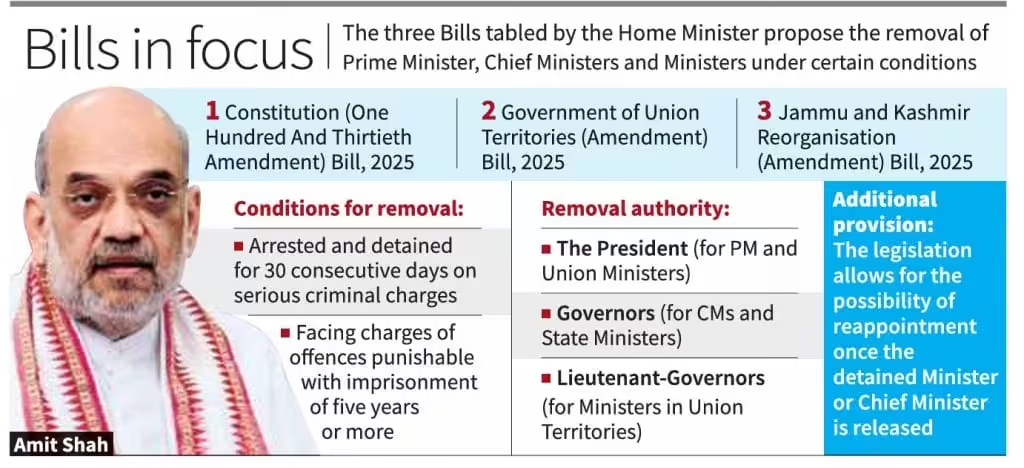
- The Bill proposes amendments to Articles 75, 164, and 239AA of the Constitution, which deal with the Union Council of Ministers, Council of Ministers in the states, and Ministers in Union Territories respectively.
- It seeks to remove a central or state Minister who is facing allegations of corruption or serious offences with provision for imprisonment of 5 years and more and has been detained for at least 30 days consecutively.
- The removal can be reversed when the Minister is released from custody.
- Chief Ministers and the Prime Minister will be in the ambit of the proposed law.
- The constitutional amendment will require a majority of two-thirds of Members present and voting to be passed.
Statement of Objects and Reasons of the Bill – There is a need for a legal framework for the removal of a Minister arrested on serious criminal charges. Ministers facing such allegations “may thwart or hinder the canons of constitutional morality and principles of good governance“, which could “diminish the constitutional trust reposed by people”.
Current Provisions for Removal of Ministers for Criminal offence:
- Section 8 of the Representation of the People Act, 1951, (RPA) – legislators are disqualified from contesting elections or continuing in office upon conviction for certain criminal offences, and being sentenced to imprisonment for at least 2 years.
- If sentenced to only a fine, disqualification lasts for 6 years from the date of conviction.
- If sentenced to imprisonment, disqualification applies from the date of conviction and continues for 6 years after release.
- Even a Minister loses membership of the house or assembly under Section 8. Losing membership under Section 8 due to disqualification means the Minister has ceased to be a member of the legislature, and cannot continue as a Minister without membership.
- The proposed amendment deals with the removal of a Minister after having spent a certain time in custody and not necessarily conviction.
- In the RPA, the yardstick for disqualification is conviction by a court. The disqualification can be stayed if the conviction is stayed by a higher court on appeal.
- In the proposed Bill, the yardstick for removal is 30 consecutive days of being “arrested and detained in custody”. Since arrest and detention are only the preliminary step in a criminal investigation, such a yardstick raises serious questions of due process.
- India’s constitutional scheme envisages the presumption of innocence for the accused, and puts the onus of proving the charges on the prosecution. Police file a chargesheet within 90 days of arrest, after which a court frames the charges. Trial begins after that, and can end in acquittal or conviction.
Debate:
In favour of the Bill:-
- Promote substantive democracy and accountability– Given the serious concerns over the growing criminalisation of politics, a view has gained ground that a legislator must be disqualified even before the stage of conviction.
- The long wait for conviction defeats the purpose of disqualification. Since September 2013, only 27 sitting MPs and MLAs have been disqualified after being convicted of offences.
- 46% members in 18th Loksabha have criminal charges against them.

Against the Bill:
- Violates Natural Justice – Constitutional principles of natural justice require a person to be given a fair opportunity to be heard before consequential action is taken against them.
- Violates Democratic principles – Disqualification impacts not only the rights of the legislator but also the will of the people who have elected the legislator.
- Against Federal Balance – Many politicians, particularly opposition and from states ruled by opposition, apprehend that the provisions may be used to topple governments of Opposition parties in States by deploying Central law enforcement agencies against them.
- The law Commission also did not recommend disqualification before framing of charges.
- According to the Commission, disqualifying a person before the “application of judicial mind” would be “against the principles of natural justice”, and “would mean that a person is penalised without proceed-ings being initiated against him”.
- The Law Commission’s 170th report in 1999 proposed that the framing of a charge for offences punishable by up to five years’ imprisonment should be made an additional ground for disqualification, which should be for five years or until acquittal, whichever was earlier.
- This proposal was reiterated by the Election Commission of India in 2004
- The Law Commission’s 2014 report recommended that a legislator could be disqualified when charges were framed against them by a court, since this showed prima facie judicial satisfaction that there existed sufficient material against a person to put them to trial.
- According to the Commission, disqualifying a person before the “application of judicial mind” would be “against the principles of natural justice”, and “would mean that a person is penalised without proceed-ings being initiated against him”.
Related Judicial Pronouncements:
- Lily Thomas vs. Union of India (2013) – The Supreme Court invalidated Section 8(4), eliminating the protection for convicted lawmakers who had appealed their conviction within 3 months. Hence, disqualification applies immediately from conviction.
- Public Interest Foundation vs Union of India (2018) – The PIL by Public Interest Foundation had sought disqualification at the stage of framing of charges for serious offences.
- The 5 Judge Bench stated that it could not legislate or add new grounds for disqualification beyond what Parliament had provided. It reiterated that the power to make laws on dis-qualification rested solely with Parliament.
- The court recommended that Parliament should enact a “strong law” making it mandatory for political parties to revoke the membership of those against whom charges have been framed for “heinous and grievous offences”, and to not give them tickets to contest elections.
- Manoj Narula v Union of India (2014) – the SC had said that there is no bar against a person with criminal antecedents being appointed as Minister.
- However, the court suggested that as the “repository of constitutional trust”, the Prime Minister should consider not choosing individuals with criminal antecedents, especially if charges have been framed for heinous or serious criminal offences or corruption.
- State v. K Ponmudi (2023) – This case reaffirmed that even fine or imprisonment for a single day under Section 8(1) leads to disqualification, with disqualification lasting for six years from conviction or imprisonment plus six years from release.
SC observations in recent 2 cases
- V Senthil Balaji of Tamil Nadu
- He was arrested by the Enforcement Directorate in 2023 in the alleged cash-for-jobs scam and remained in custody for 14 months. He was dropped as a Minister after pressure from the Governor and the opposition.
- In September 2024, the SC granted Balaji bail because the trial was likely to take several years. Within days of being released, Balaji was reinstated as a Cabinet Minister.
- The ED urged the SC to cancel his bail, arguing that from his position of authority, he might influence the case against him.
- The SC observed that it had not taken into account his ministerial position, as he had resigned before his bail application was heard.
- In April 2025, the court told Balaji to choose between “freedom or post” – he could either resign or risk the cancellation of his bail. Days later, Balaji stepped down, and the court allowed his bail to continue.
- Former Delhi Chief Minister Arvind Kejriwal
- He was granted bail in the alleged liquor policy money laundering case, but the SC barred him from signing official documents, entering government offices, and interacting with witnesses and accessing files connected with the case.
- The court, however, made it clear that it had no jurisdiction to compel an elected leader to step down; whether he should resign was left to Kejriwal’s discretion.
- In September 2024, the court granted him regular bail, noting that prolonged incarceration without progress in the trial would be unjust. It refrained from issuing directions on his continuance in the office. Kejriwal voluntarily resigned soon afterward.
Criminalisation of Politics:
| Causes | Impact | Way Forward |
| 1) Focus on Electoral Dynamics & Vote Bank Politics rather than criminal background. Ability to win elections matters more. | 1) Decline in parliamentary productivity and legislature – quality of deliberation and debate has declined, use of unparliamentary language and frequent disruption and misbehaviour by some MP’s and MLA’s. | 1) ARC and Law Commission– Debar such people from contesting and membership post chargesheet |
| 2) Political Patronage – Criminals are often backed by some influential politician and vice versa. | 2) Undermines Democracy as it prevents good candidates from contesting & prevents discussions and discourse on public’s issues. | 2) ECI – Life time ban for certain heinous offences. |
| 3) Contribution in terms of money power for election expenses by criminals. | 3) Social disharmony – Elected criminals act arbitrarily and cause threat to society. | 3) Criminalising false disclosure under Sec 8 of RPA, 1950. |
| 4) Legal loophole– under (sec 8) false disclosure of criminal background is not criminalised | 4) Compromises on the Morale of Civil Services – well qualified civil servants are supposed to work under alleged criminals. | 4) Follow ups and verification of affidavits submitted by candidates must be done. |
| 5) Political Culture in Country – Apathy and Tolerance to Criminals Electorate focuses more on parochial identities than background of candidate. | 5) Threat to Constitutionalism and constitutional value of Rule of Law. | |
| 6) Vohra Committee – Nexus of Criminal, Politicians, Bureaucrats Acc to CBI, RAW, IB this network runs a parallel govt. virtually. |
Source: https://anantamias.com/current-affairs/bills-for-removal-of-pm-cm-and-ministers-on-arrest/