A young man in Jammu takes delivery of a few lakh rupees in cash. He never meets the sender, never signs a form, and no bank ever records the transfer. The money started its life in another country, passed through a phone call and a code word, and arrived clean enough to buy a weapon. That, in miniature, is the problem this article is about: how dirty money becomes spendable, and how some of it ends up paying for a bomb.
Money laundering used to be filed under economics — a white-collar nuisance for tax officers and auditors. It isn’t, not any more. The moment laundered funds start financing terrorism, separatism, fake currency or organised crime, the subject crosses the border from finance into internal security. So the question for the Indian state is not only “who stole the money” but “who is the money now arming.” And the answer to that question runs through a single law, a single agency, and a global watchdog that grades India on how well it keeps score.
The Challenge, Framed
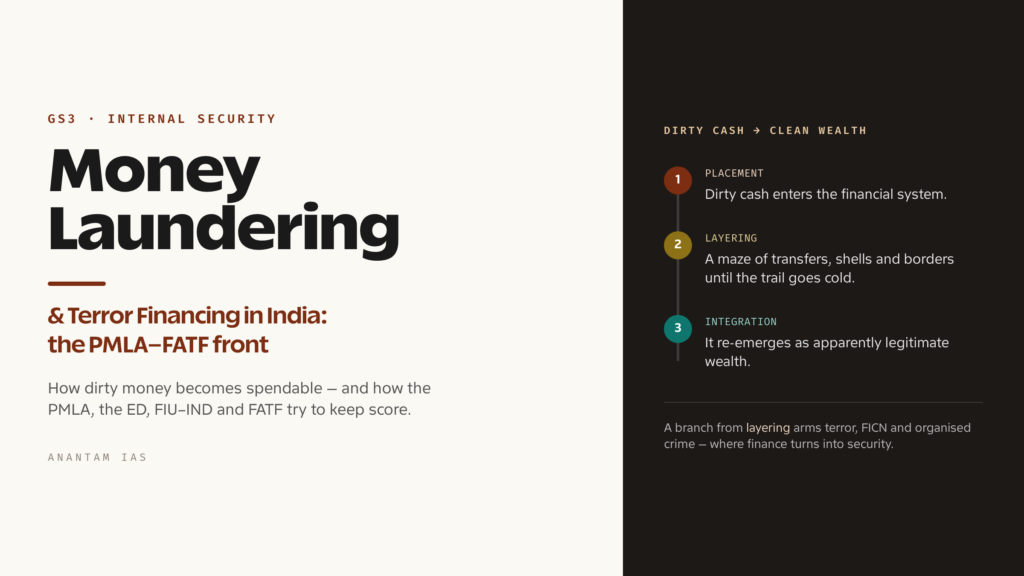
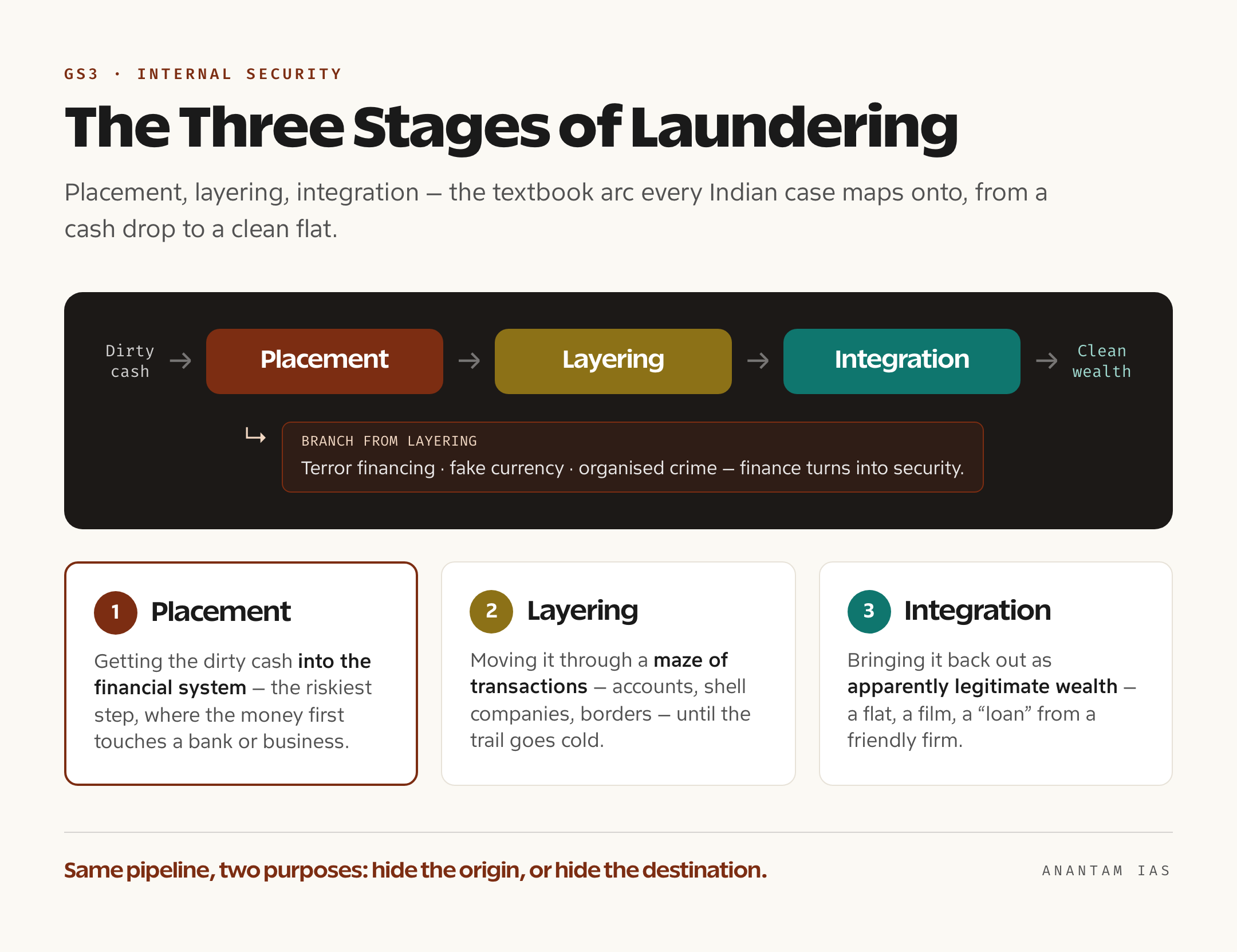
Money laundering is the process of taking the proceeds of crime — cash from bribery, fraud, drug-running, extortion or smuggling — and disguising it so it looks like honest income. The textbook breaks it into three stages, and the stages are worth memorising because every Indian case maps onto them. Placement is getting the dirty cash into the financial system. Layering is moving it through a maze of transactions — accounts, shell companies, borders — until the trail goes cold. Integration is bringing it back out as apparently legitimate wealth: a flat, a film, a “loan” from a friendly firm.
Terror financing is the mirror image, and that’s the bit that makes this a security subject rather than an accounting one. Laundering hides the origin of money that is already dirty. Terror financing hides the destination of money that may even be clean — a charitable donation, a business profit — but is heading toward violence. The two share the same plumbing: hawala, shell firms, trade invoices, cash couriers. The Financial Action Task Force, the global standard-setter on both, treats them as twin threats for exactly this reason. India’s own framework, the Prevention of Money Laundering Act of 2002, was written for the first problem and has steadily been stretched to cover the second. Getting the balance right matters because the same powerful tools that choke a terror network can, if pointed carelessly, freeze an innocent citizen’s bank account for years.
How the Money Moves
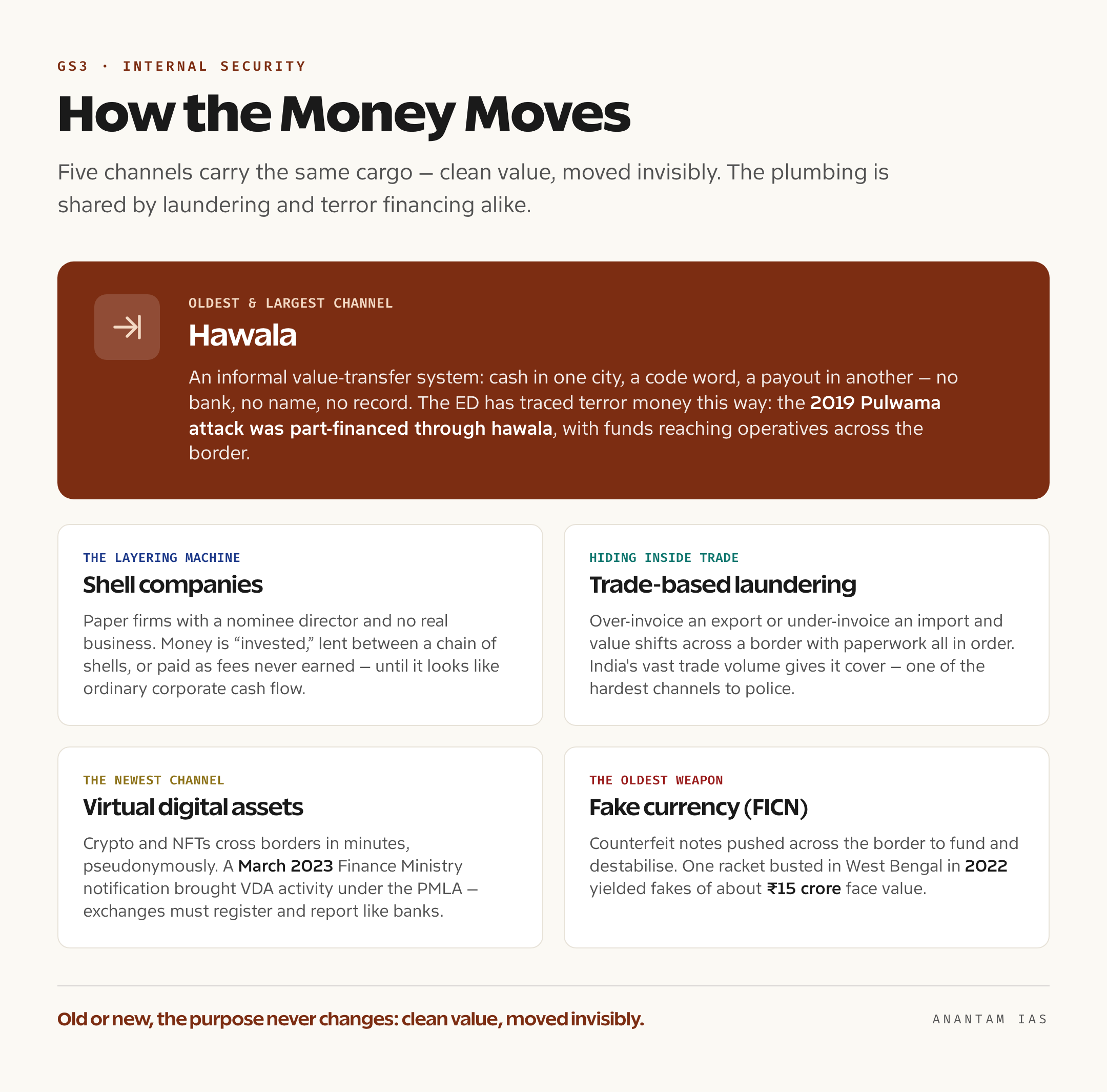
Start with the oldest channel, because it still moves the most. Hawala is an informal value-transfer system: you hand cash to a broker in one city, quote a code, and a counterpart broker in another city or country pays out the equivalent — minus a commission — to whoever knows the code. No bank, no central-bank record, no name on a form. It settles later through trade, gold or offsetting transfers between the brokers. Hawala is fast, cheap and trusted, which is why migrant workers have used it for generations; it is also anonymous and off the books, which violates India’s foreign-exchange law and makes it the laundering channel of choice. The Enforcement Directorate has traced terror money through exactly this route — investigators have found that the 2019 Pulwama attack was part-financed through hawala, with funds reaching operatives in Jammu and Kashmir from across the border.
Then there are shell companies — firms that exist only on paper, with a registered address, a nominee director and no real business. They are the layering machine. Dirty money is “invested” in the shell, lent between a chain of shells, or paid out as fees for services never rendered, until the proceeds emerge looking like ordinary corporate cash flow. Sit a few shells in different jurisdictions and the trail crosses borders, which is where investigation gets slow and expensive.
Trade-based money laundering does the same disguising job through invoices. The trick is mispricing: over-invoice an export or under-invoice an import, and you can shift value across a border with the paperwork all apparently in order. A consignment of cheap goods declared as expensive, or the reverse, moves money while a customs officer sees only a legal shipment. It is one of the hardest channels to police because it hides inside legitimate trade, and India’s enormous import-export volume gives it a lot of cover.
The newest channel is digital. Virtual digital assets — cryptocurrencies and non-fungible tokens — let value cross borders in minutes, pseudonymously, with no bank in the loop. India recognised the risk and acted: a Finance Ministry notification in March 2023 brought VDA activities formally under the PMLA, so that crypto exchanges and service providers — Indian and offshore — must register with the financial-intelligence regulator and report suspicious activity like any bank. And the oldest weapon of all still circulates alongside the newest: Fake Indian Currency Notes, or FICN, counterfeit money pushed across the border to both fund and destabilise. A single racket busted in West Bengal in 2022 yielded fake notes with a face value of around fifteen crore rupees. The channels are different; the purpose — clean value, moved invisibly — is the same.
India’s Institutional Response
The spine of the response is the Prevention of Money Laundering Act, 2002 — the PMLA. It was passed in 2002 and brought into force on 1 July 2005, and it works on a “schedule of offences” model. Money laundering is not a free-standing crime; it has to ride on a predicate offence — a corruption, fraud, drug or other scheduled crime that generated the proceeds in the first place. The Act’s central concept is “proceeds of crime,” defined in Section 2(1)(u) as any property derived directly or indirectly from a scheduled offence, or the value of such property. A 2019 amendment made clear that laundering is a continuing offence — you keep committing it as long as you hold, use or project the tainted money as clean — which sharply widens the window in which the state can act.
The agency that wields the PMLA is the Enforcement Directorate, the ED. It’s older than the law it’s now famous for: the Directorate was set up in 1956 to police foreign-exchange violations under the colonial-era FERA, which FEMA — the Foreign Exchange Management Act of 1999 — later replaced, downgrading most forex breaches from crimes to civil penalties. Today the ED runs three statutes: FEMA for exchange contraventions, the PMLA for money laundering, and the Fugitive Economic Offenders Act of 2018 for absconders like the Mallyas and Modis of the headlines. Under the PMLA the ED’s powers are formidable. It can provisionally attach property it believes is proceeds of crime under Section 5, conduct search and seizure under Section 17, summon and record statements, and arrest under Section 19 without prior judicial sign-off. Attachment is the sharpest tool of all — it freezes the asset before any conviction, on the logic that you can’t let the laundered flat be sold while the trial crawls.
Behind the ED sits the Financial Intelligence Unit, FIU-IND, set up in 2004 as the national hub for financial intelligence, reporting up to an Economic Intelligence Council chaired by the Finance Minister. Banks, insurers, intermediaries and now crypto platforms are “reporting entities” obliged to file suspicious-transaction reports with FIU-IND, which sifts them and routes leads to the ED, tax authorities and the police. In December 2023 it flexed that mandate, issuing show-cause notices to nine offshore crypto exchanges — Binance and KuCoin among them — for operating in India without registering. On the terror side, the National Investigation Agency, the NIA — the federal counter-terror agency — leads terror-financing investigations, often working the same money trail as the ED from the other end.
Over all of this sits FATF, the Financial Action Task Force, the inter-governmental body that writes the global AML and counter-terror-financing rulebook and grades countries against it. Its leverage is reputational and financial: a country with weak controls lands on the “grey list” for increased monitoring, or the “black list” for the worst offenders — currently only North Korea, Iran and Myanmar. Grey-listing scares away investment and raises borrowing costs, which is why Pakistan’s 2018-2022 stint on the list hurt, and why staying off it is a genuine national-security interest, not a box-ticking exercise.
Where the System Falls Short
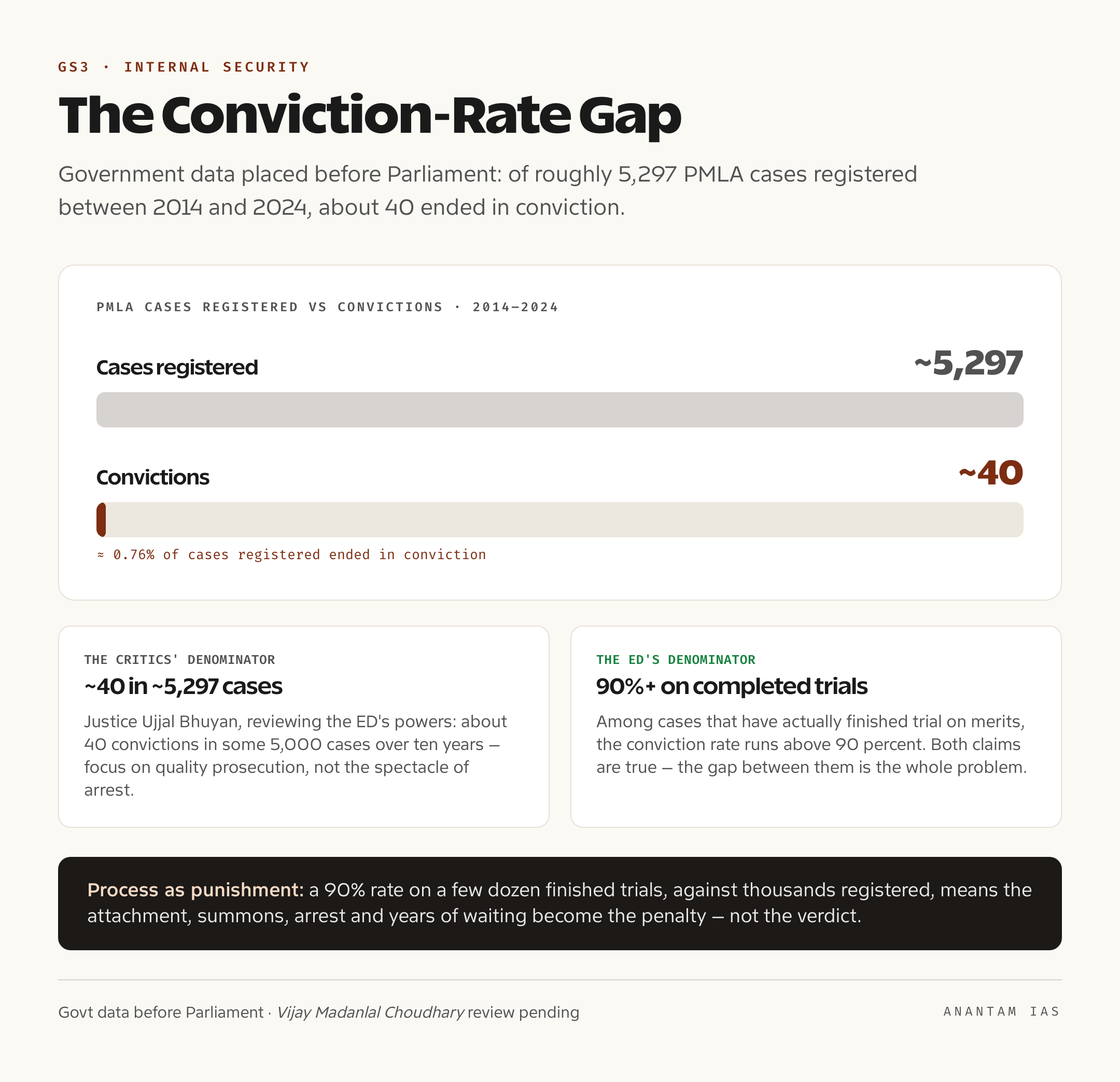
For all that machinery, the honest verdict is mixed, and the numbers are where it gets uncomfortable. Data the government itself placed before Parliament showed that of roughly 5,297 PMLA cases registered between 2014 and 2024, only about 40 ended in conviction. During the Supreme Court’s review of the ED’s powers, Justice Ujjal Bhuyan put it bluntly — out of some 5,000 cases over ten years, convictions in only 40 — and told the agency to focus on quality prosecution and evidence rather than the spectacle of arrest. The ED’s defenders point to a different denominator: among cases that have actually finished trial on merits, the conviction rate runs above 90 percent. Both claims are true, and the gap between them is the whole problem. A 90-percent rate on a few dozen completed trials, against thousands of cases registered, means the punishment is increasingly the process itself — the attachment, the summons, the arrest, the years of waiting — and not the verdict.
That is the heart of the rights critique, and it is sharpest at the point of bail. Section 45 of the PMLA imposes “twin conditions”: a court can grant bail only if it is satisfied the accused is probably not guilty and is unlikely to offend again on release. That stands the ordinary presumption of innocence on its head, asking a judge to half-decide the case before trial. The Supreme Court actually struck these conditions down in 2017, in Nikesh Tarachand Shah, as arbitrary and violative of Articles 14 and 21; Parliament redrafted the section in 2018, and in the 2022 Vijay Madanlal Choudhary judgment a three-judge bench held the twin conditions revived and upheld the ED’s powers wholesale — the arrests, the attachment, the reverse burden of proof, even the ED’s refusal to share its case-information report with the accused on the ground that it is an “internal document.” The Court also held that ED officers aren’t police officers, so statements made to them are admissible as evidence. The combined effect is a regime where it is easy to be arrested, hard to get bail, and slow to be tried — and a review of that very judgment is still pending.
There is a federal nerve here too. “Public order” and “police” are State subjects, yet the ED is a central agency that can enter any state’s affairs the moment a scheduled offence touches “proceeds of crime.” Several state governments have accused the centre of using the ED selectively against opposition figures — a charge the agency rejects, but one the low conviction rate makes hard to wave away. And FATF, no soft critic, flagged real gaps even while praising India: its 2024 evaluation called for tighter supervision of non-financial sectors like real estate, faster conclusion of money-laundering and terror-financing trials, and a careful, risk-based approach to non-profit organisations so that counter-terror rules don’t end up smothering legitimate charities. The capacity bottleneck — too few special courts, overstretched investigators, glacial mutual-legal-assistance with other countries — is the quiet thread running through all of it.
The Way Forward
- Fix the trial pipeline, not just the arrest power. Dedicated PMLA special courts, more prosecutors and time-bound trials would turn registered cases into verdicts — and a real conviction rate is the best answer to the charge of misuse.
- Build a bail safeguard that survives scrutiny. Pair the twin conditions with firm outer limits on attachment and pre-trial detention, so the process stops functioning as a punishment before guilt is proven.
- Follow the money digitally. Strengthen FIU-IND’s analytics, blockchain-tracing capacity and crypto-exchange oversight, because the next decade of laundering will move through VDAs faster than paper ever did.
- Close the channels at source. Tighten beneficial-ownership disclosure to expose shell companies, sharpen customs analytics against trade mispricing, and keep squeezing hawala through formal-remittance incentives.
- Act on FATF’s homework. Plug the real-estate and non-profit supervision gaps the 2024 evaluation named, so India keeps its place off the grey list and the cost-of-capital advantage that comes with it.
- Respect the federal line. Clearer centre-state protocols and transparent case-selection criteria would lower the political temperature without blunting genuine enforcement.
For Your Mains Answer
This topic sits squarely in GS Paper 3 — “linkages between development and spread of extremism,” “role of external state and non-state actors,” and “money-laundering and its prevention.” It also reaches into GS Paper 2 on the functioning of agencies and centre-state relations, and into Essay on the security-versus-liberty theme. Examiners reward candidates who treat it as a finance-meets-security problem and who can hold the security need and the rights concern in the same answer.
How to Build the Answer
Open with the linkage, not the law — that laundering becomes an internal-security issue the moment it funds terror, fake currency or organised crime. Then move in order: how the money moves (the three stages plus the channels), India’s institutional response (PMLA, ED, FIU-IND, NIA, FATF), the gaps (conviction rate, bail, federalism, capacity), and a balanced way forward. Anchor each limb with one precise fact, and close on the balance, never on alarm.
Common Mistakes to Avoid
Don’t reduce the answer to a description of the PMLA. Don’t take a side in the ED political debate — present both denominators of the conviction figure and let the gap speak. Don’t confuse money laundering with tax evasion or with terror financing; define each. And don’t claim India is “on the FATF grey list” — it is firmly off it, in the best follow-up category, which is itself an examinable fact.
A Compact Answer Spine
Laundering = placement, layering, integration → becomes a security threat when proceeds fund terror/FICN/organised crime → channels: hawala, shell firms, trade mispricing, VDAs → response: PMLA 2002 (proceeds of crime, attachment), ED, FIU-IND, NIA, FATF → gaps: low conviction vs cases registered, Section 45 bail, federal tension, FATF’s real-estate/NPO flags → way forward: faster trials, bail safeguards, digital tracing, beneficial-ownership transparency, rights balance.
Diagram or Flowchart Idea
Draw a horizontal flow: dirty cash → Placement → Layering → Integration → clean wealth, with a branch arrow from “Layering” pointing down to a box labelled “Terror financing / FICN.” Below the flow, stack the four institutions — PMLA, ED, FIU-IND, FATF — as a regulatory layer. One clean diagram like this shows the examiner you understand the system as a pipeline, not a list.
The Rights-and-Security Balance Angle
The mature point, worth a line in your conclusion: a counter-laundering regime is only as legitimate as its restraint. The ED’s powers exist because terror money is real and fast; the safeguards exist because attachment and arrest hit ordinary citizens too. Cite the Vijay Madanlal ruling for the powers and the pending review and the low conviction rate for the caution — that pairing reads as balance, not fence-sitting.
How to Use Data Without Overclaiming
Attribute and hedge in the same breath. “Government data placed before Parliament showed roughly 40 convictions out of about 5,297 PMLA cases between 2014 and 2024” is safe; a flat “the ED never convicts anyone” is not. Note that the ED’s own figure of a 90-percent-plus conviction rate counts only completed trials — say so, and you sound like someone who has read the numbers rather than a headline.
FAQ
What is the difference between money laundering and terror financing? Money laundering disguises the origin of money that is already dirty, making the proceeds of crime look legitimate through placement, layering and integration. Terror financing disguises the destination of money — which may even be clean — as it heads toward violence. They matter together because they use the same channels: hawala, shell companies, trade mispricing and, increasingly, cryptocurrencies. India’s Prevention of Money Laundering Act and the agencies around it are built to attack both at once.
What powers does the Enforcement Directorate have under the PMLA? Under the PMLA the ED can provisionally attach property it believes are proceeds of crime, search and seize, summon and record statements, and arrest without prior court approval. In the 2022 Vijay Madanlal Choudhary judgment the Supreme Court upheld these powers, including the stringent Section 45 bail conditions and the reversal of the burden of proof. The main criticism is that the process — attachment, arrest, long pre-trial waits — can become a punishment in itself, given how few cases end in conviction.
Is India on the FATF grey list? No. In its June 2024 Mutual Evaluation, the Financial Action Task Force placed India in the “regular follow-up” category — its best rating — a status shared by only a handful of G20 countries. FATF praised India’s high technical compliance and its shift from a cash to a digital economy, while flagging the need to tighten supervision of real estate and non-profits and to conclude money-laundering and terror-financing trials faster.
How does crypto fit into India’s anti-money-laundering law? A Finance Ministry notification in March 2023 brought virtual digital assets — cryptocurrencies and NFTs — under the PMLA. Crypto exchanges and service providers, whether based in India or offshore, now count as “reporting entities” that must register with FIU-IND and report suspicious transactions like a bank. In December 2023 FIU-IND issued show-cause notices to nine offshore exchanges, including Binance and KuCoin, for operating without registering.
Tell Google you want more of this.
Add Anantam IAS as a preferred sourceOne tap, and this site shows up more often in your own Top Stories, AI Overviews and AI Mode. Remove it any time.