Daily Digest
UPSC · Civil Services Examination
Current Affairs · Sunday, 21 December 2025
Current affairs curated and edited by Anantam IAS faculty — pulled from The Hindu, PIB, IDSA, Foreign Affairs and the ministries. Read, annotate, revise.
Old Rajinder Nagar · Delhi 110005 · anantamias.com
NTCA’s 28th Meeting Launches the 6th All-India Tiger Estimation
Why in News?
On 21 December 2025, the 28th Meeting of the National Tiger Conservation Authority (NTCA) and the 22nd Steering Committee Meeting of Project Elephant were held together at the Sundarbans Tiger Reserve in West Bengal, chaired by Union Environment Minister Bhupender Yadav. PIB confirmed the twin meetings reviewed national strategies for tiger and elephant conservation.
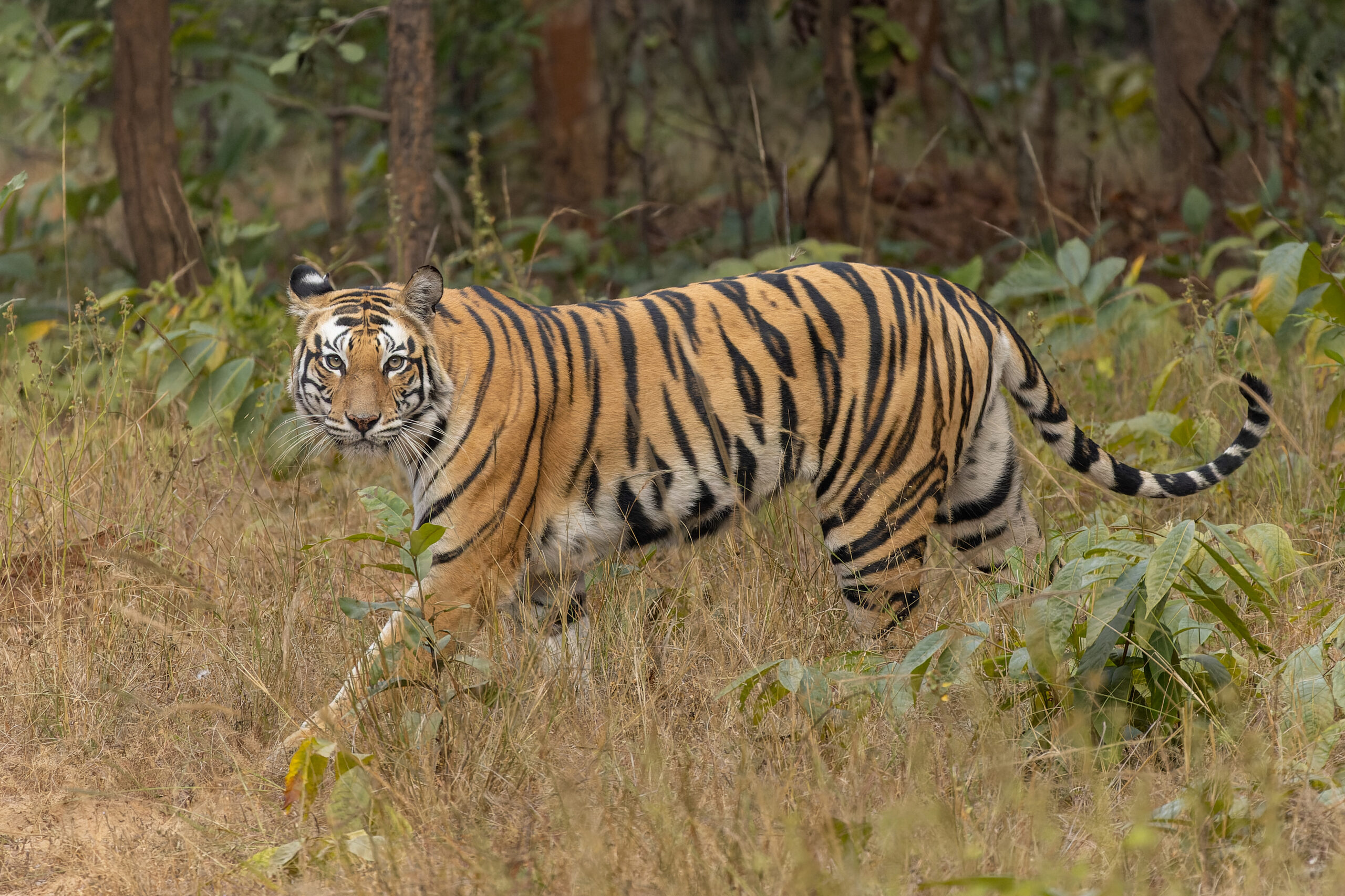
The headline outcome was a review of the sixth cycle of the All-India Tiger Estimation (AITE) — the world’s largest wildlife survey — whose ground surveys began in November 2025, alongside the release of six conservation publications including a fresh Project Cheetah report.
- Venue: Sundarbans Tiger Reserve, West Bengal — India’s only mangrove tiger habitat.
- The minutes of the 27th NTCA Meeting (18 April 2025) were confirmed and the Action Taken Report reviewed.
- Ground surveys for the 6th AITE commenced from November 2025.
- Minister Yadav released six publications, including Project Cheetah in India and the latest STRIPES journal.
- The meeting noted a recent Supreme Court Order and deliberated on its implications for tiger management.
- Project Cheetah’s expansion to Gandhisagar Wildlife Sanctuary and Banni Grassland (Gujarat) was appraised.
The development matters in the context of:
- AITE underpins India’s claim to host nearly 75% of the world’s wild tigers — a recurring prelims and mains anchor.
- The meeting sits at the intersection of protected-area governance, human-wildlife conflict and big-cat diplomacy ahead of a proposed Global Big Cat Summit.
UPSC Relevance
Prelims Relevance
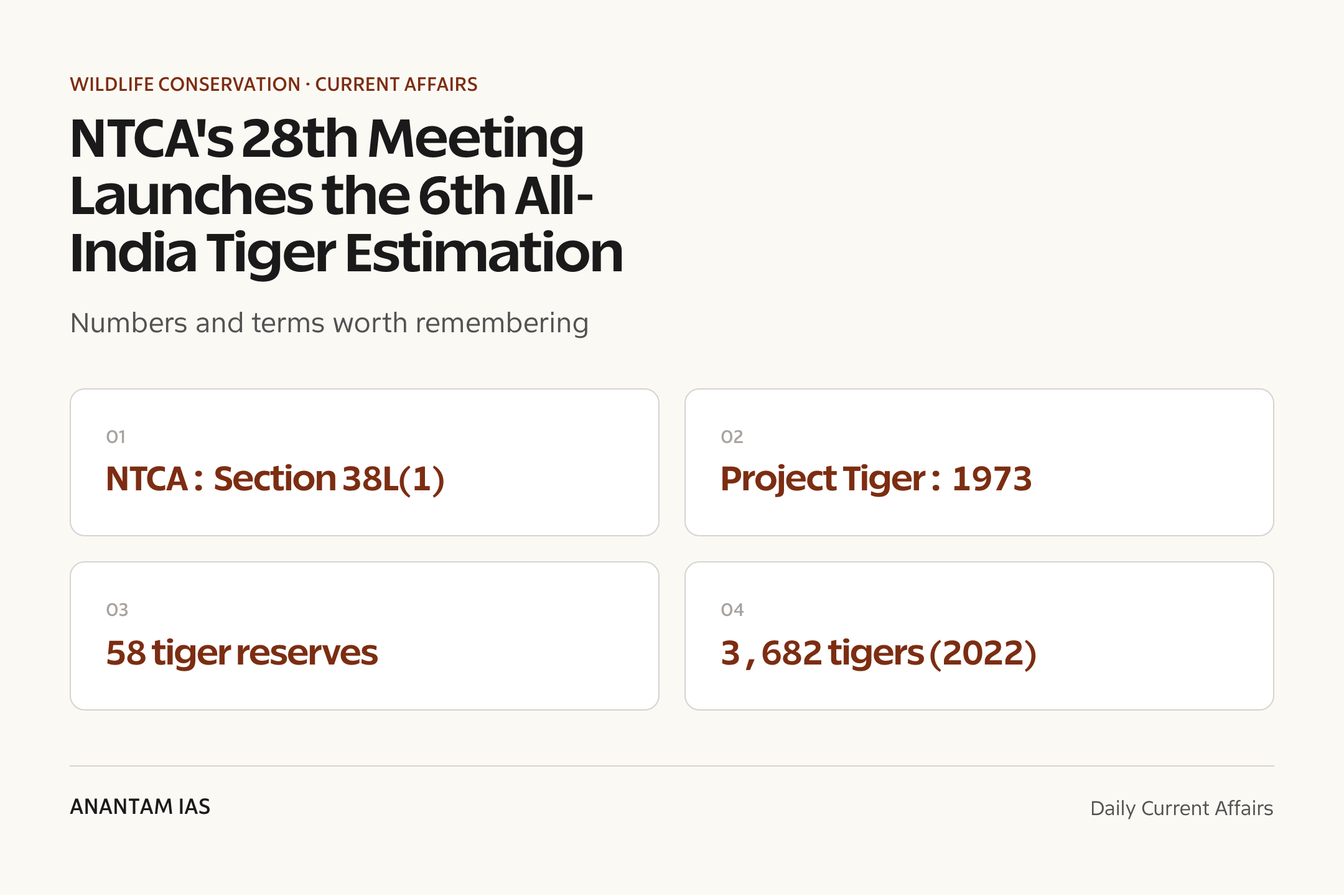
- NTCA — statutory body under Section 38L(1) of the Wildlife (Protection) Act, 1972; constituted December 2005.
- Project Tiger launched in 1973; centrally sponsored scheme administered through NTCA.
- India has 58 tiger reserves (as of March 2025), up from 9 in 1973.
- 2022 AITE estimated 3,682 wild tigers (~75% of the global wild tiger population).
- AITE is quadrennial (every four years): 1,411 (2006) → 1,706 (2010) → 2,226 (2014) → 2,967 (2018) → 3,682 (2022).
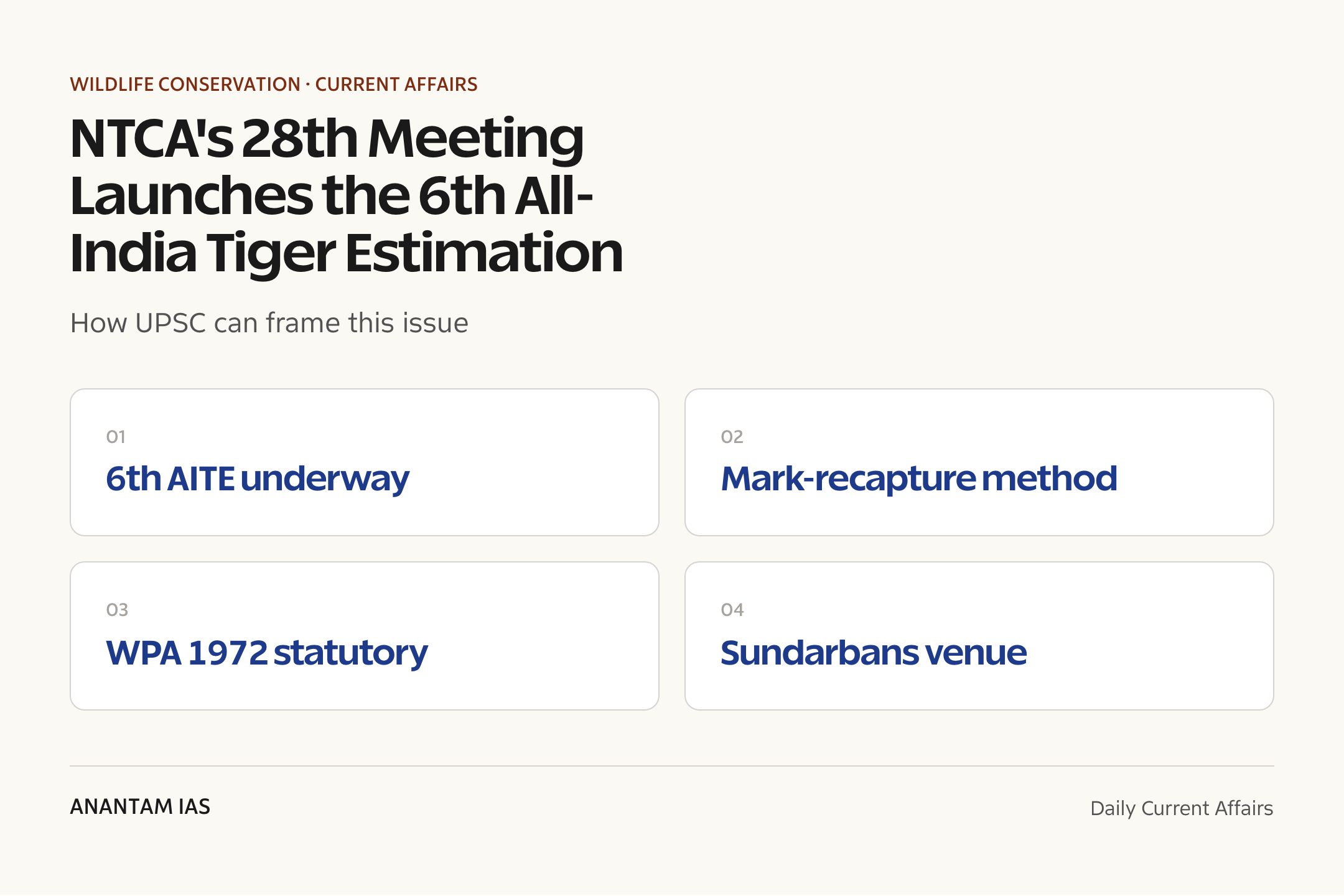
- Methodology combines camera-trap photo-capture, spatially explicit capture-recapture (mark-recapture) and sign surveys using GIS.
- Project Elephant began in 1992; uses the All-India Synchronized Elephant Estimation.
- Sundarbans — a UNESCO World Heritage Site and Biosphere Reserve shared with Bangladesh.
- NBWL (National Board for Wildlife) — apex advisory body chaired by the Prime Minister.
- CAMPA funds support several NTCA and elephant-reserve initiatives.
Mains Relevance
GS Paper 3
- Evaluate Project Tiger as a model of species-led conservation and its spillover benefits for habitats and prey ecosystems.
- Discuss methodological strengths and limits of the All-India Tiger Estimation as evidence-based wildlife policy.
GS Paper 2
- Assess the NTCA as a statutory regulator: powers, accountability and centre-state coordination in wildlife governance.
GS Paper 3
- Analyse strategies to manage human-tiger and human-elephant conflict in shared landscapes.
Essay
- Conservation and coexistence: protecting big cats without displacing forest communities.
- Science as the backbone of environmental governance in India.
Background and Context
What the NTCA is and why it has statutory teeth
The NTCA is not an advisory committee but a statutory regulator created to give Project Tiger legal backing after the Sariska crisis exposed monitoring gaps.
- Constituted in December 2005 under Section 38L(1) of the amended Wildlife (Protection) Act, 1972, on the recommendation of the Tiger Task Force.
- Chaired by the Union Minister for Environment, Forest and Climate Change; it approves Tiger Conservation Plans that states must prepare for every reserve.
- Powers include laying down standards for tiger conservation, approving reserve creation, and ensuring no ecologically unsustainable land use inside core areas.
- It runs Project Tiger (1973) as a centrally sponsored scheme and works with the Wildlife Institute of India (WII) on estimation science.
The 6th All-India Tiger Estimation — the world's largest survey
The AITE is a quadrennial census that India has refined into the largest wildlife survey on Earth, and its sixth cycle is now underway.
- Ground surveys began in November 2025; the cycle was a central agenda item at the 28th meeting.
- Conducted every four years by NTCA with WII and state forest departments.
- A two-phase design: phase-one ground-based occupancy and sign surveys, then camera-trap sampling across forested grids.
- Individual tigers are identified by their unique stripe patterns, and numbers estimated using spatially explicit capture-recapture (mark-recapture) statistics.
- The 2022 round won a Guinness World Record for the largest camera-trap survey, estimating 3,682 tigers.
- STRIPES (December 2025) flagged technology-driven monitoring and tiger dispersal as themes of the new cycle.
Decisions taken at the 28th NTCA meeting
Beyond the estimation review, the meeting ratified a slate of technical and policy decisions.
- Launch of the project ‘Management of Tigers Outside Tiger Reserves’ — recognising that many tigers now live beyond protected boundaries.
- A three-pronged strategy to mitigate human-tiger conflict was endorsed.
- Approval of Tiger Conservation Plans, tiger translocation, prey augmentation and landscape-level planning.
- Appraisal of the extension and expansion of Project Cheetah to Gandhisagar Wildlife Sanctuary and Banni Grassland in Gujarat.
- Review of staffing shortages, financial constraints, habitat degradation and invasive species in reserves.
- Preparatory work for a proposed Global Big Cat Summit was discussed.
Project Elephant runs in parallel
The 22nd Steering Committee of Project Elephant met alongside, reflecting an integrated big-mammal approach.
- Project Elephant (1992) protects elephants, their habitats and corridors and addresses welfare of captive elephants.
- The committee reviewed the All-India Synchronized Elephant Estimation for evidence-based planning.
- Regional Action Plans for Southern India and North-Eastern India, plus the Nilgiri Model Elephant Conservation Plan, were discussed.
- Work on DNA profiling of captive elephants and a study of elephant corridors in the Bandhavgarh region were noted.
- A nationwide review of human-elephant conflict drivers and compensation mechanisms was undertaken.
Project Cheetah and the publications released
The meeting doubled as a release point for six conservation publications, headlined by a Project Cheetah report.
- Project Cheetah in India — milestones under scientific management and international cooperation.
- STRIPES (Dec 2025) — NTCA’s outreach journal, themed on technology, tiger dispersal and the 6th AITE launch.
- An NTCA booklet on India’s tiger-conservation framework and institutional milestones.
- Tigerverse — little-known facts from India’s tiger reserves.
- Best Practices in Captive Elephant Management for handlers, plus the TRUMPET quarterly journal.
- Delegations from South Africa, Namibia and Botswana have engaged on cheetah cooperation.
Why Sundarbans matters as the venue
Holding the meeting in the Sundarbans was a deliberate signal about India’s most unusual tiger landscape.
- The Sundarbans is the world’s largest mangrove forest and India’s only mangrove tiger habitat, shared with Bangladesh.
- It is a UNESCO World Heritage Site, a Biosphere Reserve and a Ramsar Site.
- Its tigers are known for swimming between islands and for an unusually high incidence of human-tiger conflict.
- Rising sea levels and salinity make it a frontline case for climate-resilient conservation.
Way Forward
Strengthen the science
- Complete the 6th AITE with transparent, peer-reviewed methods so the population figure carries policy weight.
- Scale up technology — AI-assisted camera traps, M-STrIPES patrolling and DNA tools — across reserves.
Manage tigers beyond reserves
- Operationalise the new ‘Management of Tigers Outside Tiger Reserves’ project with corridor protection and conflict-response teams.
- Fund frontline staffing gaps and habitat restoration through CAMPA and Project Tiger budgets.
Centre communities
- Make compensation for human-wildlife conflict prompt and adequate, and embed local livelihoods in conservation planning.
Conclusion
The 28th NTCA meeting reaffirmed that India’s tiger story is built on a rare combination of statutory backing, sustained funding and rigorous science — with the 6th All-India Tiger Estimation set to deliver the next benchmark for a country that already shelters most of the world’s wild tigers.
By convening tiger, elephant and cheetah agendas in one room at the Sundarbans, the government framed conservation as an integrated, science-led and community-centred mission rather than a single-species effort.
UPSC Practice Questions
Prelims MCQ 1
With reference to the National Tiger Conservation Authority (NTCA), consider the following statements:
- It is a statutory body constituted under the Wildlife (Protection) Act, 1972.
- It is chaired by the Union Minister for Environment, Forest and Climate Change.
- It administers Project Tiger as a centrally sponsored scheme.
How many of the above statements are correct?
(a) Only one (b) Only two (c) All three (d) None
Answer: (c) All three
Explanation:
NTCA was constituted in 2005 under Section 38L(1) of the Wildlife (Protection) Act, 1972, is chaired by the Union Environment Minister, and runs Project Tiger (1973) as a centrally sponsored scheme. All three statements are correct.
Prelims MCQ 2
The All-India Tiger Estimation, reviewed at the 28th NTCA meeting, is conducted at what interval and uses which primary technique to count individual tigers?
(a) Annually; aerial radio-collar tracking (b) Every four years; camera-trap based capture-recapture (c) Every ten years; pugmark census only (d) Every two years; satellite thermal imaging
Answer: (b) Every four years; camera-trap based capture-recapture
Explanation:
The AITE is quadrennial. Tigers are identified by unique stripe patterns from camera-trap images and counted using spatially explicit capture-recapture statistics, supported by sign and occupancy surveys.
UPSC Mains Questions
- The All-India Tiger Estimation has been called the world’s largest wildlife survey. Examine its methodology and assess how far it serves as a credible basis for India’s tiger conservation policy. (250 words)
- Statutory bodies like the NTCA combine regulation, funding and science. Discuss how this institutional design has shaped the outcomes of Project Tiger, and identify its limitations. (250 words)
Sources: PIB, Ministry of Environment, Forest and Climate Change and Indian Masterminds.
Frequently Asked Questions
What was decided at the 28th NTCA meeting?
Held at the Sundarbans on 21 December 2025, the 28th NTCA meeting reviewed the sixth All-India Tiger Estimation, approved Tiger Conservation Plans, launched a ‘Management of Tigers Outside Tiger Reserves’ project, appraised Project Cheetah’s expansion in Gujarat, and addressed human-tiger conflict and reserve staffing gaps.
What is the All-India Tiger Estimation?
The AITE is a quadrennial census led by the NTCA and the Wildlife Institute of India. It is regarded as the world’s largest wildlife survey, combining ground sign surveys with camera-trap sampling. Tigers are identified by unique stripe patterns and counted using mark-recapture statistics. Its sixth cycle began ground surveys in November 2025.
What is the NTCA and under which law was it created?
The National Tiger Conservation Authority is a statutory body constituted in 2005 under Section 38L(1) of the Wildlife (Protection) Act, 1972. Chaired by the Union Environment Minister, it administers Project Tiger, approves Tiger Conservation Plans and sets standards for tiger reserve management across India.
How many tigers and tiger reserves does India have?
The 2022 estimation put India’s wild tiger population at about 3,682, nearly 75% of the global total. As of March 2025, India had 58 designated tiger reserves, up from the 9 with which Project Tiger started in 1973.
Why was the meeting held in the Sundarbans?
The Sundarbans is the world’s largest mangrove forest and India’s only mangrove tiger habitat, a UNESCO World Heritage Site and Ramsar wetland shared with Bangladesh. Holding the meeting there spotlighted a climate-vulnerable landscape with high human-tiger conflict and unique swimming tigers.
What is Project Elephant and how does it relate to this meeting?
Project Elephant, launched in 1992, protects elephants, their corridors and welfare of captive elephants. Its 22nd Steering Committee met alongside the NTCA on 21 December 2025, reviewing the All-India Synchronized Elephant Estimation, regional action plans and human-elephant conflict mitigation.
Source: https://anantamias.com/current-affairs/ntca-28th-meeting-sixth-tiger-estimation-2025/
Sabka Bima Sabki Raksha Act: 100% FDI in Insurance
Why in News?
On December 17, 2025, Parliament passed the Sabka Bima Sabki Raksha (Amendment of Insurance Laws) Bill, 2025, having cleared the Lok Sabha on December 16 and the Rajya Sabha on December 17. The PIB confirmed the law amends the three foundational insurance statutes at once to deepen coverage, ease doing business, and tighten regulatory governance.
The headline reform raises the Foreign Direct Investment (FDI) cap in Indian insurers from 74% to 100% of paid-up equity, alongside lower capital thresholds for foreign reinsurers and insurance co-operatives, in support of the regulator’s ‘Insurance for All by 2047’ vision.
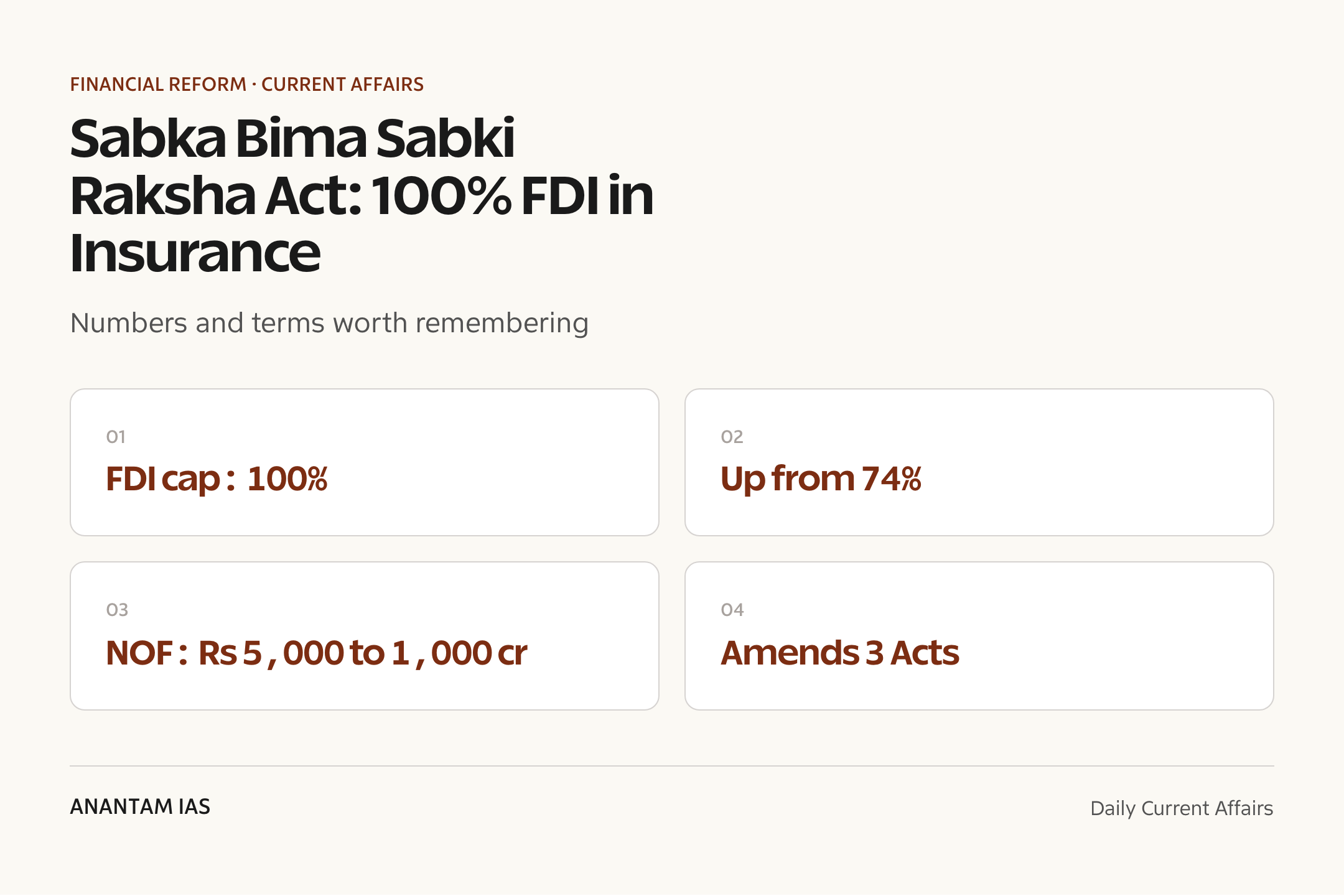
- FDI cap in Indian insurers raised from 74% to 100% of paid-up equity capital.
- Amends three Acts together — the Insurance Act, 1938, the LIC Act, 1956, and the IRDA Act, 1999.
- Net Owned Fund requirement for foreign reinsurance branches cut from Rs 5,000 crore to Rs 1,000 crore.
- Prior-approval threshold for transfer of an insurer’s share capital raised from 1% to 5%.
- A new Policyholders’ Education and Protection Fund created to spread insurance awareness.
- Policyholder data to be collected and protected in alignment with the DPDP Act, 2023.
The development matters in the context of:
- Why it matters: insurance penetration in India is low, and the sector needs large, patient capital to expand cover to households and enterprises.
- FDI in insurance has been liberalised in steps — 26% (2000), 49% (2015), 74% (2021), and now 100% — reflecting a steady opening of a once-closed sector.
- The reform pairs market opening with stronger consumer protection and regulatory teeth, rather than deregulation alone.

UPSC Relevance
Prelims Relevance
- The Bill amends the Insurance Act, 1938, the Life Insurance Corporation Act, 1956, and the IRDA Act, 1999.
- FDI cap in insurers raised from 74% to 100%.
- IRDAI (Insurance Regulatory and Development Authority of India) is the statutory regulator, headquartered in Hyderabad.
- Net Owned Fund (NOF) for foreign reinsurance branches lowered from Rs 5,000 crore to Rs 1,000 crore.
- Share-transfer prior-approval threshold raised from 1% to 5% of paid-up capital.
- New Policyholders’ Education and Protection Fund financed by government contributions, penalties, and donations.
- Reinsurance is insurance bought by insurers to spread their own risk.
- FDI in insurance was earlier 26% (2000), 49% (2015), and 74% (2021).
- IRDAI gains power to disgorge wrongful gains and to supersede insurer boards acting against policyholder interest.
- Policyholder data handling aligned with the Digital Personal Data Protection Act, 2023.
Mains Relevance
GS Paper 3
- FDI policy and financial-sector liberalisation: balancing foreign capital inflows against domestic control and consumer protection.
- Mobilising long-term capital for infrastructure and growth via a deeper insurance sector.
- Regulatory architecture of insurance — IRDAI’s mandate, powers, and the tension between development and supervision.
GS Paper 2
- Statutory regulators, accountability, and the design of consumer-protection mechanisms in financial markets.
Essay
- Opening markets while protecting citizens — the balance at the heart of economic reform.
- Financial inclusion as a foundation of economic resilience.
Background and Context
What the 2025 Act changes
A single law rewriting three insurance statutes at once.
- The Sabka Bima Sabki Raksha (Amendment of Insurance Laws) Bill, 2025 amends the Insurance Act, 1938, the LIC Act, 1956, and the IRDA Act, 1999 together.
- Its stated aims: deepen insurance coverage, ease doing business, and improve regulatory oversight and governance.
- Passed by the Lok Sabha on December 16 and the Rajya Sabha on December 17, 2025, with presidential assent following shortly after.
- The name signals the policy goal — universal cover, branded around the regulator’s ‘Insurance for All by 2047’ target.
100% FDI and the liberalisation arc
The biggest opening of the sector since it was reopened to private players.
- The Act raises the FDI cap in Indian insurers from 74% to 100% of paid-up equity capital, removing the residual ownership restriction.
- PIB framed this as opening doors to more foreign players, aiding capital augmentation, technology adoption, and global best practices.
- It continues a phased liberalisation — 26% in 2000, 49% in 2015, 74% in 2021, now full ownership.
- Greater competition is expected to drive efficiency in products and pricing for citizens.
Easing capital and entry rules
Lower thresholds to attract reinsurers, co-operatives, and intermediaries.
- Net Owned Fund (NOF) for foreign reinsurance branches cut from Rs 5,000 crore to Rs 1,000 crore, lowering the entry bar for global reinsurers.
- The minimum paid-up capital requirement of Rs 100 crore for life, general, and health insurance co-operatives is removed.
- For intermediaries, one-time licensing replaces periodic renewal, and licences can be suspended rather than cancelled outright.
- The prior-approval threshold for transfer of an insurer’s share capital rises from 1% to 5%, smoothing routine ownership changes.
Strengthening IRDAI's hand
Market opening paired with a more powerful, rules-based regulator.
- IRDAI gains the power to disgorge — recover wrongful gains from insurers and intermediaries.
- It can supersede an insurer’s board where the company acts against policyholder interest, and approve schemes of arrangement.
- It may regulate agent compensation structures and approve amalgamations.
- Regulation-making is to follow a standard operating procedure and a mandatory consultative process; penalties are rationalised with stated factors for their imposition.
Consumer protection and LIC autonomy
New safeguards for policyholders and operational freedom for the state insurer.
- A dedicated Policyholders’ Education and Protection Fund is created to spread insurance awareness, financed by government contributions, penalties, and donations.
- Policyholder data must now be collected and protected in alignment with the DPDP Act, 2023.
- The Life Insurance Corporation (LIC) gets autonomy to open zonal offices within India.
- LIC may also align its foreign offices with the laws of the jurisdictions in which they operate.
What 'Insurance for All by 2047' means
The policy vision the reform is built to serve.
- IRDAI has set a goal that every citizen has appropriate life, health, and property cover and every enterprise is suitably insured by 2047.
- India’s insurance penetration (premiums as a share of GDP) remains modest, leaving large coverage gaps among households.
- Deeper, better-capitalised insurers are meant to widen access and channel long-term savings into the economy.
- Insurance funds are a key source of patient capital for infrastructure and long-gestation projects.
Way Forward
Convert capital into coverage
- Ensure the easier FDI and capital rules translate into wider rural and low-income cover, not just metro-market consolidation.
- Use lower reinsurance thresholds to build domestic capacity for catastrophe and climate-linked risks.
Make the stronger regulator credible
- Operationalise IRDAI‘s new disgorgement and board-supersession powers transparently to protect policyholders.
- Enforce DPDP Act-aligned data norms and run the new education fund to lift insurance literacy.
With foreign ownership fully open, the test is whether competition and capital genuinely deepen penetration while consumer-protection safeguards keep pace — execution by IRDAI and insurers will decide whether the ‘Insurance for All by 2047’ goal moves from slogan to outcome.
Conclusion
The Sabka Bima Sabki Raksha Act marks the deepest opening of India’s insurance sector to date, taking the FDI cap to 100% while lowering entry barriers for reinsurers, co-operatives, and intermediaries.
Critically, it does not deregulate alone — it arms IRDAI with disgorgement and supersession powers, mandates consultative rule-making, and creates a policyholder protection fund, pairing market opening with stronger oversight.
For UPSC, the law is a clean case study of phased FDI liberalisation, the insurance regulatory architecture, and the balance between attracting capital and safeguarding consumers.
UPSC Practice Questions
Prelims MCQ 1
With reference to the Sabka Bima Sabki Raksha (Amendment of Insurance Laws) Bill, 2025, consider the following statements:
- It raises the FDI cap in Indian insurers from 74% to 100% of paid-up equity capital.
- It amends the Insurance Act, 1938, the LIC Act, 1956, and the IRDA Act, 1999.
- It increases the Net Owned Fund requirement for foreign reinsurance branches.
How many of the above statements are correct?
(a) Only one (b) Only two (c) All three (d) None
Answer: (b) Only two
Explanation:
Statements 1 and 2 are correct. Statement 3 is wrong: the Net Owned Fund requirement for foreign reinsurance branches was reduced (from Rs 5,000 crore to Rs 1,000 crore), not increased.
Prelims MCQ 2
Which statutory body regulates the insurance sector in India?
(a) Securities and Exchange Board of India (SEBI) (b) Reserve Bank of India (RBI) (c) Insurance Regulatory and Development Authority of India (IRDAI) (d) Pension Fund Regulatory and Development Authority (PFRDA)
Answer: (c) Insurance Regulatory and Development Authority of India (IRDAI)
Explanation:
IRDAI, set up under the IRDA Act, 1999 and headquartered in Hyderabad, regulates insurers. SEBI regulates securities markets, RBI banking and monetary policy, and PFRDA pension funds.
UPSC Mains Questions
- The Sabka Bima Sabki Raksha Act, 2025 raises the insurance FDI cap to 100% while strengthening the regulator. Examine the case for fully opening the sector to foreign capital and the safeguards needed to protect policyholders.
- Discuss the role of a deep, well-capitalised insurance sector in mobilising long-term capital and advancing financial inclusion in India. What reforms are needed to move towards ‘Insurance for All by 2047’?
Sources: PIB, Ministry of Finance and PRS Legislative Research.
Frequently Asked Questions
What is the Sabka Bima Sabki Raksha Act, 2025?
It is a law passed by Parliament on December 17, 2025 that together amends the Insurance Act, 1938, the LIC Act, 1956, and the IRDA Act, 1999. Its headline reform raises the FDI cap in Indian insurers to 100%, while easing capital rules and strengthening IRDAI’s oversight to deepen insurance coverage.
What is the new FDI cap in insurance?
The Act raises the Foreign Direct Investment cap in Indian insurance companies from 74% to 100% of paid-up equity capital. This removes the residual ownership restriction and continues a phased liberalisation that moved from 26% in 2000 to 49% in 2015 and 74% in 2021.
What is the Net Owned Fund change for reinsurers?
The Act reduces the Net Owned Fund requirement for foreign reinsurance branches from Rs 5,000 crore to Rs 1,000 crore. This lowers the entry barrier for global reinsurers and is intended to build domestic capacity to absorb large and catastrophe-linked risks.
What new powers does IRDAI get?
IRDAI can now disgorge, or recover, wrongful gains from insurers and intermediaries, supersede an insurer’s board where it acts against policyholder interest, regulate agent compensation, and approve schemes of arrangement. Rule-making must follow a standard operating procedure and a mandatory consultative process.
What is the Policyholders’ Education and Protection Fund?
It is a dedicated fund created by the Act to spread awareness about insurance among policyholders. It is financed through government contributions, penalties, and donations, and forms part of the law’s stronger consumer-protection framework alongside DPDP Act-aligned data rules.
What does ‘Insurance for All by 2047’ mean?
It is IRDAI’s vision that by 2047 every citizen has appropriate life, health, and property cover and every enterprise is suitably insured. With India’s insurance penetration still modest, the 2025 reform aims to attract capital and competition to close coverage gaps and widen access.
Source: https://anantamias.com/current-affairs/insurance-laws-amendment-100-percent-fdi-2025/