Why in News?
On December 17, 2025, Parliament passed the Sabka Bima Sabki Raksha (Amendment of Insurance Laws) Bill, 2025, having cleared the Lok Sabha on December 16 and the Rajya Sabha on December 17. The PIB confirmed the law amends the three foundational insurance statutes at once to deepen coverage, ease doing business, and tighten regulatory governance.
The headline reform raises the Foreign Direct Investment (FDI) cap in Indian insurers from 74% to 100% of paid-up equity, alongside lower capital thresholds for foreign reinsurers and insurance co-operatives, in support of the regulator’s ‘Insurance for All by 2047’ vision.
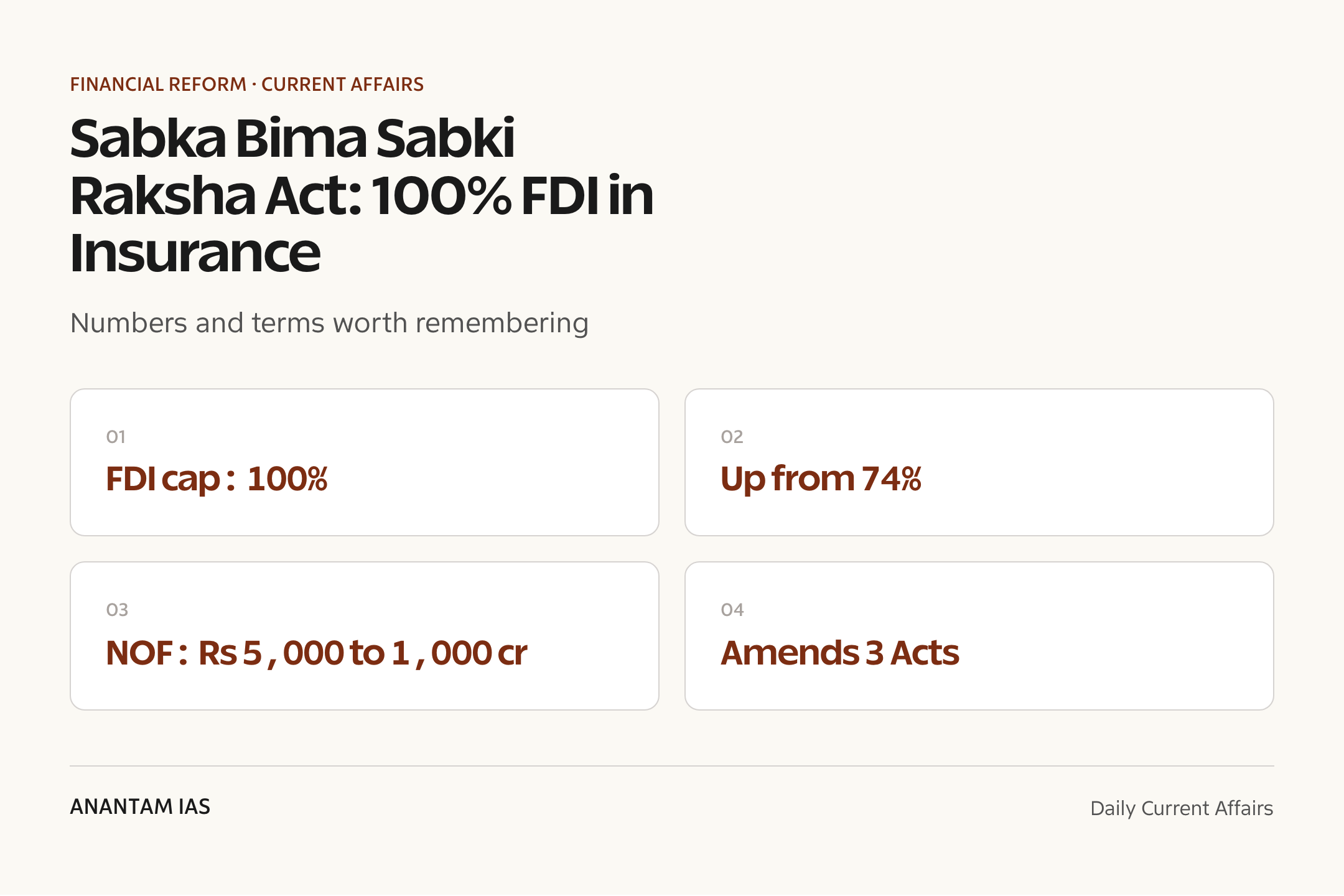
- FDI cap in Indian insurers raised from 74% to 100% of paid-up equity capital.
- Amends three Acts together — the Insurance Act, 1938, the LIC Act, 1956, and the IRDA Act, 1999.
- Net Owned Fund requirement for foreign reinsurance branches cut from Rs 5,000 crore to Rs 1,000 crore.
- Prior-approval threshold for transfer of an insurer’s share capital raised from 1% to 5%.
- A new Policyholders’ Education and Protection Fund created to spread insurance awareness.
- Policyholder data to be collected and protected in alignment with the DPDP Act, 2023.
The development matters in the context of:
- Why it matters: insurance penetration in India is low, and the sector needs large, patient capital to expand cover to households and enterprises.
- FDI in insurance has been liberalised in steps — 26% (2000), 49% (2015), 74% (2021), and now 100% — reflecting a steady opening of a once-closed sector.
- The reform pairs market opening with stronger consumer protection and regulatory teeth, rather than deregulation alone.

UPSC Relevance
Prelims Relevance
- The Bill amends the Insurance Act, 1938, the Life Insurance Corporation Act, 1956, and the IRDA Act, 1999.
- FDI cap in insurers raised from 74% to 100%.
- IRDAI (Insurance Regulatory and Development Authority of India) is the statutory regulator, headquartered in Hyderabad.
- Net Owned Fund (NOF) for foreign reinsurance branches lowered from Rs 5,000 crore to Rs 1,000 crore.
- Share-transfer prior-approval threshold raised from 1% to 5% of paid-up capital.
- New Policyholders’ Education and Protection Fund financed by government contributions, penalties, and donations.
- Reinsurance is insurance bought by insurers to spread their own risk.
- FDI in insurance was earlier 26% (2000), 49% (2015), and 74% (2021).
- IRDAI gains power to disgorge wrongful gains and to supersede insurer boards acting against policyholder interest.
- Policyholder data handling aligned with the Digital Personal Data Protection Act, 2023.
Mains Relevance
GS Paper 3
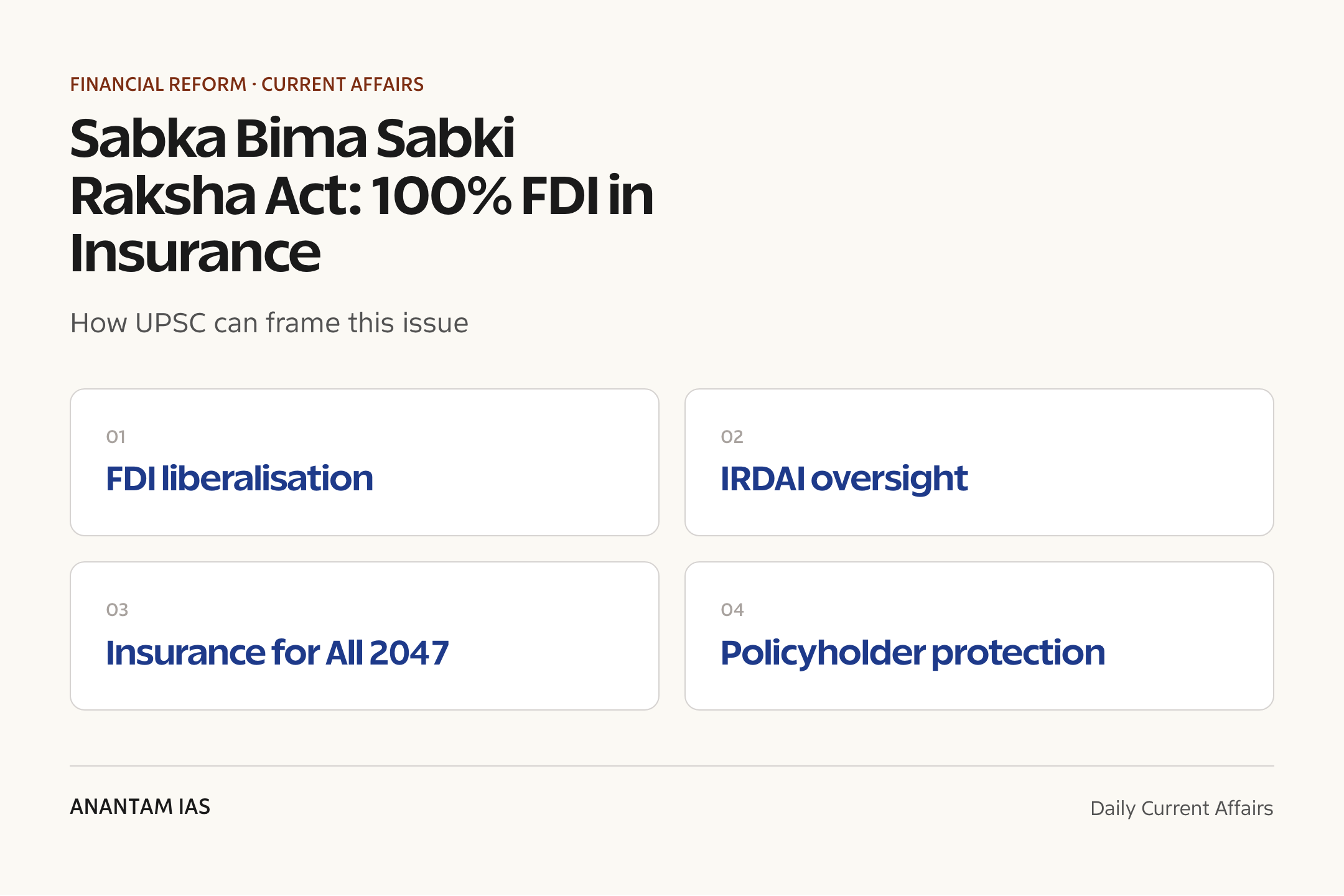
- FDI policy and financial-sector liberalisation: balancing foreign capital inflows against domestic control and consumer protection.
- Mobilising long-term capital for infrastructure and growth via a deeper insurance sector.
- Regulatory architecture of insurance — IRDAI’s mandate, powers, and the tension between development and supervision.
GS Paper 2
- Statutory regulators, accountability, and the design of consumer-protection mechanisms in financial markets.
Essay
- Opening markets while protecting citizens — the balance at the heart of economic reform.
- Financial inclusion as a foundation of economic resilience.
Background and Context
What the 2025 Act changes
A single law rewriting three insurance statutes at once.
- The Sabka Bima Sabki Raksha (Amendment of Insurance Laws) Bill, 2025 amends the Insurance Act, 1938, the LIC Act, 1956, and the IRDA Act, 1999 together.
- Its stated aims: deepen insurance coverage, ease doing business, and improve regulatory oversight and governance.
- Passed by the Lok Sabha on December 16 and the Rajya Sabha on December 17, 2025, with presidential assent following shortly after.
- The name signals the policy goal — universal cover, branded around the regulator’s ‘Insurance for All by 2047’ target.
100% FDI and the liberalisation arc
The biggest opening of the sector since it was reopened to private players.
- The Act raises the FDI cap in Indian insurers from 74% to 100% of paid-up equity capital, removing the residual ownership restriction.
- PIB framed this as opening doors to more foreign players, aiding capital augmentation, technology adoption, and global best practices.
- It continues a phased liberalisation — 26% in 2000, 49% in 2015, 74% in 2021, now full ownership.
- Greater competition is expected to drive efficiency in products and pricing for citizens.
Easing capital and entry rules
Lower thresholds to attract reinsurers, co-operatives, and intermediaries.
- Net Owned Fund (NOF) for foreign reinsurance branches cut from Rs 5,000 crore to Rs 1,000 crore, lowering the entry bar for global reinsurers.
- The minimum paid-up capital requirement of Rs 100 crore for life, general, and health insurance co-operatives is removed.
- For intermediaries, one-time licensing replaces periodic renewal, and licences can be suspended rather than cancelled outright.
- The prior-approval threshold for transfer of an insurer’s share capital rises from 1% to 5%, smoothing routine ownership changes.
Strengthening IRDAI's hand
Market opening paired with a more powerful, rules-based regulator.
- IRDAI gains the power to disgorge — recover wrongful gains from insurers and intermediaries.
- It can supersede an insurer’s board where the company acts against policyholder interest, and approve schemes of arrangement.
- It may regulate agent compensation structures and approve amalgamations.
- Regulation-making is to follow a standard operating procedure and a mandatory consultative process; penalties are rationalised with stated factors for their imposition.
Consumer protection and LIC autonomy
New safeguards for policyholders and operational freedom for the state insurer.
- A dedicated Policyholders’ Education and Protection Fund is created to spread insurance awareness, financed by government contributions, penalties, and donations.
- Policyholder data must now be collected and protected in alignment with the DPDP Act, 2023.
- The Life Insurance Corporation (LIC) gets autonomy to open zonal offices within India.
- LIC may also align its foreign offices with the laws of the jurisdictions in which they operate.
What 'Insurance for All by 2047' means
The policy vision the reform is built to serve.
- IRDAI has set a goal that every citizen has appropriate life, health, and property cover and every enterprise is suitably insured by 2047.
- India’s insurance penetration (premiums as a share of GDP) remains modest, leaving large coverage gaps among households.
- Deeper, better-capitalised insurers are meant to widen access and channel long-term savings into the economy.
- Insurance funds are a key source of patient capital for infrastructure and long-gestation projects.
Way Forward
Convert capital into coverage
- Ensure the easier FDI and capital rules translate into wider rural and low-income cover, not just metro-market consolidation.
- Use lower reinsurance thresholds to build domestic capacity for catastrophe and climate-linked risks.
Make the stronger regulator credible
- Operationalise IRDAI‘s new disgorgement and board-supersession powers transparently to protect policyholders.
- Enforce DPDP Act-aligned data norms and run the new education fund to lift insurance literacy.
With foreign ownership fully open, the test is whether competition and capital genuinely deepen penetration while consumer-protection safeguards keep pace — execution by IRDAI and insurers will decide whether the ‘Insurance for All by 2047’ goal moves from slogan to outcome.
Conclusion
The Sabka Bima Sabki Raksha Act marks the deepest opening of India’s insurance sector to date, taking the FDI cap to 100% while lowering entry barriers for reinsurers, co-operatives, and intermediaries.
Critically, it does not deregulate alone — it arms IRDAI with disgorgement and supersession powers, mandates consultative rule-making, and creates a policyholder protection fund, pairing market opening with stronger oversight.
For UPSC, the law is a clean case study of phased FDI liberalisation, the insurance regulatory architecture, and the balance between attracting capital and safeguarding consumers.
UPSC Practice Questions
Prelims MCQ 1
With reference to the Sabka Bima Sabki Raksha (Amendment of Insurance Laws) Bill, 2025, consider the following statements:
- It raises the FDI cap in Indian insurers from 74% to 100% of paid-up equity capital.
- It amends the Insurance Act, 1938, the LIC Act, 1956, and the IRDA Act, 1999.
- It increases the Net Owned Fund requirement for foreign reinsurance branches.
How many of the above statements are correct?
(a) Only one (b) Only two (c) All three (d) None
Answer: (b) Only two
Explanation:
Statements 1 and 2 are correct. Statement 3 is wrong: the Net Owned Fund requirement for foreign reinsurance branches was reduced (from Rs 5,000 crore to Rs 1,000 crore), not increased.
Prelims MCQ 2
Which statutory body regulates the insurance sector in India?
(a) Securities and Exchange Board of India (SEBI) (b) Reserve Bank of India (RBI) (c) Insurance Regulatory and Development Authority of India (IRDAI) (d) Pension Fund Regulatory and Development Authority (PFRDA)
Answer: (c) Insurance Regulatory and Development Authority of India (IRDAI)
Explanation:
IRDAI, set up under the IRDA Act, 1999 and headquartered in Hyderabad, regulates insurers. SEBI regulates securities markets, RBI banking and monetary policy, and PFRDA pension funds.
UPSC Mains Questions
- The Sabka Bima Sabki Raksha Act, 2025 raises the insurance FDI cap to 100% while strengthening the regulator. Examine the case for fully opening the sector to foreign capital and the safeguards needed to protect policyholders.
- Discuss the role of a deep, well-capitalised insurance sector in mobilising long-term capital and advancing financial inclusion in India. What reforms are needed to move towards ‘Insurance for All by 2047’?
Sources: PIB, Ministry of Finance and PRS Legislative Research.
Frequently Asked Questions
What is the Sabka Bima Sabki Raksha Act, 2025?
It is a law passed by Parliament on December 17, 2025 that together amends the Insurance Act, 1938, the LIC Act, 1956, and the IRDA Act, 1999. Its headline reform raises the FDI cap in Indian insurers to 100%, while easing capital rules and strengthening IRDAI’s oversight to deepen insurance coverage.
What is the new FDI cap in insurance?
The Act raises the Foreign Direct Investment cap in Indian insurance companies from 74% to 100% of paid-up equity capital. This removes the residual ownership restriction and continues a phased liberalisation that moved from 26% in 2000 to 49% in 2015 and 74% in 2021.
What is the Net Owned Fund change for reinsurers?
The Act reduces the Net Owned Fund requirement for foreign reinsurance branches from Rs 5,000 crore to Rs 1,000 crore. This lowers the entry barrier for global reinsurers and is intended to build domestic capacity to absorb large and catastrophe-linked risks.
What new powers does IRDAI get?
IRDAI can now disgorge, or recover, wrongful gains from insurers and intermediaries, supersede an insurer’s board where it acts against policyholder interest, regulate agent compensation, and approve schemes of arrangement. Rule-making must follow a standard operating procedure and a mandatory consultative process.
What is the Policyholders’ Education and Protection Fund?
It is a dedicated fund created by the Act to spread awareness about insurance among policyholders. It is financed through government contributions, penalties, and donations, and forms part of the law’s stronger consumer-protection framework alongside DPDP Act-aligned data rules.
What does ‘Insurance for All by 2047’ mean?
It is IRDAI’s vision that by 2047 every citizen has appropriate life, health, and property cover and every enterprise is suitably insured. With India’s insurance penetration still modest, the 2025 reform aims to attract capital and competition to close coverage gaps and widen access.
Tell Google you want more of this.
Add Anantam IAS as a preferred sourceOne tap, and this site shows up more often in your own Top Stories, AI Overviews and AI Mode. Remove it any time.