Daily Digest
UPSC · Civil Services Examination
Current Affairs · Monday, 22 December 2025
Current affairs curated and edited by Anantam IAS faculty — pulled from The Hindu, PIB, IDSA, Foreign Affairs and the ministries. Read, annotate, revise.
Old Rajinder Nagar · Delhi 110005 · anantamias.com
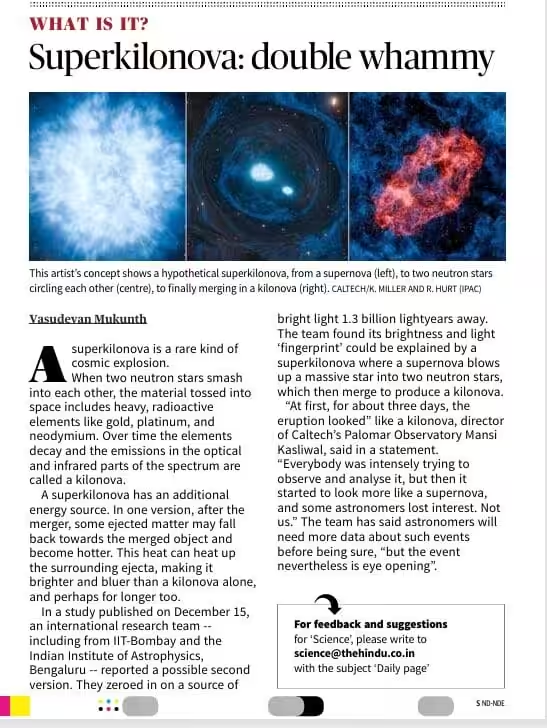
Superkilonova

Context:
Astronomers have reported observational evidence of a rare cosmic explosion called a superkilonova, based on analysis of an unusually bright and long-lasting astronomical event detected about 1.3 billion light-years away.
UPSC Relevance:
Science and Tech.
UPSC PYQ:
Q. Consider the following pairs : (2023)
| Objects in space | Description | |
| 1. | Cepheids | Giant clouds of dust and gas in space |
| 2. | Nebulae | Stars which brighten and dim periodically |
| 3. | Pulsars | Neutron stars that are formed when massive stars run out of fuel and collapse |
How many of the above pairs are correctly matched?
(a) Only one
(b) Only two
(c) All three
(d) None
About Kilonova?
- A kilonova occurs when two neutron stars merge.
- This merger ejects material rich in heavy radioactive elements like:
- Gold
- Platinum
- Neodymium
- These elements undergo radioactive decay, producing:
- Bright emission in optical and infrared wavelengths.
- Kilonovae are key sources of heavy elements in the universe (r-process nucleosynthesis).
What is a Superkilonova?
A superkilonova is a rarer, more energetic version of a kilonova.
Why “Double Whammy”?
- Because it involves two energy sources:
- Produces a kilonova.
- Supernova explosion
- A massive star explodes.
- Leaves behind two neutron stars.
- Neutron star merger
- The neutron stars spiral inward and merge.
About Neutron Star:
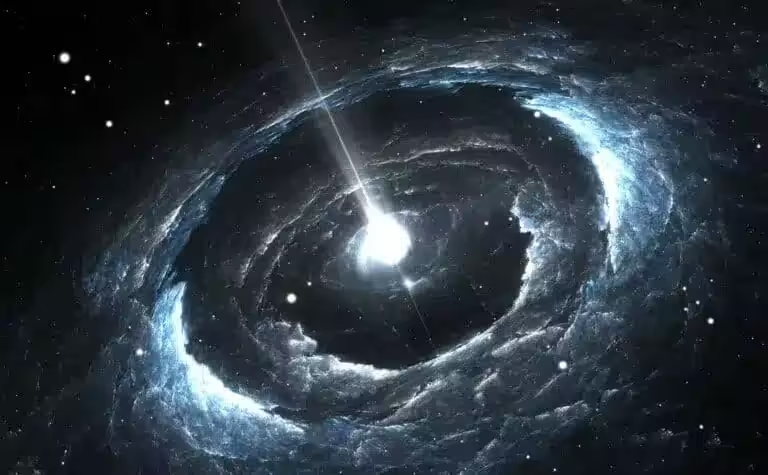
- Extremely dense and compact celestial objects formed from the collapse of a massive star’s core after it runs out of fuel.
- During this collapse, protons and electrons are crushed together, forming neutrons.
- If the collapsing core’s mass is between 1 and 3 solar masses, the newly-created neutrons can halt further collapse, resulting in a neutron star.
- Cores with masses exceeding this range continue to collapse into stellar-mass black holes .
Source: https://anantamias.com/current-affairs/superkilonova/
Lesson from China on tackling pollution

Context:
How China—especially Beijing—has sharply reduced air pollution over the past decade, drawing policy lessons for India, particularly Delhi-NCR, which continues to face severe air-quality crises.
Key Evidence Highlighted (China vs India)
China (Beijing)
- Achieved a ~50% reduction in annual PM2.5 levels between 2013 and 2021.
- Implemented:
- Clean Air Action Plan
- Blue Sky Protection Campaign
- Used:
- Strict industrial emission norms
- Closure/relocation of polluting industries
- Massive push for electric mobility
- Real-time air-quality monitoring
- Heavy penalties and strong enforcement
- Followed a regional approach: Beijing–Tianjin–Hebei “airshed” coordination to control transboundary pollution.
India (Delhi-NCR)
- Has laws like:
- Air (Prevention and Control of Pollution) Act, 1981
- Environment (Protection) Act, 1986
- But faces:
- Fragmented governance (Centre–State–Local overlap)
- Weak enforcement and regulatory capacity
- Over-reliance on short-term emergency measures (odd-even, construction bans)
- Bodies like CAQM exist but lack:
- Strong enforcement powers
- Adequate funding and accountability
What India Can Learn (Policy Lessons)
Shift from episodic response to mission-mode strategy
- Treat air pollution as a public health emergency, not a seasonal problem.
Strengthen institutional capacity
- Empower CAQM with:
- Enforcement authority
- Financial autonomy
- Accountability mechanisms
Regional (airshed-based) governance
- Adopt a Beijing–Tianjin–Hebei–style model for Delhi-NCR and neighbouring states.
Transport-sector reforms
- Stronger vehicle emission standards (beyond BS-VI)
- Expansion of public transport and EVs
- Congestion pricing and better traffic management
Data-driven regulation
- Public access to air-quality and emissions data
- Real-time emissions monitoring
- Source-apportionment-based policymaking
Must Visit:
Source: https://anantamias.com/current-affairs/lesson-from-china-on-tackling-pollution/