Context:
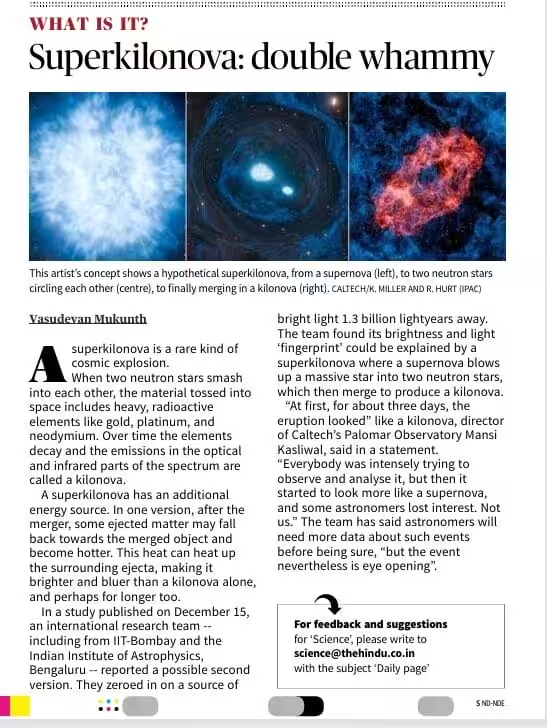
Astronomers have reported observational evidence of a rare cosmic explosion called a superkilonova, based on analysis of an unusually bright and long-lasting astronomical event detected about 1.3 billion light-years away.
UPSC Relevance:
Science and Tech.
UPSC PYQ:
Q. Consider the following pairs : (2023)
| Objects in space | Description | |
| 1. | Cepheids | Giant clouds of dust and gas in space |
| 2. | Nebulae | Stars which brighten and dim periodically |
| 3. | Pulsars | Neutron stars that are formed when massive stars run out of fuel and collapse |
How many of the above pairs are correctly matched?
(a) Only one
(b) Only two
(c) All three
(d) None
About Kilonova?
- A kilonova occurs when two neutron stars merge.
- This merger ejects material rich in heavy radioactive elements like:
- Gold
- Platinum
- Neodymium
- These elements undergo radioactive decay, producing:
- Bright emission in optical and infrared wavelengths.
- Kilonovae are key sources of heavy elements in the universe (r-process nucleosynthesis).
What is a Superkilonova?
A superkilonova is a rarer, more energetic version of a kilonova.
Why “Double Whammy”?
- Because it involves two energy sources:
- Produces a kilonova.
- Supernova explosion
- A massive star explodes.
- Leaves behind two neutron stars.
- Neutron star merger
- The neutron stars spiral inward and merge.
About Neutron Star:
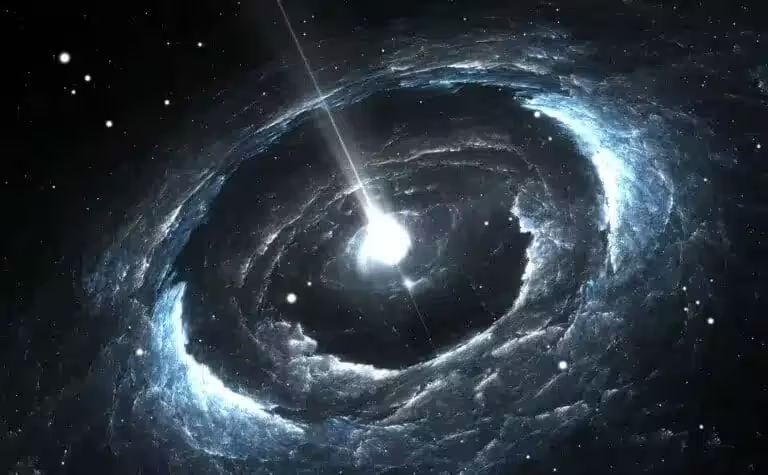
- Extremely dense and compact celestial objects formed from the collapse of a massive star’s core after it runs out of fuel.
- During this collapse, protons and electrons are crushed together, forming neutrons.
- If the collapsing core’s mass is between 1 and 3 solar masses, the newly-created neutrons can halt further collapse, resulting in a neutron star.
- Cores with masses exceeding this range continue to collapse into stellar-mass black holes .
Tell Google you want more of this.
Add Anantam IAS as a preferred sourceOne tap, and this site shows up more often in your own Top Stories, AI Overviews and AI Mode. Remove it any time.