Daily Digest
UPSC · Civil Services Examination
Current Affairs · Tuesday, 22 September 2026
Current affairs curated and edited by Anantam IAS faculty — pulled from The Hindu, PIB, IDSA, Foreign Affairs and the ministries. Read, annotate, revise.
Old Rajinder Nagar · Delhi 110005 · anantamias.com
Biovigilance: Extending Safety Monitoring to Transplant Care
Why in News?
On 21 September 2026, the Health Ministry announced approval of the Biovigilance Programme of India, with the Indian Pharmacopoeia Commission leading safety monitoring for products used in organ and tissue transplantation.
- The approved programme covers medicines and biological products used in transplantation, including products administered to both donors and recipients.
- IPC will lead reporting, assessment, monitoring and prevention of associated adverse events; the announcement does not establish a completed nationwide operational rollout.
- The seventh National Formulary of India was also launched, alongside hospital guidance on reporting adverse events associated with medical devices.
- Patient safety requires a feedback mechanism after products reach clinical practice, so observations can inform assessment and prevention.
- Reporting must invite scrutiny without presenting every suspected association as a confirmed product defect or a proven cause of harm.
UPSC Relevance
Prelims Relevance
- Biovigilance: transplant-related medicines and biological products.
- Indian Pharmacopoeia Commission: lead institution named in the approved programme.
- Pharmacovigilance: medicine-safety monitoring.
- Materiovigilance: medical-device adverse-event monitoring.
- National Formulary of India: guidance for rational prescribing.
Mains Relevance
GS Paper 2
- Health-system governance: translating safety reports into preventive action.
- Institutional capacity and patient participation in surveillance.
GS Paper 3
- Scientific evidence, causal assessment and the safe use of medical products.
Essay
- Trust in healthcare depends on learning openly from possible harm.
Background and Context
What the approved programme actually covers
The important expansion is the transplant setting: safety monitoring must account for products administered to donors as well as recipients.
- Biovigilance, as described in this announcement, concerns adverse events associated with medicines and biological products used in organ and tissue transplantation. Its specified scope should guide an answer, rather than the name alone.
- Donors and recipients are both explicitly included. This matters because an examination answer limited to the person receiving an organ would omit part of the patient-safety responsibility described in the approved programme.
- The Indian Pharmacopoeia Commission will play the lead role in strengthening reporting, assessment, monitoring and prevention. These connected functions describe learning from safety information, rather than simply maintaining a register of reported incidents.
- Government approval is the confirmed policy development. The release does not establish that every transplant centre already has trained reporting staff, functioning referral arrangements or a completed national implementation system for this programme.
- The official announcement places biovigilance alongside existing safety initiatives. Read this as an expansion of the patient-safety framework; it does not announce replacement of transplantation regulation or a new organ-allocation mechanism.

How reporting becomes useful safety evidence
An observation becomes useful when it can be assessed; receiving a report and establishing its cause are different scientific tasks.
- Reporting makes a suspected problem available for examination. WHO describes pharmacovigilance as work involving detection, assessment, understanding and prevention, showing why collecting information is only the beginning of a safety system’s work.
- An adverse event is an unwanted medical occurrence during treatment; it does not necessarily establish a causal connection. A problem observed after an intervention should not automatically be described as caused by that intervention.
- Assessment examines the possible relationship between an event and treatment. The WHO safety-monitoring guidance distinguishes suspected associations from established conclusions, helping prevent an initial report from being mistaken for proof of harm.
- Monitoring and prevention give reporting its public-health purpose. For the approved programme, the relevant governance question is whether assessed information can inform safer practice; the announcement provides no measured reduction in transplant-related harm.
- Patient participation was specifically emphasized in the announcement. Patients’ observations can add information to professional reporting, but accessible reporting channels still need a scientific assessment process before conclusions about product safety are communicated.
Different safety functions and rational prescribing
The three vigilance initiatives address different subjects, while prescribing guidance serves a related but distinct clinical purpose.
- Pharmacovigilance concerns medicine-safety information. The existing Pharmacovigilance Programme of India is coordinated through IPC’s National Coordination Centre, which systematically collects, assesses and analyses adverse drug reaction information from the reporting system described in the release.
- Materiovigilance monitors adverse events associated with medical devices. Hospital guidance released at the same event supports that function; a device-related report and a medicine-related report should not be treated as interchangeable simply because both involve healthcare.
- Biovigilance adds a transplant-focused context for medicines and biological products administered to donors and recipients. Its subject overlaps medicine safety, but the announcement highlights a specific care setting that requires attention across these linked participants.
- The National Formulary of India supports informed, evidence-based prescribing and rational medicine use. It guides healthcare professionals; its publication is different from evidence that a particular reported adverse event was caused by a medicine.
- Prescribing guidance and vigilance are complementary: one helps professionals make appropriate treatment decisions, while the other examines safety experience. Neither a new edition nor a new programme announcement demonstrates that all preventable harm has been eliminated.
Way Forward
Make reports usable and responsibilities clear
- Publish implementation responsibilities for reporting, assessment and follow-up so programme approval can be translated into accountable work at participating institutions.
- Train staff to record suspected events clearly without overstating causation, and make reporting channels understandable to donors, recipients and caregivers.
- Use assessment feedback to improve clinical practice; judge progress by the quality and use of safety evidence, rather than treating report counts alone as success.
Conclusion
- Biovigilance extends the patient-safety discussion to transplant-related medicines and biological products, including care of donors and recipients. Its value depends on connecting reporting with credible assessment, continuing monitoring and preventive action.
- For an examination answer, distinguish approval from implementation and association from causation. Explain the institutional role and evidence pathway before assessing outcomes that this announcement has not yet demonstrated.
UPSC Practice Questions
Prelims MCQ 1
With reference to the approved Biovigilance Programme of India, consider the following statements:
- The Indian Pharmacopoeia Commission will play a lead role.
- Its announced scope includes products administered to donors and recipients.
- Every reported adverse event establishes a causal relationship with a treatment.
How many of the above statements are correct?
(a) Only one (b) Only two (c) All three (d) None
Answer: (b) Only two
Explanation:
The first two statements match the announcement. An adverse event is not, by itself, proof that treatment caused the event.
Prelims MCQ 2
Which of the following best describes the National Formulary of India?
(a) A register allocating donated organs (b) A database proving causation for every safety report (c) Guidance supporting rational and safe use of medicines (d) A replacement for medical-device safety monitoring
Answer: (c) Guidance supporting rational and safe use of medicines
Explanation:
The NFI guides healthcare professionals in evidence-based prescribing and rational medicine use; it does not allocate organs or establish causation in individual reports.
UPSC Mains Questions
- Explain how a biovigilance framework can strengthen patient safety in organ and tissue transplantation. What institutional steps are needed after programme approval?
- Why must adverse-event reporting be distinguished from proof of causation? Discuss the implications for public trust and health-system governance.
Sources: PIB, Ministry of Health and Family Welfare and WHO: Pharmacovigilance.
Frequently Asked Questions
What is the Biovigilance Programme of India?
It is an approved initiative to strengthen reporting, assessment, monitoring and prevention of adverse events associated with medicines and biological products used in organ and tissue transplantation, including products administered to donors and recipients.
Has the programme already been implemented nationwide?
The September announcement confirms government approval and IPC’s lead role. It does not establish that every transplant centre is operationally reporting under the programme or provide evidence of completed nationwide implementation.
Does an adverse-event report prove that a medicine caused harm?
No. An adverse event records an unwanted medical occurrence during treatment. Establishing whether the treatment caused that occurrence requires assessment; the sequence of treatment followed by an event does not itself prove causation.
How is biovigilance different from materiovigilance?
Materiovigilance monitors adverse events associated with medical devices. The announced biovigilance programme focuses on medicines and biological products used in organ and tissue transplantation, including those administered to donors and recipients.
What does the National Formulary of India do?
The National Formulary of India provides guidance to healthcare professionals for rational and safe medicine use. Its prescribing function complements safety monitoring but does not determine the cause of an individual reported adverse event.
Source: https://anantamias.com/current-affairs/biovigilance-transplant-adverse-event-safety/
Rural Water Workforce: Linking Repairs With Water-Quality Surveillance
Why in News?
On 21 September 2026, the Department of Drinking Water and Sanitation set a state-level rollout roadmap for Nal Jal Mitra and Sujalam Shakti under Jal Jeevan Mission 2.0.
- States were asked to adopt the existing Nal Jal Mitra qualification or develop a state-specific course, alongside district assessments of actual water-system workforce gaps.
- The two Nal Jal Mitra pathways are 510-hour Short-Term Training for new entrants and 120-hour Recognition of Prior Learning for personnel already working in rural water systems.
- Sujalam Shakti focuses on women-led water sampling, field testing and basic disinfection, while the rollout also requires arrangements for deployment, remuneration and performance monitoring.
- A household connection remains useful only when water service continues after construction: equipment needs maintenance, failures need repairs and water quality needs checking.
- The announcement establishes implementation actions, not proof that every village already has trained personnel or that projected employment has materialised.
UPSC Relevance
Prelims Relevance
- Nal Jal Mitra: routine operation, preventive maintenance and first-level repairs.
- Short-Term Training and Recognition of Prior Learning: distinct entry pathways.
- Sujalam Shakti: women-led water-quality surveillance and basic disinfection.
- Field Test Kits: tools within community water-quality monitoring.
- State Water and Sanitation Missions and Gram Panchayats: workforce planning and candidate nomination.
Mains Relevance
GS Paper 2
- Local institutions, skilled personnel and accountability in rural public-service delivery.
- Women’s participation in water governance through recognised and supported technical roles.
GS Paper 3
- Maintenance of public infrastructure and the link between occupational skills and local livelihoods.
Essay
- Public infrastructure succeeds when institutions keep it working.
Background and Context
Nal Jal Mitra: keeping water infrastructure working
The maintenance role links the physical water system to a locally available technician, instead of treating the installation of a connection as the final outcome.
- Nal Jal Mitra is designed as a village-level, multi-skilled technical role covering pumps, pipelines, treatment systems and electrical installations; its scope includes routine operation, preventive maintenance and first-level repairs across rural water supply infrastructure.
- Preventive maintenance means attending to equipment before breakdown, while first-level repair addresses an identified fault; a service plan should distinguish these tasks so workers do not merely respond after households lose supply.
- Short-Term Training provides a structured entry route for newcomers, whereas Recognition of Prior Learning is intended for existing operators, plumbers, electricians and pump attendants whose experience can enter a formal qualification pathway.
- The distinction matters for workforce planning: a district with experienced pump operators needs a different training mix from one lacking personnel; counting course enrolments alone cannot establish whether its practical skills gaps are filled.
- States were advised to prioritise local youth and use training institutions such as ITIs and polytechnics; local availability matters because a certified worker must be reachable when a village system needs attention or repair.
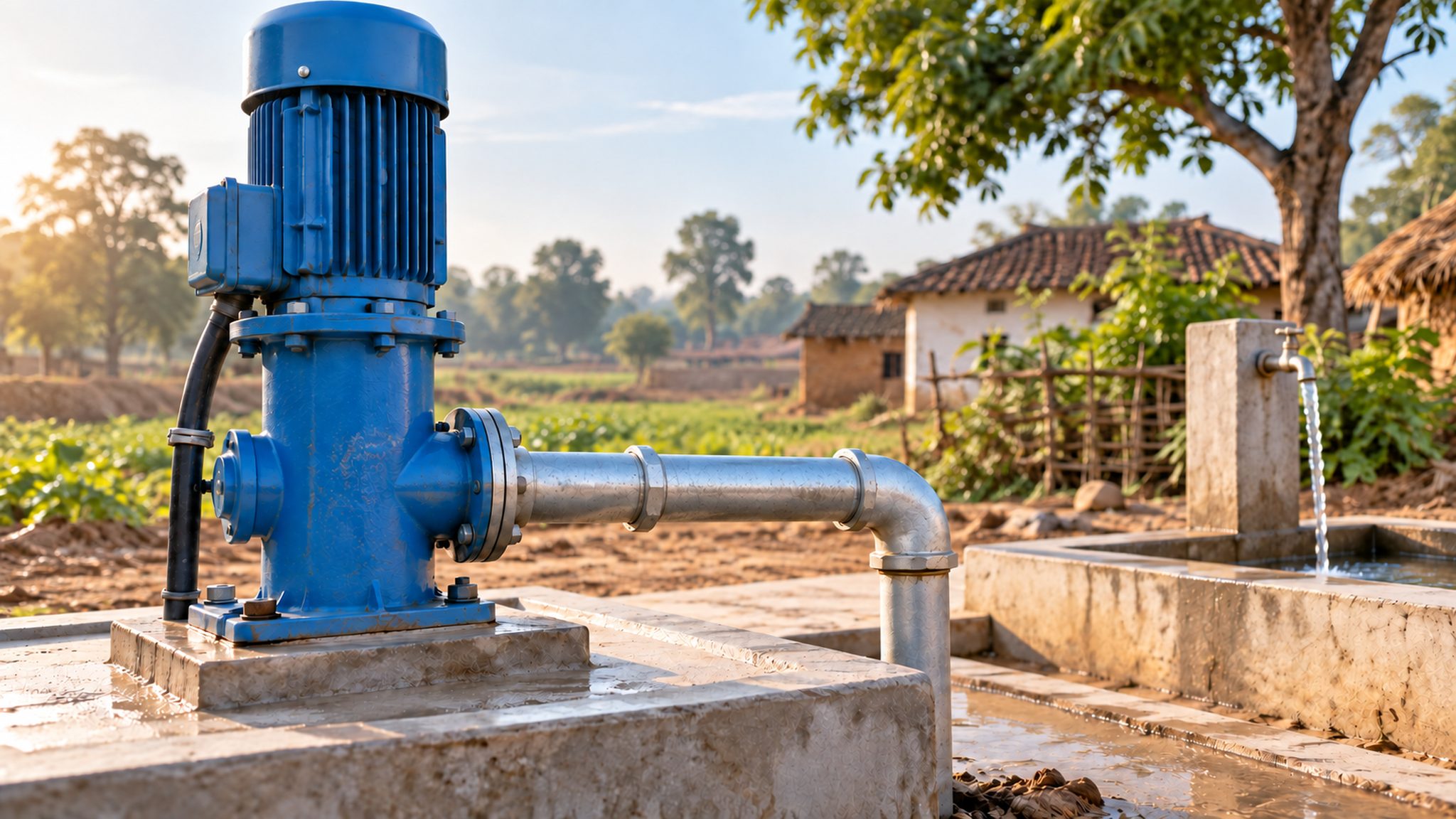
Sujalam Shakti: checking water quality near the household
A working pump answers whether water can move; quality surveillance asks whether the supply requires investigation or corrective action before people can depend on it.
- Sujalam Shakti seeks a trained, women-led village workforce for sampling, testing and basic disinfection; the roadmap prioritises women already involved in water testing, Self-Help Group members and other community representatives for participation.
- Representative sampling and Field Test Kits are part of the proposed skills package, alongside sanitary inspections and source protection; these activities look beyond whether water appears clear when it reaches a tap.
- Basic chlorination and disinfection form another part of the qualification, but this does not make each community worker a specialist responsible for every treatment problem; technical support must match the problem identified.
- Record maintenance and digital reporting connect an observation to follow-up: a test result needs its sampling context and an accountable recipient, rather than becoming a number collected without a route to corrective action.
- The key comparison is maintenance versus surveillance: repairing a pump restores its function, while sampling investigates quality; both support the same drinking-water service, but neither activity alone proves that the other requirement is satisfied.
From a certificate to an accountable service
The rollout makes human-resource planning consequential: a trained person needs an assigned role, working arrangements and an institution that responds when problems are reported.
- District-wise assessments are to reflect actual assets and operational needs, including pumping stations, treatment plants, reservoirs, distribution networks and laboratories; a uniform training quota would miss differences between the systems that workers must maintain.
- Gram Panchayats are to route candidate nominations, while state missions coordinate training choices and district missions verify institutional infrastructure; this connects selection and training capacity to the places where personnel will actually work.
- Deployment and remuneration need explicit arrangements after certification: who assigns the worker, who pays and which area is covered are service-design questions, rather than automatic consequences of successfully completing a recognised training course.
- Performance monitoring should examine whether faults and quality alerts receive follow-up, alongside training completion; a useful accountability chain connects the village worker, supervisory staff and responsible institutions without leaving unresolved problems between their roles.
- The official roadmap calls for state human-resource policies and coordinated implementation; its projected future staffing requirements must not be described as jobs already created or evidence that the full workforce is operational nationwide.
Way Forward
Make the service obligation explicit
- Match training intake to asset inventories and workforce gaps, then verify that candidates can access practical equipment and competent assessment.
- Publish clear work assignments and payment arrangements, with a named supervisor and a route for faults beyond the village worker’s competence.
- Connect quality alerts to documented follow-up, technical support and communication with affected households; participation should include authority and support to act.
- Track service outcomes, such as resolution of reported faults, alongside certification, without presenting projected staffing needs as completed appointments.
Conclusion
- Reliable rural water service depends on both functioning infrastructure and monitored quality; Nal Jal Mitra and Sujalam Shakti address distinct operational needs within that shared objective.
- For an answer on implementation, connect skills, deployment, remuneration and accountability: the new roadmap supplies a practical example, while actual service improvements remain outcomes to establish through implementation evidence.
UPSC Practice Questions
Prelims MCQ 1
With reference to the rural water workforce roadmap, consider the following statements:
- Nal Jal Mitra includes preventive maintenance and first-level repairs.
- Recognition of Prior Learning is intended only for entrants without previous water-sector experience.
- Sujalam Shakti includes representative water sampling and basic disinfection.
How many of the above statements are correct?
(a) Only one (b) Only two (c) All three (d) None
Answer: (b) Only two
Explanation:
Statements 1 and 3 are correct. Recognition of Prior Learning is intended for existing workers, including operators, plumbers and pump attendants.
Prelims MCQ 2
Which measure most directly connects training certification with sustained rural water-service delivery?
(a) Reporting enrolment numbers without worker assignments (b) Replacing all experienced workers with new trainees (c) Establishing deployment, remuneration and performance-monitoring arrangements (d) Treating a working pump as sufficient proof of water quality
Answer: (c) Establishing deployment, remuneration and performance-monitoring arrangements
Explanation:
A certificate establishes a training outcome. Assigned responsibilities, payment and monitoring connect that qualification to an ongoing service obligation.
UPSC Mains Questions
- Why must rural drinking-water policy move beyond infrastructure creation? Explain using the complementary roles of maintenance technicians and community water-quality workers.
- Examine how deployment, remuneration and accountability determine whether decentralised skilling initiatives improve public-service delivery.
Source: PIB, Ministry of Jal Shakti.
Frequently Asked Questions
What is Nal Jal Mitra?
Nal Jal Mitra is a village-level technical workforce initiative for rural water systems. Its intended tasks include routine operation, preventive maintenance and first-level repairs involving pumps, pipelines, treatment systems and associated infrastructure.
How do Short-Term Training and Recognition of Prior Learning differ?
Short-Term Training is the entry pathway for new trainees. Recognition of Prior Learning serves personnel already working in rural water systems, including operators, plumbers, electricians and pump attendants, through a separate qualification pathway.
What does Sujalam Shakti focus on?
Sujalam Shakti seeks women-led village water-quality surveillance. Its skills package includes representative sampling, Field Test Kits, basic disinfection, sanitary inspections, source protection, record maintenance and reporting, rather than replacing the infrastructure-maintenance role.
Does the roadmap mean the workforce is already deployed?
No. The announcement sets implementation actions involving qualifications, training plans, staffing assessments and human-resource policies. Projected workforce requirements are future estimates, while deployment and service improvements require separate evidence.
Source: https://anantamias.com/current-affairs/jjm-local-water-workforce-maintenance-quality-surveillance/
MSC Elsa 3: Shipowner Liability and the Admiralty Route
Why in News?
The Hindu reported that the Supreme Court issued notice on September 21, 2026, on a cargo owner’s petition concerning shipowner liability after the MSC Elsa 3 sinking.
- The container vessel sank off Kerala while sailing from Vizhinjam to Kochi in May 2025.
- The cargo owner challenges the use of an independent admiralty suit for the shipowner’s limitation action.
- The Kerala High Court had held that action maintainable; the Supreme Court has now sought the shipowning company’s response.
- A maritime casualty can create different legal questions about forum, responsibility and compensation; resolving one does not automatically resolve the others.
- The current development concerns a cargo dispute. Separate environmental claims should not be presented as already settled by this procedural step.
UPSC Relevance
Prelims Relevance
- Admiralty: jurisdiction concerning maritime claims.
- Maintainability: whether a proceeding can be entertained in its chosen form.
- Merits: substantive entitlement and responsibility.
- Limitation of liability: a legal ceiling on covered liability, distinct from a filing deadline.
Mains Relevance
GS Paper 2
- Judicial process and the distinction between procedural and substantive decisions.
- Access to remedies and legal certainty in maritime commerce.
GS Paper 3
- Accountability after maritime accidents without conflating commercial and environmental claims.
Essay
- Legal certainty and effective remedies must develop together.
Background and Context
Why the legal route matters
A maritime claim links a demand for relief to shipping; the appropriate proceeding remains a separate question that courts must examine.
- The lost consignment gives this dispute its commercial setting: a cargo owner seeks a remedy after goods disappear with a ship. The present procedural challenge concerns the shipowner’s attempt to limit liability.
- The official maritime administration maintains the Admiralty Act and Rules. The 2017 Act is the named statutory framework disputed here; its title concerns jurisdiction and settlement of maritime claims, not automatic compensation.
- Maintainability asks whether a particular proceeding may be entertained through the legal route chosen. A finding that a suit is maintainable leaves distinct questions about entitlement, responsibility and the amount recoverable for examination.
- According to The Hindu, the petitioner contests the independent admiralty-suit route, while the High Court accepted maintainability. These are opposing positions about the proceeding, not two competing calculations of the cargo’s value.
- For understanding the dispute, separate who suffered loss, who seeks limitation, and which legal route is challenged. That sequence prevents the cargo owner’s challenge from being mistaken for the shipowner’s own compensation claim.

Limiting liability is different from denying it
The useful distinction is between establishing legal responsibility and deciding whether a ceiling constrains the liability covered by the applicable framework.
- Liability concerns legal responsibility for a loss. Limitation of liability concerns a permissible ceiling. An owner seeking limitation is not, merely by doing so, obtaining a judicial finding that no loss occurred.
- The IMO explanation of maritime limitation describes ceilings for covered personal-injury and property claims. This supplies international background, not a finding that any particular ceiling has been approved in the MSC Elsa 3 dispute.
- Covered claims matter because a limitation framework has a defined scope. A learner should first identify the type of loss and governing rule, instead of assuming every consequence of a wreck receives identical treatment.
- The IMO framework includes a demanding exception involving intentional conduct or recklessness with knowledge of probable loss. Its existence shows why a cap is a legal question requiring examination, rather than universal immunity.
- Limitation of liability must also be distinguished from a time limit for bringing proceedings. One concerns the extent of recoverable liability; the other concerns timeliness. Confusing them changes the issue being discussed completely.
What the Supreme Court notice does and does not establish
Read the reported development as a procedural step in a contested case, with the substantive outcome still requiring a judicial decision.
- By issuing notice, the Supreme Court has sought a response from the shipowning company. The reported step does not itself establish that the cargo owner’s interpretation is correct or that the company must compensate him.
- The report does not describe a final reversal of the High Court or a final compensation award. A later decision would need to be read for its precise holding before describing any change in law.
- Maintainability, merits and limitation should be kept separate in an answer: can the proceeding continue, is the claim legally established, and does a liability ceiling apply? A positive answer to one cannot substitute for another.
- Cargo loss is the specific dispute reported here. Do not infer from the shipwreck’s wider environmental significance that this petition decides pollution damage, restoration costs, or the legal claims of every affected coastal resident.
- The broader governance issue is predictable remedies: traders need understandable routes to seek relief, while shipowners need clarity about applicable obligations. Fair adjudication requires identifying the actual claim before debating the appropriate balance between them.
Way Forward
Keep claims and decisions precise
- Court reporting should identify the procedural stage and distinguish a party’s argument from the court’s holding.
- Claimants should preserve cargo and transaction records so the nature and extent of the asserted loss can be examined.
- Public authorities should distinguish commercial claims and environmental claims when communicating the consequences of maritime accidents.
Conclusion
- The MSC Elsa 3 development illustrates why access to a legal forum and success on a claim are different questions: accepting a proceeding for consideration does not decide who ultimately pays.
- For UPSC answers, connect maritime accountability with precise judicial reasoning. Identify the claim, distinguish maintainability from merits and limitation, and avoid describing a notice as a final settlement of a shipwreck’s consequences.
UPSC Practice Questions
Prelims MCQ 1
With reference to the reported MSC Elsa 3 litigation, consider the following statements:
- The Supreme Court issued notice seeking the shipowning company’s response.
- The notice itself finally reversed the Kerala High Court’s maintainability decision.
- Maintainability and substantive liability are distinct legal questions.
How many of the above statements are correct?
(a) Only one (b) Only two (c) All three (d) None
Answer: (b) Only two
Explanation:
Statements 1 and 3 are correct. The reported notice is a procedural step, not a final reversal or compensation award.
Prelims MCQ 2
Which statement best describes limitation of liability in maritime law?
(a) It always removes every obligation after a shipwreck. (b) It is exclusively a deadline for filing a cargo claim. (c) It concerns a legal ceiling for covered liability under an applicable framework. (d) It automatically settles all environmental and commercial claims together.
Answer: (c) It concerns a legal ceiling for covered liability under an applicable framework.
Explanation:
A liability ceiling is different from complete immunity, a filing deadline, or a final determination of every claim arising from an accident.
UPSC Mains Questions
- Explain why maintainability, merits and limitation of liability must be distinguished when analysing maritime litigation.
- How can clarity about legal forums and the nature of claims improve accountability after maritime accidents?
Sources: The Hindu and Directorate General of Maritime Administration.
Frequently Asked Questions
What is the MSC Elsa 3 case currently about?
The reported petition challenges the legal route used for a shipowner’s limitation action after cargo was lost. The Supreme Court has sought a response; the report does not announce a final liability decision.
What does maintainability mean?
Maintainability concerns whether a proceeding can be entertained in its chosen legal form. It does not, by itself, establish the claimant’s substantive entitlement or determine the compensation that must be paid.
Does limiting liability mean there is no liability?
No. Limitation concerns a legal ceiling for covered liability under the applicable framework. It is distinct from a finding of no responsibility and from a time limit for filing proceedings.
Does this notice settle pollution claims from the wreck?
No such conclusion follows from the reported notice. This development concerns a cargo owner’s petition and the shipowner’s limitation action; separate environmental claims should not be treated as already determined.
Source: https://anantamias.com/current-affairs/msc-elsa-three-shipowner-liability-admiralty/
National Accounts Methods: Measuring Households and Quarterly Growth
Why in News?
On 21 September 2026, MoSPI released a national accounts methods compendium explaining the data sources and compilation practices already adopted in the new GDP series.
- The publication consolidates existing methods; it releases no new GDP data and does not announce another base-year revision.
- The household-sector framework combines ASUSE establishment data with PLFS workforce estimates, replacing reliance on older benchmark extrapolation.
- Quarterly estimates use Proportional Denton benchmarking to reconcile short-term indicators with annual accounts while preserving movements as closely as possible.
- Small producers may lack the detailed company accounts available for incorporated businesses; measuring their contribution requires complementary survey evidence.
- A quarterly growth estimate must be timely, but also consistent with fuller annual information when that information becomes available.
UPSC Relevance
Prelims Relevance
- ASUSE: establishment-level production and value-added information.
- PLFS: workforce evidence used in the household-sector estimation framework.
- GVA: output less intermediate consumption.
- Proportional Denton: quarterly-to-annual benchmarking.
- COICOP 2018: classification of individual consumption according to purpose.
Mains Relevance
GS Paper 3
- Measuring unincorporated production through complementary surveys.
- Balancing timeliness, coverage and consistency in national accounts.
Essay
- What a society measures shapes what its policies can see.
Background and Context
Household production needs more than company records
The household sector includes producers, not just consumers; estimating their contribution requires information about establishments and the people working in them.
- Gross value added measures output after subtracting intermediate inputs. A small weaving workshop contributes the value it adds, rather than the entire sale value of cloth already containing purchased yarn and other inputs.
- ASUSE collects establishment-level information on receipts, expenses and employment in covered unincorporated manufacturing, trade and services. Its coverage does not mean every household activity, including agriculture and construction, is measured through this survey.
- PLFS supplies workforce information for the relevant industries and institutional categories. Here its role is to estimate labour input, rather than to provide enterprise sales or directly measure the value of national output.
- The labour-input method combines estimated value added per worker from ASUSE with corresponding workforce estimates from PLFS. Matching activity categories matters: productivity from one kind of business cannot simply represent every other activity.
- Annual survey evidence supports fresh annual estimation, instead of carrying an old benchmark forward through indicators. The method still depends on reported information, consistent classifications and adjustments; direct estimation does not mean a census.

Survey evidence and administrative records do different jobs
The official methodology explains both the source combination and its limits, allowing readers to examine how measured production is constructed.
- For productivity estimates, the framework uses eligible hired-worker establishments in ASUSE after identifying concerns about own-account reporting. It excludes implausible productivity observations before applying estimates to the relevant workforce; these choices affect interpretation.
- ASUSE productivity and PLFS workforce must refer to compatible activities and populations. Otherwise, multiplying two individually valid estimates could produce a misleading aggregate because the underlying groups do not match each other.
- Corporate filings and LLP records strengthen measurement of incorporated business activity. They cannot automatically replace surveys of smaller producers whose operations are not represented adequately in those records; source coverage remains an essential question.
- Administrative data, including GST information, can provide frequent signals of economic activity. A reporting system designed for taxation still needs statistical interpretation before its observations can inform estimates of production across the economy.
- For consumption, COICOP 2018 groups expenditure by purpose, improving the organisation of household spending estimates. Classification tells users how consumption is arranged; it is not itself evidence that household consumption has increased or declined.
Quarterly movements must fit the annual total
Benchmarking reconciles different frequencies of information: faster indicators describe quarterly movement, while annual accounts provide a fuller constraint on the total.
- Annual benchmarks require the quarterly estimates for a completed year to add up to its annual estimate. Quarterly indicators alone may not satisfy that constraint because their coverage and measurement differ from annual sources.
- Proportional Denton adjusts quarterly estimates while keeping their movement close to the indicators. The objective combines consistency with the annual benchmark and preservation of useful short-term signals, rather than arbitrarily dividing the year equally.
- The earlier pro-rata approach could create an artificial step between the final quarter of one year and the first of the next. Denton distributes adjustments more smoothly across that boundary, reducing this methodological discontinuity.
- Benchmark revisions can change previously published quarterly estimates when fuller annual information arrives. Such changes need explanation, but they do not automatically mean the earlier estimates were fabricated or that the real economy suddenly changed.
- Benchmarking cannot repair every source weakness: a poorly matched indicator may misrepresent activity. Users should read the source coverage and revision policy alongside estimates instead of treating a consistency technique as independent economic evidence.
Way Forward
Make revisions understandable
- Publish clear source-to-estimate explanations, showing where survey observations, administrative records and statistical adjustments enter the accounts.
- Explain revision drivers separately: new information, changed classifications and benchmarking adjustments should not be conflated with changes in economic activity.
- Assess coverage and reporting quality regularly, particularly where selected productivity observations are applied to a broader workforce.
Conclusion
- The central lesson is complementarity: establishment surveys describe production, labour surveys describe workers, and annual benchmarks constrain quarterly estimates. None of these sources supplies the whole economic picture by itself.
- Use this development to discuss measurement credibility, not a fresh growth outcome. Better documentation lets users test the relationship between data, assumptions and results without mistaking publication of methods for publication of new GDP figures.
UPSC Practice Questions
Prelims MCQ 1
With reference to household-sector estimation in national accounts, consider the following statements:
- ASUSE provides establishment-level information used to estimate value added per worker.
- PLFS supplies workforce information used in the labour-input framework.
- Direct survey-based estimation eliminates all classification and reporting limitations.
How many of the above statements are correct?
(a) Only one (b) Only two (c) All three (d) None
Answer: (b) Only two
Explanation:
The first two statements describe the complementary survey roles. Survey estimates still depend on coverage, reporting quality, matching and methodological choices.
Prelims MCQ 2
What is the principal purpose of Proportional Denton benchmarking in quarterly national accounts?
(a) Replacing annual accounts with tax collections (b) Making all four quarterly estimates identical (c) Reconciling quarterly estimates with annual benchmarks while preserving indicator movements (d) Measuring household unemployment directly
Answer: (c) Reconciling quarterly estimates with annual benchmarks while preserving indicator movements
Explanation:
Denton benchmarking meets annual constraints while preserving short-term movements as closely as possible and reducing artificial discontinuities at year boundaries.
UPSC Mains Questions
- Explain how establishment surveys and labour-force surveys complement each other in estimating unincorporated production. What limitations remain?
- Why must quarterly national accounts be benchmarked to annual estimates? Discuss the importance of transparent revisions for economic policymaking.
Sources: PIB, Ministry of Statistics and Programme Implementation and MoSPI, Sources and Methods for Compilation of National Accounts Statistics.
Frequently Asked Questions
Did the September publication release new GDP figures?
No. MoSPI states that the publication consolidates sources and methods already used in the new series. The numerical estimates reproduced for reference were already public; this was not another GDP data release.
How do ASUSE and PLFS work together?
ASUSE provides establishment information used to estimate value added per worker. PLFS supplies corresponding workforce estimates. The labour-input framework combines them for relevant activity categories, with coverage matching and methodological adjustments.
Does household-sector production mean household consumption?
No. Households can own enterprises that produce goods and services. Their production contributes value added, while household consumption concerns spending on goods and services for final use. These are different national-accounting concepts.
What does Proportional Denton benchmarking achieve?
It reconciles quarterly estimates with annual benchmarks while keeping movements close to relevant short-term indicators. It reduces artificial breaks at year boundaries, but does not remove weaknesses in the underlying source data.
Source: https://anantamias.com/current-affairs/national-accounts-sources-methods-household-estimation/
Access-Controlled Highways: New Rules for Safer Corridor Design
Why in News?
On 21 September 2026, NHAI announced new planning and design guidelines for upcoming access-controlled high-speed national highways other than expressways.
- The guidelines cover upcoming four-lane and six-lane greenfield and brownfield high-speed access-controlled national highways.
- They seek uniform standards for Detailed Project Reports, replacing variations in corridor planning and design.
- Key provisions include ramp interchanges, advance information about entries and exits, and boundary protection.
- This is a guidelines release, not evidence that the covered highways have already been constructed or opened.
- A highway can have several lanes without having controlled access; the location and design of entry points shape traffic conflicts.
- Reliable freight movement depends on predictable corridor operation and connections to major destinations, not simply a wider carriageway.
UPSC Relevance
Prelims Relevance
- NHAI and national highway planning
- Access control and designated entry or exit points
- Interchanges, ramps and grade separation
- Greenfield and brownfield highway projects
- Detailed Project Reports and traffic assessment
Mains Relevance
GS Paper 3
- How engineering design can reduce road-safety risks.
- Connecting freight destinations without undermining corridor access control.
GS Paper 2
- Uniform standards and accountability in infrastructure project preparation.
Essay
- Public infrastructure quality depends on how safely people use it, not only how much is built.
Background and Context
What the guidelines standardise
The immediate change concerns project preparation: a common planning framework for a defined class of highways, rather than a nationwide road-opening announcement.
- Access control means vehicles join or leave through designated connections. It limits direct roadside entry, distinguishing corridor operation from an ordinary road where numerous adjoining properties or smaller roads may connect directly.
- The stated scope includes greenfield projects on new alignments and brownfield projects involving existing corridors. Both need access planning, although an existing road may already serve settlements and local movements along its route.
- Expressways are excluded from this particular framework. The release addresses the absence of separate planning and design standards for the specified high-speed national highways; it does not redefine every access-controlled road as an expressway.
- A Detailed Project Report translates a corridor proposal into a project design. Uniform requirements make safety and access arrangements part of preparation, instead of leaving comparable corridors with inconsistent technical provisions at that stage.
- Lane configuration is to follow detailed traffic assessment. The useful principle is matching capacity and structures to expected demand; more lanes alone do not establish that entry, crossing and exit movements are safely organised.
How interchanges and advance information work
The central relationship is between uninterrupted through movement and carefully designed connections: traffic must enter, leave or cross without creating uncontrolled conflict points.
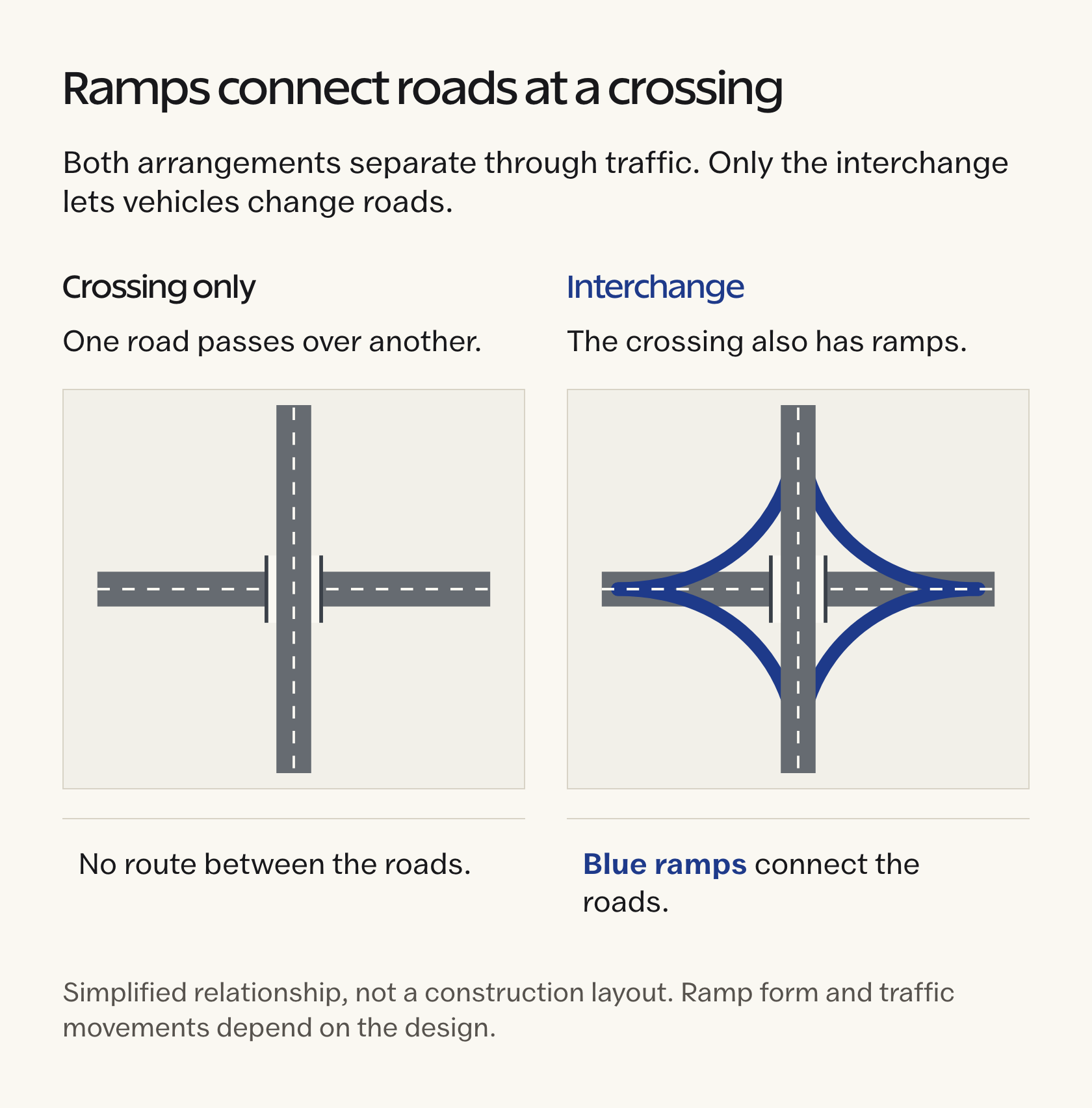
- A grade-separated crossing carries intersecting roads at different levels, while an interchange adds connecting ramps. The distinction matters: a bridge carrying one road over another does not automatically provide access between those roads.
- Ramps channel joining and departing vehicles through defined paths. They separate the act of changing roads from a direct crossing of through traffic, but their geometry and operation still require careful design and assessment.
- The release specifies interchanges at crossings with expressways, national highways, state highways and important traffic-generating arterial roads. This organises major network connections rather than allowing each roadside access demand to become an uncontrolled opening.
- Connections also serve roads leading to ports, airports and logistics parks, alongside industrial and major tourist destinations. Corridor usefulness depends on reaching such destinations while preserving the through route’s access-control function and operational continuity.
- Advance entry and exit information gives drivers time to recognise an approaching connection and prepare their movement. Its safety purpose is anticipation: an exit noticed too late can encourage sudden lane changes or braking.

Boundary protection and the implementation test
Physical separation supports access control, but the public benefit depends on complete project design, workable local connections and continuing upkeep after construction.
- The guidelines prescribe a one-metre boundary wall along the corridor’s outer edge. The stated purposes are preventing encroachment, unauthorised access and stray cattle entry; the announcement does not establish that these risks are eliminated.
- A boundary wall manages access at the corridor edge; an interchange manages authorised connections. They perform different jobs, so neither should be treated as a substitute for the other when explaining the safety mechanism.
- Local connectivity remains a planning question where settlements depend on an existing road. Restricting direct entry requires assessment of how legitimate local trips can reach designated connections without creating pressure for unsafe informal openings.
- Uniform design can improve consistency, but a standard on paper is not a measured safety outcome. Construction quality, maintained boundaries and usable driver information determine whether the intended arrangement works throughout the corridor’s operating life.
- The release establishes guidelines, not completed delivery. Evaluation should separately examine compliant project reports, constructed access arrangements and operational results, rather than using the announcement itself as proof of fewer crashes or faster freight journeys.
Way Forward
Check the design as a connected system
- Review ramps, crossings and advance signs together during project preparation, so users receive clear information before reaching the relevant decision point.
- Assess settlement access alongside corridor protection, including whether planned connections serve everyday local journeys.
- Inspect boundary continuity and upkeep after opening; damaged sections can undermine the access-control design.
- Measure safety and journey reliability after implementation rather than treating guideline publication as an outcome.
Conclusion
- Access control is a system of designated connections, understandable driver information and protected corridor edges; widening a road does not deliver those functions automatically.
- For infrastructure answers, connect planning standards to the mechanism they govern and distinguish a released framework from construction, operation and demonstrated safety improvements.
UPSC Practice Questions
Prelims MCQ 1
With reference to the newly announced NHAI guidelines, consider the following statements:
- They apply to upcoming four-lane and six-lane greenfield and brownfield high-speed access-controlled national highways other than expressways.
- They provide for advance notification of entries and exits.
- Their publication establishes that all covered corridors are already operational.
How many of the above statements are correct?
(a) Only one (b) Only two (c) All three (d) None
Answer: (b) Only two
Explanation:
The first two statements describe the release. The third confuses a planning framework with completed construction and operational delivery.
Prelims MCQ 2
Which best describes the role of connecting ramps in an interchange?
(a) They remove the need for any information about exits. (b) They permit unrestricted entry from every roadside property. (c) They provide designated paths for vehicles moving between intersecting roads. (d) They establish that every grade-separated crossing is an expressway.
Answer: (c) They provide designated paths for vehicles moving between intersecting roads.
Explanation:
A crossing can be grade-separated without connecting the roads. Interchange ramps provide the connecting movements; they do not remove the need for access management or information.
UPSC Mains Questions
- Explain how controlled access, ramp interchanges and advance exit information can contribute to safer high-speed highway operation. (150 words)
- Uniform highway design standards must address local connectivity as well as through traffic. Discuss with reference to NHAI’s new access-controlled highway guidelines. (250 words)
Source: PIB, Ministry of Road Transport and Highways.
Frequently Asked Questions
What is an access-controlled highway?
It is a highway where vehicles enter and leave through designated connections rather than unrestricted roadside openings. The objective is to organise access and reduce conflicts with traffic travelling along the corridor.
Do the new NHAI guidelines cover expressways?
No. The announced framework covers upcoming four-lane and six-lane greenfield and brownfield high-speed access-controlled national highways other than expressways. Its immediate purpose is greater consistency in planning and project preparation.
How is an interchange different from a grade-separated crossing?
Grade separation places crossing roads at different levels. An interchange also provides connecting ramps so vehicles can move between those roads. A bridge over another road need not itself provide a connection.
Have the covered highways already been built?
The release announces planning and design guidelines, not completion of the covered corridors. Construction, opening and measured safety or freight outcomes require separate evidence from individual projects and their subsequent operation.
Source: https://anantamias.com/current-affairs/nhai-access-controlled-highway-design-guidelines/
School Breakfast Expansion: Nutrition and Two Delivery Models
Why in News?
Tamil Nadu expanded its school breakfast scheme to Classes VI–VIII in government and government-aided schools on September 22, 2026, using centralised kitchens and local self-help-group preparation, The Hindu reported.
- The expansion brings upper-primary students within the announced breakfast coverage in government and government-aided schools.
- Centralised kitchens serve the Greater Chennai Corporation and designated schools in other urban and adjoining areas.
- In remaining rural and adjoining areas, women’s self-help groups affiliated with the Tamil Nadu Corporation for Development of Women prepare and serve breakfast.
- The public-policy question is how to provide a safe morning meal reliably before teaching begins, across settlements with different distances and kitchen capacity.
- Coverage announcements describe policy reach; they do not establish nutritional adequacy, daily reliability or measured educational improvement.
UPSC Relevance
Prelims Relevance
- Upper-primary coverage: Classes VI–VIII in the reported expansion.
- Institutional coverage: government and government-aided schools.
- Centralised preparation: cooking at a shared kitchen followed by delivery to schools.
- Decentralised preparation: local self-help groups prepare and serve meals.
Mains Relevance
GS Paper 2
- Designing nutrition services around access, food safety and accountable last-mile delivery.
- Comparing centralised production with community-based preparation without assuming either model is universally superior.
Essay
- A welfare entitlement becomes meaningful through the ordinary reliability of its delivery.
Background and Context
Why the morning meal is a service-delivery issue
School breakfast addresses the timing of food access, while programme quality depends on what reaches children and when it reaches them.
- Classroom hunger concerns children beginning lessons without an adequate morning meal. Breakfast provision addresses that immediate gap; its purpose should be distinguished from a claim that one meal resolves all forms of malnutrition.
- Meal timing is part of access. A nutritionally suitable breakfast delivered after lessons have begun may undermine the service’s purpose, making dependable preparation and serving schedules as important as formal inclusion on beneficiary lists.
- Diet quality requires attention to ingredients, portions and variety, rather than counting plates alone. Menu planning should complement food eaten at home and other school meals instead of treating breakfast as a complete diet.
- Upper-primary expansion extends the reported coverage to older schoolchildren. Its national relevance lies in designing age-appropriate services and managing additional demand without weakening meal reliability for students already covered by the existing programme.
- Equitable access should be assessed at the school level. Administrators need to know whether eligible children actually receive breakfast, including those facing irregular transport or attendance, without turning missed meals into blame directed at families.
Centralised kitchens and local preparation
Tamil Nadu’s reported arrangements combine shared kitchens in urban clusters with self-help-group preparation elsewhere; each model places its main operational burden at different points.
- Centralised kitchens prepare meals for several schools, allowing common procurement and cooking arrangements. Their practical advantage depends on suitable equipment, trained staff and enough capacity to finish preparation before the delivery routes must begin.
- Transport becomes critical when cooking and consumption occur at different locations. Clean containers, route planning and timely handover must preserve food safety; a functioning kitchen alone does not guarantee an acceptable meal at school.
- Local preparation places cooking closer to the school community and can reduce reliance on long delivery routes. It still requires dependable ingredients, safe water, storage, fuel and arrangements for absent workers or equipment failure.
- Women’s self-help groups are the reported preparation and serving partners in the rural arrangement. Community involvement can support local oversight, but participation should come with clear responsibilities, training and timely payment for work performed.
- The comparison is contextual: shared kitchens concentrate production capacity but add delivery dependencies; local kitchens shorten the service chain but distribute supervision across many sites. Settlement patterns and available infrastructure should guide the operational choice.

Food safety, accountability and evidence
A delivery model should be judged through observable service standards, while claims about health or learning require evidence beyond the launch announcement.
- Food safety follows the whole chain: ingredient receipt, storage, preparation, movement and serving. Checks should identify where contamination or delay could occur, rather than assuming cooked food is safe simply because it left the kitchen.
- School-level accountability requires a named person to record receipt, serving problems and complaints. Responsibility should remain traceable when a contractor, municipal kitchen or self-help group performs only one part of the overall service.
- Contingency planning should cover water interruptions, spoiled ingredients, staff absence and transport breakdowns. A written fallback and rapid reporting route help schools respond without informally lowering safety standards just to maintain the meal count.
- Outcome evaluation must separate meals delivered from changes in attendance, nutrition or learning. These outcomes have multiple influences; a launch report cannot establish that breakfast caused any improvement or show how benefits vary between schools.
- Useful monitoring combines delivery records with periodic observation and student feedback. Repeated shortages, late arrivals or uneaten food can reveal problems that a headline coverage figure misses, helping administrators correct the service before expanding it further.
Way Forward
Make reliability measurable
- Track meal availability and serving time at schools, and investigate repeated failures instead of reporting only the number of institutions covered.
- Assign food-safety responsibilities across kitchens, delivery teams and schools; provide an escalation route when a meal should not be served.
- Provide self-help-group workers with training, safe equipment and timely payment, matched to clearly defined duties.
- Evaluate nutrition and educational outcomes separately from implementation outputs, using methods that acknowledge other influences on children’s development.
Conclusion
- School breakfast illustrates how social protection depends on delivery design: the meal must be suitable, safe, timely and accessible, whether it comes from a shared kitchen or local preparation.
- For an exam answer, compare the models through capacity, transport and accountability; treat the expansion as a policy development, while keeping claims about improved health or learning conditional on credible evaluation.
UPSC Practice Questions
Prelims MCQ 1
With reference to Tamil Nadu’s reported school breakfast expansion, consider the following statements:
- The expansion covers Classes VI–VIII in government and government-aided schools.
- Every participating school uses a single centralised-kitchen model.
- Self-help groups participate in preparation and serving in the rural arrangement.
How many of the above statements are correct?
(a) Only one (b) Only two (c) All three (d) None
Answer: (b) Only two
Explanation:
Statements 1 and 3 are correct. The reported expansion uses centralised kitchens in designated urban areas and self-help-group preparation in remaining rural and adjoining areas.
Prelims MCQ 2
Which observation most directly measures the reliability of a school breakfast service?
(a) The number of speeches made at its launch (b) The announced budget alone (c) Whether eligible children receive a safe meal before lessons on scheduled days (d) The number of kitchens photographed
Answer: (c) Whether eligible children receive a safe meal before lessons on scheduled days
Explanation:
Reliability concerns actual, timely and safe delivery. Announcements and infrastructure counts alone cannot show whether children consistently receive the service.
UPSC Mains Questions
- Compare centralised kitchens and community-based preparation as delivery models for school nutrition programmes. What should determine the choice between them?
- Why must school nutrition programmes distinguish implementation outputs from educational and health outcomes? Suggest an accountability framework for reliable meal delivery.
Source: The Hindu.
Frequently Asked Questions
What changed in Tamil Nadu’s school breakfast programme?
The reported September 22 expansion covers students in Classes VI–VIII in government and government-aided schools. It combines centralised kitchen delivery in designated urban areas with self-help-group preparation in remaining rural and adjoining areas.
How do the two delivery models differ?
Centralised kitchens concentrate cooking and then deliver meals to schools. Local preparation brings cooking closer to consumption but requires supervision, infrastructure and dependable supplies across a larger number of preparation sites.
Does expansion prove that learning outcomes improved?
No. Expansion establishes broader policy coverage, not a measured educational effect. Learning, attendance and nutrition outcomes require separate evaluation that considers other influences and distinguishes association from a causal impact of breakfast provision.
What is the main accountability challenge?
Responsibility must remain clear from ingredient procurement through serving. Schools need ways to record missing or unsafe meals, report delays and secure corrective action when different organisations handle different parts of the delivery chain.
Source: https://anantamias.com/current-affairs/school-breakfast-upper-primary-nutrition-delivery/
Sowa-Rigpa Standards: From Formulations to Verifiable Drug Quality
Why in News?
The Ministry of Ayush announced on September 21 that a Sowa-Rigpa working group had begun work towards pharmacopoeias and formularies at its first meeting on September 18, 2026.
- The working group operates under the Pharmacopoeia Commission for Indian Medicine & Homoeopathy (PCIM&H), which hosted the meeting in Ghaziabad.
- Its proposed work includes formularies, pharmacopoeias and related documents supporting regulatory implementation and quality assurance for Sowa-Rigpa drugs.
- The release places the exercise within the Drugs and Cosmetics Act, 1940 and its rules; it does not announce completed standards or a new drug approval.
- The policy question is how to convert documented formulations into consistent, testable product specifications that manufacturers and laboratories can apply.
- A quality benchmark addresses what a product contains and whether it meets requirements; a therapeutic claim requires evidence about what it does in patients.
UPSC Relevance
Prelims Relevance
- PCIM&H: subordinate office under the Ministry of Ayush.
- Pharmacopoeia: an official compendium of drug-quality standards.
- Formulary: a reference describing selected formulations, their composition and preparation.
- Monograph: a specification for an individual substance or preparation within a pharmacopoeia.
- Initiation versus notification: a working-group meeting does not itself bring completed new standards into force.
Mains Relevance
GS Paper 3
- Translating traditional pharmaceutical knowledge into reproducible quality specifications.
GS Paper 2
- Institutional capacity, evidence and accountability in drug regulation.
Essay
- Preserving knowledge while making claims open to verification.
Background and Context
What the new working group is being asked to do
The immediate development is an institutional start: experts will prepare documents that can support quality regulation, rather than announce a finished regulatory outcome.
- PCIM&H develops pharmacopoeias and formularies and acts as the Central Drug Testing-cum-Appellate Laboratory for Indian systems of medicine and homoeopathy. Its mandate connects written specifications with the practical task of evaluating drug samples.
- The Ayush announcement describes a step-wise action plan for Sowa-Rigpa documents. It does not supply final specifications, a completed publication, an implementation deadline or a list of newly approved treatments.
- The working group brings specialist knowledge into the standards process. Identifying a traditional preparation is only the starting point; a usable specification must communicate requirements consistently to people outside the originating practice setting.
- Statutory and non-statutory documents are both envisaged. Their roles differ: a technical reference can support implementation, but its existence alone does not establish that every statement within it has acquired binding legal force.
- For this development, the safe distinction is between work initiated and standards issued. The meeting began an organised exercise; subsequent documents and applicable legal steps will determine the requirements that manufacturers must follow.
Pharmacopoeia and formulary answer different questions
A formulation reference describes the preparation; a quality standard gives a basis for assessing material against specified requirements. Both are needed for consistent products.
- A formulary records selected preparations, including their ingredients and preparation method. In traditional-medicine practice, this helps establish which formulation is being discussed before its quality is assessed or its production is compared across manufacturers.
- A pharmacopoeia collects official drug-quality specifications. Its individual monographs provide a reference against which a substance or preparation can be assessed, helping laboratories move from a product name to defined examination requirements.
- The practical comparison is composition and preparation versus quality specification. A manufacturer needs to know what to prepare; a laboratory needs an appropriate basis for deciding whether the resulting sample meets the stated standard.
- These functions are complementary, not interchangeable. A detailed preparation description cannot by itself establish that every batch meets quality requirements, while testing requires clarity about the material or formulation being examined.
- The Commission’s mandate connects published standards with laboratory testing. Preparation references and quality specifications support that work; neither should be read as Sowa-Rigpa documents already completed by the new group.
What standardisation can establish, and what it cannot
The value of standardisation is a shared basis for checking products. Claims about patient benefit, clinical safety or implementation require their own supporting evidence.
- Quality consistency matters because a product name alone cannot demonstrate that different batches are equivalent in the characteristics a standard measures. Specified requirements make comparison possible without relying solely on the manufacturer’s description.
- Testing capacity determines whether a written benchmark can be used effectively. Laboratories need suitable methods, equipment and trained personnel; publishing a specification is not evidence that every marketed batch has been independently checked.
- Traceability links a test result to the particular sample and batch examined. As a governance principle, records help authorities investigate failures; an acceptable result should not be generalised automatically to unrelated products or batches.
- Clinical effectiveness asks whether an intervention produces meaningful benefit for a defined condition. Meeting product-quality requirements does not answer that question, and the working-group announcement reports no clinical findings that would justify treatment recommendations.
- Implementation claims also need verification. The release describes intended support for regulatory provisions; it does not establish universal compliance, completed inspections or improved patient outcomes. Those are results to assess after the relevant systems operate.

Way Forward
Make future standards usable and auditable
- Publish clear specifications and implementation status so manufacturers and testing laboratories can identify which requirements apply and when.
- Validate testing methods and strengthen laboratory capacity before treating publication as proof of effective quality assurance.
- Maintain batch records and traceability to connect identified failures with corrective action.
- Communicate quality compliance and clinical evidence separately so technical standards are not promoted as proof of therapeutic benefit.
Conclusion
- The Sowa-Rigpa exercise begins the work of connecting formulation knowledge with verifiable product-quality requirements. Its significance lies in developing shared references that manufacturers, laboratories and regulators can use, rather than in announcing a completed standard.
- In an answer, distinguish formulation description, quality verification and clinical evidence. They answer different questions. Strong regulation requires each claim to be supported at the appropriate level, with implementation assessed through evidence rather than an institutional announcement.
UPSC Practice Questions
Prelims MCQ 1
With reference to the Sowa-Rigpa standards initiative, consider the following statements:
- PCIM&H operates under the Ministry of Ayush.
- A formulary can describe the composition and preparation of selected formulations.
- The first working-group meeting established the clinical effectiveness of all Sowa-Rigpa drugs.
How many of the above statements are correct?
(a) Only one (b) Only two (c) All three (d) None
Answer: (b) Only two
Explanation:
The first two statements are correct. The meeting initiated standards work; it neither completed the documents nor established clinical effectiveness.
Prelims MCQ 2
Which question is most directly addressed by a pharmacopoeial quality specification?
(a) Whether a product guarantees recovery in every patient (b) Whether every traditional treatment should replace existing care (c) Whether a sample meets defined requirements for the material or preparation (d) Whether a working-group meeting has completed all regulatory inspections
Answer: (c) Whether a sample meets defined requirements for the material or preparation
Explanation:
A pharmacopoeial specification supplies drug-quality requirements. Product conformity, clinical benefit and implementation outcomes must be evaluated separately.
UPSC Mains Questions
- Explain how formularies and pharmacopoeias perform complementary functions in regulating traditional medicines.
- Why is the publication of drug-quality standards insufficient to establish clinical effectiveness or successful regulatory implementation? Discuss.
Sources: PIB, Ministry of Ayush and PIB, PCIM&H mandate.
Frequently Asked Questions
What happened in the Sowa-Rigpa standards initiative?
A working group under PCIM&H held its first meeting on September 18, 2026. The September 21 announcement said it would develop pharmacopoeias, formularies and related documents supporting regulation and quality assurance.
How does a formulary differ from a pharmacopoeia?
A formulary describes selected preparations, including composition and preparation methods. A pharmacopoeia provides drug-quality specifications. Together, they help identify what should be prepared and how its quality can be assessed.
Were new Sowa-Rigpa standards already issued?
The announcement reported the initiation of work and a step-wise action plan. It did not present completed Sowa-Rigpa pharmacopoeias or formularies, or announce that new final specifications had entered into force.
Does standardisation prove that a treatment works?
No. Quality specifications establish requirements for a product or material. Clinical effectiveness concerns meaningful patient benefit for a defined condition, which needs appropriate evidence rather than an inference from standardisation.
Source: https://anantamias.com/current-affairs/sowa-rigpa-pharmacopoeia-formulary-quality-standards/
Tank Auxiliary Power Units: Supplying Electricity Beyond Propulsion
Why in News?
On September 21, 2026, the Ministry of Defence signed a contract for indigenous auxiliary power units for T-72 and T-90 tanks, advancing industry-led development into procurement.
- The contract with Accurate Industrial Controls Private Limited is worth Rs 586 crore and concerns an electrical subsystem, rather than a new tank platform.
- The ministry identifies fire control, the firing circuit, gun stabilisation and other ancillaries as systems supplied by the APU.
- The release connects the procurement to Make-II, an industry-led development route; it does not announce completed installation across the tank fleet.
- A tank combines mobility with powered equipment. Understanding which function a new subsystem serves prevents an electrical upgrade being mistaken for a replacement propulsion system.
- The case illustrates subsystem indigenisation: domestic capability can develop within an existing platform, without waiting for an entirely new vehicle design.
UPSC Relevance
Prelims Relevance
- APU: an alternate source of electrical power.
- T-72 and T-90: tank platforms named in the contract.
- Fire control and gun stabilisation: electrical loads identified by the ministry.
- Make-II: industry-funded prototype development.
- Contract signing differs from completed delivery and induction.
Mains Relevance
GS Paper 3
- Indigenisation of defence subsystems and industrial research.
- Reliability, maintenance and integration as conditions for operational capability.
Essay
- Self-reliance depends on mastering essential components as well as building complete platforms.
Background and Context
Why a tank needs more than propulsion
The key distinction is between moving the vehicle and supplying electricity to the equipment that supports its operation, observation and weapon functions.
- Propulsion provides the mechanical power needed to move a tank. An auxiliary electrical source performs a different job, so the procurement should not be described as replacing the main engine or increasing vehicle speed.
- An APU generates electricity for equipment on the platform. The ministry describes it as an alternate source, making the electrical supply function central to this announcement rather than a change in armour or ammunition.
- The fire-control system supports aiming and weapon employment. Supplying it with electricity enables its equipment to operate; the power unit does not itself select targets, calculate every firing solution or guarantee a successful engagement.
- Gun stabilisation concerns maintaining the gun’s intended orientation despite disturbances. It is a separate function from driving the tracks, even though both contribute to the usefulness of the same armoured vehicle in field conditions.
- The firing circuit and other ancillaries are additional electrical loads named in the release. The APU supports such systems through power generation; it should not be confused with the weapon, its ammunition or targeting sensors.

What subsystem indigenisation can deliver
An indigenous power unit can matter within an existing tank, but usefulness depends on how reliably the component works with the wider vehicle.
- Subsystem indigenisation concerns a defined part of a larger platform. Here, the indigenous development claim applies to APUs; it does not establish that every component of the T-72 or T-90 has become domestically designed.
- Integration is the connection between a component and its host platform. Evaluating an electrical upgrade requires checking the power supplied against equipment needs, rather than treating the existence of a domestic generator as sufficient.
- Reliability means that the unit performs its assigned function consistently. Maintenance access, fault identification and availability of replacement parts matter because an electrical supply problem can prevent otherwise serviceable equipment from doing its job.
- Domestic support capability is a relevant policy objective: repair knowledge and dependable supplies can reduce vulnerability in sustainment. Actual benefits depend on production quality and support arrangements, which this short announcement does not detail.
- The ministry expects stronger operational readiness, reliability and sustainability. These are stated benefits of induction, not measurements already demonstrated in the release; no numerical fuel-saving or noise-reduction claim should be inferred from them.
Make-II and the meaning of a signed contract
The industrial-policy lesson is the transition from developing an indigenous component to obtaining a procurement contract, while keeping delivery and service use distinct.
- The official Defence Acquisition Procedure identifies Make-II as industry-funded. This describes the development route; it does not mean the buyer receives manufactured equipment without paying under a procurement contract.
- The ministry presents this purchase as an example of industry-led research and development reaching procurement. The teaching point is commercialisation of a defined subsystem, rather than a general account of every defence acquisition stage.
- A signed contract establishes the announced procurement commitment. It is not evidence that all units have been produced, delivered, installed and accepted, or that every eligible tank already operates with the new equipment.
- Development success and sustained production are related but different challenges. Consistent manufacturing, compatibility with the receiving platform and service support should determine whether an indigenous component becomes a dependable capability throughout its useful life.
- For answer writing, separate the confirmed development from its expected consequences: the contract is confirmed, the electrical role is stated, and wider readiness benefits remain outcomes to assess as delivery and induction proceed.
Way Forward
Judge the upgrade through service performance
- Assess acceptance and integration against the electrical needs of the intended tank systems, using defined performance checks before treating contract value as capability delivered.
- Build maintenance support around diagnostics, technician familiarity and dependable spares so a locally developed subsystem remains usable beyond its initial installation.
- Report delivery and induction separately from signing, and substantiate any efficiency or acoustic benefit with measured evidence before presenting it as an achieved result.
Conclusion
- The APU procurement shows why a modest-looking subsystem can matter: electricity supports essential tank functions even though the unit does not replace propulsion, armour or the weapon itself.
- Use this example to connect indigenous development with integration, maintenance and production capability. Keep the claim proportionate: a signed contract advances procurement, while completed induction and demonstrated operational improvements require further evidence.
UPSC Practice Questions
Prelims MCQ 1
With reference to the auxiliary power units contracted for T-72 and T-90 tanks, consider the following statements:
- They are intended to provide an alternate source of electrical power.
- Their stated role includes supplying power for gun stabilisation.
- Their procurement establishes that the main propulsion engines are being replaced.
How many of the above statements are correct?
(a) Only one (b) Only two (c) All three (d) None
Answer: (b) Only two
Explanation:
The ministry identifies alternate electrical generation, including for gun stabilisation. It does not announce replacement of the main propulsion engines.
Prelims MCQ 2
Which statement best describes the distinction between Make-II development and the APU procurement contract?
(a) Industry-funded development makes subsequent equipment purchases free. (b) Contract signing proves fleet-wide induction is complete. (c) Industry-led development can lead to a paid procurement contract, with delivery and induction remaining distinct. (d) A subsystem contract establishes indigenous design of every part of the host tank.
Answer: (c) Industry-led development can lead to a paid procurement contract, with delivery and induction remaining distinct.
Explanation:
Make-II concerns industry-funded development. A procurement contract purchases equipment; it neither proves completed induction nor extends the indigenous claim to an entire platform.
UPSC Mains Questions
- How can indigenisation of critical subsystems strengthen defence preparedness? Discuss with reference to tank auxiliary power units. (150 words)
- Explain why procurement contracts, platform integration and sustained service support should be assessed separately when evaluating defence self-reliance. (250 words)
Sources: PIB, Ministry of Defence and Department of Defence Production, Make in India Defence.
Frequently Asked Questions
What does a tank auxiliary power unit do?
An APU is an alternate source of electrical generation. In this procurement, it supports fire control, the firing circuit, gun stabilisation and other tank ancillaries identified by the Ministry of Defence.
Does an APU replace the main tank engine?
The announced APU role is electrical supply, not vehicle propulsion. The contract should not be read as replacing the main engine or as evidence that the tank’s speed has increased.
What is the relevance of Make-II?
Make-II is an industry-funded development route. The ministry cites this procurement as an example of industry-led research reaching a purchase contract for an indigenously developed subsystem of existing armoured platforms.
Have these APUs already been inducted across the fleet?
The September 21 announcement confirms a signed procurement contract. It does not establish that delivery, installation and acceptance have finished across the fleet; those are separate stages requiring their own evidence.
Source: https://anantamias.com/current-affairs/tank-auxiliary-power-units-make-ii-procurement/
Kasturirangan report on Western Ghats threatens livelihoods: Karnataka CM
Why in news?
Karnataka CM says Kasturirangan ESA plan threatens livelihoods; Centre seeks State’s decision by September 27.
UPSC Relevance
- Prelims: Ecologically Sensitive Area (ESA), Western Ghats (UNESCO World Heritage Site, biodiversity hotspot), Gadgil vs Kasturirangan panels, Environment (Protection) Act, 1986, rivers rising in the Western Ghats.
- Mains: GS-III:
- Conservation, environmental degradation, EIA, disaster management (landslides).
- GS-I: Physical geography; changes in critical geographical features and flora-fauna.
- Essay: Development vs environment.
Western Ghats – why does it matter?
- About 1,600 km long hill chain across six States: Gujarat, Maharashtra, Goa, Karnataka, Kerala and Tamil Nadu.
- UNESCO World Heritage Site (2012, 39 sites)
- Biodiversity and endemism: About 5,000 flowering plants, 325+ globally threatened species, ~290 freshwater fishes, ~219 amphibians and ~227 reptiles. Flagship endemics include the lion-tailed macaque, Nilgiri tahr, purple frog, Malabar civet (critically endangered) and Neelakurinji, which blooms once every 12 years.
- Water tower of peninsular India: Godavari, Krishna, Kaveri, Tungabhadra, Periyar and Vaigai originate here. Shola forests and grasslands act as sponges that feed these rivers through the dry season. Along with many west-flowing rivers, they sustain drinking water, irrigation and hydropower (Koyna, Idukki, Sharavathi) for roughly a quarter-billion people.
- Climate regulator: The range acts as a barrier that channels southwest monsoon rain onto the coastal plains, making Agumbe the “Cherrapunji of the South” and leaving the Deccan in rain shadow. Its evergreen forests are also a major carbon sink.
- Economy: Pepper, cardamom, coffee, tea and rubber plantations, fisheries downstream, and eco-tourism in places like Munnar, Coorg and Mahabaleshwar.
- Culture and communities: Tribal groups live here, including PVTGs such as the Todas, Kurumbas and Kadars. Sacred-grove traditions include the devarakadu of Kodagu and the kavu of Kerala. The Nilgiri Biosphere Reserve (1986) was India’s first biosphere reserve.
- Disaster prone : Steep, rain-soaked slopes are prone to landslides (e.g. Wayanad and Shirur, July 2024).
The Two Expert Panels
| Point | Gadgil Panel (WGEEP), 2011 | Kasturirangan Panel (HLWG), 2013 |
| Area proposed | Entire Western Ghats as ecologically sensitive, graded into ESZ-1, 2 and 3 | About 37% (~60,000 sq km) as ESA |
| Approach | Bottom-up; key role for gram sabhas | Top-down; remote sensing, village as unit |
| Main curbs | Wide curbs incl. new dams, mining, GM crops in ESZ-1 | Ban on mining, quarrying, thermal power, red-category industries, big townships |
| Status | Rejected by States as too strict | Base of draft ESA notifications (latest 2024); not final |
Law behind ESA
- ESAs are notified by the Centre under Section 3(2)(v) of the Environment (Protection) Act, 1986 read with Rule 5 of the Environment (Protection) Rules, 1986 – power to restrict industries and processes in any area.
- Draft notifications have been issued six times (2014, 2015, 2017, 2018, 2022, 2024); none has become final.
- Latest draft (July 2024) covers about 56,825 sq km across six States; Karnataka has the largest share (20,668 sq km).
- The Centre’s draft says agriculture, plantations and daily livelihood activities will not be banned; mining, quarrying and some industries will be.
Why Karnataka objects?
- CM D.K. Shivakumar told the Legislative Assembly the Kasturirangan report could hit livelihoods in 10 districts.
- He said the proposals have created an “atmosphere of fear” among farmers and called them unscientific.
- He toured the coastal and Malnad regions before the session; farmers wanted the report rejected and a new committee formed.
- Fear of curbs on land use, housing, roads and plantations (coffee, arecanut) in Malnad and coastal districts.
- Demand: physical ground survey on the “Kerala model” – Kerala got plantations and settlements excluded after field verification.
- Missed irony: The same special session (Sept 21–23) is discussing drought in 124 taluks. The Ghats forests feed the Kaveri and Krishna catchments – weaker protection may worsen water stress.
- Policy limbo: Twelve years of draft notifications without a final one create uncertainty – itself a livelihood problem. A “new committee” would be the third review after two expert panels.
- Federal angle: Forests and wildlife moved to the Concurrent List by the 42nd Amendment, 1976 (Entries 17A, 17B). The Centre has legal power under EPA, but implementation depends on States.
- Judicial anchors
- Vellore Citizens’ Welfare Forum v. Union of India (1996) – precautionary principle and sustainable development;
- T.N. Godavarman Thirumulpad case – continuing SC oversight on forests consercation
- The National Green Tribunal has repeatedly set deadlines for Western Ghats ESA.
Threats to ecological integrity of Western Ghats
- Deforestation and fragmentation: About 40% forest loss was estimated between 1920 and 1990. Plantations, encroachment and roads have broken the forest into isolated patches, cutting off wildlife corridors.
- Mining and quarrying: The Shah Commission (2010) exposed illegal iron-ore mining in Goa, and the Supreme Court banned mining there in 2012 (Goa Foundation case). Thousands of stone quarries in Kerala destabilise slopes.
- Landslides and floods: Examples include the Kerala floods of 2018 (about 480 deaths), Kavalappara and Puthumala in 2019, Pettimudi in 2020, Irshalwadi (Raigad) in 2023, and the Wayanad landslide of July 2024 (Mundakkai–Chooralmala, 200+ dead). Quarrying, cutting slopes for construction and land-use change on fragile ground all worsen extreme rainfall events.
- Dams and hydropower: The Athirappilly project and Sharavathi pumped storage (inside a lion-tailed macaque sanctuary) remain contested. The Mullaperiyar dispute shows how dams also create inter-state conflict in ecological governance.
- Monocultures and invasive species: Tea, rubber, eucalyptus and acacia plantations replace natural forest. Invasive species such as Lantana, Senna spectabilis (Wayanad) and wattle (Nilgiris) choke native grasslands.
- Tourism and urbanisation: Unregulated resorts and homestays have spread in Munnar, Ooty and Kodagu. The Lavasa hill city became a symbol of speculative development in the hills.
- Human–wildlife conflict: Shrinking and fragmented habitat pushes elephants and other animals into farms and settlements. Kerala declared human–wildlife conflict a state-specific disaster in 2024.
- Climate change: Rain now comes in short, erratic cloudbursts. Species on “sky islands,” such as the Nilgiri tahr and shola birds, are being squeezed upslope with nowhere left to go.
- Governance deadlock: In July 2026 the MoEFCC reissued the draft ESA notification for the 7th time (first issued in 2014) after the previous draft lapsed. Karnataka opposes the notification.
Way forward
- Finalise the ESA– The draft’s phased, state-wise notification provision should be used now rather than waiting for all six states to agree.
- Cadastral-level ground survey and satellite forest-cover tracking, long-term ecological observatories, and climate-refugia mapping to show where species can shift.
- Put communities at the centre via participation of gram sabhas (Gadgil committee)
- Secure and restore corridors – Protect the Wayanad–Mudumalai–Bandipur–Nagarhole complex. Build elevated or underpass crossings on highways and railways. Restore shola grasslands, as with the wattle removal in the Nilgiris ordered by the Madras High Court.
- Payment for ecosystem services to farmers such as the Madras High Court’s e-pass system for Ooty and Kodaikanal (2024).
- Recognise rights under the Forest Rights Act, 2006
- Landslide zoning using GSI maps for disaster risk reduction.
The Gadgil vs Kasturirangan debate is really about the balance between conservation and livelihoods. The durable answer is graded, participatory protection: strict protection for natural landscapes and sustainable-use rules for cultural landscapes.
Practice MCQ
Q1. Consider the following statements about the Kasturirangan High-Level Working Group (HLWG):
- It recommended declaring about 37% of the Western Ghats as an Ecologically Sensitive Area.
- It proposed a complete ban on agriculture and plantations within the ESA.
- It used the village as the unit for demarcating the ESA.
How many of the above statements are correct?
(a) Only one
(b) Only two
(c) All three
(d) None
Answer: (b). Statement 2 is wrong – farming and plantations are not banned.
Q2. Consider the following statements:
Statement I: Ecologically Sensitive Areas in the Western Ghats are notified under the Environment (Protection) Act, 1986.
Statement II: The Act empowers the Central Government to restrict areas where industries, operations or processes may be carried out.
(a) Both correct, and II explains I
(b) Both correct, but II does not explain I
(c) I correct, II incorrect
(d) I incorrect, II correct
Answer: (a). Section 3(2)(v) of EPA is the source of ESA notifications.
Mains Practice Question
“The repeated failure to finalise the Western Ghats ESA notification shows the unresolved tension between ecological security and livelihoods.” Critically examine in the light of the Gadgil and Kasturirangan reports, and suggest a way forward. (15 marks, 250 words)
Accused entitled to release if grounds of arrest not given: SC
Why in news?
SC has judged that arrest without grounds violates Article 22(1) in Jaskaran Jeet Singh Deol v. State of Punjab.
UPSC Relevance
Prelims – constitutional provisions
Mains GS-II:
Indian Constitution – significant provisions and basic structure (Articles 21 and 22).
Jaskaran Jeet Singh Deol v. State of Punjab, 2026
- Ruling: an arrested person kept in the dark about the grounds of arrest and denied a lawyer is entitled to immediate release.
- Nature of right: knowing the grounds in writing, in a familiar language, and access to a lawyer of choice is a sacrosanct fundamental right under Article 22(1) that cannot be breached in any situation.
- Scope: applies to all offences, including ordinary penal law and special laws on terrorism and money laundering.
- Not a technicality: agencies cannot call a breach a ‘mere procedural lapse’. It vitiates both arrest and remand.
- Not bail: release for breach of Article 22(1) is release from illegal detention, not bail.
- No cure later: a chargesheet or order of cognisance filed afterwards does not validate the illegal arrest.
- Re-arrest procedure: police must first give written grounds to the accused, then apply to the Magistrate; the application must be endorsed by the arresting officer’s superior and explain why grounds were not given earlier.
- Why it matters: about three-fourths of India’s prisoners are undertrials (Prison Statistics India, NCRB). Stronger arrest safeguards directly reduce avoidable custody.
Article 22 at a glance
- Article 22(1): No person who is arrested shall be detained in custody without being informed, as soon as may be, of the grounds for such arrest nor shall he be denied the right to consult, and to be defended by, a legal practitioner of his choice.
- Article 22(2): arrested person must be produced before the nearest Magistrate within 24 hours, excluding travel time; no further custody without the Magistrate’s order.
- Article 22(3): clauses (1) and (2) do not apply to enemy aliens or to persons held under preventive detention laws.
- Articles 22(4)–(7): safeguards for preventive detention (Advisory Board, grounds of detention, right to representation).
- Link with Article 21: Maneka Gandhi v. Union of India (1978) – any law taking away liberty must be fair, just and reasonable. Remedies: habeas corpus under Articles 32 and 226.
Statutory backing – BNSS 2023
- Section 47 (old CrPC 50): tell the arrested person the full particulars of the offence and of the right to bail.
- Section 48 (old CrPC 50A): inform a relative or friend about the arrest.
- Section 38 (old CrPC 41D): right to meet an advocate during interrogation.
- Section 58 (old CrPC 57): no detention beyond 24 hours without a Magistrate’s order.
- Special laws: Section 19 of PMLA and Section 43B of UAPA also require informing the grounds of arrest.
Judicial Evolution
| Case | Year | What it held |
| Joginder Kumar v. State of U.P. | 1994 | Arrest cannot be routine; police must justify the need to arrest |
| D.K. Basu v. State of West Bengal | 1997 | Guidelines on arrest: memo of arrest, informing relatives, medical check-up |
| Arnesh Kumar v. State of Bihar | 2014 | No automatic arrest for offences punishable up to 7 years; checklist for police |
| Pankaj Bansal v. Union of India | 2023 | Grounds of arrest must be given in writing under PMLA (Section 19) |
| Mihir Rajesh Shah v. State of Maharashtra | 2025 | Written grounds for every offence, including BNS, in a language the accused understands |
| Jaskaran Jeet Singh Deol v. State of Punjab | 2026 | arrest without grounds violates Article 22(1) |
Practice MCQ
With reference to Article 22 of the Constitution of India, consider the following statements:
1. The right to consult and be defended by a legal practitioner of one’s choice is guaranteed under Article 22(1).
2. The 24-hour period under Article 22(2) includes the time taken for the journey from the place of arrest to the Magistrate’s court.
3. The safeguards under Article 22(1) and 22(2) do not apply to a person arrested under a law providing for preventive detention.
How many of the statements given above are correct?
(a) Only one
(b) Only two
(c) All three
(d) None
Answer: (b). Statement 2 is wrong – travel time is excluded from the 24 hours.
Mains Practice Question
Procedural safeguards at the time of arrest are not mere technicalities but the very substance of personal liberty. Discuss in the light of recent Supreme Court judgments on Article 22(1). (15 marks, 250 words )
India to attend session on UN-based multilateralism
Why in news?
EAM Jaishankar attends the Partners for Multilateralism meeting at UNGA, launched by EU, Brazil, Kenya, Canada.
UPSC Relevance
Prelims
- New groupings: Partners for Multilateralism (P4M) – founders and aims.
Mains GS-II
- Important international institutions, agencies and fora – their structure, mandate.
- Bilateral, regional and global groupings and agreements involving India and/or affecting India’s interests.
- GS-II: Effect of policies and politics of developed and developing countries on India’s interests.
P4M initiative
- Founders –
- Leaders of the EU (Antonio Costa)
- Brazil (Lula da Silva)
- Kenya (William Ruto)
- Canada (Mark Carney)
- Aim: support the UN and push reform, staying away from superpowers, to make it more representative, legitimate, effective and trusted; ready for AI, climate change, health security and digital transformation.
- Not a bloc: P4M says it will not be another exclusive bloc or bureaucracy, but a flexible, open framework to build coalitions for reform.
- India’s position: it is unclear whether India was asked to join the joint message; India is already part of NAM, BRICS, G20 and G4, which have similar goals.
- Guterres view: UN Secretary-General Antonio Guterres (term ends this year) said superpowers are discovering their limits, pointing to Russia in Ukraine and the U.S. in Iran.
- Data: 2025 saw the highest number of state-based armed conflicts since 1946, in 35 countries, and record military spending of nearly $3 trillion.
What is multilateralism?
- Robert Keohane (1990) – coordinating national policies in groups of three or more states.
- It is based on shared, general rules that apply to all, not on power.
- Different from minilateralism (small, issue-based groups like the Quad, I2U2); plurilateralism (a subset of members agreeing within a larger body, e.g. WTO plurilateral deals);
- P4M’s model: middle powers build coalitions on specific issues, prove what works, and feed results back into the UN system.
Why is the UN led multilateralism in crisis ?
- Veto paralysis: Article 27 gives the P5 (US, UK, France, Russia, China) a veto – blocking action on Ukraine, Gaza and other conflicts.
- Outdated structure: the UNSC was last expanded in 1965 (11 to 15 members). Africa has no permanent seat; Latin America and India are also left out.
- Funding and trust: unpaid dues, U.S. cuts and exits from UN bodies; the UN80 Initiative (March 2025) seeks efficiency and cost savings.
- Present uncertainty: growing unhappiness with unilateral moves by Russia, China and the U.S. (trade tariffs, expansionism, the Iran conflict).
- New challenges: AI, pandemics, climate and cyber threats have no strong global rulebook.
Legal hurdle to reform
- Article 108: a Charter amendment needs a two-thirds vote in the General Assembly AND ratification by two-thirds of members, including all five permanent members. So every P5 member has an effective veto over reform.
- Intergovernmental Negotiations (IGN) on UNSC reform have run since 2009 without a single negotiating text.
- Pact for the Future (UNGA, September 2024): commits to UNSC reform and to redressing the historical injustice against Africa; includes the Global Digital Compact.
Various UNSC reform camps
| Group | Members / leaders | Stand on UNSC reform |
| G4 | India, Brazil, Germany, Japan | Back each other’s claim to permanent seats; expand both categories |
| Uniting for Consensus (UfC) | Italy, Pakistan, Argentina, South Korea, Mexico and others | Oppose new permanent seats; only more non-permanent / longer-term seats |
| Ezulwini Consensus | African Union (2005) | 2 permanent seats with veto + 5 non-permanent seats for Africa |
| L.69 Group | Developing countries from Asia, Africa, Latin America, small islands (India a member) | Expansion in both categories; text-based negotiations |
India’s stand
- ‘Reformed multilateralism’: India pushes reform of the UNSC, IMF, World Bank and WTO.
- Voice of the Global South: Voice of Global South Summits; African Union made a permanent G20 member under India’s presidency (New Delhi, 2023).
- Multi-alignment: India hosted the 18th BRICS Summit in New Delhi in 2026 while keeping close ties with the U.S. and Europe.
- Why P4M suits India: it is issue-based and flexible, like India’s own multi-alignment; it gives India a bridge between the Global South (Brazil, Kenya) and the West (EU, Canada).
- Risks for India:
- ‘forum fatigue’ with too many groupings;
- Guterres’s remarks single out Russia and the U.S., two key partners India does not want to antagonise.
Practice MCQ
Consider the following pairs:
1. G4: India, Brazil, Germany, Japan
2. Uniting for Consensus: Opposes new permanent seats in the UNSC
3. Ezulwini Consensus: Common position of ASEAN on UNSC reform
4. Partners for Multilateralism: Launched by the EU, Brazil, Kenya and Canada
How many of the pairs given above are correctly matched?
(a) Only one (b) Only two (c) Only three (d) All four
Answer: (c). Pair 3 is wrong – the Ezulwini Consensus (2005) is the African Union’s position.
Mains Practice Question
Q. In an era of great-power unilateralism, flexible coalitions of middle powers are emerging as a new route to reformed multilateralism. Discuss the relevance of such initiatives for India’s pursuit of UN reform. (15 marks, 250 words)
Source: https://anantamias.com/current-affairs/india-to-attend-session-on-un-based-multilateralism/
