Why in News?
On 11 September 2026, the Indian Pharmacopoeia Commission announced an authenticated enoxaparin sodium reference substance for bioassays, strengthening the measurement infrastructure behind pharmaceutical quality testing.
- The Indian Pharmacopoeia Reference Substance was released during a national conference addressing quality and safety of biosimilars.
- Enoxaparin sodium is a low-molecular-weight heparin anticoagulant used in preventing and treating thromboembolic disorders.
- IPC states that the material may support accurate, consistent and comparable assessment of biological activity.
- A reference material makes a laboratory comparison more meaningful; it does not itself approve the medicine being tested.
- The development concerns quality infrastructure, including standards and analytical capability, rather than a newly demonstrated treatment benefit.
UPSC Relevance
Prelims Relevance
- IPC is an autonomous institution under the Ministry of Health and Family Welfare.
- A bioassay assesses biological activity through an appropriate biological response or system.
- Enoxaparin belongs to the low-molecular-weight heparin group of anticoagulants.
- An authenticated reference substance supports comparison of test results.
- Pharmacovigilance concerns monitoring and assessing medicine-related safety problems.
Mains Relevance
GS Paper 3
- Measurement infrastructure as a foundation for pharmaceutical manufacturing and credible innovation.
- Distinguishing analytical evidence from clinical evidence in biotechnology.
GS Paper 2
- Regulatory capacity, drug quality and patient safety in public-health governance.
Essay
- Trust in science depends on what measurements establish and what they leave unanswered.
Background and Context
What the New Reference Substance Provides
The reference substance supplies a recognised comparison point for laboratory testing; its value lies in the reliability of the measurement relationship.
- Biological activity describes an effect measured in a biological testing system. Identifying a substance chemically and measuring its activity answer related questions, but the answers should not automatically be treated as interchangeable.
- An authenticated reference gives laboratories an established material against which a test sample can be evaluated. This reduces dependence on an arbitrary local comparison whose properties may be poorly established or inconsistently understood.
- The newly released material is specifically enoxaparin sodium for bioassays. It supports the quality-testing ecosystem around an existing anticoagulant; the announcement does not describe discovery of a different medicine or a new clinical indication.
- IPC links its release to consistent, comparable assessment of biological activity. This is a contribution to measurement capability, not a published finding that every product using the standard meets every applicable quality requirement.
- The conference discussed biosimilar quality and safety, but that setting does not classify every discussed product as a newly approved biosimilar. The concrete development to remember is the authenticated substance released for bioassay-related testing.

How Reference and Sample Become Comparable
A meaningful comparison requires both an appropriate reference and controlled testing conditions; placing two vials together does not establish equivalence.
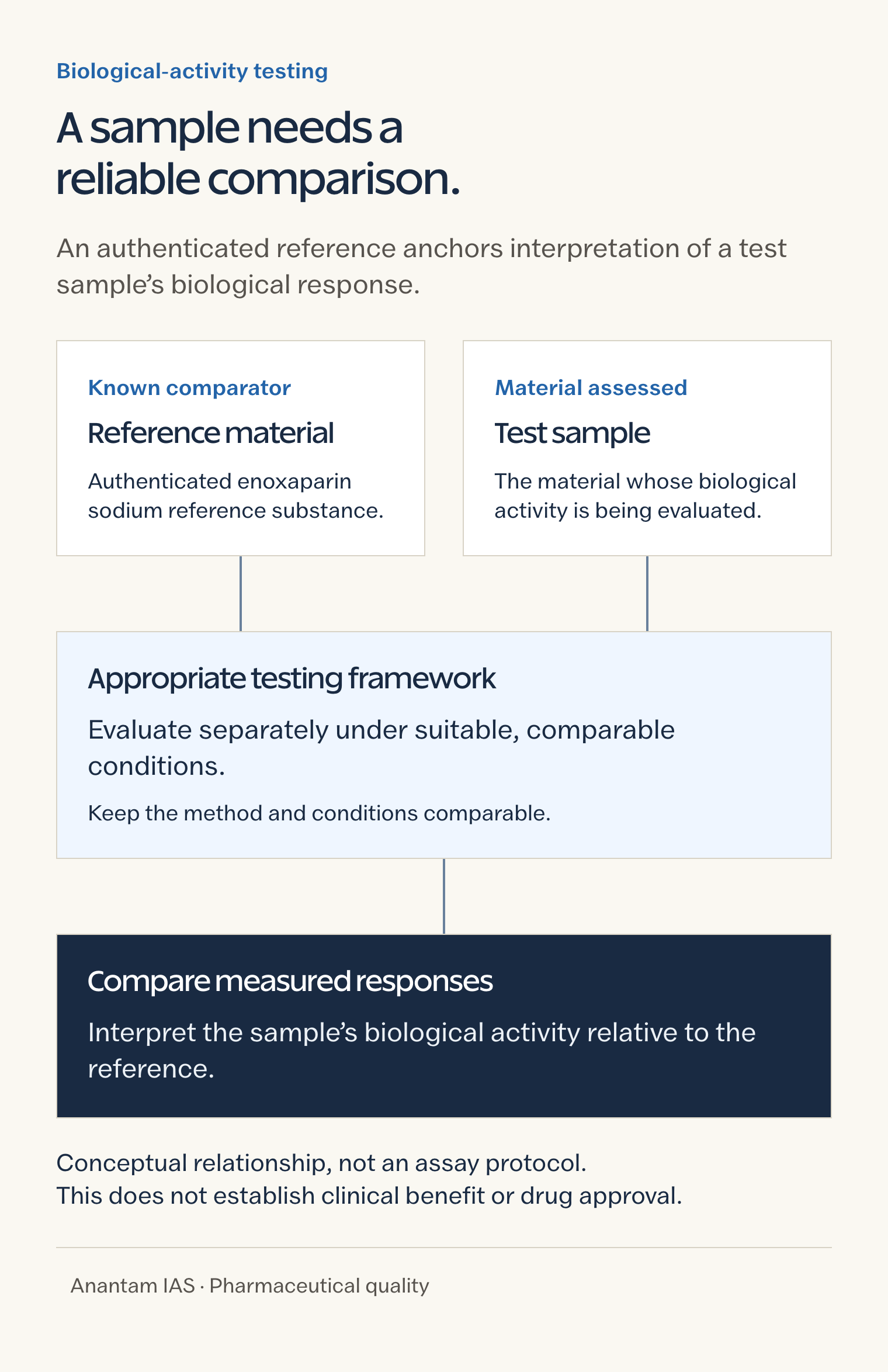
- Conceptually, the reference material and the test sample enter an appropriate testing framework. Their measured responses are interpreted in relation to each other, rather than treating the sample response as a self-explanatory number alone.
- Testing conditions matter because a response can reflect the method as well as the material. Comparable preparation, suitable procedures and reliable equipment help prevent procedural differences from being mistaken for differences between the tested substances.
- Repeatability asks whether testing can produce consistent results under specified conditions. A recognised reference supports interpretation, but cannot compensate for poor laboratory practice, unsuitable methods or errors in handling, recording and evaluating a sample.
- Reference availability also helps laboratories speak a common measurement language. Agreement becomes more meaningful when users understand the comparator and procedure, instead of assuming that identically labelled results necessarily describe the same measured property.
- This is a conceptual explanation, not the announced enoxaparin assay protocol. The release supplies no detailed experimental procedure, numerical potency requirement or acceptance range from which a student should reconstruct a laboratory test.
Where Quality Evidence Ends and Other Evidence Begins
Pharmaceutical confidence combines several kinds of evidence; a biological-activity comparison contributes to that system without replacing its other safeguards.
- An analytical comparison concerns properties measured under test conditions. A clinical assessment concerns effects in people. Good laboratory comparability can support evaluation, but alone cannot establish the size of a treatment benefit in patients.
- Immunogenicity concerns the possibility of an immune response to a biological product. The conference treated it as a separate scientific challenge; an activity measurement should not be represented as a complete assessment of that risk.
- Pharmacovigilance continues the safety task beyond a single quality test. Monitoring suspected adverse effects and examining their causes can reveal concerns that a reference-substance comparison was never designed, by itself, to resolve fully.
- Separate commercialisation support from clinical proof, as in patient-specific bone grafts. These developments concern different products, but both require claims to stay within the kind of evidence actually available for each decision.
- Patient-level registry evidence illustrates another distinct layer: observing outcomes in care. A reference standard, regulatory evaluation and patient follow-up serve complementary purposes; none should silently substitute for the others in public communication.
Way Forward
Make the Standard Useful in Practice
- Pair reference availability with appropriate laboratory training, documented procedures and dependable handling so the material improves real testing capability.
- Communicate exactly which quality attribute a test assesses, and separate its result from broader safety, efficacy or authorisation claims.
- Strengthen links between pharmacopoeial institutions, regulators and testing laboratories while retaining safety monitoring and evidence appropriate to each product.
Conclusion
- The enoxaparin reference substance strengthens comparability in biological-activity testing. Its importance is the shared basis it provides for measurement, with benefits depending on appropriate methods, capable laboratories and careful interpretation of their results.
- For an exam answer, distinguish reference material, quality assessment and clinical evidence. The new standard supports the first link and helps the second; it does not announce drug approval, prove efficacy or remove the need for safety evaluation.
UPSC Practice Questions
Prelims MCQ 1
With reference to the newly released enoxaparin sodium reference substance, consider the following statements:
- It is intended for bioassay-related testing.
- Its release by itself establishes clinical efficacy of every enoxaparin product.
- It may support comparable assessment of biological activity.
How many of the above statements are correct?
(a) Only one (b) Only two (c) All three (d) None
Answer: (b) Only two
Explanation:
Statements 1 and 3 are correct. The reference supports testing; its release is not clinical proof or a product approval.
Prelims MCQ 2
What is the principal purpose of using an authenticated reference substance in an appropriate bioassay?
(a) To replace all clinical and safety evaluation (b) To grant a manufacturing licence automatically (c) To provide a recognised basis for comparing biological activity (d) To guarantee identical outcomes in every patient
Answer: (c) To provide a recognised basis for comparing biological activity
Explanation:
A reference substance supports meaningful laboratory comparison. Clinical outcomes, regulatory authorisation and safety assessment require their own evidence.
UPSC Mains Questions
- Explain how pharmacopoeial reference substances strengthen pharmaceutical quality infrastructure. Why can their availability not be equated with proof of clinical efficacy?
- Discuss the complementary roles of analytical comparability, regulatory evaluation and pharmacovigilance in building confidence in biopharmaceutical products.
Source: PIB, Ministry of Health and Family Welfare.
Frequently Asked Questions
What did IPC release?
IPC released an Indian Pharmacopoeia Reference Substance for enoxaparin sodium for bioassays. It may serve as an authenticated material supporting accurate, consistent and comparable assessment of biological activity.
Is this a new medicine or drug approval?
No. The announcement concerns a reference substance used in testing an existing anticoagulant. It does not announce approval of a new medicine, a new clinical indication or demonstrated patient benefit.
Why does a bioassay need a reference substance?
A recognised reference gives the test sample a meaningful comparison point. Its usefulness depends on an appropriate method, controlled conditions and sound laboratory practice, rather than the reference material alone.
Does comparable activity prove clinical efficacy?
No. Biological activity measured under test conditions is one kind of evidence. Clinical efficacy concerns effects in people and cannot be established solely by announcing a reference material or an analytical comparison.
Tell Google you want more of this.
Add Anantam IAS as a preferred sourceOne tap, and this site shows up more often in your own Top Stories, AI Overviews and AI Mode. Remove it any time.