Daily Digest
UPSC · Civil Services Examination
Current Affairs · Friday, 23 January 2026
Current affairs curated and edited by Anantam IAS faculty — pulled from The Hindu, PIB, IDSA, Foreign Affairs and the ministries. Read, annotate, revise.
Old Rajinder Nagar · Delhi 110005 · anantamias.com
Parakram Diwas 2026 at Sri Vijaya Puram: Netaji, INA and Andaman Memory
Parakram Diwas 2026 marked Netaji Subhas Chandra Bose’s 129th birth anniversary with national commemorations at Sri Vijaya Puram in the Andaman and Nicobar Islands. The location mattered as much as the event.
For UPSC, this is not only a culture-calendar item. It opens a modern-history question about the Indian National Army, wartime nationalism, symbolic geography and how the state remembers freedom-struggle narratives outside the mainstream Congress framework.
This article reads Parakram Diwas 2026 through the Andaman lens: Netaji, the INA, colonial imprisonment, island memory and the politics of commemoration.
Quick Facts
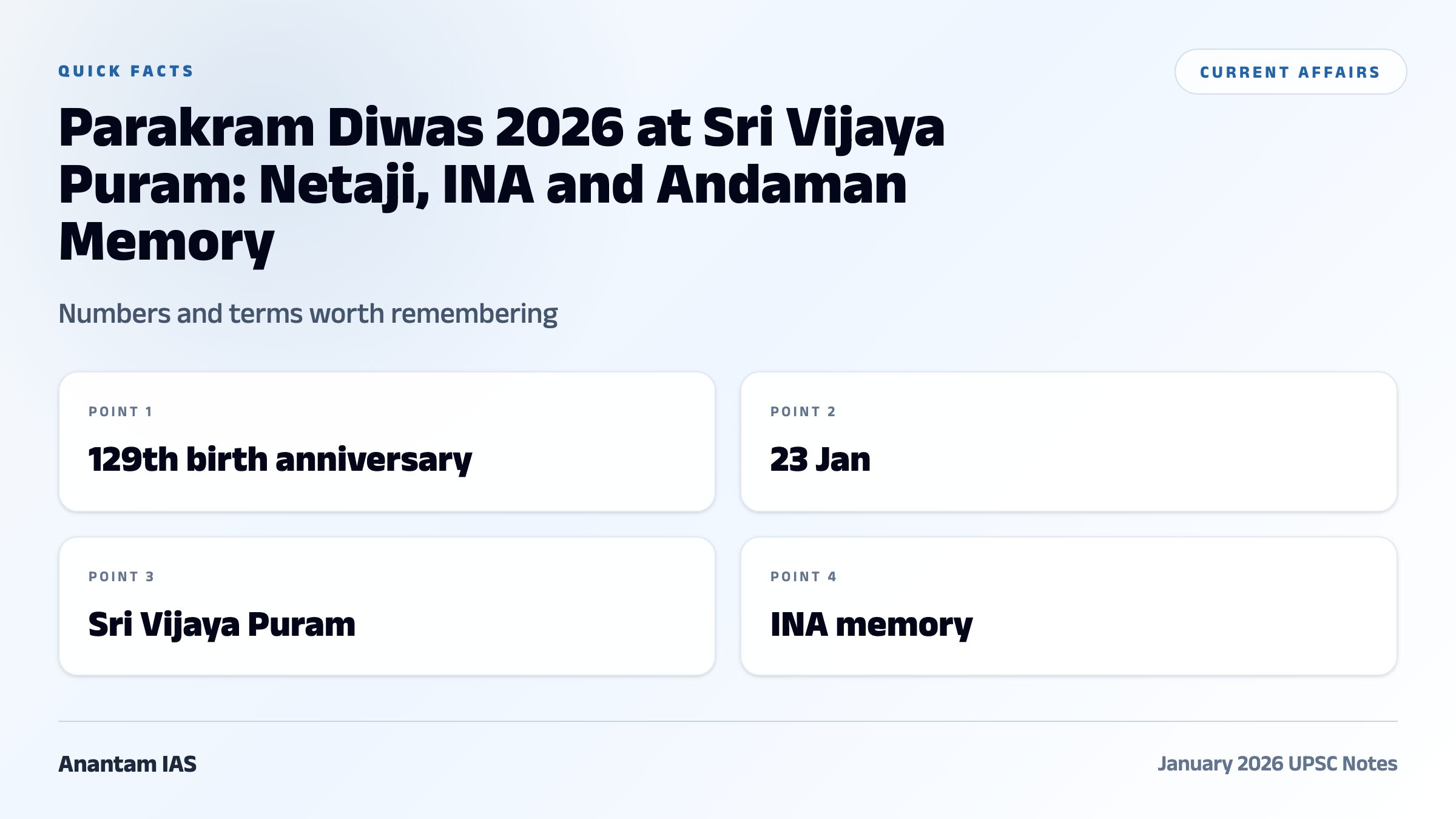
- Parakram Diwas is observed on 23 January, Netaji Subhas Chandra Bose’s birth anniversary.
- The 2026 commemoration marked his 129th birth anniversary.
- The national event was held at Sri Vijaya Puram in the Andaman and Nicobar Islands.
- The event ran from 23 to 25 January 2026 across multiple iconic locations.
- A veteran of the INA, Madhavan Pillai, was felicitated at the event.
- Netaji Subhas Chandra Bose Island, formerly Ross Island, was part of the symbolic geography.
- Official source: PIB, Ministry of Culture.
What Just Happened
The Ministry of Culture organised Parakram Diwas commemorations in Sri Vijaya Puram, foregrounding Netaji’s connection with the Andaman and Nicobar Islands. The program included exhibitions, cultural events and tributes at historically significant locations.
The event location was deliberate. The Andaman Islands carry memories of the Cellular Jail, political imprisonment, anti-colonial sacrifice and the brief wartime symbolism of Azad Hind authority.
For aspirants, the news hook should be used to revise Netaji’s ideological journey, the INA’s military and political role, the impact of INA trials and the contribution of non-mainland spaces to India’s freedom struggle.
Background and Historical Context
Subhas Chandra Bose was elected Congress president in 1938 and 1939 but later broke with the Congress high command over strategy, pace of struggle and wartime politics. He formed the Forward Bloc before leaving India during World War II.
The Indian National Army, initially associated with Mohan Singh and later reorganised under Bose, sought to fight British rule with Japanese support. Bose’s Provisional Government of Azad Hind gave the INA a political frame beyond a military formation.
The Andaman and Nicobar Islands became symbolically important when Bose visited Port Blair in December 1943 and associated the islands with the names Shaheed and Swaraj. That memory continues to shape official commemorations.
Key Features of the 2026 Commemoration
The core policy architecture can be read through these features.
- Birth anniversary: 23 January was observed as Parakram Diwas.
- Island location: Sri Vijaya Puram placed the Andaman story at the centre.
- INA memory: the event linked Netaji with soldiers, veterans and wartime nationalism.
- Public history: exhibitions and cultural programs translated archival history for citizens.
- Symbolic geography: Netaji Subhas Chandra Bose Island and Cellular Jail remain central memory sites.
- Modern-history relevance: the event gives a news hook for revising INA and Bose for UPSC.
Why It Matters
This is a high-yield UPSC topic because it joins current news with durable syllabus themes.
- It gives GS-I Modern History material on Netaji, INA and freedom-struggle diversity.
- It connects commemoration with nation-building and public memory.
- It helps avoid reducing Netaji to one-line factual notes.
- It offers Essay material on memory, sacrifice and the many streams of nationalism.
Detailed Analysis: History and Culture Lens
Netaji remains a difficult figure to simplify. He was a radical nationalist, a mass leader, an organiser and a wartime strategist. Good UPSC answers recognise both his courage and the moral complexity of wartime alliances.
The INA’s direct military impact was limited, but its political impact was large. The Red Fort trials, public sympathy and unrest among armed forces contributed to the psychological erosion of British authority.
The Andaman setting widens the freedom-struggle map. Indian nationalism was not only built in Delhi, Bombay, Calcutta or Lahore. Penal colonies, islands, borderlands and diaspora networks also shaped resistance.
Comparative Perspective
A comparison helps prevent the answer from becoming a one-dimensional news summary.
- Gandhian nationalism: mass mobilisation, non-violence and moral politics.
- Revolutionary nationalism: armed struggle, secret societies and sacrifice.
- INA approach: military struggle combined with expatriate mobilisation and provisional government symbolism.
- Constitutional politics: negotiations, elections, legislatures and institution-building.
Challenges
The policy or institutional promise runs into recurring constraints.
- Commemoration can become symbolic without improving public understanding of historical complexity.
- Netaji’s wartime alliances require careful treatment, not hagiography or dismissal.
- Public history often underrepresents women, soldiers and diaspora contributors in the INA story.
- Regional and island histories need better integration into school and exam narratives.
- Memorialisation must preserve archives, sites and oral histories before they disappear.
Prelims Pointers
- Parakram Diwas is observed on 23 January.
- Netaji Subhas Chandra Bose was born in Cuttack in 1897.
- He was Congress president at Haripura in 1938 and Tripuri in 1939.
- Forward Bloc was founded by Bose in 1939.
- The Provisional Government of Azad Hind was formed in 1943.
- Cellular Jail in the Andaman Islands was a major colonial penal institution.
Mains Questions
- Assess the contribution of Subhas Chandra Bose and the INA to the final phase of India’s freedom struggle. (GS Paper I, 250 words)
- Public commemorations shape historical memory as much as textbooks do. Discuss with reference to Parakram Diwas. (GS Paper I, 150 words)
- The INA’s importance was more political than military. Critically examine. (GS Paper I, 250 words)
- Why should island and diaspora histories be integrated into the narrative of Indian nationalism? (GS Paper I, 250 words)
Way Forward
Parakram Diwas should be used to build better public history: digitised INA records, oral histories, museum pedagogy and translations of archival material into Indian languages.
UPSC aspirants should avoid a binary treatment of Netaji. The stronger answer explains his ideological differences with Congress leadership, his mass appeal, the INA’s symbolic power and the ethical complexity of wartime choices.
The Andaman focus is welcome because it moves the freedom-struggle narrative beyond mainland capitals and reminds students that geography can be an archive.
The examiner is unlikely to reward a bare fact dump here. The better answer connects the January 2026 event to institutional design, implementation capacity and India’s long-term development priorities.
Frequently Asked Questions
What is Parakram Diwas?
Parakram Diwas is observed on 23 January to mark the birth anniversary of Netaji Subhas Chandra Bose.
Why was Sri Vijaya Puram important in 2026?
The 2026 national commemoration was held there to foreground Netaji’s connection with the Andaman and Nicobar Islands.
What was the INA?
The Indian National Army was a military force of Indian soldiers and expatriates that sought to fight British rule during World War II.
Why is Netaji important for UPSC?
He connects Modern History with debates on nationalism, armed struggle, leadership, diaspora mobilisation and public memory.
What was the Provisional Government of Azad Hind?
It was a government-in-exile proclaimed under Bose’s leadership in 1943 to give political form to the INA struggle.
How should students write about Bose?
With balance: recognise courage, organisation and mass appeal, while also noting the complexity of wartime alliances.
Source: https://anantamias.com/current-affairs/parakram-diwas-2026-netaji-andaman/
ODOP Reforms 2026: District Products, Exports and Local Economic Development
The January 2026 ODOP update highlighted the One District One Product approach as a tool for local economic development, branding and market access. The policy idea is simple: identify what a district is good at and help it sell better.
For UPSC, ODOP is useful because it connects MSMEs, exports, handicrafts, agriculture processing, district planning and cooperative federalism.
This article explains ODOP as an economic-governance instrument and evaluates whether district-level branding can translate into jobs and exports.
Quick Facts
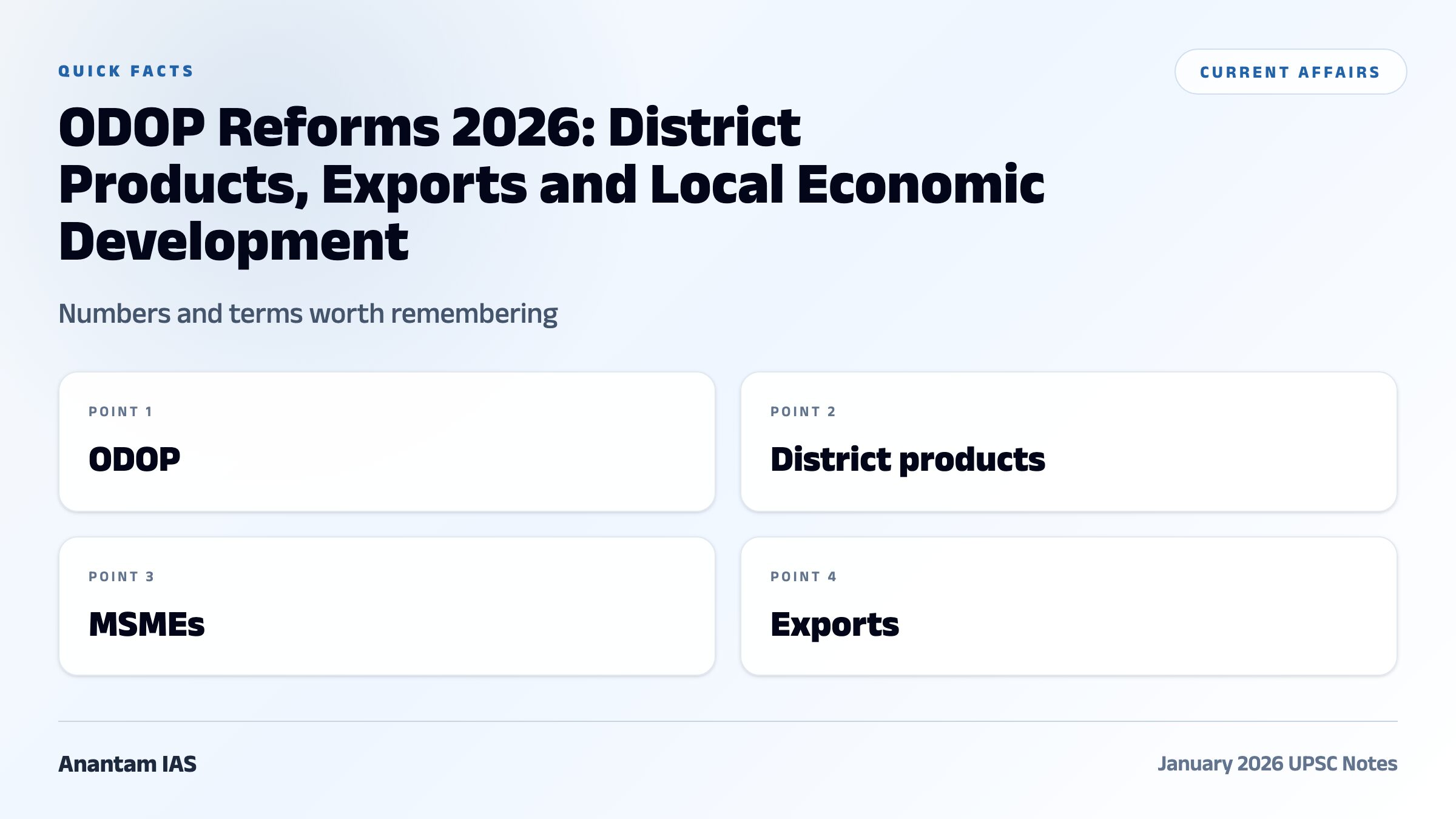
- ODOP stands for One District One Product.
- It identifies and promotes products with district-level strength.
- The approach supports branding, market access, value addition and exports.
- ODOP connects with Districts as Export Hubs and Vocal for Local.
- Products may include handicrafts, food processing, textiles, agriculture and local industry.
- Official source: PIB DPIIT release dated 23 January 2026.
- Official source: PIB, DPIIT.
What Just Happened
The official update highlighted ODOP reforms and the continuing push to strengthen district products.
The news matters because local products often fail not due to lack of skill, but because of weak packaging, finance, design, certification, logistics and market access.
For aspirants, ODOP is a good example of place-based economic development.
Background and Historical Context
The ODOP approach gained national visibility through state initiatives and central adoption as part of local-product promotion.
India’s districts often have clusters of skill, craft or agricultural specialisation, but producers remain fragmented and under-capitalised.
Districts as Export Hubs seeks to connect local products with export planning and trade facilitation.
Key Features of Local Economy
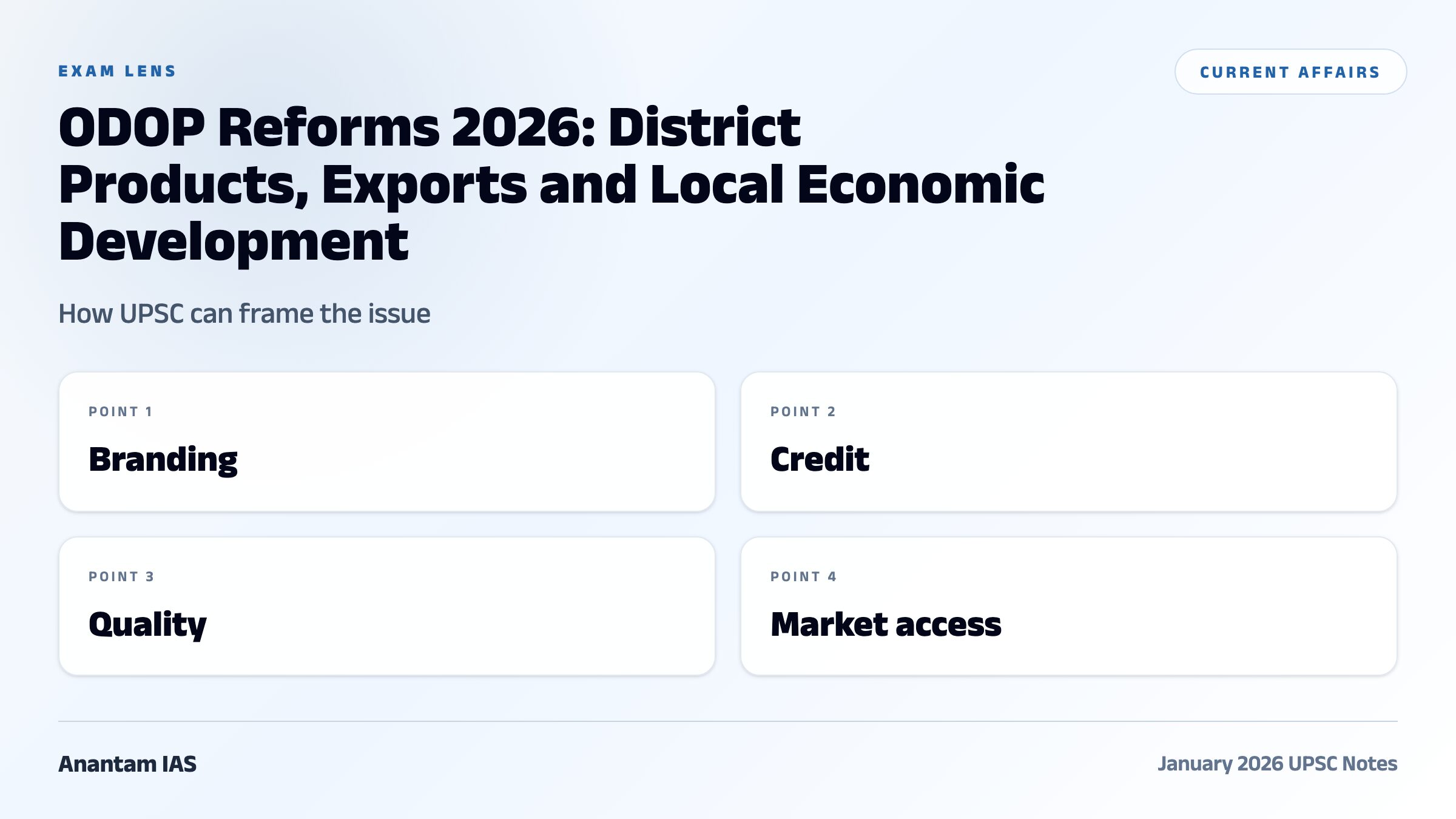
The core policy architecture can be read through these features.
- Product mapping: each district identifies priority products.
- Branding: local products receive a stronger market identity.
- Value addition: packaging, processing and design can raise incomes.
- Export linkage: district plans can connect producers with foreign markets.
- MSME support: credit, training and certification are critical.
- Federal role: district, state and Union agencies must coordinate.
Why It Matters
This is a high-yield UPSC topic because it joins current news with durable syllabus themes.
- It connects a January 2026 event with durable UPSC syllabus themes.
- It gives usable facts for Prelims and analytical hooks for Mains.
- It helps students move from news recall to policy reasoning.
- It can be linked with static concepts in polity, economy, governance, science, environment or society.
Detailed Analysis: Local Economy Lens
ODOP works when it solves business bottlenecks. Branding alone cannot compensate for poor quality control or working-capital shortages.
Cluster depth matters. Successful districts need common facilities, testing labs, design support and producer organisations.
Exports require compliance. Food safety, packaging, GI tagging, customs documentation and buyer reliability become decisive.
Comparative Perspective
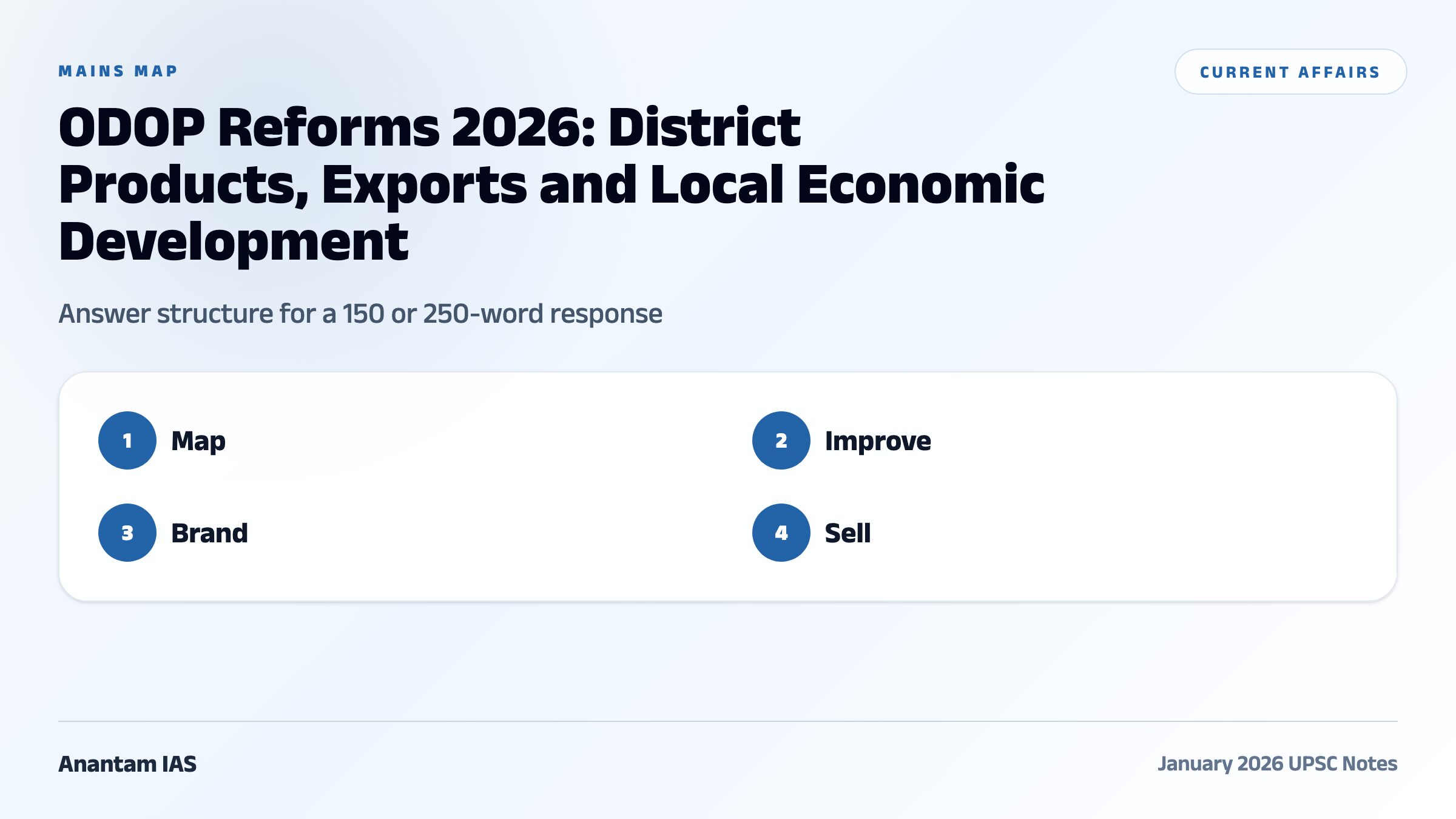
A comparison helps prevent the answer from becoming a one-dimensional news summary.
- ODOP: district-product promotion and branding.
- GI tags: legal protection for geographical indications.
- Cluster development: common facilities and ecosystem support.
- Districts as Export Hubs: export planning and trade facilitation at district level.
Challenges
The policy or institutional promise runs into recurring constraints.
- Producer fragmentation weakens bargaining power.
- Quality control and certification can be expensive.
- Market access often depends on intermediaries.
- District officials may lack export expertise.
- Branding can become symbolic without logistics and finance.
Prelims Pointers
- ODOP stands for One District One Product.
- GI means Geographical Indication.
- Districts as Export Hubs links district products with export planning.
- DPIIT is linked to industrial promotion and internal trade.
- MSMEs are important for employment and exports.
- Value addition raises producer income beyond raw-product sale.
Mains Questions
- ODOP can support local economic development only if branding is backed by market access and value addition. Discuss. (GS Paper III, 250 words)
- How can Districts as Export Hubs improve India’s export diversification? (GS Paper III, 150 words)
- Evaluate the role of district administration in MSME and craft-sector development. (GS Paper II/III, 250 words)
- Place-based development can reduce regional imbalance. Analyse with reference to ODOP. (GS Paper III, 250 words)
Way Forward
ODOP should be paired with credit support, common facility centres, quality certification, e-commerce onboarding and export documentation handholding.
District product plans should track producer income, repeat buyers and jobs, not only exhibitions.
In Mains, use ODOP as a bridge between local economy and national export strategy.
The examiner is unlikely to reward a bare fact dump here. The better answer connects the January 2026 event to institutional design, implementation capacity and India’s long-term development priorities.
Frequently Asked Questions
What is ODOP?
One District One Product is an approach to promote one or more products linked to a district’s strengths.
Why is ODOP important?
It can improve branding, value addition, market access and local jobs.
How does it link to exports?
District products can be integrated with Districts as Export Hubs and trade facilitation.
What is the main limitation?
Branding is not enough without credit, quality control, logistics and buyer access.
Which sectors benefit?
Handicrafts, food processing, textiles, agriculture products and local manufacturing clusters.
What is the UPSC angle?
MSME development, exports, district planning, cooperative federalism and inclusive growth.
Source: https://anantamias.com/current-affairs/odop-reforms-2026/
CERT-In Cyber Defender Program 2026: India’s Frontline Cyber Capacity
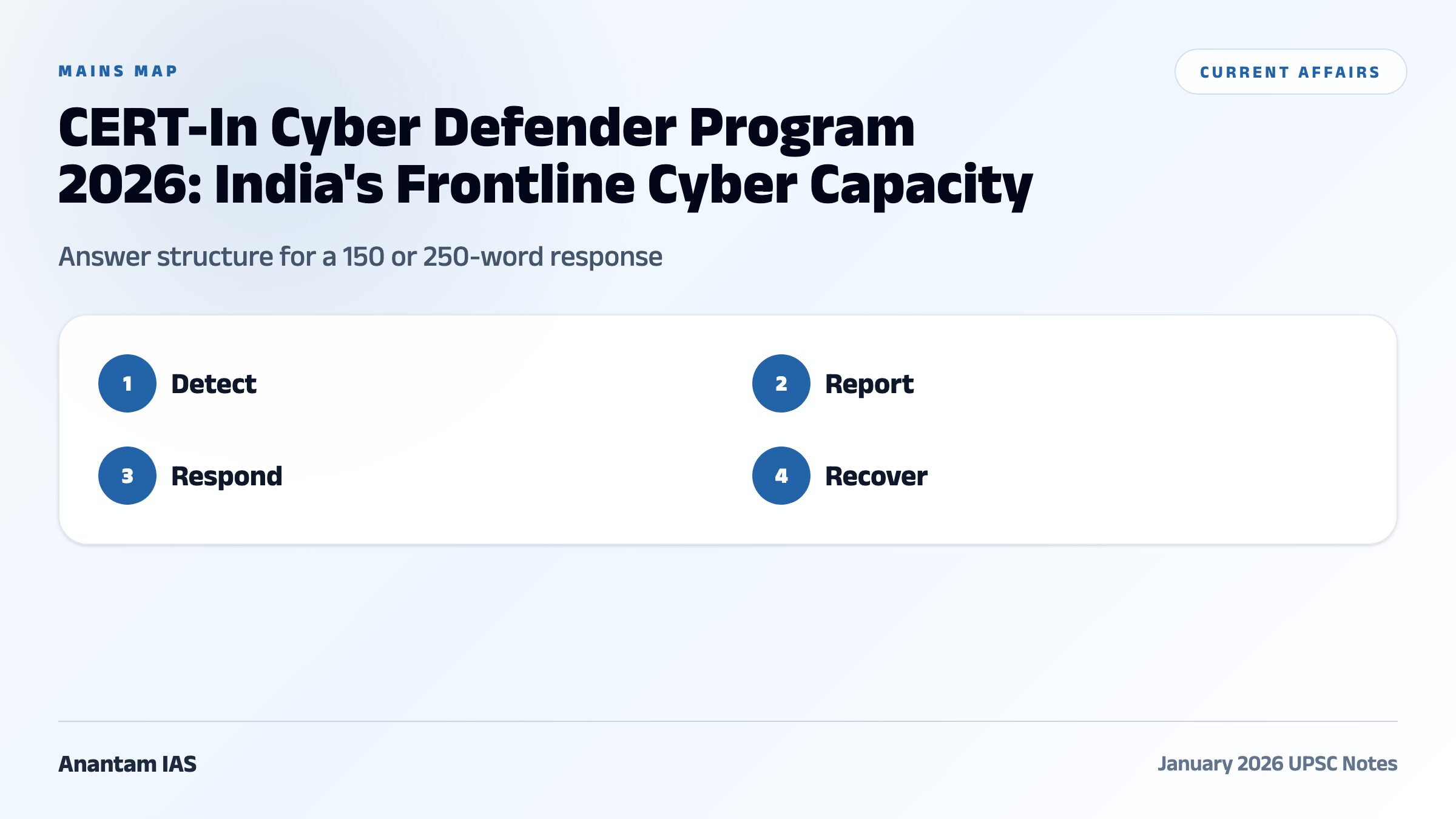
A January 2026 official backgrounder on CERT-In’s frontline cyber-defender work highlighted India’s need for trained personnel who can detect, respond to and recover from cyber incidents across public and private systems.
For UPSC, the issue is urgent because cyber threats now affect banking, health, power grids, telecom, government portals, personal data and national security.
This article explains CERT-In’s cyber-defender role and situates it within India’s wider cyber-security architecture.
Quick Facts
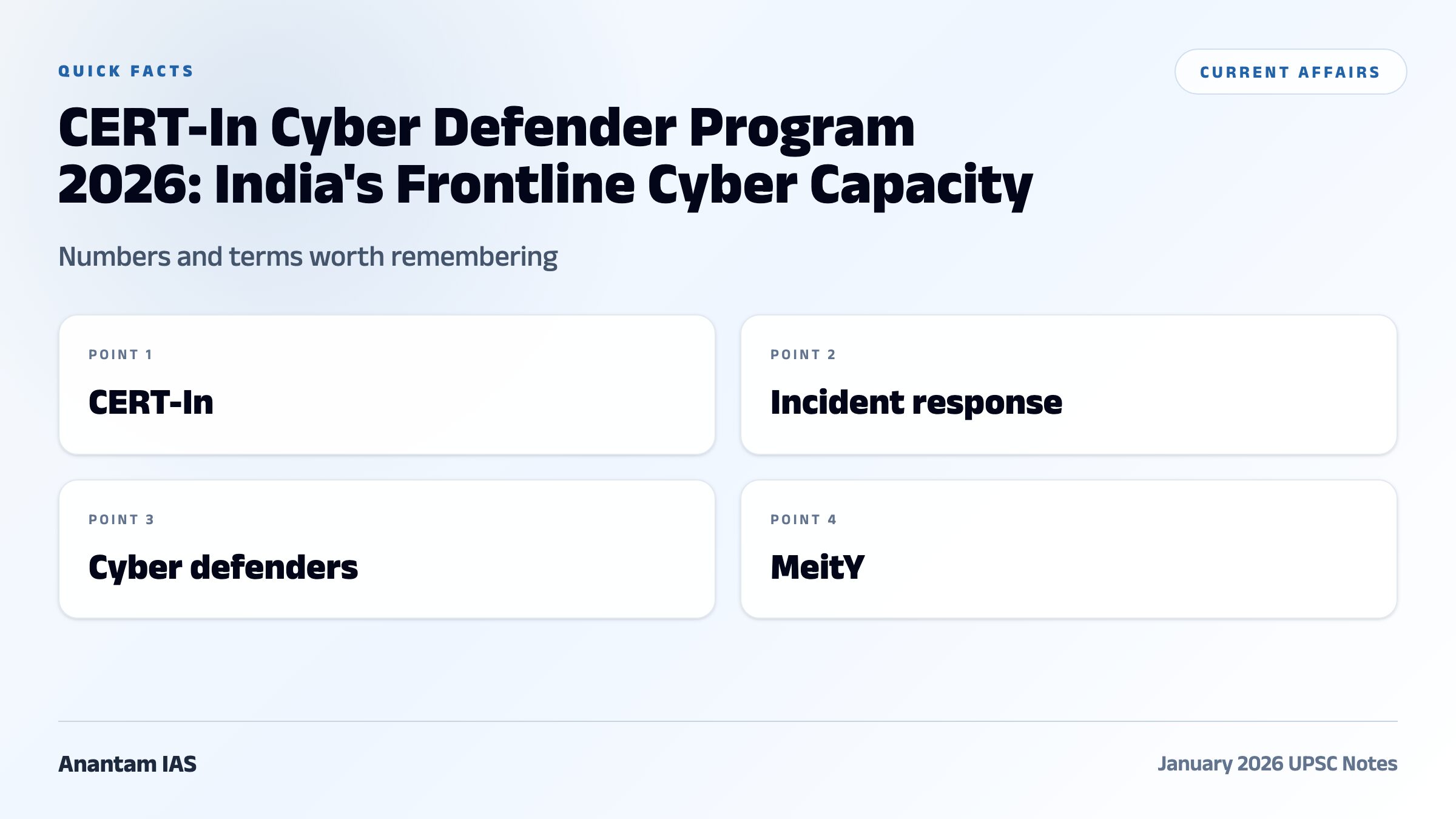
- CERT-In is the Indian Computer Emergency Response Team.
- It is India’s national agency for cyber incident response under MeitY.
- Cyber defenders support detection, reporting, mitigation and coordination.
- Cybersecurity is linked to digital public infrastructure and critical information infrastructure.
- Digital arrest scams, ransomware and data breaches have made cyber capacity a public concern.
- Official source: PIB January 2026 backgrounder on CERT-In cyber defenders.
- Official source: PIB backgrounder.
What Just Happened
The official backgrounder emphasised frontline cyber-defender capacity and the role of CERT-In in incident response.
The update matters because India’s digital economy has expanded faster than its cyber-response workforce.
For aspirants, this topic connects internal security, digital governance, privacy and institutional design.
Background and Historical Context
CERT-In operates under the Information Technology Act framework and coordinates cyber-incident response, advisories and vulnerability information.
India’s critical information infrastructure is protected through NCIIPC, while I4C addresses cybercrime coordination under the Home Ministry.
The growing use of UPI, Aadhaar-linked services, cloud systems and public digital platforms raises the stakes of cyber resilience.
Key Features of Cyber Security
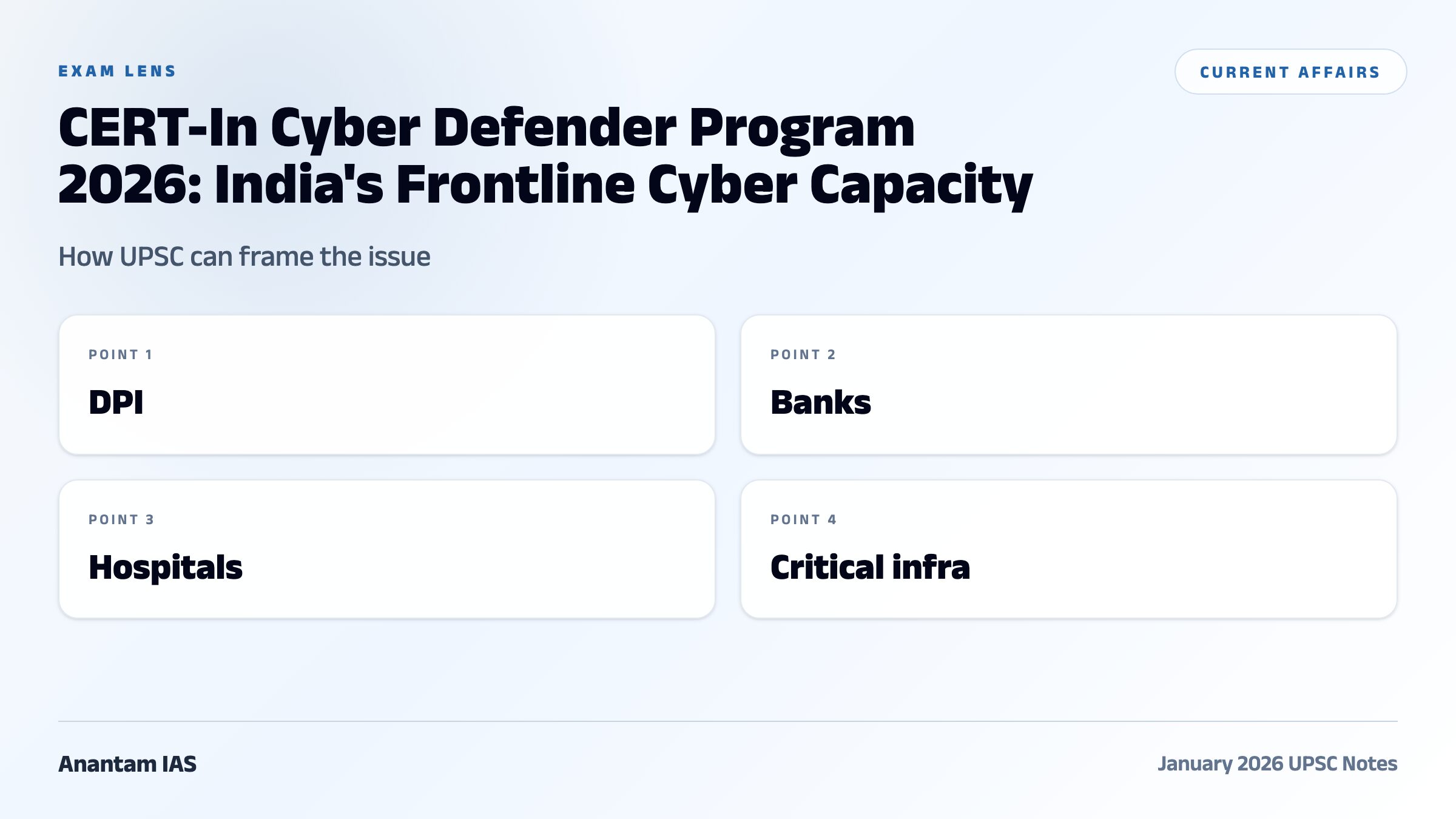
The core policy architecture can be read through these features.
- Incident response: CERT-In coordinates action after cyber incidents.
- Advisories: it issues alerts and vulnerability notes.
- Reporting: cyber incident reporting improves situational awareness.
- Capacity building: trained defenders are needed across sectors.
- Coordination: cyber response spans MeitY, MHA, RBI, sector regulators and states.
- Resilience: prevention, response and recovery must all be planned.
Why It Matters
This is a high-yield UPSC topic because it joins current news with durable syllabus themes.
- It connects a January 2026 event with durable UPSC syllabus themes.
- It gives usable facts for Prelims and analytical hooks for Mains.
- It helps students move from news recall to policy reasoning.
- It can be linked with static concepts in polity, economy, governance, science, environment or society.
Detailed Analysis: Cyber Security Lens
Cybersecurity is no longer a specialist issue. Every welfare database, payment system and hospital network now creates public risk.
Human capacity is the bottleneck. Tools matter, but trained analysts, auditors and incident responders decide whether systems recover quickly.
Fragmented jurisdiction is a challenge. Cybercrime, critical infrastructure, data protection and national security sit across different institutions.
Comparative Perspective
A comparison helps prevent the answer from becoming a one-dimensional news summary.
- CERT-In: national cyber incident response agency.
- NCIIPC: protects critical information infrastructure.
- I4C: coordinates cybercrime response and citizen reporting.
- RBI: regulates cyber resilience in financial entities.
Challenges
The policy or institutional promise runs into recurring constraints.
- Incident reporting by organisations can be delayed or incomplete.
- States lack uniform cyber-forensics capacity.
- Small businesses have weak cyber hygiene.
- Critical infrastructure uses legacy systems.
- Cyber workforce demand exceeds supply.
Prelims Pointers
- CERT-In stands for Indian Computer Emergency Response Team.
- It functions under MeitY.
- NCIIPC stands for National Critical Information Infrastructure Protection Centre.
- I4C stands for Indian Cyber Crime Coordination Centre.
- Ransomware encrypts data and demands payment.
- Cyber resilience includes prevention, detection, response and recovery.
Mains Questions
- Cybersecurity is now a core internal-security challenge for a digital welfare state. Discuss. (GS Paper III, 250 words)
- Explain the role of CERT-In in India’s cyber-security architecture. (GS Paper III, 150 words)
- Why is cyber workforce development critical for India’s digital economy? (GS Paper III, 250 words)
- Fragmented cyber governance can weaken incident response. Analyse. (GS Paper III, 250 words)
Way Forward
India needs sector-wise cyber drills, stronger state cyber labs, mandatory incident-response plans and cyber hygiene support for MSMEs.
CERT-In advisories should be paired with capacity building in public institutions and critical sectors.
For UPSC, connect cyber defenders with digital public infrastructure and citizen trust.
The examiner is unlikely to reward a bare fact dump here. The better answer connects the January 2026 event to institutional design, implementation capacity and India’s long-term development priorities.
Frequently Asked Questions
What is CERT-In?
CERT-In is India’s national computer emergency response team under MeitY.
What does CERT-In do?
It issues advisories, coordinates incident response and supports cyber-risk mitigation.
How is it different from I4C?
CERT-In focuses on cyber incidents and technical response, while I4C focuses on cybercrime coordination.
Why are cyber defenders important?
They detect, respond to and help recover from cyber attacks.
Which GS paper is relevant?
GS-III internal security and science and technology.
What is the main challenge?
Cyber workforce shortage and fragmented institutional response.
Source: https://anantamias.com/current-affairs/cert-in-cyber-defender-program-2026/