A January 2026 official backgrounder on CERT-In’s frontline cyber-defender work highlighted India’s need for trained personnel who can detect, respond to and recover from cyber incidents across public and private systems.
For UPSC, the issue is urgent because cyber threats now affect banking, health, power grids, telecom, government portals, personal data and national security.
This article explains CERT-In’s cyber-defender role and situates it within India’s wider cyber-security architecture.
Quick Facts
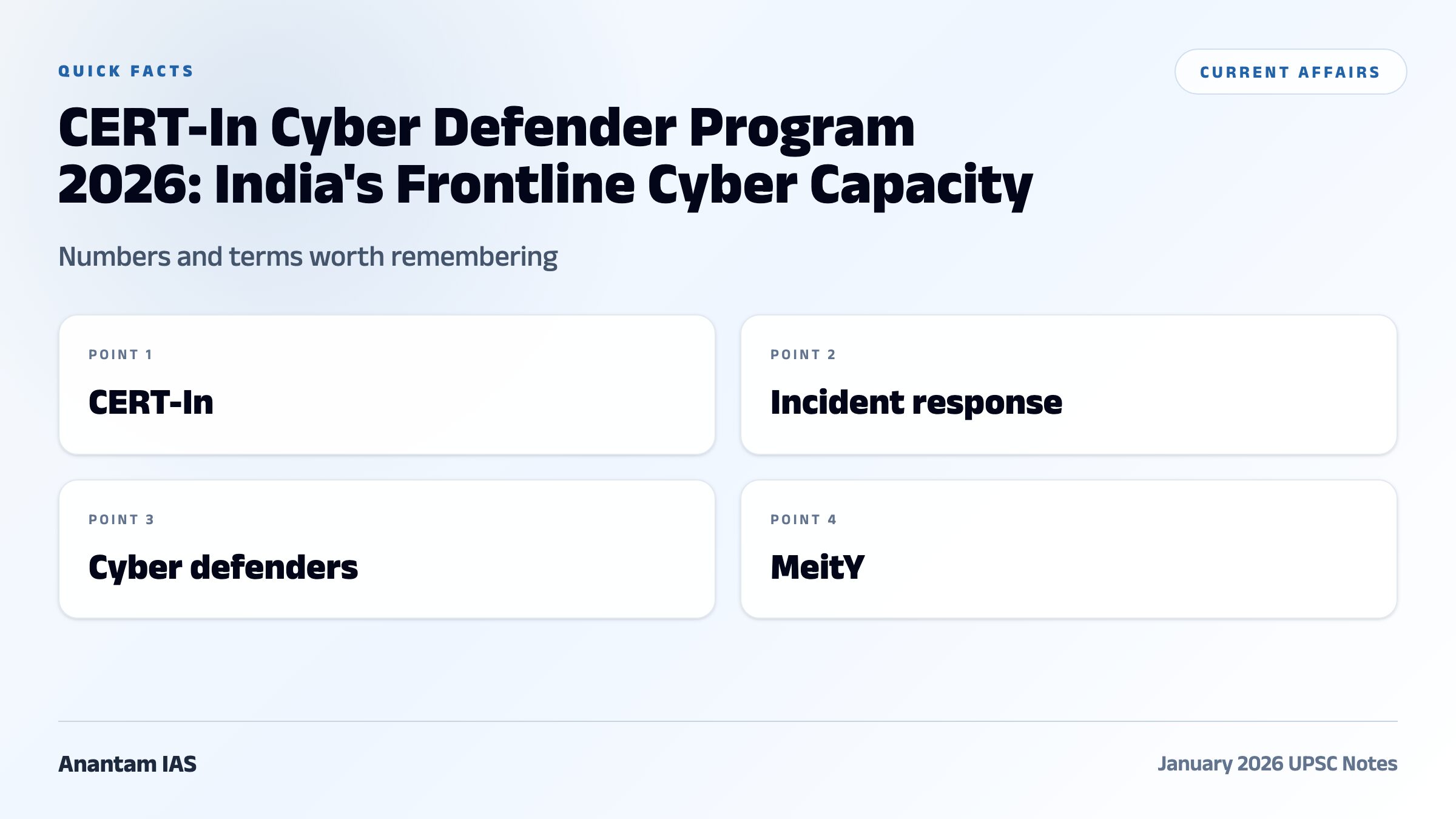
- CERT-In is the Indian Computer Emergency Response Team.
- It is India’s national agency for cyber incident response under MeitY.
- Cyber defenders support detection, reporting, mitigation and coordination.
- Cybersecurity is linked to digital public infrastructure and critical information infrastructure.
- Digital arrest scams, ransomware and data breaches have made cyber capacity a public concern.
- Official source: PIB January 2026 backgrounder on CERT-In cyber defenders.
- Official source: PIB backgrounder.
What Just Happened
The official backgrounder emphasised frontline cyber-defender capacity and the role of CERT-In in incident response.
The update matters because India’s digital economy has expanded faster than its cyber-response workforce.
For aspirants, this topic connects internal security, digital governance, privacy and institutional design.
Background and Historical Context
CERT-In operates under the Information Technology Act framework and coordinates cyber-incident response, advisories and vulnerability information.
India’s critical information infrastructure is protected through NCIIPC, while I4C addresses cybercrime coordination under the Home Ministry.
The growing use of UPI, Aadhaar-linked services, cloud systems and public digital platforms raises the stakes of cyber resilience.
Key Features of Cyber Security
The core policy architecture can be read through these features.
- Incident response: CERT-In coordinates action after cyber incidents.
- Advisories: it issues alerts and vulnerability notes.
- Reporting: cyber incident reporting improves situational awareness.
- Capacity building: trained defenders are needed across sectors.
- Coordination: cyber response spans MeitY, MHA, RBI, sector regulators and states.
- Resilience: prevention, response and recovery must all be planned.
Why It Matters
This is a high-yield UPSC topic because it joins current news with durable syllabus themes.
- It connects a January 2026 event with durable UPSC syllabus themes.
- It gives usable facts for Prelims and analytical hooks for Mains.
- It helps students move from news recall to policy reasoning.
- It can be linked with static concepts in polity, economy, governance, science, environment or society.
Detailed Analysis: Cyber Security Lens
Cybersecurity is no longer a specialist issue. Every welfare database, payment system and hospital network now creates public risk.
Human capacity is the bottleneck. Tools matter, but trained analysts, auditors and incident responders decide whether systems recover quickly.
Fragmented jurisdiction is a challenge. Cybercrime, critical infrastructure, data protection and national security sit across different institutions.
Comparative Perspective
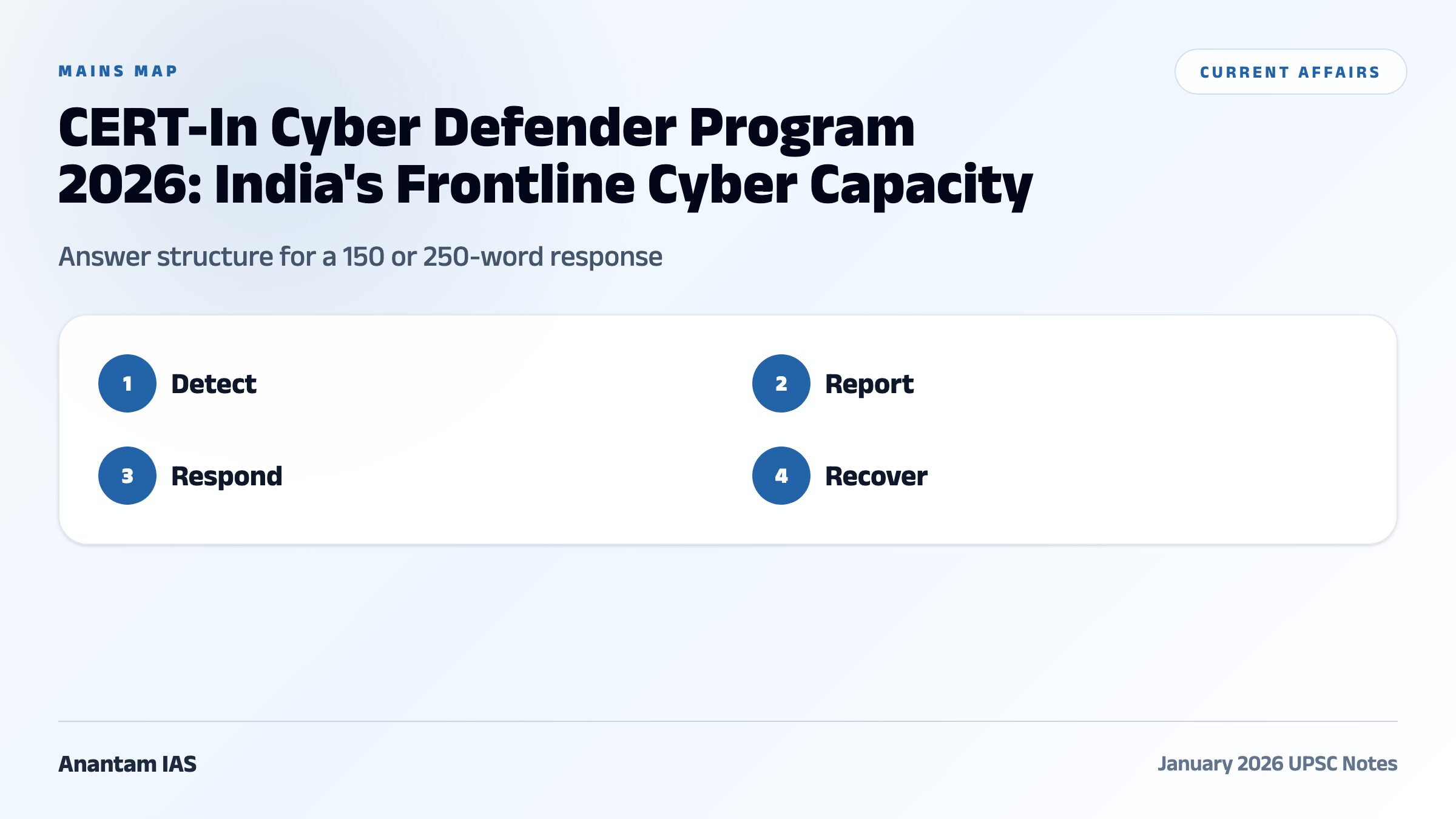
A comparison helps prevent the answer from becoming a one-dimensional news summary.
- CERT-In: national cyber incident response agency.
- NCIIPC: protects critical information infrastructure.
- I4C: coordinates cybercrime response and citizen reporting.
- RBI: regulates cyber resilience in financial entities.
Challenges
The policy or institutional promise runs into recurring constraints.
- Incident reporting by organisations can be delayed or incomplete.
- States lack uniform cyber-forensics capacity.
- Small businesses have weak cyber hygiene.
- Critical infrastructure uses legacy systems.
- Cyber workforce demand exceeds supply.
Prelims Pointers
- CERT-In stands for Indian Computer Emergency Response Team.
- It functions under MeitY.
- NCIIPC stands for National Critical Information Infrastructure Protection Centre.
- I4C stands for Indian Cyber Crime Coordination Centre.
- Ransomware encrypts data and demands payment.
- Cyber resilience includes prevention, detection, response and recovery.
Mains Questions
- Cybersecurity is now a core internal-security challenge for a digital welfare state. Discuss. (GS Paper III, 250 words)
- Explain the role of CERT-In in India’s cyber-security architecture. (GS Paper III, 150 words)
- Why is cyber workforce development critical for India’s digital economy? (GS Paper III, 250 words)
- Fragmented cyber governance can weaken incident response. Analyse. (GS Paper III, 250 words)
Way Forward
India needs sector-wise cyber drills, stronger state cyber labs, mandatory incident-response plans and cyber hygiene support for MSMEs.
CERT-In advisories should be paired with capacity building in public institutions and critical sectors.
For UPSC, connect cyber defenders with digital public infrastructure and citizen trust.
The examiner is unlikely to reward a bare fact dump here. The better answer connects the January 2026 event to institutional design, implementation capacity and India’s long-term development priorities.
Frequently Asked Questions
What is CERT-In?
CERT-In is India’s national computer emergency response team under MeitY.
What does CERT-In do?
It issues advisories, coordinates incident response and supports cyber-risk mitigation.
How is it different from I4C?
CERT-In focuses on cyber incidents and technical response, while I4C focuses on cybercrime coordination.
Why are cyber defenders important?
They detect, respond to and help recover from cyber attacks.
Which GS paper is relevant?
GS-III internal security and science and technology.
What is the main challenge?
Cyber workforce shortage and fragmented institutional response.
Tell Google you want more of this.
Add Anantam IAS as a preferred sourceOne tap, and this site shows up more often in your own Top Stories, AI Overviews and AI Mode. Remove it any time.