Daily Digest
UPSC · Civil Services Examination
Current Affairs · Thursday, 25 September 2025
Current affairs curated and edited by Anantam IAS faculty — pulled from The Hindu, PIB, IDSA, Foreign Affairs and the ministries. Read, annotate, revise.
Old Rajinder Nagar · Delhi 110005 · anantamias.com
Leh Protest

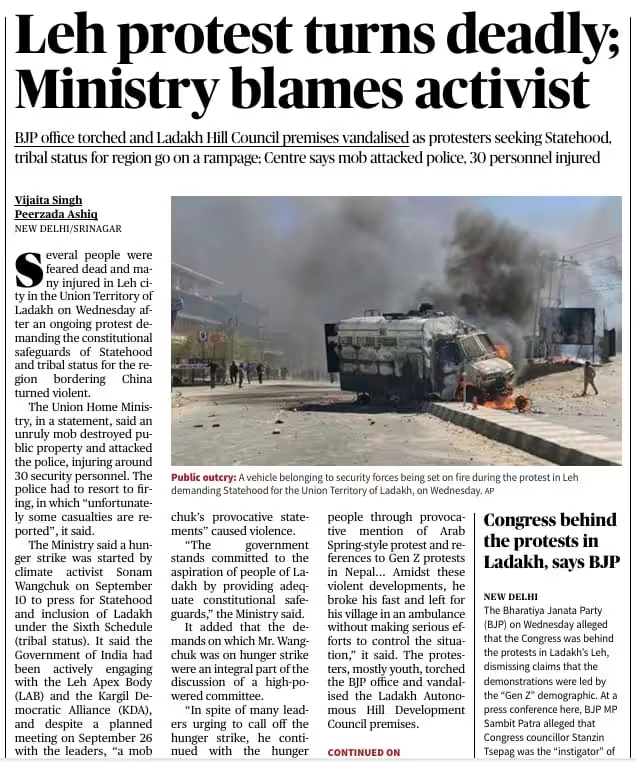
Context:
Protests in Leh (UT of Ladakh) demanding Statehood and inclusion under the Sixth Schedule (tribal safeguards) turned violent.
UPSC Relevance:
Functions and responsibilities of the Union and the States, issues and challenges pertaining to the federal structure, devolution of powers and finances up to local levels and challenges therein.
PYQ:
Q. Why are the tribals in India referred to as ‘the Scheduled Tribes? Indicate the major provisions enshrined in the Constitution of India for their upliftment. (2016)
Reason behind Ladakh issue:
- Ladakh was carved out as a separate Union Territory in 2019 after the abrogation of Article 370 and the bifurcation of Jammu and Kashmir. The other UT in the erstwhile state is Jammu and Kashmir.
- Within few months, concerns emerged over what residents described as a political vacuum under the administration of the Lieutenant Governor. This precisely because Ladakh was without a legislature, placing the region under direct central rule.
Why the statehood demand?
- When Ladakh became a UT in 2019 and was separated from Jammu and Kashmir, it was left without its own representation in the legislature. Locals argued that the lack of assembly has reduced their ability to govern themselves and protect local interests.
- Job opportunities, land rights, and protections that previously existed are weakening in Ladakh by being reduced to a UT.
- Locals also fear that since Ladakh has a fragile ecology, large scale projects (solar, infrastructure, etc.) will put this environment at risk, especially when decision-making is centralised.
- Inclusion under the Sixth Schedule for constitutional protection.
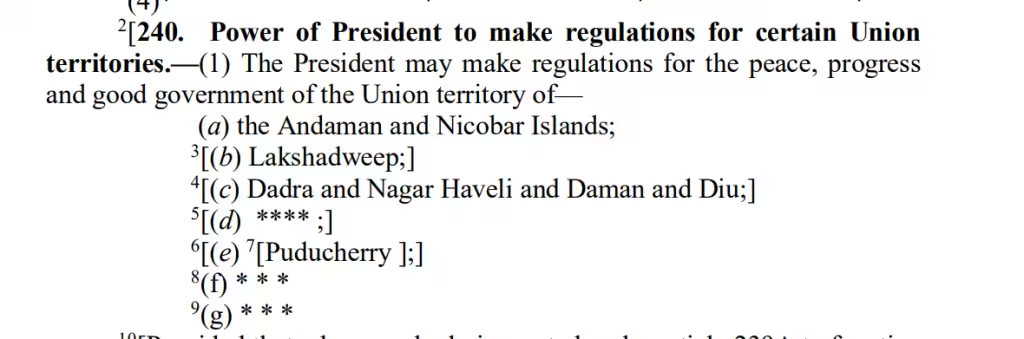
Why 6th Schedule:
The Sixth Schedule under Article 244 of the Indian Constitution provides for the formation of autonomous administrative regions called Autonomous District Councils (ADCs), which govern tribal-majority areas in certain northeastern states.
- The Sixth Schedule (Articles 244(2)) of the Constitution provides for the administration of tribal areas in the four northeastern states — Assam, Meghalaya, Tripura, and Mizoram — where tribes have largely preserved their traditional ways, unlike other tribal populations in India.
- Under 6th schedule Autonomous District Councils are formed to give greater control to local communities over governance.
- Autonomy in Governance: ADCs have the power to make laws on matters such as land use, inheritance, marriage, and social customs. However, these laws require the Governor’s approval to come into effect.
- Judicial Authority: They can establish local courts to decide cases where both parties belong to Scheduled Tribes (STs).
- Revenue and Taxation Powers: ADCs are authorized to collect land revenue and levy taxes on professions, trades, and other activities.
Sixth Schedule grants local bodies wider executive, legislative, judicial, and financial powers compared to the Fifth Schedule areas, thereby ensuring greater autonomy in self-governance.
Comptroller and Auditor General (CAG)

Context:
The Comptroller and Auditor General (CAG) has recently flagged the misappropriation of public fund for the development projects under the Integrated Tribal Development Agencies in Odisha.
UPSC Relevance:
Important Constitutional Bodies.
PYQ:
Q. In India, other than ensuring that public funds are used efficiently and for intended purpose, what is the importance of the office of the Comptroller and Auditor General (CAG)? (2012)
1. CAG exercises exchequer control on behalf of the Parliament when the President of India declares national emergency/financial emergency
2. CAG reports on the execution of projects or programmes by the ministries are discussed by the Public Accounts Committee.
3. Information from CAG reports can be used by investigating agencies to press charges against those who have violated the law while managing public finances.
4. While dealing with the audit and accounting of government companies, CAG has certain judicial powers for prosecuting those who violate the law.
Which of the statements given above is/are correct?
(a) 1, 3 and 4 only
(b) 2 only
(c) 2 and 3 only
(d) 1, 2, 3 and 4
About CAG:
- The Comptroller and Auditor-General of India (CAG) heads the Indian Audit and Accounts Department.
- He/she is the guardian of the public purse of the Union of India (the Centre and the states).
Constitutional Provisions Related to the Office of CAG:
- Article 148: Provides for an independent office of the Comptroller and Auditor General of India.
- Article 149 (Duties and Powers of the CAG): Shall audit the accounts of the Union of India and any other authority or body as may be prescribed by any law made by Parliament.
- Article 150 (Form of Accounts of the Union & States): The President, with advice from the CAG, decides how the accounts should be maintained.
- Article 151 (Audit Reports): CAG’s reports on Union accounts go to the President, who then shares them with the Parliament. CAG’s reports on State accounts are sent to the State Governor , who then shares them with the State Legislature.
- Article 279: Calculation of “net proceeds” is ascertained and certified by CAG, whose certificate is final.
Appointment and Term:
- Appointed by the President by warrant under his/her hand and seal.
- Holds office for a period of six years or up to the age of 65 years, whichever is earlier.
- He can resign from his office at any time by addressing the resignation letter to the President.
Removal
- CAG does not hold his office at the pleasure of the President. The Indian Constitution prescribes his/her terms of office and removal.
- The removal of CAG involves a procedure similar to the removal of a Supreme Court Judge. That is, the President can remove CAG based on a resolution passed by both Houses of Parliament with a special majority, either on proven misbehaviour or incapacity.
Independence:
- Its administrative expenses are charged to the Consolidated Fund of India (not subject to the vote of Parliament).
- CAG is provided with the security of tenure.
- CAG is not eligible for further office under the Government of India or the Government of any State after his term.
- His/her salary is equal to that of a judge of the Supreme Court. The Parliament determines his/her salary and other service conditions.
- His/her rights regarding leave of absence, pension, etc., cannot be altered to his/her disadvantage.
- No minister can represent the CAG in Parliament (both Houses). No minister can be called upon to take any responsibility for any actions taken by the office of CAG.
Audits by CAG:
CAG conducts three kinds of audits:
- Compliance audit, or an assessment of whether the provisions of the applicable laws, rules, and regulations, and various orders and instructions issued by the competent authority are being followed;
- Performance audit, or an assessment of the implementation of schemes or programmes; and
- Financial audit, or certification of the government’s accounts and the accounts of Public Sector Undertakings.
Audit reports submitted by the CAG to the President (which are later tabled in the legislature):
- Appropriation audit report
- Financial account audit report
- Public sector undertaking audit report
Parliament’s Public Accounts Committee (PAC) examines the three CAG reports.
Critical Evaluation of CAG:
Significance of CAG:
- Exposed Scams: Highlighted significant irregularities such as the 2G spectrum allocation, Coal block allocation, and Commonwealth Games, bringing transparency and accountability. It has exposed inefficiencies in schemes like MNREGA, Mid-Day Meal, and defence procurement.
- Impact of Reports on Policies: CAG audit reports expose financial and procedural losses while giving recommendations that often shape reforms—for e.g, Telangana altered its Engineering Procurement Contract mode after CAG audit.
- Strengthening Parliamentary Oversight: CAG reports are examined by the Public Accounts Committee and the Committee on Public Undertakings, enabling informed parliamentary discussions.
- De-Facto Fourth Pillar of Democracy: Though not formally considered so, CAG strengthens democratic functioning by curbing misuse of authority.
Limitations of CAG:
- Post-facto Nature of Audit: The CAG’s work is largely a “post-mortem.” It audits expenditures after the money has already been spent. It can’t stop a transaction, only point out irregularities later.
- Opaque Appointment Process: The CAG (Duties, Powers and Conditions of Service) Act, 1971 is silent on the required qualification for the incumbent and a transparent procedure for appointment to CAG position.
- No Enforcement Power: The CAG is an advisory body. It can report its findings, but it has no power to take action against those found at fault. The responsibility to act on its reports lies with the Parliament and the executive.
- Delay in Laying of Reports: Article 151 does not specify any time limit for laying CAG reports before legislatures, enabling governments to delay them, for e.g., the Delhi government kept reports pending for four years, and West Bengal too has delayed reports.
- Limited Scope: CAG cannot directly audit private entities, PPP projects using substantial public funds, unless explicitly mandated.
Suggested Reforms:
- Wider Audit Jurisdiction: Expand the coverage of CAG to include all entities that receive public funds or provide public goods, such as PRIs and government-funded societies.
- Collegium-based Appointment: Introduce a Collegium-type mechanism to appoint a new CAG, similar to how the CVC is chosen, to ensure independence and impartiality.
- Time-bound Laying of Reports: Amend Article 151/introduce statutory provisions mandating strict timelines for tabling CAG reports in Parliament/State legislatures.
- Adopt models from countries like the UK’s National Audit Office, where audit reports directly feed into parliamentary decision-making and reforms.
- Capacity building: Invest in training auditors in AI, blockchain, big data, and cybersecurity to match evolving governance challenges.
Source: https://anantamias.com/current-affairs/comptroller-and-auditor-general-cag/