Daily Digest
UPSC · Civil Services Examination
Current Affairs · Friday, 26 June 2026
Current affairs curated and edited by Anantam IAS faculty — pulled from The Hindu, PIB, IDSA, Foreign Affairs and the ministries. Read, annotate, revise.
Old Rajinder Nagar · Delhi 110005 · anantamias.com
Drug Track-and-Trace: QR codes extended to vaccines, antimicrobials and cancer medicines
Why in News?
The Ministry of Health and Family Welfare has amended the Drugs Rules, 1945 to widen the QR-code / barcode track-and-trace regime, which until now applied only to the country’s top 300 drug brands. The amendment brings several high-risk categories of medicines under mandatory traceability for the first time.
All vaccines, antimicrobials, narcotic and psychotropic drugs under the NDPS Act, 1985, and all anti-cancer drugs have been added to Schedule H2, requiring a scannable code that carries a unique product code, batch, and manufacturing and expiry details.
- New categories added to Schedule H2: all vaccines, all antimicrobials, all anti-cancer drugs, and NDPS-listed narcotic and psychotropic medicines.
- Staggered rollout – vaccines, anti-cancer and NDPS drugs from 1 July 2027; antimicrobials from 1 July 2028.
- Manufacturers must print or affix the Bar Code or QR Code on the primary packaging label, or on the secondary label where space is inadequate.
- The code stores the unique product identification code, generic and brand names, manufacturer name and address, batch number, manufacturing and expiry dates, and licence number.
- Earlier, Schedule H2 (added by the Drugs (Eighth Amendment) Rules, 2022) covered only the top 300 brands from 1 August 2023.
The development matters in the context of:
- India is the ‘pharmacy of the world’ – the largest supplier of generic medicines – so traceability is central to its export credibility.
- Spurious, falsified and Not of Standard Quality (NSQ) drugs erode patient safety and public trust in the supply chain.
- Self-medication and counterfeit antibiotics are a major driver of Antimicrobial Resistance (AMR); serialising antimicrobials helps detect substandard products.
- A scannable code lets patients, chemists and regulators verify authenticity at the point of sale and trace recalls batch-by-batch.

UPSC Relevance
Prelims Relevance
- Schedule H2 of the Drugs Rules, 1945 – the schedule listing drugs requiring barcode/QR traceability.
- Drugs (Eighth Amendment) Rules, 2022 – introduced Schedule H2 for the top 300 brands.
- Parent law: Drugs and Cosmetics Act, 1940 and the Drugs Rules, 1945.
- Regulator: CDSCO (Central Drugs Standard Control Organisation) under the DCGI.
- NDPS Act, 1985 governs narcotic and psychotropic substances now covered.
- Rollout dates: vaccines / anti-cancer / NDPS from 1 July 2027; antimicrobials from 1 July 2028.
- QR data fields: unique product code, batch number, manufacturing and expiry dates.
- Antimicrobial Resistance (AMR) and ‘Not of Standard Quality’ (NSQ) are key linked concepts.
- India is the world’s largest supplier of generic medicines by volume.
Mains Relevance
GS Paper 2
- Regulation of the pharmaceutical sector and the State’s role in ensuring access to safe, quality medicines as a dimension of the right to health.
- Governance and transparency – how digital traceability strengthens institutional oversight of the drug supply chain.
GS Paper 3
- Science and technology in service delivery – using serialisation, QR codes and GS1-style standards to secure supply chains.
- Antimicrobial Resistance as a One Health challenge and the role of drug traceability in containing it.
Essay
- Technology as a guardian of public trust – from blind faith to verifiable medicine.
- Health security and the cost of counterfeit goods in a globalised supply chain.
Background and Context
What the amendment does
The Health Ministry has expanded an existing barcode mandate to cover the most safety-critical drug classes.
- Amends the Drugs Rules, 1945 (framed under the Drugs and Cosmetics Act, 1940) to enlarge Schedule H2.
- Adds all vaccines, all antimicrobials, all anti-cancer drugs, and narcotic and psychotropic drugs under the NDPS Act, 1985.
- Manufacturers must print or affix a Bar Code or QR Code on the primary packaging label, shifting to the secondary label only when space is inadequate.
- Scanning reveals the unique product identification code, generic and brand names, manufacturer name and address, batch number, manufacturing and expiry dates, and the manufacturing licence number.
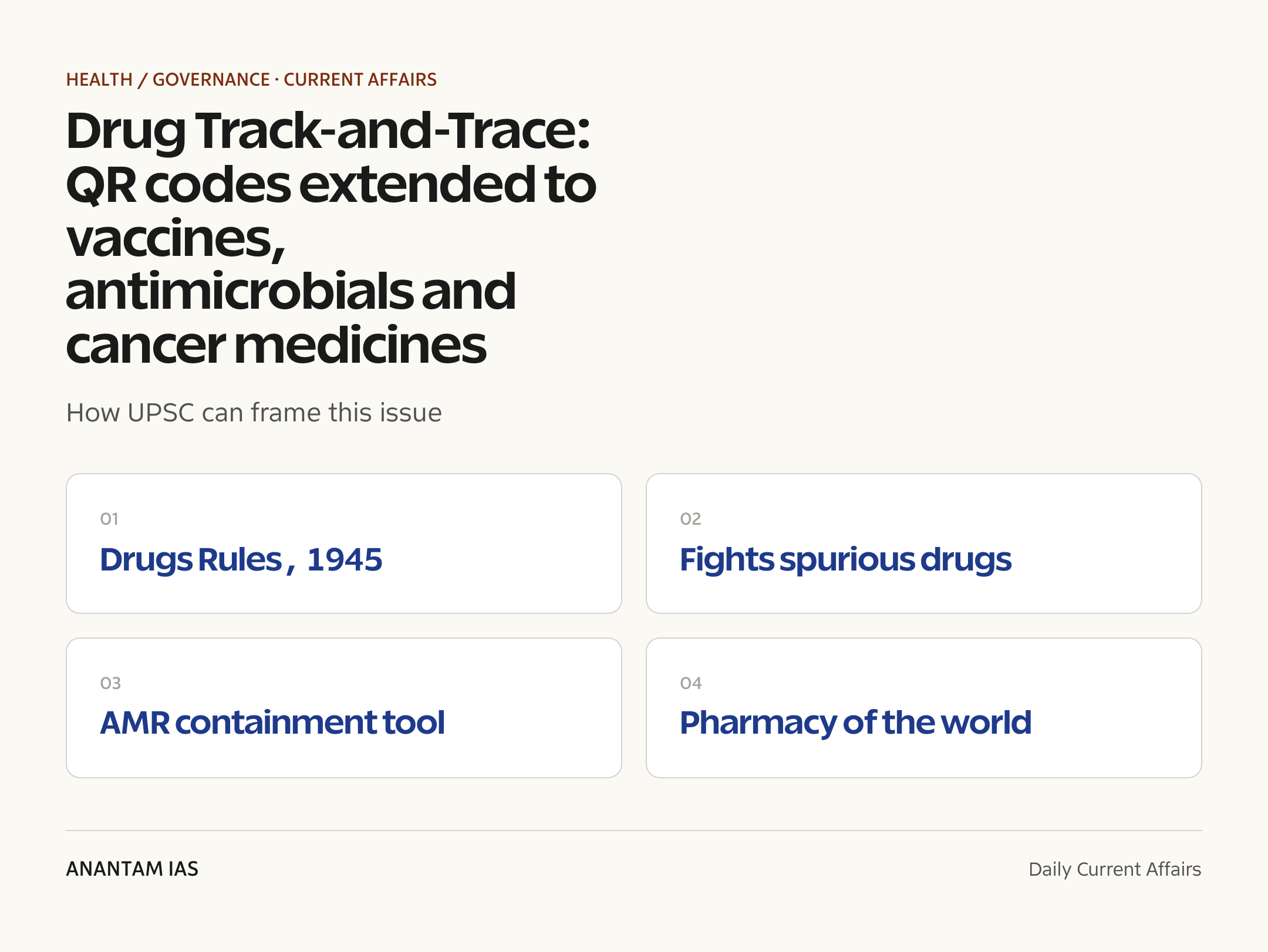
From top-300 brands to whole categories
Traceability in India began narrow and is now being scaled to entire therapeutic classes.
- Schedule H2 was first introduced by the Drugs (Eighth Amendment) Rules, 2022, notified in November 2022.
- It mandated a barcode or QR code on the top 300 drug brands by sales value from 1 August 2023.
- Big-selling brands like common painkillers, antacids and vitamins were the first to carry the codes.
- The new step moves from a curated brand list to category-wide coverage of vaccines, antimicrobials, anti-cancer and NDPS drugs.
Staggered timeline and who it hits
The rollout is phased to give manufacturers time to retool packaging lines.
- 1 July 2027 – vaccines, anti-cancer medicines, and NDPS narcotic and psychotropic drugs come under the QR mandate.
- 1 July 2028 – antimicrobials (including antibiotics) become subject to mandatory coding.
- The phasing reflects the larger number of antimicrobial SKUs and the line-side serialisation burden.
- Both domestic and foreign manufacturers supplying these categories in India must comply.
Why spurious drugs and AMR make this urgent
Traceability is a frontline tool against fake medicines and drug resistance.
- Counterfeit, falsified and Not of Standard Quality (NSQ) medicines undermine treatment and can be fatal.
- Sub-potent or fake antibiotics fuel Antimicrobial Resistance (AMR) by exposing pathogens to inadequate doses.
- Vaccines and anti-cancer drugs are high-value, cold-chain-sensitive products where authenticity directly affects survival.
- Serialisation supports faster, batch-level recalls and lets chemists and patients verify a pack before use.
India as the 'pharmacy of the world'
Traceability protects both domestic patients and India’s export reputation.
- India is the largest global supplier of generic medicines by volume and a major vaccine producer.
- Verifiable, serialised packaging strengthens trust in ‘Made in India’ medicines abroad.
- It aligns India with global serialisation norms used in regulated export markets.
- Stronger traceability complements regulator CDSCO in policing the supply chain end to end.
Way Forward
Build the digital backbone
- Move toward an interoperable, centrally readable traceability database so codes are verifiable nationwide, not just printed.
- Adopt consistent global standards (such as GS1-style identifiers) to ease exports and avoid duplicate coding systems.
Close enforcement and awareness gaps
- Equip chemists, hospitals and patients with simple scan-to-verify apps and run awareness drives.
- Pair traceability with stronger penalties for spurious and NSQ drugs and routine risk-based inspections by CDSCO and state drug controllers.
Support small manufacturers
- Offer technical and financial support to MSME drug makers to install serialisation lines before the 2027-28 deadlines.
- Extend coverage progressively to more categories once compliance stabilises.
Conclusion
Extending QR-code traceability from a top-300 brand list to whole classes of vaccines, antimicrobials, anti-cancer and NDPS medicines marks a shift from selective oversight to systemic supply-chain transparency. For a country that medicates much of the world, every fake or sub-standard pack is both a patient-safety failure and a reputational risk.
The real test lies in execution – a readable, interoperable verification system, support for smaller manufacturers, and tough enforcement against spurious drugs. Done well, the 2027-28 rollout can make authenticity checkable at the chemist’s counter and turn traceability into a quiet but powerful weapon against drug resistance.
UPSC Practice Questions
Prelims MCQ 1
With reference to the QR-code / barcode traceability regime for medicines in India, consider the following statements:
- Schedule H2 of the Drugs Rules, 1945 lists drugs required to carry a barcode or QR code.
- The mandate originally applied only to the top 300 drug brands before being expanded.
- The framework is administered under the Narcotic Drugs and Psychotropic Substances Act, 1985.
How many of the above statements are correct?
(a) Only one (b) Only two (c) All three (d) None
Answer: (b) Only two
Explanation:
Statements 1 and 2 are correct – Schedule H2 lists the drugs and first covered the top 300 brands. Statement 3 is wrong: the regime sits under the Drugs and Cosmetics Act, 1940 and Drugs Rules, 1945, not the NDPS Act (though NDPS-listed drugs are now included).
Prelims MCQ 2
Under the 2026 expansion, which category of drugs is scheduled to come under the QR-code mandate LAST?
(a) Vaccines (b) Anti-cancer drugs (c) Antimicrobials (d) Narcotic and psychotropic drugs
Answer: (c) Antimicrobials
Explanation:
Vaccines, anti-cancer and NDPS narcotic/psychotropic drugs come under the mandate from 1 July 2027, while antimicrobials follow later, from 1 July 2028.
UPSC Mains Questions
- Spurious and Not of Standard Quality medicines threaten both patient safety and India’s standing as the ‘pharmacy of the world’. Examine how QR-code-based drug traceability can address this challenge, and the institutional and technological gaps that may limit its success. (250 words)
- Antimicrobial Resistance is a One Health crisis that no single intervention can solve. Discuss the role of pharmaceutical supply-chain traceability, alongside other measures, in India’s strategy to contain AMR. (250 words)
Sources: The Hindu and Business Standard.
Frequently Asked Questions
What exactly has the Health Ministry changed?
It amended the Drugs Rules, 1945 to expand Schedule H2, bringing all vaccines, all antimicrobials, all anti-cancer drugs and NDPS narcotic and psychotropic medicines under mandatory barcode or QR-code traceability, beyond the earlier top-300 brand list.
What is Schedule H2?
Schedule H2 of the Drugs Rules, 1945 lists drug formulations whose packaging must carry a barcode or QR code storing traceability data. It was introduced by the Drugs (Eighth Amendment) Rules, 2022 and initially covered only the top 300 brands from 1 August 2023.
When do the new rules take effect?
The rollout is staggered: vaccines, anti-cancer medicines and NDPS narcotic and psychotropic drugs come under the mandate from 1 July 2027, while antimicrobials follow from 1 July 2028, giving manufacturers time to upgrade packaging lines.
What information does the QR code carry?
Scanning the code reveals the unique product identification code, generic and brand names, the manufacturer’s name and address, the batch number, manufacturing and expiry dates, and the manufacturing licence number, allowing point-of-sale verification.
How does this help fight Antimicrobial Resistance?
Fake or sub-potent antibiotics expose bacteria to inadequate doses, accelerating resistance. Mandating QR codes on antimicrobials helps identify and weed out counterfeit and substandard products, supporting India’s broader AMR containment efforts.
Who regulates drug quality and traceability in India?
The Central Drugs Standard Control Organisation (CDSCO), headed by the Drugs Controller General of India (DCGI), administers the Drugs and Cosmetics Act, 1940 and Drugs Rules, 1945, working with state drug controllers on enforcement.
Source: https://anantamias.com/current-affairs/qr-code-drug-traceability-vaccines-antimicrobials/
Passport and Citizenship: Why a Passport Is Not Proof of Citizenship, and the July Fee Revision
Why in News?
An Indian Express Explained piece has revived a recurring legal question: is an Indian passport proof of citizenship? The settled position is that a passport, issued under the Passports Act, 1967, is a travel document establishing identity and nationality for the purpose of foreign travel, but it is not by itself conclusive proof of citizenship under the Citizenship Act, 1955.
Alongside, The Hindu reported that the Ministry of External Affairs (MEA) has revised passport fees with effect from July 1, 2026, making the topic a useful crossover of durable polity with live current affairs for exam preparation.
- Courts and government affidavits have repeatedly held that a passport is not standalone proof of citizenship.
- Citizenship in India is governed by the Constitution (Part II, Articles 5-11) and the Citizenship Act, 1955; the passport is governed by the separate Passports Act, 1967.
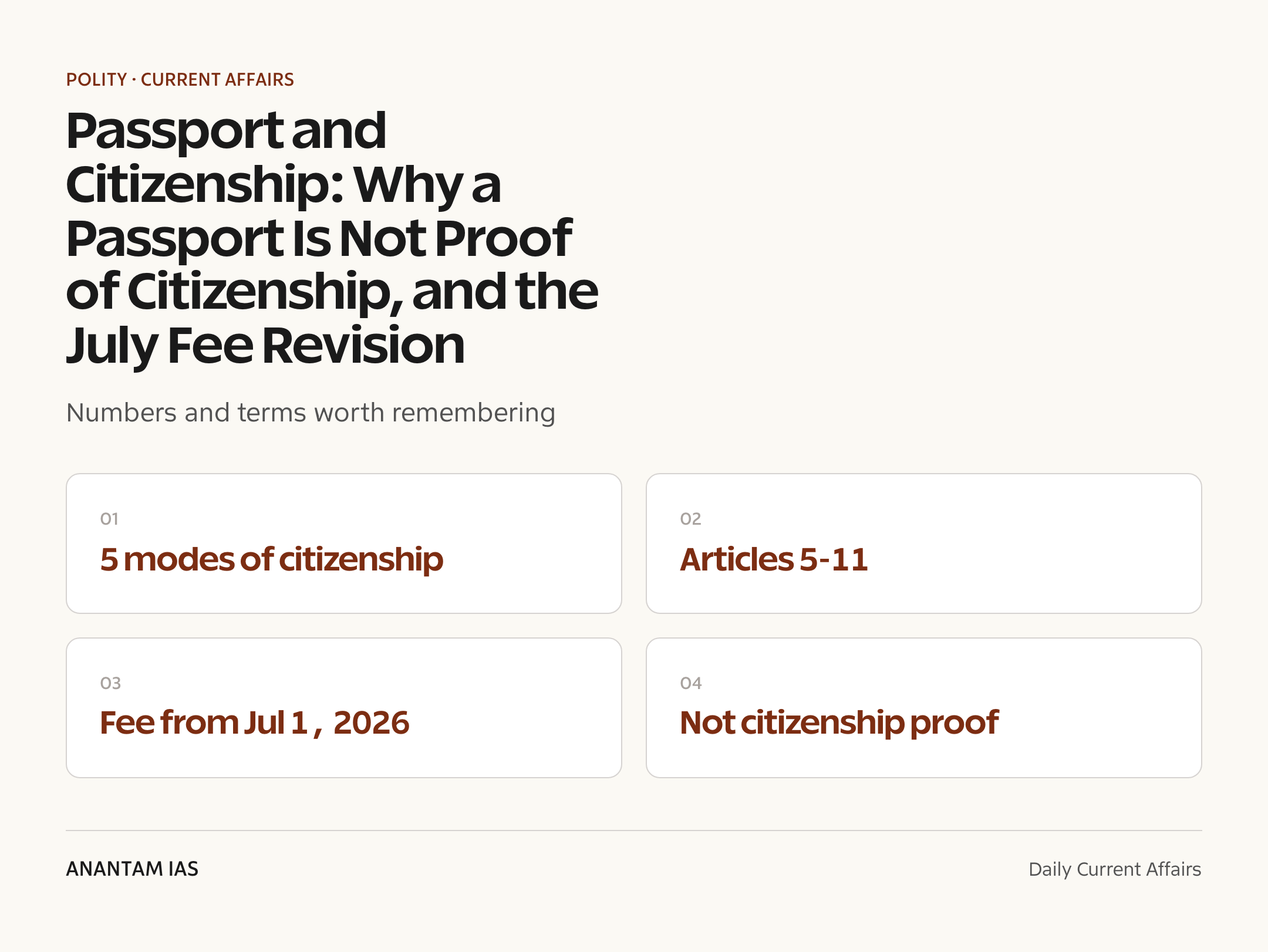
- Per The Hindu, the MEA has revised passport application fees from July 1, 2026 (reported new fee for a 36-page ordinary passport around Rs 2,500; verify against the MEA notification).
- The debate sits within the wider NRC and CAA discourse on what counts as a valid ‘document of citizenship’.
The development matters in the context of:
- Nationality and citizenship overlap in everyday use but are distinct legal concepts; a passport certifies nationality for travel, not the full bundle of citizenship rights.
- No single document is, by itself, conclusive proof of Indian citizenship; authorities rely on a combination of documents and the modes set out in the Citizenship Act, 1955.
- Aadhaar is expressly not proof of citizenship or even of residence; the UIDAI itself states this.

UPSC Relevance
Prelims Relevance
- Part II of the Constitution (Articles 5-11) deals with citizenship at the commencement of the Constitution; Article 11 empowers Parliament to regulate citizenship by law.
- The Citizenship Act, 1955 provides five modes of acquisition: by birth, by descent, by registration, by naturalisation, and by incorporation of territory.
- Section 9 of the Citizenship Act deals with termination of citizenship (voluntary acquisition of foreign citizenship); the Act also covers renunciation and deprivation.
- The Passports Act, 1967 is administered by the MEA; it provides for issue of passports and travel documents and lists grounds for refusal or impounding.
- A passport establishes identity and nationality for travel but is not conclusive proof of citizenship or of domicile.
- Aadhaar is a proof of identity, not of citizenship or residence; this is stated by the UIDAI.
- The Registration of Births and Deaths (Amendment) Act, 2023 makes the birth certificate a key proof of date of birth for various services.
- Citizenship is a Union subject (Union List), and India follows single citizenship.
- Documents commonly but wrongly treated as citizenship proof include voter ID, ration card, and Aadhaar.
- The NRC exercise and the Citizenship (Amendment) Act, 2019 are the policy backdrop to the ‘documents of citizenship’ debate.
Mains Relevance
GS Paper 2
- Examine the legal distinction between a travel document and proof of citizenship, and why a single document cannot establish citizenship under the Citizenship Act, 1955.
- Discuss the governance and rights implications of the absence of a single, reliable proof of citizenship in the context of NRC and welfare delivery.
- Analyse the roles of the MEA (Passports Act) and the MHA (Citizenship Act) and the need for inter-ministerial clarity on identity documents.
Essay
- Identity, documents and the citizen: how the state sees the individual.
- Belonging without paperwork: dignity in an age of mandatory proof.
Background and Context
Citizenship Act, 1955: How Indians become citizens
Citizenship is conferred by law, not by any one card.
- The Citizenship Act, 1955, enacted under Article 11, governs acquisition and loss of citizenship after the commencement of the Constitution.
- Five modes of acquisition: by birth, by descent, by registration, by naturalisation, and by incorporation of territory.
- Conditions for citizenship by birth have been tightened over time, linking it to the citizenship status of parents at the time of birth.
- Section 9 provides that a citizen who voluntarily acquires the citizenship of another country ceases to be an Indian citizen; the Act also covers renunciation and deprivation.
- India follows single citizenship; the OCI (Overseas Citizen of India) status is not dual citizenship and confers no political rights.
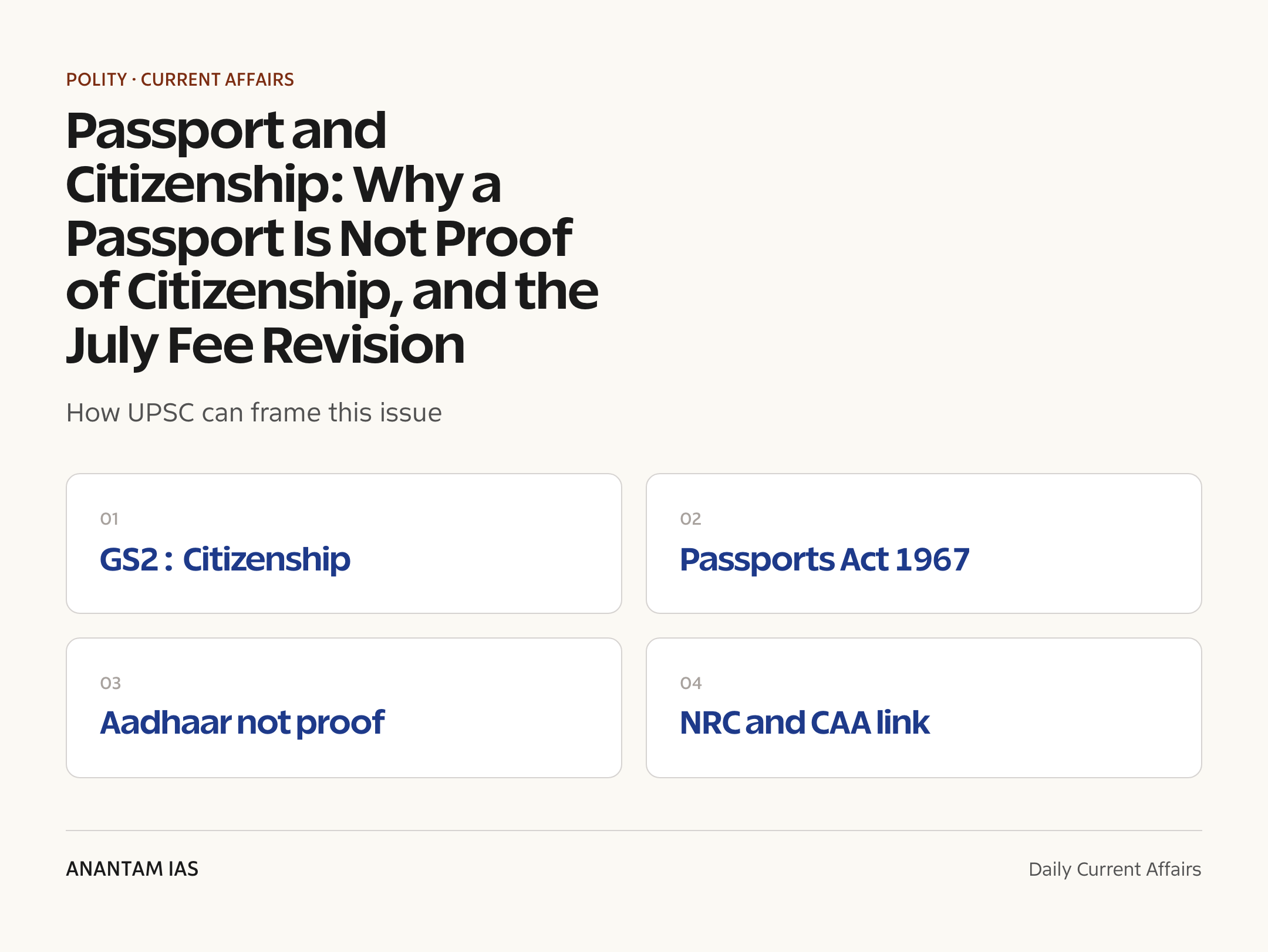
Passports Act, 1967: A travel document, not a citizenship certificate
The passport proves who you are for travel, not your full legal status.
- The Passports Act, 1967 empowers the MEA to issue passports and other travel documents and to refuse or impound them on specified grounds.
- A passport certifies identity and nationality so that other countries permit entry; it is accepted internationally as a recognised travel document.
- Courts and government affidavits have held that a passport is not conclusive proof of citizenship and can be revisited if citizenship itself is in question.
- A passport can be issued, and later questioned, without finally settling the holder’s citizenship under the Citizenship Act.
- The right to a passport is linked to the Article 21 right to travel abroad, recognised in Maneka Gandhi v. Union of India (1978).
The 'documents of citizenship' debate
Several common documents are mistaken for citizenship proof.
- Aadhaar is explicitly not proof of citizenship or residence; the UIDAI states it is only proof of identity.
- Voter ID, ration card, and PAN establish entitlement or identity for specific purposes, not citizenship.
- The Registration of Births and Deaths (Amendment) Act, 2023 elevates the birth certificate as a key single proof of date of birth, though not of citizenship by itself.
- Authorities typically assess citizenship through a combination of documents and the legal modes of acquisition, not one card.
- This ambiguity becomes acute during exercises such as the NRC, where the burden of proof shifts to the individual.
NRC, CAA and why the question matters
The legal gap has real consequences for ordinary people.
- The National Register of Citizens (NRC), conducted in Assam, required residents to prove citizenship through legacy and linkage documents.
- The Citizenship (Amendment) Act, 2019 (CAA) created a path to citizenship for specified non-Muslim migrants from Pakistan, Bangladesh and Afghanistan who entered before a cut-off date.
- Absence of a single authoritative proof raises fears of exclusion, statelessness, and denial of welfare for the poor and documentation-weak.
- Foreigners Tribunals and courts adjudicate disputed cases, where even a passport may not end the inquiry into citizenship.
The July 2026 passport fee revision
MEA has revised passport charges effective July 1, 2026.
- Per The Hindu, the MEA revised passport application fees with effect from July 1, 2026; the reported new fee for a 36-page ordinary passport is around Rs 2,500 (verify against the official MEA notification).
- Separate charges typically apply for 60-page passports, Tatkal (urgent) issuance, and re-issue for minors and lost or damaged passports; confirm the exact slabs from the notification.
- Services are delivered through the Passport Seva network of Passport Seva Kendras and Post Office Passport Seva Kendras.
- The wider modernisation includes Passport Seva Programme V2.0 and the rollout of the e-passport with an embedded chip.
Way Forward
Legal clarity on identity documents
- Issue clear, consistent guidance distinguishing identity, residence and citizenship proof across the MEA, MHA and UIDAI.
- Avoid treating any single document as conclusive proof of citizenship in administrative practice.
Protecting the vulnerable
- Build safeguards so that documentation gaps do not translate into denial of welfare or risk of statelessness.
- Strengthen the Registration of Births and Deaths system so that every citizen has reliable foundational records.
Citizen-friendly passport services
- Keep fee revisions transparent and proportionate, with exemptions retained for the genuinely needy.
- Expand Passport Seva capacity and the e-passport rollout to cut delays.
Conclusion
The recurring confusion between a passport and proof of citizenship reflects a deeper gap: India has no single document that conclusively certifies who is a citizen. The passport, governed by the Passports Act, 1967, settles identity and nationality for travel; citizenship itself flows from the Constitution and the Citizenship Act, 1955.
For aspirants, the topic ties durable polity to live administration, the July 1, 2026 fee revision. The governance lesson is to keep documentation regimes humane and transparent so that proof of belonging never becomes a barrier to rights.
UPSC Practice Questions
Prelims MCQ 1
With reference to citizenship and identity documents in India, consider the following statements:
- An Indian passport is conclusive legal proof of Indian citizenship.
- Aadhaar is proof of identity but not of citizenship or residence.
- The Citizenship Act, 1955 provides for acquisition of citizenship by naturalisation.
How many of the above statements are correct?
(a) Only one (b) Only two (c) All three (d) None
Answer: (b) Only two
Explanation:
Statement 1 is wrong: a passport is a travel document, not conclusive proof of citizenship. Statements 2 and 3 are correct, so only two are correct.
Prelims MCQ 2
Which one of the following is NOT a mode of acquiring citizenship under the Citizenship Act, 1955?
(a) By birth (b) By descent (c) By naturalisation (d) By possession of an Aadhaar number
Answer: (d) By possession of an Aadhaar number
Explanation:
The Act recognises birth, descent, registration, naturalisation and incorporation of territory. Aadhaar is only an identity number and is not a mode of acquiring citizenship.
UPSC Mains Questions
- A passport establishes nationality for travel but is not conclusive proof of citizenship. In light of the Citizenship Act, 1955 and the Passports Act, 1967, examine why India lacks a single conclusive document of citizenship and the governance challenges this creates. (250 words)
- Discuss how the absence of a single proof of citizenship interacts with exercises such as the NRC and welfare delivery, and suggest safeguards to protect the documentation-weak from exclusion. (250 words)
Sources: Indian Express and The Hindu.
Frequently Asked Questions
Is an Indian passport proof of citizenship?
No. A passport issued under the Passports Act, 1967 is a travel document that establishes identity and nationality for foreign travel. Courts and government affidavits have held it is not conclusive proof of citizenship, which is governed separately by the Constitution and the Citizenship Act, 1955.
What are the modes of acquiring Indian citizenship?
The Citizenship Act, 1955 provides five modes: by birth, by descent, by registration, by naturalisation, and by incorporation of territory. Conditions, especially for citizenship by birth, have been amended over time and depend on the citizenship status of parents.
Is Aadhaar proof of citizenship?
No. The UIDAI states that Aadhaar is only proof of identity, not of citizenship or even of residence. Documents like voter ID, ration card and PAN also establish identity or entitlement for specific purposes but do not by themselves prove citizenship.
What changed in passport fees from July 2026?
Per The Hindu, the MEA revised passport application fees from July 1, 2026, with the reported fee for a 36-page ordinary passport around Rs 2,500. Exact slabs for 60-page, Tatkal and minor passports should be confirmed from the official MEA notification.
Which constitutional provisions deal with citizenship?
Part II of the Constitution, Articles 5 to 11, deals with citizenship at the commencement of the Constitution. Article 11 empowers Parliament to make laws on citizenship, under which the Citizenship Act, 1955 was enacted. India follows single citizenship.
Why does the citizenship-proof question matter?
Because no single document conclusively proves citizenship, exercises like the NRC shift the burden of proof to individuals, risking exclusion, statelessness and denial of welfare for the poor and documentation-weak. This makes humane, transparent documentation systems essential.
Source: https://anantamias.com/current-affairs/passport-not-proof-of-citizenship-fee-hike/
Operation Chakra-VI: CBI’s nationwide crackdown on digital-arrest scam networks
Why in News?
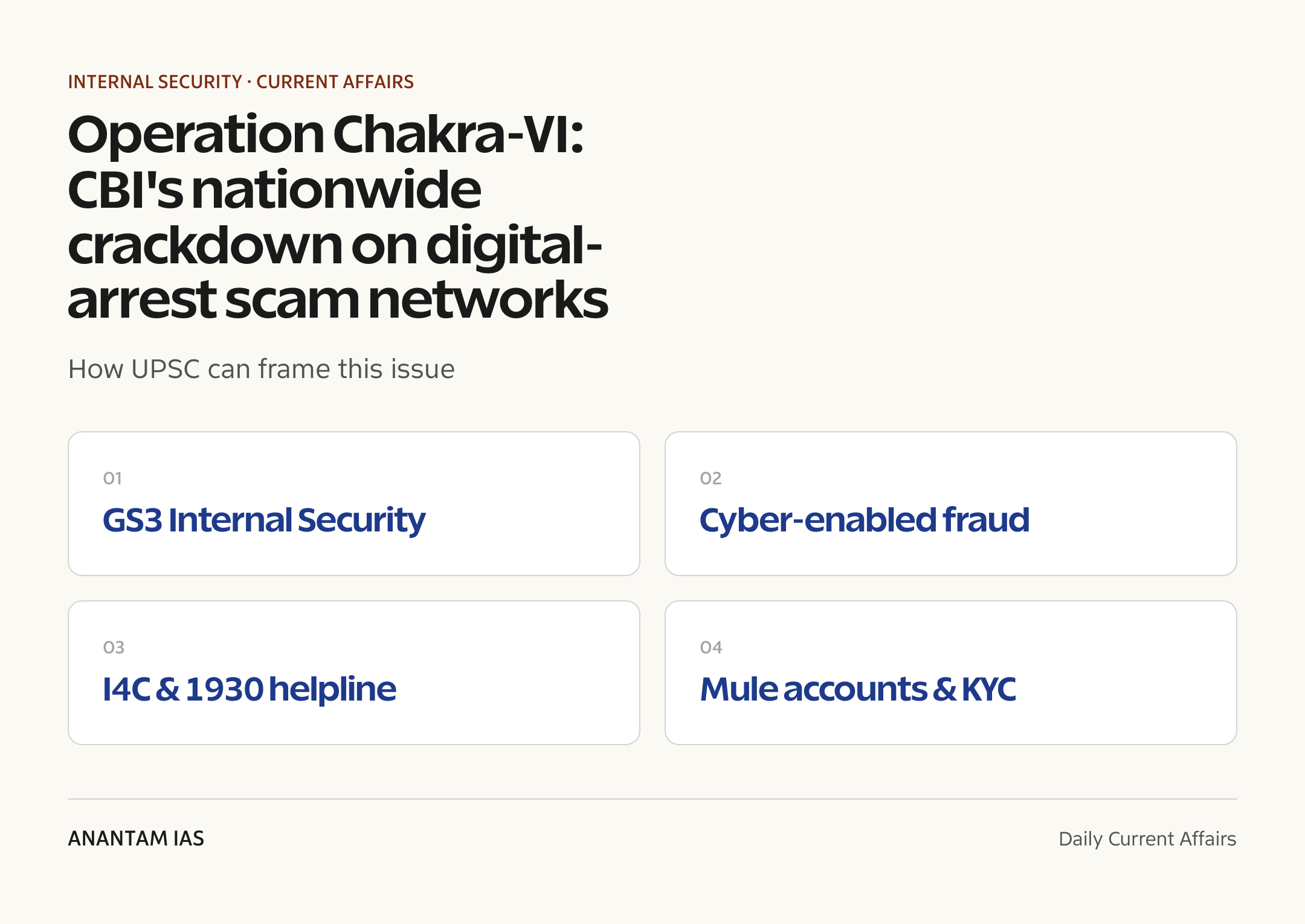
The Central Bureau of Investigation (CBI) launched Operation Chakra-VI, conducting simultaneous searches at more than 80 locations across 16 states and Union Territories to dismantle organised networks running the so-called ‘digital arrest’ fraud. The Hindu reported that the operation targeted syndicates that impersonated law-enforcement and judicial authorities to extort money from victims over fake video calls.
Deccan Herald reported that one network operated a fake Supreme Court website and used a web of mule bank accounts to layer and launder the proceeds. The case is a flagship illustration of cyber-enabled financial crime and how India’s investigative and coordination machinery is responding to a fast-evolving threat.
- Operation Chakra-VI is the sixth edition of the CBI’s series of anti-cybercrime operations targeting international and organised online fraud.
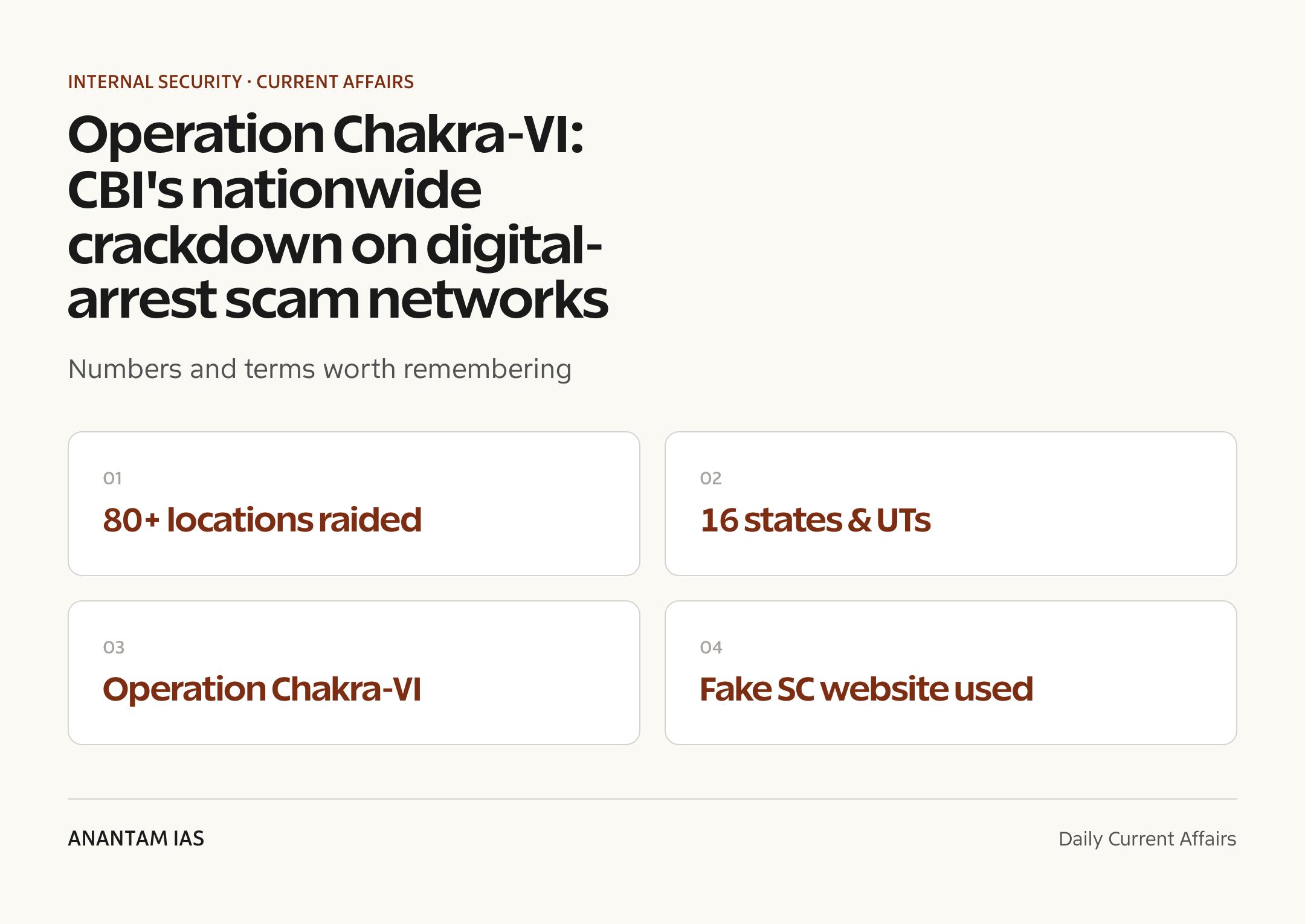
- Searches spanned 80+ premises across 16 states/UTs, with seizures of digital devices, documents and account records.
- Fraudsters built a fake Supreme Court website to lend false legitimacy to fabricated ‘arrest warrants’ and court orders.
- Money was routed through mule accounts – bank accounts rented or sold by third parties to move criminal proceeds.
- The probe links to complaints registered on the National Cyber Crime Reporting Portal (NCRP) and the 1930 cyber helpline.
The development matters in the context of:
- ‘Digital arrest’ is a scam in which fraudsters posing as CBI, police, ED or customs officials place victims under a fake, prolonged video-call ‘house arrest’ and coerce payments.
- Prime Minister Narendra Modi flagged the menace in his Mann Ki Baat address in November 2024, coining the mantra ‘Ruko, Socho, Action Lo’ (Stop, Think, Take Action).
- Coordination runs through the Indian Cyber Crime Coordination Centre (I4C) under the Ministry of Home Affairs.
UPSC Relevance
Prelims Relevance
- Operation Chakra is the CBI’s series of operations against organised cyber-enabled financial crime, often involving international cooperation with Interpol and the FBI.
- I4C (Indian Cyber Crime Coordination Centre) functions under the Ministry of Home Affairs, not the Ministry of Electronics and IT.
- The National Cyber Crime Reporting Portal is cybercrime.gov.in; the dedicated cyber-fraud helpline number is 1930.
- The Citizen Financial Cyber Fraud Reporting and Management System (CFCFRMS) enables quick reporting and freezing of defrauded funds.
- Mule accounts are third-party bank accounts used to receive and move the proceeds of crime to obscure the money trail.
- ‘Digital arrest’ has no basis in Indian law – no agency arrests or interrogates citizens over a video call.
- Cyber offences are prosecuted under the Information Technology Act, 2000 and the new Bharatiya Nyaya Sanhita (BNS), 2023 read with Bharatiya Nagarik Suraksha Sanhita (BNSS), 2023.
- The CBI is the nodal agency for Interpol coordination in India and derives its powers from the Delhi Special Police Establishment Act, 1946.
Mains Relevance
GS Paper 3
- Map the challenges in countering cyber-enabled financial crime – jurisdiction, mule-account chains, cross-border servers – and assess the role of coordinated operations like Operation Chakra.
- Evaluate the institutional architecture (I4C, NCRP, 1930 helpline, CFCFRMS) for cyber-fraud prevention, detection and rapid fund-freezing.
GS Paper 2
- Examine how impersonation of state authority in ‘digital arrest’ scams erodes citizen trust in institutions, and discuss the governance and grievance-redress response.
Essay
- Technology is a double-edged sword: the same connectivity that empowers citizens also arms the fraudster.
- Fear in the digital age – how scammers weaponise the authority of the state against the citizen.
Background and Context
What 'digital arrest' actually means
It is a confidence fraud built on fear, fake authority and isolation.
- Fraudsters call or video-call a victim claiming a parcel, SIM card or bank account is linked to crime – drugs, money laundering or human trafficking.
- They pose as officers of the CBI, police, Enforcement Directorate (ED) or customs, often in uniform against fake police-station backdrops.
- The victim is told they are under ‘digital arrest’ and must stay on continuous video, cut off from family, until they ‘clear’ their name.
- Under sustained psychological pressure, victims transfer large sums for ‘verification’ or ‘bail’, which is then siphoned through mule accounts.
- There is no such thing in law – no Indian agency conducts arrests or interrogations over video calls.
Operation Chakra: the CBI's anti-cybercrime series
Chakra-VI is the latest in a multi-year, internationally coordinated drive.
- The Operation Chakra series (I to VI) targets organised cyber-financial crime, tech-support scams and call-centre frauds operating across borders.
- Earlier editions saw the CBI work with Interpol, the FBI and platforms like Microsoft and Amazon to trace international fraud rings.
- Operation Chakra-VI struck 80+ locations across 16 states/UTs, as reported by The Hindu, seizing devices and financial records.
- Deccan Herald reported the use of a fake Supreme Court website to fabricate court orders and intimidate victims with apparent judicial authority.
- Targeting infrastructure – the fake site, mule accounts and handlers – aims to break the syndicate, not just individual scammers.
The institutional response architecture
India has layered a coordination, reporting and fund-freezing system over the last few years.
- The Indian Cyber Crime Coordination Centre (I4C), under the Ministry of Home Affairs, is the apex body coordinating cybercrime response across states.
- The National Cyber Crime Reporting Portal (NCRP) at cybercrime.gov.in lets citizens report frauds, especially against women and children and financial fraud.
- The 1930 helpline and the Citizen Financial Cyber Fraud Reporting and Management System (CFCFRMS) enable rapid reporting to freeze defrauded money before withdrawal.
- The CBI, as India’s Interpol nodal agency, leads cross-border operations; state cyber cells handle local FIRs and arrests.
- I4C has flagged and blocked thousands of fraudulent SIM cards, accounts and apps linked to digital-arrest rackets.
The legal toolkit
Cyber-fraud prosecution now draws on both special and general criminal law.
- The Information Technology Act, 2000 covers identity theft (Section 66C), cheating by personation using a computer (Section 66D) and related offences.
- The new Bharatiya Nyaya Sanhita (BNS), 2023 covers cheating, criminal impersonation, extortion and organised crime, replacing the IPC.
- Procedure now runs under the Bharatiya Nagarik Suraksha Sanhita (BNSS), 2023, with provisions for electronic records and zero-FIR.
- Mule accounts attract money-laundering scrutiny, linking the Prevention of Money Laundering Act (PMLA) and the ED to the chain.
- Banks face tightened KYC and account-monitoring obligations to choke the mule-account supply that powers these scams.
Why this matters for internal security
Cyber-fraud has moved from nuisance to a systemic threat to public order and the economy.
- ‘Digital arrest’ frauds have drained citizens of thousands of crores, hitting pensioners and professionals alike.
- Impersonating the CBI, courts and police erodes public trust in the very institutions meant to protect citizens.
- Servers, handlers and money mules often sit across borders, making attribution and recovery hard.
- The scam exploits low digital and financial literacy and the reflexive fear of state authority.
- It sits at the intersection of cybersecurity, financial crime and policing – a textbook GS-III internal-security challenge.
Way Forward
Citizen awareness and the 'Stop, Think, Act' reflex
- Mainstream the ‘Ruko, Socho, Action Lo’ message that no genuine agency conducts arrests over video calls.
- Run targeted campaigns for vulnerable groups – the elderly, students and first-time digital-payment users.
Choke the financial plumbing
- Tighten KYC and real-time monitoring to detect and freeze mule accounts faster.
- Strengthen the 1930 helpline and CFCFRMS for faster fund-freezing within the critical first hours.
Institutional and cross-border coordination
- Deepen CBI-Interpol and platform cooperation to dismantle international call-centre and server infrastructure.
- Build capacity in I4C and state cyber cells for forensics, attribution and faster takedowns of fake sites.
Conclusion
Operation Chakra-VI signals a shift from reactive complaint-handling toward proactive dismantling of cyber-fraud syndicates and the infrastructure – fake websites and mule-account chains – that sustains them. The use of a counterfeit Supreme Court website shows how scammers weaponise the symbols of state authority to manufacture fear and compliance.
Lasting protection will come from a triad: an alert citizen who pauses before paying, a financial system that can freeze fraudulent transfers within minutes, and an investigative ecosystem – CBI, I4C and state cyber cells – able to follow the money across borders. Technology created the threat, and a calibrated mix of awareness, law and coordination must contain it.
UPSC Practice Questions
Prelims MCQ 1
With reference to India’s cyber-fraud response architecture, consider the following statements:
- The Indian Cyber Crime Coordination Centre (I4C) functions under the Ministry of Home Affairs.
- The number 1930 is the dedicated helpline for reporting financial cyber fraud.
- ‘Digital arrest’ is a recognised arrest procedure under the Bharatiya Nagarik Suraksha Sanhita, 2023.
How many of the above statements are correct?
(a) Only one (b) Only two (c) All three (d) None
Answer: (b) Only two
Explanation:
I4C is under the MHA and 1930 is the cyber-fraud helpline, so statements 1 and 2 are correct. ‘Digital arrest’ has no legal basis – no Indian law permits arrest over a video call, making statement 3 wrong.
Prelims MCQ 2
The ‘Operation Chakra’ series of operations is associated with which of the following?
(a) Counter-insurgency operations in the Northeast (b) The CBI’s drive against organised cyber-enabled financial crime (c) Anti-narcotics seizures by the Narcotics Control Bureau (d) Border infrastructure projects along the LAC
Answer: (b) The CBI's drive against organised cyber-enabled financial crime
Explanation:
Operation Chakra (editions I-VI) is the CBI’s series of operations targeting organised cyber-enabled financial crime, often with Interpol and FBI cooperation. Operation Chakra-VI dismantled ‘digital arrest’ fraud networks.
UPSC Mains Questions
- ‘Digital arrest’ frauds represent a new frontier of cyber-enabled financial crime that exploits both technology and the fear of state authority. Examine the modus operandi and evaluate India’s institutional response, including Operation Chakra and the I4C ecosystem. (250 words)
- Discuss how mule accounts and fake official identities sustain organised online fraud in India. Suggest financial, legal and awareness-based measures to break this chain. (150 words)
Sources: The Hindu and Deccan Herald.
Frequently Asked Questions
What is a ‘digital arrest’ scam?
It is a fraud where criminals posing as CBI, police, ED or customs officers place a victim under a fake, prolonged video-call ‘house arrest’. They claim the victim is linked to a crime and coerce money for ‘verification’ or ‘bail’. No Indian agency arrests or interrogates anyone over a video call – it is entirely a confidence trick built on fear.
What is Operation Chakra-VI?
Operation Chakra-VI is the sixth edition of the CBI’s series of operations against organised cyber-enabled financial crime. In this round, the CBI searched more than 80 locations across 16 states and Union Territories to dismantle digital-arrest fraud networks, including one that ran a fake Supreme Court website and used mule bank accounts.
What is the I4C?
The Indian Cyber Crime Coordination Centre (I4C) is the apex body under the Ministry of Home Affairs that coordinates India’s response to cybercrime across states. It runs the National Cyber Crime Reporting Portal (cybercrime.gov.in), supports the 1930 helpline, and blocks fraudulent SIMs, accounts and apps used by scammers.
What are mule accounts?
Mule accounts are bank accounts rented, sold or lent by third parties so that criminals can receive and move the proceeds of fraud. By layering money through many such accounts, scammers obscure the trail and make recovery difficult. Tighter KYC and real-time monitoring of suspicious accounts are key to choking this network.
What should I do if I receive a ‘digital arrest’ call?
Stay calm, do not pay, and do not stay on the call. Remember the official advice – ‘Ruko, Socho, Action Lo’ (Stop, Think, Act). No genuine agency arrests anyone over video. Disconnect, verify with the actual agency through official numbers, and report immediately on the National Cyber Crime Reporting Portal or by calling the 1930 helpline.
Which laws apply to these cyber frauds?
Such frauds are prosecuted under the Information Technology Act, 2000 (identity theft and cheating by personation) read with the new Bharatiya Nyaya Sanhita, 2023 and Bharatiya Nagarik Suraksha Sanhita, 2023. Where laundering is involved, the Prevention of Money Laundering Act can also apply, bringing the Enforcement Directorate into the chain.
Source: https://anantamias.com/current-affairs/operation-chakra-vi-digital-arrest-scam-crackdown/
Intelligence Bureau: Mahesh Dixit Appointed Director and the Agency’s Place in India’s Security Architecture
Why in News?
The Appointments Committee of the Cabinet (ACC), headed by the Prime Minister, has approved the appointment of senior IPS officer Mahesh Dixit as the new Director of the Intelligence Bureau (DIB), India’s premier domestic intelligence agency under the Ministry of Home Affairs (MHA). Dixit succeeds Tapan Deka, who headed the IB since 2022.
The Hindu and ANI reported that Dixit, a 1993-batch IPS officer who was serving as a Special Director in the IB, has been given a fixed tenure of two years. The change at the top of the country’s oldest intelligence organisation is a natural prompt to revise the IB’s role, history, and the long-running debate on intelligence accountability.
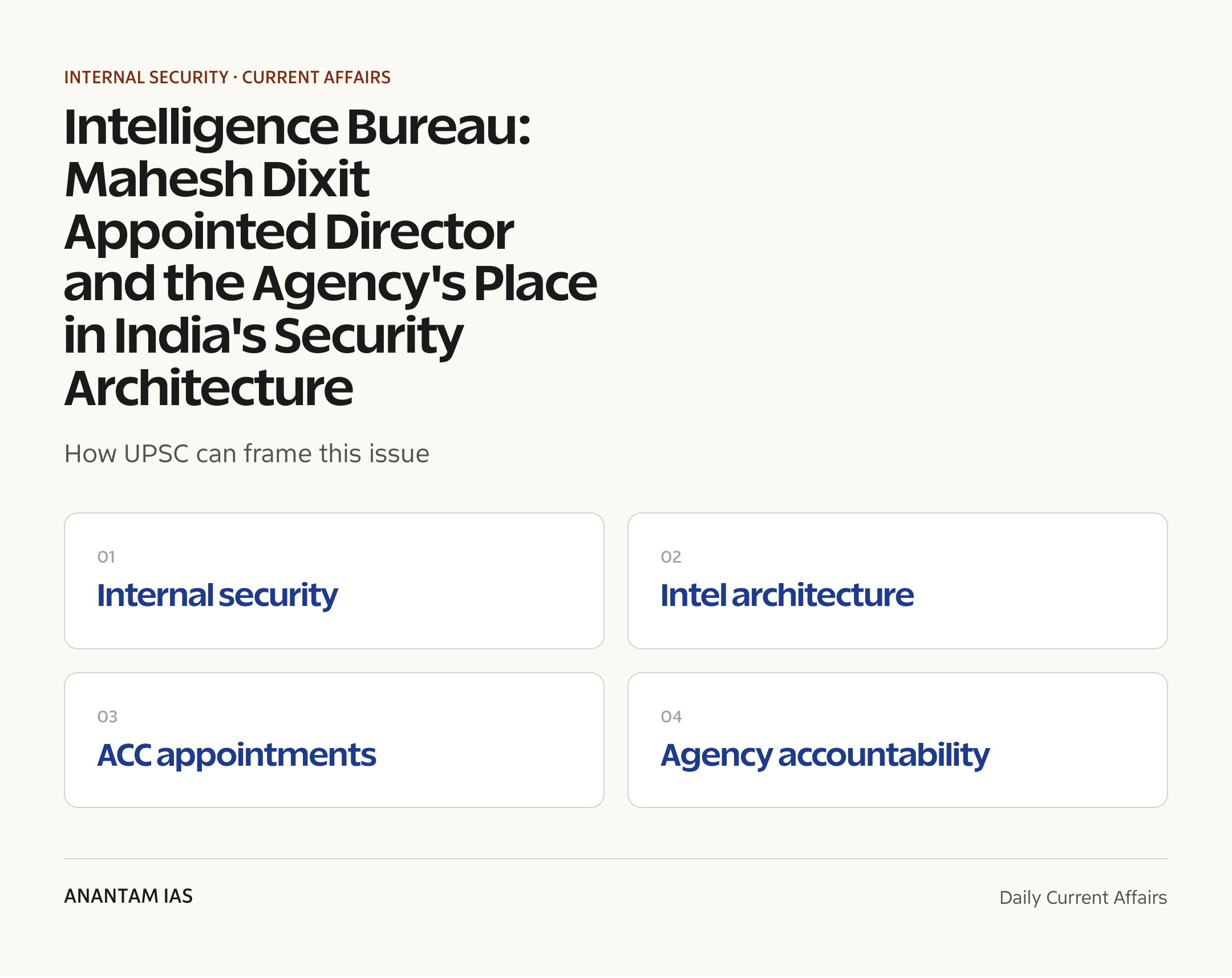
- ACC cleared Mahesh Dixit as the next Director, Intelligence Bureau (DIB).
- Reported by The Hindu and ANI to be a 1993-batch IPS officer, earlier a Special Director in the IB.
- He succeeds Tapan Deka, IB chief since 2022.
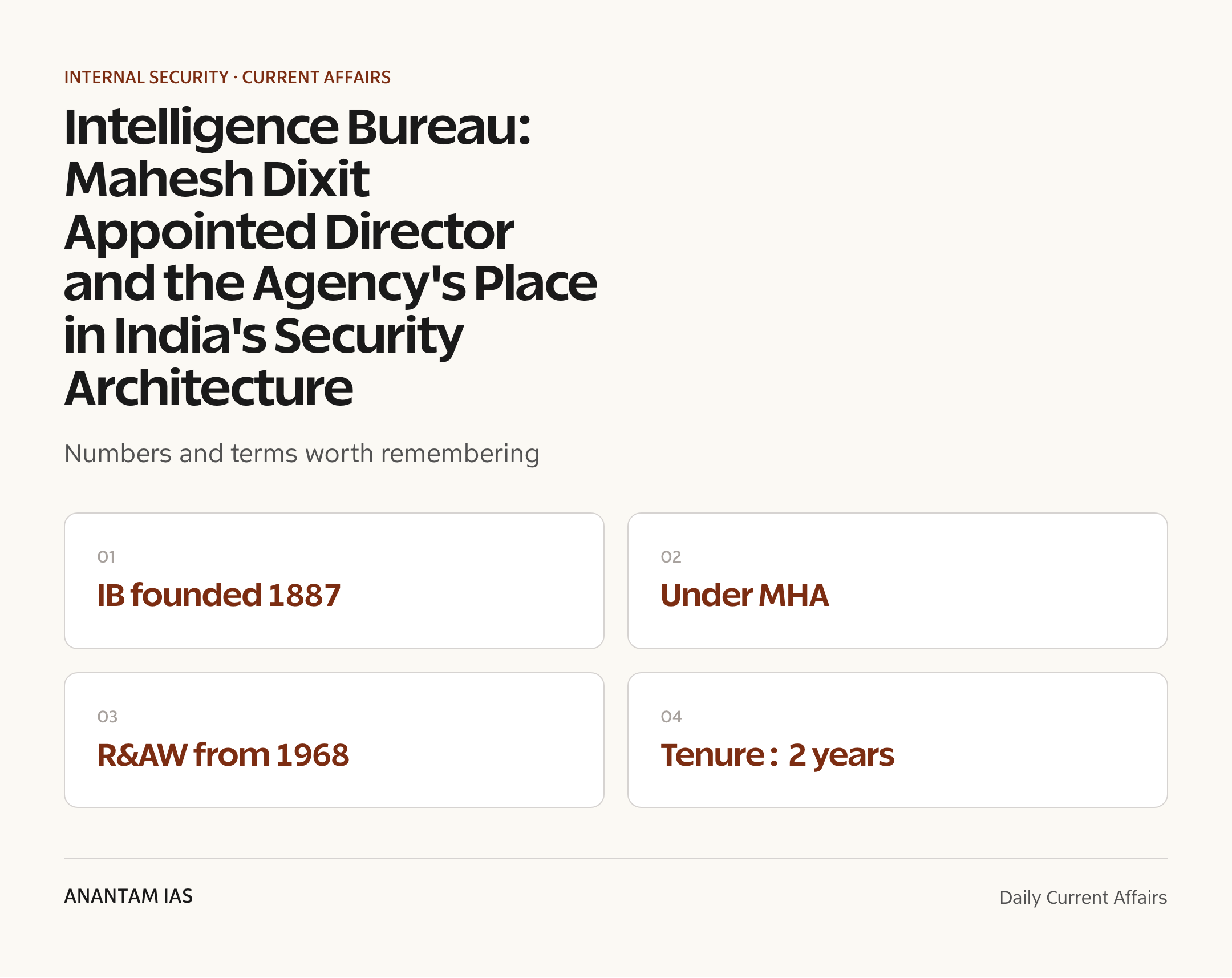
- Tenure fixed at two years from the date he assumes charge.
- The IB operates under the MHA and handles internal/domestic intelligence.
The development matters in the context of:
- The Intelligence Bureau (IB) is India’s lead agency for internal security intelligence, counter-intelligence and counter-terrorism on home soil.
- Its head, the DIB, is conventionally an IPS officer and reports to the Home Minister and Prime Minister.
- The IB is distinct from R&AW, which handles external intelligence under the Cabinet Secretariat.
- Neither agency has a specific statutory charter or direct parliamentary oversight, fuelling an accountability debate.
UPSC Relevance
Prelims Relevance
- Intelligence Bureau (IB) traces its origin to the Central Special Branch (1887); reorganised in 1947 and often described as among the world’s oldest intelligence agencies.
- The IB functions under the Ministry of Home Affairs (MHA) and deals with internal/domestic intelligence.
- The IB is headed by the Director, Intelligence Bureau (DIB), usually an IPS officer.
- Appointments to the post are made by the Appointments Committee of the Cabinet (ACC), chaired by the Prime Minister.
- R&AW (Research and Analysis Wing) handles external intelligence, works under the Cabinet Secretariat, and was created in 1968 after the 1962 and 1965 wars.
- The Multi Agency Centre (MAC), a shared intelligence-coordination grid run by the IB, was strengthened after the 26/11 (2008) Mumbai attacks.
- NATGRID (National Intelligence Grid) is a networked database platform linking security and intelligence agencies to multiple databases.
- Neither the IB nor R&AW was created by a specific Act of Parliament; both lack a dedicated statutory charter.
- The IB is the designated lead agency for counter-intelligence and internal counter-terrorism assessments.
Mains Relevance
GS Paper 3
- Map India’s internal-security intelligence architecture – IB, MAC, NATGRID, NIA – and evaluate post-26/11 coordination reforms.
- Assess the case for a statutory charter and oversight mechanism for intelligence agencies without compromising operational secrecy.
GS Paper 2
- Examine the role of the Appointments Committee of the Cabinet (ACC) and fixed tenures in insulating sensitive security appointments from arbitrariness.
Essay
- Security and liberty: can a democracy run powerful intelligence agencies without statutory accountability?
- The unseen state: intelligence, secrecy, and the limits of public scrutiny.
Background and Context
What the Intelligence Bureau Is
The IB is India’s domestic intelligence backbone, working quietly under the Home Ministry.
- Lead agency for internal intelligence, counter-intelligence and on-soil counter-terrorism assessment.
- Operates under the Ministry of Home Affairs (MHA); the DIB reports to the Home Minister and Prime Minister.
- Staffed largely by IPS officers on deputation alongside a dedicated cadre of intelligence personnel.
- Functions include VIP security inputs, monitoring of extremist and subversive activity, and border-area human intelligence.
Origin and Evolution
The IB carries one of the longest institutional pedigrees among the world’s intelligence services.
- Traces back to the Central Special Branch (1887) set up in British India.
- Reorganised as the Intelligence Bureau in 1947 after Independence.
- Until 1968, the IB handled both internal and external intelligence; external work was then carved out to create R&AW.
- Continues as a purely civilian, non-statutory body without a founding Act of Parliament.
IB vs R&AW – the Internal-External Divide
India’s two flagship agencies split the intelligence task by geography of threat.
- IB – internal/domestic intelligence, under the MHA; head is the DIB.
- R&AW – external/foreign intelligence, under the Cabinet Secretariat; head is the Secretary (R).
- R&AW was created in 1968 after intelligence gaps exposed by the 1962 and 1965 wars.
- Both feed assessments into national decision-making but neither is directly answerable to Parliament.
Coordination Architecture After 26/11
The 2008 Mumbai attacks triggered a redesign of how intelligence is shared.
- Multi Agency Centre (MAC), run by the IB, was upgraded into a round-the-clock intelligence-sharing grid linking central and state agencies.
- NATGRID was conceived to give authorised agencies networked access to multiple databases (travel, banking, telecom).
- National Investigation Agency (NIA) was created in 2008 as the federal counter-terror investigating body.
- State Special/Subsidiary MACs extend the grid to the district level.
The Accountability Debate
Powerful agencies without a statutory charter raise persistent governance questions.
- No specific Act defines the IB’s powers, limits, or oversight – it rests on executive authority.
- Unlike several democracies, India has no dedicated parliamentary intelligence committee to scrutinise budgets and operations.
- Private members’ bills and commentators have urged a statutory framework with secure, in-camera oversight.
- The balance sought is between operational secrecy and constitutional accountability in a rights-based democracy.
Significance of This Appointment
Leadership and tenure stability at the IB matter for continuity in security planning.
- The Hindu and ANI report Mahesh Dixit as a 1993-batch IPS officer, earlier a Special Director in the IB.
- He takes over from Tapan Deka, IB chief since 2022.
- A two-year fixed tenure aims to give continuity across counter-terror and internal-security priorities.
- The ACC, chaired by the Prime Minister, retains the final say on such sensitive appointments.
Way Forward
Statutory and Oversight Reform
- Consider a calibrated statutory charter for intelligence agencies that protects secrecy while defining mandate and limits.
- Explore a secure, in-camera parliamentary oversight mechanism on the lines of mature democracies.
Coordination and Technology
- Deepen integration of MAC and NATGRID with state police and central agencies for seamless intelligence flow.
- Invest in cyber, financial and AI-driven analytics capability to track evolving threats.
Capacity and Professionalism
- Strengthen specialised recruitment, training and analyst cadres beyond IPS deputation.
- Institutionalise fixed tenures and merit-based succession to insulate leadership from arbitrariness.
Conclusion
The change of guard at the Intelligence Bureau is more than a routine personnel move – it is a reminder of how central domestic intelligence is to India’s internal-security architecture, from counter-terrorism to monitoring extremism. The agency’s quiet, non-statutory character has given it operational flexibility but has also kept it outside the framework of formal accountability that defines most state institutions.
As threats grow more networked and technology-driven, the long-term challenge is institutional, not personal: building coordinated, professional and technologically capable intelligence services while answering the democratic question of who watches the watchers. A fixed-tenure, experienced leadership at the top is one step; a thoughtful debate on a statutory charter and credible oversight is the larger task ahead.
UPSC Practice Questions
Prelims MCQ 1
With reference to India’s intelligence agencies, consider the following statements:
- The Intelligence Bureau functions under the Ministry of Home Affairs and handles internal intelligence.
- The Research and Analysis Wing (R&AW) was created in 1968 and works under the Ministry of Defence.
- Appointments to the post of Director, Intelligence Bureau are approved by the Appointments Committee of the Cabinet.
How many of the above statements are correct?
(a) Only one (b) Only two (c) All three (d) None
Answer: (b) Only two
Explanation:
Statements 1 and 3 are correct. R&AW was created in 1968 but functions under the Cabinet Secretariat, not the Ministry of Defence, so statement 2 is wrong.
Prelims MCQ 2
The Multi Agency Centre (MAC), associated with intelligence coordination in India, is operated under which of the following organisations?
(a) Research and Analysis Wing (b) National Investigation Agency (c) Intelligence Bureau (d) Central Bureau of Investigation
Answer: (c) Intelligence Bureau
Explanation:
The Multi Agency Centre, an intelligence-sharing grid strengthened after the 26/11 attacks, is run under the Intelligence Bureau to pool inputs from central and state agencies.
UPSC Mains Questions
- India’s principal intelligence agencies operate without a specific statutory charter or parliamentary oversight. Critically examine the case for a statutory framework for intelligence agencies while safeguarding operational secrecy. (250 words)
- Evaluate the reforms in India’s internal-security and intelligence-coordination architecture undertaken after the 2008 Mumbai attacks. To what extent have they addressed earlier gaps? (250 words)
Sources: The Hindu and ANI.
Frequently Asked Questions
What is the Intelligence Bureau (IB)?
The Intelligence Bureau is India’s lead domestic intelligence agency, working under the Ministry of Home Affairs. It handles internal intelligence, counter-intelligence and counter-terrorism assessment within the country, and is headed by the Director, Intelligence Bureau (DIB), conventionally a senior IPS officer.
Who is the new Director of the Intelligence Bureau?
The Appointments Committee of the Cabinet has appointed senior IPS officer Mahesh Dixit as the new Director of the Intelligence Bureau. As reported by The Hindu and ANI, he is a 1993-batch officer who earlier served as a Special Director in the IB, and he succeeds Tapan Deka.
How is the IB different from R&AW?
The IB handles internal or domestic intelligence and works under the Ministry of Home Affairs. The Research and Analysis Wing (R&AW) handles external or foreign intelligence and functions under the Cabinet Secretariat. R&AW was carved out of the IB in 1968 after intelligence gaps in the 1962 and 1965 wars.
Who appoints the Director of the Intelligence Bureau?
The Director of the Intelligence Bureau is appointed by the Appointments Committee of the Cabinet (ACC), which is chaired by the Prime Minister. The post is usually filled by a senior IPS officer and, in recent practice, carries a fixed tenure to ensure continuity.
Why is there an accountability debate around the IB?
Neither the IB nor R&AW was created by a specific Act of Parliament, so they lack a statutory charter and direct parliamentary oversight. Critics argue this leaves powerful agencies outside formal accountability, and have urged a statutory framework with secure, in-camera oversight that still protects operational secrecy.
What are MAC and NATGRID?
The Multi Agency Centre (MAC) is an intelligence-sharing grid run by the IB that pools inputs from central and state agencies; it was strengthened after the 2008 Mumbai attacks. NATGRID, the National Intelligence Grid, is a networked platform giving authorised agencies access to multiple databases to track security threats.
Source: https://anantamias.com/current-affairs/mahesh-dixit-intelligence-bureau-director/
Strait of Hormuz: Dispute Over Transit Routes Resurfaces Despite the Ceasefire MoU
Why in News?
The ceasefire memorandum may have reopened the Strait of Hormuz to commercial traffic, but a fresh quarrel has broken out over the precise lanes ships may use and whether transit tolls will eventually apply. Iran’s Islamic Revolutionary Guard Corps (IRGC) has publicly opposed a new shipping corridor announced by Oman and the International Maritime Organization (IMO), asserting that the only authorised routes are those designated by Iran.
The flashpoint is procedural, not just military. A Liberian-flagged tanker reportedly used the Oman-coordinated lane that partly bypasses Iranian control, prompting IRGC objections — a reminder that the world’s most critical oil chokepoint, carrying roughly one-fifth of global oil, remains hostage to who gets to write the map. Al Jazeera reported the IRGC warning; this note builds on our earlier coverage of the US-Iran agreement and the strait’s reopening.
- IRGC stated the only authorised transit routes through the strait are those designated by Iran, rejecting the new corridor.
- Oman and the IMO announced a shipping corridor that partly bypasses Iran’s direct control; Iran says it was not coordinated with Tehran.
- Iran issued its own acceptable shipping map in April, directing vessels closer to Iranian shores than the earlier lanes.
- A Liberian-flagged tanker used the Omani corridor, triggering the latest IRGC protest.
- The ceasefire MoU guarantees free, safe passage for 60 days only; Iran signalled Hormuz ‘will never return’ to pre-war terms, hinting at future transit fees.
The development matters in the context of:
- The Strait of Hormuz connects the Persian Gulf to the Gulf of Oman and the Arabian Sea, the sole sea route for much of the Gulf’s crude and LNG exports.
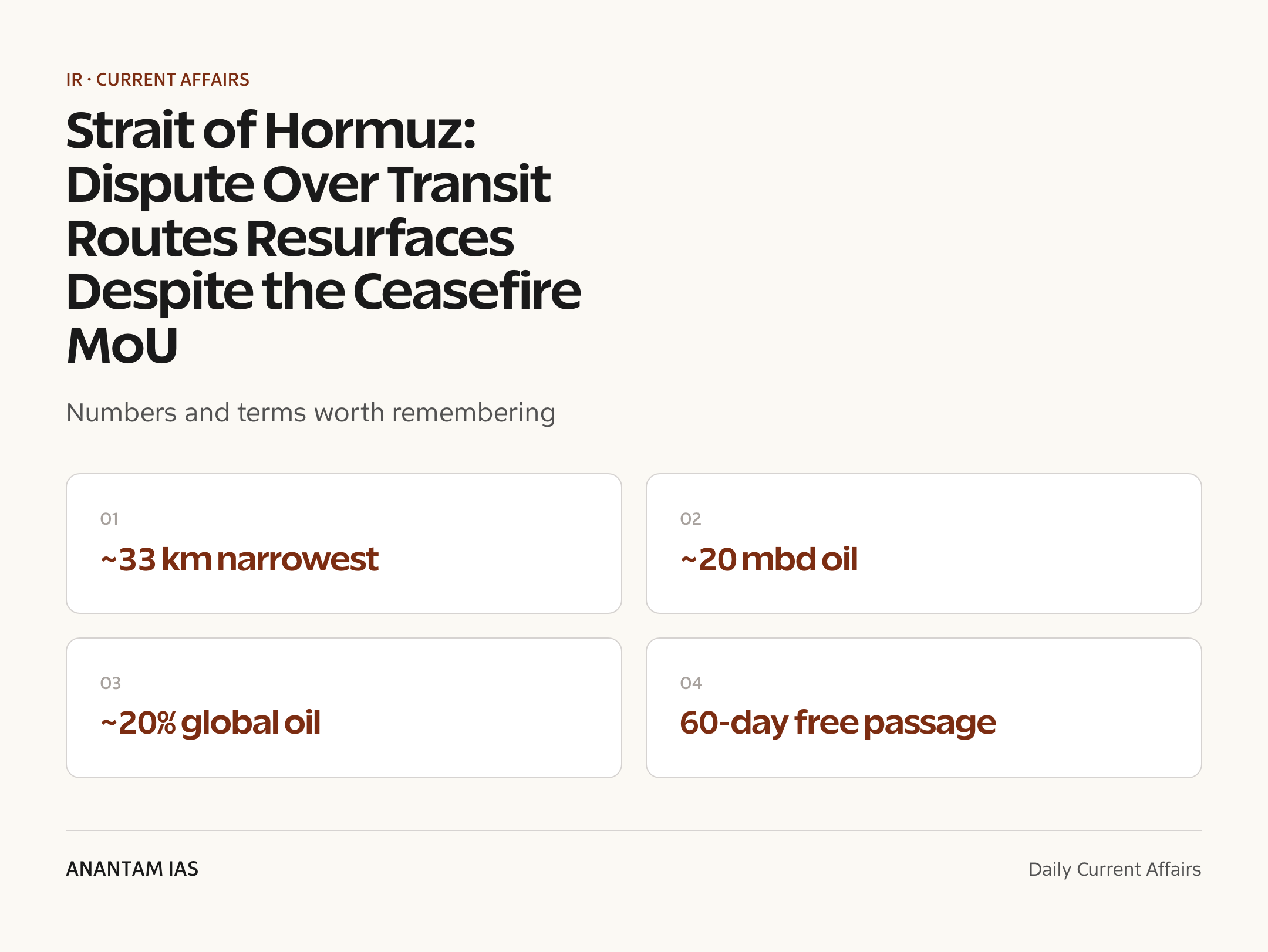
- Roughly 20 million barrels a day (about 20% of global oil and LNG) pass through, making it the single most consequential energy chokepoint.
- India sources a large share of its crude and Qatari LNG via the strait, so any lane or toll dispute touches Indian energy security directly.
- The legal hook is UNCLOS transit passage through straits used for international navigation — which Iran signed but never ratified.
UPSC Relevance
Prelims Relevance
- Strait of Hormuz connects the Persian Gulf to the Gulf of Oman / Arabian Sea.
- It lies between Iran (north) and Oman/UAE (south); Oman’s Musandam peninsula sits on the southern side.
- Narrowest point is about 33 km wide; the navigable shipping lanes are far narrower, separated by a buffer, partly within Oman’s territorial waters.
- Vessel movement is organised under an IMO Traffic Separation Scheme (TSS) with inbound and outbound lanes.
- Around 20 million barrels/day (~20% of global oil and LNG), including much of Qatar’s LNG, transits the strait.
- UNCLOS provides for transit passage through straits used for international navigation; Iran signed but did not ratify UNCLOS.
- The IRGC (Islamic Revolutionary Guard Corps) is a branch of Iran’s armed forces, distinct from the regular army.
- Bypass options that reduce Hormuz dependence include Saudi Arabia’s East-West (Petroline) pipeline and the UAE’s Habshan-Fujairah pipeline.
Mains Relevance
GS Paper 2
- How a coastal state’s claim to designate transit lanes tests the UNCLOS regime of transit passage and the limits of unilateral fees on international straits.
- India’s diplomatic and energy-security stakes in West Asia, and the case for diversifying crude sources and routes away from a single chokepoint.
GS Paper 1
- The geography of maritime chokepoints — why narrow straits like Hormuz, Malacca and Bab-el-Mandeb concentrate global trade risk.
Essay
- Geography is destiny: how narrow waters shape the fate of nations.
- Energy security and the politics of chokepoints in an interdependent world.
Background and Context
Where the Strait Lies and Why It Matters
A sliver of sea that the world’s energy economy cannot do without.
- Connects the Persian Gulf westward to the Gulf of Oman and the open Arabian Sea; it is the only maritime exit for Gulf oil and gas.
- Bordered by Iran to the north and Oman and the UAE to the south, with Oman’s Musandam exclave forming the southern shoulder.
- Narrows to roughly 33 km at its tightest; the usable inbound and outbound lanes are only a few kilometres wide each, lying partly in Oman’s territorial waters.
- Carries about 20 million barrels a day — close to 20% of global oil — plus a large slice of Qatar’s LNG.
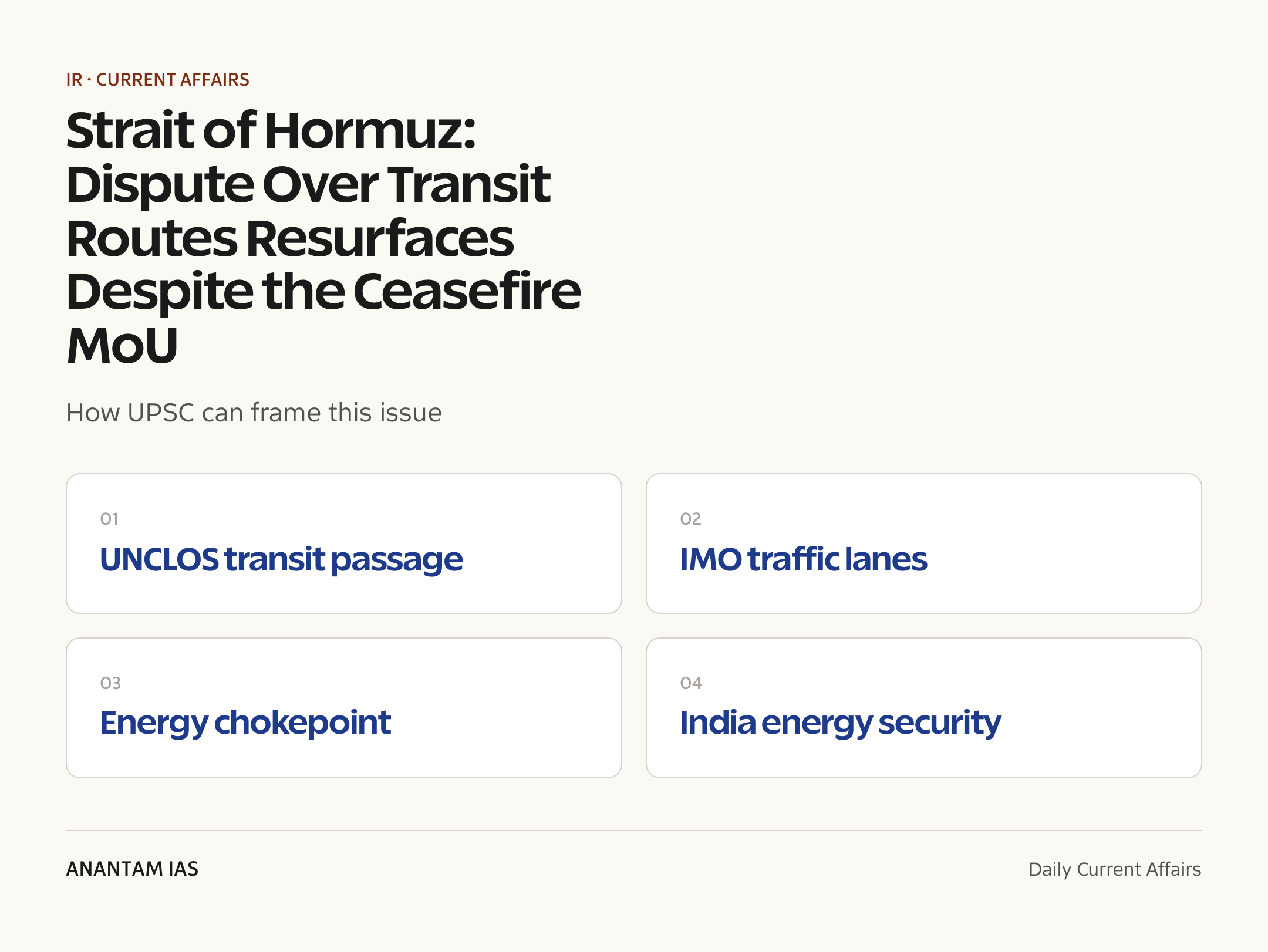
The New Lane Dispute
The fight is no longer about whether ships sail, but where exactly they may sail.
- Oman and the IMO announced a shipping corridor that partly sidesteps direct Iranian control; Iran says it was not coordinated with Tehran.
- The IRGC declared that ‘the only authorised transit routes through the Strait of Hormuz are those designated by the Islamic Republic of Iran’.
- Iran circulated its own acceptable shipping map in April, pushing vessels closer to Iranian shores than the routes ships had used before.
- A Liberian-flagged tanker sailed the Omani corridor, drawing IRGC objections and crystallising the standoff, as reported by Al Jazeera.
The Toll Question
A temporary waiver of fees may be the calm before a permanent charge.
- The ceasefire MoU guarantees ‘safe passage of commercial vessels with no charge, for 60 days only‘.
- Iran’s negotiators signalled that Hormuz ‘will never return’ to pre-war conditions, hinting that transit fees could follow once the window closes.
- Tehran said it would waive planned fees during the 60-day negotiating period — implying that charges were already on the drawing board.
- Any standing fee on through-traffic would be unprecedented for an international strait and would invite legal and diplomatic challenge.
What UNCLOS Says About Transit Passage
International law leans against any single coast deciding the rules.
- UNCLOS grants ships and aircraft the right of transit passage through straits used for international navigation, which cannot be suspended.
- Coastal states may regulate traffic separation for safety, but in coordination with the competent international body — the IMO — not unilaterally.
- Iran signed UNCLOS but never ratified it, and reads transit rules more restrictively, treating much of its preferred lane as a matter of sovereignty.
- Imposing a toll on through-traffic would sit awkwardly with the principle that transit passage is a right, not a service to be charged for.
Why India Is Watching Closely
A few kilometres of contested water sit upstream of India’s fuel pumps.
- India imports a heavy share of its crude and Qatari LNG through Hormuz, so lane risk and possible tolls feed straight into landed energy costs.
- Disruption or higher transit costs would widen the import bill, pressure the rupee and stoke inflation.
- Bypass infrastructure such as Saudi Arabia’s East-West (Petroline) pipeline and the UAE’s Habshan-Fujairah line can move only a fraction of Gulf exports around the strait.
- The episode strengthens the case for India’s source diversification — Russian, US and West African crude — and for strategic petroleum reserves.
Way Forward
Anchor the rules in the IMO, not in unilateral maps
- Push for IMO-coordinated lane and TSS changes rather than coast-by-coast designations, preserving the predictability shipping needs.
- Keep any safety regulation consistent with UNCLOS transit-passage norms to avoid setting a precedent for fee-charging straits.
Reduce India's single-chokepoint exposure
- Expand crude and LNG sourcing beyond the Gulf and deepen strategic petroleum reserves to buffer short disruptions.
- Back bypass routes — Petroline, Habshan-Fujairah — and longer-term West Asian and Eurasian energy corridors.
Use diplomacy to keep the lane open and toll-free
- Work with Gulf partners and importing states to keep passage free and unimpeded beyond the 60-day window.
- Encourage quiet Iran-Oman coordination so a single agreed corridor replaces rival maps.
Conclusion
The guns may have fallen silent, but the Strait of Hormuz shows that a chokepoint can be contested without a single shot — through maps, lanes and the threat of tolls. The clash between Iran’s IRGC and the Oman/IMO corridor is a contest over who sets the rules in waters the whole world depends on, and over whether transit passage stays a right or becomes a fee.
For India, the lesson is durable rather than topical: a few kilometres of disputed sea sit between Gulf wells and Indian refineries. The answer lies less in any one ceasefire than in diversified sources, robust reserves and steady support for an international, IMO-anchored rulebook for the world’s narrow waters.
UPSC Practice Questions
Prelims MCQ 1
With reference to the Strait of Hormuz, consider the following statements:
- It connects the Persian Gulf to the Gulf of Oman and the Arabian Sea.
- It lies between Iran to the north and Oman and the UAE to the south.
- Its navigable shipping lanes lie entirely within Iran’s territorial waters.
How many of the above statements are correct?
(a) Only one (b) Only two (c) All three (d) None
Answer: (b) Only two
Explanation:
Statements 1 and 2 are correct. Statement 3 is wrong — the shipping lanes lie partly within Oman’s territorial waters, not entirely within Iran’s, which is central to the current lane dispute.
Prelims MCQ 2
Under the UN Convention on the Law of the Sea (UNCLOS), the right of ‘transit passage’ applies to which of the following?
(a) Internal waters of a coastal state (b) Straits used for international navigation (c) A state’s exclusive economic zone only (d) The high seas beyond any jurisdiction
Answer: (b) Straits used for international navigation
Explanation:
UNCLOS provides the right of transit passage through straits used for international navigation, such as Hormuz; this right cannot be suspended by the bordering states.
UPSC Mains Questions
- The Strait of Hormuz dispute shows that a maritime chokepoint can be contested through transit rules and tolls rather than blockades. Examine the UNCLOS framework on transit passage and the limits it places on a coastal state’s authority over an international strait. (250 words)
- Energy security for India is increasingly a question of geography and diplomacy at distant chokepoints. Discuss India’s exposure to the Strait of Hormuz and the measures needed to reduce single-route dependence. (250 words)
Sources: The Hindu and Al Jazeera.
Frequently Asked Questions
What is the new dispute over the Strait of Hormuz about?
After the ceasefire MoU reopened the strait, Oman and the IMO announced a shipping corridor that partly bypasses Iranian control. Iran’s IRGC rejected it, insisting that only routes designated by Iran are authorised. The quarrel is over which lanes ships may use and whether transit tolls will eventually apply.
Why is the Strait of Hormuz so important?
It is the only sea route out of the Persian Gulf, connecting it to the Gulf of Oman and the Arabian Sea. Around 20 million barrels of oil a day — roughly 20% of global oil and LNG, including much of Qatar’s gas — pass through, making it the world’s most critical energy chokepoint.
What does the ceasefire MoU say about transit fees?
The MoU guarantees safe, free passage for commercial vessels for 60 days only. Iran has waived its planned fees during this negotiating window but signalled that Hormuz ‘will never return’ to pre-war terms, hinting that transit charges could follow once the window closes.
What does UNCLOS say about passage through the strait?
UNCLOS grants the right of transit passage through straits used for international navigation, which bordering states cannot suspend. Safety regulation such as traffic separation must be coordinated with the IMO. Notably, Iran signed but never ratified UNCLOS and reads the rules more restrictively.
How does the dispute affect India?
India imports a large share of its crude and Qatari LNG through Hormuz. Lane uncertainty or future tolls would raise landed energy costs, widen the import bill and pressure the rupee. It strengthens the case for diversifying sources and supporting bypass routes like Petroline and Habshan-Fujairah.
Who or what is the IRGC?
The Islamic Revolutionary Guard Corps is a branch of Iran’s armed forces, separate from the regular army, with significant control over strategic and maritime matters. In this dispute it has asserted that only Iran-designated routes through the strait are authorised.
Source: https://anantamias.com/current-affairs/strait-of-hormuz-transit-routes-dispute/
India Opens Fresh Anti-Dumping Probes on Chinese Imports
Why in News?
India has initiated a clutch of fresh anti-dumping investigations against imports from China and other countries, following separate complaints by domestic manufacturers, the Commerce Ministry confirmed on 25 June 2026. The probes are run by the Directorate General of Trade Remedies (DGTR), the body that investigates dumping and recommends protective duties.
Four applications cover thermal paper, Biaxially Oriented Polyamide (BOPA) film, certain antioxidants, and a sunset review of decor paper, with a parallel probe into Cold Rolled Grain Oriented (CRGO) electrical steel from China, Japan, Korea and Russia. The wave lands as the India-China trade deficit hit an all-time high, making trade remedies a live exam theme on WTO law, MSME protection and Atmanirbhar Bharat.
- DGTR initiated anti-dumping probes on three products from China: thermal paper, BOPA film and certain antioxidants (other countries involved: Korea, Singapore, U.S., Thailand).
- Applicants include Vinati Organics (antioxidants), JPFL Films (BOPA film), the Indian Association of Thermal Paper Manufacturers (thermal paper) and ITC Ltd (sunset review of decor-paper duty).
- A separate probe targets CRGO electrical steel and amorphous metal from China, Japan, Korea, Russia, on a complaint by JSW JFE Electrical Steel Nashik Pvt Ltd; the inputs are core materials for transformers.
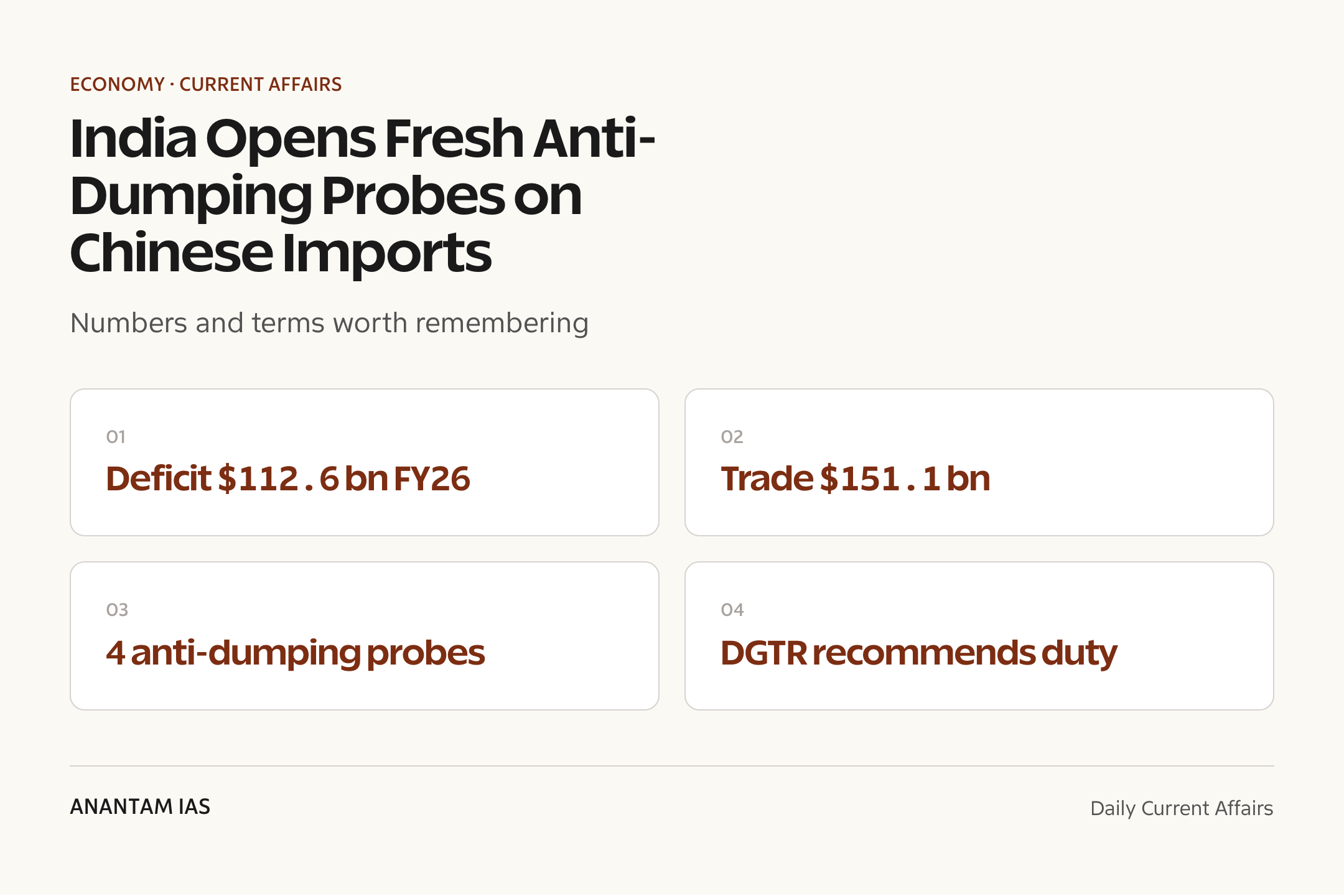
- China is India’s largest trading partner in FY26 with bilateral trade of $151.1 billion; the trade deficit swelled to a record $112.6 billion (vs $99.2 billion in FY25).
- DGTR recommends duties; the Ministry of Finance takes the final decision to impose them.
The development matters in the context of:
- Anti-dumping action is permitted under the WTO framework (Article VI of GATT 1994 and the Anti-Dumping Agreement) and targets goods exported below their normal value.
- For China, treated as a non-market economy, normal value is built from Indian cost of production plus reasonable profit rather than Chinese domestic prices.
- The probes reflect concern over Chinese industrial overcapacity and the risk of cheap goods being diverted to India amid U.S.-China trade tensions.
UPSC Relevance
Prelims Relevance
- DGTR functions under the Department of Commerce, Ministry of Commerce and Industry (not the Finance Ministry).
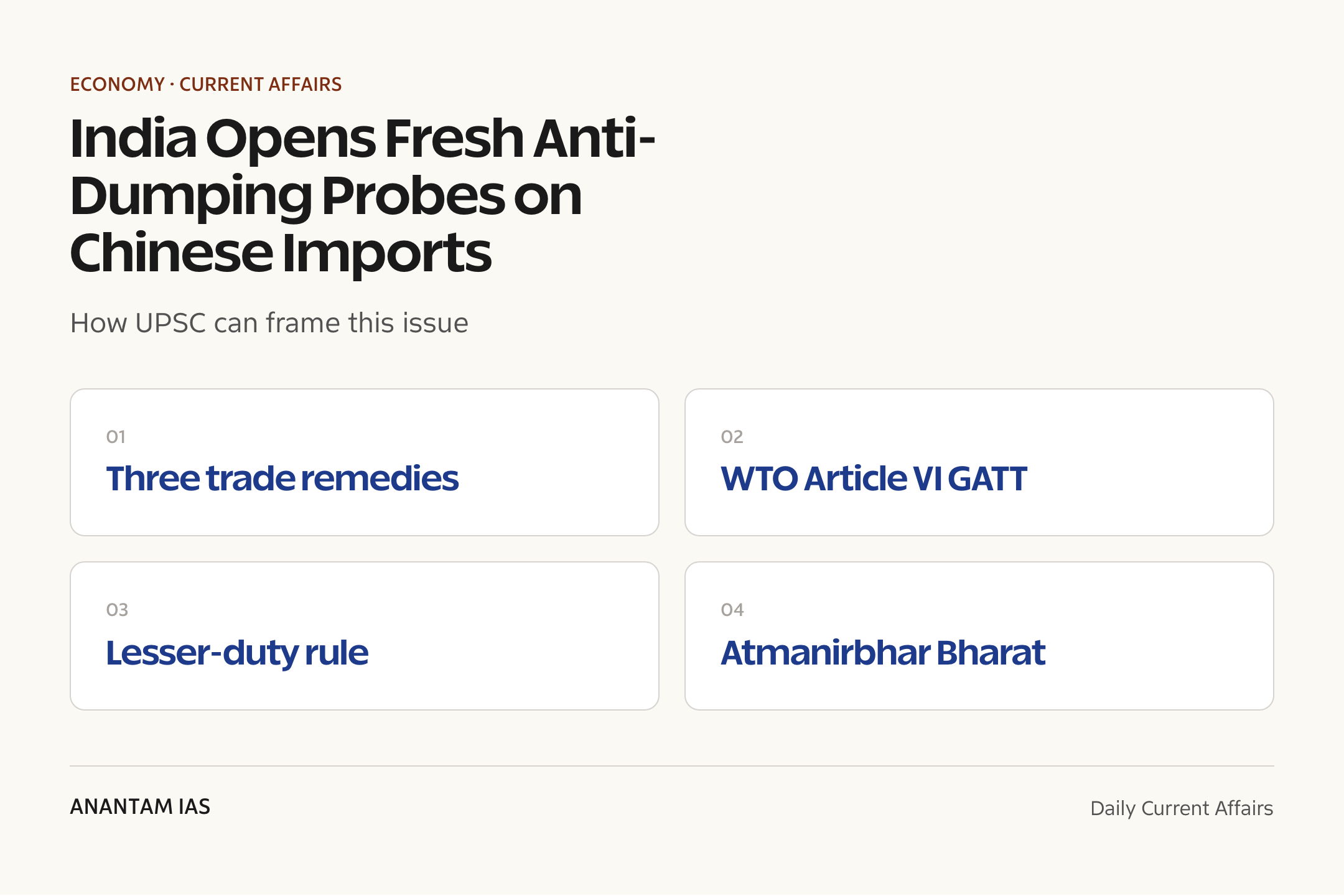
- Three trade remedies: anti-dumping duty, countervailing (anti-subsidy) duty, and safeguard duty.
- Anti-dumping duty counters exporting below normal value; safeguard duty counters import surges and is country-neutral.
- WTO basis: Article VI of GATT 1994 + Anti-Dumping Agreement; subsidies covered by the Agreement on Subsidies and Countervailing Measures (ASCM); surges by the Agreement on Safeguards.
- Dumping margin = normal value minus export price; injury to domestic industry must be established.
- Lesser-duty rule: duty is capped at the level needed to remove injury, even if the dumping margin is higher.
- Sunset review reassesses whether an existing anti-dumping duty should continue beyond its term.
- DGTR recommends, the Ministry of Finance imposes the duty.
- China is a non-market economy for India’s dumping calculations; normal value uses surrogate cost data.
- India-China bilateral trade in FY26 reached $151.1 billion, with a record trade deficit of $112.6 billion.
Mains Relevance
GS Paper 3
- Evaluate trade-remedy instruments (anti-dumping, countervailing, safeguard) as tools to protect domestic industry and MSMEs without breaching WTO commitments.
- Link rising anti-dumping action to Atmanirbhar Bharat, import dependence in chemicals and electrical steel, and value-chain self-reliance.
GS Paper 2
- Assess the India-China economic relationship: a record $112.6 billion deficit, overcapacity-driven dumping, and the policy space WTO rules leave for India.
Essay
- Free trade versus fair trade: protecting domestic industry in an age of overcapacity.
- Self-reliance and globalisation need not be opposites if calibrated by rules-based remedies.
Background and Context
What DGTR Does and the Three Trade Remedies
DGTR is India’s single investigating authority for unfair-trade and import-surge cases.
- DGTR (Directorate General of Trade Remedies) sits in the Department of Commerce under the Ministry of Commerce and Industry; it investigates and recommends, while the Ministry of Finance imposes duties.
- Anti-dumping duty counters dumping, that is, exporting a product below its normal value in the home market.
- Countervailing (anti-subsidy) duty neutralises export subsidies granted by the exporting government.
- Safeguard duty responds to a sudden import surge and is country-neutral, applying to all sources of a product.
- All three require evidence of injury (or serious injury, for safeguards) to the domestic industry.
How a Dumping Case Is Built
Dumping is established by comparing prices, not merely by low cost.
- Normal value is the comparable price of the good in the exporter’s home market (or a constructed cost-plus-profit value).
- Export price is the price at which the good is sold to India.
- Dumping margin = normal value minus export price, usually expressed as a percentage.
- For a non-market economy like China, surrogate or constructed costs replace unreliable domestic prices.
- DGTR must also show a causal link between dumped imports and material injury to domestic producers.
WTO Discipline Behind the Duties
Trade remedies are exceptions allowed within a rules-based order.
- Anti-dumping action is grounded in Article VI of GATT 1994 and the WTO Anti-Dumping Agreement.
- Subsidies and countervailing measures fall under the Agreement on Subsidies and Countervailing Measures (ASCM).
- Import surges are governed by the Agreement on Safeguards.
- India applies the lesser-duty rule: the duty is held to the minimum needed to remove injury.
- A sunset review tests whether dumping and injury would recur if an existing duty lapsed.
- All parties in the current probes, including China, are WTO members, so the action proceeds within the multilateral regime.
Products in the News and Why They Matter
The probes span packaging chemicals, paper and a strategic steel input.
- Thermal paper (from U.S., China, South Korea), BOPA film used in packaging (China, Thailand) and certain antioxidants for the polymer industry (China, Korea, Singapore).
- ITC Ltd sought a sunset review of the existing anti-dumping duty on decor paper from China.
- CRGO electrical steel and amorphous metal (China, Japan, Korea, Russia) are core materials for power and distribution transformers, a strategic energy-infrastructure input.
- Domestic applicants allege the dumped imports cause material injury to local manufacturing and seek protective duties.
The India-China Trade Anxiety
The remedies wave coincides with a record bilateral imbalance.
- China overtook the U.S. as India’s largest trading partner in 2025-26, with bilateral trade of $151.1 billion.
- India’s imports from China rose 16% to $131.63 billion; exports rose 36.66% to $19.47 billion.
- The trade deficit hit an all-time high of $112.6 billion in FY26, up from $99.2 billion in FY25 (figures attributed to The Hindu’s report of the Commerce Ministry data).
- Overcapacity in Chinese industry and U.S.-China tensions raise the risk of cheap-import diversion into India.
- Trade remedies dovetail with Atmanirbhar Bharat and protection of MSMEs in chemicals, paper and steel.
Way Forward
Strengthen the Trade-Remedy Machinery
- Resource DGTR for faster, evidence-rich investigations so injury to domestic industry is addressed in time.
- Apply the lesser-duty rule judiciously to balance producer protection with downstream-user and consumer costs.
Address Structural Import Dependence
- Scale domestic capacity in strategic inputs like CRGO electrical steel through PLI-type support and technology partnerships.
- Diversify import sources and deepen quality controls to reduce reliance on dumped goods.
Stay Within WTO Discipline
- Ensure duties are WTO-consistent to withstand challenge at the Dispute Settlement Body.
- Pair remedies with export competitiveness so protection does not become permanent insulation.
Conclusion
The fresh round of probes shows trade remedies working as intended: a rules-based, evidence-led response to dumping rather than blunt protectionism. With the China trade deficit at a record $112.6 billion, instruments like anti-dumping duties let India shield manufacturing and MSMEs while remaining inside the WTO framework.
The deeper test is structural. Duties buy time, but durable balance needs competitive domestic capacity in chemicals, paper and strategic inputs such as electrical steel. Trade remedies and Atmanirbhar Bharat succeed together only when protection is calibrated, time-bound and paired with genuine industrial upgrading.
UPSC Practice Questions
Prelims MCQ 1
With reference to trade remedies available to India, consider the following statements:
- Anti-dumping duties are recommended by the Directorate General of Trade Remedies but imposed by the Ministry of Finance.
- A safeguard duty is applied against a specific exporting country found to be dumping goods.
- Anti-dumping action by India is permitted under the World Trade Organisation framework.
How many of the above statements are correct?
(a) Only one (b) Only two (c) All three (d) None
Answer: (b) Only two
Explanation:
Statements 1 and 3 are correct. Statement 2 is wrong: a safeguard duty counters an import surge and is country-neutral, not aimed at a single dumping exporter.
Prelims MCQ 2
Which one of the following best distinguishes an anti-dumping duty from a safeguard duty?
(a) An anti-dumping duty targets export subsidies, while a safeguard duty targets dumping. (b) An anti-dumping duty addresses pricing below normal value, while a safeguard duty addresses an import surge and is country-neutral. (c) A safeguard duty is recommended by the RBI, while an anti-dumping duty is recommended by DGTR. (d) An anti-dumping duty is always permanent, while a safeguard duty is reviewed every year.
Answer: (b) An anti-dumping duty addresses pricing below normal value, while a safeguard duty addresses an import surge and is country-neutral.
Explanation:
Anti-dumping duty counters exports below normal value from specific countries; safeguard duty responds to import surges and applies regardless of source.
UPSC Mains Questions
- Trade remedies are exceptions within a rules-based trading order, not departures from it. In light of India’s recent anti-dumping investigations, examine how instruments such as anti-dumping, countervailing and safeguard duties protect domestic industry while remaining WTO-consistent.
- India’s trade deficit with China reached a record high in 2025-26. Discuss the structural drivers of this imbalance and assess whether trade-remedy measures alone can address it, or whether domestic capacity building is indispensable.
Sources: The Hindu and Business Standard.
Frequently Asked Questions
What is dumping in international trade?
Dumping occurs when an exporter sells a product to another country below its normal value, that is, below the comparable price in its own home market or below its cost of production. If these dumped imports cause material injury to the importing country’s domestic industry, that country may impose an anti-dumping duty to restore a level playing field.
Who imposes anti-dumping duties in India?
The Directorate General of Trade Remedies (DGTR), under the Department of Commerce, investigates dumping and recommends a duty. The final decision to impose the duty rests with the Ministry of Finance. So investigation and imposition lie with two different ministries, a frequently tested distinction.
How does an anti-dumping duty differ from a safeguard duty?
An anti-dumping duty targets goods exported below normal value and is applied against specific countries found to be dumping. A safeguard duty responds to a sudden surge in imports of any product and is country-neutral, applying to all sources. Anti-dumping addresses unfair pricing; safeguards address volume shocks.
What is the lesser-duty rule?
Under the lesser-duty rule, the anti-dumping duty is capped at the level needed to remove the injury to domestic industry, even if the calculated dumping margin is higher. India follows this rule, which keeps duties proportionate and limits the cost burden on downstream users and consumers.
Why is China treated as a non-market economy in these probes?
For dumping calculations India treats China as a non-market economy because state influence makes its domestic prices unreliable as a benchmark. Normal value is then built from India’s cost of production plus a reasonable profit, or from surrogate data, rather than from Chinese domestic prices.
How large is India’s trade deficit with China?
Per Commerce Ministry data reported by The Hindu, India’s trade deficit with China reached an all-time high of about $112.6 billion in 2025-26, up from $99.2 billion in 2024-25. Bilateral trade touched $151.1 billion, making China India’s largest trading partner that year.
Source: https://anantamias.com/current-affairs/india-anti-dumping-probe-chinese-imports/