

Why in News?
An Indian Express Explained piece has revived a recurring legal question: is an Indian passport proof of citizenship? The settled position is that a passport, issued under the Passports Act, 1967, is a travel document establishing identity and nationality for the purpose of foreign travel, but it is not by itself conclusive proof of citizenship under the Citizenship Act, 1955.
Alongside, The Hindu reported that the Ministry of External Affairs (MEA) has revised passport fees with effect from July 1, 2026, making the topic a useful crossover of durable polity with live current affairs for exam preparation.
- Courts and government affidavits have repeatedly held that a passport is not standalone proof of citizenship.
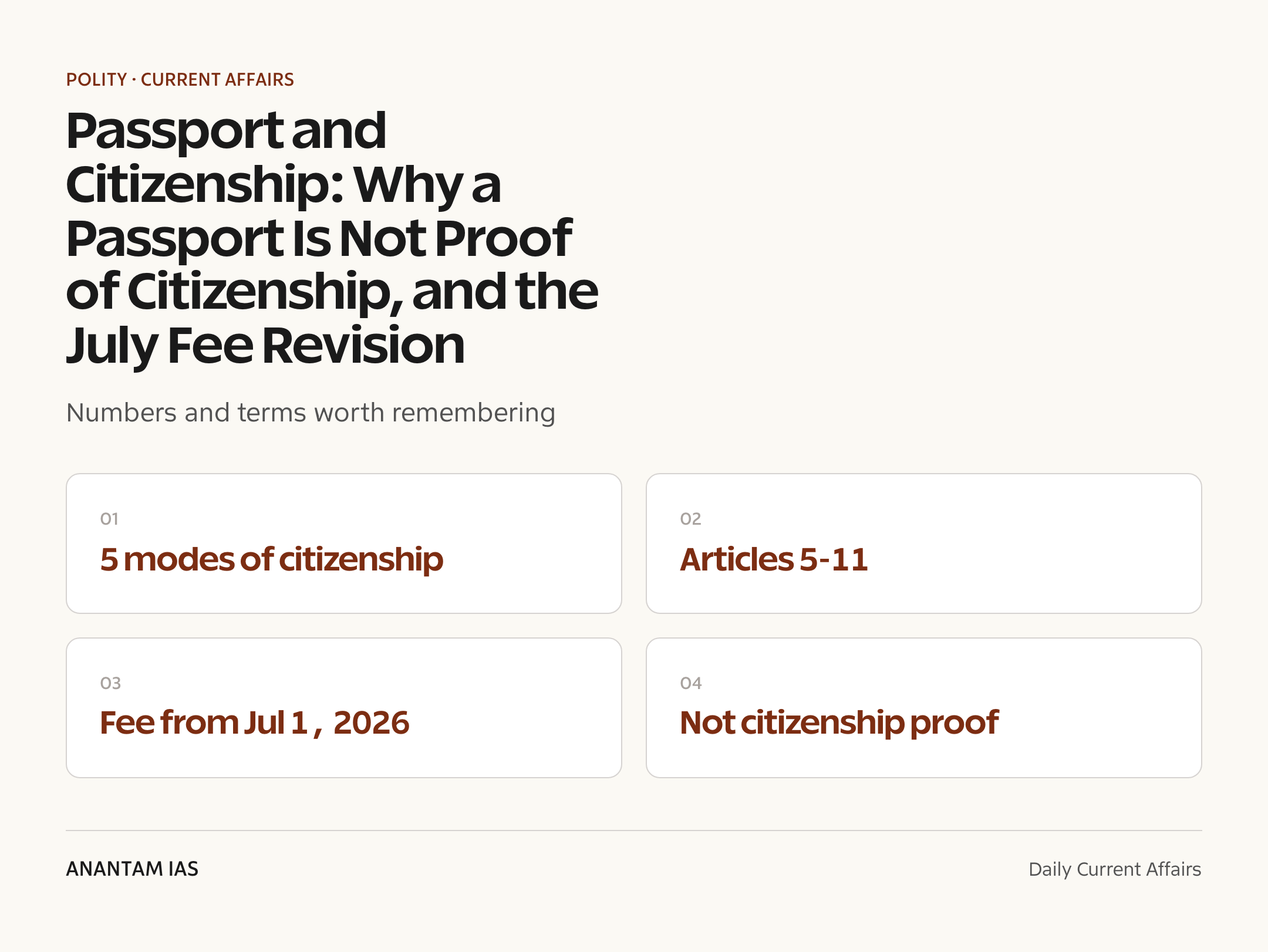
- Citizenship in India is governed by the Constitution (Part II, Articles 5-11) and the Citizenship Act, 1955; the passport is governed by the separate Passports Act, 1967.
- Per The Hindu, the MEA has revised passport application fees from July 1, 2026 (reported new fee for a 36-page ordinary passport around Rs 2,500; verify against the MEA notification).
- The debate sits within the wider NRC and CAA discourse on what counts as a valid ‘document of citizenship’.
The development matters in the context of:
- Nationality and citizenship overlap in everyday use but are distinct legal concepts; a passport certifies nationality for travel, not the full bundle of citizenship rights.
- No single document is, by itself, conclusive proof of Indian citizenship; authorities rely on a combination of documents and the modes set out in the Citizenship Act, 1955.
- Aadhaar is expressly not proof of citizenship or even of residence; the UIDAI itself states this.

UPSC Relevance
Prelims Relevance
- Part II of the Constitution (Articles 5-11) deals with citizenship at the commencement of the Constitution; Article 11 empowers Parliament to regulate citizenship by law.
- The Citizenship Act, 1955 provides five modes of acquisition: by birth, by descent, by registration, by naturalisation, and by incorporation of territory.
- Section 9 of the Citizenship Act deals with termination of citizenship (voluntary acquisition of foreign citizenship); the Act also covers renunciation and deprivation.
- The Passports Act, 1967 is administered by the MEA; it provides for issue of passports and travel documents and lists grounds for refusal or impounding.
- A passport establishes identity and nationality for travel but is not conclusive proof of citizenship or of domicile.
- Aadhaar is a proof of identity, not of citizenship or residence; this is stated by the UIDAI.
- The Registration of Births and Deaths (Amendment) Act, 2023 makes the birth certificate a key proof of date of birth for various services.
- Citizenship is a Union subject (Union List), and India follows single citizenship.
- Documents commonly but wrongly treated as citizenship proof include voter ID, ration card, and Aadhaar.
- The NRC exercise and the Citizenship (Amendment) Act, 2019 are the policy backdrop to the ‘documents of citizenship’ debate.
Mains Relevance
GS Paper 2
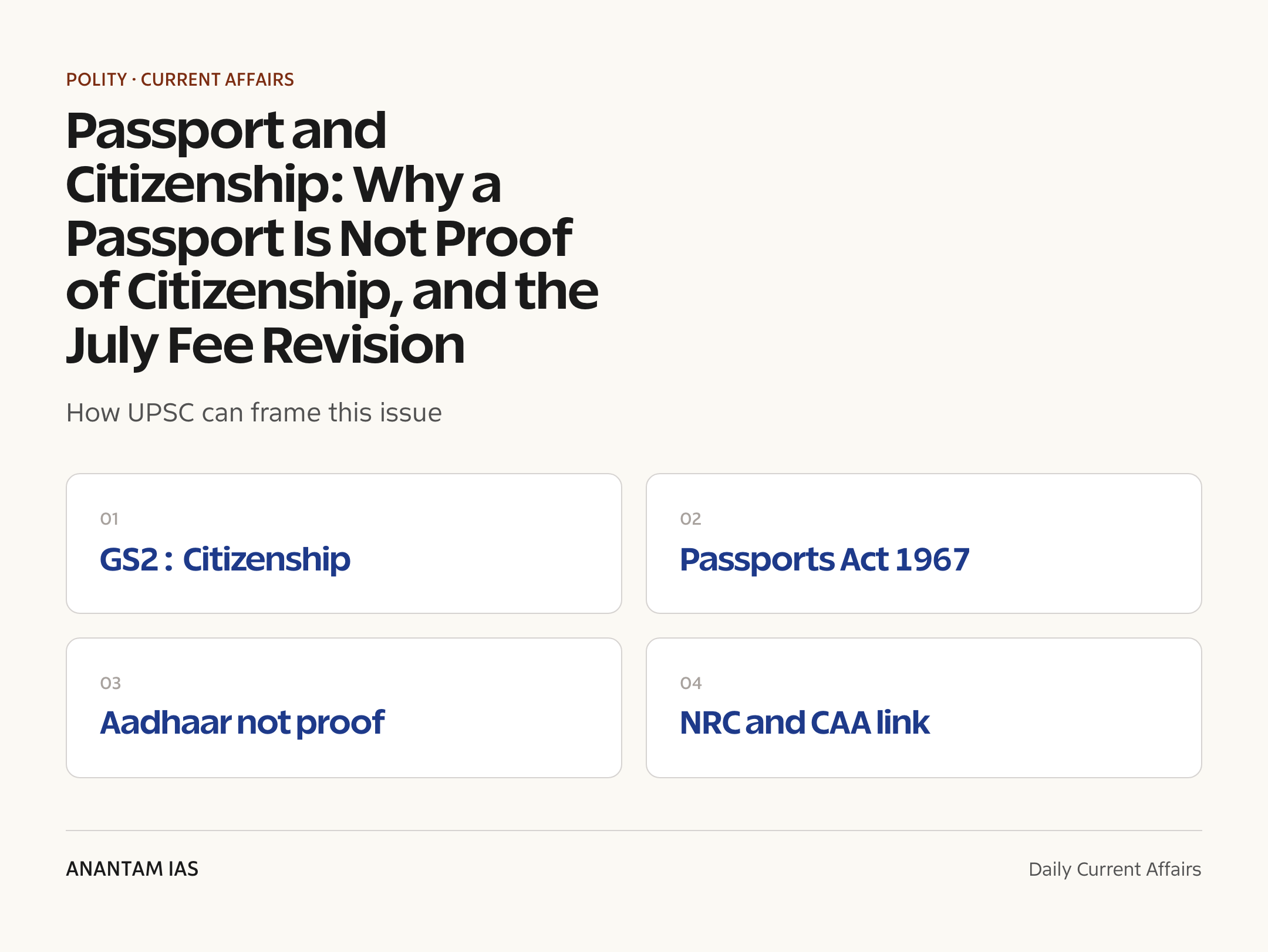
- Examine the legal distinction between a travel document and proof of citizenship, and why a single document cannot establish citizenship under the Citizenship Act, 1955.
- Discuss the governance and rights implications of the absence of a single, reliable proof of citizenship in the context of NRC and welfare delivery.
- Analyse the roles of the MEA (Passports Act) and the MHA (Citizenship Act) and the need for inter-ministerial clarity on identity documents.
Essay
- Identity, documents and the citizen: how the state sees the individual.
- Belonging without paperwork: dignity in an age of mandatory proof.
Background and Context
Citizenship Act, 1955: How Indians become citizens
Citizenship is conferred by law, not by any one card.
- The Citizenship Act, 1955, enacted under Article 11, governs acquisition and loss of citizenship after the commencement of the Constitution.
- Five modes of acquisition: by birth, by descent, by registration, by naturalisation, and by incorporation of territory.
- Conditions for citizenship by birth have been tightened over time, linking it to the citizenship status of parents at the time of birth.
- Section 9 provides that a citizen who voluntarily acquires the citizenship of another country ceases to be an Indian citizen; the Act also covers renunciation and deprivation.
- India follows single citizenship; the OCI (Overseas Citizen of India) status is not dual citizenship and confers no political rights.
Passports Act, 1967: A travel document, not a citizenship certificate
The passport proves who you are for travel, not your full legal status.
- The Passports Act, 1967 empowers the MEA to issue passports and other travel documents and to refuse or impound them on specified grounds.
- A passport certifies identity and nationality so that other countries permit entry; it is accepted internationally as a recognised travel document.
- Courts and government affidavits have held that a passport is not conclusive proof of citizenship and can be revisited if citizenship itself is in question.
- A passport can be issued, and later questioned, without finally settling the holder’s citizenship under the Citizenship Act.
- The right to a passport is linked to the Article 21 right to travel abroad, recognised in Maneka Gandhi v. Union of India (1978).
The 'documents of citizenship' debate
Several common documents are mistaken for citizenship proof.
- Aadhaar is explicitly not proof of citizenship or residence; the UIDAI states it is only proof of identity.
- Voter ID, ration card, and PAN establish entitlement or identity for specific purposes, not citizenship.
- The Registration of Births and Deaths (Amendment) Act, 2023 elevates the birth certificate as a key single proof of date of birth, though not of citizenship by itself.
- Authorities typically assess citizenship through a combination of documents and the legal modes of acquisition, not one card.
- This ambiguity becomes acute during exercises such as the NRC, where the burden of proof shifts to the individual.
NRC, CAA and why the question matters
The legal gap has real consequences for ordinary people.
- The National Register of Citizens (NRC), conducted in Assam, required residents to prove citizenship through legacy and linkage documents.
- The Citizenship (Amendment) Act, 2019 (CAA) created a path to citizenship for specified non-Muslim migrants from Pakistan, Bangladesh and Afghanistan who entered before a cut-off date.
- Absence of a single authoritative proof raises fears of exclusion, statelessness, and denial of welfare for the poor and documentation-weak.
- Foreigners Tribunals and courts adjudicate disputed cases, where even a passport may not end the inquiry into citizenship.
The July 2026 passport fee revision
MEA has revised passport charges effective July 1, 2026.
- Per The Hindu, the MEA revised passport application fees with effect from July 1, 2026; the reported new fee for a 36-page ordinary passport is around Rs 2,500 (verify against the official MEA notification).
- Separate charges typically apply for 60-page passports, Tatkal (urgent) issuance, and re-issue for minors and lost or damaged passports; confirm the exact slabs from the notification.
- Services are delivered through the Passport Seva network of Passport Seva Kendras and Post Office Passport Seva Kendras.
- The wider modernisation includes Passport Seva Programme V2.0 and the rollout of the e-passport with an embedded chip.
Way Forward
Legal clarity on identity documents
- Issue clear, consistent guidance distinguishing identity, residence and citizenship proof across the MEA, MHA and UIDAI.
- Avoid treating any single document as conclusive proof of citizenship in administrative practice.
Protecting the vulnerable
- Build safeguards so that documentation gaps do not translate into denial of welfare or risk of statelessness.
- Strengthen the Registration of Births and Deaths system so that every citizen has reliable foundational records.
Citizen-friendly passport services
- Keep fee revisions transparent and proportionate, with exemptions retained for the genuinely needy.
- Expand Passport Seva capacity and the e-passport rollout to cut delays.
Conclusion
The recurring confusion between a passport and proof of citizenship reflects a deeper gap: India has no single document that conclusively certifies who is a citizen. The passport, governed by the Passports Act, 1967, settles identity and nationality for travel; citizenship itself flows from the Constitution and the Citizenship Act, 1955.
For aspirants, the topic ties durable polity to live administration, the July 1, 2026 fee revision. The governance lesson is to keep documentation regimes humane and transparent so that proof of belonging never becomes a barrier to rights.
UPSC Practice Questions
Prelims MCQ 1
With reference to citizenship and identity documents in India, consider the following statements:
- An Indian passport is conclusive legal proof of Indian citizenship.
- Aadhaar is proof of identity but not of citizenship or residence.
- The Citizenship Act, 1955 provides for acquisition of citizenship by naturalisation.
How many of the above statements are correct?
(a) Only one (b) Only two (c) All three (d) None
Answer: (b) Only two
Explanation:
Statement 1 is wrong: a passport is a travel document, not conclusive proof of citizenship. Statements 2 and 3 are correct, so only two are correct.
Prelims MCQ 2
Which one of the following is NOT a mode of acquiring citizenship under the Citizenship Act, 1955?
(a) By birth (b) By descent (c) By naturalisation (d) By possession of an Aadhaar number
Answer: (d) By possession of an Aadhaar number
Explanation:
The Act recognises birth, descent, registration, naturalisation and incorporation of territory. Aadhaar is only an identity number and is not a mode of acquiring citizenship.
UPSC Mains Questions
- A passport establishes nationality for travel but is not conclusive proof of citizenship. In light of the Citizenship Act, 1955 and the Passports Act, 1967, examine why India lacks a single conclusive document of citizenship and the governance challenges this creates. (250 words)
- Discuss how the absence of a single proof of citizenship interacts with exercises such as the NRC and welfare delivery, and suggest safeguards to protect the documentation-weak from exclusion. (250 words)
Sources: Indian Express and The Hindu.
Frequently Asked Questions
Is an Indian passport proof of citizenship?
No. A passport issued under the Passports Act, 1967 is a travel document that establishes identity and nationality for foreign travel. Courts and government affidavits have held it is not conclusive proof of citizenship, which is governed separately by the Constitution and the Citizenship Act, 1955.
What are the modes of acquiring Indian citizenship?
The Citizenship Act, 1955 provides five modes: by birth, by descent, by registration, by naturalisation, and by incorporation of territory. Conditions, especially for citizenship by birth, have been amended over time and depend on the citizenship status of parents.
Is Aadhaar proof of citizenship?
No. The UIDAI states that Aadhaar is only proof of identity, not of citizenship or even of residence. Documents like voter ID, ration card and PAN also establish identity or entitlement for specific purposes but do not by themselves prove citizenship.
What changed in passport fees from July 2026?
Per The Hindu, the MEA revised passport application fees from July 1, 2026, with the reported fee for a 36-page ordinary passport around Rs 2,500. Exact slabs for 60-page, Tatkal and minor passports should be confirmed from the official MEA notification.
Which constitutional provisions deal with citizenship?
Part II of the Constitution, Articles 5 to 11, deals with citizenship at the commencement of the Constitution. Article 11 empowers Parliament to make laws on citizenship, under which the Citizenship Act, 1955 was enacted. India follows single citizenship.
Why does the citizenship-proof question matter?
Because no single document conclusively proves citizenship, exercises like the NRC shift the burden of proof to individuals, risking exclusion, statelessness and denial of welfare for the poor and documentation-weak. This makes humane, transparent documentation systems essential.
Tell Google you want more of this.
Add Anantam IAS as a preferred sourceOne tap, and this site shows up more often in your own Top Stories, AI Overviews and AI Mode. Remove it any time.






